
 Philosophising in Wolof: Beyond Translation
Abstract
This article focuses on academic endeavours which philosophise in Wolof, from Cheikh Anta Diop to Souleymane Bachir Diagne. For each example, it offers a contextualised analysis, revealing elements of personal biographies and historico-political context. It makes these contexts and debates intelligible for a non-Wolophone readership beyond Senegal. The article discusses the Wolof notions proposed for concepts such as philosophy, epistemology, knowledge, and thinking. The examples show that questions of translation and multilingualism are always directly linked to the definition of philosophy. By highlighting the (dis)continuities of philosophical terminology, the article sheds light on the implications of translating philosophical concepts and texts into Wolof or choosing selected Wolof terms for a philosophical contribution. Therefore, the article provides a template for questioning philosophical translations into and from African indigenous languages.
Wolof; philosophy; translation; African indigenous languages; Senegal; Cheikh Anta Diop; Souleymane Bachir Diagne; Pathé Diagne; Assane Sylla
Introduction
The mutual influence of language and philosophy has been a topic of debate for centuries. While language determinism could not be backed up by applied research, the language we employ favours or suggests certain thought patterns (Borghi and Mazzuca 2023; Geeraerts and Cuyckens 2010). Philosophical endeavours must acknowledge language as having an impact on research and conceptualisations (Diagne 2017; Elberfeld 2017); otherwise, philosophers risk fortifying their language-induced biases. Taking into account African languages beyond the colonial languages is often presented as a matter of epistemic justice. Additionally, it is also a matter of academic rigour and of critical scholarship. Ignoring the multilingual nature of our world means hindering the truth-seeking or wisdom-seeking of philosophy.
The African continent is home to more than 3,000 languages. With European colonisation, most of these languages have been marginalised in academic discourses at the expense of colonial languages, such as English, French, and Portuguese. This also includes philosophical debates in academia, where discourses are mainly in the languages of a specific European coloniser of a particular African country.
In Senegal, the only official language is French, which is, therefore, the language of academia. Nonetheless, other languages play a crucial role in everyday life and in philosophical discourses outside of the university. Arabic has been present in the country since the 11th century and is the language of Islamic scholarship. Pulaar, Sereer, and Joola are languages of regional importance in which different types of discourses, including philosophical dialogue, take place. While each of these languages and intellectual traditions deserves its own studies, this article is concerned with philosophising in Wolof. Wolof is the most widely spoken language of Senegal, often qualified as a lingua franca. This means that most everyday encounters in Senegal take place in Wolof. This extends to the university, where hallway conversations are held in Wolof while written academic output is in French.
This article focuses on the academic endeavours of philosophising, which constitutes only one arena of philosophical discourse. In future work, it will be necessary to explore oral philosophical traditions, as for instance the teachings of philosophers such as Kocc Barma Fall (Centre d'étude des Civilisations 1984; Diagne 1979; Fall 2003), and the Ajami philosophical traditions (Faye 2016; Minerba, forthcoming; Sylla n.d.) in depth.
The article discusses different attempts at philosophising in Wolof and translating philosophical notions into Wolof. Thereby, it takes into consideration the context of each text, including intertextual references, biographical notes, and key philosophical discourses. By discussing the notions as embedded in a politico-epistemological frame, the reader will be enabled to gain an in-depth understanding of the challenges that have been discussed in Senegal for decades.
The texts chosen for illustrations of philosophising in Wolof are of different genres: dictionaries, wordlists, and essays. For each text, I discuss the Wolof terms proposed for concepts such as philosophy, epistemology, knowledge, and thinking. I will offer a contextualised analysis, revealing elements of personal and work biographies and of the historico-political context, potentially explaining terminological choices. Through these examples, I will show that questions of translation and multilingualism are always linked to the definition of philosophy. By highlighting the (dis)continuities regarding terminological choices, the article sheds light on the implications of translating philosophical concepts and texts into Wolof, or choosing selected Wolof terms for a philosophical contribution. Through comparison, this article opens up an interrogation of the political and epistemological baggage of certain concepts. Beyond Senegal, the article provides a framework for questioning philosophical translations into and from African indigenous languages.
Wutkatu Dëgg1
This exploration of philosophising in Wolof begins with Cheikh Anta Diop, a prominent Senegalese intellectual, whose theses continue to be discussed controversially. Born in 1923, he posed questions about Eurocentric bias in scientific research. He was a multidisciplinary scholar engaging in fields as diverse as philosophy, chemistry, history, physics, and linguistics. Amongst his controversially discussed publications are his books Nations Nègres et Culture2 (Diop 1979[1954]) and Civilisation ou Barbarie3(Diop 1981). Diop's explorations are introduced here first because other texts and their authors are directly related to them. Diop's Afrocentric approach inspired a range of publications in Wolof, in and beyond philosophy. As I will show in this article, the authors Pathé Diagne, Anne Tamsir, and Assane Sylla put Diop's theses into practice.
Concerning language, Diop puts forward two main arguments. On the one hand, he argues that Wolof4 and Ancient Egyptian were related languages. His linguistic analysis is motivated by the will to reconstruct African history prior to the Ghana empire as having a common origin in the Egyptian civilisations (Diop 1979[1954], 27-28). Diop conceives knowledge about one's own history as a precondition for development and, therefore, advocates for historical and linguistic research that reconnects sub-Saharan Africa to Northern Africa and to the Egyptian and Ethiopian civilisations. On the other hand, he develops a political framework to elevate indigenous African languages as languages of governance, science, and culture (Fal 1996, 15; Gnonsea 2003). In his work, Diop criticises the continuous use of French as an exclusionary tool and proposes reforms in the educational system and the language used in politics. He insists on the necessity to elaborate scientific vocabulary and promote literature in African indigenous languages.
These two arguments are, for Diop, two sides of the same coin. A contemporary African development necessitates both the historical reconstruction and re-identification of Africans with their past civilisation and the re-appropriation of African languages as tools for contemporary scientific research and intellectual culture. Next to his own theorising, for which he largely uses French, Diop focused on enabling the use of Wolof in the disciplines of physics and mathematics (Fal 1996, 17). Widely known is that he translated parts of Einstein's Theory of Relativity into Wolof (Diop 1979[1954], 443-447). Importantly, Diop (1984, 192) sees philosophy as intimately linked to science. He claims that any advancement of the natural sciences pushes the metaphysically orientated philosophy into a crisis. Diop speculates that it may become increasingly difficult to philosophise, taking into account, for instance, genetic research that revolutionises our understanding of the boundaries between animals and plants (Diop 1984, 192-193). Simultaneously, Diop sketches a way out of this crisis. For him, philosophy, as an endeavour that gives meaning to life and human existence, is needed more than ever. He sees African philosophers at the forefront of such an epistemological revolution, which "aidera l'homme à se reconcilier avec lui-même et qui sera issue, en grande partie, du contact de la réflexion philosophique et de la science"5 (Diop 1984, 196).
While in writing, Diop theorises mainly in French, he used Wolof in personal encounters and in speeches, some of which are available as manuscripts (Jóob 1984). In addition, inspired by Nations Nègres et Culture (Diop 1979[1954]), a group of students gathered around Diop to develop a standardised transcription of Wolof and tools for alphabetisation. Under the leadership of Sylla, this work turned into its published form of the Ijjib Volof manual (Chaudemanche 2023, 54). Diop's focus on Wolof was criticised as Wolofocentrism by some, although Diop emphasised that Wolof served merely as an example (Chaudemanche 2021, 193; Diop 1979[1954], 29). In Senegal, Diop is also remembered among the leaders of the institutional opposition to President Leopold Sédar Senghor. Diop's activities included founding political parties and unions, and an opposition newspaper. In the 1970s, it came to a major dispute on the existence of geminated consonances in Wolof between Senghor and Diop, which led to the bans of critical media output, including the newspaper Siggi, Ousmane Sembène's film Ceddo, and the first Wolof-language newspaper Kàddu (Chaudemanche 2023, 59).
Based on different speeches and wordlists of Diop, linguist Fal (2013) made available a glossary entitled Lexique Scientifique Bilingue Français-Wolof/Wolof-Français.6Here one finds Diop's translation for scientific terms, including a few terms relevant for philosophising in Wolof. Diop translated philosopher as a wutkatu dëgg, which literally means searcher of truth (Fal 2013). Thus, the search for truth (dëgg) is constitutive for philosophy. Recalling Diop's stance on the relation of philosophy and the sciences, the primary agent seems to be the philosopher, instructed both in the natural sciences and in the humanities. However, there is no term for directly translating philosophy into Wolof included in Fal's glossary.
The glossary provides a word for theory, namely faramfàcce b. In everyday conversations, faramfàcce is usually used as a verb, meaning to explain. It is the verbal action one undertakes to clarify an issue to someone else (Diouf 2003, 119; Fal, Santos, and Doneaux 1990, 71). Thus, the philosopher's task may be, alongside other scholars, to clarify matters through the elaboration offaramfàcce yi (theories). In the context of his other writings, I understand Diop's conceptualisation of theory as relatively large: it goes well beyond the humanities and must be understood in the realm of his research in natural sciences and historical linguistics.
A third term relevant in the context of this article is xalaat l., translated as "notion" or "concept." I want to argue that xalaat l. is here the scientific thought, articulated to be defined and formalised. To strengthen this argument, a word on Wolof grammar. To linguists, Wolof is known as a rare case of a Niger-Congo language in which noun classes exist without being marked within the noun7 itself (McLaughlin 1997; Pozdniakov and Robert 2015). The noun-class-marker has semantic value, which is an interesting option in philosophical translation. Wolof noun classes are not directly marked on the verb but through an article.8 Wolof has eight singular and two plural noun classes. The l. of xalaat l. indicates that it belongs to the l-noun-class, while the b. of faramfàcce places it into the b-noun-class. A word can carry different meanings, not only depending on its word class it is used in (verb or noun), but also depending on its noun class. Thus, the dictionaries consulted place xalaat in the m-class and translate it as "thought, idea, sorrow" (Diouf 2003, 377) or "thought, reflection, idea, opinion" (Fal et al. 1990, 249). I assume that xalaat l. was purposely placed in the l-class to differentiate its meaning from the use indicated in the dictionaries. Xalaat l. is the scientific thought, articulated to be defined and formalised, while xalaat m. includes any thought, be it a sorrow or an individual opinion.
This first exploration, based on a few terms, shows the implications of translation: the speaker, writer, or translator takes epistemological decisions within a philosophical discourse. As stated before, Diop left the issue of developing a full philosophical vocabulary to others. Next, I will introduce Pathé Diagne, a linguist who took up this challenge as a friend and disciple of Diop.
Xam Sa Lakk, Xam Sa Bopp9
The work discussed here bears the bulky title of, L'europhilosophie Face à la Pensée du Négro-Africain; suivi de Thèses sur Épistémologie du réel et Problématique Néo-Pharaonique10 (Diagne 1981). The text was published in 1981 by Sankoré. Its author, Pathé Diagne, was a trained linguist who dedicated his career to showing that African languages, notably Wolof, have the same value as European languages. Born in Saint-Louis in 1934, he was trained in Senegal, France, and the US, and worked at different institutions of the University of Dakar until his death in 2023. He translated internationally renowned works into Wolof, including the Coran and literary classics such as Shakespeare and Tolstoï. His motto, therefore, was knowing your language means knowing yourself, "xam sa lakk, xam sa bopp" (Diop and Sall 2023).
I am referring to the last part of the book, entitled "Extraits: jukki" (excerpts), which offers excerpts of selected philosophical texts in French and Wolof, a selection of philosophical and scientific notions in French and Wolof, and a short essay in Wolof. The essay bears the title "Xam ag xamxam xalaat ag xelaat filosofi ag erofilosofi," which (based on the word list) would correspond roughly to the following title in English: "Knowing and knowledge, thought and ideology, philosophy and europhilosophy." The title already demonstrates Pathé Diagne's aptitude in navigating Wolof concepts and introduces the critical stance of his work.
Interestingly, neither wutkatu dëgg nor faramfàcce b., proposed by Diop, reappear in Pathé Diagne's work. While both scholars share a similar conviction, there seem to be differences in application. Philosophy is rendered into Wolof by Pathé Diagne as filofosi. Pathé Diagne (1981, 194) describes this process as morphological naturalisation, meaning to include a foreign term, here the French philosophie, by making it phonetically and orthographically similar to the target language, Wolof. However, in Pathé Diagne's filosofi resonates not only the French philosophie but also the Arabic falsafa, which had been adopted into Wolof long before French colonialism. The presence of Islam and Islamic philosophy in the area dates back to around the 11th century. Pathé Diagne acknowledges this heritage in privileging filosofi over other notions.11 In his wordlist, he includes one derivation of this filosofi, namely etnofilosof (ethnophilosophy). In translations, he makes use of the formulation filosofi waa Afrig (lit. philosophy of the African people, here: African philosophy), in translating Paulin Hontoundji's work, or filosofi judduwaale (lit. innate philosophy, here: spontaneous philosophy) in translating Louis Althusser. Further, the term erofilosofi (europhilosophy) is used in Pathé Diagne's original essay.
In this essay, Pathé Diagne argues that neither ethnophilosophers nor europhilosophers have accomplished the task at hand for African philosophers and academics: "gëstu ci xamxam ag xalaat" (to do research on knowledge and thought) (Diagne 1981, 221). Each one caught in its own epistemological framework, ethnophilosophy and europhilosophy, failed to study African thought, knowledge, wisdom, and philosophy in its own right and on its own terms. As Pathé Diagne states: "Il n'y a aucune nécessité à être un perroquet"12 or "dafa nguy def mbaam"13 (Diagne 1981, 153). Pathé Diagne, in line with Diop, sees the need for an epistemological revolution and uses translations as a means in this fight (Chaudemanche 2021). Therefore, he proposes another term for philosophy, grounded in Wolof conceptualisation: xercixamxam. It is formed by three components: 1) the verb xer, meaning to delicately remove, especially water from something solid as rice, 2) the preposition ci, meaning in, inside, or on, and 3) xamxam, to be translated as knowledge or science. Therefore, philosophising means to gently plunge into knowledge/science.
Pathé Diagne frequently uses derivations of xam (to know), such as xamxam (knowledge, science). Epistemology is, for instance, rendered as xam, xamenuwaay (to know the location of knowing) and metaphysics as xamxamu biir (knowledge of the inside). Similar to Diop, Pathé Diagne emphasises the relation between philosophical endeavours and other forms of scholarly knowledge production. In contrast to Diop, Pathé Diagne bases himself on shared language in use in the development of scientific language (Diagne 1981, 192).
Next to xam (to know), Pathé Diagne uses the terms xalaat (to think, thought), and derives from it the term calaat (to conceptualise, concept, conceptualisation) and expressions such as xalaat mu wer (thinking without flaws). Pathé Diagne further introduces the term xelaat. Derived from the noun xel, which Pathé Diagne renders into French as outil d'intellection, intelligence (utensil of intellection, intelligence),14 in Pathé Diagne's work, xelaat means pensée critique, repenser, réflechir, épistemologie critique (critical thinking, rethinking, reflecting, epistemological critique). In Dakar, I encountered the word xelaatkat, referring to an elder who could be considered Wolof "sage." This shows again that Pathé Diagne developed a philosophical vocabulary based on his work as an applied linguist. However, others also took up the challenge given by Diop, coming to different propositions.
Filosofi ci Wolof15
A more recent endeavour of proposing a framework for philosophy in Wolof using linguistic tools has been undertaken by Tamsir (2020) with the dictionary Filosofi ci Wolof. Tamsir is not only trained in a variety of academic disciplines, such as linguistics, sociology, and philosophy, but is also an IT-consultant. He merges these competences in the administration of the web page, wolof-online.com. In his academic and activist work, he is clearly inspired by the work of Diop. The blurb of the dictionary Filosofi Ci Wolof refers to Diop by the first sentence: "La traduction de la terminologie scientifique dans les langues nationales a fait depuis les travaux fondateurs de Cheikh Anta Diop des avancées significatives"16 (Tamsir 2020).
The majority of the dictionary's 167 pages is taken up by Wolof terms in alphabetical order, explained in-depth in Wolof and translated into French, reaching from aada j. (custom) to yoon (law). In addition, one finds a French-Wolof glossary, and as Annex the translation into Wolof of Emanuel Kant's (see conclusion) text, "Was ist Aufklärung"17, rendered by the author as "Tontu laaj bi: lan mooy gindeeku?" (The answer to the question: What is enlightenment?). Tamsir here chooses the neologism gindeeku (enlightenment), which is derived from the Wolof verb gindi (to enlighten, to orient).18 Thus, the dictionary includes terms common to philosophical discourses as well as everyday language use (see: law, custom), alongside neologisms to express a certain philosophical concept in Wolof.
Tamsir references two of Pathé Diagne's works, namely the translation of the Coran into Wolof and his Wolof grammar, without mentioning the work discussed above. Due to financial restrictions, Pathé Diagne's publications were only printed in a limited number and are only available in very few archives and libraries (Chaudemanche 2021, 189). Nonetheless, both authors use the term filosofi for philosophy. Even though Tamsir uses the term filosofi throughout, he does neither justify this choice nor provide an entry for filosofi in the dictionary.
Tamsir's aim seems to align with a Eurocentric conception and understanding of philosophy and to enable a philosophical discourse of this kind in the Wolof language. He takes care in offering translations and explanations of derivations and subdisciplines of philosophy, including cynicism, filosofi kalbiyaa b., existentialism, filosofi nekkin w., or analytic philosophy, filosofi paramfàceel g. As these selected examples demonstrate, the dictionary takes terms, terminologies, and concepts from the Western philosophical debate and offers translations for these in Wolof.
Tamsir uses varied strategies of translation, including borrowing as in filosofi or calque as in filosofi paramfàceel (analytic philosophy). In his translation of analytic philosophy, he thus uses a derivation offaramfàcce, discussed above in regards to Diop. Tamsir himself translates the verb faramfàcce as "to analyse or criticise" into French. In Wolof, he defines faramfàcce as "baat bi day màndargaal ndemmeelu nees di toje ab baat, kàddu, ak wax walla am mbir ba jot yax ba" (this word means to dissect a word, a phrase, a discourse so that the quintessence is revealed). Another derivation of faramfàcce is epistemology, namely paramfàcce xam g., meaning literally to analyse knowing.
As Diop, Tamsir uses the potential of semantic noun classes in distinguishing philosophical terms and concepts. As an illustrative example can serve the distinction of idea (idée), xalaat w., from thought (pensée), xalaat b. Both Tamsir and Diop seem to avoid the habitual form xalaat m. and its possible connotation of sorrow. The former does not, however, take up Diop's proposition xalaat l..
While both Tamsir and Pathé Diagne use the term filosofi and are inspired by Diop, their approaches are nonetheless diametrically opposed. Where Pathé Diagne criticises adherence to europhilosophy, Tamsir translates a Western understanding of philosophy into Wolof. By contrast, the next work discussed here searches for the inherent conceptualisations of an oral philosophical discourse in Wolof.
Lu ne Fàηη19
Among the first works explicitly concerned with a philosophical discourse in Wolof, is Sylla's (1978) La Philosophie Morale des Wolof.20 As the title indicates, it is a monography in the French language. It is based on Sylla's doctoral dissertation, defended in 1976 at the Université de Grenoble II (Sylla 1980). Of special interest here is the third chapter, Le Témoignage de la Langue,21 focusing on questions of language and discourse. Assane Sylla, who lived from 1928 to 2012, was an interdisciplinary scholar. In addition to being a trained philosopher, he taught physics, chemistry, and mathematics in schools. He served as the head of the Department of Cultural Anthropology at what is now Institut Fondamental d'Afrique Noire Cheikh Anta Diop (IFAN). Sylla published numerous works concerned with reasoning and culture of the Wolof and Lebu people of Senegal (Sylla n.d.; Sylla 1992). Alongside other important figures in the development of Wolof, such as the writer Cheikh Aliou Ndao, Sylla was a member of the Grenoble group of the association of students of Black Africa,22 who developed and printed Ijjib Volof (Chaudemanche 2023, 53-54).
For Sylla, the question of philosophical discourse and language is intertwined with the nature of logic. As other authors in African philosophy (Chimakonam 2019; Ocaya 2006), Sylla distinguishes formal logic from a "Wolof logic." The former is characterised by a rigour regarding the coherence of premises and conclusions, which translates into a logic of form. The latter, following Sylla (1978, 77), is concerned with "la clarté ou à la véracité du contenu de la proposition."23 In the Wolof philosophical discourse, certain images, puns, or allegories are directly comprehensible by the audience addressed and fulfil the criterion of "truthfulness" arguably better than a formal approach.
However, it appears that there is also an audience not addressed or even excluded by this kind of philosophical discourse, namely those who are incapable of understanding the puns due to their self-imposed ignorance. This may also extend to those who are seeking easy-to-apply insights. As an illustration of this exclusionary function of Wolof philosophical discourse, Sylla introduces the example of the philosopher Kocc Barma Fall. With his sayings and acts containing an allegorical meaning,24 Fall mocked and criticised the ruler Damel Demba, king of Cayor from 1640 to 1647 (Sylla 1978, 80). The legacy of Kocc Barma Fall is discussed until today and continues to inspire contemporary philosophers (Fall 2023; Fall 2025). To work with ambiguity and to be capable of deciphering Fall's messages plays a crucial role in this discourse. For Sylla, these traits are linked to a more general characteristic of philosophical discourse in Wolof. For him, the (oral) philosophical discourse in Wolof is marked by different features, including: a) flexibility in meaning (assigning a new, deeper, or philosophical meaning to commonly used words depending on the context of use); and b) a liberty of introduction new expressions (Sylla 1978, 75-76).
Sylla is deeply concerned with the contexts of utterances, thoughts, and philosophy. Because of the arguable proximity with ethnography and ethnophilosophy, his work had been rejected in the past. A reinvestigation of Sylla's propositions shows that he teases out the signification of concepts in Wolof with care. In his work, Sylla is deeply concerned with the understanding of truth. In Sylla's (1978, 82) conceptualisation, the most important concept seems to be fàηη, a verb that can be translated as being visible, being in sight, or being evident. From this fàηη, the expression lu ne fàηη (what is visible, what is in sight, what is evident) is derived, as is its emphatic form fànnaaral (being completely visible, being in plain sight, being very evident). The metaphor of seeing, visibility and light, an essential part of many philosophical discourses, also resurfaces in another expression given, leer na nàññ (to be very clear). Following Sylla (1980, 79), the action of clarifying can be spoken of as faramfàcce (to analyse, to give details), settantal (clarify rather; than, derived from set: to be clean/pure), or leeral (explain; rather than, derived from leer: to be clear, the light). In line with Pathé Diagne, Sylla includes xelaat (to think, idea) and adds the expression seet sa xel (to reflect, lit. to search one's mind).
The expression xamxam invoked earlier appears in the monograph in the form of a poem, composed by Libasse Niang and quoted by Sylla:
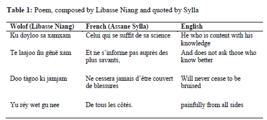
It is interesting that Sylla himself translates sa xamxam as sa science (his science) in French. Rather than drawing a distinction between types of knowledge, the poem seems to illustrate that truthful knowledge is predicated on being shared.
These reflections bring me to my last example, which is the only example that does depart from the French language completely. It is an essay written in Wolof by Souleymane Bachir Diagne and translated into English by Omar Ka.
Dëgg ak Ludul Dëgg25
Souleymane Bachir Diagne, born in 1955, has published widely on logic, philosophy, Islam, and translation. His works, such as Comment Philosopher en Islam?26 (Diagne 2008), L'encre des Savants: Réflexions sur la Philosophie en Afrique27 (Diagne 2013), and De Langue à Langue. L'hospitalité de la Traduction28 (Diagne 2022) have been discussed widely. Later a professor at Columbia University in the United States, he left his imprint on Senegalese academia as vice-chancellor of the Arts and Humanities of UCAD, as editor of the journal Éthiopiques, and as a counsellor for education in culture to the Senegalese President Abdou Diouf.
Thus far, Souleymane Bachir Diagne has only published one written essay in Wolof, included in the anthology Listening to Ourselves, edited by Jeffers (2013).29 The anthology is unique in uniting seven philosophical essays written in indigenous African languages by contemporary African philosophers. Each essay is accompanied by a translation into English. The essays touch upon various topics in African philosophy, including proverbs, naming practices, or the distinction of good and evil. Souleymane Bachir Diagne's essay bears the title Dëgg ak Ludul Dëgg: Waxtaan Diggante Soxna ak Càmmiñam Ngóór, translated by Omar Ka as Truth and Untruth: A Conversation Between Soxna and Her Friend Ngóór.
The text is a conversation overheard by Souleymane. Through this form, Souleymane Bachir Diagne first acknowledges oral genres of philosophising, here waxtaan (to have a conversation, to discuss, to speak to each other). Second, he admits a plurality of perspectives in philosophising. I understand the text as an acknowledgement of philosophical instruction avant-la-lettre: Souleymane Bachir Diagne's own curiosity for truth, thinking, or epistemology may be linked to his childhood experience of listening to elders. His later career path may be intimately linked to the fact of accompanying a woman (soxna), who is curious about the nature and value of truth.30
The concept of dëgg (truth) is not only prominent in the headline but throughout the texts. Soxna enters the conversation by interrogating a common practice. She wants to know why "béppub kàddu gu waay di dëggal di dëgëral, da naan Wolof Njaay a ko wax?" (who wants to emphasise the truth of what he is saying affirms that Wolof Njaay said it?) (Diagne 2013, 2). In the quoted phrase, dëggal means to render true, make true, or "truthify" and dëgëral to harden or strengthen. The two verbs are rendered as emphasising the truth in the English translation.
The conversation elaborates on different ways of truthmaking, touching upon the knowledge of ancestors (Wolof Njaay, maam), tradition and history (cosaan), thinking (xalaat), belief (gëm), religion (diine), words (baat yi), and, to a limited degree, tales (léeb). There may be different types of truth that have their relevance, notwithstanding that there are also clear limits or opposites of truths. Opposites of truth include lie (fen) or mistake (juum). There is also a marked difference between truth and correspondence. The speakers further encounter truthmaking practices limited to a certain time or context, which may nonetheless be considered truth (dëgg).
Souleymane Bachir Diagne clearly shows that philosophising, here exemplified as a reflection on the notion of truth, is practised by Wolof speakers. Elsewhere Diagne (2017, 89) argues that "quand nous philosophons, c'est toujours dans une certaine langue donnée. "31 He writes against a national ontologism, which, as in the colonial enterprise, would perceive of one language as the language of reason, of philosophy, and see all other languages as minor and deficient (Diagne 2017, 90). Without falling into the trap of linguistic determinism, Souleymane Bachir Diagne (2017, 91) invites philosophers, including but not limited to African philosophers, to think in and with translation. Philosophising in non-European languages asks questions differently and, in its translation, might bring us closer to what could be considered (philosophical) truth. From Souleymane Bachir Diagne's reflection in Wolof, one can retain that correspondence to the mind or mentality (dëppook xel) is not a sufficient criterion for truth. Thinking (xalaat) and discussing, speaking (waxtaan) are essential parts of philosophising, as is listening (dégg, déglu), as illustrated through Souleymane Bachir Diagne.
The Plurality of Philosophising
The examples discussed demonstrate that questions of philosophical terminology are not new in the context of Wolof in Senegal. Authors have been proposing dictionaries and wordlists, analysed philosophical concepts, translated philosophical texts and wrote original essays. A point is proven: Wolof is a language apt for philosophising, regardless of whether philosophising means to study the thought of philosophers, such as Immanuel Kant or Kocc Barma Fall, or to examine philosophical notions and concepts.
Despite sharing a language and the conviction that it is possible and necessary to philosophise in that language, in the practice of philosophising in Wolof, there are more differences than similarities: each of the authors takes a different starting point. Diop is concerned primarily with science, and only secondarily with philosophy. Two approaches, continuing his work more explicitly in the realm of philosophy, take completely different paths. Pathé Diagne develops a philosophical vocabulary based on his research as an applied linguist, while Tamsir translates the terminology of a Western canon into Wolof. Sylla studies Wolof philosophical discourses and renders them intelligible in French. Even though Souleymane Bachir Diagne has written on translation, he moves away from translation and philosophises in Wolof.
For the philosopher wanting to philosophise in Wolof (by writing a text, by giving a lecture, or by engaging in a conversation), the terminological question is a central one. This article shows that in this endeavour one need not start from scratch. Valid propositions have been made for almost every term used in philosophical discourse. At the same time, the absence of a "standard philosophical vocabulary" also opens up opportunities for philosophising. Who am I, and who do I want to be: a xelaatkat (critical thinker), a wutkatu dëgg (searcher for truth), or a filosof (philosopher)? This seems to point the finger at the very essence of philosophical reflection.
Terminological questions are central to any philosopher, regardless of the language she/he uses and regardless of how well-studied or codified this language is. The first heading in this text is wutkatu dëgg, searcher for truth. The idea of the philosopher as a searcher for truth seems to be underlying also Tamsir's (2020, 39) dictionary, who writes: "laaj lan mooy dëgg benn la ci laaj yi gën a sax ci filosofi. Wante li war a teqale dëgg ak fenn mooy càmbar lu baati dëgg ci boppam ëmb" (the question what is truth is a question that drives philosophy. But what must separate truth and lie depends on the selection of the words for truth and the meaning encoded). Also, Souleymane Bachir Diagne agrees that questions such as "what is truth?" or "what is true?" are constitutive for philosophy. The conversation in Wolof distinguishes and discusses different ways of truthmaking. There may be different types of truth that have their relevance, notwithstanding that there are also clear limits or opposites of truths. This is the realm of philosophical exploration.
A key difference between the authors concerns the relationship of philosophical discourse and everyday encounters in Wolof. To take abstract philosophical language established in academia as a starting point for philosophising or the Senegalese lived reality, are two completely different endeavours. To take a Wolophone discourse that disguises itself as philosophical, or one that sees philosophy always in close relation to scientific endeavours, are also two distinct approaches. It is these different stances that the authors practise in their philosophical endeavours. And it is this plurality of approaches that characterises philosophising (in Wolof).
In their plurality, there seems to be agreement that the search, analysis, explanation, and critique of truth do not know disciplinary boundaries. All of the authors quoted in this article were trained, and most were even active in different disciplines. These disciplines include chemistry, mathematics, linguistics, and anthropology. In one or the other sense, they all followed Diop's call: "Formez-vous, armez-vous de sciences jusqu'aux dents ... et arrachez votre patrimoine culturel"32 (IFAN n.d.).
Acknowledgements
This article was supported by the Centre for Advanced Studies "Philosophising in a Globalised World: Historical and Systematic Perspectives", funded by the Deutsche Forschungsgemeinschaft (DFG, German Research Foundation): Project number 510912588, and received financial support by Stiftung Universität Hildesheim. I further thank the two anonymous reviewers and Prof. Bado Ndoye for their comments.
References
-
Borghi, A. M., and C. Mazzuca. 2023. "Grounded Cognition, Linguistic Relativity, and Abstract Concepts." Topics in Cognitive Science 15 (4): 662-667. https://doi.org/10.1111/tops.12663
» https://doi.org/10.1111/tops.12663 - Centre d'étude des Civilisations. n.d. "Kocc Barma Faal." Démb ak tey = Cahiers du mythe no. 3. Les Nouvelles Éditions Africaines.
- Chaudemanche, A. 2021. "L'Anthologie Wolof de littérature de Pathé Diagne: La Traduction Comme Engagement Politique et Poétique." In Traduire, un Engagement Politique?, edited by Florence X. Zhang and N. Froelinger, 187-207. Bruxelles: Peter Lang.
-
Chaudemanche, A. 2023. "Du Tableau Noir au Papier: Ijjib Volof (1959) et Kàddu (1971-1978), Deux Instruments de la Lutte par la Langue." Revue d'Histoire Contemporaine de l'Afrique (4): 49-63. https://doi.org/10.51185/journals/rhca.2023.0404
» https://doi.org/10.51185/journals/rhca.2023.0404 -
Chimakonam, J. 2019. Ezumezu: A System of Logic for African Philosophy and Studies. Springer. https://doi.org/10.1007/978-3-030-11075-8
» https://doi.org/10.1007/978-3-030-11075-8 - Diagne, L. 1979. Kotch Barma Fall: Un Philosophe Sénégalais du XVIIe Siècle. Mémoire de Maîtrise. Université de Dakar.
- Diagne, P. 1981. l'europhilosophie face à la pensée du Negro-Africain suivi de Thèses sur épistemologie du réel et problématique néo-pharaonique. Dakar: Sankoré
-
» https://doi.org/10.2307/j.ctvh8r27t - Diagne, S. B. 2008. Comment Philosopher en Islam? Paris: Éditions du Panama.
- Diagne, S. B. 2013. "Dëgg ak ludul dëgg: Waxtaan diggante Soxna ak cammiñam Ngóór." In Listening to Ourselves. A Multilingual Anthology of African Philosophy, edited by Chike Jeffers, 2-13. New York: Suny Press.
- Diagne, S. B. 2013. L'encre des Savants: Réflexions sur la Philosophie en Afrique. Paris: Présence Africaine.
-
Diagne, S. B. 2017. "Pour une Histoire Postcoloniale de la Philosophie." Cités 72 (4): 81-93. https://doi.org/10.3917/cite.072.0081
» https://doi.org/10.3917/cite.072.0081 -
Diagne, S. B. 2018. Open to Reason. Muslim Philosophers in Conversation with the Western Tradition. Columbia University Press. https://doi.org/10.7312/diag18546
» https://doi.org/10.7312/diag18546 - Diagne, S. B. 2022. De Langue à Langue. L'hospitalité de la Traduction. Paris: Albin Michel.
-
Diop, B., and A. O. Sall. 2023. "Sénégal: Décès de Pathé Diagne, un Intellectuel Aux Multiples Talents." The Conversation. https://theconversation.com/senegal-deces-de-pathe-diagne-un-intellectuel-aux-multiples-talents-212560
» https://theconversation.com/senegal-deces-de-pathe-diagne-un-intellectuel-aux-multiples-talents-212560 - Diop, C. A. 1979 [1954]. Nations Nègres et Culture. De l'antiquité nègre égyptienne aux Problèmes Culturels de l'Afrique noire d'aujourd'hui. Paris: Présence Africaine.
- Diop, C. A. 1981. Civilisation ou Barbarie. Anthropologie sans Complaisance. Paris: Présence Africaine.
- Diop, C. A. 1984. "Philosophie, Science et Religion. Les Crises Majeures de la Philosophie Contemporaine." Revue Sénégalaise de Philosophie no. 5-6. Actes du Colloque Philosophie et Religions. Les Nouvelles Éditions Africaines, 179-199.
- Diop, C. A. 1991. Civilization or Barbarism: An Authentic Anthropology. Brooklyn: Lawrence Hill Books.
- Diouf, J.-L. 2003. Dictionnaire Wolof-Français et Français-Wolof. Paris: Karthala.
-
Elberfeld, R. 2017. Sprache und Sprachen. Eine Philosophische Grundorientierung. Freiburg: Verlag Karl Alber. https://doi.org/10.5771/9783495861028
» https://doi.org/10.5771/9783495861028 - Fal, A., R. Santos, and J. L. Doneux. 1990. Dictionnaire Wolof-Français suivi d'un index Français-Wolof. Paris: Karthala.
- Fal, A. 1996. "La Question Linguistique Dans l'œuvre de Cheikh Anta Diop." Notes Africaines no. 192. Spécial Cheikh Anta Diop, 11-18.
- Fal, A. 2013. Lexique Scientifique Bilingue Français-Wolof/Wolof-Français. Organisation Sénégalaise d'appui au développement (OSAD).
- Fall, K. 2003. "Senegalesisch-deutsche Gedanken zu einer Humanisierung des Menschen. Kocc Barma Faal und Johann Gottfried Herder." In Weltengarten: Deutsch-Afrikanisches Jahrbuch für Interkulturelles Denken, 184-190. Hannover: Wehrhahn.
- Fall, P. A. 2025. "Philosopher en Wolof." Presentation. Groupe Interdisciplinaire de Recherche sur les Cultures et les Identités (GIRCI). Université Cheikh Anta Diop de Dakar.
- Faye, B. 2016. The African Moral Philosophy and Spirituality in Non-Western Writings: The Cases of Sheikh Ahmadou Bamba Mbacke and Sheikh Moussa Ka. Master II Dissertation. Université Cheikh Anta Diop de Dakar.
-
Geeraerts, D., and H. Cuyckens. 2010. "Introducing Cognitive Linguistics." In The Oxford Handbook of Cognitive Linguistics, edited by D. Geeraerts and H. Cuyckens, 3-21. Oxford University Press. https://doi.org/10.1093/oxfordhb/9780199738632.013.0001
» https://doi.org/10.1093/oxfordhb/9780199738632.013.0001 - Gnonsea, D. 2003. Cheikh Anta Diop, Théophile Obenga: Combat pour la Re-naissance Africaine. Paris: L'Harmattan.
-
IFAN. n.d. "Citations de Cheikh Anta Diop." Institut fondamental d'Afrique noire Cheikh Anta Diop. https://ifan.ucad.sn/citations-de-cheikh-anta-diop/
» https://ifan.ucad.sn/citations-de-cheikh-anta-diop/ -
Jeffers, C. 2013. Listening to Ourselves. A Multilingual Anthology of African Philosophy. New York: Suny Press. https://doi.org/10.1353/book26523
» https://doi.org/10.1353/book26523 -
McLaughlin, F. 1997. "Noun Classification in Wolof: When Affixes are not Renewed." Studies in African Linguistics 26 (1): 1-28. https://doi.org/10.32473/sal.v26i1.107395
» https://doi.org/10.32473/sal.v26i1.107395 - Minerba, E., forthcoming. Knowledge is Action. Versifying xam-xam in Wolof Sufi poetry.
-
Ocaya, V. 2006. "Logic in the Acholi Language." In A Companion to African Philosophy, edited by Kwasi Wiredu, 285-295. Malden: Blackwell Publishing. https://doi.org/10.1111/b.9781405145671.2005.00022.x
» https://doi.org/10.1111/b.9781405145671.2005.00022.x - Pozdniakov, K., and S. Robert. 2015. "Les Classes Nominales en Wolof. Fonctionnalités et Singularités d'un Système Restraint." In Les classes Nominales Dans les Langues Atlantiques, edited by D. Creissels and K. Pozdniakov, 567-655. Köln: Rüdiger Köppe Verlag.
-
Jóob, S. 1984. "Làmminu réew mi ak gëstu." Semaine Culturelle de l'École Normale Germaine Legoff, Thiès. https://www.wolof-online.com/?p=2264
» https://www.wolof-online.com/?p=2264 - Sylla, A. 1978. La Philosophie Morale des Wolof. Dakar: Sankoré
- Sylla, A. 1980. La Philosophie Morale des Wolof. Lille: Université de Lille III.
- Sylla, A. 1992. Le peuple Lebou de la presqu'île du Cap-Vert. Dakar: Les Nouvelles Éditions africianes du Sénégal.
- Sylla, A. N.d. Poèmes et Pensées Philosophiques Wolof: (de l'oralité à l'écriture). Tome I-IV.
- Tamsir, A. 2020. Filosofi ci Wolof. Montréal: Presses Panafricaines.
2 Translated as: "Negro Nations and Culture."
3 A translation of the monograph into English is available with the title Civilization or Barbarism: An Authentic Anthropology (Diop 1991). .
4 Diop rather speaks of Walaf or Valaf. The name Walaf is constituted by waa, meaning the people of, and laf, meaning shore, thus said to signify "the people of the shore" or "the people coming from the shore."
5 Translated as: "... will help man to reconcile with himself and will be largely the result of contact between philosophical reflection and science."
6 Bilingual French-Wolof /Wolof-French scientific glossary.
7 In Wolof, many terms can serve as verbs and nouns. In a given context, the use of an article or dependent clause would clarify the word type.
8 In this sense, contemporary Wolof is similar to German or other indo-European languages in which articles categorise nouns in different classes. An earlier form of Wolof probably marked the class directly on the noun, as in most other Niger-Congo languages (Mc Laughlin 1997).
9 Translated as: "Knowing your language means knowing yourself."
10 Translated as: "Europhilosophy in the Face of Black African Thought; followed by Theses concerning the Epistemology of the neo-Pharaonic Problem."
11 I would like to thank Prof. Bado Ndoye for drawing my attention to this crucial aspect.
12 Translated as: "There is no need for being a parrot."
13 Translated as: "Making us donkeys."
14 In contemporary Wolof this bears a relatively wide range of context-dependent connotations and can be translated as mind, intelligence, mentality, or idea (Diouf 2003).
15 Translated as: "Philosophy in Wolof. "
16 Translated as: "The translation of scientific terminology in national languages has made significant strides since foundational works of Diop. "
17 Translated as: "What is enlightenment."
18 As pointed out to me by Prof. Ndoye, a possibly misleading connotation of gindi is the need for guidance or orientation from someone else. While Kant's Aufklärung prioritises reason as a means for self-eludication, Tamsir's gindeeku refers to being lost and needing guidance from someone else.
19 Translated as: "What is evident. "
20 Translated as: "The moral philosophy of the Wolof. "
21 Translated as: "The testimony of language. "
22 I am referring here to the Fédération des étudiants d'Afrique noire (FEANF).
23 Translated as: "Clarity or veracity of the content of the proposition."
24 A comparison to Heraclitus' philosophising in Ancient Greece may constitute an interesting line of future inquiry.
25 Translated as: "Truth and untruth."
26 While the title literally means in English "How to philosophise in Islam?" the work has been published in English with the title Open to Reason. Muslim Philosophers in Conversation with the Western Tradition (Diagne 2018).
27 A translation into English is available with the title, The Ink of the Scholars: Reflection on Philosophy in Africa (Diagne 2016).
28 Translated as: "From Language to Language. The Hospitality of Translation."
29 However, Diagne uses Wolof in philosophising orally in Senegal recorded, for instance in encounters with students.
30 His later career has definitely also been inspired by Pathé Diagne, to whom Souleymane Bachir Diagne is related. Who knows, he may be the counterpart of the conversation.
31 Translated as: "When we are philosophising, we do so in a certain language."
32 Translated as: "Educate yourself, arm yourself with science to the teeth ... and reclaim your cultural heritage."
