A study on willingness to take the COVID-19 vaccine at a tertiary institution community in Johannesburg, South Africa
Abstract
BACKGROUND: South Africa is aiming to achieve herd immunity against the coronavirus disease 2019 (COVID-19) by the first quarter of 2022. The success of the COVID-19 vaccination roll-out depends primarily on the willingness of the population to take the vaccines. AIM: This study aimed to examine the willingness to take the COVID-19 vaccine, along with the factors of concern, efficacy and preferences of the individual, which may increase the willingness to be vaccinated. SETTING: This study was conducted at the University of the Witwatersrand, Johannesburg, amongst adult students and academic and professional staff. METHODS: A cross-sectional online survey from 27 July 2021 to 14 August 2021 was conducted. We performed descriptive and inferential analysis to determine the factors associated with willingness to take the COVID-19 vaccine. RESULTS: A total of 2364 participants responded to a survey link and 82.0% were students, 66.8% were in the 18-29 years age band and females represented 64.0%. A total of 1965 participants (83.3%) were willing to receive a COVID-19 vaccine, the most preferred vaccines were Pfizer (41%) and J (23%), local pharmacy (29%) and General Practitioner (GP) (17%) were the preferred places for vaccination and the trusted sources of information on COVID-19 vaccines were the general practitioners (40.6%) and specialists (19.2%). Perceptions that vaccines are safe (adjusted odds ratio [aOR] = 31.56, 95% confidence interval [CI]: 16.02-62.12 for affirmative agreement) and effective (aOR = 5.92, 95% CI: 2.87-12.19 for affirmative agreement) were the main determinants of willingness to taking a COVID-19 vaccine CONCLUSION: It is imperative to reinforce the message of COVID-19 vaccine safety and efficacy and to include the GPs and the community pharmacies in the vaccination roll-out in South Africa.
COVID-19; South Africa; vaccination; vaccine hesitancy; willingness to be vaccinated
Background
Vaccination for the coronavirus disease 2019 (COVID-19) is the primary intervention, together with the other public health measures to curb the COVID-19 pandemic.123
By mid-August 2021, 190 countries have begun mass vaccination campaigns and 4.7 billion doses of the COVID-19 vaccines have been administered worldwide.4567
A global Independent Polling System of Society89
Evidence suggests that conspiracy beliefs and misinformation increase vaccine hesitancy and decrease the willingness to be vaccinated.1010
The Wellcome Global Monitor 201811121314
There is limited evidence concerning the people's willingness to take the COVID-19 vaccine in resource-constrained countries. In this study, we examined the willingness to take the COVID-19 vaccine, along with the factors of concern, efficacy and preferences of the individual that may increase the willingness to be vaccinated.
Methods
Study design
The study was a cross-sectional online survey of adult students and staff members at the University of the Witwatersrand, Johannesburg, South Africa.
Study population and setting
The study population was adults studying or working at the University of the Witwatersrand. All students, academicians and the administrative and service staff older than 18 years were eligible to participate in the study. This university has a campus in Braamfontein and Parktown with approximately 40 129 registered students, 1642 academic staff members and nearly 3960 administrative and service staff members.
Sample size and sampling
Using the OpenEpi software15N = 42 000), 50% of the participants will be willing to undertake COVID-19 vaccine, marginal error 5%, design effect of 2 and the 70% online survey non-response rate resulted in the estimated minimum sample size of 1300. We expected the distribution of participants to be at the ratio of 9:1 (1170 students and 130 staff). All adult students and staff were invited to participate in the study.
Data collection procedures and ethical considerations
After permission was obtained from the University of the Witwatersrand registrar, the registrar's office sent the survey link to all students and staff. The email contained information on the study and participants had to consent before they could access the survey questionnaire. The questionnaire was based on the number of factors, which includes the acceptability of the COVID-19 vaccine,1617131819
Data management and analysis
Data from REDCap was exported to Stata version 14 for management and analysis. The data set contained categorical variables and therefore the descriptive statistics frequencies (proportion) is summarised. The Chi-square test was used to determine the bivariate association of factors associated with willingness to undertake the COVID-19 vaccine. It was decided a priori that age and gender will be forced in the multivariable logistic regression model regardless of the bivariate analysis. The p-value and other factors were entered into the logistic regression multivariable model if the bivariate analysis p-value was < 0.20. The authors reported adjusted odds ratios (aORs) and considered a p-value of < 0.05 statistically significant.
Ethical considerations
Approval to conduct the study was received from the Human Research Ethics Committee (Medical) of the University of the Witwatersrand (M210495).
Results
General characteristics of the study population
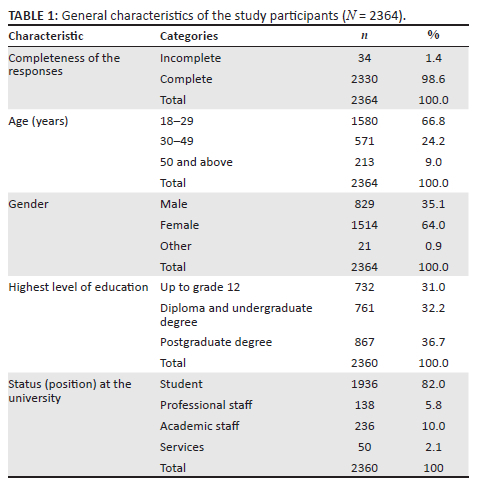
The university registrar shared the survey link with 40 129 students, 1642 academic staff and 3960 professional and administrative staff. The survey response rate was 2364/45 731 (5.0%). Table 1 shows that almost all participants responded to all survey questions 2330 (98.6%). Amongst all participants (n = 2364), 82.0% were students, 66.8% were in the 18-29 years age band and females represented 64.0% of all participants.
Willingness to receive COVID-19 vaccines and the preferred vaccines type
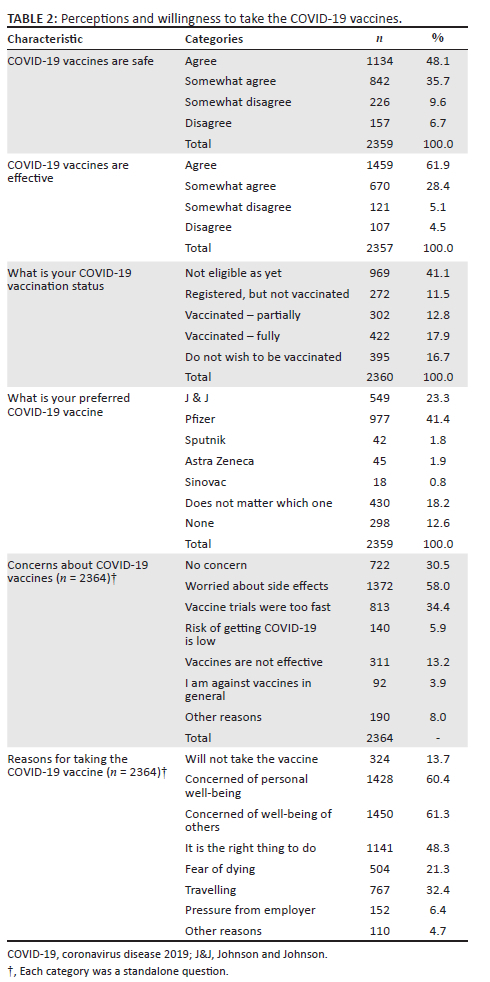
Table 2 further shows that 395/2360 participants (16.7%) indicated that they do not wish to receive COVID-19 vaccines. Amongst the 83.3% who indicated their willingness to take the COVID-19 vaccines - 30.7% had vaccinated (fully or partially). The most preferred COVID-19 vaccine types by the participants were Pfizer (41.4%) and J&J (23.3%) vaccines. The least preferred ones were Sinovac (0.8%), AstraZeneca (1.9%) and Sputnik (1.8%). Amongst those willing to take the vaccines their main motivations were concern about their personal well-being (60.4%) and concerns for the well-being of others (61.3%). Side effects (58.0%) and short timelines of the vaccine trials (34.4%) were major concerns of the COVID-19 vaccines reported by the participants.
Perceptions on safety and effectiveness of the COVID-19 vaccines
Of the participants (n = 2359) who responded to the question on the safety of COVID-19 vaccines, 1134 (48.1%) agreed affirmatively that the vaccines were safe and 35.7% of the respondents somewhat agreed that the vaccines were safe. On the other hand, 2357 participants who responded to the vaccine effectiveness question, 1459 (61.9%) agreed affirmatively that the COVID-19 vaccines were effective and 28.4% indicated that they somewhat agreed (Table 2).
Preferred COVID-19 vaccination places and the sources of COVID-19 information
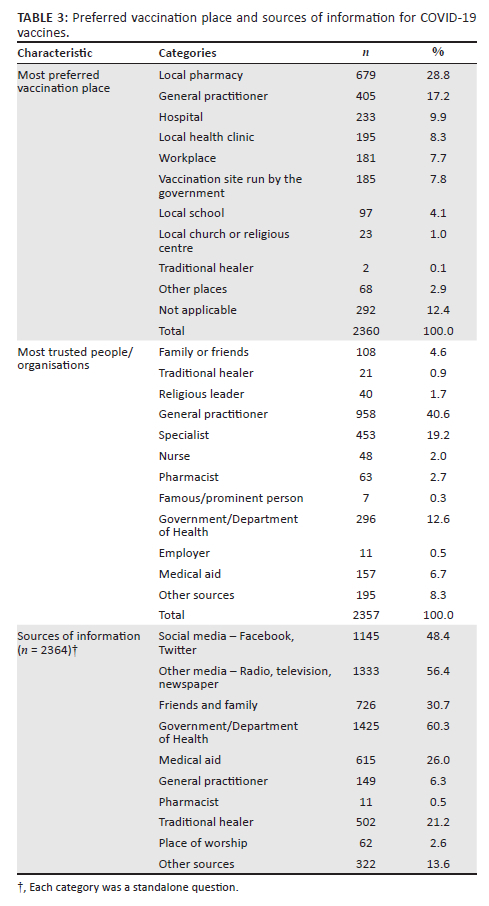
Table 3 describes the preferred places for vaccination and sources of information. Participant's preferences were a local pharmacy (28.8%), general practitioner (17.2%), hospital (9.9%), local health clinic (8.3%), workplace (7.7%) and vaccination site run by the government (7.8%). The trusted sources of information on COVID-19 vaccines were the general practitioners (40.6%), specialists (19.2%), the Government Department of Health (12.6%) and the medical aids (6.7%). The participants of this study postulated that the main sources of information were by the Government Department of Health (60.3%), via mainstream media (Radio, television, newspapers) (56.4%), social media (48.4%) and by medical aids (26.0%).
Factors associated with willingness to take the COVID-19 vaccines
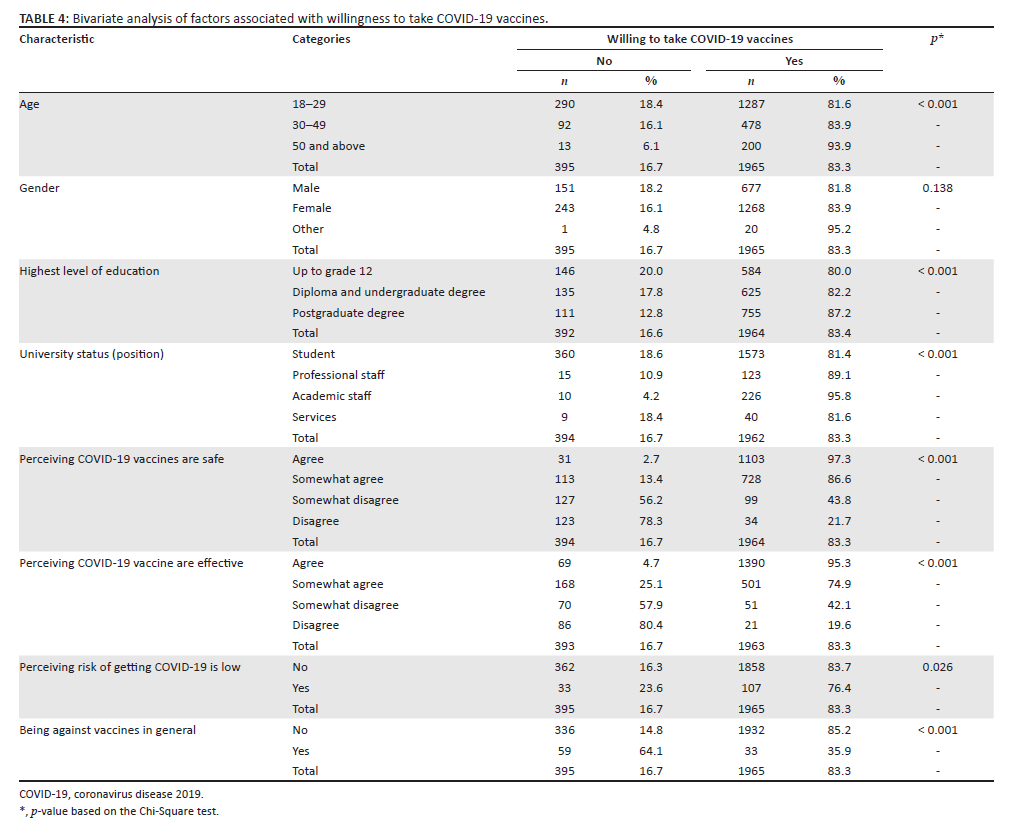
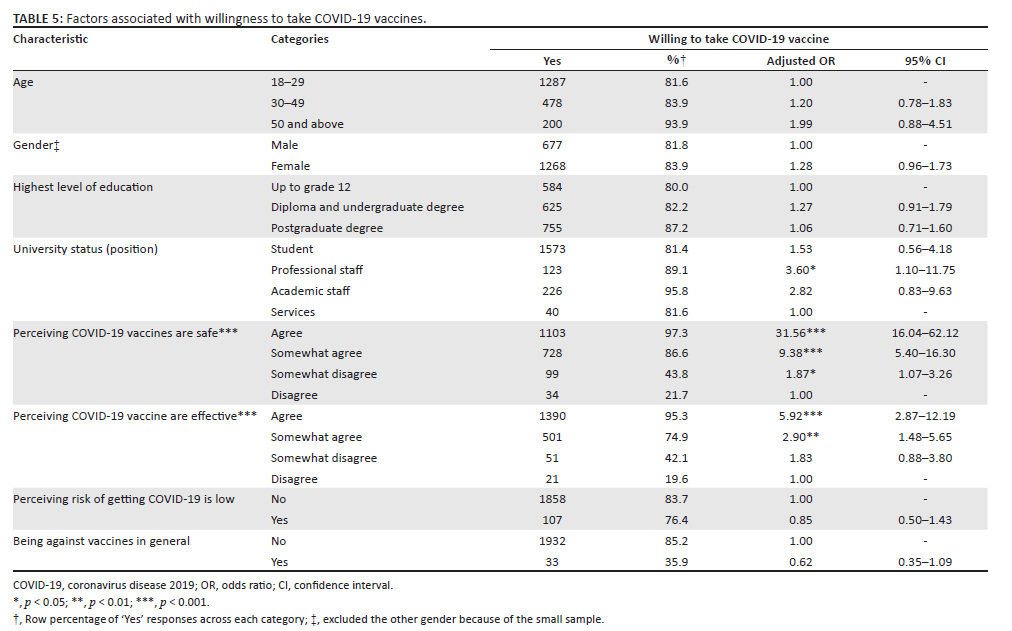
Overall, the prevalence of willingness to take the COVID-19 vaccines was 83.3%. All reported sociodemographic factors, the perceptions of vaccine safety and effectiveness, the perception that one was at low risk of COVID-19 infection and generally being against all vaccines were associated with the willingness to take the COVID-19 vaccines at the bivariate analysis (Table 4). However, only the perception that the COVID-19 vaccines are safe (aOR = 31.56, 95% confidence interval [CI]: 16.02-62.12 for affirmative agreement and aOR = 9.38, 95% CI: 5.40-16.30 for a somewhat agree) and that the vaccines are effective (aOR = 5.92, 95% CI: 2.87-12.19 for affirmative agree and aOR = 2.90, 95% CI: 1.48-5.65 for a somewhat agree) remained significantly associated with the willingness to take COVID-19 vaccines (Table 5).
Discussion
Key findings of this study were that more than 80.0% of participants declared their willingness to be vaccinated. They also had a clear preference for Pfizer and Johnson and Johnson vaccines. Mainstream media and social media were sources of information and safety, and efficacy were prominent determinants of willingness to vaccinate. The trusted sources of information on COVID-19 vaccines were the general practitioners (40.6%), specialists (19.2%).
The findings of this study are consistent with the result of the Coronavirus Rapid Mobile Survey,2021
Several studies have found a three-way relationship between the factors of perceived severity, perceived susceptibility and perceived benefits, which influenced the willingness to take the COVID-19 vaccine.2,21,22,23
The willingness may also have been influenced because the survey included participants in a tertiary education facility with better access to information and developed reasoning skills. A study in Thailand showed that increased health education and increased willingness in the uptake of influenza vaccinations,242526
Vaccine hesitancy is an important hurdle in the willingness to be vaccinated, thus hesitancy is an essential component to address for a successful vaccination roll-out.2728
Confidence (importance, safety and efficacy of vaccines); Complacency (perception of low risk and low disease severity); Convenience (access issues dependent on the context, time and specific vaccine being offered); Communications (sources of information); and Context (sociodemographic characteristics).
In this study, although the main sources of health information concerning the COVID-19 vaccines were obtained via the department of health, social media (Facebook, Twitter, Instagram), mainstream media (radio, television and newspapers), and the medical aids, the most trusted source of the health information was from general practitioners and followed by specialists. This is new information in the South African context. Although many study participants obtained their vaccine-related information from social media, the study participants based in a tertiary institution seem discerning in interpreting the information and not be swayed by the conspiracy theories that abound on social media.10
The trusted source of information result is also in keeping with Opel et al.,29
Most of the study population were keen on obtaining two types of COVID-19 vaccines currently offered in SA. Willingness to vaccinate may decrease if the other vaccine products become available in the market and people do not have a choice of the vaccine they will receive.
In countries where the COVID-19 vaccination has been successfully rolled-out to the majority of the population, primary healthcare and community-based teams played a central role in rolling out the vaccination programme.30,31,32
The findings of this study should be interpreted considering the following limitations. Firstly, a poor response rate (5%) introduces the selection bias of participation of those using the university email, internet access (for those working from home) and those interested in the topic. Secondly, a potential risk of a social desirability response of over-reporting willingness to take the COVID-19 vaccines but the online anonymous survey would have mitigated this bias. Thirdly, even though the university communitycomprises individuals from all walks of life and geographical areas in the Gauteng province, the findings may not be entirely generalisable to the general population but university communities in South Africa. Finally, because of the cross-sectional nature of the study, we are only able to determine the factors associated with willingness to take the COVID-19 vaccine.
Conclusion
This study identified that the safety and efficacy of the COVID-19 vaccines are significantly associated with the willingness to be vaccinated against COVID-19. There is an urgent need to reinforce the communication around the safety of vaccines and effectiveness for the individual and the community, through doctors, media and other approaches to reduce vaccine hesitancy and increase the willingness to be vaccinated. The policymakers should consider incorporating the community pharmacies and the GPs in the primary care-led vaccination roll-out, in addition to the current large vaccination sites, to achieve herd immunity as soon as possible.
Competing interests
The authors declare that they have no financial or personal relationships that may have inappropriately influenced them in writing this article.
Authors' contributions
B.H.M., D.P. and J.M.F. contributed to the design and implementation of the research, to the analysis of the results and the writing of the manuscript.
Funding information
The authors received no financial support for the research, authorship, and publication of this article.
Data availability
The data that support the findings of this study are available from the corresponding author, B.H.M., upon reasonable request.
Disclaimer
The views and opinions expressed in the submitted article are the author's own and not an official position of the institution.
Acknowledgements
References
-
1.Doherty M, Buchy P, Standaert B, Giaquinto C, Prado-Cohrs D. Vaccine impact: Benefits for human health. Vaccine. 2016;34(52):6707-6714. https://doi.org/10.1016/j.vaccine.2016.10.025
» https://doi.org/10.1016/j.vaccine.2016.10.025 -
2.Seboka BT, Yehualashet DE, Belay MM, et al. Factors influencing covid-19 vaccination demand and intent in resource-limited settings: Based on health belief model. Risk Manag Healthc Policy. 2021;14:2743-2756. https://doi.org/10.2147/rmhp.s315043
» https://doi.org/10.2147/rmhp.s315043 -
3.Smith MJ. What constitutes success in the roll-out of COVID-19 vaccines? Lancet. 2021;398(10295):115-116. https://doi.org/10.1016/S0140-6736(21)01244-7
» https://doi.org/10.1016/S0140-6736(21)01244-7 -
4.Tracking covid-19 across the world. The Economist [serial online]. 2021 [cited 2021 Aug 16]. Available from: https://www.economist.com/graphic-detail/tracking-coronavirus-across-the-world
» https://www.economist.com/graphic-detail/tracking-coronavirus-across-the-world -
5.The best and worst places to be as reopening, variants collide. Bloomberg [serial online]. 2021 [cited 2021 Aug 20]. Available from: https://www.bloomberg.com/graphics/covid-resilience-ranking/
» https://www.bloomberg.com/graphics/covid-resilience-ranking/ -
6.Latest vaccine statistics in SA. COVID-19 Online Resource & News Portal [serial online]. 2021 [cited 2021 Aug 20]. Available from: https://sacoronavirus.co.za/latest-vaccine-statistics/
» https://sacoronavirus.co.za/latest-vaccine-statistics/ -
7.Media Hack, Bhekisisa Centre for Health Journalism. Coronavirus in South Africa [homepage on the Internet]. 2021 [cited 2021 Aug 16]. Available from: https://mediahack.co.za/datastories/coronavirus/dashboard/
» https://mediahack.co.za/datastories/coronavirus/dashboard/ -
8.Abbreviations [homepage on the Internet]. [cited 2021 Dec 15]. Available from: https://www.abbreviations.com/IPSOS
» https://www.abbreviations.com/IPSOS -
9.IPSOS. Global attitudes on a COVID-19 vaccine ipsos survey for the world economic forum [homepage on the Internet]. 2021. [cited 2021 Mar 02]. Available from: https://www.ipsos.com/sites/default/files/ct/news/documents/2021-09/Global-attitudes-about-COVID-19-Vaccine-Booster-Shots-Sept-2021.pdf
» https://www.ipsos.com/sites/default/files/ct/news/documents/2021-09/Global-attitudes-about-COVID-19-Vaccine-Booster-Shots-Sept-2021.pdf -
10.Earnshaw VA, Eaton LA, Kalichman SC, Brousseau NM, Hill EC, Fox AB. COVID-19 conspiracy beliefs, health behaviors, and policy support. Transl Behav Med. 2020;10(4):850-856. https://doi.org/10.1093/tbm/ibaa090
» https://doi.org/10.1093/tbm/ibaa090 -
11.Wellcome Trust. Wellcome global monitor 2018: How does the world feel about science and health? [homepage on the Internet]. 2019 [cited 2021 Mar 25]. Available from: https://wellcome.ac.uk/sites/default/files/wellcome-global-monitor-2018.pdf
» https://wellcome.ac.uk/sites/default/files/wellcome-global-monitor-2018.pdf - 12.Hamel L, Krizinger A, Lopes L, Kearney A, Sparks G, Brodie M. KFF COVID-19 vaccine monitor: January 2021. San Francisco, CA: Kaiser Family Foundation; 2021.
- 13.Hamel L, Sparks G, Brodie M. KFF COVID-19 vaccine monitor: Experiences with vaccine access and information needs. San Francisco, California: Kaiser Family Foundation; 2021.
-
14.Goold SD, Klipp G. Managed care members talk about trust. Soc Sci Med. 2002;54(6):879-888. https://doi.org/10.1016/s0277-9536(01)00070-3
» https://doi.org/10.1016/s0277-9536(01)00070-3 -
15.Dean A, Sullivan K, Soe M. OpenEpi: Open-source epidemiologic statistics for public health, version [homepage on the Internet]. 2013 [cited 2021 Mar 29]. Available from: https://www.OpenEpi.com
» https://www.OpenEpi.com -
16.Sevidzem Wirsiy F, Nkfusai NC, Ebot Ako-Arrey D, Kenfack Dongmo E, Titu Manjong F, Nambile Cumber S. Acceptability of COVID-19 vaccine in Africa. Int J Matern Child Heal AIDS. 2021;10(1):134-138. https://doi.org/10.21106%2Fijma.482
» https://doi.org/10.21106%2Fijma.482 -
17.Chopra H, Vashishtha A, Pal R, Ashima, Tyagi A, Sethi T. Mining trends of COVID-19 vaccine beliefs on Twitter with lexical embeddings. New York, NY: Cornell University; 2021. https://doi.org/10.48550/arXiv.2104.01131
» https://doi.org/10.48550/arXiv.2104.01131 -
18.Schoch-Spana M, Brunson EK, Long R, et al. The public's role in COVID-19 vaccination: Human-centered recommendations to enhance pandemic vaccine awareness, access, and acceptance in the United States. Vaccine. 2021;39(40):6004-6012. https://doi.org/10.1016/j.vaccine.2020.10.059
» https://doi.org/10.1016/j.vaccine.2020.10.059 -
19.REDCap (Research Electronic Data Capture) [homepage on the Internet]. [cited 2021 Mar 29]. Available from: https://projectredcap.org/
» https://projectredcap.org/ -
20.Burger R, Maughan-Brown B, Köhler T, English R, Tameris M. A shot in the arm for South Africa - increased openness to accepting a COVID-19 vaccine: Evidence from NIDS-CRAM Waves 4 and 5 [homepage on the Internet]. 2021 [cited 2021 Aug 20]. Available from: https://cramsurvey.org/reports/#wave-5
» https://cramsurvey.org/reports/#wave-5 -
21.Lazarus JV, Ratzan SC, Palayew A, et al. A global survey of potential acceptance of a COVID-19 vaccine. Nat Med. 2021;27(2):225-228. https://doi.org/10.1038/s41591-020-1124-9
» https://doi.org/10.1038/s41591-020-1124-9 -
22.Zampetakis LA, Melas C. The health belief model predicts vaccination intentions against COVID-19: A survey experiment approach. Appl Psychol Heal Well-Being. 2021;13(2):469-484. https://doi.org/10.1111/aphw.12262
» https://doi.org/10.1111/aphw.12262 -
23.Guidry JPD, Laestadius LI, Vraga EK, et al. Willingness to get the COVID-19 vaccine with and without emergency use authorization. Am J Infect Control. 2021;49(2):137-142. https://doi.org/10.1016/j.ajic.2020.11.018
» https://doi.org/10.1016/j.ajic.2020.11.018 -
24.Worasathit R, Wattana W, Okanurak K, Songthap A, Dhitavat J. Health education and factors influencing acceptance of and willingness to pay for influenza vaccination among older adults. BMC Geriatr. 2015;15(136):1-14. https://doi.org/10.1186/s12877-015-0137-6
» https://doi.org/10.1186/s12877-015-0137-6 -
25.Logan J, Nederhoff D, Koch B, et al. 'What have you HEARD about the HERD?' Does education about local influenza vaccination coverage and herd immunity affect willingness to vaccinate? Vaccine. 2020;36(2018):4118-4125. https://doi.org/10.1016/j.vaccine.2018.05.037
» https://doi.org/10.1016/j.vaccine.2018.05.037 -
26.Agbo H, Noel N, Nkala C, Mamza J, Balogun R. Knowledge and risk perception of COVID-19 and the willingness to take COVID-19 vaccine among tertiary institution students in Jos, Plateau State: A comparative assessment of medical and nursing students. J Epidemiol Soc Niger. 2021;4(1):75-88. https://doi.org/10.46912/jeson.43
» https://doi.org/10.46912/jeson.43 -
27.Chen H, Li X, Liu X, Mao Y, Wang R, Dai J. Health belief model perspective on the control of COVID-19 vaccine hesitancy and the promotion of vaccination: A web-based cross-sectional. J Med Internet Res. 2021;23(9):e29329. https://doi.org/10.2196/29329
» https://doi.org/10.2196/29329 -
28.Razai MS, Oakeshott P, Esmail A, Wiysonge CS, Viswanath K, Mills MC. COVID-19 vaccine hesitancy: The five Cs to tackle behavioural and sociodemographic factors. J R Soc Med. 2021;114(6):295-298. https://doi.org/10.1177/01410768211018951
» https://doi.org/10.1177/01410768211018951 -
29.Opel DJ, Heritage J, Taylor JA, et al. The architecture of provider-parent vaccine discussions at health supervision visits. Pediatrics. 2013;132(6):1037-1046. https://doi.org/10.1542%2Fpeds.2013-2037
» https://doi.org/10.1542%2Fpeds.2013-2037 -
30.Rosen B, Waitzberg R, Israeli A. Israel's rapid rollout of vaccinations for COVID-19. Isr J Health Policy Res. 2021;10(6):1-14. https://doi.org/10.1186/s13584-021-00440-6
» https://doi.org/10.1186/s13584-021-00440-6 -
31.Mahase E. Covid-19 : Logistical problems frustrate GPs ready to deliver vaccine in England. BMJ. 2020;371:m4849. https://doi.org/10.1136/bmj.m4849
» https://doi.org/10.1136/bmj.m4849 -
32.Majeed A, Molokhia M. Vaccinating the UK against COVID-19. BMJ. 2020;371:m4654. https://doi.org/10.1136/bmj.m465
» https://doi.org/10.1136/bmj.m465

Accepted: 03 Mar. 2022
Published: 28 July 2022