Prevalence of hypertension in community members in a low-income community in Windhoek, Namibia
Abstract
BACKGROUND: Hypertension remains a significant risk factor for the development of several non-communicable diseases such as stroke, myocardial infarction and renal failure. In many African countries, undiagnosed and unmanaged hypertension within the population remains a challenge. Proactive screening and health education therefore become important interventions. AIM: This study aimed to investigate the prevalence of hypertension among community members in a low-income, peri-urban community. SETTING: The study was conducted in Otjomuise township, Windhoek, Namibia. METHODS: A quantitative, cross-sectional design with a survey method was followed. A pre-validated health screening instrument was used to record the presence of hypertension in a sample of 358 community members who presented for screening over 2 days. A purposive sampling method was employed. Systolic and diastolic blood pressure reading were recorded, analysed and categorised using the American Heart Association classification scale. Blood pressures were classified as being either normal, elevated, hypertension stage 1 or hypertension stage 2. The data were analysed by a statistician using SPSS version 27 statistical software program and presented in tables. RESULTS: A total of 210/358 (59%) of participants were found to have blood pressures within normal limits. Moreover, 57/358 (16%) had elevated blood pressures, 52/358 (14%) were in hypertension stage 1 and 39/358 (11%) were in hypertension stage 2. CONCLUSION: The 41% prevalence of abnormally elevated blood pressures found in our study is in line with the findings of other studies and confirms that hypertension in the Namibian population remains an ongoing public health concern. Larger scale and more regular screening exercises with appropriate referral are recommended. CONTRIBUTION: Our study give insight on the prevalence of hypertension in a community in Namibia.
non-communicable diseases; prevalence; hypertension; Namibia; low-income; peri-urban
Introduction
Hypertension is often asymptomatic and referred to as the 'silent killer'.11,2 Hypertension is a risk factor for cardiovascular and circulatory diseases, including stroke, myocardial infarction and renal failure.34
Most of the estimated 1.13 billion people suffering from hypertension reside in low-middle income countries, with the highest prevalence rates seen in Africa.5652
Namibia is a middle-income country in SSA with an estimated population of 2.61m people in 2023.7742,5,8 Despite the high prevalence of hypertension in Namibia, the disease remains largely undiagnosed and untreated.88
There are several risk factors that contribute to the development of hypertension including age, tobacco use, obesity, inactivity and alcohol consumption.822
Research conducted in the capital city of Windhoek through several household surveys showed that, along with high levels of food insecurity, many community members lack diversity in their diet and are largely dependent on starchy staples, sugars and foods made from oils with an inadequate consumption of healthier foodstuffs such as fruits and vegetables.99
The WHO global target for the prevention and control of NCDs globally (2013-2020) was aimed at a 25% relative reduction in the overall mortality from cardiovascular diseases, cancer, diabetes, or chronic respiratory diseases by 2025.1010,11 Such targets exist in a context where NCDs are viewed as both preventable and manageable, provided the causative disorders and drivers can be detected and managed early on. This is important in the context of our study as hypertension remains both preventable and treatable with early detection and the patient's adherence to prescribed antihypertensive treatment interventions.1
Despite the above being well documented and known, the early diagnosis, treatment and adherence to treatment interventions remain a significant challenge among many African countries and hamper their achievement of the WHO goals.5,10 Also, the level of development of the country, region and the socioeconomic context can play a significant role in the effectiveness of efforts to manage hypertension. In Namibia, there are free hypertension screening and treatment programmes administered under the Ministry of Health and Social Services (MoHSS).5
In this article we aim to share our findings about the prevalence of hypertension in a sample of community members in a low-income, peri-urban community in Windhoek, Namibia and make selected recommendations for future research and related interventions that may assist to better understand the nature of hypertension in African contexts and assist in management of the disease.
Research methods and design
A quantitative, cross-sectional design with a survey method was followed using a pre-validated health screening instrument. The community outreach project was funded by the University of Johannesburg.
Study setting
The community of Otjomuise is a low-income, peri-urban community in north-west Windhoek, Namibia. Adjacent to the residential area of Otjomuise, is a large informal settlement named 'Agste laan/Eight avenue'. The community is characterised by poverty, high unemployment rates, substance abuse and scarce resources such as running water and electricity. In 2020, Windhoek had a total of 41 900 informal housing dwellings or 'shacks', accommodating close to 100 000 residents.1277
Population, sample and sampling strategy
The target population consisted of adult community members of the Otjomuise community, aged 18 years and older. The Otjomuise community was purposively selected by academics from the Namibia University of Science and Technology who were familiar with the socio-economic conditions and health-related challenges in this community. The sample consisted of 358 community members who attended the screening and who provided informed consent for their demographic and health data to be captured and included in the study.
Data collection and instrumentation
The screening was conducted in July 2023. Although health screening such as blood pressure, cholesterol and glucose screening are offered to most patients at Otjamuise clinic, visual screening are not routinely offered to all patients. The nurses referred patients for screening and the community health workers used word of mouth and direct engagement strategies to invite members of the community to present themselves for free health screening over the 2 days that data was gathered. Those who did not meet the inclusion criteria (being an adult aged 18 and above) and those who did not agree to participate were still offered an opportunity to receive the free screening; however, their data were not included in the study. Where there were significant concerns with either the systolic blood pressure (SBP), diastolic blood Pressure (DBP) or both, the respondent was counselled and referred to the nearest clinic (Otjamuise clinic or Katatura Hospital) for further investigation and treatment.
A survey adapted from the WHO1313
Participants had their blood pressures measured using a Microlife® electronic non-invasive blood pressure (NIBP) monitor. Both SBP and DBP were taken at three different times. All blood pressure recordings were measured on the right arm after a 5-min rest period. The NIBP monitors were calibrated before use and checked again before taking the blood pressure levels. Participants who presented with abnormal readings were allowed to 'rest' for about 30 min and have their blood pressure taken again for a fourth time at the end of the screening process to verify the accuracy of readings.
Data analysis
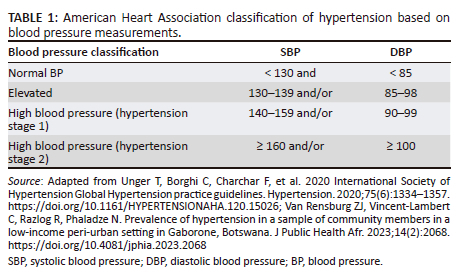
Data from the screening forms were uploaded onto an Excel spread sheet. Separate sheets were used to record the socio-demographic data, the history taking and the blood pressure readings. Other results such as the respondent's height, weight and body mass index (BMI), cholesterol and blood glucose levels and eye screening were also recorded; however, these data are not the subject of discussion in this article. The data were analysed by a statistician using SPSS version 27 statistical software program. The data were presented as descriptive statistics using tables. The blood pressure classification and ranges from the American Heart Association were used to report on the prevalence of hypertension in this sample of community members and are indicated in Table 1.14,15
Ethical considerations
Ethical clearance to conduct this study was obtained from the University of Johannesburg Research Ethics Committee (No. REC-1985-2023). Permission was also granted from the Namibia Ministry of Health and Social Service to conduct the study. Written consent was obtained from each respondent before the screening was conducted and a respondent number was allocated to each respondent to maintain confidentiality of the respondent and to protect their privacy. The respondents were free to decide whether they wanted to participate or not and were not forced in any way. If a respondent started the screening but opted to terminate the screening, the respondent was free to do so without any negative consequences.
Results
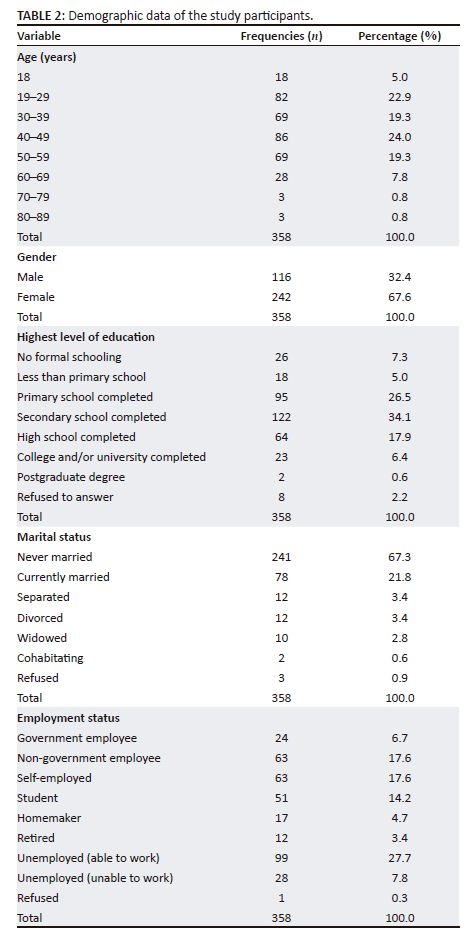
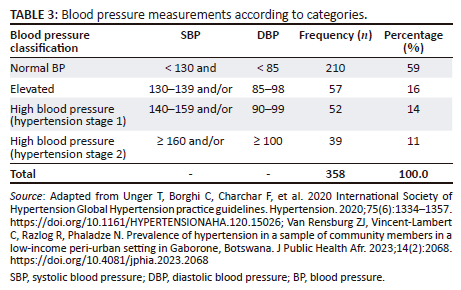
Our results are presented beginning with the participants' demographics (Table 2). Thereafter, in Table 3, we highlight the prevalence of hypertension within the sample.
Demographics
The demographic data showing the participants' gender, age, highest level of education, marital and employment status is presented in Table 2.
As shown in Table 2, most of the respondents were between the ages of 19 and 59 years (66.2%). Few respondents were 60 years and above (9.4%) or 18 years of age (5%). Our participants were mostly females (67.6%). Most of our participants, 78.5%, indicated that they completed either primary school (26.5%), secondary school (34.1%) or high school (17.9%). Few respondents indicated that they had no formal schooling (7.3%), or schooling less than primary school completed (7.8%). Most of our participants were not married (67.3%). A total of 27.7% of our participants indicated that they were unemployed while they were able to work and another 7.8% indicated that they were unemployed but unable to work. Most of our participants were non-government employees (17.6%), self-employed (17.6%) or a student (14.2%).
Prevalence of hypertension
The blood pressure of the study participants (N = 358) is indicated in Table 3.14,15
From Table 3, one can see that 210/358 (59%) of our participants had a normal BP while 57/358 (16%) had elevated blood pressures with 52/358 (14%) being classified as hypertension stage 1 and 39/358 (11%) as hypertension stage 2.
Discussion
Demographic data
As one ages, the risk of developing hypertension increases.16171618
There were significantly more females than males who presented themselves for the free screening. This was expected as globally females are more prone than males to seek healthcare and health screening.1819
Only 64 (17.9%) of our participants indicated that they had completed high school and very few (6.4%) indicated having a college or university education (0.6%). Previous studies have linked lower levels of education to the propensity to develop hypertension.202121
Factors such as stress caused by work or unemployment may be a risk factor for development of hypertension.2,10,22 Stress related to elevated blood pressure is, however, thought to be more prevalent among men than women.215
Regarding marital status, 67.3% of our participants indicated that they were unmarried. Evidence shows that having a partner with hypertension increases one's risk of having high blood pressure.323
Prevalence of hypertension
Hypertension is a growing concern in Africa and Namibia appears to be no exception with a previous study revealing a 46% prevalence of hypertension.21615
Regarding the classification of hypertension we found, 16% of our participants presented with an elevated blood pressure, 14% with hypertension stage 1 and 11% with hypertension stage 2. These findings are in line with the results published by the WHO in 20192424425
The fact that most of the hypertensive cases we found fall into the elevated (16%) or hypertension stage 1 category is potentially good news as early detection of elevated or stage 1 hypertension together with appropriate intervention can significantly decrease the progression to hypertension stage 2 and related systematic complications.8222627
Study's limitations
The nature of our recruitment made it difficult to control the sample size and the percentage of males and females that presented themselves for the screening. As most of our participants were between the age of 18 and 50 years, the prevalence of stage 1 and specifically stage 2 hypertension may have been greater if older community members had presented for the screening. Comorbidities such as diagnosed hypertension and diabetes were not taken into consideration when the screening was performed. Comorbidities might have influenced the prevalence of hypertension among the community members. Although the respondents were given time to rest before the screening, factors that may cause increased blood pressure, such as stress and anxiety, were not ruled out beforehand. The blood pressure equipment was calibrated beforehand, and all students received training on the measuring and documentation prior to the screening. Information bias might however have occurred and influenced the accuracy of the data that were collected; however, none of the results suggested any biasness.
Conclusion
In our study, we did not focus heavily on the recording of detailed information about behavioural risk factors such as alcohol consumption, physical inactivity and diet. Future studies of this nature may consider also recording these predictors of hypertension.
Based on what we found, we would recommend healthcare managers consider more regular screening exercises that revisit the same community over time to continue to identify and refer hypertensive cases and importantly to establish what trends are developing. This should be coupled with the provision of additional health education and advice to community members about the nature of hypertension and how this may be managed through diet, exercise and regular health checks.
The SDG target 3.4 is aimed to reduce premature mortality from NCDs by a third by 2030 relative to 2015 levels (SDG countdown). Even though this target is in place, NCDs continue to be the leading cause of morbidity and mortality globally (SDG countdown). The prevalence of hypertension among Namibian adults remains high, despite free healthcare in the country. Future research should be targeted to determine interventions needed to improve the overall diagnosis and prevention of hypertension in Namibia.
Competing interests
The authors reported that they received funding from the University of Johannesburg International Office and Faculty of Health Sciences that may be affected by the research reported in the enclosed publication. They have disclosed those interests fully and have implemented an approved plan for managing any potential conflicts arising from their involvement. The terms of these funding arrangements have been reviewed and approved by the affiliated university in accordance with its policy on objectivity in research.
Authors' contributions
Z.J.v.R. contributed to conceptualisation, methodology, investigation, data curation, and writing of original draft. C.V.-L. contributed to supervision, visualisation, and writing (review and editing).
Funding information
The authors received funding from the University of Johannesburg International Office and Faculty of Health Sciences.
Data availability
The data that support the findings of this study are available on reasonable request from the corresponding author, Z.J.v.R.
Disclaimer
The views and opinions expressed in this article are those of the authors and are the product of professional research. It does not necessarily reflect the official policy or position of any affiliated institution, funder, agency, or that of the publisher. The authors are responsible for this article's results, findings, and content.
Acknowledgements
The authors would like to thank the research participants who accepted to be part of this research study.
References
-
1. Abu-El-Noor NI, Aljeesh YI, Bottcher B, Abu-El-Noor MK. Assessing barriers to and level of adherence to hypertension therapy among Palestinians living in the Gaza strip: A chance for policy innovation. Int J Hypertens. 2020;2020(1):7650915. https://doi.org/10.1155/2020/7650915
» https://doi.org/10.1155/2020/7650915 -
2. Gafane-Matemane LF, Craig A, Kruger R, et al. Hypertension in sub-Saharan Africa: The current profile, recent advances, gaps, and priorities. J Hum Hypertens [serial online]. 2024 [cited 2024 Nov 11];1-16. Available from: https://www.nature.com/articles/s41371-024-00913-6
» https://www.nature.com/articles/s41371-024-00913-6 -
3. Weare AR, Feng Z, McGrath N. The prevalence of hypertension and hypertension control among married Namibian couples. PLoS One. 2023;18(8):e0289788. https://doi.org/10.1371/journal.pone.0289788
» https://doi.org/10.1371/journal.pone.0289788 -
4. Basenero A, Neidel J, Ikeda DJ, et al. Integrating hypertension and HIV care in Namibia: A quality improvement collaborative approach. PLoS One. 2022;17(8):e0272727. https://doi.org/10.1371/journal.pone.0272727
» https://doi.org/10.1371/journal.pone.0272727 -
5. Mashozhera S, Bamitale SK, Godman B, Kibuule D. Compliance to hypertensive prescribing guidelines and blood pressure control in elderly patients in Namibia: Findings and implications. J Pharm Health Serv Res. 2021;12(1):53-60. https://doi.org/10.1093/jphsr/rmaa017
» https://doi.org/10.1093/jphsr/rmaa017 -
6. World Health Organisation. Report on the status of major risk factors for noncommunicable diseases: WHO African Region, 2015 [homepage on the Internet]. 2015 [cited 2024 Nov 10]. Available from: https://www.afro.who.int/publications/report-status-major-health-risk-factors-noncommunicable-diseases-who-african-region-0
» https://www.afro.who.int/publications/report-status-major-health-risk-factors-noncommunicable-diseases-who-african-region-0 -
7. Statista. Namibia total population 2019-2019 [homepage on the Internet]. 2024 [cited 2024 Oct 12]. Available from: https://www.statista.com/statistics/510137/total-population-of-namibia/#:~:text=The%20total%20population%20in%20Namibia%20was%20forecast%20to,people%20and%20therefore%20a%20new%20peak%20in%202029
» https://www.statista.com/statistics/510137/total-population-of-namibia/#:~:text=The%20total%20population%20in%20Namibia%20was%20forecast%20to,people%20and%20therefore%20a%20new%20peak%20in%202029 -
8. Craig LS, Gage AJ, Thomas AM. Prevalence and predictors of hypertension in Namibia: A national-level cross-sectional study. PLoS One. 2018;13(9):e0204344. https://doi.org/10.1371/journal.pone.0204344
» https://doi.org/10.1371/journal.pone.0204344 -
9. Crush J, Nickanor N, Kazembe L. Urban food system governance and food security in Namibia [homepage on the Internet]. 2021 [cited 2024 Oct 10]. Available from: http://hungrycities.net
» http://hungrycities.net -
10. World Health Organisation. Follow-up to the political declaration if the high-level meeting of the general assembly on the prevention and control of non-communicable diseases [homepage on the Internet]. 2013 [cited 2024 Oct 09]. Available from: https://apps.who.int/gb/ebwha/pdf_files/WHA75/A75_10Add8-en.pdf
» https://apps.who.int/gb/ebwha/pdf_files/WHA75/A75_10Add8-en.pdf -
11. NCD Countdown 2030 collaborators. NCD Countdown 2030: Pathways to achieving Sustainable Development Goal target 3.4. Lancet. 2020;396(10255):918-934. https://doi.org/10.1016/S0140-6736(20)31761-X
» https://doi.org/10.1016/S0140-6736(20)31761-X -
12. Otjamuise [homepage on the Internet]. 2024 [cited 2024 Oct 10]. Available from: https://en.wikipedia.org/wiki/Otjomuise
» https://en.wikipedia.org/wiki/Otjomuise -
13. WHO STEPS instrument question-by-question guide (core and expanded) STEPS question-by-question (Q-by-Q) guide overview [homepage on the Internet]. [cited 2024 Sep 07]. Available from: https://www.who.int/publications/m/item/standard-steps-instrument
» https://www.who.int/publications/m/item/standard-steps-instrument -
14. Unger T, Borghi C, Charchar F, et al. 2020 International Society of Hypertension global hypertension practice guidelines. Hypertension. 2020;75(6):1334-1357. https://doi.org/10.1161/HYPERTENSIONAHA.120.15026
» https://doi.org/10.1161/HYPERTENSIONAHA.120.15026 -
15. Van Rensburg ZJ, Vincent-Lambert C, Razlog R, Phaladze N. Prevalence of hypertension in a sample of community members in a low-income peri-urban setting in Gaborone, Botswana. J Public Health Afr. 2023;14(2):2068. https://doi.org/10.4081/jphia.2023.2068
» https://doi.org/10.4081/jphia.2023.2068 -
16. Keetile M, Navaneetham K, Letamo G. Patterns and determinants of hypertension in Botswana. J Public Health (Germany). 2015;23(5):311-318. https://doi.org/10.1007/s10389-015-0682-7
» https://doi.org/10.1007/s10389-015-0682-7 -
17. World Health Organisation. Non-communicable diseases [homepage on the Internet]. 2023 [cited 2024 Oct 13]. Available from: https://www.who.int/news-room/fact-sheets/detail/noncommunicable-diseases
» https://www.who.int/news-room/fact-sheets/detail/noncommunicable-diseases -
18. Van Rensburg ZJ. Levels of health literacy and English comprehension in patients presenting to South African primary healthcare facilities. Afr J Prim Health Care Fam Med [serial online]. 2020 [cited 2024 Oct 02];12(1):a2047. Available from: https://phcfm.org/index.php/PHCFM/article/view/2047
» https://phcfm.org/index.php/PHCFM/article/view/2047 -
19. Teo CH, Ng CJ, Booth A, White A. Barriers and facilitators to health screening in men: A systematic review. Soc Sci Med. 2016;165:168-176. https://doi.org/10.1016/j.socscimed.2016.07.023
» https://doi.org/10.1016/j.socscimed.2016.07.023 - 20. Manning K, Senekal M, Harbron J. Afr J Prim Health Care Fam Med. 2016.
-
21. Ditshwane B, Janse van Rensburg Z, Jacobs W. Health-related word recognition and pronunciation by patients in Gauteng, South Africa in English and native languages. Afr J Prim Health Care Fam Med. 2024;16(1):a4492. https://doi.org/10.4102/phcfm.v16i1.4492
» https://doi.org/10.4102/phcfm.v16i1.4492 -
22. Cois A, Ehrlich R. Analysing the socioeconomic determinants of hypertension in South Africa: A structural equation modelling approach. BMC Public Health. 2014;14:414. https://doi.org/10.1186/1471-2458-14-414
» https://doi.org/10.1186/1471-2458-14-414 -
23. Guwatudde D, Nankya-Mutyoba J, Kalyesubula R, et al. The burden of hypertension in sub-Saharan Africa: A four-country cross sectional study. BMC Public Health. 2015;15(1):1211. https://doi.org/10.1186/s12889-015-2546-z
» https://doi.org/10.1186/s12889-015-2546-z -
24. Onwuchekwa AC, Mezie-Okoye MM, Chukwubike Onwuchekwa A, Mary F, Mezie-Okoye M, Babatunde S. Prevalence of hypertension in Kegbara-Dere, a rural community in the Niger Delta Region, Nigeria [homepage on the Internet]. 2012 [cited 2024 Oct 02]. Available from: https://www.researchgate.net/publication/230631173
» https://www.researchgate.net/publication/230631173 -
25. World Health Organisation. Hypertension Namibia 2023 country profile [homepage on the Internet]. 2023 [cited 2024 Nov 05]. Available from: https://www.who.int/publications/m/item/hypertension-nam-2023-country-profile
» https://www.who.int/publications/m/item/hypertension-nam-2023-country-profile -
26. Chou CC, Lin WS, Kao TW, Chang YW, Chen WL. Adherence to available clinical practice guidelines for initiation of antihypertensive medication in patients with or without diabetes mellitus and other comorbidities in Taiwan. J Clin Pharmacol. 2012;52(4):576-585. https://doi.org/10.1177/0091270011398658
» https://doi.org/10.1177/0091270011398658 -
27. Verloop WL, Vink EE, Spiering W, et al. Effects of renal denervation on end organ damage in hypertensive patients. Eur J Prev Cardiol. 2015;22(5):558-567. https://doi.org/10.1177/2047487314556003
» https://doi.org/10.1177/2047487314556003

Accepted: 29 Jan. 2025
Published: 18 Apr. 2025