Patient-centred care: The patients' perspective - A mixed-methods pilot study
Abstract
BACKGROUND: Patient centredness is a broad concept, a moral philosophy. Patient-centred care can be viewed as the actions of patient-centredness. One of the most pertinent actions that a healthcare practitioner can utilise to deliver patient-centred care is empathic communication. Whilst many medical programmes include empathetic communication skills as part of their curricula, the recipients of this care are not asked about the relevance of this teaching. AIM: We attempted to determine whether the Western constructs of empathy were relevant in our context and also establish whether there were any parts of the medical interview which participants felt were especially important to be communicated to in their home language. SETTING: Two urban communities within the City of Cape Town, Western Cape Province, South Africa. METHODS: This was a mixed-methods pilot study using an explanatory sequential design. Participants who would typically make use of public health care facilities and whose first language was Afrikaans or isiXhosa were conveniently sampled. A subgroup of participants was invited to take part in a follow-up focus group discussion to add clarity to the survey responses. RESULTS AND CONCLUSION: Western constructs for empathy appeared to be relevant within our multicultural context. Patients wanted to communicate with their doctors and understand the cause of their problems as well as the management plan. Finally, whilst the numbers in this pilot study were too small to be generalisable, it was evident that patient-centred care was not perceived to be implemented in some public healthcare facilities attended by the participants, which resulted in them feeling unseen and disrespected.
empathy; patient-centred care; healthcare clinics; education; primary health care
Introduction
The structure, content and delivery of undergraduate medical curricula have undergone important transformations over the last two decades. Medical education curricula in many institutions now include formal training in communication and language skills, and they have a focus on patient-centred care.12,3
Patient centredness is a multifaceted construct, which requires a change in doctor perspective from disease to whole-patient focus. In patient-centred care, it is the patient, not the doctor, who controls the relationship, communication and decision-making.456
Empathy or the capacity to understand and share the feelings of another is a widely used term, with multiple meanings. Within the doctor-patient relationship, both the affective and cognitive domains of empathy are considered important.373
Patient-centred care is foundational for the delivery of culturally competent healthcare with the potential to reduce racial and ethnic disparities.89,10
The ability to communicate effectively is an important component cognitive empathy and patient-centred care and one which needs attention in multilingual societies11121314
In South Africa, which has 11 official spoken languages, patients come from a large number of different cultural groups. There have been anecdotal concern that cultural differences in non-verbal communication maybe even more challenging for the healthcare provider. The limited tested models for non-verbal empathic communication within the healthcare setting are mostly based on Western (European and American) models of empathy and may not be culturally appropriate in our more complex context. The authors were keen to explore local patient perceptions of empathy and language used by doctors to develop greater insights into this important topic.
Aim of this pilot study
The aims of this pilot study were firstly to explore the extent to which accepted components of empathic communication developed in the West are relevant within the South African context. Secondly, we wanted to determine whether there were any parts of the clinical interview which patients perceived as more important than others about spoken language proficiency.
Research methods and design
Study design
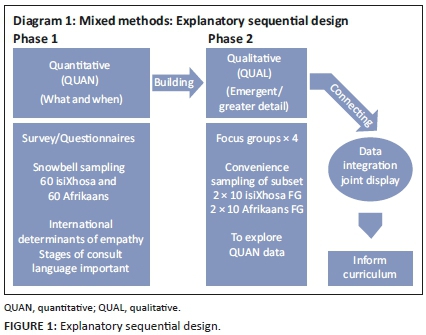
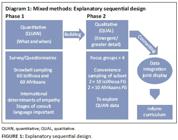
This study uses a mixed-methods approach. Mixed-methods research is a relatively new research design that is more than the simple combination of qualitative (QUAL) and quantitative (QUAN) methods1516Figure 1.
Setting and study population
The study was conducted in the Western Cape Province of South Africa where, in terms of the language policy of the Provincial Government,17
Data collection
The specifically designed questionnaire was used for phase 1 and comprised 14 items. Each item is an internationally accepted element of clinical empathy drawn from previously tested and published scales that explored empathy from the patient's perspective. The scales included were the Patient Perception of Clinical Empathy Score (Hojat et al. 2010),311418
This was followed by a second subset of questions using a similar scale. These questions listed the stages of the doctor visit as described in the Calgary Cambridge guide, to the medical interview which is taught to the medical students at our institution.19
At the time of data collection, there was an increase in gang violence within the target community, necessitating the deployment of the South African Defence Force. Concern for researcher and participant safety influenced sampling decisions. Some participants were sampled outside shopping malls in two Cape Town suburbs and invited to complete the questionnaires. The IsiXhosa participants were recruited at school functions and access to further participants gained through community gatekeepers. Consent was signed and participants were provided with an explanation about how to complete Likert scales before being asked to complete a questionnaire in their home language. Translated questionnaires were available in both Afrikaans and isiXhosa. Data collection occurred during weekday afternoons.
Following the analysis of the first phase, an interview schedule was developed to allow further exploration of aspects of non-verbal communication essential for the development of trust indicative of care. Also, preferences around the use of interpreters to convey meaning were explored, if doctors are not proficient in patient's home language.
Both Afrikaans focus groups were conducted in the same venue at different times. Because of safety and other logistical concerns, the private home of a member of the community had been offered, which was considered safe, central and easily accessible for all participants. At the time of the study, gang violence in this area was of particular concern. Two isiXhosa focus groups were conducted in a meeting hall in the community library. There were two first-language Afrikaans or isiXhosa speakers and facilitators for each of the focus groups. These facilitators were all part of the research team. A copy of the semi-structured interview schedule used, has been attached.
Data analysis and integration
In mixed-methods research, data obtained during the QUAN and QUAL phases must be integrated and presented as a whole and in such a way that it allows greater understanding of the findings than when each aspect was reported independently.20,21
The QUAN survey data were entered into an Excel spreadsheet for simple descriptive analysis.
Recordings from four focus groups were translated into English and then transcribed. The transcriptions were then thematically coded by two researchers. The first researcher coded inductively by hand, whilst the second used Atlas.ti (V8), a qualitative data computer analysis software (QDCAS) package as a form of triangulation.2021,22
Ethical consideration
The protocol for this project (HREC Reference # N19/01/009) was reviewed by the Stellenbosch University Health Research Ethics Committee 2 (HREC2) and approved on 08/04/2019.
Results
Questionnaires were completed by 120 participants; 60 first-language isiXhosa speakers and 60 first-language Afrikaans speakers. All those who were approached agreed to participate.
Demographic data
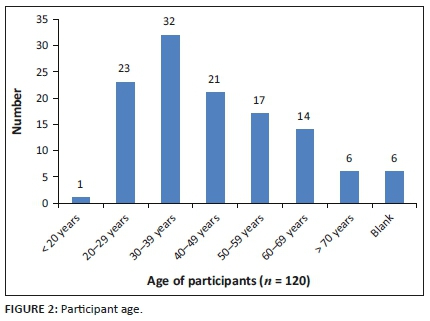
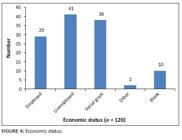
Demographic data that aimed to capture details about age, gender, level of education, economic status, frequency of visits to the doctor and whether doctors were consulted in the state or private sector were included. During conceptualisation, we had hoped to gain insight into whether the expectations of empathy varied based on education, economic status and those using public- or private-sector healthcare. This was not possible because of logistical issues; and in retrospect, the demographic section of the questionnaire should have been simpler and clearer as only the questions related to age, level of education and economic status (Figures 2-4) were adequately completed by the participants and able to be analysed and presented.
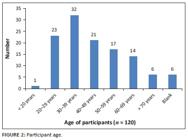

The youngest participant was 19 years old and the oldest 84 years. Five participants were in their 70s and six did not complete this section.
Almost 70% of participants had not completed Grade 12, and one participant had a higher education qualification. The data are probably not representative of the population in the area as sampling occurred during weekday afternoons when those who are employed as well as those at higher education institutions would not be available. A small percentage (25%) of participants sampled was employed. However, because the majority of participants were unemployed and receiving social grants, they were more likely to attend public hospitals and clinics when requiring healthcare.
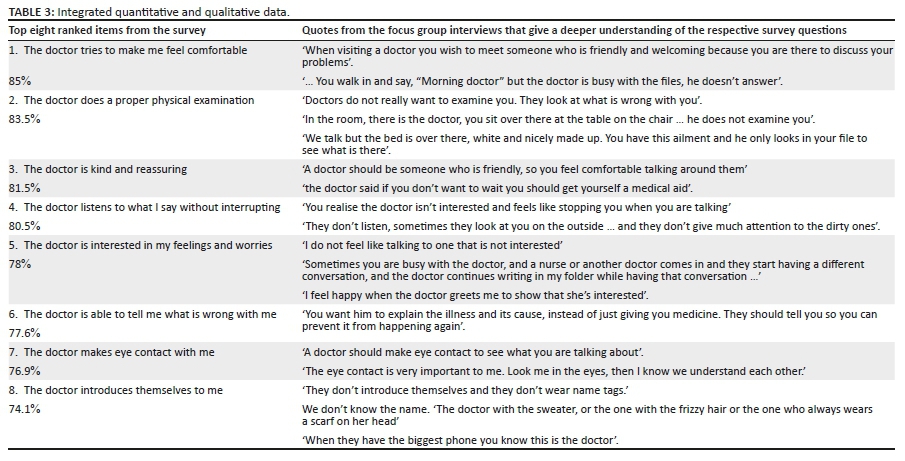
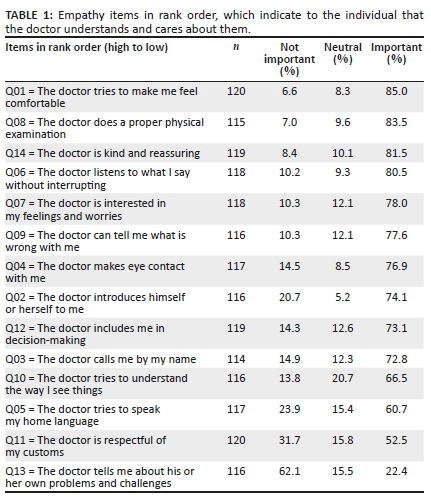
In the section below, the results from the survey are presented (Tables 1 and 2), followed by the integration of the QUAN and QUAL data (Table 3).
Quantitative data
As described above, participants were asked to rate the importance of various elements of cognitive empathy using a 5-point Likert rating scale. During analysis, the ranks 'not at all important' and 'slightly important' were combined and appear in Table 1 as 'not important'. And ranks 'quite important' and 'extremely important' were combined and are presented (Table 1) as 'important'. These items were then ranked according to the percentage of participants who considered them important. All responses over 40% are considered to be significant because the probability of any of the points on the Likert scale being selected was equal, and could have resulted in an even distribution across all five points (i.e. 20% per point).
Language proficiency and the various stages of a clinical visit
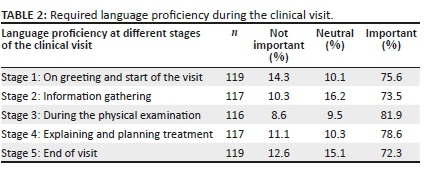
Participants were also asked the following questions in the questionnaire: 'How important is it to you that your doctor can speak your home language well during the following stages of your visit?' See Table 2 for the results. Participants expressed a desire to be able to properly understand and be understood during all stages of the clinical visit. Stages 3 (the physical examination) and 4 (explaining and planning treatment) of the visit were rated as the most important stages.
Qualitative data
We have integrated the data by linking relevant quotes from the focus group interviews (QUAL) with the survey findings (QUAN) to give the readers deeper insight.
Integrated data
In Table 3, the data from both phases are integrated and presented in a way which allows a deeper understanding of the initial survey findings. Only the top eight ranked items in the survey are presented in the left column. These items were later explored more in-depth during the focus group discussions. Quotes from the transcripts which most clearly represent participant views about the survey questions have been included in the right column.
Focus group findings
Language proficiency
Language proficiency was considered important during all phases of the clinical interview. In this section, quotes from the focus group interviews have been inserted into the text in italics. Being able to be understood by and to understand the doctor is an important part of the clinical visit. Participants felt that doctors must be able to cater to the needs of the community. Appointing foreign doctors or those that do not speak any of the local languages well 'does not work for the community' because 'they cannot interact, and you cannot put the problem on the table' which means 'they do not understand the problem'. Participants want to be told what is happening to them, so they can understand any 'changes in treatment or their condition', 'terminology', 'what is wrong with them' as well as 'what they need to do to get better', what the doctor plans to do and ongoing 'details about their condition'. Participants expressed a need to be able to understand what is happening in their body, so they can take independent action to help themselves in the future and prevent the same situation occurring again. Whilst participants felt verbal language is important to ensure both parties understand each other, a lack of fluency was accepted if the patient felt comfortable with the doctor:
'[S]he tried, she tried to use at least one Afrikaans word in a sentence. … in that case language wasn't a problem.'
'Even if communication is a barrier, if the person feels comfortable and trusts the doctor it will not be an issue.' (Quotes from Focus group)
Interpreters
Participants want to be part of the clinical process; and whilst they would prefer the doctor to be able to speak their language, they understand this is not always possible. Patients want interpreters to help them access information if the doctor does not speak their language. Indeed participants said they would be comfortable for information to be communicated through 'interpreters', 'sign language' or even 'cell phone applications'. Some were concerned about the use of interpreters and the confidentiality of their information and stressed it is important to make use of interpreters who have an understanding of medical terminology.
Discussion
To the best of our knowledge, this is one of the first South African studies exploring community perceptions specifically related to empathy and patient-centred healthcare. One of our aims was to explore the language needs of various groups in the community who may not be proficient in English. It became clear during the focus group discussions that patients often feel unseen at public clinics, regardless of what language is being spoken. This highlights a potentially more urgent need, especially given the rapidly escalating levels of medico-legal litigation in this country.23
Participants from two metro areas within the Northern subdistrict of the City of Cape Town were approached during working hours. The demographic data indicate levels of disempowerment, i.e. the low levels of education, high unemployment and continued socio-economic deprivation in the sampled areas. Almost three quarters (73.5%) of participants were aged under 50 years. Despite being fairly young, participants reported suffering a variety of chronic health conditions necessitating regular visits to healthcare clinics, which is another indication of socio-economic deprivation.24
Many examples are available in the focus group discussions, which appear to highlight that patients are very aware of these power differences, for example, the multiple references to the size, model and functionality of the doctor's cell phone. The highest ranked needs in the QUAN data related to a desire for the doctor to make them feel comfortable and to be friendly and welcoming.
Patient empowerment is important for the improvement in medical outcomes as well as lowering treatment costs.2571026179,10
Most participants in this study complained about being unable to establish any relationship with their constantly changing doctors who appeared more interested in the files than in their patients. Doctors need to be able to access the patient's story, and this fact must be conveyed to patients who appear to place more emphasis on the physical examination than on the history taking. Doctors could easily include patients in their review of patient history as a means of establishing empathic communication. Swaminath102728
According to Levison et al. (2010)2910
Patients expressed a wish to be addressed in their home language although they understood this was not always possible. They want to be able to understand and be understood especially during the physical examination and whilst treatment is being planned and explained. These findings are similar to those reported by Cubaka et al.262630
Strengths and limitations
This pilot study provided an opportunity for the voices from two communities to be heard about empathy. To research communities takes considerable time and resources and therefore we believe that whilst this is a small scale study, we have contributed towards the body of knowledge. We are not aware of previous studies where members of the community have expressed their needs and opinions related to empathic communication in healthcare clinics.
An escalation of gang violence impacted sampling and data collection. However, the authors do not believe these factors negatively influenced the outcome of this study.
This was a small pilot study and so is not representative nor generalisable. The small number of participants is, therefore, a limitation. The lessons learned from this pilot will, however, be useful in assisting us with the development of a larger follow-up study with patients.
An unexpected limitation was the low level of basic education that complicated data collection. The questionnaire and relatively complex Likert scales were not fully understood by some participants despite prior explanation from the research team.
Implications or recommendations
•There is a need for patient-centred care in public healthcare clinics.
•The ranked list of empathy items highlights a low cost and easy intervention to increase patient satisfaction and potentially reduce medico-legal litigation, namely, training doctors in empathic communication.
•Future research is needed regarding the use of interpreters and technology to relay accurate information as an adjunct to patient-centred care.
•The perceptions of first-language English speaking as well as employed participants and adolescents would add valuable insights.
Conclusion
The components of empathy articulated in Western research are relevant in our multicultural context. Patients want their doctors to listen and to examine them. They also want to be able to understand their doctors, so they can be more actively involved in their health. Patients want their doctor to be empathic and try to make them feel comfortable. They want doctors to be kind and respectful and to try to communicate. If these are in place then interpreters would be an acceptable way to address language deficits.
It may be possible to implement simple strategies to improve empathic communication within public healthcare clinics to ensure patients feel seen and respected.
Competing interests
The authors have declared that no competing interest exists.
Authors' contributions
All authors contributed equally to this work.
Funding information
Teaching and learning fellowship: Stellenbosch University.
Data availability statement
That data are available if required by the journal.
Disclaimer
The views and opinions expressed in this article are those of the authors and do not necessarily reflect the official policy or position of any affiliated agency of the authors.
Acknowledgements
The authors want to give acknowledgments to the following people who helped with the translation of the questionnaires as well as with the data collection, I. Meyer, N. Masiba, L. Mhlabeni and F. Dyubeni.
References
-
1.Donetto, S. Medical students and patient-centred clinical practice: The case for more critical work in medical schools. Br J Sociol Educ. 2012;33(3):431-449. https://doi.org/10.1080/01425692.2012.662821
» https://doi.org/10.1080/01425692.2012.662821 -
2.Mead N, Bower P, Hann M. The impact of general practitioners' patient-centredness on patients' post-consultation satisfaction and enablement. Soc Sci Med. 2002;55(2):283-299. https://doi.org/10.1016/S0277-9536(01)00171-X
» https://doi.org/10.1016/S0277-9536(01)00171-X -
3.Hojat M, Louis DZ, Markham FW, Wender R, Rabinowitz C, Gonnella JS. Physicians' empathy and clinical outcomes for diabetic patients. Acad Med. 2011;86(3):359-364. http://doi.org/10.1016/j.pec.2013.07.012
» http://doi.org/10.1016/j.pec.2013.07.012 - 4.Stewart M. Reflections on the doctor-patient relationship: From evidence and experience. Br J Gen Pract. 2005;55(519):793-801.
-
5.Epstein RM, Franks P, Fiscella K, et al. Measuring patient-centred communication in patient-physician consultations: Theoretical and practical issues. Soc Sci Med. 2005;61(7):1516-1528. https://doi.org/10.1016/j.socscimed.2005.02.001
» https://doi.org/10.1016/j.socscimed.2005.02.001 -
6.Hegazi I, Wilson I. Maintaining empathy in medical school: It is possible. Med Teach. 2013;35(12):1002-1008. https://doi.org/10.3109/0142159X.2013.802296
» https://doi.org/10.3109/0142159X.2013.802296 -
7.Selani G, Lamm C, Ruff CC, Singer T. Right supramarginal gyrus is crucial to overcome emotional egocentricity bias in social judgments. J Neurosci. 2013;33(39):15466-15476. https://doi.org/10.1523/JNEUROSCI.1488-13.2013
» https://doi.org/10.1523/JNEUROSCI.1488-13.2013 -
8.Beach MC, Rosner M, Cooper LA, Duggan PS, Shatzer J. Can patient-centered attitudes reduce racial and ethnic disparities in care? Academic Medicine. 2007;82(2):193-198. https://doi.org/10.1097/ACM.0b013e31802d94b2.
» https://doi.org/10.1097/ACM.0b013e31802d94b2 -
9.Riess H. The science of empathy. J Patient Exp. 2017;4(2):74-77. https://doi.org/10.1177/2374373517699267
» https://doi.org/10.1177/2374373517699267 -
10.Swaminath G. Doctor-patient communication: Patient perception. Indian J Psychiatry. 2007;49(3):150. https://doi.org/10.4103/0019-5545.37309
» https://doi.org/10.4103/0019-5545.37309 -
11.Tongue JR, Epps HR, Forese LL. Communication skills for patient-centered care. J Bone Joint Surg. 2005;87(3):652-658. https://doi.org/10.2106/00004623-200503000-00027
» https://doi.org/10.2106/00004623-200503000-00027 - 12.Mehrabian A. Non-verbal communication. London: Routledge; 1972.
-
13.Roberts L, Bucksey SJ. Communicating with patients: What happens in practice? Phys Ther. 2007;87(5):586-594. https://doi.org/10.2522/ptj.20060077
» https://doi.org/10.2522/ptj.20060077 -
14.Riess H, Kraft-Todd G. E.M.P.A.T.H.Y.: A tool to enhance nonverbal communication between clinicians and their patients. Acad Med. 2014;89(8):1108-1112. https://doi.org/10.1097/ACM.0000000000000287
» https://doi.org/10.1097/ACM.0000000000000287 - 15.Mertins DM, Hesse-Biber S. Mixed methods and credibility of evidence in evaluations. In: Mertins DM, Hesse-Bilber S, editors. Mixed methods and credibility of evidence in evaluation. Special Issue. New directions for evaluation. Volume 138. Hoboken: American Evaluation Society, Wiley Periodicals; 2013; p. 15-26.
- 16.Creswell JW. A concise introduction to mixed methods research. Sage: London; 2015.
-
17.Western Cape Provincial Languages Act, 13 of 1998. https://www.westerncape.gov.za/assets/departments/cultural-affairs-sport/.
» https://www.westerncape.gov.za/assets/departments/cultural-affairs-sport/ -
18.Mercer SW, McConnachie A, Maxwell M, Heaney D, Watt GCM. Relevance and practical use of the Consultation and Relational Empathy (CARE) Measure in general practice. Fam Pract. 2005;22(3):328-334. https://doi.org/10.1093/fampra/cmh730
» https://doi.org/10.1093/fampra/cmh730 -
19.Kurtz S, Silverman J. Marrying content and process in clinical method teaching: Enhancing the Calgary-Cambridge guides. Acad Med. 2003;78(8):802-809. https://doi.org/10.1097/00001888-200308000-00011
» https://doi.org/10.1097/00001888-200308000-00011 -
20.O'Cathain A, Murphy E, Nicholl J. Three techniques for integrating data in mixed methods studies. BMJ. 2010;341(1);c4587. https://doi.org/10.1136/bmj.c4587
» https://doi.org/10.1136/bmj.c4587 -
21.Guetterman TC, Fetters MD, Creswell JW. Integrating quantitative and qualitative results in health science mixed methods research through joint displays. Ann Fam Med. 2015;13(6):6554-6561. https://doi.org/10.1370/afm.1865
» https://doi.org/10.1370/afm.1865 -
22.Richards DA, Bazeley P, Borglin G, et al. Integrating quantitative and qualitative data and findings when undertaking randomised controlled trials. BMJ Open. 2019;9(11):e032081. https://doi.org/10.1136/bmjopen-2019-032081
» https://doi.org/10.1136/bmjopen-2019-032081 -
23.Taylor B. Medicolegal storm threatening maternal and child healthcare services. S Afr Med J. 2018;108(3):149-150. https://doi.org/10.7196/SAMJ.2018.v108i3.13139
» https://doi.org/10.7196/SAMJ.2018.v108i3.13139 -
24.Sverdlik A. Ill-health and poverty: A literature review on health in informal settlements. Int Inst Environ Dev. 2011;23(1):123-155. https://doi.org/10.1177/0956247811398604
» https://doi.org/10.1177/0956247811398604 -
25.Chatzimarkakis J. Why patients should be more empowered: A European perspective on lessons learned in the management of diabetes. J Diabetes Sci Technol. 2010;4(6):1570-1573. https://doi.org/10.1177/193229681000400634
» https://doi.org/10.1177/193229681000400634 -
26.Cubaka VK, Schriver M, Kayitare JB, et al. 'He should feel your pain': Patient insights on patient-provider communication in Rwanda. Afr J Prm Health Care Fam Med. 2018;10(1):a1514. https://doi.org/10.4102/phcfm.v10i1.1514
» https://doi.org/10.4102/phcfm.v10i1.1514 -
27.Kim SS, Kaplowitz S, Johnston MV. The effects of physician empathy on patient satisfaction and compliance. Eval Health Prof. 2004;27(3):237-251. https://doi.org/10.1177/0163278704267037
» https://doi.org/10.1177/0163278704267037 -
28.Ekman E, Krasner M. Empathy in medicine: Neuroscience, education and challenges. Med Teach. 2017;39(2):164-173. https://doi.org/10.1080/0142159X.2016.1248925
» https://doi.org/10.1080/0142159X.2016.1248925 -
29.Levison W, Lesser CS, Epstein RM. Developing Physician Communication Skills For Patient-Centered Care Health Affairs. 2010;29(7):1310-1318. https://doi.org/10.1377/hlthaff.2009.0450
» https://doi.org/10.1377/hlthaff.2009.0450 -
30.Lundahl B, Moleni T, Burke BL, et al. Motivational interviewing in medical care settings: A systematic review and meta-analysis of randomized controlled trials. Patient Educ Couns. 2013;93(2):157-168. https://doi.org/10.1016/j.pec.2013.07.012
» https://doi.org/10.1016/j.pec.2013.07.012 -
31.Hojat M, Louis DZ, Maxwell K, Markham F, Wender R, Gonnella JS. Patient perceptions of physician empathy, satisfaction with physician, interpersonal trust, and compliance. Int J Med Educ. 2011;1(1):83-87. https://doi.org/10.5116/ijme.4d00.b701
» https://doi.org/10.5116/ijme.4d00.b701
Accepted: 23 July 2020
Published: 09 Oct. 2020