Suboptimal control for patients with type 2 diabetes in the Central Chronic Medicine Dispensing programme in South Africa
Abstract
BACKGROUND: In South Africa, the Central Chronic Medicine Dispensing and Distribution (CCMDD) programme allows stable patients with non-communicable diseases, including type 2 diabetes mellitus (T2DM), to collect their medication from a pick-up location near their home, thus avoiding long waiting times and travel expenses. The CCMDD programme aims at improving patient retention and adherence through better access to medicines, resulting in better health outcomes. AIM: We assessed whether patients with T2DM enrolled in CCMDD achieved the recommended targets for glycaemic, blood pressure (BP) and lipid control. SETTING: City of Tshwane, South Africa. METHODS: We reviewed the records of 198 T2DM patients enrolled in CCMDD and assessed their control of haemoglobin A1c (HbA1c), BP and lipids. RESULTS: Most of the records reviewed belonged to women (64.7%), African (89.9%), hypertensive (82.7%) and to patients exclusively on oral antidiabetic agents (98.5%). Patients were, on average, 57.7 (s.d. = 12.1) years old and had participated in the CCMDD programme for, on average, 2 years. The mean HbA1c was 8% (s.d. = 2). Glycaemic control was achieved by only 29.2% of patients, and 49% of patients had HbA1c between 7% and 9%. Ninety-three patients (66%) had achieved the total cholesterol target, 57.4% achieved BP targets and 6.9% had achieved the low-density lipoprotein cholesterol target. CONCLUSION: A small group of patients achieved the targets for glycaemic, BP and lipid control. Despite improved accessibility to medication, the CCMDD is not synonymous of improved clinical outcomes. Future research should ascertain the factors associated with suboptimal control for these patients.
audit; CCMDD programme; glucose control; primary health care; SEMDSA guidelines; type 2 diabetes
Introduction
In Africa, an increasing number of people with type 2 diabetes mellitus (T2DM) has been reported day by day. This increase has been linked to various factors, including lifestyle changes, urbanisation and the growing consumption of processed foods coupled with an increasing prevalence of obesity.1,23334
Several activities across Africa aim to improve the management of type 2 diabetes and related comorbidities.11,5,61,6,77,86
Patients are eligible for the CCMDD programme if they are older than 18 years of age, able to provide consent and are stable on chronic medication. Being stable on medication is defined as being on the same treatment regimen for at least 12 months, with the two most recent laboratory results being normal. Eligible patients cannot be under tuberculosis medication or any other medical condition requiring regular clinical consultations.98,10
According to various reviews, the CCMDD programme improves facility congestion, reduces patient travel and long waiting times, and improves treatment adherence and patient retention.1,6,10,11812
International trials demonstrate that glycaemic control is important for preventing both acute and long-term complications of diabetes mellitus.13,141516,17,18,19,2021
In this article, we describe the clinical outcomes of patients with type 2 diabetes who are enrolled in the CCMDD programme in the City of Tshwane. We assess whether these patients with type 2 diabetes achieve the 2017 SEMDSA recommended targets for glycaemic, blood pressure (BP) and lipid control. Policymakers could use the results of this study as a basis for a full evaluation in order to determine whether the patients with type 2 diabetes enrolled are truly benefitting from the CCMDD programme.
Research methods and design
Study design
This research study stemmed from a clinical audit conducted between February and May 2019. The audit identified gaps in diabetes management and care, as well as missed opportunities for therapy intensification. This study forms part of the Tshwane Insulin Project (TIP), a 5-year translational research programme at the University of Pretoria. The TIP aimed to improve diabetes management at primary healthcare in South Africa.
Setting
The study population included patients from 23 primary healthcare facilities, including 20 clinics and three community healthcare centres in the Tshwane Health District. The Tshwane Health District is situated in the northern part of Gauteng Province in South Africa and has the same geographical boundaries as that of the City of Tshwane Metropolitan Municipality.
Although diabetes mellitus is included in the Integrated Chronic Disease Management (ICDM) model, its prevalence in the Tshwane Health District is unknown.222322
Study population
For this audit, we selected medical records of patients with type 2 diabetes who received care at a primary healthcare facility and who were enrolled in the CCMDD programme. Patients with type 2 diabetes are eligible to enrol in the CCMDD programme if they have two consecutive levels for fasting plasma glucose (FPG) normal and two consecutive levels for BP normal (if hypertensive). Trained fieldworkers visited the selected healthcare facilities. Using a consecutive sampling technique, they selected the first 10-15 medical records per facility of adults with type 2 diabetes who were already on CCMDD.
Data collection
We used Qualtrics (Provo, UT) to design a data extraction sheet to collect data from patient medical records. Trained fieldworkers were equipped with electronic tablets to collect and record data, which included demographics, clinical measurements (BP) and laboratory measurements, such as haemoglobin A1c (HbA1c) and lipids (total cholesterol and low-density lipoprotein (LDL)). We could not calculate the body mass index because most patient records lacked weight and height measurements.
Data collection was limited by the poor quality of medical records, and facilities not having diabetes registries hampering our ability to identify the medical records of patients with type 2 diabetes. Not all medical records had laboratory results, further limiting the collection of data.
Data analysis
Data were analysed using STATA version 15.1 (Statacorp LP, College Station, TX). Patient characteristics were summarised by descriptive statistics. Categorical variables are reported with frequencies and percentages. Continuous variables are reported with means and standard deviations or medians and interquartile ranges. The proportion of patients who met the treatment goals are reported with 95% confidence intervals.
In this study, we used the targets set out by the 2017 SEMDSA guidelines for the management of T2DM as the reference standard.151515
Ethical considerations
This study was approved by the University of Pretoria's Faculty of Health Sciences Research Ethics Committee (Ethics Reference: 496/2018) and the Tshwane Research Committee (NHRD Number: GP_201810_049). Access to medical records was granted by the custodians of the data, namely, the health district authorities and the health facility managers.
Results
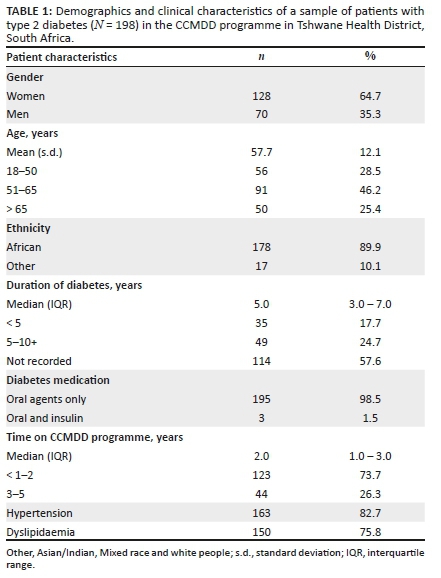
We audited 232 patient medical records from 23 primary healthcare facilities. We excluded 34 records because of missing data and retained the records of 198 patients who had enrolled in the CCMDD programme between 2014 and 2019. The patient characteristics are displayed in Table 1. The mean age of the patients was 57.7 (s.d. = 12.1) years, with a median duration of diabetes of 5.0 years (CI: 4% - 6%). Most of the patients were women (64.7%), African (89.9%) and exclusively on oral antidiabetic agents (98.5%). At the time of the study, participants had been enrolled in the CCMDD programme for 2.0 years, on average, and 82.7% had hypertension. The most recent prescription in medical records indicated that 150 (75.8%) patients were receiving statins for dyslipidaemia.
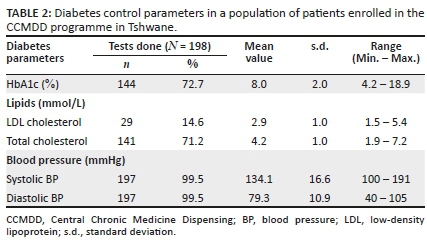
Of 198 patients, 144 (72.7%) patients recorded HbA1c measurements for the previous year with a mean HbA1C of 8.0% (s.d. = 2.0) (Table 2). Blood pressure was recorded for 99.5% of patients at their most recent clinic visit, however, only 14.6% of patients had an LDL cholesterol test performed in the previous year.
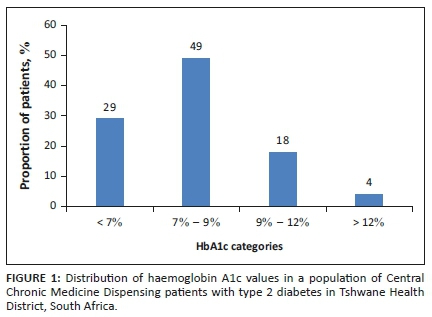
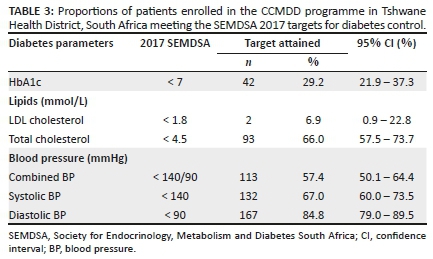
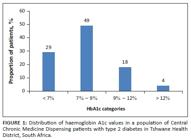
Of the patients who had HbA1c measurements, only 29.2% (CI: 21.9% - 37.3%) met the 2017 SEMDSA target of HbA1c < 7% (Table 3). Almost half (49%) of the patients reported HbA1c values between 7% and 9% (Figure 1). Only 57.4% (CI: 50.1% - 64.4%) of the patients achieved the BP target (< 140/90 mmHg); 67.0% (CI: 60.0% - 73.5%) and 84.8% (CI: 79.0% - 89.5%) met the targets for systolic and diastolic BP, respectively. More than half of the patients met their total cholesterol target (66%, CI: 57.5% - 73.7%), but only two (6.9%, CI: 0.9% - 22.8%) of the 29 patients with LDL cholesterol levels met the LDL target.
Discussion
In this study, we assessed whether South African primary care patients with type 2 diabetes enrolled in the CCMDD programme were achieving the recommended 2017 SEMDSA targets for diabetes management. These include targets for glycaemic (HbA1c), BP and lipid control. From the patient records, we observed that as a whole, patients enrolled in the CCMDD programme reported suboptimal diabetes control, with only 29.2% of patients achieving glycaemic targets, 57.4% of patients achieving BP targets and 6.9% of patients achieving LDL cholesterol targets. Similar to other studies focussing on patients with type 2 diabetes in the South African primary healthcare sector, the patients in this study were predominantly African and women, with a reported mean age of 53.0-59.4 years.16,17,18,24
Historically, glycaemic control has been suboptimal in South Africa's primary healthcare sector.25,2624,271616,17,18,24
For people living with diabetes, glycaemic control is improved by various factors, including higher socio-economic status, better dietary knowledge, and higher self-efficacy and empowerment.2829303131
Patients enrolled in the CCMDD programme require management that recognises the importance of managing hypertension, as well as other comorbidities related to diabetes. In addition to glycaemic control, the management of type 2 diabetes should focus on lowering levels of LDL cholesterol and BP to prevent cardiovascular diseases.14,3216,17,18,3317,18,34323218192410,30,31
Dyslipidaemia was prevalent in the type 2 diabetes patients (75.8%) in this study. We analysed total cholesterol levels for 71.2% of patients in this study, which was similar to testing rates in other South African studies.2435151618181624,27
Recommendations for the Central Chronic Medicine Dispensing programme for people with type 2 diabetes
The CCMDD programme was designed to improve access to chronic medication for stable patients. The benefits to patients include reduced clinical visits, waiting times and travel expenses. The benefits to the healthcare system include facility decongestion and reduction of medicine stock-outs.6,8,11
Currently, the CCMDD programme evaluates the glycaemic control of potential patients using two consecutive FPG measurements.9363738,3936
Once enrolled in the CCMDD programme, patients with type 2 diabetes have less contact with the public healthcare system than those frequently attending clinics. Patients in the CCMDD programme have to perform a number of self-management activities and make daily decisions contributing to their well-being whilst dealing with the demands and burdens of diabetes, and thus, require high levels of self-efficacy. Not assessing self-efficacy before being enrolled in the CCMDD programme may disadvantage patients because low self-efficacy will lead to treatment failure and poor clinical outcomes.4041
The successful management of chronic diseases depends on effective, systematic and interactive communication between patients and healthcare professionals.4215,434444,451546
Limitations of the study
This research study was the first audit of diabetes control in patients enrolled in the CCMDD programme. The cross-sectional design only reflects the once-off measurements recorded at the time of the study. A prospective study of patients with diabetes in the CCMDD programme, in the form of a large-scale evaluation, would provide more information in terms of disease status at enrolment into the programme, as well as factors that influence control over time. A future evaluation of the programme could make use of control groups or could be a cohort study.
This study looked at a relatively small number of patients with type 2 diabetes enrolled in the CCMDD programme, predominantly women and African in an urban setting. The generalisability of the findings may not be entirely applicable to all patients with diabetes in the programme across South Africa. A strength of the study, however, was the spread of the cohort of patients over 23 primary healthcare facilities.
The quality of patient medical records was not always satisfactory, and therefore, this study may have missed important information because of missing data.
Conclusion
A small proportion of patients enrolled in the CCMDD programme achieved the recommended targets for glycaemic, BP and lipid control. The findings of this study suggest that the ability to access medicines remotely does not guarantee good health outcomes compared with other primary healthcare populations. We recommend that the CCMDD programme for people with diabetes should consider revising how patients with diabetes are selected, assessing self-efficacy before enrolment, and should include additional accompanying measures for patient empowerment and education.
Competing interests
The authors declare that they have no financial or personal relationships that may have inappropriately influenced them in writing this article.
Authors' contribution
P.N.P., E.M.W. and P.R. conceptualised the study and developed the data extraction sheet. P.N.P. conducted data analysis as well as the interpretation of the results. All authors contributed towards writing of the article, discussed the results and commented on the article. All the authors read the final article and contributed to the interpretation of the data.
Funding information
This research study was supported by the Lilly Global Health Partnership (Project Grant: A1B004/04408).
Data availability
The data that support the findings of this study are available from the corresponding author, P.N.P., upon reasonable request.
Disclaimer
All views expressed in this article are of the authors and do not reflect the views or official position of any institution or funder.
Acknowledgements
The authors thank the health facility managers and the health authorities from the City of Tshwane Metropolitan Municipality, the Tshwane Health District and the Gauteng Province for granting access to patients' medical records, the staff from the Tshwane Insulin Project (TIP) for their commitment and collecting the data, and Prof. D.G. van Zyl for reviewing the article. Dr Cheryl Tosh for editing the manuscript.
References
-
1.Godman B, Basu D, Pillay Y, et al. Review of ongoing activities and challenges to improve the care of patients with type 2 diabetes across Africa and the implications for the future. Front Pharmacol. 2020;11(1):108. https://doi.org/10.3389/fphar.2020.00108
» https://doi.org/10.3389/fphar.2020.00108 -
2.Cois A, Day C. Obesity trends and risk factors in the South African adult population. BMC Obesity. 2015;2(1):42. https://doi.org/10.1186/s40608-015-0072-2
» https://doi.org/10.1186/s40608-015-0072-2 - 3.International Diabetes Federation. IDF diabetes atlas. 9th ed. Brussels: International Diabetes Federation; 2019.
- 4.Statistics South Africa. Mortality and causes of death in South Africa, 2016: Findings from death notification. Pretoria: Statistics South Africa; 2018.
-
5.Werfalli M, Murphy K, Kalula S, Levitt N. Current policies and practices for the provision of diabetes care and self-management support programmes for older South Africans. Afr J Prim Health Care Fam Med. 2019;11(1):1-12. https://doi.org/10.4102/phcfm.v11i1.2053
» https://doi.org/10.4102/phcfm.v11i1.2053 -
6.Meyer JC, Schellack N, Stokes J, et al. Ongoing initiatives to improve the quality and efficiency of medicine use within the public healthcare system in South Africa; A preliminary study. Front Pharmacol. 2017;8(1):751. https://doi.org/10.3389/fphar.2017.00751
» https://doi.org/10.3389/fphar.2017.00751 -
7.Smith KG, Nicol E. Process evaluation of the central chronic medicines dispensing and distribution programme in Namakwa district, Northern Cape province protocol: A multimethod approach. BMJ Open. 2020;10(2);e032530. https://doi.org/10.1136/bmjopen-2019-032530
» https://doi.org/10.1136/bmjopen-2019-032530 - 8.Jagaroo N. Efficacy of the central chronic medicine dispensing and delivery programme in South Africa. Johannesburg: University of Witwatersrand; 2017.
- 9.South Africa Department of Health. Adherence guidelines for HIV, TB and NCDs. Pretoria: South Africa Department of Health; 2016.
-
10.Rampamba EM, Meyer JC, Helberg E, Godman B. Knowledge of hypertension and its management among hypertensive patients on chronic medicines at primary health care public sector facilities in South Africa; Findings and implications. Expert Rev Cardiovas Ther. 2017;15(8):639-647. https://doi.org/10.1080/14779072.2017.1356228
» https://doi.org/10.1080/14779072.2017.1356228 - 11.Maharaj L. Assessment of factors affecting healthcare workers involved in the Centralised Chronic Medicines Dispensing and Distribution (CCMDD) Programme: The case of eThekwini Metropolitan Health district [Master dissertation]. Durban: University of KwaZulu-Natal; 2018.
- 12.Huge applause for the KZN Department of Health as patients collect chronic medication closer to home and save on traveling costs [press release]. Pietermaritzburg: KwaZulu-Natal Department of Health; 2016.
-
13.Diabetes Control Complications trial Research Group. The effect of intensive treatment of diabetes on the development and progression of long-term complications in insulin-dependent diabetes mellitus. N Engl J Med. 1993;329(14):977-986. https://doi.org/10.1056/NEJM199309303291401
» https://doi.org/10.1056/NEJM199309303291401 -
14.UK Prospective Diabetes Study Group. Intensive blood-glucose control with sulphonylureas or insulin compared with conventional treatment and risk of complications in patients with type 2 diabetes (UKPDS 33). Lancet. 1998;352(9131):837-853. https://doi.org/10.1016/S0140-6736(98)07019-6
» https://doi.org/10.1016/S0140-6736(98)07019-6 - 15.The Society for Endocrinology Metabolism and Diabetes of South Africa Type 2 Diabetes Guidelines Expert Committee. The 2017 SEMDSA guidelines for the management of type 2 diabetes. JEMDSA. 2017;22(1 Suppl 1):S1-S196.
-
16.Webb EM, Rheeder P, Van Zyl DG. Diabetes care and complications in primary care in the Tshwane district of South Africa. Primary Care Diabetes. 2015;9(2):147-154. https://doi.org/10.1016/j.pcd.2014.05.002
» https://doi.org/10.1016/j.pcd.2014.05.002 -
17.Bulbulia S, Variava F, Bayat Z. Are type 2 diabetic patients meeting targets? A Helen Joseph Hospital Diabetic Clinic Audit. JEMDSA. 2019(1):1-6. https://doi.org/10.1080/16089677.2019.1692471
» https://doi.org/10.1080/16089677.2019.1692471 -
18.Pinchevsky Y, Butkow N, Chirwa T, Raal F. Treatment gaps found in the management of type 2 diabetes at a community health centre in Johannesburg, South Africa. J Diabetes Res. 2017;2017:Article ID 9536025. https://doi.org/10.1155/2017/9536025
» https://doi.org/10.1155/2017/9536025 -
19.Govender RD, Gathiram P, Panajatovic M. Poor control and management of type 2 diabetes mellitus at an under-resourced South African Hospital: Is it a case of clinical inertia? S Afr Fam Pract. 2017;59(5):154-159. https://doi.org/10.1080/20786190.2017.1307909
» https://doi.org/10.1080/20786190.2017.1307909 -
20.Ngassa Piotie P, Van Zyl DG, Rheeder P. Diabetic nephropathy in a tertiary care clinic in South Africa: A cross-sectional study. JEMDSA. 2015;20(1):57-63. https://doi.org/10.1080/16089677.2015.1030858
» https://doi.org/10.1080/16089677.2015.1030858 -
21.Zhu L, She Z-G, Cheng X, et al. Association of blood glucose control and outcomes in patients with COVID-19 and pre-existing type 2 diabetes. Cell Metab. 2020;31(6):1068-1077.e3. https://doi.org/10.1016/j.cmet.2020.04.021
» https://doi.org/10.1016/j.cmet.2020.04.021 -
22.Webb EM, Rheeder P, Wolvaardt JE. The ability of primary healthcare clinics to provide quality diabetes care: An audit. Afr J Prim Health Care Fam Med. 2019;11(1):e1-e6. https://doi.org/10.4102/phcfm.v11i1.2094
» https://doi.org/10.4102/phcfm.v11i1.2094 - 23.Essential Drugs Programme. Primary healthcare standard treatment guidelines and essential medicines list. 6th ed. Health. RoSANDo, editor. Pretoria: The National Department of Health; 2018.
-
24.Igbojiaku OJ, Harbor OC, Ross A. Compliance with diabetes guidelines at a regional hospital in KwaZulu-Natal, South Africa. Afr J Prim Health Care Fam Med. 2013;5(1):447. https://doi.org/10.4102/phcfm.v5i1.447
» https://doi.org/10.4102/phcfm.v5i1.447 -
25.Levitt NS, Bradshaw D, Zwarenstein MF, Bawa AA, Maphumolo S. Audit of public sector primary diabetes care in Cape Town, South Africa: High prevalence of complications, uncontrolled hyperglycaemia, and hypertension. Diabet Med. 1997;14(12):1073-1077. https://doi.org/10.1002/(SICI)1096-9136(199712)14:12<1073::AID-DIA498>3.0.CO;2-9
» https://doi.org/10.1002/(SICI)1096-9136(199712)14:12<1073::AID-DIA498>3.0.CO;2-9 -
26.Erasmus R, Blanco EB, Okesina A, Gqweta Z, Matsha T. Assessment of glycaemic control in stable type 2 black South African diabetics attending a peri-urban clinic. Postgrad Med J. 1999;75(888):603-606. https://doi.org/10.1136/pgmj.75.888.603
» https://doi.org/10.1136/pgmj.75.888.603 -
27.Rampersad K, Rangiah S, Kendon M. Compliance with local diabetic guidelines at a district hospital in KwaZulu-Natal, South Africa. S Afr Fam Pract. 2019;61(2):60-64. https://doi.org/10.1080/20786190.2018.1507565
» https://doi.org/10.1080/20786190.2018.1507565 -
28.Cheng LJ, Wang W, Lim ST, Wu VX. Factors associated with glycaemic control in patients with diabetes mellitus: A systematic literature review. J Clin Nurs. 2019;28(9-10):1433-1450. https://doi.org/10.1111/jocn.14795
» https://doi.org/10.1111/jocn.14795 -
29.Mostert Wentzel K, Nel C, Van Rooijen AJ, et al. High levels of self-efficacy in patients with type 2 diabetes attending a tertiary level clinic. S Afr J Physiother. 2008;64(3):7-11. https://doi.org/10.4102/sajp.v64i3.108
» https://doi.org/10.4102/sajp.v64i3.108 - 30.Moosa A, Bezuidenhout S, Meyer JC. Knowledge of type-2 diabetes among patients attending a community health centre in Pretoria, South Africa: Patient centered treatment and care. Afr J Phys Health Edu Recreat Dance. 2015;21(Supp 2):241-251.
-
31.Murphy K, Chuma T, Mathews C, Steyn K, Levitt N. A qualitative study of the experiences of care and motivation for effective self-management among diabetic and hypertensive patients attending public sector primary health care services in South Africa. BMC Health Serv Res. 2015;15(1):303. https://doi.org/10.1186/s12913-015-0969-y
» https://doi.org/10.1186/s12913-015-0969-y -
32.Pinchevsky Y, Butkow N, Chirwa T, Raal F. Glycaemic, blood pressure and cholesterol control in 25 629 diabetics. Cardiovasc J Afr. 2015;26(4):188. https://doi.org/10.5830/CVJA-2015-050
» https://doi.org/10.5830/CVJA-2015-050 -
33.Klisiewicz A, Raal F. Sub-optimal management of type 2 diabetes mellitus - A local audit. JEMDSA. 2009;14(1):13-16. https://doi.org/10.1080/22201009.2009.10872186
» https://doi.org/10.1080/22201009.2009.10872186 -
34.Pinchevsky Y, Butkow N, Raal FJ, Chirwa T. The implementation of guidelines in a South African population with type 2 diabetes. JEMDSA. 2013;18(3):154-158. https://doi.org/10.1080/22201009.2013.10844554
» https://doi.org/10.1080/22201009.2013.10844554 -
35.Doll R. Efficacy of cholesterol-lowering therapy in 18 686 people with diabetes in 14 randomised trials of statins: A meta-analysis. Lancet. 2008;371(9607):117-125. https://doi.org/10.1016/S0140-6736(08)60104-X
» https://doi.org/10.1016/S0140-6736(08)60104-X -
36.Woo V, Shestakova M, Ørskov C, Ceriello A. Targets and tactics: The relative importance of HbA1c, fasting and postprandial plasma glucose levels to glycaemic control in type 2 diabetes. Int J Clin Pract. 2008;62(12):1935-1942. https://doi.org/10.1111/j.1742-1241.2008.01941.x
» https://doi.org/10.1111/j.1742-1241.2008.01941.x -
37.Caputo S, Pitocco D, Ruotolo V, Ghirlanda G. What is the real contribution of fasting plasma glucose and postprandial glucose in predicting HbA1c and overall blood glucose control? Diabetes Care. 2001;24(11):2011. https://doi.org/10.2337/diacare.24.11.2011
» https://doi.org/10.2337/diacare.24.11.2011 -
38.Butler C, Peters J, Stott N. Glycated haemoglobin and metabolic control of diabetes mellitus: External versus locally established clinical targets for primary care. BMJ. 1995;310(6982):784-788. https://doi.org/10.1136/bmj.310.6982.784
» https://doi.org/10.1136/bmj.310.6982.784 -
39.Bouma M, Dekker JH, De Sonnaville JJ, et al. How valid is fasting plasma glucose as a parameter of glycemic control in non-insulin-using patients with type 2 diabetes? Diabetes Care. 1999;22(6):904-907. https://doi.org/10.2337/diacare.22.6.904
» https://doi.org/10.2337/diacare.22.6.904 -
40.Mishali M, Omer H, Heymann A. The importance of measuring self-efficacy in patients with diabetes. Family Pract. 2011;28(1):82-87. https://doi.org/10.1093/fampra/cmq086
» https://doi.org/10.1093/fampra/cmq086 -
41.King DK, Glasgow RE, Toobert DJ, et al. Self-efficacy, problem solving, and social-environmental support are associated with diabetes self-management behaviors. Diabetes Care. 2010;33(4):751-753. https://doi.org/10.2337/dc09-1746
» https://doi.org/10.2337/dc09-1746 -
42.Rothberg AD, Mshunqane N, Stewart AV. Type 2 diabetes management: Patient knowledge and health care team perceptions, South Africa: Original research. Afr J Prim Health Care Fam Med. 2012;4(1):1-7. https://doi.org/10.4102/phcfm.v4i1.392
» https://doi.org/10.4102/phcfm.v4i1.392 -
43.Mullooly CA, Kemmis KL. Diabetes educators and the exercise prescription. Diabetes Spectrum. 2005;18(2):108. https://doi.org/10.2337/diaspect.18.2.108
» https://doi.org/10.2337/diaspect.18.2.108 -
44.Beck J, Greenwood DA, Blanton L, et al. 2017 National Standards for diabetes self-management education and support. Diabetes Care. 2017;40(10):1409-1419. https://doi.org/10.2337/dci17-0025
» https://doi.org/10.2337/dci17-0025 - 45.Van Zyl D, Rheeder P. Physician education programme improves quality of diabetes care. S Afr Med J. 2004;94(6):455-459.
-
46.Rampamba EM, Meyer JC, Helberg EA, Godman B. Empowering hypertensive patients on chronic medicines at primary health care facilities in South Africa with knowledge to improve disease management. J Res Pharm Pract. 2019;8(4):208-213. https://doi.org/10.4103/jrpp.JRPP_18_74
» https://doi.org/10.4103/jrpp.JRPP_18_74

Accepted: 11 Feb. 2021
Published: 24 Mar. 2021
Number: GP_201810_049