Conveying hypertension message: An investigation into the language and content used in primary health clinics in South Africa
Abstract
BACKGROUND: Hypertension is a global health burden affecting developed and developing countries, and South Africa is no exception. AIM: This article aims to highlight the language and content used in health education on hypertension in primary healthcare (PHC) by health promoters and in pamphlets. METHODS: The study design was quantitative descriptive. The population comprised a purposive selected sample of 12 health promoters in 12 PHC clinics and 50 pamphlets relating to health education on hypertension. An audio recorder was used to record health education provided by health promoters. Quantitative content analysis and frequency distribution was used to analyse the data. RESULTS: The health promoters used various South African languages mixed with English (code switching). Patients were taught about lifestyle modifications and encouraged to adhere to management therapy. The switching in language usage may affect the understanding of those who do not speak the local language and that may explain the reason for lack of hypertension-suited life modification required by health education. CONCLUSION: It is important that heath education on hypertension should be standardised so that the content of health education in clinic A is similar to that in clinic B. Information contained in pamphlets should be summarised and standardised to the content presented by health promoters.
hypertension; health education; language; health promoters; primary healthcare clinics
Introduction
Hypertension is primarily a condition of developing countries as two-thirds of the population suffering from hypertension lives in these countries.11234
Hypertension is a chronic non-communicable but preventable disease with approximately 17 million patient visits to South Africa's primary healthcare (PHC) clinics for consultation of non-communicable diseases.445
Health education is a learning experience that fosters motivation, skills and self-efficacy necessary to improve health and facilitate behavioural changes.5,6,7789
For successful management and treatment of patients, the healthcare practitioner needs to avoid medical terminology and jargon and be clear and concise, and portray explicit factual content in a language comprehensible to the persons intended to receive the message.1011118
According to the US Department of Health and Human Sciences12121313
The purpose of this study was to describe the language and the content used by health promoters during health education sessions in PHC clinics focusing on hypertension as well as the pamphlets provided to patients.
Research design and methods
Study design
The study followed a quantitative descriptive design. The content of health education on hypertension from pamphlets and as provided by health promoters during health education sessions at PHC clinics was described.1415
Study setting
The study was conducted in 12 PHC clinics situated in Tshwane municipality, Gauteng, South Africa. These clinics were responsible for the management of patients diagnosed with hypertension and treatment. Each of these clinics was allocated a health promoter whose main function was to provide health education to patients.
Study population and sampling strategy
The population comprised health promoters in 12 PHC clinics and pamphlets or posters as unit of analysis relating to health education on hypertension. The non-probability purposive sampling method was used to select health promoters and pamphlets.14
Validity and reliability of the study
The following measures were used to ensure reliability and validity:
•An audit trail was created to record data analysis decisions as they occurred.
For reliability, data were recorded on a normal working day, while health promoters were not expecting anyone to be recording them, this was done to prevent them from behaving in a certain manner. A trained field worker recorded the session, so they wouldn't see the researcher on that specific day to prevent the health promoter acting in a certain manner. To ensure reliability, this was managed as health promoters agreed that they would be focusing on hypertension health education on two dates, and they allowed the researcher to visit the clinic and record health education session on any of the two dates.
•Field workers were trained prior to data collection to prevent the Hawthorn effect.
•An independent coder confirmed the data by checking it against audios and transcripts, and analysed the data to confirm emerging categories.
Data collection
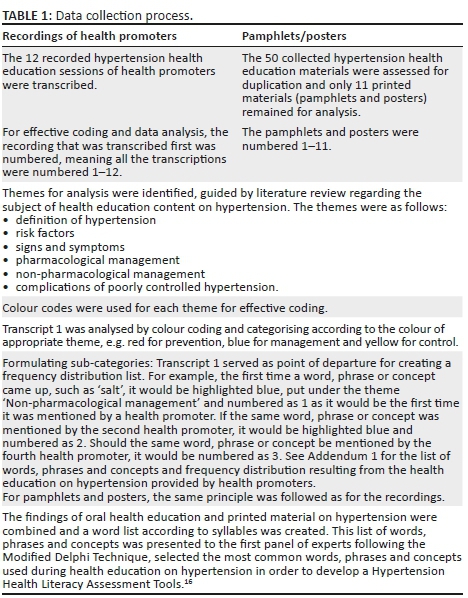
From the 12 PHCs, only 12 health promoters gave consent to participate, and data were collected through audio recording of the delivered health education session on hypertension. Pamphlets were collected each clinic immediately after health promoters completed their health education sessions. Fifty pamphlets related to health education on hypertension were collected, and after removing duplicates, only 11 pamphlets were left for the study.
Data analysis
Data were analysed using quantitative content analysis and descriptive statistics for frequency distribution. Quantitative content analysis focuses on the presence of certain words, concepts, themes, phrases, characters or sentences in texts or sets of texts and to quantify this presence in an objective manner.15Table 1 describes the process followed to analyse the data using quantitative content analysis.
Ethical considerations
The research was based on the three principles of Belmont Report concerning ethical conduct during research.1717
Approval to conduct the study was obtained from the Research Ethics Committee of the University Faculty of Higher Degrees Committee (#FREC2013/06/001 (2) (SCI)). Written permission to conduct the study was obtained from the Gauteng Department of Health (DoH); the managers of PHC clinics also gave their permission for the research to be conducted. The health promoters were provided with information leaflet, and written informed consent was obtained before commencement of recording of their health education sessions.
Results
The results are presented in terms of the demographics of health promoters, the languages used and the content of the hypertension-related health education sessions (i.e. what is being taught to patients by healthcare promoters).
Characteristics of health promoters and languages used during hypertension-related health education sessions
All health promoters (n = 12) had passed Grade 12 and were employed for more than five years. All collected pamphlets (n = 11) were in English. The languages used by health promoters during health education mixed with English were Setswana (seven promoters), Sepedi (two promoters) and IsiNdebele (three promoters).
Content of hypertension-related health education
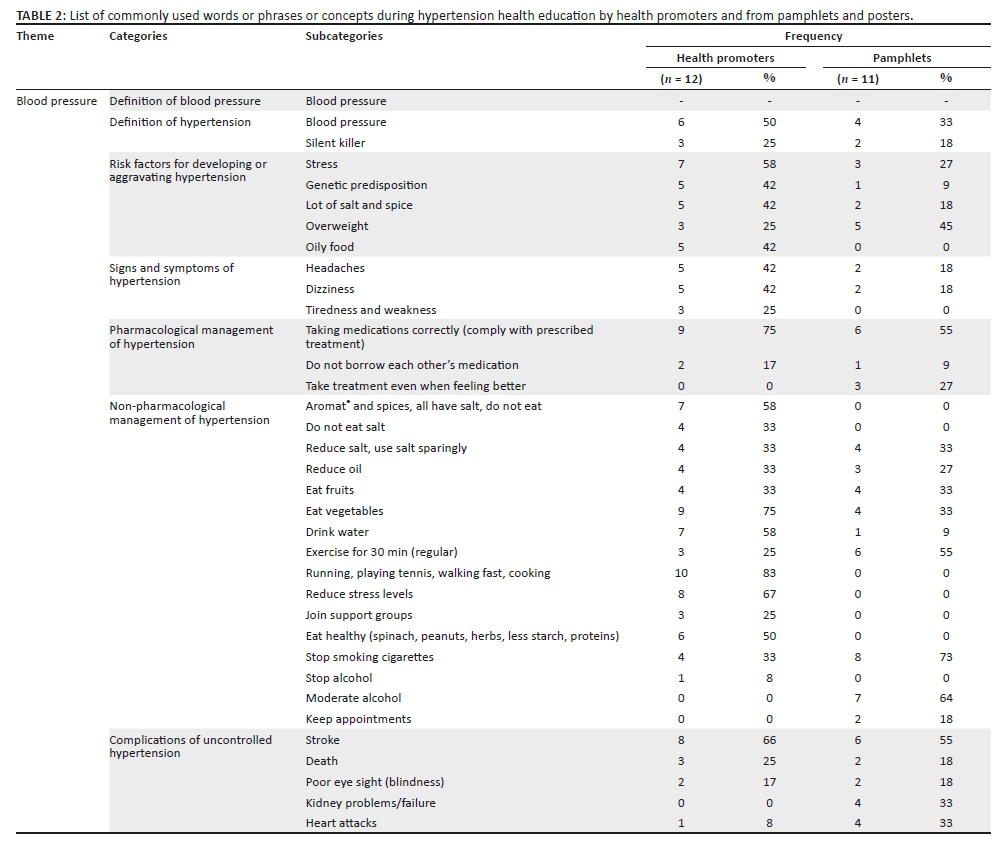
Table 2 contains the content in terms of words/phrases/concepts that were commonly used during health education on hypertension by health promoters and pamphlets. These were categorised in terms of definition of blood pressure and hypertension, risk factors, signs and symptoms, pharmacological and non-pharmacological management, and complications of uncontrolled hypertension.
Discussion
Language used in pamphlets and during health education sessions
All (n = 11; 100%) printed health education materials found in the PHC clinics were written in English. This could be a limitation for patients who are not able to read or speak English and have no one to read for them at home; moreover, the pamphlet remains the only point of reference from the clinic. The health promoters used native languages mixed with English in their health education sessions. Even though it is not entirely ineffective to use native languages during health education, the implication of this is that patients might not adequately understand what is being taught, which consequently affects their daily self-management.1111
Another challenge with language use was that immigrants who might not understand any of the 11 languages and even the sign language could miss valuable information provided by health promoters when they switched to native language, which was mostly Setswana as the commonly spoken language in Tshwane. In addition, health promoters might not speak all 12 official languages, meaning that some patients who spoke other South African language might miss important information because of language barrier. Thus, they have to rely on the already limited summarised information in pamphlets if they know English, otherwise they would not be able to access complete information.
Content of hypertension-related health education from health promoters and pamphlets
For the theme 'Definition of Hypertension', the most common term used for hypertension was blood pressure, as explained by 50% (n = 6) of health promoters. However, blood pressure is not an accurate translation of hypertension.
For the theme 'Non-pharmacological Management of Hypertension', overweight was least mentioned; it was used by only 25% (n = 3) of health promoters and in 41.6% (n = 5) of pamphlets on hypertension. Obesity or overweight, especially adipose tissue, is a major contributing factor to the development and complications of hypertension and type 2 diabetes.41819
Furthermore 58% (n+7) of the health promoters' health education content emphasised that salt and spices are risk factors that aggravate hypertension and should not be used at all. However, all pamphlets lacked this crucial information. Moreover, every health professional should know that food without spices and salt is tasteless, and patients are not easily motivated to stop using these.20n = 4) of health promoters and pamphlets said 'use salt sparingly or reduce salt intake', whilst 58% (n = 7) of health promoters advised not to use salt/spice at all; these two statements could confuse patients. A person should not eat more than half a teaspoon of salt a day regardless of what the person eats throughout the day.2122
Although health promoters taught hypertensive patients to eat more fruits and vegetables, but failed to mention that fruits and vegetables should be eaten daily. Another risk factor for development of hypertension is tobacco sniffing and smoking. Tobacco, whether it is cigarette smoking or sniffing, is a risk factor for increased hypertension.2324n = 4) of health promoters mentioned to stop smoking as a non-pharmacological management of hypertension.
Health promoters need to educate patients with hypertension about smoking in relation to hypertension and not just in a general way. Similarly, drinking alcohol has to be discouraged in patients with hypertension. This was mentioned by only one (8.3%) health promoter whilst educating about hypertension and nothing was mentioned on this (0%) in pamphlets. Alcohol drinking should be limited to just one standard drink per day for women and two drinks per day for men.2526,27
Exercise, including brisk walking, running, cooking and playing tennis, was mentioned by 83.3% (n = 10) of health promoters, but not in pamphlets, which are intended for reference at home. Reducing stress by joining support groups was mentioned as non-pharmacological management of hypertension, which is supported by scientific literature as well.28,29
In this study, headache 41.6% (n = 5), dizziness 41.6% (n = 5) and weakness and tiredness 25% (n = 3) were mentioned by health promoters as signs and symptoms of hypertension. However, most people initially do not experience these symptoms, but by the time person experiences headache, dizziness and weakness in any part of the body, hypertension has advanced to a chronic state for not being diagnosed or because it is poorly controlled.284
Under the theme 'Pharmacological Management', compliance with medication was mentioned. Hypertension is one of those conditions where people might not see the need to comply to the medication and stop taking it, especially because they do not feel sick or have any signs of being sick.29
To add to the treatment regimen, only 17% health promoters (n = 2) and 9% pamphlets (n = 1) mentioned that borrowing hypertension medication from friends or other people was an unacceptable practice. Literature reveals that patients with chronic conditions often share their medications.30313233
Under the theme 'Uncontrolled Hypertension', health promoters and pamphlets noted strokes, blindness and death as the complications of uncontrolled hypertension. However, kidney failure, another complication of uncontrolled hypertension, was not mentioned by health promoters, but only in 33.3% (n = 4) of pamphlets. In South Africa, about 60%-65% adult population is suffering from kidney failure because of uncontrolled hypertension with a waiting period for kidney transplant being 6-12 years.34
Implications of the findings and recommendations
Patients who are provided health education in PHC clinics might be missing much of information on account of language barriers and illiteracy. The government (DoH) should invest in pamphlets and posters in PHC clinics that are written in languages commonly used by the community. The presentation of these pamphlets should not be academic but professional with decent illustrations. Organisations should conduct seminars and workshops for health promoters on Continuous Professional Development (CPD) programmes to keep abreast of developments in hypertension-related health education. The selection criteria to become a health promoter need to be revisited; this is similar to the findings of Peu and Mthombeni35 who in their study investigated the needs of health promoters. Health promoters should advocate for printed hypertension-related health education material that are easy to read (preferably of grade 4 reading level) and culturally relevant for patients. A lesson plan of health education on hypertension should be designed by health promoters and be reviewed on monthly basis.
Limitations
The limitation of the study could be that the health promoters who participated in the study might have had limited knowledge about hypertension. The health promoters gave two possible dates for when they would be providing health education; therefore, the authors tried to prevent bias by obtaining two dates, to use one of the dates to record the health education. On these two dates, the health promoters might have changed their behaviour, leading to desirability bias.
Conclusion
Language in health education is an important factor. Even though health promoters did the right thing by providing health education in the language most spoken in each PHC clinic, immigrants using clinics must be provided with the translation so that they could also benefit from health education. Health information in pamphlets should be available in all possible local languages so that patients can refer to pamphlets in case they forget what was taught in the clinic. The results from the content taught by health promoters and the matter in pamphlets reflect that information provided about hypertension could differ, which could be confusing. For example, if a patient was told to reduce salt intake in clinic A and next week on visiting clinic B was told to stop taking salt, these two statements could be confusing for the patient, and he might even lose trust in health promoters as well as pamphlets.
Pamphlets did not contain all the relevant information provided by health promoters. Therefore, it is important that heath education on hypertension should be standardised so that the content of health education taught in all clinics, including in clinics A and B, should be the same. Information contained in pamphlets should be summarised and standardised with the content presented by health promoters. Additionally, pamphlets should be approved by DoH and there must be a guideline regarding the content of pamphlets. The South African DoH needs to control and regulate the information provided to patients, and to make sure that furnished information is up to date, precise and fits South Africans and their lifestyles.
Competing interests
The authors declare that they have no financial or personal relationships which may have inappropriately influenced them in writing this article.
Author's contributions
N.G.N.-M. wrote the article under the guidance of co-authors who equally contributed to the article.
Funding information
No grant was received to conduct this study. However, financial support for field workers and transport during data collection was provided by the Tshwane University of Technology.
Data availability statement
Data sharing is not applicable to this article as no new data were created or analysed in this study.
Disclaimer
The views and opinions expressed in this article are those of the authors and do not necessarily reflect the official policy or position of any affiliated agency of the authors.
Acknowledgements
The authors thank the Adelaide Tambo School of Nursing Science, Tshwane University of Technology, for supporting the study.
References
-
1.Anon. Salt is killing South Africans. Heart and stroke foundation [homepage on the Internet]. 2014 [cited 2018 Dec 12]. Available from https://www.heartfoundation.co.za/media-releases/salt-killing-south-africans-and-it-time-take-action.
» https://www.heartfoundation.co.za/media-releases/salt-killing-south-africans-and-it-time-take-action - 2.Seedat YK, Rayner BL. South African hypertension guideline 2011. SAMJ. 2012;102(1):60-83.
-
3.Hajer GR, Van Haeften TW, Visseren FL. Adipose tissue dysfunction in obesity, diabetes, and vascular diseases. Eur Heart J. 2008 Sep 5;29(24):2959-2971. https://doi.org/10.1093/eurheartj/ehn387
» https://doi.org/10.1093/eurheartj/ehn387 -
4.South Africa. Department of Health. National strategic plan for non-communicable diseases [homepage on the Internet]. 2013 [cited 2018 Apr 24]. Available from: https://www.hsrc.ac.za/uploads/pageContent/3893/NCDs%20STRAT%20PLAN%20% 20CONTENT%208%20april%20proof.pdf.
» https://www.hsrc.ac.za/uploads/pageContent/3893/NCDs%20STRAT%20PLAN%20% 20CONTENT%208%20april%20proof.pdf -
5.Nutbeam D. Health literacy as a public health goal: A challenge for contemporary health education and communication strategies into the 21st century. Health Promot Int. 2000 Sep 1;15(3):259-267. https://doi.org/10.1093/heapro/15.3.259
» https://doi.org/10.1093/heapro/15.3.259 - 6.Giddens JF. Concepts for nursing practice-e-book. Elsevier Health Sciences; 2015.
-
7.Elder RW. Combination of mass media health campaigns and health-related product distribution is recommended to improve healthy behaviors. Am J Prev Med. 2014;47(3):372-374. https://doi.org/10.1016/j.amepre.2014.05.032
» https://doi.org/10.1016/j.amepre.2014.05.032 -
8.STATISTICA. 2007-2015 Literacy rates by gender [homepage on the Internet]. [cited 2019 Jan 15]. Available from: https://www.statista.com/statistics/572836/literacy-rate-in-south-africa.
» https://www.statista.com/statistics/572836/literacy-rate-in-south-africa -
9.Scudder L. Words and well-being: How literacy affects patient health. J Nurse Pract. 2006;2(1):28-35. https://doi.org/10.1016/j.nurpra.2005.11.006
» https://doi.org/10.1016/j.nurpra.2005.11.006 -
10.Fischoff B, Brewer NT, Downs J. Communicating risks and benfits: An evidence-based user's guide. Vasa [homepage on the Internet]. 2011 [cited 2018 Feb 20]; p. 242. Available from: https://www.fda.gov/ScienceResearch/SpecialTopics/RiskCommunication/default.htm.
» https://www.fda.gov/ScienceResearch/SpecialTopics/RiskCommunication/default.htm -
11.Nkosi NG, Wright SC. Knowledge related to nutrition and hypertension management practices of adults in Ga-Rankuwa day clinics. Curationis. 2010;33(2):33-40. https://doi.org/10.4102/curationis.v33i2.1083
» https://doi.org/10.4102/curationis.v33i2.1083 -
12.United States Department of Health and Human Services. Plain language: A promising strategy for clearly communicating health information and improving health literacy [homepage on the Internet]. 2009 [cited 2019 Jan 15]. Available from: https://health.gov/communication/literacy/plainlanguage/default.htm.
» https://health.gov/communication/literacy/plainlanguage/default.htm - 13.Pillay Y, Baron P. The implementation of PHC re-engineering in South Africa. PHASA Newsletter. 2011 Nov 15. pp. 1-6.
- 14.Brink H, Van Der Walt C, Van Rensburg G. Fundamentals of research methodology for health care professionals. Cape Town: Juta and Company; 2006.
-
15.Waltz CF, Strickland OL, Lenz ER, editors. Measurement in nursing and health research [homepage on the Internet]. New York: Springer; 2010 [cited 2016 Apr 24]. Available from: https://books.google.com/books?id=1xAdjkR14ocC.
» https://books.google.com/books?id=1xAdjkR14ocC -
16.Mafutha NG, Mogotlane S, De Swardt HC. Development of a hypertension health literacy assessment tool for use in primary healthcare clinics in South Africa, Gauteng. Afr J Prim Health Care Fam Med. 2017;9(1):1-8. https://doi.org/10.4102/phcfm.v9i1.1305
» https://doi.org/10.4102/phcfm.v9i1.1305 - 17.Burns N, Grove SK. Study guide for the practice of nursing research: Conduct, critique, and utilization. Philadelphia, PA: Saunders; 2005.
- 18.Ramukumba TS, Wrigh SC, Hoffmann WA. Phase III: Evaluation of a community intervention for obesity: A South African experience. Can J Diabetes. 2011;35(2):169.
- 19.Holland K. Cultural awareness in nursing and health care: An introductory text. Abingdon, Oxfordshire: Routledge; 2017.
-
20.Shima R, Farizah MH, Majid HA. A qualitative study on hypertensive care behavior in primary health care settings in Malaysia. Patient Prefer Adherence. 2014;8:1597. https://doi.org/10.2147/PPA.S69680
» https://doi.org/10.2147/PPA.S69680 -
21.Charlton KE, Steyn K, Levitt NS, et al. Diet and blood pressure in South Africa: Intake of foods containing sodium, potassium, calcium, and magnesium in three ethnic groups. Nutrition. 2005;21(1):39-50. https://doi.org/10.1016/j.nut.2004.09.007
» https://doi.org/10.1016/j.nut.2004.09.007 -
22.Lifton RP, Gharavi AG, Geller DS. Molecular mechanisms of human hypertension. Cell. 2001;104(4):545-556. https://doi.org/10.1016/s0092-8674(01)00241-0
» https://doi.org/10.1016/s0092-8674(01)00241-0 -
23.Gupta R, Gupta N, Khedar RS. Smokeless tobacco and cardiovascular disease in low and middle income countries. Indian Heart J. 2013;65(4):369-377. https://doi.org/10.1016/j.ihj.2013.06.005
» https://doi.org/10.1016/j.ihj.2013.06.005 - 24.Primatesta P, Brookes M, Poulter NR. Improved hypertension management and control: Results from the health survey for England 1998. Hypertension. 2001;38(4):827-832.
-
25.Weber MA, Schiffrin EL, White WB, et al. Clinical practice guidelines for the management of hypertension in the community: A statement by the American Society of Hypertension and the International Society of Hypertension. J Clin Hypertens. 2014;16(1):14-26. https://doi.org/10.1111/jch.12237
» https://doi.org/10.1111/jch.12237 - 26.Ritchie CS, Joshipura K. Oral health and nutrition. In: Handbook of clinical nutrition and aging. In: Bales CW, Ritchie CS, editors. Totowa, NJ: Humana Press, 2004; p. 533-545.
-
27.Mujica V, Urzúa A, Leiva E, et al. Intervention with education and exercise reverses the metabolic syndrome in adults. J Am Soc Hypertens. 2010;4(3):148-153. https://doi.org/10.1016/j.jash.2010.02.008
» https://doi.org/10.1016/j.jash.2010.02.008 -
28.World Health Organization. Noncommunicable disease education manual for primary health care professionals and patients [homepage on the Internet]. 2017 [cited 2018 Feb 20]. Available from: https://wpro.who.int/handle/10665.1/13561
» https://wpro.who.int/handle/10665.1/13561 -
29.Chobanian A, Bakris GL, Black HR, et al. The seventh report of the joint national committee on prevention, detection, evaluation, and treatment of high blood pressure: The JNC 7 report. JAMA. 2003;289:2560-2572. https://doi.org/10.1001/jama.289.19.2560
» https://doi.org/10.1001/jama.289.19.2560 -
30.Holman H, Lorig K. Patient self-management: A key to effectiveness and efficiency in care of chronic disease. Public Health Rep. 2004;119(3):239-243. https://doi.org/10.1016/j.phr.2004.04.002
» https://doi.org/10.1016/j.phr.2004.04.002 -
31.Houston MC, Harper KJ. Potassium, magnesium, and calcium: Their role in both the cause and treatment of hypertension. J Clin Hypertens. 2008;10(7):3-11. https://doi.org/10.1111/j.1751-7176.2008.08575.x
» https://doi.org/10.1111/j.1751-7176.2008.08575.x -
32.City Press. Here's how a retail pharmacy is helping to relieve pressure on state clinics [homepage on the Internet]. 2018 [cited 21 Jan 2019]. Available from: https://city-press.news24.com/News/heres-how-a-retail-pharmacy-is-helping-to-relieve-pressure-on-state-clinics-20180806.
» https://city-press.news24.com/News/heres-how-a-retail-pharmacy-is-helping-to-relieve-pressure-on-state-clinics-20180806 - 33.Ellis J, Mullan J. Prescription medication borrowing and sharing: Risk factors and management. Aust Fam Physician. 2009;38(10):816.
-
34.National Kidney Foundation. Kidney failure in South African adults is mainly due to inherited Hypertension (60-65%) or Type 2 Diabetes (20-25%) [homepage on the Internet]. 2014 [cited 2019 Dec 03]. Available from: https://www.nkf.org.za/default.htm.
» https://www.nkf.org.za/default.htm - 35.Peu MD, Mthobeni MP. The needs of health promoters on a health promotion programme for families with adolescents orphaned by HIV and AIDS. Curations. 2013;36(1):1-8.

Accepted: 09 Oct. 2019
Published: 13 Feb. 2020