High prevalence of overall overweight/obesity and abdominal obesity amongst adolescents: An emerging nutritional problem in rural high schools in Limpopo Province, South Africa
Abstract
BACKGROUND: As the gap in nutritional profiles between urban and rural rapidly reduces because of nutrition transition, rural adolescents are likely to engage in urban lifestyle behavioursAIM: The study determined the prevalence of overweight/obesity amongst adolescents in rural high schools and the association with selected factorsSETTING: Fetakgomo Municipality in rural Limpopo Province, South AfricaMETHODS: A cross-sectional study was conducted amongst 378 adolescents selected through multistage sampling from high schools. Data collected were socio-demography, nutritional knowledge, dietary practices and anthropometry. The International Obesity Task Force age and sex-specific body mass index (BMI) cut-off values were used to determine overweight/obesity, whilst adult BMI cut-off values were used for those ≥ 18 years. Waist-to-height ratio (WHtR) greater than 0.5 indicated abdominal obesity, as well as waist circumference (WC) and waist-to-hip ratio (WHR) above the cut-off valuesRESULTS: The proportion of overweight/obesity amongst adolescents was 35%, whilst 25% had abdominal obesity by WHR and 21% by WHtR. Multivariate logistic regression showed that being a girl (AOR = 2.9, 95% CI: 1.74-4.85), older adolescent (AOR = 3.1, 95% CI: 1.57-6.29) and living in a household with employed adults (AOR = 2.3, 95% CI: 1.19-4.51) were associated with increased odds of being overweight/obese. Eating breakfast was associated with reduced odds of being overweight/obese (AOR = 0.6, 95% CI: 0.34-0.97CONCLUSION: Overweight/obesity and abdominal obesity amongst adolescents were more prevalent than underweight. The Integrated School Health Programme should have clear guidelines on food items served and sold at schools
overweight and obesity; socio-demography; nutrition knowledge; dietary practices; high school adolescents; rural South Africa
Introduction
Being overweight and obesity are one of the current public health issues123,4 Adolescence is a vulnerable time for the development of obesity because it is marked by a slowing of growth and corresponding decrease in physical activity levels.56,7 Therefore, adolescents who are overweight or obese have an increased risk of metabolic, cardiovascular and other related non-communicable diseases (NCDs), which may persist in adulthood.8,9 Therefore, the well-being of adolescents is critical to achieving the sustainable development goals.10
The rate of overweight/obesity amongst South African children and adolescents is comparable to rates found more than a decade ago in some developed countries, and is amongst the highest in Africa.11121314,15,16,17
A shift from traditional diets composed of whole foods to an energy-dense and nutrient-poor diet is defined as nutrition transition.1418,19 The home environment determines the occurrence of overweight/obesity in children and adolescents.112010,21,22,23,24 Research further indicates that overweight and obesity amongst children and adolescents is strongly dependent on age, gender and populations.11,25,26 Addressing these issues in a holistic manner could curb the escalating prevalence of overweight/obesity in the country.
The Strategy for the Prevention and Control of Obesity 2015-2020 has a strong focus on preventing childhood obesity and aims to enable access to healthy food choices in various settings, including schools.27282930
However, in general, the school food and nutrition environment are not conducive for promoting healthy eating.313032,33 and, as a result, consume foods which predispose one to obesity.3422,35 The ISHP should have clear guidelines on food items served and sold at schools and unhealthy foods should not be tolerated on school premise, as suggested by Okeyo et al.31
There is a dearth of recent data on adolescent overweight/obesity in most rural settings of the country. In view of this, the current study aimed to determine the prevalence of overweight/obesity amongst adolescents in rural high schools and the association with socio-demographics, dietary practices and nutritional knowledge. Adolescence is a suitable age for interventions that can enforce good nutritional practices and avert the beginning of NCD that are nutrition-related during adulthood,10,36,37 and schools offer an opportune setting for obesity prevention.38
Research methods and design
Study design, population and setting
This article is part of a dissertation for Masters in Public Health. The study was cross-sectional in design and was conducted in 2017 in the Fetakgomo Municipality, located in Limpopo Province in South Africa. The municipality is rural and made up of a cluster of several villages with similarities in terms of poor infrastructure, economic status and cultural practise. High schools in this area are located across the villages. According to the Education Management Information System (EMIS),3940
Sample size and sampling technique
A sample size was calculated using Rao software size calculator.414242
Data collection
Information on socio-demography, dietary practices and nutrition knowledge was collected from the adolescents, and anthropometry was measured. Prior to data collection, a written consent was obtained from the parents whose children participated in the study.
Socio-demography
A validated questionnaire was distributed to learners to fill information on the socio-demographic factors. The questionnaire covered a range of socio-demographic characteristics and the household situation of adolescents, in accordance with the variables used in other studies conducted in rural areas of Limpopo Province.43
Nutrition knowledge and dietary practices
Nutrition knowledge was measured using a set of 10 true or false questions, adapted from a study by Kigaru et al.2222
Anthropometric measurements
Weight and height of adolescents were measured using smart D-quip electronic scale and stadiometer, respectively, based on the WHO standard procedures.44222244,45 Abdominal obesity was defined at waist-to-hip ratio (WHR) more than 0.90 for males and 0.85 for females whilst waist-to-height ratio (WHtR) of 0.5 was used for both sexes.46
Data analysis
STATA was used to analyse data. Data were presented as frequencies and percentages (i.e. categorical variables) and means and standard deviations (s.d.) (i.e. continuous variables). Chi-squared test compared the percentages, whilst the Student's t-test compared the means. The association of overweight/obesity with socio-demographic characteristics, nutritional knowledge and dietary practices was computed using a multivariate logistic regression analysis. At bivariate analysis, independent variables associated with overweight/obesity at a p ≤ 0.2 were included in the multiple logistic regression analysis, using forward stepwise regression. Significance was set at p < 0.05.
Ethical considerations
This study was conducted according to the guidelines laid down in the Declaration of Helsinki47
Results
The characteristics of adolescents
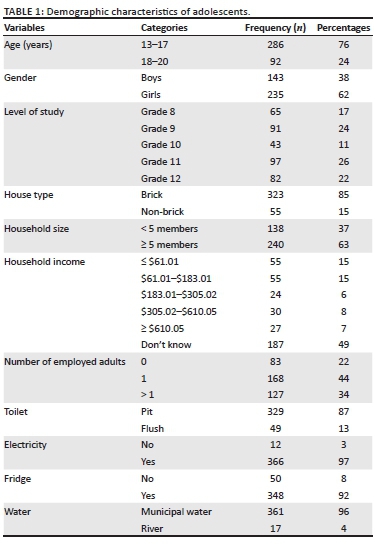
The demographics of the 378 high school adolescents are presented in Table 1. The majority (62%) were females, 76% were < 18 years and 24% were ≥ 18 years. The mean age for adolescents was 16 years (s.d. = ±2), and the mean age of 16 years (s.d. = ±2) was similar in boys and girls (p = 0.111). Most adolescents lived in brick houses (85%), and the majority (97%) used electricity. Although 96% had access to municipal water, pit toilets were commonly used (87%). Over two-thirds (63%) lived in households that were large (≥ 5 members), with a monthly income of less than $183.01 (30%), whilst 49% did not know their household income, and 22% came from households with no employed adults.
Anthropometric characteristics of adolescents
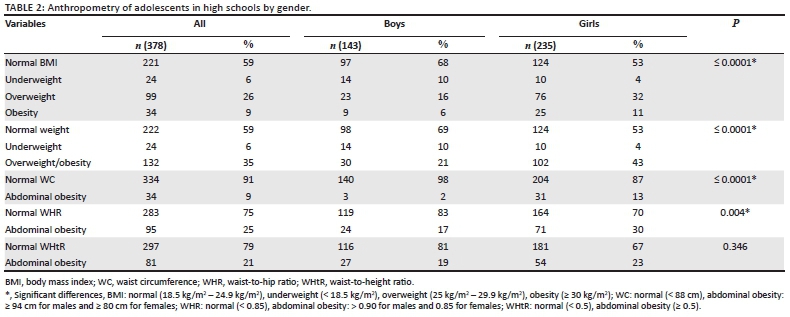
Table 2 presents BMI status of the adolescents. Overall overweight/obesity was 35%, with 26% and 9% of adolescents being overweight and obese, respectively, whilst 6% were underweight. More of the girls (32%) than boys (16%) were overweight; more girls (11%) than boys (6%) were obese, whilst more boys (10%) than girls (4%) were underweight (p ≤ 0.0001). Central or abdominal obesity was significantly different by gender: girls had higher prevalence of overweight/obesity (43%) compared with boys (21%), and abdominal obesity (by WC; 13% vs. 2% and WHR; 30% vs. 17%). The observed differences were statistically significant (p ≤ 0.0001). Overweight and obesity were merged as one variable for the analysis.
Nutrition knowledge of adolescents
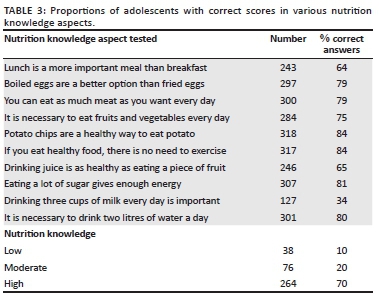
Table 3 shows the correct responses of the adolescents on nutrition knowledge, based on the literature.22,48,49 Two-thirds (64%) knew that the mid-day meal is not as important as breakfast, 81% knew that it is necessary to drink 2 litres (L) of water a day. A minimum daily fluid requirement of 2 L per day has been acknowledged.4849Table 4). The mean knowledge score was 7.2 (s.d. = ±1.9), with a minimum point of 1 and maximum points of 10. The median score was 9, with the lower quartile at eight and the upper quartile at 10. This indicates that the level of knowledge amongst most adolescents was high.
Dietary practices of adolescents
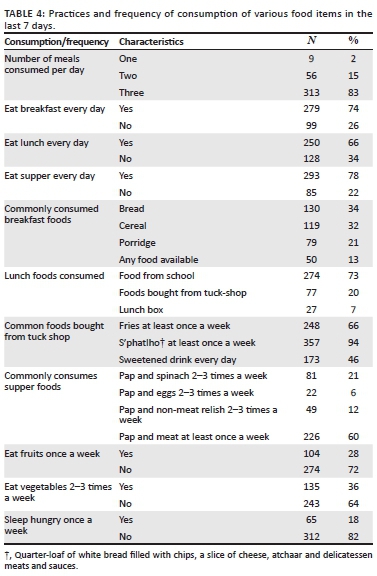
Table 4 shows the dietary habits and eating practices in the last 7-day period. Most (83%) consumed three meals per day and 18% went to sleep hungry at least once in a week. The majority (74%) ate breakfast, 66% ate lunch and 78% ate supper every day. Common breakfast foods consumed were bread (34%), cereal (32%) and porridge (21%). During lunchtime, 73% ate food provided by the school, 20% bought food from the tuck-shops and 7% brought lunch boxes. Pap and non-meat relish (40%) were often consumed as a supper meal rather than pap and meat that were consumed once in a week (60%). Sweetened drinks (42%) were consumed daily, whilst low fruit (28%) and vegetable (36%) consumption was observed per week.
Factors associated with overweight/obesity
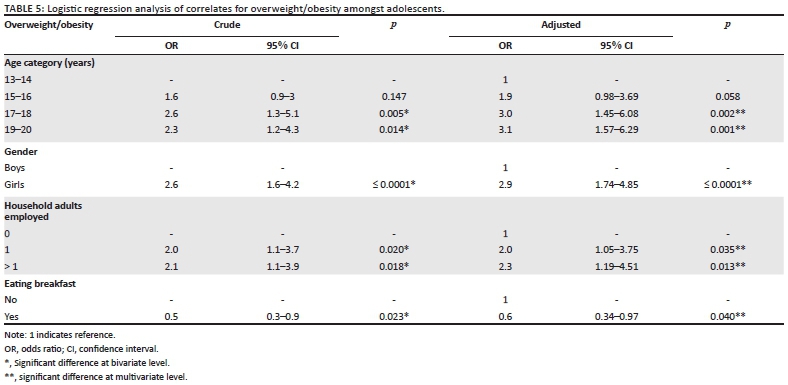
The determinants of overweight/obesity are shown in Table 5. In the bivariate logistic regression analysis, ages (17-18 years; p = 0.005) and (19-20 years; p = 0.014), gender (p ≤ 0.0001), and the number of household adults employed (one member; p = 0.020) and (> one member; p = 0.018) were associated with overweight/obesity. Furthermore, bivariate analysis showed that girls were significantly affected by abdominal obesity compared to boys (WHR; OR = 2.7, 95% CI: 1.23-3.49) and (WC; OR = 7.0, 95% CI: 2.10-23.37). No significant association was observed between overweight/obese and nutritional knowledge at the bivariate level.
At multiple logistic analyses, overweight/obesity was significantly associated with age, gender, number of adults employed in the household and eating breakfast. The odds of being overweight/obese was 1.9 times for adolescents aged 15-16 years (adjusted odds ratio [AOR] = 1.9, 95% CI; 0.98-3.69), three times for those 17-18 years (AOR = 3.0, 95% CI; 1.45-6.08), and 3.1 times for 19-20-year-olds (AOR = 3.1, 95% CI; 1.57-6.29). Girls were more likely to be overweight/obese compared with boys (AOR = 2.9, 95% CI: 1.74-4.85). Adolescents living in households with at least one employed adult (AOR = 2.0, 95% CI: 1.05-3.75) and more than one employed adult (AOR = 2.3, 95% CI: 1.19-4.51) were more likely to be overweight/obese than those living in households with no employed adult. Eating breakfast reduced the odds of being overweight/obese (AOR = 0.6, 95% CI: 0.34-0.97).
Discussion
The aim of this study was to determine overweight/obesity prevalence, and further study its associations with socio-demography, nutritional knowledge and dietary practices of adolescents in high schools in Limpopo Province, South Africa. The findings showed a high prevalence of overweight/obesity amongst adolescents, similar to several studies in South Africa and sub-Saharan Africa (SSA).11,50,51,52,53
The high overall prevalence of overweight/obesity (35%) far outweighed those who were underweight (6%) amongst adolescents in this poorly resourced community. Over a third (36%) lived in households where the income of employed adults ranged from $55.00 to $264.00 per month. Nevertheless, overweight/obesity was prevalent in households with at least one employed adult than those with no employed adults. Yet, the diet of adolescents was an energy-dense and nutrient-poor diet mainly based on starches. In a recent review, Wrottesley et al.3410
The overall overweight/obesity prevalence in this study is higher than the national range of 8.6% - 27.0% amongst adolescents aged 15-19 years reported by the United Nations Children's Fund.545321,53,55,56 and rates reported in urban schools in Ghana, Ethiopia and Nigeria.50,51,52,57 Our results are similar with worldwide implications with the difference that obesity in the rural and the urban is decreasing, and the rate of overweight/obesity is increasing amongst populations in the rural setting.14
Our results showed a significantly higher overweight/obesity amongst in girls (43%) than in boys (21%). The difference between rates reported in boys and girls is comparable with rates reported in several studies in South Africa,21,53,55,56 rates in SSA50,51,52 and rates in national estimates.26,53 However, the prevalence reported in girls (43%) is higher than the 26.3% national prevalence reported in South Africa in 2013.1358596021,53,56 as well as studies conducted in rural schools.61,62 The prevalence reported in this study is higher than values reported in urban schools in Ghana, Ethiopia and Nigeria.50,51,52,57
In addition to the high overall overweight/obesity prevalence, the results found a high prevalence of abdominal obesity indicated by elevated WHtR (21%), elevated WHR (25%) and elevated WC (9%). Girls were more significantly affected by abdominal obesity (by WC and WHR) compared with boys. Similarly, several studies have reported abdominal obesity (by WC, WHR and WHtR) amongst adolescents in South Africa.6336,64 Adolescent females were almost twice as likely to be abdominally obese than males based on the WHtR and WHR indicators. The abdominal obesity rates reported in the current study has significant public health implications. Compared with generalised obesity, abdominal obesity in children and adolescents is more strongly correlated with metabolic risk factors.65,66 Of public health importance is the link between the onsets of abdominal obesity with modifiable lifestyle patterns;36
An increase in overweight/obesity rate with age has been reported in studies and national estimates in SSA.6167685067
Although no association was observed between dietary patterns and overweight/obesity amongst adolescents by other researchers,352333,38,69 A recent review of South African studies found that food unavailability and inaccessibility to healthy food in some households deprive the consumption of breakfast amongst learners in rural settings.3434,69 The link between eating breakfast and low snacking is reported in several studies.66,70,71 Appropriate and context-relevant interventions to promote healthy dietary practices are crucial to stem the tide of adolescent overweight/obesity.
Limitations
It is important to interpret the findings of the current study with an understanding because a cross-sectional descriptive study was used. We only used food frequency to recall the types and frequency of foods consumed, but did not quantify the energy and nutrients of foods consumed by adolescents. Nonetheless, we were able to study the dietary practices of adolescents and learn about the kind of foods they access with ease in the school environment. There is a possibility that the absence of a significant association between overweight/obesity and dietary intake might be influenced by the incorrectness to in dietary measurements, as well as dietary recall, and under-reporting of other foods such as rich-carbohydrates foods usually consumed by the obese individuals.
Conclusion
The study reported a high prevalence of overweight/obesity amongst adolescents in these poorly resourced communities. The reported prevalence was higher than the rates reported in the national estimates and the rates reported in urban studies. Overweight/obesity was more prevalent than underweight amongst adolescents, especially amongst girls, and increased with age. There is a need to bring up children and adolescents in a health-promoting environment in an effort to reverse and stop the increased trend of overweight and obesity. Therefore, it is crucial that interventions address the occurrence and management of overweight and obesity in adolescents, seeing as adolescence obesity may persist into adulthood. Multi-stakeholder interventions focus on improving nutritional knowledge of children and adolescents to enable them to make healthier food choices and undertake dietary practices like eating breakfast, amidst existing programmes. Moreover, modifiable household vulnerabilities such as a poor socio-economic status should be considered in the intervention programs.
In addition, the school is viewed as an ideal health-promoting environment that can develop children and adolescents physically, emotionally and socially. The Department of Basic Education, South Africa, sees the school as a place to feed and educate learners but mostly to address undernutrition.727331
Competing interests
The authors declare that they have no financial or personal relationships that may have inappropriately influenced them in writing this article.
Authors' contribution
S.D. was responsible for conceptualisation, methodology, investigation, project administration, writing - original draft. P.M. was responsible for conceptualisation, methodology, investigation, supervision, formal analysis, writing - original draft and review. S.M. was responsible for conceptualisation, methodology, writing - original draft, review and editing.
Funding information
This research received no specific grant from any funding agency in the public, commercial, or not-for-profit sectors.
Data availability
The dataset for adolescents generated and analysed during the current study is available from the corresponding author upon reasonable request.
Disclaimer
The views and opinions expressed in this article are those of the authors and do not necessarily reflect the official policy or position of any affiliated agency of the authors.
Acknowledgements
The authors thank the population of the Fetakgomo Municipality, particularly the high schools' governing bodies, learners and parents, as well as the research assistants for assisting with the study.
References
-
1. WHO. Childhood overweight and obesity [homepage on the Internet]. 2015 [cited 2019 Dec 7]. Available from: https://www.who.int/dietphysicalactivity/childhood/en/.
» https://www.who.int/dietphysicalactivity/childhood/en/ -
2. Abarca-Gómez L, Abdeen ZA, Hamid ZA, et al. Worldwide trends in body-mass index, underweight, overweight, and obesity from 1975 to 2016: A pooled analysis of 2416 population-based measurement studies in 128 9 million children, adolescents, and adults. Lancet. 2017;390:2627-2642. https://doi.org/10.1016/S0140-6736(17)32129-3
» https://doi.org/10.1016/S0140-6736(17)32129-3 -
3. Sheehan P, Sweeny K, Rasmussen B, et al. Building the foundations for sustainable development: A case for global investment in the capabilities of adolescents. Lancet. 2017;390:1792-1806. https://doi.org/10.1016/S0140-6736(17)30872-3
» https://doi.org/10.1016/S0140-6736(17)30872-3 -
4. United Nations. World Population Prospects [homepage on the Internet]. 2017 [cited 2019 Dec 14]. Available from: https://populationunorg/wpp/
» https://populationunorg/wpp/ - 5. Daniels RS. From critical periods for abnormal weight gain in children and adolescents. In: Goran MI, Southern M, editors. Handbook of pediatric obesity: Etiology, pathophysiology & prevention. Boca Raton, FL: Taylor & Francis Group, 2006; p. 67-75.
-
6. Patton GC, Olsson CA, Skirbekk V, et al. Adolescence and the next generation. Nature. 2018;554:458-466. https://doi.org/10.1038/nature25759
» https://doi.org/10.1038/nature25759 -
7. Patton GC, Sawyer SM, Santelli JS, et al. Our future: A Lancet commission on adolescent health and wellbeing. Lancet. 2016;387(10036):2423-2478. https://doi.org/10.1016/S0140-6736(16)00579-1
» https://doi.org/10.1016/S0140-6736(16)00579-1 -
8. Akseer N, Al-Gashm S, Mehta S, et al. Global and regional trends in the nutritional status of young people: A critical and neglected age group. Ann N Y Acad Sci. 2017;1393(1):3-20. https://doi.org/10.1111/nyas.13336
» https://doi.org/10.1111/nyas.13336 -
9. Reilly JJ, Kelly J. Long-term impact of overweight and obesity in childhood and adolescence on morbidity and premature mortality in adulthood: Systematic review. Int J Obes. 2011;35:891-898. https://doi.org/10.1038/ijo.2010.222
» https://doi.org/10.1038/ijo.2010.222 -
10. Keats EC, Rappaport AI, Shah S, et al. The dietary intake and practices of adolescent girls in low-and middle-income countries: A systematic review. Nutrients. 2018;10(12):1978. https://doi.org/10.3390/nu10121978
» https://doi.org/10.3390/nu10121978 -
11. Rossouw HA, Grant CC, Viljoen M. Overweight and obesity in children and adolescents: The South African problem. S Afr J Sci. 2012;108(5/6):31-37. https://doi.org/10.4102/sajs.v108i5/6.907
» https://doi.org/10.4102/sajs.v108i5/6.907 -
12. Reddy S, Resnicow K, James S, et al. Underweight, overweight and obesity among South African adolescents: Results of the 2002 National Youth Risk Behaviour Survey. Public Health Nutr. 2009;12(2):203-207. https://doi.org/10.1017/S1368980008002656
» https://doi.org/10.1017/S1368980008002656 -
13. Ng M, Fleming T, Robinson M, et al. Global, regional, and national prevalence of overweight and obesity in children and adults during 1980-2013: A systematic analysis for the Global Burden of Disease Study 2013. Lancet. 2014;384(9945):766-781. https://doi.org/10.1016/S0140-6736(14)60460-8
» https://doi.org/10.1016/S0140-6736(14)60460-8 -
14. Ford ND, Patel SA, Narayan KV. Obesity in low-and middle-income countries: Burden, drivers, and emerging challenges. Annu Rev Public Health. 2017;38(1):145-164. https://doi.org/10.1146/annurev-publhealth-031816-044604
» https://doi.org/10.1146/annurev-publhealth-031816-044604 -
15. Kimani-Murage EW. Exploring the paradox: Double burden of malnutrition in rural South Africa. Glob Health Action. 2013;6(1):19249. https://doi.org/10.3402/gha.v6i0.19249
» https://doi.org/10.3402/gha.v6i0.19249 -
16. Modjadji P, Madiba S. The double burden of malnutrition in a rural health and demographic surveillance system site in South Africa: A study of primary schoolchildren and their mothers. BMC Public Health. 2019;19:1087. https://doi.org/10.1186/s12889-019-7412-y
» https://doi.org/10.1186/s12889-019-7412-y -
17. Tzioumis E, Adair LS. Childhood dual burden of under-and overnutrition in low-and middle-income countries: A critical review. Food Nutr Bull. 2014;35(2):230-243. https://doi.org/10.1177/156482651403500210
» https://doi.org/10.1177/156482651403500210 - 18. Hwalla N, Nasreddine L, El Labban S. Cultural determinants of obesity in low-and middle-income countries in the Eastern Mediterranean region. In: Romieu I, Dossus L, Willett WC, editors. Energy Balance and Obesity. Lyon (FR): International Agency for Research on Cancer; 2017. (IARC Working Group Reports, No. 10.) CHAPTER 8.
-
19. Micklesfield LK, Lambert EV, Hume DJ, et al. Socio-cultural, environmental and behavioural determinants of obesity in black South African women. Cardiovasc J Afr. 2013;24(9):369. https://doi.org/10.5830/CVJA-2013-069
» https://doi.org/10.5830/CVJA-2013-069 -
20. Labadarios D, Steyn NP, Nel J. How diverse is the diet of adult South Africans? Nutr J. 2011;10:33. https://doi.org/10.1186/1475-2891-10-33
» https://doi.org/10.1186/1475-2891-10-33 -
21. Feeley AB, Musenge E, Pettifor JM, et al. Investigation into longitudinal dietary behaviours and household socio-economic indicators and their association with BMI Z-score and fat mass in South African adolescents: The birth to twenty (Bt20) cohort. Public Health Nutr. 2013;16(4):693-703. https://doi.org/10.1017/S1368980012003308
» https://doi.org/10.1017/S1368980012003308 -
22. Kigaru DMD, Loechl C, Moleah T, et al. Nutrition knowledge, attitude and practices among urban primary school children in Nairobi City, Kenya: A KAP study. BMC Nutr. 2015;1:44. https://doi.org/10.1186/s40795-015-0040-8
» https://doi.org/10.1186/s40795-015-0040-8 -
23. Onyiriuka AN, Umoru DD, Ibeawuchi AN. Weight status and eating habits of adolescent Nigerian urban secondary school girls. S Afr J Child Health. 2013;7(3):108-111. https://doi.org/10.7196/sajch.529
» https://doi.org/10.7196/sajch.529 -
24. Voorend CG, Norris SA, Griffiths PL, et al. 'We eat together; Today she buys, tomorrow I will buy the food': Adolescent best friends' food choices and dietary practices in Soweto, South Africa. Public Health Nutr. 2013;16(3):559-567. https://doi.org/10.1017/S1368980012003254
» https://doi.org/10.1017/S1368980012003254 -
25. Reddy SP, Resnicow K, James S, et al. Rapid increases in overweight and obesity among South African adolescents: Comparison of data from the South African National Youth Risk Behaviour Survey in 2002 and 2008. Am J Public Health. 2012;102(2):262-268. https://doi.org/10.2105/AJPH.2011.300222
» https://doi.org/10.2105/AJPH.2011.300222 -
26. Muthuri SK, Francis CE, Wachira L-JM, et al. Evidence of an overweight/obesity transition among school-aged children and youth in Sub-Saharan Africa: A systematic review. PLoS One. 2014;9(3):e92846. https://doi.org/10.1371/journal.pone.0092846
» https://doi.org/10.1371/journal.pone.0092846 - 27. SADH (South African Department of Health). Strategy for the prevention and control of obesity in South Africa 2015-2020. Pretoria: South African Department of Health; 2015.
- 28. Department of Basic Education. Nutrition educators manual volume 1: Educators. Pretoria: South African Departmentof Basic Education; 2010.
- 29. Department of Health and Department of Basic Education. DoH and DBE integrated school health policy. Pretoria: Government Printer; 2012.
-
30. Story M, Kaphingst KM, French S. The role of schools in obesity prevention. Future Child. 2006;16(1):109-142. https://doi.org/10.1353/foc.2006.0007
» https://doi.org/10.1353/foc.2006.0007 -
31. Okeyo AP, Seekoe E, De Villiers A, et al. The food and nutrition environment at secondary schools in the Eastern Cape, South Africa as reported by learners. Int J Environ Res Public Health. 2020;17(11):4038. https://doi.org/10.3390/ijerph17114038
» https://doi.org/10.3390/ijerph17114038 -
32. Abrahams Z, De Villiers A, Steyn NP, et al. What's in the lunchbox? Dietary behaviour of learners from disadvantaged schools in the Western Cape, South Africa. Public Health Nutr. 2011;14(10):1752-1758. https://doi.org/10.1017/S1368980011001108
» https://doi.org/10.1017/S1368980011001108 - 33. Peebles R. Adolescent obesity: Etiology, office evaluation, and treatment. Adolesc Med State Art Rev. 2008;19(3):380-405.
-
34. Wrottesley SV, Pedro TM, Fall CH, et al. A review of adolescent nutrition in South Africa: Transforming adolescent lives through nutrition initiative. S Afr J Clin Nutr. 2019;33(4):1-39. https://doi.org/10.1080/16070658.2019.1607481
» https://doi.org/10.1080/16070658.2019.1607481 -
35. Abizari A-R, Ali Z. Dietary patterns and associated factors of schooling Ghanaian adolescents. J Health Popul Nutr. 2019;38:5. https://doi.org/10.1186/s41043-019-0162-8
» https://doi.org/10.1186/s41043-019-0162-8 -
36. Mogre V, Nyaba R, Aleyira S, et al. Demographic, dietary and physical activity predictors of general and abdominal obesity among university students: A cross-sectional study. SpringerPlus. 2015;4:226. https://doi.org/10.1186/s40064-015-0999-2
» https://doi.org/10.1186/s40064-015-0999-2 - 37. UNICEF. The achievable imperative for global progress. New York, NY: NY United Nations Children's Fund; 2013.
-
38. Story M, Nanney MS, Schwartz MB. Schools and obesity prevention: Creating school environments and policies to promote healthy eating and physical activity. Milbank Q. 2009;87(1):71-100. https://doi.org/10.1111/j.1468-0009.2009.00548.x
» https://doi.org/10.1111/j.1468-0009.2009.00548.x - 39. Education Management Information System (EMIS). Learners enrollment number. Limpopo Province: Department of Education; 2016.
- 40. StatsSA. Men, women and children: Findings of the living conditions survey 2014/15. Pretoria: Statistics South Africa; 2018.
-
41. Raosoft I. Sample size calculator [homepage on the Internet] 2004 [cited 2017 Mar 8]. Available from: http://www.raosoft.com/samplesize.html
» http://www.raosoft.com/samplesize.html -
42. Psychology Today. Adolescence: Puberty, teenagers [homepage on the Internet]. [cited 2020 Oct 20]. Available from: https://www.psychologytoday.com/za/basics/adolescence
» https://www.psychologytoday.com/za/basics/adolescence -
43. Maimela E, Alberts M, Modjadji SE, et al. The prevalence and determinants of chronic non-communicable disease risk factors amongst adults in the Dikgale health demographic and surveillance system (HDSS) site, Limpopo Province of South Africa. PLoS One. 2016;11(2):e0147926. https://doi.org/10.1371/journal.pone.0147926
» https://doi.org/10.1371/journal.pone.0147926 - 44. WHO. Physical status: The use of and interpretation of anthropometry. Report of a World Health Organization Expert Committee. Geneva, Switzerland: WHO; 1995.
-
45. Cole TJ, Bellizzi MC, Flegal KM, et al. Establishing a standard definition for child overweight and obesity worldwide: International survey. Br Med J. 2000;320:1240. https://doi.org/10.1136/bmj.320.7244.1240
» https://doi.org/10.1136/bmj.320.7244.1240 -
46. Ashwell M. Obesity risk: Importance of the waist-to-height ratio. Nurs Stand. 2009;23(41):49-56. https://doi.org/10.7748/ns2009.06.23.41.49.c7050
» https://doi.org/10.7748/ns2009.06.23.41.49.c7050 -
47. World Medical Association Declaration of Helsinki. Ethical principles for medical research involving human subjects [homepage on the Internet]. [cited 2019 Mar 12]. Available from: http://wwwwmanet/e/policy/b3htm2008
» http://wwwwmanet/e/policy/b3htm2008 - 48. Sawka MN, Montain SJ. Fluid and electrolyte balance: Effects on thermoregulation and exercise in the heat. Washington, DC: ILSI Press; 2001.
-
49. World Cancer Research Fund/American Institute for Cancer Research. Recommendations and public health and policy implications [homepage on the Internet]. Continuous update project expert report 2018 [cited 2019 Mar 12]. Available from: dietandcancerreport.org
» dietandcancerreport.org -
50. Adom T, De Villiers A, Puoane T, et al. Prevalence and correlates of overweight and obesity among school children in an urban district in Ghana. BMC Obes. 2019;6:14. https://doi.org/10.1186/s40608-019-0234-8
» https://doi.org/10.1186/s40608-019-0234-8 -
51. Aryeetey R, Lartey A, Marquis GS, et al. Prevalence and predictors of overweight and obesity among school-aged children in urban Ghana. BMC Obes. 2017;4:38. https://doi.org/10.1186/s40608-017-0174-0
» https://doi.org/10.1186/s40608-017-0174-0 -
52. Gali N, Tamiru D, Tamrat M. The emerging nutritional problems of school adolescents: Overweight/obesity and associated factors in Jimma town, Ethiopia. J Pediatr Nurs. 2017;35:98-104. https://doi.org/10.1016/j.pedn.2017.03.002
» https://doi.org/10.1016/j.pedn.2017.03.002 -
53. Negash S, Agyemang C, Matsha TE, et al. Differential prevalence and associations of overweight and obesity by gender and population group among school learners in South Africa: A cross-sectional study. BMC Obes. 2017;4:29. https://doi.org/10.1186/s40608-017-0165-1
» https://doi.org/10.1186/s40608-017-0165-1 - 54. UNICEF. Consultant for development of a national school nutrition guideline. Pretoria: UNICEF; 2018.
-
55. Pedro TM, Kahn K, Pettifor J, et al. Under-and overnutrition and evidence of metabolic disease risk in rural black South African children and adolescents. S Afr J Clin Nutr. 2014;27(4):194-200. https://doi.org/10.1080/16070658.2014.11734509
» https://doi.org/10.1080/16070658.2014.11734509 -
56. Peer N, Ganie YN. A weighty matter: Identification and management of overweight and obesity in adolescents. S Afr Med J. 2016;106(7):662-665. https://doi.org/10.7196/SAMJ.2016.v106i7.10946
» https://doi.org/10.7196/SAMJ.2016.v106i7.10946 -
57. Anteneh ZA, Gedefaw M, Tekletsadek KN, et al. Risk factors of overweight and obesity among high school students in Bahir Dar City, North West Ethiopia: School based cross-sectional study. Adv Prev Med. 2015;2015:294902. https://doi.org/10.1155/2015/294902
» https://doi.org/10.1155/2015/294902 -
58. Wells JC. Sexual dimorphism of body composition. Best Pract Res Clin Endocrinol Metab. 2007;21(3):415-430. https://doi.org/10.1016/j.beem.2007.04.007
» https://doi.org/10.1016/j.beem.2007.04.007 -
59. Wardle J, Haase AM, Steptoe A, et al. Gender differences in food choice: The contribution of health beliefs and dieting. Ann Behav Med. 2004;27(2):107-116. https://doi.org/10.1207/s15324796abm2702_5
» https://doi.org/10.1207/s15324796abm2702_5 -
60. Lenhart CM, Hanlon A, Kang Y, et al. Gender disparity in structured physical activity and overall activity level in adolescence: Evaluation of youth risk behavior surveillance data. ISRN Public Health. 2012;2012:674936. https://doi.org/10.5402/2012/674936
» https://doi.org/10.5402/2012/674936 -
61. Kimani-Murage EW, Kahn K, Pettifor JM, et al. Predictors of adolescent weight status and central obesity in rural South Africa. Public Health Nutr. 2011;14(6):1114-1122. https://doi.org/10.1017/S1368980011000139
» https://doi.org/10.1017/S1368980011000139 -
62. Toriola A, Moselakgomo V, Shaw B, et al. Overweight, obesity and underweight in rural black South African children. S Afr J Clin Nutr. 2012;25(2):57-61. https://doi.org/10.1080/16070658.2012.11734406
» https://doi.org/10.1080/16070658.2012.11734406 -
63. Sekokotla MA, Goswami N, Sewani-Rusike CR, et al. Prevalence of metabolic syndrome in adolescents living in Mthatha, South Africa. Ther Clin Risk Manag. 2017;13:131. https://doi.org/10.2147/TCRM.S124291
» https://doi.org/10.2147/TCRM.S124291 -
64. Mogre V, Nyaba R, Aleyira S. Lifestyle risk factors of general and abdominal obesity in students of the school of medicine and health science of the University of Development Studies, Tamale, Ghana. ISRN Obes. 2014;2014:508382. https://doi.org/10.1155/2014/508382
» https://doi.org/10.1155/2014/508382 -
65. Huxley R, Mendis S, Zheleznyakov E, et al. Body mass index, waist circumference and waist: Hip ratio as predictors of cardiovascular risk - A review of the literature. Eur J Clin Nutr. 2010;64:16-22. https://doi.org/10.1038/ejcn.2009.68
» https://doi.org/10.1038/ejcn.2009.68 -
66. Kelishadi R. Childhood overweight, obesity, and the metabolic syndrome in developing countries. Epidemiol Rev. 2007;29(1):62-76. https://doi.org/10.1093/epirev/mxm003
» https://doi.org/10.1093/epirev/mxm003 -
67. Lundeen E, Norris S, Adair L, et al. Sex differences in obesity incidence: 20-year prospective cohort in South Africa. Pediatr Obes. 2016;11(1):75-80. https://doi.org/10.1111/ijpo.12039
» https://doi.org/10.1111/ijpo.12039 - 68. Shisana O, Labadarios D, Rehle T, et al. South African National Health and Nutrition Examination Survey (SANHANES-1). Cape Town: HSRC Press; 2013.
- 69. Buxton CNA. Ghanaian junior high school adolescents dietary practices and food preferences: Implications for public health concern. J Nutr Food Sci. 2014;4(5):1.
-
70. Smith KJ, Gall SL, McNaughton SA, et al. Skipping breakfast: Longitudinal associations with cardiometabolic risk factors in the childhood determinants of adult health study. Am J Clin Nutr. 2010;92(6):1316-1325. https://doi.org/10.3945/ajcn.2010.30101
» https://doi.org/10.3945/ajcn.2010.30101 -
71. Timlin MT, Pereira MA, Story M, et al. Breakfast eating and weight change in a 5-year prospective analysis of adolescents: Project EAT (Eating Among Teens). Pediatrics. 2008;121(3):e638-e645. https://doi.org/10.1542/peds.2007-1035
» https://doi.org/10.1542/peds.2007-1035 - 72. Education DoB. National school nutrition programme grants framework 2014/2015. Pretoria: Department of Basic Education; 2014.
-
73. Mbusi NP. School feeding programme 'Gone Horribly Wrong' [homepage on the Internet]. 2005 [cited 2010 Oct 18]. Available from: http://www.suntimes.co.za/zones/sundaytimesNEW/basket10st/basket16st111417493
» http://www.suntimes.co.za/zones/sundaytimesNEW/basket10st/basket16st111417493

Accepted: 02 Feb. 2021
Published: 18 May 2021