Clinical utility of smartphone-based audiometry for early hearing loss detection in HIV-positive children: A feasibility study
Abstract
BACKGROUND: Paediatric human immunodeficiency virus (HIV)/acquired immune deficiency syndrome (AIDS) often manifests with hearing loss (HL). Given the impact of HL, early detection is critical to prevent its associated effects. Yet, the majority of children living with HIV/AIDS (CLWHA) cannot access hearing healthcare services because of the scarcity of audiologists and expensive costs of purchasing screening equipment. Alternative solutions for early detection of HL are therefore necessaryAIM: The overall aim of this study was to assess the feasibility of using self-administered smartphone-based audiometry for early HL detection amongst CLWHASETTING: This study was conducted at the paediatrics department of a state hospital in the Eastern Cape province, South AfricaMETHODS: This was a feasibility study conducted amongst twenty-seven (27) CLWHA who were in the age group of 6-12 years. The participants self-administered hearing screening tests using a smartphone-based audiometric test. The primary end-points of this study were to determine the sensitivity, specificity and test-retest reliability of self-administered hearing screeningRESULTS: The sensitivity and specificity for self-administered screening were 82% and 94%, respectively, with positive and negative predictive values of 90% and 88%, respectively. Moreover, a strong positive test-retest reliability (r = 0.97) was obtained when participants self-administered the screening testCONCLUSION: Six- to 12-year-old CLWHA were able to accurately self-administer hearing screening tests using smartphone-based audiometry. These findings show that self-administered smartphone audiometry can be used for serial hearing monitoring in at-risk paediatric patients
paediatric HIV; hearing loss; early detection; self-administered; mHealth
Introduction
An estimated 240 000 children are living with the human immunodeficiency virus (HIV)/acquired immune deficiency syndrome (AIDS) in South Africa (SA).12,3,4 A recent study in Mthatha23n = 5/37).45,6 The latter leads to poor academic achievement, which often translates to poor vocational outcomes and dependence on social security.67,8,9,10 Early detection and intervention (EDI) of HL are therefore important to prevent these negative impacts.611
Although early detection leads to appropriate interventions, hearing healthcare is inaccessible to the majority of South Africans, mainly because of lack of diagnostic equipment12131314n = 499) of these audiologists are currently practising in state hospitals.13
This scarcity of audiologists leaves people in the rural areas of SA unable to access these services. A recent report indicates that only 22 hospitals in the Eastern Cape (EC) province have 41 audiologists to render audiological services to an estimated 6.9 million people residing in the EC province. The latter compounds an estimated 0.5:100 000 ratio of audiologist to population, notwithstanding the fact that more than 30 of these audiologists are practising in urban areas. In addition to the scarcity of professionals, the majority of these hospitals do not have the necessary equipment to facilitate EDI for HL.12
One of the models that may provide alternative solutions for early detection is mHealth, which is described as the use of mobile technologies to address healthcare challenges such as access, affordability and matching of resources.1515,16 By using these tools, it may be possible for patients to self-screen and then be referred to the closest specialist or these results can be sent via store and send protocols, for further management. One application that may be used for EDI is the hearScreen®, which has been developed by the HearX Group, to screen for the presence of HL. Unfortunately, data on its reliability and clinical validity when patients self-administer the screening tests is unavailable. The latter is echoed by Mahomed-Asmail et al.,17
Methods
This feasibility study was part of a larger study that was carried out at the paediatrics department at a referral hospital in SA. After enrolling in this study, information related to their demographic features, hearing sensitivity, HIV status and HIV treatment was retrieved from the previous study's records. To be included in this study, participants had to be aged between 6-12 years old and able to follow instructions to perform a hearing test. They were included in this study if their primary caregivers gave consent. Participants who were cognitively unable to follow instructions or those with known conditions that may affect concentration were excluded.
Non-probability purposive sampling was used to select the participants whose audiometric information was known from the larger study. Purposive sampling was used as it allowed the researchers to select participants with HL and those without HL, which enabled the researchers to assess the sensitivity and specificity of the self-administered test. Whilst the audiometric information of the participants enrolled in the study was known, the researchers were blinded to the audiological information during data collection of this study.
Since the participants' hearing sensitivity was already known, they were given instructions to self-administer a hearing screening test using the smartphone-based hearScreen® application. The hearing screening was developed to screen for HL at four frequencies: 500 Hz- 4000 Hz at 25 dB HL. To pass the screening, participants had to hear the tone and press the button at all four test frequencies in each ear. The screening test was carried out in an ambient room using the hearScreen on a Samsung Galaxy J5 Prime smartphone and Sennheiser HD280 Pro headphones. The hearScreen® is a clinically validated tool for hearing screening with a sensitivity and specificity of > 90% when testing is administered by a hearing professional.17
Prior to undergoing screening, participants were given instructions in their home language and included informing them that they "should press the green button on the screen each time they heard a beeping sound in the ear". A conditioning was done with each participant at 1000 hertz (Hz) at 40 decibels (dB) HL prior undergoing the self-administered screening. The participants underwent screening twice, with a 30-min break between the two tests.
Findings from the two self-administered tests were compared to each other to determine the test-retest reliability, sensitivity and specificity of the self-administered screening test. Moreover, self-administered results were also compared with previous audiometric information to determine correlation between the screening results with audiometric information. Statistical analysis was performed using Statistical Package for Social Sciences version 26 for Macintosh, and percentages were generated for categorical values whilst Pearson correlation coefficient assessed the test-retest reliability.
Ethical considerations
This research adhered to the World Medical Association's declaration of Helsinki for conducting research with human participants. Ethical approval was obtained from the University of KwaZulu-Natal's Biomedical Research Ethics Committee (BREC/00001185/2020). All participants in this study provided assent and their caregivers gave informed consent.
Results
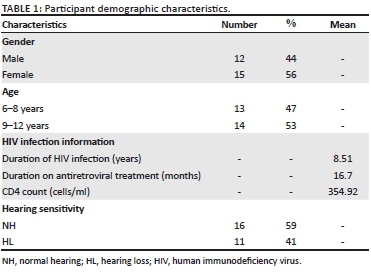
A total of twenty-seven participants with a mean age of 8.3 years (range: 6-12 years) took part in this study. Eleven participants had HL whilst 16 participants had normal hearing. Table 1 summarises the demographic characteristics, HIV infection and hearing sensitivity information.
A calculation was done to assess the sensitivity and specificity of the self-administered screening test in the detection of HL. Analysis of the results revealed a sensitivity of 82% and a specificity of 94% with positive and negative predictive values of 90% and 88%, respectively, when the test was self-administered by the participants.
Further analysis using the Pearson correlation coefficient test to assess the test-retest reliability showed a true positive test-retest reliability (r = 1) from the normal-hearing participants whilst a strong positive reliability (r = 0.98) was obtained from the participants with HL.
Discussion
As far as we know, this was the first study to assess the sensitivity, specificity and test-retest reliability of self-administered smartphone-based hearing screening of CLWHA in SA. This study found a sensitivity and specificity of 82% and 94%, respectively, when the participants self-administered the smartphone-based hearing screening test. Moreover, these findings show that our participants reliably (r = 0.97) self-administered the screening. Whilst this study is the first to document sensitivity and specificity of self-administered screening, our findings are comparable to the available literature on the studies conducted amongst adult populations and those conducted by the hearing professionals. Louw et al.161515,16 was administered by audiologists. Nevertheless, these studies consistently reported a high sensitivity and specificity of the hearScreen® to identify HL.
These findings are useful in successful planning of screening services for at-risk groups such as CLWHA. Because the hearScreen® employs artificial intelligence (AI) to allow automated testing, noise monitoring capabilities, instant data capturing and cloud-based data storage, this technology has the potential to maximise human resources where audiologists spend more time on diagnostic evaluations and treatment rather than screening. In this instance, patients can self-administer the screening and only those who fail the screening are referred to audiologists for further diagnostic evaluation and management. Moreover, these findings pave the way for decentralising hearing screening where CLWHA can self-administer the screening when they access their monthly or 3-monthly follow-up care consultations, and only those who fail the screening are referred for further diagnostic evaluation and management.
A strong positive test-retest reliability (r = 0.97) was obtained when the participants self-administered the hearing screening tests using the hearScreen® application. As far as we know, this was the first study to determine the test-retest reliability of self-administered screening in children, and these results should be interpreted with caution given the small sample size of this study. Nevertheless, this high test-retest reliability shows that in rural contexts such as the EC province where a scarcity of audiologists exists,13
Although conventional face-to-face audiological consultations are still the status quo, alternative models of care should be employed in instances where face-to-face consultations become impossible. This is especially important in recent times where because of the global COVID-19 pandemic, travel restrictions were imposed and many public hospitals in SA closed down non-emergency outpatient's departments, in an effort to prevent the further spread of the virus. This made it particularly difficult for those at-risk to access hearing screening. In such cases, self-administered hearing screening using the tools with AI capabilities could be used to enable the access to hearing screening for these risk groups. Self-administered screenings do not require face-to-face interactions, and thus they allow for social distancing to be maintained during assessments. Moreover, less personal protective equipment (PPE) are required because the patient does not have to be in the same room as the clinician during evaluation. Consequently, a screening/diagnostic equipment could be sent to the patient to self-administer the assessments and have the results uploaded to cloud-based storage for further analysis and treatment recommendation.
Study limitations
The data collection was conducted when the country was under strict lockdown levels 3 and 4, during the beginning of the second wave of the COVID-19 pandemic. This imposed travel restrictions for non-emergency travel, and in addition to that, most hospitals in the country closed down non-emergency OPDs in an effort to reduce the further spread of COVID-19. These circumstances collectively reduced the number of participants who could be enrolled in this study, resulting in a small sample size in our study. Also, data collection for this study occurred in only one site, and as a result, caution should be applied when generalising these findings to the whole of the EC.
Conclusion and recommendations
The findings from this study show a high test-retest reliability when CLWHA, who are in the age group of 6-12 years, self-administered a hearing screening test. Large-scale research is recommended to determine the feasibility of using smartphone applications to decentralise hearing screening to primary healthcare clinics where majority of the CLWHA receive their follow-up care.
Competing interests
The authors declare that they have no financial or personal relationships that may have inappropriately influenced them in writing this article.
Authors' contributions
M.P. formulated the presented idea, performed the data collection and data analysis and wrote the manuscript with support from A.J.R. A.J.R. helped supervise the research process and approved the final version of this manuscript.
Funding information
The authors received no financial support for the research, authorship and publication of this article.
Data availability
The data that support the findings of this study are available from the corresponding author, M.P., upon reasonable request.
Disclaimer
The views expressed in this article are the researcher's own and not an official position of the institution.
Acknowledgements
References
-
1. Avert. HIV and AIDS in South Africa. Global information and education on HIV and AIDS website. 2020 [cited 2021 Jun 8]. Available from: https://www.avert.org/professionals/hiv-around-world/sub-saharan-africa/south-africa#footnote2_l7z7nwr
» https://www.avert.org/professionals/hiv-around-world/sub-saharan-africa/south-africa#footnote2_l7z7nwr - 2. Phanguphangu M, Ross AJ. Auditory manifestations in HIV-infected children at a State Hospital in South Africa. Hear. Balance Commun. In press 2021.
-
3. Peter VZ, Paken J, Joseph L. An audiological profile of a cohort of school-aged children with HIV and AIDS attending an antiretroviral clinic in South Africa. S Afr J Commun Disord. 2020;67(1):a651. https://doi.org/10.4102/sajcd.v67i1.651
» https://doi.org/10.4102/sajcd.v67i1.651 -
4. Torre P, Cook A, Elliott H, Dawood G, Laughton B. Middle ear function in human immunodeficiency virus (HIV)-infected South African children. J Paediatr Care Insight. 2016;1(1):13-17. https://doi.org/10.24218/jpci.2016.04
» https://doi.org/10.24218/jpci.2016.04 - 5. Halliday LF, Tuomainen O, Rosen S. Language development and impairment in children with mild to moderate sensorineural hearing loss. J Speech Lang Hear Res. 2018;61(2):398.
-
6. Tomblin BJ, Harrison M, Ambrose SE, et al. Language outcomes in young children with mild to severe hearing loss. Ear Hear. 2015;36 (Suppl 1):77S-91S. https://doi.org/10.1097/AUD.0000000000000219
» https://doi.org/10.1097/AUD.0000000000000219 -
7. Phanguphangu MC. Otoscopic examinations reveal high prevalence of outer and middle ear pathologies in paediatrics in Limpopo, South Africa. Int J Audiol. 2017;56(4):215-218. https://doi.org/10.1080/14992027.2016.1244868
» https://doi.org/10.1080/14992027.2016.1244868 -
8. Kouwenberg M, Rieffe C, Theunissen SC, De Rooij M. Peer victimization experienced by children and adolescents who are deaf or hard of hearing. PLoS One. 2012;7(12):e52174. https://doi.org/10.1371/journal.pone.0052174
» https://doi.org/10.1371/journal.pone.0052174 -
9. Warner-Czyz AD, Loy B, Pourchot H, White T, Cokely E. Effect of hearing loss on peer victimization in school-age children. Exceptional Children. 2018;84(3):280-297. https://doi.org/10.1177/0014402918754880
» https://doi.org/10.1177/0014402918754880 - 10. Bauman S, Pero H. Bullying and cyberbullying among deaf students and their hearing peers: An exploratory study. J Deaf Stud Deaf Educ. 2011;16(2):236-253.
-
11. World Health Organization. Deafness and hearing loss. World Health Organization website. 2021 [cited 2021 Jun 8]. Available from: https://www.who.int/news-room/fact-sheets/detail/deafness-and-hearing-loss
» https://www.who.int/news-room/fact-sheets/detail/deafness-and-hearing-loss -
12. Teixeira L, Joubert K. Availability of audiological equipment and protocols for paediatric assessment and hearing aid fitting in Gauteng, South Africa. S Afr J Commun Disord. 2014;61(1):58. https://doi.org/10.4102/sajcd.v61i1.58
» https://doi.org/10.4102/sajcd.v61i1.58 -
13. Pillay M, Tiwari R, Kathard H, Chikte U. Sustainable workforce: South African audiologists and speech therapists. Hum Resour Health 18, 47. https://doi.org/10.1186/s12960-020-00488-6
» https://doi.org/10.1186/s12960-020-00488-6 -
14. Brook G. ASHA-certified audiologist-and speech-language pathologist-to-population ratios. Workforce Reports website. 2019 [cited 2021 Jun 8]. Available from: https://www.asha.org/siteassets/uploadedfiles/2019-Audiologist-and-SLP-to-Population-Ratios.pdf
» https://www.asha.org/siteassets/uploadedfiles/2019-Audiologist-and-SLP-to-Population-Ratios.pdf -
15. Mahomed-Asmail F, De Swanepoel W, Eikelboom RH. Diagnostic hearing assessment in schools: Validity and time efficiency of automated audiometry. J Am Acad Audiol. 2016;27(1):42-48. https://doi.org/10.3766/jaaa.15041
» https://doi.org/10.3766/jaaa.15041 -
16. Louw C, Swanepoel W, Eikelboom RH, Myburgh HC. Smartphone-based hearing screening at primary health care clinics. Ear Hear. 2017;38(2):e93-e100. https://doi.org/10.1097/AUD.0000000000000378
» https://doi.org/10.1097/AUD.0000000000000378 -
17. Mahomed F, De Swanepoel W, Eikelboom RH, Soer M. Validity of automated threshold audiometry: A systematic review and meta-analysis. Ear Hear. 2013;34(6):745-752. https://doi.org/10.1097/01.aud.0000436255.53747.a4
» https://doi.org/10.1097/01.aud.0000436255.53747.a4

Accepted: 13 Aug. 2021
Published: 30 Sept. 2021