Exploring primary health care nurses' perceptions of cervical cancer screening in Leribe, Lesotho
Abstract
BACKGROUND: Cervical cancer ranks fourth among cancers recorded globally and is the second most common cause of cancer-related morbidity and mortality in women. Although cervical cancer is fatal, the early discovery of precancerous cells by extensive and recurrent screening could lead to a significant decline in incidence. However, the acceptance of cervical cancer screening is low, even among healthcare workers AIM: To explore the perceptions of primary care nurses about cervical cancer screening SETTING: The study was carried out in four primary health care centres (PHCCs) in the Leribe district METHODS: This is an exploratory qualitative study. The researcher purposively selected and interviewed 10 nurses at the selected PHCCs. The data were analysed thematically RESULTS: Nurses' perceptions of cervical cancer screening influenced whether they routinely detect the disease. Certain perceptions, such as being susceptible to cancer, fear of cancer consequences, feeling relieved by negative results, high self-efficacy, training and witnessing deaths, all encouraged routine screening. Those that discouraged routine screening included fear of positive testing, lack of results, perceived lack of confidence and privacy in screeners and low self-efficacy CONCLUSION: These findings show that nurses' decisions to undergo a regular screening are either encouraged or discouraged by their perceptions about cervical cancer screening. They also imply that the general public may be impacted by these perceptions as well CONTRIBUTION: These findings add significantly to the body of knowledge about how policies can be improved to improve nursing screening programmes, which can improve screening rates among the general population
cervical cancer screening; nurses' perceptions; negative perceptions; positive perceptions; subsequent screening
Introduction
An estimated 604 127 cases of cervical cancer and 341 831 deaths were recorded worldwide in 2020.11234456
Although cervical cancer is fatal, Mkhonta and Shirinde78,938
Lesotho has adopted some of these measures and introduced a free cervical screening programme employing the VIA, VILI and Pap smear to reduce the incidence of cervical cancer.101011121313,1413,1516171810,192020
Research methods and design
Study design
This was a qualitative exploratory investigation in which an inductive approach was used. Armat et al.212222
Setting
The Leribe district, where this study was conducted, is the second most populated district in Lesotho, with a population of 298 352.232424
Study population
Inclusion criteria
The unit of analysis in this study was the primary health care (PHC) nurses, of all age groups and all levels of work experience, working in the PHCCs in Leribe, who had undergone screening for cervical cancer.
Exclusion criteria
Male nurses and women nurses who had never undergone cervical cancer screening were excluded.
Sampling strategy
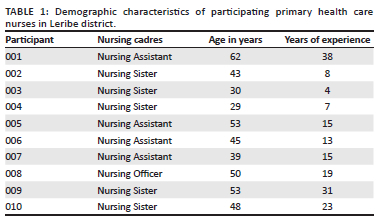
Two to three participants were selected for the four identified facilities. The ages of the nurses ranged from 29 years to 62 years. The researcher conducted interviews in close-by PHCCs and then moved to distal PHCCs. Therefore, this study employed a purpose sampling technique, particularly the maximum variation sample, in which participants with various work experiences, training, skills and different age groups were selected.
Data collection
To invite women nurses willing to participate in this study, the study's information sheet, which included invitations to participate, was sent to the District Health Management Team (DHMT) to distribute or send to all women nurses within the district. The researcher made telephone appointments with the facility managers about the interviews. On the scheduled interview days, the researcher interviewed nurses who were eligible, available and willing to participate. According to Sim et al.,2526
In-depth face-to-face, semi-structured interviews, which lasted for 20 to 30 min, were conducted using an interview guide (Online Appendix 1) with a reliable audio recorder (participants granted permission for recording), enabling the researcher to observe non-verbal behaviour. The semi-structured interview guide allowed the researcher to ask spontaneous questions, follow-up questions and seek more information. The researcher did not take any field notes as she was observing the participants for non-verbal behaviour. Although the interviews were conducted in English, the participants were allowed to respond in Sesotho, their home language, allowing them to express themselves in depth.
Data analysis
Following the in-depth face-to-face recorded interviews, the researcher translated and transcribed the audiotapes from Sesotho into English. The transcribed data were then analysed using thematic analysis, using the following steps as explained by Maguire and Delahunt.27
Measure of trustworthiness
Credibility is described as the extent to which the findings correctly reflect the truth about what the participants went through.28
Transferability refers to the extent to which qualitative research findings can be transferred to other settings with different respondents.28
Dependability refers to the consistency of results over comparable contexts.292929
Confirmability aims to ensure that the study's findings are not impacted by any biases or preferences of the researcher.28
Reflexivity
According to Palaganas et al.,30
At the time when the research was conducted, the researcher was working in another PHCC named Emmanuel Health Centre. This time around, cervical cancer screening was mostly done at PHCCs through mainly visual inspection methods and a few smears. The researcher became interested in this topic because she needed to get an in-depth understanding of PHC nurses' perceptions of cervical cancer screening.
The preceding autobiography was used to neutralise the impact of the researcher's subjectivity. The neutralising work was achieved through bracketing, in which a researcher kept a reflexive journal to reflect on her perceptions.
Ethical considerations
Ethical approval to conduct this study was obtained from the University of KwaZulu-Natal Biomedical Research Ethics Committee (No. BREC/00006211/2023). It was ensured that participation was voluntary and that participants had the right to withdraw from the study at any time. Before participating in the study, participants signed an informed consent form and granted verbal consent for recording. Participant codes were used to reference verbatim quotes.
Results
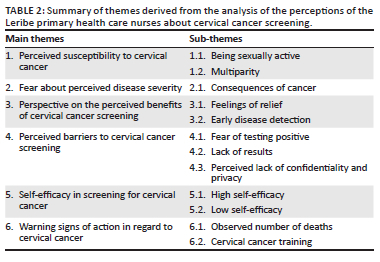
The findings of the study (see Table 2) are presented under the broad themes identified from the data that addressed the objective of the study, which was to describe the perceptions of PHC nurses about cervical cancer screening in the Leribe district in Lesotho. From the analysis of the findings, six themes (perceived susceptibility, fear of perceived disease severity, outlook on the perceived benefits of cervical cancer screening, perceived barriers to cervical cancer screening, self-efficacy in cervical cancer screening and cues to action) and sub-themes (multiparity, being sexually active, cancer consequences, feelings of relief, early disease detection, fear of testing positive, lack of results, perceived lack of privacy and confidentiality, high self-efficacy, low self-efficacy, cervical cancer training and observed number of deaths) were identified.
In all, 10 respondents participated in this study. Table 1 presents the profile of these respondents in terms of their backgrounds, age and years of work experience. Their ages ranged from 29 years to 62 years, with work experience from 4 years to 38 years. Regarding their cadres, they ranged from nursing assistants as the lowest cadre to nursing sisters and nursing officers as the highest cadre. The rest of the findings is presented and grouped in themes, with the verbatim excerpts of the participants presented in italics.
Theme 1: Perceived susceptibility to cervical cancer
Participants in this study acknowledged being susceptible to cervical cancer because they were sexually active and associated the risk of developing cervical cancer with multiparity.
Sub-theme 1.1: Being sexually active
'I understood that I needed to be tested for cervical cancer, especially because I am sexually active and of childbearing age.' (003, 29 years, Nursing Sister)
Sub-theme 1.2: Multiparity
'I decided to get tested because I noticed that there were too many cases of cervical cancer and because I have more than two children, I thought I was at high risk of having cervical cancer.' (001, 62 years, Nursing Assistant)
Because of this perceived susceptibility to cervical cancer, some nurses were self-motivated to get screened for it.
Theme 2: Fear about perceived disease severity
Similarly to the preceding statements, the fear of cancer and its consequences appeared to encourage nurses to undergo screening. To underscore this issue, the participants said:
'I feared cancer and noticed that people with cancer suffer a lot, so I did not want to suffer.' (001, 62 years, Nursing Assistant)
Sub-theme 2.1: Consequences of cancer
'Maybe it's because we have seen so many women with cancer at certain stages, some having to undergo a hysterectomy. So, I don't want to find myself in such situations.' (003, 30 years, Nursing Sister)
Theme 3: Perspective on the perceived benefits of cervical cancer screening
Some participants cited factors that encouraged them to screen for cancer, including feelings of relief after testing.
Sub-theme 3.1: Feelings of relief
'I don't know if my mind was playing tricks on me. After the workshop, I felt something like pain down here (pointing to the lower abdomen). However, after screening and receiving the results, the pain was no longer there.' (010, 48 years, Nursing Sister)
'Yes, because even when my time to repeat the screening has passed, I would feel like I have lower abdominal pain. So, I would regret not doing what I should have done.' (006, 45 years, Nursing Assistant)
From these statements, it appears that the information that the nurses received and the knowledge of what needed to be done caused unusual agony (which was just psychological), which the negative results helped relieve.
Sub-theme 3.2: Early disease detection
Another encouraging factor was early detection of the disease. One participant stated:
'[…A]lso, it is better to screen early than late when cancer has advanced.' (001, 62 years, Nursing Assistant)
Half of the participants agreed with this sentiment. Following are some of the comments of the participants about early disease detection:
'But when we started working and attended training, we got a clear picture that if one does not detect on time, this cancer can progress to a stage where it cannot be treated or has metastasized to other parts of the body.' (003, 30 years, Nursing Sister)
'I wanted to know my cancer status so that I could be treated early if I had it, and to avoid complications that would require treatment outside the country or stage in which I would be terminally ill.' (008, 50 years, Nursing Officer)
Theme 4: Perceived barriers to cervical cancer screening
Although some participants cited factors that encouraged them to be screened, some expressed factors that discouraged them from seeking further screening tests.
Sub-theme 4.1: Fear of testing positive
Perception of positive testing and their ability to handle it was a key factor that discouraged nurses from screening routinely:
'So, after taking the test, I was stressed about my results and wondered how I would feel if they were positive. That is why I wanted them out urgently to escape the stress of waiting for the result.' (006, 45 years, Nursing Assistant)
'I was worried and asked myself what would happen to me if the results were positive.' (005, 53 years, Nursing Assistant)
It is evident from these statement that nurses perceive themselves as at risk of cervical cancer.
Sub-theme 4.2: Lack of results
Even though nurses perceive themselves as at risk, the prolonged waiting period of the participants for their subsequent screening could be caused by the second factor, delay in receiving the results, or worse, not receiving them at all. The participants underscored this by saying:
'[…T]hey performed a Pap smear whose results never returned.' (009, 53 years, Nursing Sister)
'Those (the results of the samples) that are taken to the referral hospital do not always come back. I think they return the results only when they are positive. When I look at the patients' results, their turnaround time is too long.' (001, 62 years, Nursing Assistant)
Failure to get results could be because of the inadequacy of the health system, as one participant puts it:
'…VIA because you get the results immediately. But with a Pap smear, there is a problem; we were told that there was a backlog caused by the reagents being out of stock and so on.' (009, 53 years, Nursing Sister)
Sub-theme 4.3: Perceived lack of confidentiality and privacy
Fears of positive testing and the long turnaround time of the results were not the only factors; some participants expressed concerns about the perceived lack of confidentiality and privacy of their screening partners:
'It's like the person conducting your screening is going to look at your private parts, and then they would talk about you … Yes, like here at work, when someone looks at you, it's like they are saying ah, what I saw on this one, ah (laughed and said it with a condescending face).' (005, 53 years, Nursing Assistant)
This position implies that nurses often go for screening tests in unfamiliar facilities rather than in their places of employment.
Theme 5: Self-efficacy in screening for cervical cancer
As reported earlier, the participants' experiences and perceptions impacted their decisions on whether or not to take subsequent screening tests.
Sub-theme 5.1: High self-efficacy
Those with positive experiences had high self-efficacy and were therefore confident in adopting healthy behaviour and regularly undertaking screening tests:
'I will go to the screening without worrying about anything, knowing that anything is possible and the results can be positive or negative. When they are positive, according to the health education I received, I will just have to take care of myself. When positive, treatment is available, so I shouldn't be concerned.' (002, 43 years, Nursing Sister)
This statement suggests that nurses' confidence in taking screening tests depends on the health education they receive. Therefore, nurses also need health education to make the right decision about undergoing cervical cancer screening.
Sub-theme 5.2: Low self-efficacy
For others, their low self-efficacy had affected their confidence in their ability to detect cervical cancer again in the future:
'I don't know why it has taken me this long to repeat the test, I believe it's because this nurse of mine no longer works there. And you know, when you are not sick, you don't feel the need to go back, especially because I was motivated by the training.' (010, 48 years, Nursing Sister)
It appears that the low self-efficacy of this participant in reversing the screening was because of the absence of her preferred healthcare professional, whom she was familiar with and who worked in a different facility from her.
Of the two participants who indicated a preference for the HPV test, one expressed that the inaccessibility of her preferred screening method put her in low self-efficacy, as she said:
'I am never taking the test again until the HPV test is available, then I can conduct my own screening. I don't want to be seen naked.' (004, 29 years, Nursing Sister)
It appears that this participant had low self-efficacy because of her past experiences of being seen naked. This reaffirms the analysis made earlier on about the perceived lack of confidentiality and privacy of nurses in their screeners, hence, the desire for screening that involves self-sampling. The preceding statements also reaffirm the analysis made earlier that health education (and/or training) plays an important role in reactivating nurses to screen. If nurses are motivated by training and health education, it is quite clear that health education can do a lot for the general public.
Theme 6: Warning signs of action in regard to cervical cancer
In addition to the confidence of the participants in their ability to act and undergo cervical cancer screening, they also reported factors that prompt action.
Sub-theme 6.1: Observed number of deaths
Among factors that prompt action were the observations that the participants have made throughout the course of their careers:
'I had never been tested and seeing that women were dying of cervical cancer, I felt I should be tested.' (008, 50 years, Nursing Officer)
Sub-theme 6.2: Cervical cancer training
Another reported factor was the cervical cancer training nurses received:
'After receiving the training, what was taught made me get screened so that when I encourage others, I also know the good and bad of it or what the consequences would be of delaying undergoing the screening.' (007, 39 years, Nursing Assistant)
It appears that training the nurses received not only prompted action among them alone but also allowed them to have honest conversations with their clients. Therefore, it is safe to assume that frequent training can potentially positively influence cervical cancer screening among nurses and, in turn, among the general population.
Discussion
Our study indicated the varying perceptions that encouraged or inhibited nurses from routinely screening for cervical cancer. Among those that were encouraging, the most cited was perceived susceptibility to cervical cancer among nurses, who believe they are at risk of the disease because they are sexually active and have more than two children and therefore felt the need to get tested. The results of a Turkish study, including nurses and midwives, agree with these findings. In that study, participants who had given birth once or twice were more likely than those who had never given birth to have had Pap smear tests at least once in their lifetime.31
Furthermore, based on their perception of their own risk of cervical cancer, the nurses in this study also perceived benefits of cervical cancer screening. Thus, they thought that screening would help detect the disease early and that they would be relieved if the results were negative. These results are consistent with those of the study conducted by De Queiroz Neves et al.,32
In this study, what inhibited nurses from undergoing routine screening were perceived barriers to cervical cancer screening, including their ability to cope with a positive (abnormal) test result, the perceived lack of privacy and confidentiality in the screeners, especially when the screeners are their colleagues, and the delay in receiving the results. Several studies20,33202033
As previously discussed, despite the perceived barriers that discouraged nurses from undergoing routine screening, they had positive perceptions of self-efficacy and therefore persisted in undergoing screening. This is similar to a study conducted by Suantika et al.,20
In addition to the high self-efficacy of the participants, certain cues encouraged them to take the screening tests. For example, the observations made by nurses regarding the number of deaths from cervical cancer. Moreover, the cervical cancer training that nurses received played a crucial role in motivating and recalling nurses to take the screening tests. These findings are consistent with a study conducted in three selected public hospitals in Ethiopia among female health professionals. According to the results of that study, respondents who had received training in cervical cancer screening were 1.6 times more likely to be screened for the disease than those who had not.3435
The older participants, that is, those over 30 years of age with more than 10 years of work experience, had more than one screening test compared to younger participants with less than 10 years of work experience. These findings are almost comparable to those of a study conducted in Nigeria with participants under 30 years of age and who had practised for 5 years or less.17363731
Strengths
Through the use of an exploratory qualitative design, the study explored the perceptions of PHC nurses about cervical cancer screening, as this design allowed the researcher to probe more into the area. Furthermore, this study makes an important contribution to the body of knowledge on how cervical cancer screening programmes can be enhanced in light of the perceptions of nurses that encouraged routine screening and those that discouraged nurses from routine screening.
Limitations
Because of the design of this study, only one nursing officer participated in this study as the nursing officers at other PHCCs were unable to participate because of work restrictions. Therefore, future research should consider the availability of all nursing cadres. Since this study was unfunded and conducted by a full-time employee, the interviews were only conducted among nurses working in PHCCs located in lowland areas. Therefore, the transferability of these findings is limited. Future research with PHC nurses in remote and highland locations should be considered to explore this topic in depth.
Recommendations
Based on the study findings, the authors recommend the following: Firstly, since most nurses were inspired to detect cervical cancer from what they learned about it, regular cervical cancer training is recommended among HCWs. Secondly, interventions to improve the turnaround time of the results should be explored, as one of the factors that deterred nurses from screening was the waiting period for the results. Thirdly, less intrusive screening modalities should be investigated to alleviate the discomfort caused by existing methods of cervical cancer screening. One of these less intrusive screening modalities, HPV testing, was only introduced in the Leribe district months after data collection. Therefore, we recommend further studies on how to improve the screening experience, as the new Guide for Human Papillomavirus Test and Management.38
Conclusion
The study shows that PHC nurses participate in cervical cancer screening. However, the problem is routine screening. Even those who had subsequent screenings had them long after the due dates. Their perceptions of cervical cancer screening are one of the factors that contribute to this and might also contribute to fewer screening recommendations and education for the general public by these health professionals who understand the importance of screening but prefer to postpone the planned screening because of these perceptions. As seen in the Results section, the most often suggested way around this obstacle is to attend routine cervical cancer training sessions, since the information they learn there encourages nurses to be screened.
Competing interests
The authors declare that they have no financial or personal relationships that may have inappropriately influenced them in writing this article.
Authors' contributions
The authors, M.G.P. and S.B.D., were involved in the design and theoretical basis for this study. M.G.P. conducted the research under the supervision of S.B.D. The authors read and approved the content of the manuscript.
Funding information
This research received no specific grant from any funding agency in the public, commercial or not-for-profit sectors.
Data availability
The datasets generated and/or analysed during the current study are not publicly available because of confidentiality but are available from the corresponding author, M.G.P., upon reasonable request.
Disclaimer
The views and opinions expressed in this article are those of the authors and are the product of professional research. The article does not necessarily reflect the official policy or position of any affiliated institution, funder or agency or that of the publisher. The authors are responsible for this article's results, findings and content.
Acknowledgements
The authors would like to thank all the participants for their active participation despite their busy schedules. They would like to thank the Leribe District Health Management Team and the PHCC managers for permitting them to conduct this research in their facilities. This article is partially based on the author, Maliketso Polane's dissertation titled 'Exploring the Primary Healthcare Nurses' Lived Experiences of Cervical Cancer Screening in Leribe District' towards the degree of Master of Public Health in the Department of Public Health Medicine, University of KwaZulu-Natal, South Africa in 2025, with supervisor Dr Siyabonga Dlamini.
References
-
1. Singh D, Vignat J, Lorenzoni V, et al. Global estimates of incidence and mortality of cervical cancer in 2020: A baseline analysis of the WHO Global Cervical Cancer Elimination Initiative. Lancet Glob Health. 2023;11(2):e197-e206. https://doi.org/10.1016/S2214-109X(22)00501-0
» https://doi.org/10.1016/S2214-109X(22)00501-0 -
2. Bray F, Laversanne M, Sung H, et al. Global cancer statistics 2022: GLOBOCAN estimates of incidence and mortality worldwide for 36 cancers in 185 countries. CA Cancer J Clin. 2024;74(3):229-263. https://doi.org/10.3322/caac.21834
» https://doi.org/10.3322/caac.21834 - 3. Anyebe E, Opaluwa S, Muktar H, Philip F. Knowledge and practice of cervical cancer screening amongst nurses in Ahmadu Bello University Teaching Hospital Zaria. Cancer. 2014;4(27):33-40.
-
4. Lim JN, Ojo AA. Barriers to utilisation of cervical cancer screening in sub-Sahara Africa: A systematic review. Eur J Cancer Care. 2017;26(1):e12444. https://doi.org/10.1111/ecc.12444
» https://doi.org/10.1111/ecc.12444 -
5. Cancer IAfRo. Global cancer observatory 2022 [homepage on the Internet]. [cited 2024 Jul 22]. Available from: https://gco.iarc.who.int/media/globocan/factsheets/populations/426-lesotho-fact-sheet.pdf
» https://gco.iarc.who.int/media/globocan/factsheets/populations/426-lesotho-fact-sheet.pdf -
6. Dsouza JP, Broucke SVd, Pattanshetty S, Dhoore W. A comparison of behavioural models explaining cervical cancer screening uptake. BMC Women's Health. 2022;22(1):235. https://doi.org/10.1186/s12905-022-01801-2
» https://doi.org/10.1186/s12905-022-01801-2 -
7. Mkhonta SS, Shirinde J. Registered nurses' perspectives on barriers of cervical cancer screening in Swaziland: A qualitative study. Pan Afr Med J. 2021;38(1):295. https://doi.org/10.11604/pamj.2021.38.295.22431
» https://doi.org/10.11604/pamj.2021.38.295.22431 -
8. Pegu B, Dhiman N, Chaturvedi J, Sharma SK. Nurse's knowledge and attitude regarding cervical cancer screening at a tertiary care hospital. Int J Reprod Contracept Obstet Gynecol. 2017;6(5):907-910. https://doi.org/10.18203/2320-1770.ijrcog20170554
» https://doi.org/10.18203/2320-1770.ijrcog20170554 -
9. Ampofo AG, Adumatta AD, Owusu E, Awuviry-Newton K. A cross-sectional study of barriers to cervical cancer screening uptake in Ghana: An application of the health belief model. PLoS One. 2020;15(4):e0231459. https://doi.org/10.1371/journal.pone.0231459
» https://doi.org/10.1371/journal.pone.0231459 -
10. Nyangu I, Moteane T. Young women's knowledge and attitudes towards cervical cancer screening at a selected higher education institution in Lesotho. medRxiv. 2021:2021.10. 11.21264801. https://doi.org/10.1101/2021.10.11.21264801
» https://doi.org/10.1101/2021.10.11.21264801 -
11. Mphunyane EM, Nyangu I. Attitudes and practices of women towards cervical cancer screening in Lesotho: A descriptive cross-sectional survey. Am J Nurs Health Sci. 2024;5(3):51-57. https://doi.org/10.11648/j.ajnhs.20240503.11
» https://doi.org/10.11648/j.ajnhs.20240503.11 -
12. Harder MT, Mokete M, Chammartin F, et al. Cervical cancer screening delay and associated factors among women with HIV in Lesotho: A mixed-methods study. BMC Women's Health. 2024;24(1):543. https://doi.org/10.1186/s12905-024-03382-8
» https://doi.org/10.1186/s12905-024-03382-8 - 13. Owolabi BA, Adejumo PO. Utilization of cervical cancer screening service among nurses in Ekiti State, Nigeria. Cancer Res J. 2021;9(1):71.
-
14. Abebaw E, Tesfa M, Gezimu W, Bekele F, Duguma A. Female healthcare providers' knowledge, attitude, and practice towards cervical cancer screening and associated factors in public hospitals of Northwest Ethiopia. SAGE Open Med. 2022;10:20503121221095931. https://doi.org/10.1177/20503121221095931
» https://doi.org/10.1177/20503121221095931 -
15. Chawla B, Taneja N, Awasthi AA, Kaur KN, Janardhanan R. Knowledge, attitude, and practice on screening toward cervical cancer among health professionals in India-A review. Women's Health. 2021;17:17455065211017066. https://doi.org/10.1177/17455065211017066
» https://doi.org/10.1177/17455065211017066 -
16. Tay K, Tay SK, Tesalona KC, Rashid NM, Tai EY, Najib SJ. Factors affecting the uptake of cervical cancer screening among nurses in Singapore. Int J Gynecol Obstetr. 2015;130(3):230-234. https://doi.org/10.1016/j.ijgo.2015.03.037
» https://doi.org/10.1016/j.ijgo.2015.03.037 -
17. Ifemelumma CC, Anikwe CC, Okorochukwu BC, et al. Cervical cancer screening: Assessment of perception and utilization of services among health workers in low resource setting. Int J Reprod Med. 2019;2019:6505482. https://doi.org/10.1155/2019/6505482
» https://doi.org/10.1155/2019/6505482 -
18. Oyekale R, Oluwatosin A, Edet B. Predictors of uptake of cervical cancer screening among nurses in Ogbomoso, Oyo State, Nigeria. Am Soc Clin Oncol. 2018;4(Suupl 2):7s-7s. https://doi.org/10.1200/jgo.18.88000
» https://doi.org/10.1200/jgo.18.88000 -
19. Ramathebane MM, Sooro MA, Kabuya RM, Sayed A-R. Knowledge and attitudes relating to cervical and breast cancer among women in Maseru, Lesotho. Afr J Prim Health Care Fam Med. 2022;14(1):8. https://doi.org/10.4102/phcfm.v14i1.3459
» https://doi.org/10.4102/phcfm.v14i1.3459 -
20. Suantika PIR, Hermayanti Y, Kurniawan T. Factors associated with participation of nurses in early detection of cervical cancer. Belitung Nurs J. 2019;5(1):47-53. https://doi.org/10.33546/bnj.610
» https://doi.org/10.33546/bnj.610 -
21. Armat MR, Assarroudi A, Rad M. Inductive and deductive: Ambiguous labels in qualitative content analysis. Qual Rep. 2018;23(1):219-221. https://doi.org/10.46743/2160-3715/2018.2872
» https://doi.org/10.46743/2160-3715/2018.2872 - 22. Mbaka N, Isiramen OM. The changing role of an exploratory research in modern organisation. GPH-Int J Bus Manage. 2021;4(12):27-36.
-
23. Lesotho Go. National Strategic Development Plan 2018 [homepage on the Internet]. 2018 [cited 2023 Apr 01]. Available from: https://www.gov.ls/wp-content/uploads/2021/06/National-Strategic-Development-Plan-II-2018-19-2022-23.pdf
» https://www.gov.ls/wp-content/uploads/2021/06/National-Strategic-Development-Plan-II-2018-19-2022-23.pdf -
24. Mostafa MA, Ogunmuyiwa JO, Tenney KA, et al. Health for all: Primary care facility localization in Lesotho using qualitative research and GIS. Glob Trans. 2024;6:123-135. https://doi.org/10.1016/j.glt.2024.05.002
» https://doi.org/10.1016/j.glt.2024.05.002 -
25. Sim J, Saunders B, Waterfield J, Kingstone T. Can sample size in qualitative research be determined a priori? Int J Soc Res Methodol. 2018;21(5):619-634. https://doi.org/10.1080/13645579.2018.1454643
» https://doi.org/10.1080/13645579.2018.1454643 -
26. Sarfo JO, Debrah T, Gbordzoe N, Afful W, Obeng P. Qualitative research designs, sample size and saturation: Is enough always enough. J Advoc Res Educ. 2021;8(3):60-65. https://doi.org/10.13187/jare.2021.3.60
» https://doi.org/10.13187/jare.2021.3.60 - 27. Maguire M, Delahunt B. Doing a thematic analysis: A practical, step-by-step guide for learning and teaching scholars. All Ireland J High Educ. 2017;9(3):3351.
-
28. Ahmed SK. The pillars of trustworthiness in qualitative research. J Med Surg Public Health. 2024;2:100051. https://doi.org/10.1016/j.glmedi.2024.100051
» https://doi.org/10.1016/j.glmedi.2024.100051 -
29. Haq ZU, Rasheed R, Rashid A, Akhter S. Criteria for assessing and ensuring the trustworthiness in qualitative research. Int J Bus Reflect. 2023;4(2):150-173. https://doi.org/10.56249/ijbr.03.01.44
» https://doi.org/10.56249/ijbr.03.01.44 -
30. Palaganas EC, Sanchez MC, Molintas MVP, Caricativo RD. Reflexivity in qualitative research. The Qualitative Report. 2017;22(2): 426-438. https://doi.org/10.46743/2160-3715/2017.2552
» https://doi.org/10.46743/2160-3715/2017.2552 -
31. Yörük S, Açıkgöz A, Türkmen H, Ergör G. Risk factors and relationship between screening periodicity and risk of cervical cancer among nurses and midwives. A cross-sectional study. Sao Paulo Med J. 2019;137(2):119-125. https://doi.org/10.1590/1516-3180.2018.0244230119
» https://doi.org/10.1590/1516-3180.2018.0244230119 - 32. De Queiroz Neves, KT, Oliveira, AWN, Galvão, TRAF, Ferreira, IT, Mangane, EM, De Sousa, LB. Users'perception of screening tests for preventing cervical cancer. Cogitare Enferm. 2016;21(4):01-07.
-
33. Butler TL, Anderson K, Condon JR, et al. Indigenous Australian women's experiences of participation in cervical screening. PLoS One. 2020;15(6):e0234536. https://doi.org/10.1371/journal.pone.0234536
» https://doi.org/10.1371/journal.pone.0234536 -
34. Aytenew TM, Kassie YT, Kebede SD. Uptake of cervical cancer screening and its barriers using health belief model among health professionals working in public hospitals in South Gondar Zone, Northcentral Ethiopia: Multicenter cross-sectional study. Womens Health Rep (New Rochelle). 2024;5(1):152-160. https://doi.org/10.1089/whr.2023.0030
» https://doi.org/10.1089/whr.2023.0030 -
35. Gonul K, Akyuz A. Evaluating the effectiveness of interventions on increasing participation in cervical cancer screening. J Nurs Res. 2019;27(5):e40. https://doi.org/10.1097/jnr.0000000000000317
» https://doi.org/10.1097/jnr.0000000000000317 -
36. Daglas V, Kostopoulos N, Mrvoljak-Theodoropoulou I, et al. Healthcare professionals' attitudes and practices according to their recommendations on exercise during the first trimester of pregnancy: A Greek cross-sectional study. Sports (Basel). 2024;12(7):173. https://doi.org/10.3390/sports12070173
» https://doi.org/10.3390/sports12070173 -
37. Vishram B, Letley L, Jan Van Hoek, A, et al. Vaccination in pregnancy: Attitudes of nurses, midwives and health visitors in England. Hum Vaccin Immunother. 2018;14(1):179-188. https://doi.org/10.1080/21645515.2017.1382789
» https://doi.org/10.1080/21645515.2017.1382789 - 38. Lesotho Ministry of Health. Guidance for human papilloma virus test and management for the prevention of cervical cancer in Lesotho. 2024.

Accepted: 02 July 2025
Published: 05 Sept. 2025