Knowledge, attitude and practice of infant feeding in the first 6 months among HIV-positive mothers at the Queen Mamohato Memorial hospital clinics, Maseru, Lesotho
Abstract
BACKGROUND: The balance between the risks of transmission of human immunodeficiency virus (HIV) through breastfeeding and its life-saving benefits complicates decisions about infant feeding among HIV-positive mothers in the first 6 months. OBJECTIVE: The aim of this study was to assess the knowledge, attitude and practice of infant feeding among HIV-positive mothers attending the prevention of mother-to-child transmission services in Maseru, Lesotho. METHOD AND SETTING: This observational cross-sectional study was done by collecting data from HIV-positive mothers attending the filter clinics of Queen Mamohato Memorial hospital in Maseru, Lesotho. HIV-positive mothers with infants below the age of 6 months attending the clinics at the time of the study were interviewed using a standardised questionnaire. We described the sociodemographic profile of the mothers, the information and education received on prevention of mother-to-child transmission (PMTCT) infant feeding options, the mothers' knowledge, attitudes and practices of infant feeding, and assessed risk factors for improved knowledge, attitudes and practices. RESULTS: The majority (96%) of the 191 HIV-positive mothers who participated in the survey knew about the PMTCT programme and related breastfeeding services. Most of the participants chose to breastfeed (89%), while only 8% formula-fed their infants. Knowledge received during the PMTCT programme was significantly associated with the decision to exclusively breastfeed their infants. Earlier infant feeding counselling and education was associated with more exclusively breastfeeding as compared to late infant feeding counselling (p < 0.001 CONCLUSION: The study found that HIV-positive mothers attending health clinics in Maseru, Lesotho, had high knowledge, and appropriate attitudes and practices with respect to infant feeding; and that early counselling and education improved infant feeding methods among these mothers.
Introduction
The Joint United Nations Programme on HIV/AIDS (UNAIDS) reported in 2015 that there were an estimated 36.7 million people living with HIV globally, 1.8 million of whom were children. Of this population, 2.1 million were newly infected and 1.1 million died from the disease.122
The prevention of mother-to-child transmission (PMTCT) of HIV programme was officially launched in Lesotho in February 2003, and it serves as an entry point for the prevention of HIV infection and care of HIV-infected women and their exposed infants. Currently there are 186 PMTCT sites, reflecting an increase in programme coverage from 16% in 2006 to 71% in 2009. This was made possible by the expanded training of health care providers, adoption of the provider-initiated testing approach, involvement of partners at implementation sites and the decentralisation of PMTCT services to health centre level in the entire country. PMTCT services are integrated into antenatal clinics (ANC) and all other maternal and child health (MCH) services.333
In Lesotho, the general population of mothers who exclusively breastfed their infants under 6 months has increased over the last decade, from 36% in 2004 to 67% in 2014.445
In 1999, De Cock et al. estimated that between 5% and 20% of infants would become infected if breastfed beyond 18 months.6786769
The Government of Lesotho has implemented several HIV prevention strategies, including educational campaigns, work-based HIV prevention initiatives, the targeting of high-risk groups and PMTCT.10111
The PMTCT programme in Lesotho has made some advances in the past few years by creating great awareness of MTCT around the country.1110,11122
The following WHO or United Nations Children's Fund or UNAIDS definitions are used for describing feeding options: EBF is defined as giving only breast milk and prescribed medicine, but no water, other liquids or food to infants. Exclusive replacement feeding (ERF) is the process of feeding a child who is not receiving any breast milk with a diet that provides all the nutrients the infant needs. Exclusive formula feeding is defined as feeding an infant only with prepared formula instead of the breast milk. Mixed feeding is defined as giving other liquids or foods together with breast milk to infants under 6 months of age.1010
The 2014 Lesotho National ARV guidelines recommend EBF for the first 6 months of an infant's life, lifelong ARVs for the mother and Nevirapin (NVP) from birth to 6 weeks of the infant's life.2
The above recommendations align with international recommendations for RF summarised as acceptable, feasible, affordable, sustainable and safe (AFASS).1011,12
No previous studies have been conducted on the KAP of infant feeding among HIV-positive mothers in Lesotho. A South African study among 815 HIV-positive mothers attending postnatal clinics (mothers' mean age was 27.7 years) showed that 71% knew that HIV could be transmitted during pregnancy, 78.7% knew that it could be transmitted during delivery and 78% agreed that it could be transmitted by breastfeeding. Half (50.6%) were EFF, 35.6% EBF and 12.4% reported MF. The study reported that 94.4% of women had received counselling on IFOs, although 14.7% did not receive counselling on IFOs within 72 h of delivery. Of the participants, 93% received information on the dangers of MF.13
A study in Kenya to assess the KAP with regard to infant feeding in the context of HIV showed that most of the respondents (85.5%) knew about breastfeeding as a route of HIV transmission. Breastfeeding was the custom in the society, but exclusive breastfeeding was not practiced among HIV-positive mothers. Cow's milk, the main breast milk substitute, was reported as being given to infants as early as 2 weeks and was the most popular (93.5%) IFO in the context of HIVand AIDS.14
In Uganda, a study on the knowledge of MTCT of HIV among women enrolled in the PMTCT programme showed that out of 198 women, 26% believed that transmission of the virus is inevitable.1516
Most of these studies demonstrated the major predictors of IFOs ranging from maternal attributes, mode of delivery and disclosure of HIV status to a spouse.
However, the most important factor was the knowledge acquired during the PMTCT programme.17
Community views concerning the dangers of HIV transmission through breastfeeding and the discrimination associated with not breastfeeding make it difficult for HIV-positive mothers to initiate and maintain optimal infant feeding practices.1819
The aim of this study was therefore to determine the extent to which HIV-positive mothers attending PMTCT services in Lesotho complied with recommended infant feeding practices, and to identify factors that influenced their KAP.6
Self-reported maternal recall has been found to be a valid and reliable method of describing breastfeeding practices in cross-sectional studies, particularly for recall periods of less than 6 months.20
Methods
Study design and setting
A cross-sectional study design was used to describe the infant feeding KAP of HIV-positive mothers registered at three primary health care facilities (Mabote, Qoaling and Likosi clinics) which refer patients to the Queen Mamohato Memorial hospital located in Maseru the capital city of Lesotho. The three clinics serve an estimated population of approximately 89 000 in the city of Maseru, which has a total population of about 4 million.18,21
Sampling and data collection
Systematic sampling was employed to select HIV-positive mothers 18 years and older, with infants less than 6 months old, who visited and registered at the clinics during February and March 2015. Data collection was conducted using face-to-face interviews to complete a standardised questionnaire (Appendix 1) with each mother at the health facility. Mothers or infants with acute, life-threatening illness or neonatal deaths before 6 months were excluded from the study.
The desired sample size of 191 was estimated using Fisher's formula, with the assumption of 95% confidence level, a margin of error of 5% and a prevalence value of knowledge of infant feeding based on western Kenya of 85.5%.21
Data handling and analysis
Three hospital nurses who were trained as research assistants conducted the interviews in the native language of the participants using a structured questionnaire which was adapted from an earlier WHO AIDS Questionnaire.2223
The analysis described the sociodemographic characteristics of participants, exposure to IEC on PMTCT and IFOs, and KAP of PMTCT and infant feeding. The results were organised in frequency counts, tables and graphs. With regard to KAP about breastfeeding in PMTCT, the number of correct responses by participants was categorised as either 'high' or 'low' knowledge.
Bivariate analysis and Fisher's exact test or Pearson's chi-squared test were used to assess factors associated with the KAP of IFOs. A two-tailed probability level of p < 0.05 was chosen as the level of statistical significance in the analysis.
Fisher's exact test or Pearson's chi-squared test was used to compare results between categorical data. Some groups were combined because of small numbers as follows:
Completely satisfied or very satisfied or somewhat satisfied = Satisfied
Somewhat dissatisfied or very dissatisfied = Dissatisfied
No and do not know = No.
Ethical considerations
Ethical approval (Ref#: S15/09/213) was obtained from the Health Research Ethics Review Committee of the Faculty of Medicine and Health Sciences, University of Stellenbosch, South Africa. Informed consent was obtained from all participants who agreed to be interviewed.
Results
Demographic profile and factors associated with practising exclusively breastfeed among the participants
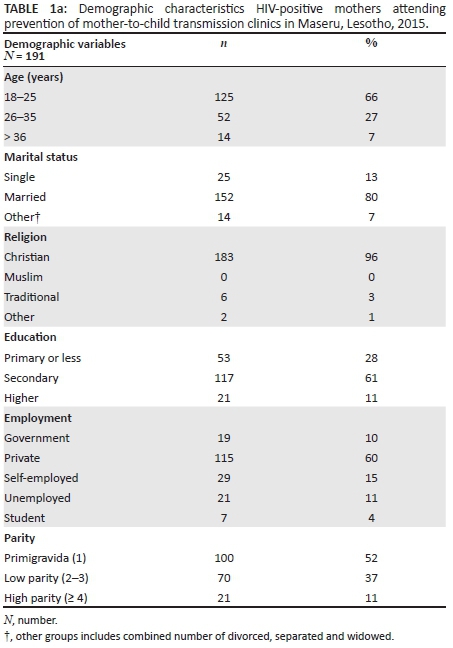
Data were obtained from 191 HIV-positive mothers who had infants between the ages of 2 weeks and 6 months. The demographic profile of the respondents, including age, marital status, education, employment status and parity, is summarised in Table 1.

The majority of respondents (189, 99%) had their infant tested for HIV, of whom 187 (98%) were HIV negative, while two (1%) of the infants had not received the test report during the period of the study. The viral load level was not included in the study. Of the 191 mothers, only two had a caesarean section done at the main hospital, while all others had a normal vaginal delivery. Most (134, 70%) of the mothers confirmed that their partner was aware of their HIV status. Of the 191 respondents, 189 (99%) were on ART, of whom 132 (69%) started therapy during pregnancy, 38 (20%) were on treatment before their pregnancy and 19 (10%) started therapy after delivery. Only two (1%) of the mothers were yet to start therapy. Other attributes of the mothers with respect to IEC like IFO on type of feeding to avoid are included in Table 1.
Knowledge, attitude and practice of infant feeding option
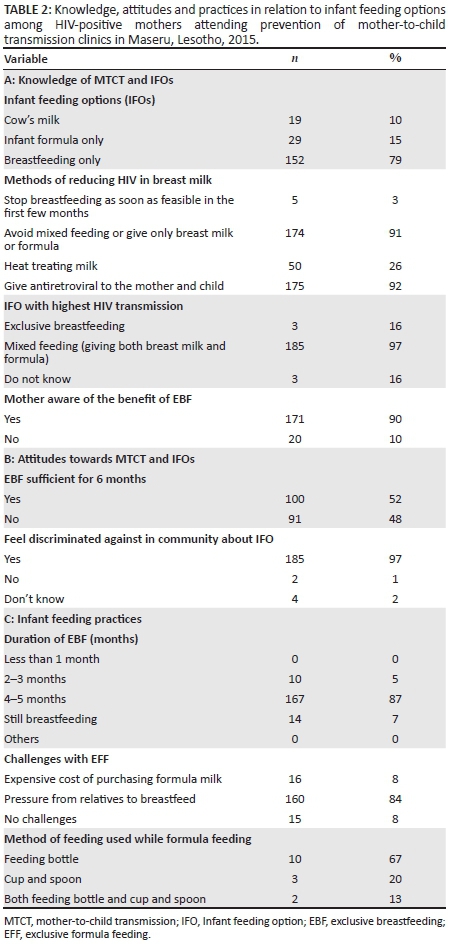
The various factors associated with KAP of HIV-positive in EBF their infants in the first six 6 months are displayed in Table 2.
The mothers' knowledge of MTCT through infant feeding was good. Most of the mothers (152, 80%) were aware of the two main IFOs (breastfeeding and IF), while only 39 (20%) had knowledge of other feeding options. Ninety-four per cent of the mothers (179) were aware of the risk of transmitting HIV to their infants during breastfeeding.
More than half (100, 52%) of the mothers agreed that breast milk alone was sufficient for the infant in the first 6 months, while 91 (48%) felt that this was not enough for proper growth.
The mothers' knowledge of methods of HIV transmission during breastfeeding was categorised as 'high' if the participant responded correctly to two or more of the questions, or 'low' if the participant responded incorrectly to two or more of the questions. Using this summarised score of mothers' knowledge about various methods of HIV transmission in MTCT, 76 (40%) of the participants gave one correct response, 65 (34%) gave two correct responses, and 50 (26 %) gave three correct responses.
The majority (176, 92%) of the HIV-positive mothers reported that even if provided with a free supply of IF, they would still prefer to exclusively breastfeed their infant, but 15 mothers (8%) preferred to formula feed their infants.
Most mothers (150, 78%) reported that their partners preferred them to EBF, but 30 (16%) partners preferred the mother to formula feed, while 11 (6%) mothers were not sure of the partner's preference. About half (90, 47%) of the mothers agreed that infant feeding practices were decided by family members, while the rest of the mothers embraced the advice of the health staff (67, 35%), self (32, 17%) and spouse (2, 1%), respectively. More than half of the mothers (152, 79%) felt that EBF was the best IFO, while the rest of the mothers preferred other IFO.
Most of the mothers were not adherent to their choice of feeding. The study revealed that more than three-quarters (150, 78%) introduced other feeds apart from breast milk at about 5-6 months, while 26 (14%) EBF for more than 6 months, and 15 (8%) introduced other feeds earlier.
Most of the mothers (156, 82%) did not experience any challenges with EBF, while 11 (6%) claimed to not have enough breast milk, 10 (5%) had either cracked or sore nipples or were ill and 4 (2%) experienced pressure from relatives or friends to give water, formula or solid food to their infants.
Mothers indicated that family pressure and concerns that breast milk would not be enough for their infant were the main reasons for using IF or MF before 6 months. Of the 15 mothers who EFF their infant, 14 (93%) did so because of the worry of HIV transmission through breastfeeding, and 1 (6%) was too ill with a breast problem. Of these formula feeding mothers, 10 (67%) used piped or tap water for their IF preparation, and 5 (33%) used water from a closed well. All mothers who agreed to formula feed indicated that the water was boiled before use. More than three-quarters (160, 96%) will prefer to EBF if provided with IF.
There was a statistically significant relationship between the mother's age (p < 0.001) and knowledge of methods of reduction of MTCT of HIV in infant feeding, with younger mothers aged 18-25 years being more knowledgeable. This did not however translate into a difference in EBF practices, with age not being associated with EBF at 4-5 months (p = 0.06).
The association between perception of the sufficiency of EBF in the first 6 months and mother's age (p < 0.08) and mother's education (p = 0.29) was not significant. The association between mothers' age and their desire to exclusively breastfeed their infants for the first 4-5 months was not statistically significant (p = 0.06).
Knowledge about various feeding options and the level of satisfaction with the level of information provided during the programme was not statistically significant at p = 0.68, but the knowledge acquired about the various IFs compared with the time this information was given during this programme was statistically significant ( p < 0.0001).
Mothers who received information, education and counselling on IFO early during pregnancy were more likely to exclusively breastfeed as compared to mothers who received IEC late in their pregnancy or postnatally (p = 0.01). Mothers' satisfaction with the IEC provided during the PMTCT programme was positively associated with EBF of infants (p = 0.006).
Discussion
This study investigated infant feeding KAP of HIV-positive mothers at health clinics referring to Queen Mamohato Memorial hospital in Maseru, Lesotho. The high response rate and profile of mothers who participated in the study is typical of HIV-positive women in developing countries where MTCT of HIV is a public health challenge.11
The majority of the mothers in the study were aware of the benefits of EBF and preferred to exclusively breastfeed their infants, in agreement with their mothers-in-law's and family advice. This is aligned with the strong cultural value attached to breastfeeding in the society.24
Most of the HIV-positive mothers were mindful of the risk of transmitting HIV to their infants during pregnancy, and the risk of MTCT associated with MF. This is similar to findings in other studies in sub-Saharan Africa, such as north-west Ethiopia, where most (89.5%) of the respondents had a good knowledge about EBF.25
The basic ethical principle of informed choice requires that HIV-positive mothers are provided with adequate information about their IFOs in the framework of PMTCT of HIV.6
Early provision of IEC during pregnancy was associated with higher rates of EBF among the mothers.
Many health workers at the facilities had received training in the PMTCT programme a year prior to the study.66
Most mothers were aware that they could transmit HIV to their infants through breastfeeding, but other modes of transmission of HIV were generally less well known. This compares well to findings from a study in Ogun State, Nigeria, which revealed that only 27% of respondents understood the transmission of HIV during infant feeding.24
However, it was observed that three-quarters of the HIV-infected mothers understood that they need to make a choice between EBF and EFF. This gap suggests that there is some room for improvement with respect to education and counselling on infant feeding.
This outcome suggests a need to intensify health education on EBF among the mothers, with more emphasis on the goal and objectives of safe infant feeding practices. There was also overwhelming evidence that not all the mothers felt that breast milk was sufficient for the first 6 months. This implies that the knowledge about the sufficiency of breast milk for the first 6 months among mothers in the context of HIV and AIDS is still limited.
The proportion of MF in this study was 10.5%, which is lower than that reported by a study conducted in Ghana (40%),17261227
In order to assess the role of society members, mothers were asked about who influenced their choice of IFO and the source of information. The most common source of information regarding IFOs adhered to by the mothers was from their mothers-in-law, followed closely by the nurses at the health facilities. It is worth noting that the preferences of IFOs by mothers are those of the relatives despite the fact that the main source of information about IFO was from the health facilities.
This reinforces the difficulty women with HIV face in adhering to infant feeding in the face of the often over-whelming pressures that they face from their families. It supports other studies which found that parents of HIV-positive mothers and other key family members are very important in MTCT prevention programmes.28
Few of the mothers who did not breastfeed did so because they were worried about transmitting the virus to their infants. This is similar to other studies in India, where the majority of the mothers chose not to breastfeed for similar reasons.29
The pressure from relatives and friends to give water or adult foods to the infants has been attributed as the other challenges preventing HIV-positive mothers from exclusively breastfeeding their infant in the first 6 months. Therefore, there is a need for a multidimensional behavioural change strategy involving mothers and other family members. The finding that most participants felt that HIV-positive mothers are still experiencing discrimination in the community further reinforces the need for broader IEC and behavioural change strategies.
Limitations
Only HIV-positive mothers attending the Queen Mamohato three filter clinics located in three large districts in Maseru were included in the study, limiting the generalisability of the study to the rest of Lesotho or other countries.
The maternal self-reporting method used in this study is a valid and reliable method of measuring knowledge and attitudes, as well as initiation and duration of breastfeeding particularly for short-term recall. However, it may overestimate EBF and underestimate MF practices. The involvement of health workers as research assistants may also have contributed to participants providing more 'socially acceptable' responses, leading to an overestimation of the desirable IFOs.
Lastly, as not all infants were 6 months old at the time of the survey, infant feeding practices may not reflect the actual 6-month practice of the mother infant pairs.
Recommendations
The finding that some of the participants do not receive the recommended counselling on infant feeding underscores the need for the PMTCT programme in Lesotho. Although the Lesotho policy is aligned with international recommendations, the government needs to improve upon the present level of education among mothers and the communities so that they can make informed choices with respect to proper IFOs.
Further research is needed to understand the factors that affect women's infant feeding decision-making, particularly the role of partners and mothers-in-law.
Conclusions
HIV-positive mothers attending the PMTCT programme in Lesotho generally are knowledgeable and show a positive disposition to EBF their infants, with a clear understanding of the benefits of EBF.
Concerns about the sufficiency of EBF in the first 6 months was noted to be the major factor for mothers practising other forms of infant feeding. Therefore, the education and counselling concerning postnatal HIV transmission and safe IFOs should be adequate and clear.
The support of mothers-in-law or other key family members is an important factor in determining HIV-positive mothers' infant feeding choices. Strong efforts should therefore be made to involve key family members in PMTCT programmes.
In summary, this study found that some mothers do not understand the risks of not practising correct IFOs, and confirmed that breastfeeding is considered a cultural norm as has been reported in similar settings of sub-Saharan Africa.30
Finally, my special thanks go to my wife, who gave me a hand when I most needed it.
This research project is prepared in partial fulfilment of the requirements for the Master's of Science in Clinical Epidemiology degree at the Faculty of Medicine and Health Sciences, Stellenbosch University, Cape Town, South Africa.
Competing interests
The authors declare that they have no financial or personal relationships that may have inappropriately influenced them in writing this article.
Author's contributions
S.O. conceptualised this study, facilitated data collection, and led the data analysis under the close supervision of my supervisor L.D. L.D. supervised the development of the research protocol, the data collection tools, the data analysis, and the drafting of the article, which included reviewing and contributing to the revision of the final manuscript.
Acknowledgements
Firstly, I wish to thank the Lord Almighty in Heaven through the Lord Jesus Christ for being with me and granting me the grace and strength throughout my studies. I am greatly indebted to Prof. Lilian Dudley, my supervisor, for her intelligent guidance, encouragement, support and most especially patience at every stage of this study. Without her invaluable input, it would not have been possible for me to complete this dissertation. I would like to thank Dr Karen Prins, my hospital director, all members of the Department of Community Health, University of Stellenbosch, and the course coordinator for their assistance. Also Prof. R. Mash who always responded to my email at odd times during the peer review.
References
-
1. UNAIDS. UNAIDS 2015 | AIDS by the numbers [homepage on the Internet]. [cited 2015 Mar 19]. Available from: www.unaids.org/sites/…/JC2571_AIDS_by_the_numbers_en_1.pdf
» www.unaids.org/sites/…/JC2571_AIDS_by_the_numbers_en_1.pdf -
2. Government of Lesotho. National Guidelines for HIV and AIDS care and Treatment. 2014 Government of Lesotho [homepage on the Internet]. Maseru. [cited 2015 Jun 08]. Available from: www.emtct-iatt.org/…/National-ART-Guidelines_Final_16-June-20142.pdf
» www.emtct-iatt.org/…/National-ART-Guidelines_Final_16-June-20142.pdf -
3. Government of Lesotho. Guidelines to prevent mother to child transmission of HIV 5th edition [homepage on the Internet]. 2016. [cited 2016 Aug 08]. Available from: www.health.gov.ls/documents/Revised%20PMTCT%20GUIDELINES.pdf
» www.health.gov.ls/documents/Revised%20PMTCT%20GUIDELINES.pdf -
4. Lesotho Health Data - 2015 Profile - Countdown to 2015 [homepage on the Internet]. [cited 2017 Jan 31]. Available from: http://www.countdown2015mnch.org/documents/2015Report/Lesotho_2015.pdf
» http://www.countdown2015mnch.org/documents/2015Report/Lesotho_2015.pdf -
5. Appolinaire T, Leopold B, Anthony I, et al. Prevention of mother to child transmission (PMTCT) in rural Lesotho: A cornerstone for reducing paediatric HIV/AIDS in resource-limited settings. [cited 2017 Jan 31]. Available from: http://pdf.usaid.gov/pdf_docs/Pnadx553.pdf
» http://pdf.usaid.gov/pdf_docs/Pnadx553.pdf -
6. De Cock KM, Fowler MG, Mercier E, et al. Prevention of mother-to-child HIV transmission in resource-poor countries: Translating research into policy and practice. JAMA. 2000;283:1175-1182. https://doi.org/10.1001/jama.283.9.1175
» https://doi.org/10.1001/jama.283.9.1175 -
7. Coutsoudis A, Dabis F, Fawzi W, et al. Late postnatal transmission of HIV-1 in breast-fed children: An individual patient data meta-analysis. J Infect Dis. 2004;189:2154-2166. https://doi.org/10.1086/420834
» https://doi.org/10.1086/420834 -
8. Kourtis AP, Lee FK, Abrams EJ, Jamieson DJ, Bulterys M. Mother-to-child transmission of HIV-1: Timing and implications for prevention. Lancet Infect Dis. 2006;6:726-732. https://doi.org/10.1016/S1473-3099(06)70629-6
» https://doi.org/10.1016/S1473-3099(06)70629-6 - 9. WHO, UNICEF, UNAIDS, UNFPA. HIV and infant feeding. Update. Based on the technical consultation held on behalf of the Inter-agency Task Team (IATT) on Prevention of HIV Infection in Pregnant Women, Mothers and their Infants; 2006 Oct 25-27; Geneva, Switzerland; 2007.
-
10. WHO/UNICEF/UNAIDS. HIV and Infant Feeding: Guideline for decision maker 1998:WHO/FRH/NUT/CHD/98.1 [homepage on the Internet]. [cited 2016 May 16]. Available from: http://whqlibdoc.who.int/publications/2007/9789241595964_eng.pdf
» http://whqlibdoc.who.int/publications/2007/9789241595964_eng.pdf -
11. WHO. Country Cooperation Strategy at a glance [homepage on the Internet]. 2013. [cited 2015 May 19]. Available from: http://www.who.int/countryfocus/cooperation_strategy/ccsbrief_lso_en.pdf
» http://www.who.int/countryfocus/cooperation_strategy/ccsbrief_lso_en.pdf -
12. WHO. Indicators for assessing breastfeeding practices 1991 (WHO/CDD/SER/91.14) [homepage on the Internet]. [cited 2017 Jan 31]. Available from: http://www.who.int/nutrition/publications/iycf_indicators_for_peer_review.pdf
» http://www.who.int/nutrition/publications/iycf_indicators_for_peer_review.pdf -
13. Ladzani R, Peltzer K, Mlambo MG, Phaweni K. Infant-feeding practices and associated factors of HIV-positive mothers at GertSibande, South Africa. Acta Paediatr. 2011;100(4):538-542. https://doi.org/10.1111/j.1651-2227.2010.02080.x
» https://doi.org/10.1111/j.1651-2227.2010.02080.x -
14. Wachira J, Otieno-Nyunya B, Ballidawa J, Braitstein P. Assessment of knowledge, attitudes and practices of infant feeding in the context of HIV: A case study from western Kenya. SAHARA J [serial online]. 2009 [cited 2015 May 19];6(3):120-126; quiz 127-133. Available from: http://www.ncbi.nlm.nih.gov/pubmed/20485852
» http://www.ncbi.nlm.nih.gov/pubmed/20485852 -
15. Navubya D, Kakanwage A, Okirya A, et al. Evaluation of a community-based prevention of mother to child transmission (PMTCT) programme in a slum area of Kampala, Uganda: AIDS 2010 - XVIII International AIDS Conference: Abstract no. CDD0975. [cited 2016 May 19]. Available from: pdf.usaid.gov/pdf_docs/Pnadx553.pdf
» pdf.usaid.gov/pdf_docs/Pnadx553.pdf -
16. Suuk AL, Veloshnee G. Factors influencing the choices of infant feeding of HIV positive mothers in Southern Ghana: The role of counsellors, mothers, families and socio-economic status. J AIDS HIV Res. 2011;3(7):129-137. [cited 2016 May 19]. Available from: http://www.academicjournals.org/article/article1379512157_
» http://www.academicjournals.org/article/article1379512157_ -
17. Yeo EA, Béquet L, Ekouévi DK, Krawinkel M. Attitudes towards exclusive breastfeeding and other infant feeding options--a study from Abidjan. Cote d'Ivoire J Trop Pediatr. 2005;51(4):223-226. https://doi.org/10.1093/tropej/fmi005
» https://doi.org/10.1093/tropej/fmi005 -
18. Ministry of Health and Social Welfare. Demographic and health survey [homepage on the Internet]. Lesotho: Ministry of Health and Social Welfare, Bureau of Statistics; 2009. [cited 2015 May 7]. Available from: www.measuredhs.com/pubs/pdf/FR241/FR241.pdf
» www.measuredhs.com/pubs/pdf/FR241/FR241.pdf -
19. Chopra M, Rollins N. Infant feeding in the time of HIV: Rapid assessment of infant feeding policy and programmes in four African countries scaling up prevention of mother to child transmission programmes. Arch Dis Childhood [serial online]. 2007 [cited 2016 May 15];93:288-229. PubMed. 2008. www.ncbi.nlm.nih.gov/pubmed/17686796
» www.ncbi.nlm.nih.gov/pubmed/17686796 -
20. Ruowei L, Scanlon KS, Serdula MK. The validity and reliability of maternal recall of breastfeeding practice. Nutr Rev [serial online]. 2005 [cited 2017 Feb 10];63(4):103-110. Available from: https://www.ncbi.nlm.nih.gov/pubmed/15869124
» https://www.ncbi.nlm.nih.gov/pubmed/15869124 -
21. Government of Lesotho. Kingdom of Lesotho National Tuberculosis Programme Policy and Manual 2013 [homepage on the Internet]. p. 9. [cited 2015 May 16]. Available from: http://www.who.int/hiv/guidline/lesotho_tb.pdf
» http://www.who.int/hiv/guidline/lesotho_tb.pdf -
22. Bhagavathula AS, Bandari DK, Elnour AA, et al. A cross sectional study: The knowledge, attitude, perception, misconception and views (KAPMV) of adult family members of people living with human immune virus-HIV acquired immune deficiency syndrome-AIDS (PLWHA). Springer Plus. 2015;4:769. https://doi.org/10.1186/s40064-015-1541-2.
» https://doi.org/10.1186/s40064-015-1541-2 - 23. Stata Corp. Stata Statistical Software: Release 13. College Station, TX: Stata Corp LP; 2013.
-
24. WHO. PMTCT strategic vision 2010-2015: Preventing mother-to-child transmission of HIV to reach the UNGASS and Millennium Development Goals [homepage on the Internet]. [cited 2016 Jun 13]. Available from: www.who.int/hiv/pub/mtct/strategic_vision.pdf
» www.who.int/hiv/pub/mtct/strategic_vision.pdf -
25. Kruger M, Ndebele P, Horn L. Research ethics in Africa: A resource for research ethics committees [homepage on the Internet]. [cited 2016 Sept 19]. Available from: http://www.sun.ac.za/english/faculty/healthsciences/paediatrics-and-child-health/Documentspdf
» http://www.sun.ac.za/english/faculty/healthsciences/paediatrics-and-child-health/Documentspdf -
26. Olaitan O. Knowledge of transmission patterns of HIV/Aids among students of tertiary institutions in Kwara State Nigeria [homepage on the Internet]. 1993. [cited 2016 Sept 30]. Available from: www.cefwa.net/compilation_for_proceedings.pdf
» www.cefwa.net/compilation_for_proceedings.pdf -
27. McLaughlin, Olivia M. Breastfeeding and subsistence work: Connecting theory and experience. Hilltop Rev [serial online]. [cited 2016 Mar 25];8(1):9. Available from: http://scholarworks.wmich.edu/hilltopreview/vol8/iss1/9
» http://scholarworks.wmich.edu/hilltopreview/vol8/iss1/9 -
28. Bill SC, Otieno N, Siika A, Rotich S. Infant feeding practices among infected women receiving prevention of mother-to-Child Transmission services at Kitale District Hospital/ Kenya. East Afr Med J [serial online]. 2008 [cited 2015 Jun 19];85(4). Available from: http://www.ajol.info/index.php/eamj/article/download/9639/31054
» http://www.ajol.info/index.php/eamj/article/download/9639/31054 - 29. Nishi S, Sasi J, Ashwini SE, et al. Infant feeding practices of HIV-positive mothers in India. J Nutr. 2003;133(5):1326-1331.
-
30. Dagnachew M, Desalegn W, Mucheye G, Moges T. Infant feeding practice and associated factors of HIV positive mothers attending prevention of mother to child transmission and antiretroviral therapy clinics in Gondar Town health institutions, Northwest Ethiopia. BMC Public Health. 2012;12:240. https://doi.org/10.1186/1471-2458-12-240
» https://doi.org/10.1186/1471-2458-12-240
Accepted: 08 Nov. 2017
Published: 17 May 2018