Sickle cell disease prevention: How prepared are the senior secondary school students in Surulere Local Government Area, Lagos, Nigeria?
Abstract
BACKGROUND: Sickle cell disease (SCD), a common hereditary disease, can be prevented by preparing young people ahead of the conception of an affected foetus AIM: To assess the knowledge and attitude regarding SCD amongst senior secondary school students in Surulere Local Government Area (LGA), Lagos, Nigeria SETTING: Senior secondary schools in Surulere LGA METHODS: This was a descriptive cross-sectional study amongst 300 senior secondary school students. Data were collected using a self-administered questionnaire and analysed using Stata16. The Chi-square and Fisher's exact tests were used to determine the association between categorical variables. The level of significance was predetermined at p < 0.05 RESULTS: The mean age of the respondents was 15.2 (±1.3) years, with a male-to-female ratio of about 1:2. The majority (90.0%) of the respondents were aware of SCD, 63.0% had good knowledge, although less than half of them (46.3%) knew SCD to be a blood disorder, whilst about two-thirds (53.1%) knew that it was an inherited condition. About one fifth (24.4%) of them knew about prevention by genetic counselling. The majority (97.0%) of them had a positive attitude towards SCD. Over two-thirds (72.6%) were aware of their genotype. The prevalence of SCD was 2.0%, whilst 18.9% of them were carriers of the sickle cell trait. Knowing their SCD status but not necessarily their genotype was significantly associated with their attitude towards the disease (p = 0.014 CONCLUSION: The prevention of SCD was not known to the majority, and better attitudes were more likely when the SCD status was known. Therefore, routine screening and counselling could potentially aid SCD control
knowledge; attitude; sickle cell disease; genetic counselling; students; Lagos; Nigeria
Introduction
Sickle cell disease (SCD) is an autosomal-recessive genetically transmitted haemoglobinopathy that is responsible for considerable morbidity and mortality.122
In Nigeria, the prevalence of HbSS is about 20 per 1000 births, meaning that in Nigeria alone, about 150 000 children are born annually with sickle cell anaemia.34
In SCD, the main pathology is the trapping of sickle-shaped red cells in small blood vessels that result in blockages and this usually manifests as bone pain, which is one of the most dreadful symptoms in people affected by SCD.567
In addition, it is important to note that social and environmental factors are likely to contribute to the occurrence of psychopathology in SCD. A very important aspect of the social environment is the attitude and perception of non-sufferers towards affected persons.855999
Senior secondary school students are likely to be in relationships that may eventually lead to marriage, so the issue of pre-marital screening is of importance but may be affected by the existing knowledge and attitudes to SCD.1010
Methods
Study design
This was a descriptive cross-sectional study.
Study setting
Lagos State lies in the south-western part of Nigeria with a population of close to 20 million inhabitants and a population density of 47 111 inhabitants per square kilometre.1111
Study population
The study participants were senior secondary school students, attending schools in Surulere LGA. The senior students, who are usually much older than the juniors, are typically in their late teens and are, therefore, much likely to be deciding to get married and bear children soon.
Sample size
The minimum sample size was determined using the Cochran formula (n = z2212
Sampling strategy
A multistage sampling method was employed to select the respondents from the sampling population.
In the first stage, the simple random sampling method by ballot was used to select one LCDA out of three, whilst in stage two, six secondary schools from an average of about 14 secondary schools in each of the two LCDAs were selected by ballot. In the third stage, after proportionate sampling to determine the number of students to be selected from each of the six schools, from each school, in each of the three levels (SS1, SS2 and SS3), the systematic random sampling method was applied according to the classroom sitting arrangements of the students. The school register was used as a sampling frame, based on a sampling interval of one, therefore, every other student was selected for the study.
Data collection
Data were collected using a pretested, semi-structured, self-administered questionnaire developed from a review of relevant literature.10,13,14,15,16,17 The questionnaire was divided into three sections: 'Section A' elicited the socio-demographic data of the respondents, 'Section B' assessed the knowledge of SCD, 'Section C' was designed to examine the attitude of secondary school students towards SCD, based on a 5-point Likert scale, whilst 'Section D' was designed to examine the respondents' sickle cell status and their genotype, if known. The questionnaire was pretested amongst 30 senior secondary school students in a public secondary school in another LGA, which had a similar setting to the setting of the current study. After the pretest, the questionnaire was restructured to eliminate incomprehensible questions, to include constructs that adequately measured the required variables and to make instructions clearer.
Data analysis
A scoring system13p < 0.05.
Ethical considerations
Ethical approval for this study was obtained from the Health Research Ethics Committee (HREC) of the Lagos University Teaching Hospital (LUTH) (HREC assigned Number: ADM/DCST/HREC/APP/547). A letter of approval was granted by the authorities of the concerned educational district and permission was granted by the head of each of the schools before data collection was commenced. Written informed consent was obtained from each respondent before enrolment into the study after being informed of the study's scope and objectives. Anonymity was maintained throughout the study. The respondents were assured of the confidentiality of their responses, and that the data collected would be used strictly for the study. Participation was purely voluntary and without coercion. The students were assured that there would be no consequences for non-participation.
Results
Three hundred secondary school students participated in this study, with a response rate of 100%.
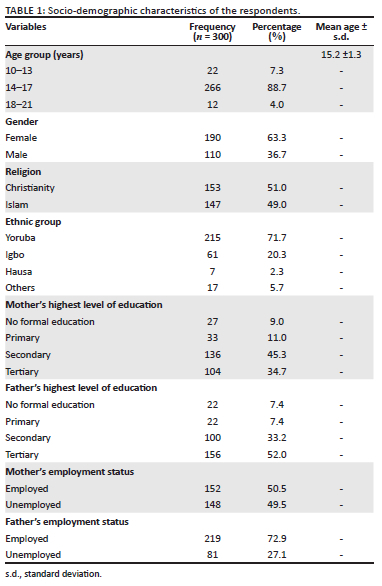
The mean age of the respondents was 15.2 ± 1.3 years, ranging from 10 years to 21 years. Most (88.7%) of the respondents were within the 14-17 years age group. There were more females (63.3%) than males (36.7%). Other socio-demographic characteristics are shown in Table 1.
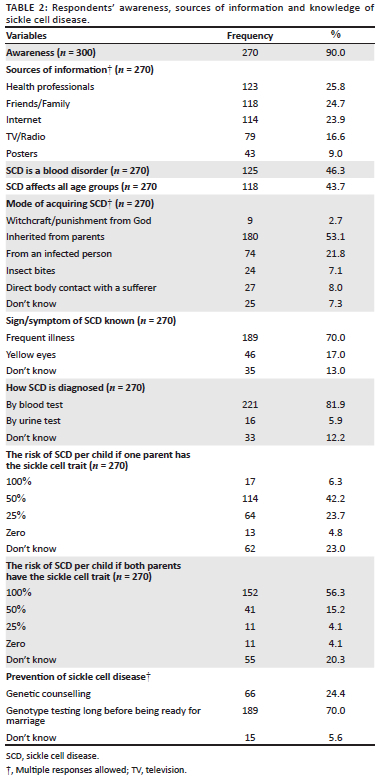
As shown in Table 2, the majority (90.0%) of the respondents were aware of SCD. Healthcare workers (25.8%) were the most frequently identified source of information, followed by friends and family (24.7%) and the internet (23.9%), but the mass media (television/radio [16.6%] and posters [9.0%]) were less recognised as sources of information on SCD. Out of those who had heard about SCD, 46.3% knew that it was a blood disorder, whilst 43.7% knew that SCD affects people of all ages. Inheritance from one's parents was rightly the most frequently reported method of acquiring SCD, whilst about 21.8% wrongly stated that the disease was infectious. Over one third (70.0%) of the respondents identified frequent illness as a sign of SCD. The majority (81.9%) rightly identified blood testing as the means of diagnosing SCD. Regarding the risk of acquiring SCD per child if one parent had the sickle cell trait, respondents mostly identified it as a 50.0% risk, and only 4.8% of them rightly stated that there was no risk of SCD. The risk of acquiring SCD per child if both parents carried the sickle cell trait was mostly (56.3%) given as 100.0%, whilst only 4.1% correctly reported a 25.0% risk. The majority (70.0%) opined that the prevention of SCD was best achieved if the genotype was known well ahead of marriage.
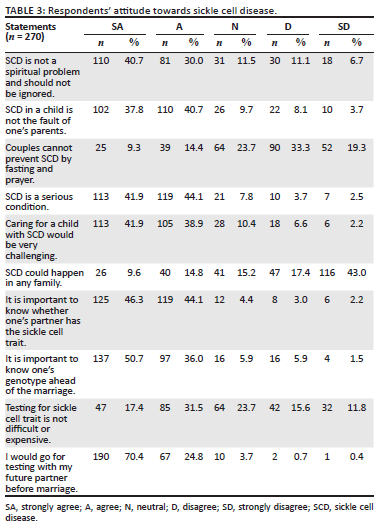
In Table 3, it is shown that 40.7% strongly agreed that SCD is not a spiritual problem and should not be ignored, whilst 37.8% believed that SCD is not the fault of one's parents. However, the opinion that SCD could not be prevented by prayer and fasting was not popular. Whilst the greater proportion of the respondents agreed that SCD is a serious condition and that caring for a child with SCD would be very challenging, a smaller proportion believed that SCD could happen in any family. Regarding being aware of a partner's sickle cell status, a larger proportion believed that it was important to know one's genotype ahead of marriage. The ease of accessibility of testing for SCD in terms of cost was strongly expressed by 17.4%, whilst the majority (70.4%) supported a decision to test ahead of marriage.
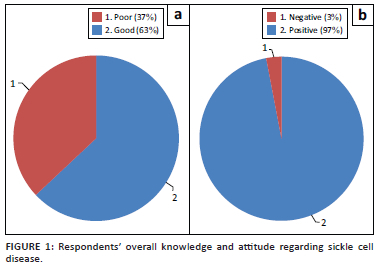
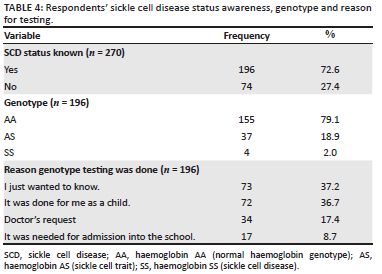
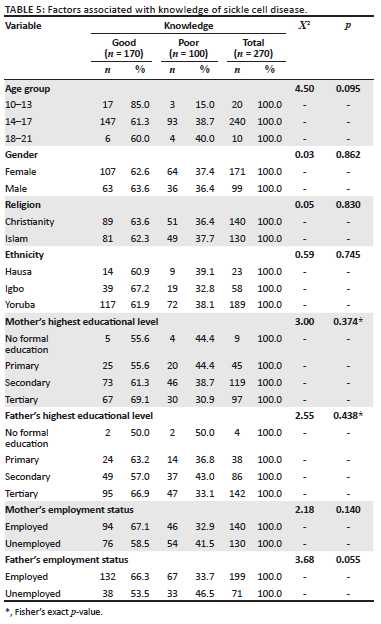
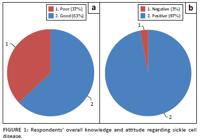
Overall, about 63.0% of the students had good knowledge about SCD, whilst the majority (97.0%) had a positive attitude regarding the condition (Figure 1). In Table 4, it is shown that over 70.0% of the students knew their sickle cell status, the majority (79.1%) having genotype AA, whilst about 18.9% had genotype AS. The SCD prevalence was found to be 2.0%. Of those who knew their genotype, 37.2% of them got tested out of curiosity, 36.7% were tested when they were young children, by their parents, 17.4% were tested at the doctor's request and 8.7% of them were tested as a school enrolment requirement. The level of SCD knowledge of the students did not significantly differ based on their socio-demographic characteristics (Table 5).
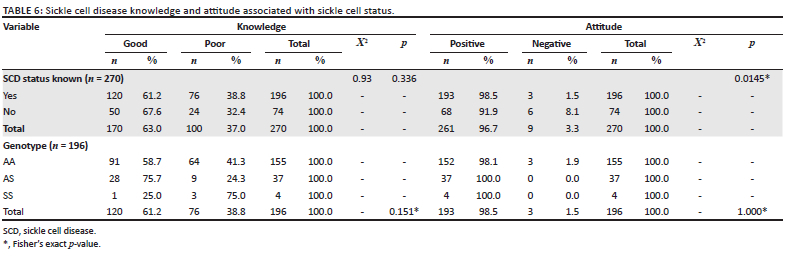
Knowing their SCD status was significantly associated with their attitude towards the disease (p = 0.014), and a larger proportion of those who knew their SCD status had a positive attitude. However, their reported genotype did not significantly influence their knowledge or attitude regarding SCD (Table 6).
Discussion
In this study, the level of SCD awareness was high, about two-thirds had a good level of knowledge of SCD, and over 95.0% had a positive attitude towards the disease. Over 70.0% of the respondents were aware of their genotypes, whilst the SCD prevalence was 2.0%. The mean age of the respondents was 15.2 ± 1.3 years, the female-to-male ratio was about 2:1 and the highest levels of education of the respondents' mothers and fathers, an important factor in the awareness and prevention of SCD, were mostly secondary school and higher education, respectively, similar to the findings of a study carried out amongst secondary school students in Federal Capital Territory (FCT), Abuja, Nigeria,1210
According to this study, the majority of the respondents knew about SCD, whilst the remaining one-tenth did not know about SCD. This compares well with a study carried out amongst secondary school students in Jos which found that 113 (97.4%) of respondents were aware of SCD, whilst only three (2.6%) of them were not aware.101018
The majority of the respondents in this study chose testing before marriage as a method of preventing SCD, followed by genetic counselling. This can be compared to a study in Kampala, Uganda where testing before marriage (40.2%) and genetic counselling (21.6%) were chosen as methods of preventing SCD, whereas in the same study, one third of the students (38.2%) did not know of any methods of SCD prevention.1417
Similar to the current study, a study performed in Ghana found that a majority of the students had a strong belief that SCD is not an evil disease (70.6%) but an inherited disease acquired from one's parents (48.3%).131019
Out of the total number of respondents who were aware of SCD, about two-thirds had good knowledge of the disease, lower than those found in a study performed amongst youths in Yaba, Lagos, Nigeria which showed that the majority (80.0%) had good knowledge of SCD.
This higher level of knowledge may be because Yaba, Lagos, Nigeria is surrounded by many health facilities and higher institutions of learning and so, the respondents are more likely to have a good knowledge of SCD.2021
In this study, about three-quarters knew their SCD status, meaning that they reported that they did or did not have SCD, whilst about a quarter of them did not know their genotype. The majority of the respondents who knew their genotype (79.1%) were of genotype AA, 18.9% were of genotype AS and 2.0% were of genotype SS. This can be compared to a study in Jos where in terms of knowing their SCD status, 89.6% believed in the importance of knowing one's genotype, whilst only 59.2% knew their genotype. Amongst those who claimed to know their genotype, 59.2% were of genotype AA, 11.1% were of genotype AS, whilst 29.6% had other combinations.10
Whilst the current study found no factors associated with the knowledge of SCD and attitude to be influenced only by knowing one's SCD status, other studies found SCD knowledge to be associated with the area of study, religion and age (each p < 0.001),22p = 0.030) and knowing a relative with SCD (p = 0.010),13p < 0.001,22
Strengths and limitations of the study
This was a school-based study; therefore, the students were able to provide their responses without parental pressure that may have existed at home; however, the self-reported genotype of the respondents was, therefore, unconfirmed.
Conclusion and recommendation
The majority of the respondents had good knowledge of SCD, but this did not translate into a mostly positive attitude. However, a gap in knowledge regarding the genetic nature and inheritance pattern of the disease still exists. The majority of the respondents were not knowledgeable about the prevention of SCD considering that they are at the point in life just preceding the decision to bear children. To adequately prepare our young people to prevent SCD routine screening, counselling towards attitudinal change and teachings inclusive of the inheritance pattern of SCD should be part of the secondary school curriculum in Nigeria.
Competing interests
The authors declare that they have no financial or personal relationships that may have inappropriately influenced them in writing this article.
Authors' contributions
O.J.K-O., A.O.A., O.Y.O and E.E.E. contributed to the design and implementation of the research, to the analysis of the results and to the writing of the article.
Funding information
This research received no specific grant from any funding agency in the public, commercial or not-for-profit sectors.
Data availability
All the tables and figures in this work have raw data available on request. The data that support the findings of this study are available on request from the corresponding author, O.J.K-O. The data are not publicly available because of restrictions, for example, they contain information that could compromise the privacy of research participants.
Disclaimer
The views and opinions expressed in this article are those of the authors and do not necessarily reflect the official policy or position of any affiliated agency of the authors.
Acknowledgements
References
-
1. Patil SS, Thikare AA, Wadhva SK, Narlawar UW, Shukla S. Knowledge, attitude and practice regarding SCD in adult sufferers and carriers in a rural area. Int J Community Med Public Health. 2017;4(4):1075-1080. https://doi.org/10.18203/2394-6040.ijcmph20171327
» https://doi.org/10.18203/2394-6040.ijcmph20171327 - 2. Serjeant GR. Sickle cell disease. 3rd ed. New York, NY: Oxford University Press, 2001; p. 3-15.
-
3. Abioye-Kuteyi EA, Osakwe C, Oyegbade O, Bello I. Sickle cell knowledge, premarital screening and marital decisions among local government workers in Ile-Ife, Nigeria. Afr J Prim Health Care Fam Med. 2009;1(1):1-5. https://doi.org/10.4102/phcfm.v1i1.22
» https://doi.org/10.4102/phcfm.v1i1.22 - 4. Bazuaye GN, Olayemi EE. Knowledge and attitude of senior secondary school students in Benin City Nigeria to Sickle Cell Disease. World J Med Sci. 2009;4(1):46-49.
-
5. Olatona A, Odeyemi A, Onajole T, Asuzu M. Effects of health education on knowledge and attitude of youth corps members to SCD and its screening in Lagos state. J Community Med Health. 2012;2(7):251-257. https://doi.org/10.4172/2161-0711.1000163
» https://doi.org/10.4172/2161-0711.1000163 -
6. Ameade EP, Mohammed BS, Helegbe GK, Yakubu S. Sickle cell gene transmission: Do public servants in Tamale, Ghana have the right knowledge and attitude to curb it?. Open J Prev Med. 2015;5(06):299. https://doi.org/10.4236/ojpm.2015.56033
» https://doi.org/10.4236/ojpm.2015.56033 -
7. Dyson SM, Atkin K, Culley LA, Dyson SE, Evans H, Rowley DT. Disclosure and sickle cell disorder: A mixed methods study of the young person with sickle cell at school. Soc Sci Med. 2010;70(12):2036-2044. https://doi.org/10.1016/j.socscimed.2010.03.010
» https://doi.org/10.1016/j.socscimed.2010.03.010 -
8. Jenerette CM, Brewer C. Health-related stigma in young adults with sickle cell disease. J Natl Med Assoc. 2010;102(11):1050-1055. https://doi.org/10.1016/S0027-9684(15)30732-X
» https://doi.org/10.1016/S0027-9684(15)30732-X -
9. CDC Genomics & Precision Health. Genetic counseling [homepage on the Internet]. [cited 2021 Aug 7]. Available from: https://www.cdc.gov/genomics/gtesting/genetic_counseling.htm
» https://www.cdc.gov/genomics/gtesting/genetic_counseling.htm -
10. Olakunle OS, Kenneth E, Olakekan AW, Adenike OB. Knowledge and attitude of secondary school students in Jos, Nigeria on sickle cell disease. Pan Afr Med J. 2013;15(1):127. https://doi.org/10.11604/pamj.2013.15.127.2712
» https://doi.org/10.11604/pamj.2013.15.127.2712 -
11. Lagos Bureau of Statistics. Abstract of local government statistics [homepage on the Internet]. Lagos State Government, 2019 [cited 2019 Aug 20]; p. 3. Available from: http://mepb.lagosstate.gov.ng/wp-content/uploads/sites/29/2020/08/Abstract-of-Local-Government-Statistics-Y2019.pdf
» http://mepb.lagosstate.gov.ng/wp-content/uploads/sites/29/2020/08/Abstract-of-Local-Government-Statistics-Y2019.pdf - 12. Owolabi RS, Alabi P, Olusoji D, Ajayi S, Otu T, Ogundiran A. Knowledge and attitudes of secondary school students in Federal Capital Territory (FCT), Abuja, Nigeria towards sickle cell disease. Niger J _Med. 2011;20(4):479-485.
- 13. Boadu I, Addoah T. Knowledge, beliefs and attitude towards SCD among University students. J Community Med Health Educ. 2018;8:593.
-
14. Tusuubira SK, Nakayinga R, Mwambi B, Odda J, Kiconco S, Komuhangi A. Knowledge, perception and practices towards sickle cell disease: A community survey among adults in Lubaga division, Kampala Uganda. BMC Public Health. 2018;18(1):1-5. https://doi.org/10.1186/s12889-018-5496-4
» https://doi.org/10.1186/s12889-018-5496-4 -
15. Daak AA, Elsamani E, Ali EH, et al. SCD in Western Sudan: Genetic epidemiology and predictors of knowledge attitude and practices. Trop Med Int Health. 2016;21(5):642-653. https://doi.org/10.1111/tmi.12689
» https://doi.org/10.1111/tmi.12689 - 16. Adewoyin AS, Alagbe AE, Adedokun BO, Idubor NT. Knowledge, attitude and control practices of SCD among youth corps members in Benin city, Nigeria. Ann Ib Postgrad Med. 2015;13(2):100-107.
-
17. Uche E, Olowoselu O, Augustine B, et al. An assessment of knowledge, awareness and attitude of undergraduates toward sickle cell disease in Lagos, Nigeria. Niger Med J. 2017;58(6):167-172. https://doi.org/10.4103/nmj.NMJ_111_18
» https://doi.org/10.4103/nmj.NMJ_111_18 -
18. Ugwu NI. Sickle cell disease: Awareness, knowledge and attitude among undergraduate students of a Nigerian tertiary educational institution. Asian J Med Sci. 2016;7(5):87-92. https://doi.org/10.3126/ajms.v7i5.15044
» https://doi.org/10.3126/ajms.v7i5.15044 - 19. Isah BA, Musa Y, Mohammed UK, Ibrahim MT, Awosan KJ, Yunusa EU. Knowledge and attitude regarding premarital screening for sickle cell disease among students of State school of nursing Sokoto. Ann Int Med Dent Res. 2016;2(3):29-34.
- 20. Oludare GO, Ogili MC. Knowledge, attitude and practice of premarital counseling for SCD among youth in Yaba, Nigeria. Afr J Reprod Health. 2013;17(4):175.
- 21. Oluwadamilola AD, Akinreni TI, Adefisan MA, Olayiwola SD. Knowledge, attitude and control practices of sickle cell diseases among senior secondary students in Osun State, Nigeria. Pan Afr Med J. 2021;38:350.
- 22. Hussaini MA, Durbunde AA, Jobbi YD, et al. Assessment of experience, perception and attitude towards premarital sickle cell disease screening among students attending Federal College of Education, Kano. Niger Int J Res Rep Hematol. 2019;2(1):1-12.

Accepted: 02 Dec. 2021
Published: 19 Apr. 2022