Understanding implementation research
Abstract
Implementation research (IR) focuses on understanding and closing the gap between evidence-based interventions and practice. Key elements to evaluate include the design of the intervention itself, contextual barriers and enablers to implementation, the use of implementation strategies as well as the achievement of implementation outcomes. This article gives an overview of IR for doctoral-level researchers in the fields of family medicine and primary care. The consolidated framework for IR and socioecological model are considered for making sense of the contextual factors. A typology of implementation strategies is also described to make conceptualisation, reporting and sharing of findings easier. Standard implementation outcomes are described, such as coverage or reach, acceptability, adoption, appropriateness, feasibility, fidelity, costs and sustainability. The RE-AIM framework for implementation outcomes is described. Finally, different study designs are discussed, including hybrid effectiveness-implementation designs and approaches to reporting using the IR logic model.
implementation; implementation research; methodology; methods; implementation outcomes; implementation strategies; primary care
Introduction
Basic research develops new products, technologies or processes and has given health care a plethora of interventions known to reduce suffering and save lives.123
Implementation research (IR) studies look at understanding and addressing challenges of translating evidence-based interventions and policies into real-world practice within health systems.456
This focus on improving the quality of care highlights an overlap of IR with quality improvement.47
Most health problems are managed in primary care, and African family medicine also includes care at the primary hospital.89
The need for implementation research
The toolkit of evidence-based interventions continues to grow globally, and with it, the knowledge-practice gap.1011,12 As a result, primary care providers and family medicine practitioners do not have the tools needed to improve outcomes, and implementation needs to be a focus for researchers in these fields.
Some of the plausible reasons for evidence-based interventions not working in the real world could be:13,14,15
-
the intervention was the wrong one for the population (e.g. implementing individual brief behaviour change counselling instead of group empowerment for people with type 2 diabetes),
-
the intervention was not delivered as planned (e.g. key components of the intervention were not implemented, such as the wrong hypertension medications),
-
the wrong strategies were used to implement the intervention (e.g. over-reliance on training healthcare workers and not engaging decision makers),
-
the correct strategies were poorly implemented (e.g. the wrong people sent to the training course, supportive supervision was done solely as audit), and
-
previously existing barriers (e.g. cultural distrust, weak supporting systems) or new barriers (e.g. coronavirus disease 2019 [COVID-19] pandemic) could not be overcome by the chosen strategies.
Finding answers on how to prevent or address all these gaps and getting the right care to the right people can be addressed by IR.
The key elements of implementation research
Implementation research deconstructs the process of implementation and enables the different elements to be studied. Four different elements can be considered:16
1. The intervention: the design of the intervention and the strength of the evidence that it is effective.
2. Contextual factors: factors in the context that may act as barriers or enablers to implementation.
3. Implementation strategies: the actions that we take to help people or systems use the intervention.
4. Implementation outcomes: outcomes that can be evaluated to determine whether implementation is effective.
Each of these elements has its own concepts and frameworks that will be considered below. Frameworks can help provide insights into contextual factors, help with planning and guide evaluation (prospective or retrospective).16
The intervention
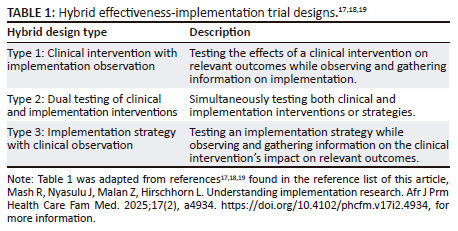
Typically, IR begins once an evidence-based intervention has been established as effective and needs to be implemented. However, interventions are often being implemented with an evidence base that is still incomplete. There may be a need to design studies that simultaneously evaluate the effectiveness of the intervention and its implementation. This could mean evaluating intervention effectiveness in terms of health outcomes and implementation effectiveness in terms of implementation outcomes at the same time. These may be referred to as hybrid effectiveness-implementation trials, as shown in Table 1.17,18,19
When reporting on IR, it is important to fully describe the design of the intervention. Key issues to consider include the development of the intervention and the strength of the evidence for its effectiveness. The complexity of the intervention may also be an issue as well as the design quality and packaging.
Contextual factors
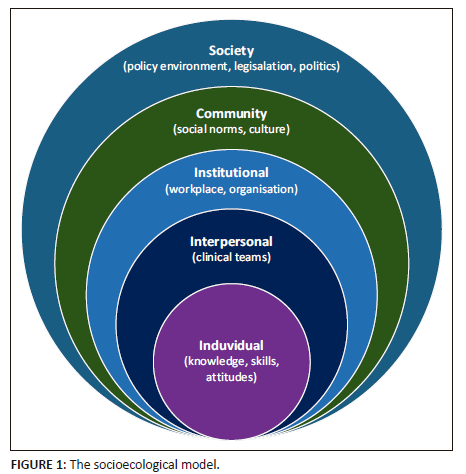
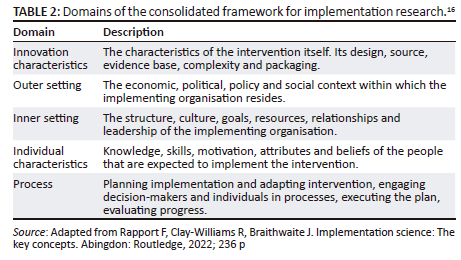
Before designing and testing implementation, it may be necessary to understand the context in more detail. These contextual barriers and enablers can be conceptualised by determinant frameworks. There are many frameworks such as the Consolidated Framework for Implementation Research (CFIR) 1.0, the socioecological model and theoretical domains.16Table 2, and three of them refer directly to the contextual factors: outer setting, inner setting and individual characteristics. The socioecological model similarly considers the context of implementation as a series of nested systems putting the individual in the centre. Moving from the immediate individual to the broader society as shown in Figure 1.20
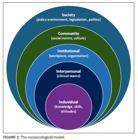
Contextual factors identified in mixed methods research can be categorised and better understood by using these frameworks. Often the same factor could be both a barrier and an enabler depending on how strongly it is present.
Implementation strategies
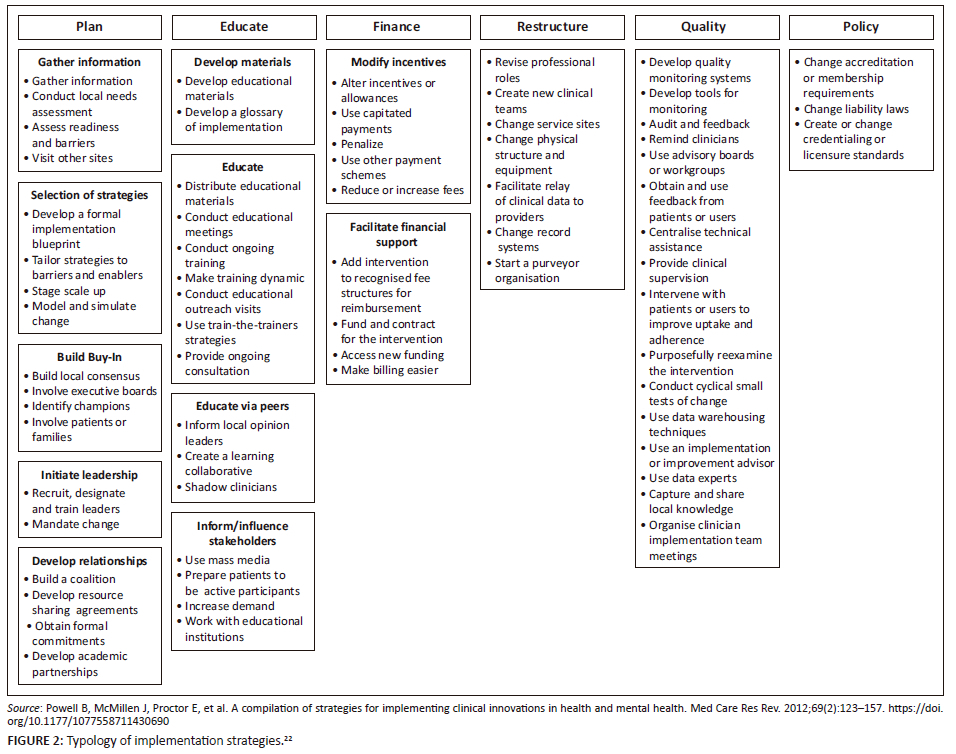
Interventions are often implemented with little thought given to the range of strategies and how they can be conceptualised. Strategies are often implicit and poorly defined. It is helpful to have a standardised way of labelling and categorising strategies.21Figure 2 presents one of the commonly used typologies of implementation strategies.22
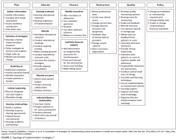
Strategies have also been organised into nine categories as expert recommendations for implementing change (ERIC):23
1. Engage consumers or users
2. Use evaluative and iterative strategies
3. Change infrastructure
4. Adapt and tailor to the context
5. Develop stakeholder interrelationships
6. Utilise financial strategies
7. Support clinicians
8. Provide interactive assistance
9. Train and educate stakeholders
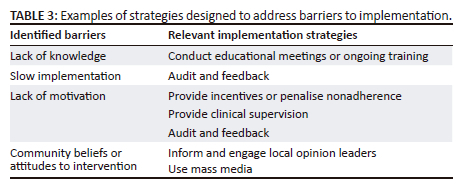
Implementation strategies can be designed to consciously address the barriers and leverage the enablers as illustrated in Table 3. In addition, publications on documenting strategies in low- and middle-income countries have identified strategies not captured in ERIC. These were predominantly strategies targeting systems- or policy-level barriers and highlight the need for additional research and conceptualisation of strategies in these settings.24
Implementation outcomes
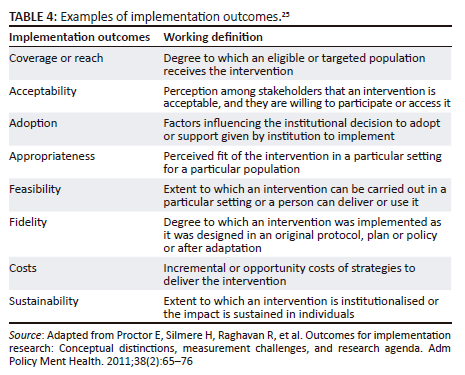
We are used to thinking about clinical outcomes in terms of improved health status or symptoms for a particular disease, functioning or quality of life. Cross-cutting health service outcomes look at issues such as safety, efficiency, equity, timeliness and the core functions of primary care: first contact access, coordination, continuity, comprehensiveness and person centredness. Implementation outcomes are a different set of outcomes from what we are used to. Eight commonly used implementation outcomes are listed in Table 4.25
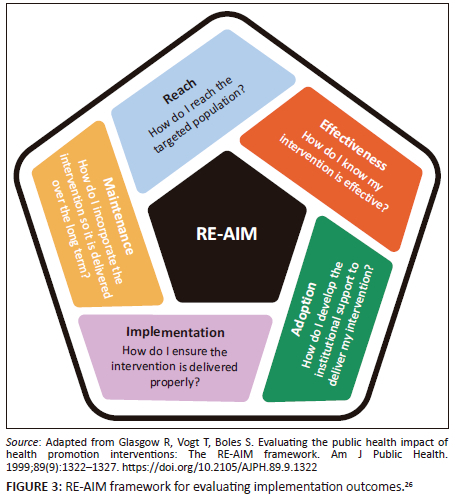
Frameworks have also been developed to help measure implementation outcomes. The most common is the RE-AIM framework as shown in Figure 3.26
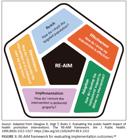
To evaluate sustainability, there would need to be a reasonable period between implementation and evaluation. This allows the researcher to evaluate whether the intervention continues and individual behaviour is maintained, whether the intervention has evolved and adapted and whether it continues to have beneficial effects. Sustainability is often a problem in low-resourced settings. Too often, researchers introduce and evaluate interventions over a short period that is aligned with funding cycles and the need for research outputs. Once the funding and researcher disappear, so does the intervention. Health systems and beneficiaries are more interested in longer-term benefits and returns on investment.
Implementation research questions
Research questions would focus on one or more of the key concepts described above. For example, exploring the contextual factors prior to implementation to plan a better intervention and implementation strategies. Often studies focus on evaluating the implementation outcomes using a framework such as RE-AIM and might also identify the key contextual factors influencing these outcomes. Studies could also evaluate different implementation strategies and the mechanisms by which they lead to outcomes. For example: Does training nurses at lower level facilities to identify patients and prescribe hypertensive treatment as part of routine care lead to provider adoption and to reaching more eligible patients compared to referring patients to higher level facilities?
This research question includes both implementation strategies (training and restructuring care), an intervention (hypertensive treatment) and implementation outcomes (adoption and reach).
Study designs for implementation research
Implementation science is the study of methods to promote the integration of research findings into healthcare practice. There are no unique methods to IR, but often a mixed-methods approach is needed. For example, in evaluating implementation outcomes, there may be quantitative data to measure reach, costs and effects, but qualitative data to explore acceptability, appropriateness, adoption, feasibility and fidelity. The usual methodological considerations for collecting and analysing such data would apply. Descriptive exploratory qualitative studies, observational and experimental studies (e.g. before-and-after, clinical trials) and mixed methods are all possibilities.27
Embedded approaches to research are common.7
Hybrid implementation-effectiveness studies were described earlier. Newer and more complex designs may also be valuable, such as stepped wedge or adaptive platform clinical trials. These could potentially allow multiple strategies to be tested consecutively with sample sizes determined by achieving probability thresholds.
Reporting and disseminating implementation research results
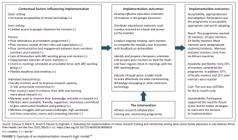
The four key elements discussed in this article should be included in reporting on IR. For example, if the focus of the study is on evaluating implementation outcomes and identifying the key determinants that influenced these outcomes, then the methods section should contain a detailed description of the intervention and in a separate section the implementation strategies. The findings will report on the contextual factors and the outcomes.2828
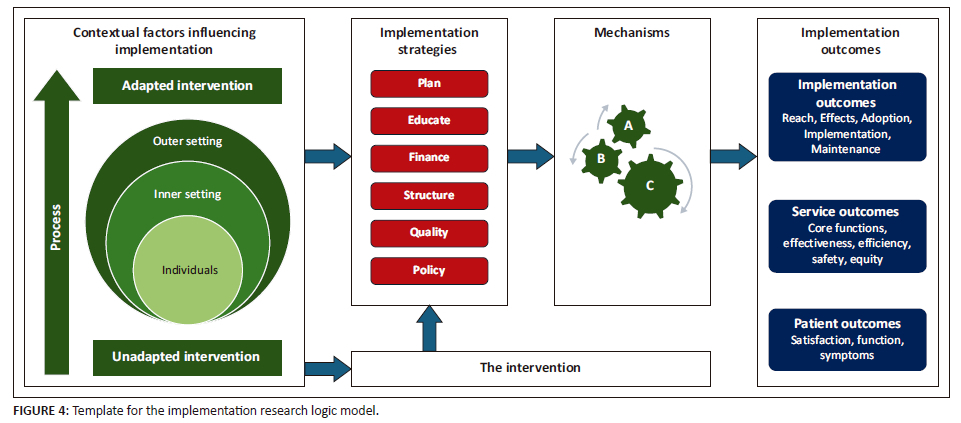
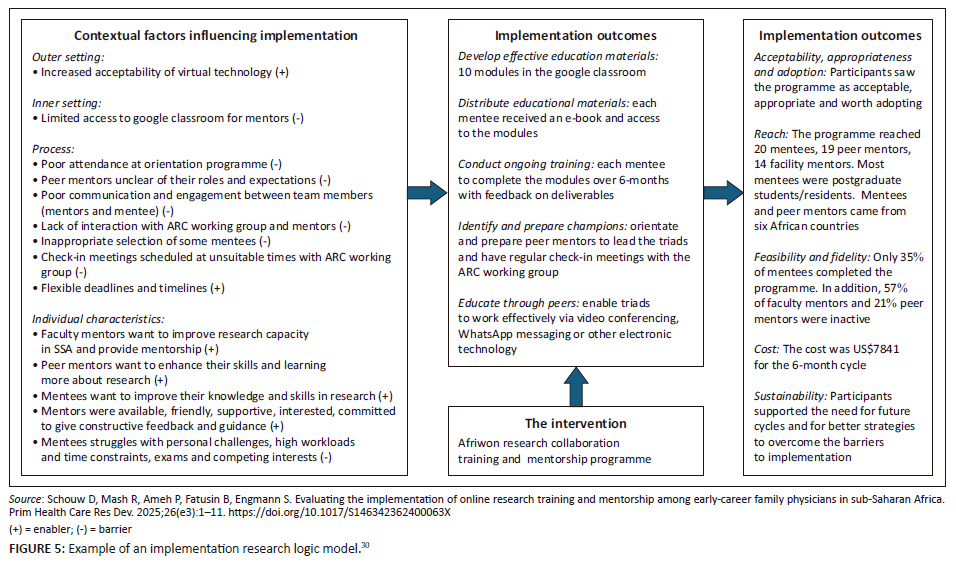
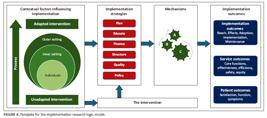
The implementation research logic model (IRLM) (Figure 4) can be a useful framework for summarising all the findings and key elements and showing their relationships.29Figure 5.30
Conclusion
This series looks at methods for doctoral-level and early career researchers in the fields of family medicine and primary care. Implementation research could be the focus of your doctoral degree or one of the studies within it. Implementation research is a growing field, and there are a plethora of frameworks and concepts that are too many to present here. Being familiar with the key IR elements and a few of the frameworks can assist you to design and to report on your study. This should help you to position yourself in the field and communicate what you have done and found in a way that other implementation researchers can understand, review and relate to.
Competing interests
The authors declare that they have no financial or personal relationships that may have inappropriately influenced them in writing this article. R.M. declares that he is the Editor-in-Chief and Z.M. is a section editor of the African Journal of Primary Health Care & Family Medicine. The peer review process for this submission was handled independently, and the authors had no involvement in the editorial decision-making process for this article. The authors has no other competing interests to declare.
Authors' contributions
R.M. drafted the article, which was then edited and revised by J.N., Z.M. and L.H. All authors approved the final article.
Funding information
This publication was funded by the NIHR (NIHR158451) using UK international development funding from the UK government to support global health research. The views expressed in this publication are those of the authors and not necessarily those of the NIHR or the UK government. See: https://www.nihr.ac.uk/nihr-global-health-research-branding-guide.
Disclaimer
The views and opinions expressed in this article are those of the authors. It does not necessarily reflect the official policy or position of any affiliated institution, funder, agency or that of the publisher. The authors are responsible for this article's results, findings and content.
Acknowledgements
References
-
1. National Science Board. Science and Engineering Indicators [homepage on the Internet]. Alexandria, VA; 2018. [Cited 2025 February 17]. Available from: https://www.nsf.gov/statistics/indicators/
» https://www.nsf.gov/statistics/indicators/ -
2. Singal A, Higgins P, Waljee A. A primer on effectiveness and efficacy trials. Clin Transl Gastroenterol. 2014;5(1):e45. https://doi.org/10.1038/ctg.2013.13
» https://doi.org/10.1038/ctg.2013.13 -
3. Kruk M, Pate M. The Lancet Global Health Commission on high quality health systems 1 year on: Progress on a global imperative. Lancet Glob Health. 2020;8(1):e30-e32. https://doi.org/10.1016/S2214-109X(19)30485-1
» https://doi.org/10.1016/S2214-109X(19)30485-1 -
4. Peters DH, Adam T, Alonge O, Agyepong IA, Tran N. Implementation research: What it is and how to do it. BMJ. 2013;347:f6753. https://doi.org/10.1136/bmj.f6753
» https://doi.org/10.1136/bmj.f6753 - 5. Peters D, Tran N, Adam T. Implementation research in health: A practical guide. Geneva: World Health Organization; 2013.
-
6. Amberbir A, Sayinzoga F, Mathewos K, et al. Maintaining delivery of evidence-based interventions to reduce under-5 mortality during COVID-19 in Rwanda: Lessons learned through implementation research. Ann Glob Health. 2024;90(1):47. https://doi.org/10.5334/aogh.4348
» https://doi.org/10.5334/aogh.4348 -
7. Biermann O, Schleiff M, Romao D, Mikaelsdotter C, Alfven T, Wanyenze R. Action towards connecting knowledge translation and implementation research. Lancet Glob Health. 2025;13(3):e404. https://doi.org/10.1016/S2214-109X(24)00522-9
» https://doi.org/10.1016/S2214-109X(24)00522-9 -
8. Mash R. The contribution of family physicians to African health systems. Afr J Prim Health Care Fam Med. 2022;14(1):a3651. https://doi.org/10.4102/phcfm.v14i1.3651
» https://doi.org/10.4102/phcfm.v14i1.3651 -
9. Nazha B, Yang J, Owonikoko T. Benefits and limitations of real-world evidence: Lessons from EGFR mutation-positive non-small-cell lung cancer. Future Oncol. 2021;17(8):965-977. https://doi.org/10.2217/fon-2020-0951
» https://doi.org/10.2217/fon-2020-0951 -
10. Boaz A, Baeza J, Fraser A, Persson E. 'It depends': What 86 systematic reviews tell us about what strategies to use to support the use of research in clinical practice. Implement Sci. 2024;19(1):15. https://doi.org/10.1186/s13012-024-01337-z
» https://doi.org/10.1186/s13012-024-01337-z -
11. Balas E, Boren S. Managing clinical knowledge for health care improvement. Yearb Med Inform. 2000;9(1):65-70. https://doi.org/10.1055/s-0038-1637943
» https://doi.org/10.1055/s-0038-1637943 -
12. Green L, Glasgow R, Atkins D, Stange K. Making evidence from research more relevant, useful, and actionable in policy, program planning, and practice: Slips 'twixt cup and lip'. Am J Prev Med. 2009;37(6Suppl1):S187-S191. https://doi.org/10.1016/j.amepre.2009.08.017
» https://doi.org/10.1016/j.amepre.2009.08.017 -
13. Klaic M, Kapp S, Hudson P, et al. Implementability of healthcare interventions: An overview of reviews and development of a conceptual framework. Implement Sci. 2022;17(1):10. https://doi.org/10.1186/s13012-021-01171-7
» https://doi.org/10.1186/s13012-021-01171-7 -
14. Thomas A, Ellaway R. Rethinking implementation science for health professions education: A manifesto for change. Perspect Med Educ. 2021;10(6):362-368. https://doi.org/10.1007/S40037-021-00688-3
» https://doi.org/10.1007/S40037-021-00688-3 -
15. Peters-Corbett A, Parke S, Bear H, Clarke T. Barriers and facilitators of implementation of evidence-based interventions in children and young people's mental health care - A systematic review. Child Adolesc Ment Health. 2023;29(3):242-265. https://doi.org/10.1111/camh.12672
» https://doi.org/10.1111/camh.12672 - 16. Rapport F, Clay-Williams R, Braithwaite J. Implementation science: The key concepts. Abingdon: Routledge, 2022; 236 p.
-
17. Curran G, Bauer M, Mittman B, Pyne J, Stetler C. Effectiveness-implementation hybrid designs: Combining elements of clinical effectiveness and implementation research to enhance public health impact. Med Care. 2012;50(3):217-226. https://doi.org/10.1097/MLR.0b013e3182408812
» https://doi.org/10.1097/MLR.0b013e3182408812 -
18. Landes S, McBain S, Curran G. An introduction to effectiveness-implementation hybrid designs. Psychiatry Res. 2019;280. https://doi.org/10.1016/j.psychres.2019.112513
» https://doi.org/10.1016/j.psychres.2019.112513 -
19. Ullman A, Beidas R, Bonafide C. Methodological progress note: Hybrid effectiveness-implementation clinical trials. J Hosp Med. 2022;17(11):912-916. https://doi.org/10.1002/jhm.12936
» https://doi.org/10.1002/jhm.12936 -
20. Bronfenbrenner U. Toward an experimental ecology of human development. Am Psychol. 1977;32(7):513-531. https://doi.org/10.1037/0003-066X.32.7.513
» ):513-531. https://doi.org/10.1037/0003-066X.32.7.513 -
21. Proctor E, Powell B, McMIllen J. Implementation strategies: Recommendations for specifying and reporting. Implement Sci. 2013;8:139. https://doi.org/10.1186/1748-5908-8-139
» https://doi.org/10.1186/1748-5908-8-139 -
22. Powell B, McMillen J, Proctor E, et al. A compilation of strategies for implementing clinical innovations in health and mental health. Med Care Res Rev. 2012;69(2):123-157. https://doi.org/10.1177/1077558711430690
» https://doi.org/10.1177/1077558711430690 -
23. Powell B, Waltz T, Chinman M, et al. A refined compilation of implementation strategies: Results from the Expert Recommendations for Implementing Change (ERIC) project. Implement Sci. 2015;10:21. https://doi.org/10.1186/s13012-015-0209-1
» https://doi.org/10.1186/s13012-015-0209-1 -
24. Lovero K, Kemp C, Wagenaar B, et al. Application of the Expert Recommendations for Implementing Change (ERIC) compilation of strategies to health intervention implementation in low- and middle-income countries: A systematic review. Implement Sci. 2023;18(1):56. https://doi.org/10.1186/s13012-023-01310-2
» https://doi.org/10.1186/s13012-023-01310-2 - 25. Proctor E, Silmere H, Raghavan R, et al. Outcomes for implementation research: Conceptual distinctions, measurement challenges, and research agenda. Adm Policy Ment Health. 2011;38(2):65-76.
-
26. Glasgow R, Vogt T, Boles S. Evaluating the public health impact of health promotion interventions: The RE-AIM framework. Am J Public Health. 1999;89(9):1322-1327. https://doi.org/10.2105/AJPH.89.9.1322
» https://doi.org/10.2105/AJPH.89.9.1322 -
27. Hwang S, Birken S, Melvin C, Rohweder C, Smith J. Designs and methods for implementation research: Advancing the mission of the CTSA program. J Clin Transl Sci. 2020;4(3):159-167. https://doi.org/10.1017/cts.2020.16
» https://doi.org/10.1017/cts.2020.16 -
28. Pinnock H, Barwick M, Carpenter C, et al. Standards for reporting implementation studies (StaRI) statement. BMJ. 2017;356:i6795. https://doi.org/10.1136/bmj.i6795
» https://doi.org/10.1136/bmj.i6795 -
29. Smith J, Li D, Rafferty M. The implementation research logic model: A method for planning, executing, reporting, and synthesizing implementation projects. Implement Sci. 2020;15(84):1-12. https://doi.org/10.1186/s13012-020-01041-8
» https://doi.org/10.1186/s13012-020-01041-8 -
30. Schouw D, Mash R, Ameh P, Fatusin B, Engmann S. Evaluating the implementation of online research training and mentorship among early-career family physicians in sub-Saharan Africa. Prim Health Care Res Dev. 2025;26(e3):1-11. https://doi.org/10.1017/S146342362400063X
» https://doi.org/10.1017/S146342362400063X

Accepted: 04 Apr. 2025
Published: 03 June 2025