Primary health care nursing students' knowledge of and attitude towards the provision of preconception care in KwaZulu-Natal
Abstract
BACKGROUND: Sub-Saharan African countries have been the worst affected by the high incidence of maternal and child mortality rates and HIV/AIDS (human immunodeficiency virus/acquired immunodeficiency syndrome) pandemic. Preventive care is the area that requires serious attention as a lot of maternal and child morbidity and mortality can be averted through rendering comprehensive care to women of child-bearing age. Preconception care (PCC) is recognised as an important factor in improving pregnancy outcome; yet, most primary health care (PHC) nurses lack the necessary resources to render PCC. AIM: To describe the PHC nursing student's knowledge of and attitude towards the provision of PCC. SETTING: Higher Education Institution that offers PHC programme at six different sites to nurses working in the PHC clinics in the province METHODS: A quantitative, non-experimental, descriptive study design was used. The total population from three sites selected, based on their geographical location were all invited to participate in the study. Questionnaire was used to collect data which was subsequently analysed using the Statistical Package for Social Sciences (SPSS) version 24. RESULTS: The response rate was approximately 85% (n = 138). The respondents have practised in the PHC clinic for more than 1 year. Study centre, age and area of employment were found to be predictors of knowledge, but no direct association was found between the demographic factor and attitude. Furthermore, a significant difference was found between knowledge and age, and between the area of employment and attitude. CONCLUSION: PHC nursing students were knowledgeable and had a favourable attitude towards PCC, but the absence of PCC resources in many practices has hindered them to a greater extent. It is recommended that for proper implementation of PCC to occur, health care workers should be provided with the necessary resources.
primary health care; nurses; preconception care; pre-pregnancy counselling; knowledge; attitude
Introduction
Preconception care (PCC) or pre-pregnancy care according to World Health Organization121
Sub-Saharan Africa has been identified to be the area worst affected by the high rate of maternal and child mortality and morbidity rates.33
The South Africa's 2010-2013 'National Committee on Confidential Enquiries into Maternal Deaths'44
Even though many initiatives have been undertaken both globally and nationally to address this issue, the majority of them are not tackling the problem at the grassroots level, which is preconceptionally. Preventive care in health is the area that requires serious attention as a lot of maternal and child morbidity, and mortality can be averted through rendering comprehensive holistic care to reproductive-aged women.55
To reach the sustainable development goal (SDG) 3,67
Background
Preconception care has been advocated as a major intervention to decrease maternal and child mortality.89,10,119121314,15,1617181710
Problem statement
Preconception care is not well-implemented in South Africa and many other countries worldwide;1920
The knowledge of health professionals and women about preconception is low globally, and there is a confusion among health workers about who is responsible for the provision of PCC.2122232425262723
Although the primary health care (PHC) nurses are at the forefront of rendering preventive interventions, both in the primary health care and in the community settings, PCC is not always provided to women in the PHC setting and women find that health professionals scarcely discuss the availability and need for PCC with them.2829,308,31
Research methodology
Research design
A non-experimental, descriptive, and cross-sectional survey was employed for this study. Through quantitative descriptive studies, a researcher discovers new meaning, describes what is known, determines the frequency with which something occurs, and categorises the information using a predetermined instrument.32
Setting
The research setting for this study was a higher education institution (HEI) in KZN. This study targeted a programme that uses a decentralised mode of teaching in PHC. This primary health care programme is offered at six different sites around KZN to nurses who are already working in the PHC clinics in the province. For this study, three sites under the patronage of the selected HEI were considered, namely Durban, Pietermaritzburg, and Empangeni. These three settings were selected based on their geographical location and characteristics (urban, semi-urban and rural), and accessibility.
Study population and sampling strategy
The three selected sites have a population of 163 PHC nursing students. Convenience sampling method was used to enrol PHC nursing student from the selected sites who met the criteria, who had agreed to participate in the study. All the PHC nursing students available from the selected sites were asked to participate in the study but 138 out of 163 participated in the study. The minimum sample size required in a population of 200, to achieve a 95% level of confidence and 5% margin of error according to Leslie Kish was 134.33 Therefore, a sample size of 138 for a population of 163 is considered very adequate for this study.
The inclusion criterion considers all nurses enrolled in the PHC programme and registered with South African Nursing Council (SANC) as general, community and midwifery nurses, and were willing to participate in the study. All those who had de-registered or were on long sick leave or those that did not practice in a primary health care setting or did not render services to women in the reproductive age and those other under the age of 18 were excluded from the study.
Research Instrument and validity
The self-administered questionnaire was used to collect data. The instrument was adapted from studies on PCC conducted in the United Kingdom and the Netherlands.29,30 It consisted of three sections A to C. Section A was the demographic data, B was composed of the two knowledge parts and C was the attitude. The two instruments were merged to form the knowledge and the attitude section of the instrument, while the researcher added the demographic section. The content and face validity of the instrument were assessed through extensive literature review and in line with the study objective and with the help of the supervisor. The study instrument was pretested by means of a test-retest method to measure the stability and reliability of the instrument over time. The test-retest involved five PHC facilitators who also work in the PHC setting and they were not included in the main study. The 'Cronbach's alphas' for the various sections of the questionnaire were as follows: knowledge: 0.85 and attitude: 0.70.
Data collection procedure
The study data were collected in October 2017 at the three centres. Consent form, together with information sheet with details of the study, was given to the participants to obtain an informed consent. Questionnaires were subsequently handed out to those who consented to the study, and they were guided on how to complete it. The completed questionnaires were returned at the participant's convenience.
Data analysis
Responses from the questions were coded numerically by assigning numbers to the responses given by the respondents to enable analysis of data. 'Statistical Package for Social Sciences' (SPSS) version 24 was used to capture and analyse the collected data. The knowledge of PCC as a whole was measured using 10 items on five-point Likert scale, which ranged from strongly disagree to strongly agree. The attitude of PCC was also assessed using 12 items on a five-point Likert scale. The strongly disagree was scored as one and strongly agree scored as five in a positive statement whereas the score was reversed in negative statements. The knowledge and attitude score were further computed to come up with a composite score where respondents who scored below the 75th percentile were categorised as not knowledgeable or with unfavourable attitude while those who scored above the 75th percentile were categorised as knowledgeable or with a favourable attitude. Descriptive statistics, mainly percentages and frequencies, were used to describe and synthesise data, while frequency tables were used to display the frequency of data. The 'Kruskal-Wallis test', 'Mann-Whitney U test', 'Fishers exact test' and 'Pearson chi-squared test' was used to test if the distribution of knowledge and attitude differed across the nurses' social demographic characteristics. A Chi-square test was used to ascertain the independence of knowledge and attitude of nurses towards PCC. As some of the chi-squared test was significant, 'Logistic Regression' was further used to identify factors influencing knowledge level. The level of significance was set at 0.05. Furthermore, the crude odd ratios (COR) and adjusted odds ratios (AOR), respectively, were used to explain the relationship between knowledge and the demographic profile of the study population.
Results from the univariate logistic regression model (crude odds ratio) informed the profile of variables to be included into the multivariate logistic regression model. The analysis was all made fixing the confidence interval (CI) at 95%
Ethical considerations
Ethical clearance for the study was obtained from the University of KwaZulu-Natal (Ethical Committee protocol reference number HSS/0994/017M). This was done to protect the rights of the respondents. Gate keeper's permission was sought from the registrar and the dean of the HEI before conducting the study. The respondents gave their consent before the questionnaires were distributed to them, and all ethical considerations were maintained, especially anonymity and confidentiality.
Results
Out of 163, 138 questionnaires distributed were returned giving a response rate of approximately 85%.
Sociodemographic data
In this study, of 138 PHC nurses, the majority (83.3%) were female. Approximately 47% were aged between 31 and 40 years, and only 8.7% were aged 51 years and above. They were mainly African (92.8%) and 58.7% were married.
For the years of experience, 80.4% had worked from 1 to 5 years, while 19.6% had worked for more than 6 years. The employment area was divided among 83.3% for the public clinic, 12.3% for the municipal clinic, and 4.3% for non-governmental organisation (NGO) and others. For the study centre of the respondents, 38.4% were from Durban, 29% were from Pietermaritzburg and 32.6% were from Empangeni.
Knowledge of preconception care
The findings of the respondent's knowledge of PCC showed that on a more favourable note, the majority of the respondents 88.4% (n = 122) agreed that PCC can lead to better pregnancy outcome, while 92% (n = 127) agreed, that PCC could reduce the incidences of unplanned and unwanted pregnancy. Similarly, a further 92.8% (n = 128) agreed that PCC could reduce maternal and child mortality rate and 89.9% (n = 124) agreed PCC is for all women of child-bearing age. Most of the respondents 84.1% (n = 116) agreed, that PCC could reduce the incidences of HIV PCR positive and more than two-thirds 71.8% (n = 99) agreed that PCC could reduce the chances of acquiring HIV among serodiscordant couples while 42.8% agreed that there is little evidence base for PCC. On a less favourable note, more than two-thirds of the respondents 68.1% (n = 94) disagreed that PCC would not change the patient's risk profile and a further majority 81.2% (n = 112) disagreed that PCC should only be offered to women with high risks. On the other hand, 44.9% (n = 62) were uncertain regarding the absence of PCC policy in South Africa, while 39.2% (n = 54) had disagreed and 15.9% (n = 22) agreed.
The knowledge about PCC had 10 items; thus, the possible minimum score was 10, and the maximum score was 50. The minimum score for the respondents was 28, and the maximum score was 50; M = 39.7 and s.d. (standard deviation) = 4.8. On grouping of the scores, with a score of less than 39 indicating not knowledgeable and 40-50 knowledgeable, the majority of respondents 55.0% (n = 76) fell within the knowledgeable group while 45.0% (n = 62) were in the not knowledgeable group. Hence, on average, the result indicated that the participants was knowledgeable about PCC.
Predictors of good preconception care knowledge and favourable preconception care attitude
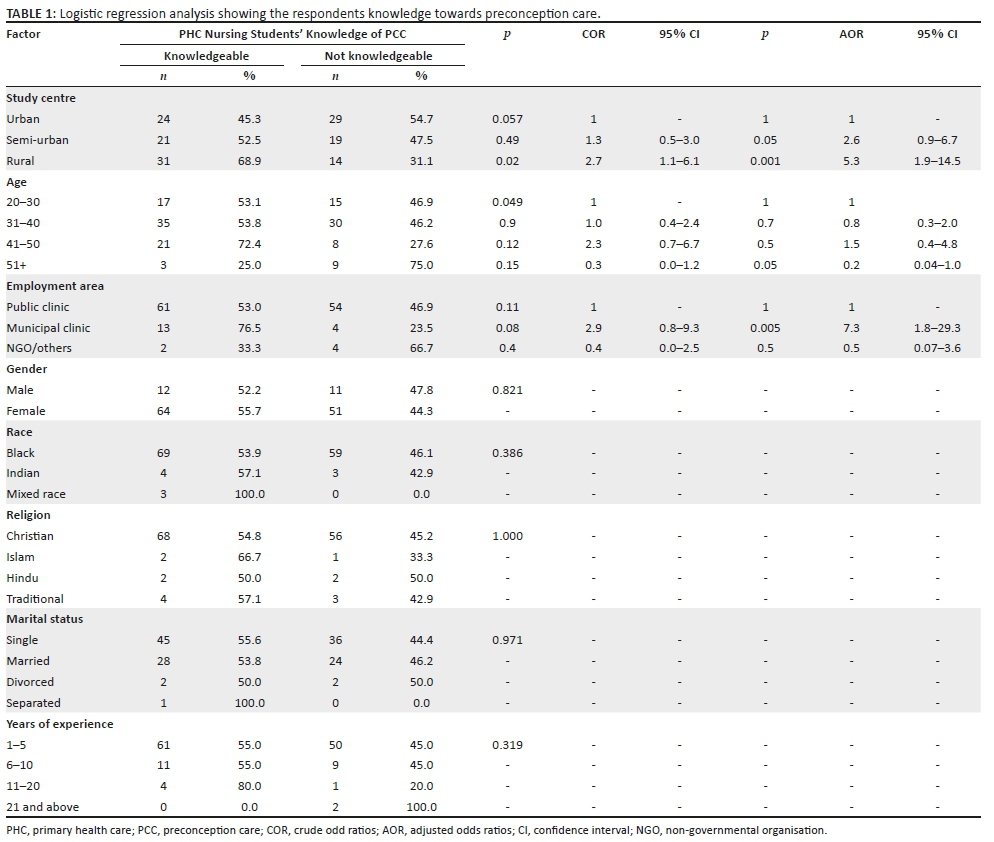
The knowledge of PCC was compared with the demographic factors of the respondents to assess the predictor of good knowledge. As shown in Table 1, the knowledge of PCC was compared between the three study centres. Urban students' knowledge of PCC was compared with their counterparts in semi-urban and rural areas. The AOR for semi-urban was 2.6 (95% CI 0.9-6.7), while for the rural population was 5.3 (95% CI 1.9-14.5). Students from rural areas are 5.3 times more likely to be knowledgeable about PCC as compared to urban students. Also, students from semi-rural were 2.6 times more likely to be knowledgeable about preconception care as compared to urban students.
The knowledge level as compared across the age groups with ages 20-30 as the reference group revealed that ages 31-40 are 20% less likely to be knowledgeable about PCC and ages 41-50 were 1.5 times more likely to be knowledgeable while those above 50 years of age were 80% less likely to be knowledgeable about preconception care. The knowledge of the respondents was compared across their employment areas with those in the public clinic as the reference group showed that those in the municipal clinics are 7.3 times more likely to be knowledgeable and those working for the NGO's and others not mentioned are 50% less likely to be knowledgeable. There was no significant association between gender, race, religion, marital status, years of experience and knowledge levels.
Attitude towards preconception care
The results revealed that most respondents are on a less favourable note; 45.7% (n = 63) disagreed that a dedicated clinic for PCC is a luxury service, while 49.2% (n = 68) disagreed that a hospital setting was the best place to provide PCC, and interestingly, 58.7% (n = 81) disagreed that there was not enough time to provide. In the same vein, 47.8% (n = 66) disagreed that as PHC nurses they did not have enough skills to offer PCC, and more than two-thirds of the respondents 82.6% (n = 114) disagreed that PHC nurses were not the best people to offer PCC and more than two-thirds 69.6% (n = 96) disagreed that initiating the talk about pregnancy wishes was uncomfortable. Similarly, 57.3% (n = 79) disagreed that PCC, without women asking for it, was objectionable. On the favourable note, the majority of the respondents 93.5% (n = 129) agreed that PCC is an important health issue for women of child-bearing age and 47.1% (n = 65) agreed that in their practice, population planning for pregnancy does not often happen. The results further showed that more than half of the respondents 52.2% (n = 72) agreed that PCC was a high priority in their workload while 84.8% (n = 117) agreed that they preferred to deal with risk factors before pregnancy rather than in pregnancy and 82.6% (n = 114) agreed that with PCC they could do something extra for their patients.
The attitude level had 12 items, thus the possible minimum score was 12 and the maximum score was 60. The minimum score for the respondents was 28 and the maximum score was 55 with M = 42.9 and s.d. = 5.17. On grouping of the scores, with a score of less than 35 indicating unfavourable attitude and 36-60 indicating favourable attitude, the majority of respondents 92.8% (n = 128) has a favourable attitude, and 7.2% (n = 10) has a less favourable attitude towards PCC. Hence, on an average, the result indicates that the participant has a favourable attitude towards PCC.
Difference and association of demographic with knowledge and attitude
Non-parametric testing Kruskal Wallis and Mann-Whitney U were used for difference and associations between the demographic variables with knowledge and attitude. The Kruskal Wallis test revealed a statistically significant difference between the age of the nurses and their knowledge of PCC, p = 0.004. There was also a statistical difference found between employment area and attitude, p = 0.005. However, no difference was found between knowledge of PCC, attitude and other demographic variables. Mann-Whitney U tests revealed a statistically significant association between knowledge and attitude, with a p-value of 0.000.
Discussion
The ultimate aim of PCC is short- and long-term improvements in maternal and child health outcomes.1,1830343035,36
There are conflicting reports about nurses and primary health care workers' knowledge of preconception care. Several studies have revealed a low level of knowledge regarding PCC services,21,23,37,38394041
Kachoria and Shawe34,42431,4444,4584622,2339
The results of their attitude dimensions revealed that most respondents had favourable attitude towards preconception care. These results were in line with previous literature on PCC30,4748,49
There is a recommendation for the establishment of a special PCC clinic.50514350,522053
Time has been cited in many studies as a major barrier to the provision of preconception services.23,38,548,21,30,552330
Strengths and limitations
The major limitation of the present study is that the data was collected using only the questionnaire, which may have limited the responses given by the respondents and may have been subjected to personal bias and the respondents' capacity in interpreting the questions.
Another limitation is that the study was conducted in a higher education institution using only primary health care nurses who are students, which may not be generalised to the entire PHC nurses in the district.
Implications
•There is a need to explore the patient's knowledge and attitude of preconception care, especially in the context of HIV and AIDS.
•There is the need to explore the concept using the qualitative research method for in-depth understanding of the subject.
•Further studies can explore all the primary health care workers or all the health workers that are responsible for the provision of PCC.
Conclusion
The results revealed that PHC nurses were knowledgeable about PCC, and they possess favourable attitudes towards PCC as well.
Knowledge and attitude were affected by the demographic characteristics. The knowledge of PCC was found to be influenced by study centre, employment area, and age. The high knowledge level among nurses in the rural area and those employed in the public clinics might be an indication of their job responsibility as majority of them initiate and manage patients on antiretroviral therapy. There is lack of PCC resources in the country. The provisions of PCC is very necessary for the improvement of pregnancy outcome; therefore, PHC nurses need to be prepared for this purpose.
Competing interests
The authors declare that they have no financial or personal relationships that may have inappropriately influenced them in writing this article.
Authors' contributions
W.C.U. conducted the research project for her master's degree in Nursing (maternal and child health), while M.D. was the project supervisor. The article was produced from the thesis, and both authors contributed towards the compilation of this article.
Funding information
This research received no specific grant from any funding agency in the public, commercial or not-for-profit sectors.
Data availability statement
Data sharing is not applicable to this article as no new data were created or analysed in this study.
Disclaimer
This article as a professional research represents the opinion of the authors and respondents and, therefore, not the official position of the institution.
Acknowledgements
The authors would like to appreciate all those who participated in the study and the managers and facilitators of the institution where the study was undertaken.
References
- 1.World Health Organization. Meeting to develop a global consensus on preconception care to reduce maternal and childhood mortality and morbidity. Geneva: WHO; 2013.
-
2.Lassi ZS, Dean SV, Mallick D, Bhutta ZA. Preconception care: Delivery strategies and packages for care. Reprod Health. 2014;11(3):1-17. https://doi.org/10.1186/1742-4755-11-S1-S1
» https://doi.org/10.1186/1742-4755-11-S1-S1 - 3.UNICEF. Levels and trends in child mortality. New York: UNICEF; 2011.
- 4.NCCEMD. Saving mothers: Annual report and detailed analysis of maternal deaths due to non-pregnancy related infections. In: National Committee for Confidential Enquiry into Maternal Deaths RoSA, editor. Pretoria: Government Printer; 2014.
- 5.World Health Organization. Draft action plan for the prevention and control of noncommunicable diseases 2013-2020. Geneva: WHO; 2013.
-
6.Osborn D, Cutter A, Ullah F, editors. Universal sustainable development goals. Stakeholder Forum, commissioned by the UN Development Program [homepage on the Internet]. Geneva, Switzerland; 2015 [cited 2017 Apr 4]. Available from: https://sustainabledevelopment.un.org/content/documents/1684SF_-_SDG_Universality_Report_-_May_2015.pdf.
» https://sustainabledevelopment.un.org/content/documents/1684SF_-_SDG_Universality_Report_-_May_2015.pdf -
7.You D, Hug L, Ejdemyr S, Beise J. Levels and trends in child mortality. Report 2015. Estimates developed by the UN Inter-agency Group for Child Mortality Estimation [homepage on the Internet]. UNICEF; 2015 [cited 2017 Apr 4]. Available from: https://www.who.int/maternal_child_adolescent/documents/levels_trends_ child_mortality_2012.pdf.
» https://www.who.int/maternal_child_adolescent/documents/levels_trends_ child_mortality_2012.pdf -
8.Zühlke L, Acquah L. Pre-conception counselling for key cardiovascular conditions in Africa: Optimising pregnancy outcomes. Cardiovas J Afr. 2016;27(2):79-83. https://doi.org/10.5830/CVJA-2016-017
» https://doi.org/10.5830/CVJA-2016-017 - 9.World Health Organization. Born too soon: The global action report on preterm birth. Geneva, Switzerland: WHO; 2012.
-
10.Dean SV, Imam AM, Lassi ZS, Bhutta ZA. Importance of intervening in the preconception period to impact pregnancy outcomes. Nestlé Nutr Inst Workshop Ser. 2013;74:63-73. https://doi.org/10.1159/000348402
» https://doi.org/10.1159/000348402 -
11.Eslami M, Yazdanpanah M, Taheripanah R, Andalib P, Rahimi A, Nakhaee N. Importance of pre-pregnancy counseling in Iran: Results from the high risk pregnancy survey 2012. Int J Health Pol Manag. 2013;1(3):213-218. https://doi.org/10.15171/ijhpm.2013.39
» https://doi.org/10.15171/ijhpm.2013.39 -
12.Nielsen LA, Nielsen TRH, Holm J-C. The impact of familial predisposition to obesity and cardiovascular disease on childhood obesity. Obes Facts. 2015;8(5):319-328. https://doi.org/10.1159/000441375
» https://doi.org/10.1159/000441375 -
13.Dean SV, Imam AM, Lassi ZS, Zulfiqar A. Systematic review of preconception risks and interventions [homepage on the Internet]. 2013[cited 2017 Nov 17]. Available from: https://globalmotherchildresearch.tghn.org/site_media/media/articles/Preconception_ Report.pdf.
» https://globalmotherchildresearch.tghn.org/site_media/media/articles/Preconception_ Report.pdf -
14.Boelig RC, Coleman JS, Keller J, Sewell C, Anderson J. Preconception counseling and care in the setting of HIV: Clinical characteristics and comorbidities. Infect Dis Obstet Gynecol. 2015;2015:1-6. https://doi.org/10.1155/2015/240613
» https://doi.org/10.1155/2015/240613 -
15.World Health Organization. Pre-conception care: Maximizing the gains for maternal and child health 2013 [cited 2017 Apr 21]. Available from: http://www.who.int/maternal_child_adolescent/documents/preconception_ care_policy_brief.pdf.
» http://www.who.int/maternal_child_adolescent/documents/preconception_ care_policy_brief.pdf - 16.UNAIDS. Unaids strategy 2016-2021: On the fast track to end aids. Geneva, Switzerland: UNAIDS; 2015.
-
17.Upadhya KK, Jalazo ER, Connor KA, Mistry KB, Cheng TL. Optimizing preconception health among young women: What are we missing? PEDADO J Pediatr Adolesc Gynecol. 2016;29(5):464-466. https://doi.org/10.1016/j.jpag.2016.02.010
» https://doi.org/10.1016/j.jpag.2016.02.010 -
18.Dean SV, Lassi ZS, Imam AM, Bhutta ZA. Preconception care: Closing the gap in the continuum of care to accelerate improvements in maternal, newborn and child health. Reprod Health. 2014;11:1-8. https://doi.org/10.1186/1742-4755-11-S3-S1
» https://doi.org/10.1186/1742-4755-11-S3-S1 -
19.Mason E, Chandra-Mouli V, Baltag V, Christiansen C, Lassi ZS, Bhutta ZA. Preconception care: Advancing from 'important to do and can be done' to 'is being done and is making a difference'. Reprod Health. 2014;11(3):S8. https://doi.org/10.1186/1742-4755-11-S3-S8
» https://doi.org/10.1186/1742-4755-11-S3-S8 - 20.World Health Organization. Preconception care: Regional expert group consultation. New Delhi, India: WHO; 2014.
-
21.Bortolus R, Oprandi NC, Morassutti FR, et al. Why women do not ask for information on preconception health? A qualitative study. BMC Preg Childbirth. 2017;17(1):1-11. https://doi.org/10.1186/s12884-016-1198-z
» https://doi.org/10.1186/s12884-016-1198-z - 22.Ferreira FR, Akiba HRR, Júnior EA, Figueiredo EN, Abrahão AR. Prevention of birth defects in the pre-conception period: Knowledge and practice of health care professionals (nurses and doctors) in a city of Southern Brazil. Iran J Reprod Med. 2015;13(10):655-662.
-
23.Coll AS, Potter JE, Chakhtoura N, Alcaide ML, Cook R, Jones DL. Providers' perspectives on preconception counseling and safer conception for HIV-infected women. AIDS Care. 2016;28(4):513-518. https://doi.org/10.1080/09540121.2015.1112349
» https://doi.org/10.1080/09540121.2015.1112349 -
24.Hampanda K. Vertical transmission of HIV in Sub-Saharan Africa: Applying theoretical frameworks to understand social barriers to PMTCT. ISRN Infect Dis. 2012;2013:1-5. https://doi.org/10.5402/2013/420361
» https://doi.org/10.5402/2013/420361 -
25.Dinh T-H, Delaney KP, Goga A, et al. Impact of maternal HIV seroconversion during pregnancy on early mother to child transmission of HIV (MTCT) measured at 4-8 weeks postpartum in South Africa 2011-2012: A national population-based evaluation. PLoS One. 2015;10(5):1-17. https://doi.org/10.1371/journal.pone.0125525
» https://doi.org/10.1371/journal.pone.0125525 -
26.Kendall C, Dorward J, Mfeka G, Gate K, Claessens L. Reasons for failure of prevention of mother-to-child HIV transmission in a rural South African district hospital. S Afr J HIV Med. 2015;16(1):1-3. https://doi.org/10.4102/sajhivmed.v16i1.365
» https://doi.org/10.4102/sajhivmed.v16i1.365 -
27.Iyun V, Brittain K, Phillips TK, et al. Prevalence and determinants of unplanned pregnancy in HIV-positive and HIV-negative pregnant women in Cape Town, South Africa: A cross-sectional study. BMJ Open. 2018;8(4):e019979. https://doi.org/10.1136/bmjopen-2017-019979
» https://doi.org/10.1136/bmjopen-2017-019979 - 28.Collins LA. Knowledge, attitudes, and beliefs about preconception care among American adolescent females [doctoral dissertation]. Walden University; 2016.
-
29.Heyes T, Long S, Mathers N. Preconception care practice and beliefs of primary care workers. Fam Pract. 2004;21(1):22-27. https://doi.org/10.1093/fampra/cmh106
» https://doi.org/10.1093/fampra/cmh106 -
30.Van Voorst S, Plasschaert S, De Jong-Potjer L, Steegers E, Denktaş S. Current practice of preconception care by primary caregivers in the Netherlands. Eur J Contracep Reprod Health Care. 2016;21(3):251-218. https://doi.org/10.3109/13625187.2016.1154524
» https://doi.org/10.3109/13625187.2016.1154524 - 31.Gezahegn A. Assessment knowledge and experience of preconception care among pregnant mothers attending antenatal care in West Shoa Zone Public Health Centers, 2016 [doctoral dissertation]. Addis Ababa University; 2016.
- 32.Polit DF, Beck CT. Nursing research: Generating and assessing evidence for nursing practice. Philadelphia: Lippincott Williams & Wilkins; 2016.
- 33.Israel GD. Sampling the evidence of extension program impact. Gainesville, FL: University of Florida Cooperative Extension Service, Institute of Food and Agriculture Sciences: EDIS; 1992.
-
34.Kachoria R, Oza-Frank R. Receipt of preconception care among women with prepregnancy and gestational diabetes. Diabet Med. 2014;31(12):1690-1695. https://doi.org/10.1111/dme.12546
» https://doi.org/10.1111/dme.12546 -
35.Rahangdale L, Stewart A, Stewart RD, et al. Pregnancy intentions among women living with HIV in the United States. J Acquir Immune Defic Syndr. 2014;65(3):306-311. https://doi.org/10.1097/QAI.0000000000000014
» https://doi.org/10.1097/QAI.0000000000000014 -
36.Dean SV, Lassi ZS, Imam AM, Bhutta ZA. Preconception care: Promoting reproductive planning. Reprod Health. 2014;11(3):1-17. https://doi.org/10.1186/1742-4755-11-S3-S1
» https://doi.org/10.1186/1742-4755-11-S3-S1 - 37.Braspenningx S, Haagdorens M, Blaumeiser B, Jacquemyn Y, Mortier G. Preconceptional care: A systematic review of the current situation and recommendations for the future. Facts Views Vis ObGyn. 2013;5(1):13-25.
-
38.Ojukwu O, Patel D, Stephenson J, Howden B, Shawe J. General practitioners' knowledge, attitudes and views of providing preconception care: A qualitative investigation. Upsala J Med Sci. 2016;121(4):256-263. https://doi.org/10.1080/03009734.2016.1215853
» https://doi.org/10.1080/03009734.2016.1215853 -
39.Williams JL, Abelman SM, Fassett EM, et al. Health care provider knowledge and practices regarding folic acid, United States, 2002-2003. Maternal Child Health J. 2006;10(1):67-72. https://doi.org/10.1007/s10995-006-0088-9
» https://doi.org/10.1007/s10995-006-0088-9 -
40.Sattarzadeh N, Farshbaf-Khalili A, Khari E. Socio-demographic predictors of midwives' knowledge and practice regarding preconception care. Int J Womens Health Reprod Sci. 2017;5(3):212-217. https://doi.org/10.15296/ijwhr.2017.38
» https://doi.org/10.15296/ijwhr.2017.38 -
41.Kassa A, Human SP, Gemeda H. Knowledge of preconception care among healthcare providers working in public health institutions in Hawassa, Ethiopia. PLoS One. 2018;13(10):e0204415. https://doi.org/10.1371/journal.pone.0204415
» https://doi.org/10.1371/journal.pone.0204415 - 42.Shawe J, Delbaere I, Ekstrand M, et al. Preconception care policy, guidelines, recommendations and services across six European countries: Belgium (Flanders), Denmark, Italy, the Netherlands, Sweden and the United Kingdom. Eur J Contracept Reprod Health Care. 2015;20(2):77-87.
- 43.NDoH. Guidelines for maternity care in South Africa: A manual for clinics, community health centres and district hospitals. In: National Department of Health RoSA, editor. 4th ed. Pretoria: Government Printer; 2015.
-
44.Hoyt MJ, Storm DS, Aaron E, Anderson J. Preconception and contraceptive care for women living with HIV. Infect Dis Obstet Gynecol. 2012;2012:1-14. https://doi.org/10.1155/2012/604183
» https://doi.org/10.1155/2012/604183 -
45.Moodley T, Moodley D, Sebitloane M, Maharaj N, Sartorius B. Improved pregnancy outcomes with increasing antiretroviral coverage in South Africa. BMC Pregnancy Childbirth. 2016;16(35):1-10. https://doi.org/10.1186/s12884-016-0821-3
» https://doi.org/10.1186/s12884-016-0821-3 -
46.Goodfellow A. Improving preconception care in Lanarkshire [homepage on the Internet]. 2015 [cited 2017 Nov 10]. Available from: http://www.nhslanarkshire.org.uk/publications/Documents/Improving-Preconception-Care-in-NHS-Lanarkshire.pdf.
» http://www.nhslanarkshire.org.uk/publications/Documents/Improving-Preconception-Care-in-NHS-Lanarkshire.pdf -
47.Klein J, Boyle J, Kirkham R, et al. Preconception care for women with type 2 diabetes mellitus: A mixed-methods study of provider knowledge and practice. Diabetes Res Clin Pract. 2017;129:105-115. https://doi.org/10.1016/j.diabres.2017.03.035
» https://doi.org/10.1016/j.diabres.2017.03.035 - 48.Ahmed K, Elbashir IMH, Ibrahim SM, Mohamed AKM, Alawad AAM. Knowledge, attitude and practice of preconception care among Sudanese women in reproductive age about rheumatic heart disease at Alshaab and Ahmad Gassim hospitals 2014-2015 in Sudan. Basic Res J Med Clin Sci. 2015;4(7):199-203.
-
49.Posner SF, Johnson K, Parker C, Atrash H, Biermann J. The national summit on preconception care: A summary of concepts and recommendations. Maternal Child Health J. 2006;10:199-207. https://doi.org/10.1007/s10995-006-0107-x
» https://doi.org/10.1007/s10995-006-0107-x -
50.Poels M, Koster MPH, Franx A, Van Stel HF. Healthcare providers' views on the delivery of preconception care in a local community setting in the Netherlands. BMC Health Serv Res. 2017;17(1):92. https://doi.org/10.1186/s12913-017-2051-4
» https://doi.org/10.1186/s12913-017-2051-4 -
51.Boulet SL, Parker C, Atrash H. Preconception care in international settings. Maternal Child Health J. 2006;10(1):29-35. https://doi.org/10.1007/s10995-006-0091-1
» https://doi.org/10.1007/s10995-006-0091-1 -
52.Shannon GD, Alberg C, Nacul L, Pashayan N. Preconception healthcare delivery at a population level: Construction of public health models of preconception care. Matern Child Health J. 2014;18(6):1512-1531. https://doi.org/10.1007/s10995-013-1393-8
» https://doi.org/10.1007/s10995-013-1393-8 -
53.Singh S, Sedgh G, Hussain R. Unintended pregnancy: Worldwide levels, trends, and outcomes. Stud Fam Plan. 2010;41(4):241-250. https://doi.org/10.1111/j.1728-4465.2010.00250.x
» https://doi.org/10.1111/j.1728-4465.2010.00250.x -
54.Mazza D, Chapman A, Michie S. Barriers to the implementation of preconception care guidelines as perceived by general practitioners: A qualitative study. BMC Health Serv Res. 2013;13(1):1-8. https://doi.org/10.1186/1472-6963-13-36
» https://doi.org/10.1186/1472-6963-13-36 -
55.Stephenson J, Patel D, Barrett G, et al. How do women prepare for pregnancy? Preconception experiences of women attending antenatal services and views of health professionals. PLoS One. 2014;9(7):1-11. https://doi.org/10.1371/journal.pone.0103085
» https://doi.org/10.1371/journal.pone.0103085

Accepted: 02 May 2019
Published: 12 Nov. 2019