Prevalence and factors associated with malnutrition among under 5-year-old children hospitalised in three public hospitals in South Africa
Abstract
BACKGROUND: Malnutrition is a significant risk factor for ill health among children under 5 years of age and the consequences are significant. AIM: The aim of this study was to determine the prevalence and factors associated with malnutrition among under-5-year-old hospitalised children. SETTING: This study was set at Sebokeng, Kopanong and Heidelberg hospitals, Sedibeng district, South Africa. METHODS: This was a cross-sectional study comprising 306 hospitalised under-5-year-old children. Information on socio-demography, feeding practices, immunisation and clinical problems was obtained from caregivers and medical records. Anthropometric measurements were also performed. RESULTS: Most participants were male (59.8%), had normal birth weights (80.0%), come from a household with a monthly income R2000 (about 150 US dollars) (50.3%), up-to-date immunisation (97.4%), breastfed for 6 months (57.4%) and were fed 3-4 meals/day (66.7%) and, at most, one snack/day (63.4%). Acute malnutrition accounted for 9.5% (n = 29) of admissions. Among these, 82.8% (n = 24) had severe acute malnutrition. On test of association, monthly household income (p = 0.01), mother's and father's employment status (p = 0.01; p = 0.01), breastfeeding history (p = 0.01) and having diarrhoea in index admission (p = 0.01) were significantly associated with malnutrition admission. In multivariate regression analyses, not being breastfed (odds ratio [OR] = 3.9; 95% confidence interval [CI]: 1.23-12.29; p = 0.02) and diarrhoea at index admission were independently associated with malnutrition (OR = 23.3; 95% CI: 6.85-79.43; p = 0.01. CONCLUSION: A significant proportion of participants had malnutrition and were subjected to suboptimal feeding practices. Healthcare providers in primary care need to entrench dietary education and anthropometric screening in all clinic visits for children 5 years old, particularly when they present with diarrhoea or are not being breastfed.
factors; malnutrition; under 5 years; hospitalised; children
Introduction
Malnutrition remains a significant risk factor for ill-health among under 5-year-old children, and the short- and long-term consequences are significant.122,34
The risk of malnutrition in the under 5-year-old age group is related to the increased nutritional needs that are indispensable for the growth of young children.565
In South Africa, several studies have examined the prevalence, associated factors, impact and the double burden of malnutrition (underweight and overweight).789
Methods
Design
This was a cross-sectional study with analytical component.
Setting
This study was conducted at the paediatric wards of Heidelberg, Kopanong and Sebokeng hospitals. The first two are district hospitals with 126 and 248 beds, respectively, while Sebokeng is a regional specialist hospital with 800 beds.
Participants and sampling
All children aged 1-59 months admitted to the paediatric wards of the three hospitals from 15 March to 15 May 2016 were eligible for the study. During 2014 and 2015, 153 of 1463 (10.5%) of the children aged 1-60 months admitted to the three hospitals were for malnutrition.910
Participants were consecutively recruited during admission. Caregivers were approached and briefed by the ward clerk or research assistant on the nature and purpose of the research. Each carer was invited to participate, and assent and consent obtained from parents or legal guardians. If a caregiver did not want to participate, the next caregiver was approached, and recruitment continued until sample size was reached over a period of 2 months. Children who were too sick to participate and those admitted to the intensive care unit were excluded.
Measuring tools and data collection
Prior to proceeding with data collection, the first author trained the research assistant and ward clerk on the aim and objectives of the study, and how to administer the questionnaire independently. Where the participants could not speak English, the research assistant or ward clerk interpreted for the researcher.
A researcher-administered questionnaire adapted from a previous study11
•The question on religion listed under caregiver's characteristics was removed.
•The questions relating to the source and quality of water, dietary practices, diarrhoea, health characteristics and immunisation were adapted to local contexts.
Caregivers were approached by the ward clerk as part of his normal duties of obtaining information from patients and capturing this electronically. After the consent form was signed, the questionnaire was administered by the research assistant alone or in the presence of the researcher. Interviews were conducted within 2 days of admission to avoid significant changes in anthropometric parameters. Each interview lasted a maximum of 30 min.
Data collected included information on each participant's demographic profile, household, socio-economic status and medical conditions. Additional information on socio-economic status, clinical condition, environmental condition, breastfeeding and dietary practices was extracted from the child's medical records. Anthropometric parameters (weight, height or length and mid-upper arm circumference [MUAC]) were measured by the first author. Other information such as immunisation and deworming status and previous episodes of clinic attendance for illness were collected from the Road-to-Health Card (RTHC).
Each participant was given a unique code. Data from all completed questionnaires were captured into a secured computerised file. Only the research team had access to this information.
Data analysis
Data were captured onto Microsoft Excel spreadsheets and imported into STATA statistical analysis software, version 14.0, with the assistance of a statistician. Descriptive statistics were used to summarise participants' socio-demographic, clinical, dietary and anthropometric characteristics. These were reported as frequencies, percentages (categorical data) and means with standard deviations (continuous data). Where data were not deemed normally distributed, medians and interquartile ranges were reported.
The proportions of participating children with different categories of malnutrition were determined based on the WHO classification. Moderate acute malnutrition (MAM) was defined as a standard deviation of less than -2 for height-for-age (stunting) or for weight-for-age (underweight). Severe acute malnutrition was defined as a standard deviation of less than -3 for weight-for-height.
The sample was divided into two groups: those who were wellnourished and those who were malnourished (MAM or SAM). These were compared by using Pearson's Chi-square test and logistic regression in terms of socio-economic, dietary and clinical characteristics. Where statistically significant associations were detected, further analyses were carried out by using multivariate logistic regression to determine factors independently associated with malnutrition. Statistical significance was taken as p < 0.05.
Ethical consideration
Ethics clearance was obtained from the Human Research and Ethics Committee of the University of the Witwatersrand (Number M161041). Permission was obtained from the Sedibeng District Health Services management. To ensure anonymity, questionnaires were coded and did not collect personal identifiable data.
Results
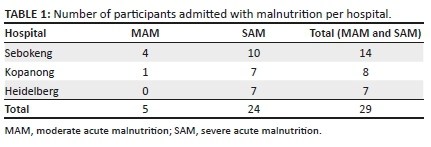
Three hundred and six children participated in the study. Participants were almost equally distributed between the provincial regional (48.4%, n = 148) and district hospitals (51.6%, n = 158) (see Table 1).
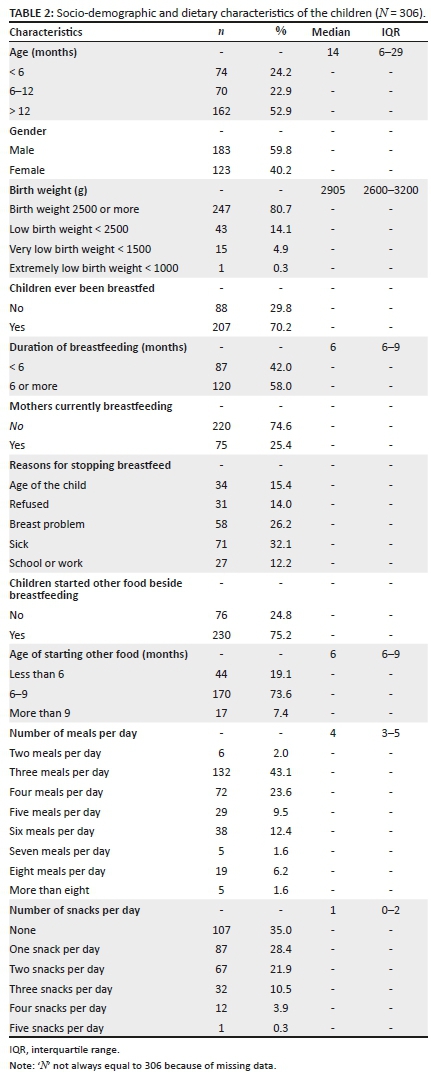
As shown in Table 2, most participants were male (59.8%), > 12 months of age (52.9%), had normal birth weights (80.7%), had a total household income of < R2000 per month (50.3%) and were up to date with immunisation (97.4%). Pneumonia (52.3%) and diarrhoea (20.9%) were the two most common presenting medical problems.
In terms of diet, most participants were reportedly breastfed for > 6 months of age (57.4%, n = 120). However, at the time of the study, most were no longer breastfeeding (74.6%) and many had stopped because the child was sick (32.2%, n = 71) or there were breast problems in the mother (26.2%, n = 58). Although supplementary foods were started for most participants between 6 and 9 months of age (73.6%), one in five (19.1%) were on supplementary feeds before the age of 6 months. Most participants (66.7%) were fed only three to four meals a day and had at most one additional snack per day (63.4%).
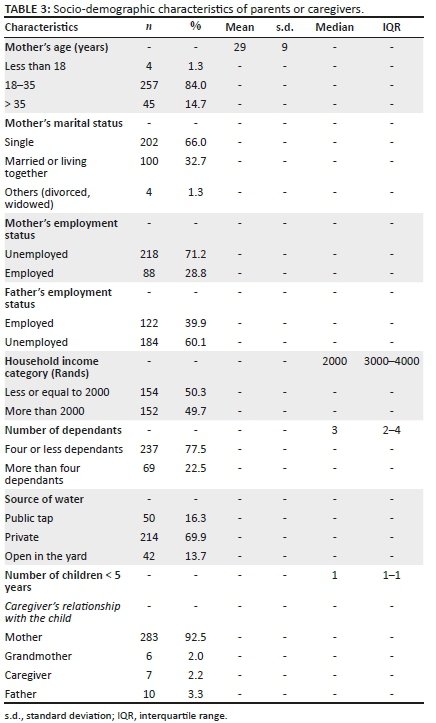
Most carers were the mother of the baby (92.5%, n = 283) and were aged 18-35 years (84.0%), single (66.0%) and unemployed (71.2%). In contrast, most of the fathers were employed (60.1%). Most households had four or less dependents (77.5%), private water source (69.9%) and total≈monthly income of 2000 Rands ($150) or less (50.3%) (Table 3).
The median weight, height and MUAC of the participants were 9.15 kilograms (kg) (interquartile range [IQR]: 6.4-11.8), 75 centimetres (cm) (IQR: 61-88) and 14 cm (IQR: 12.3-15), respectively. By using the WHO classification, 9.48% (n = 29) of study participants were categorised as being malnourished, of whom 82.8% (24) had SAM (Table 1).
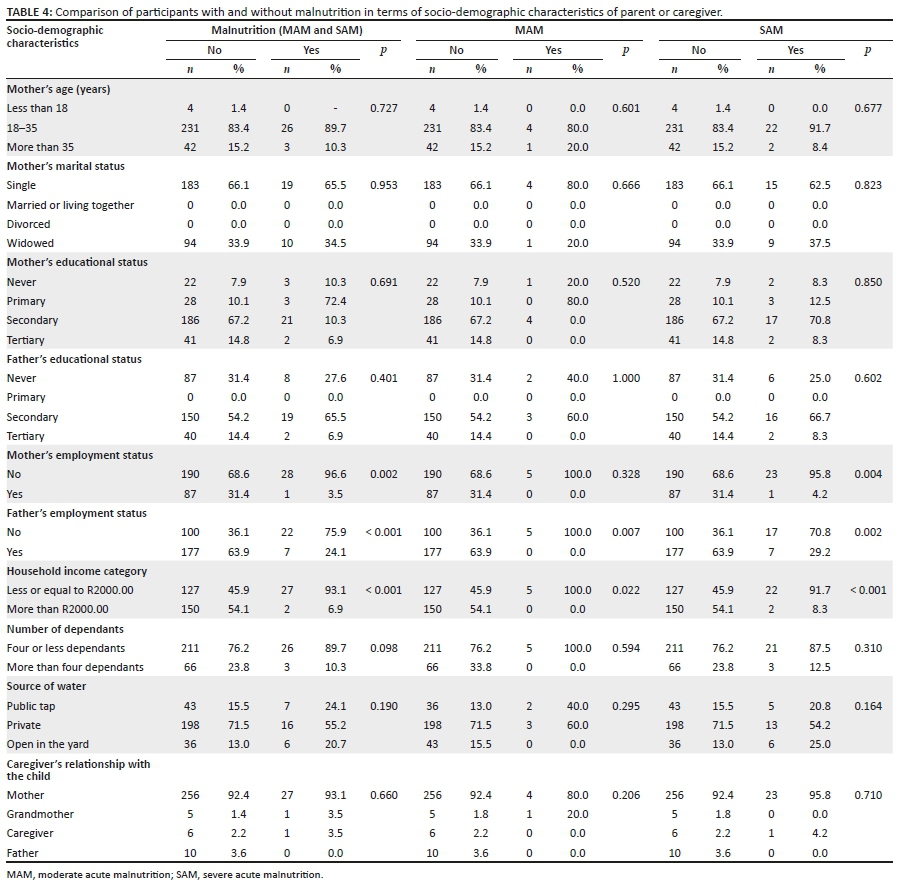
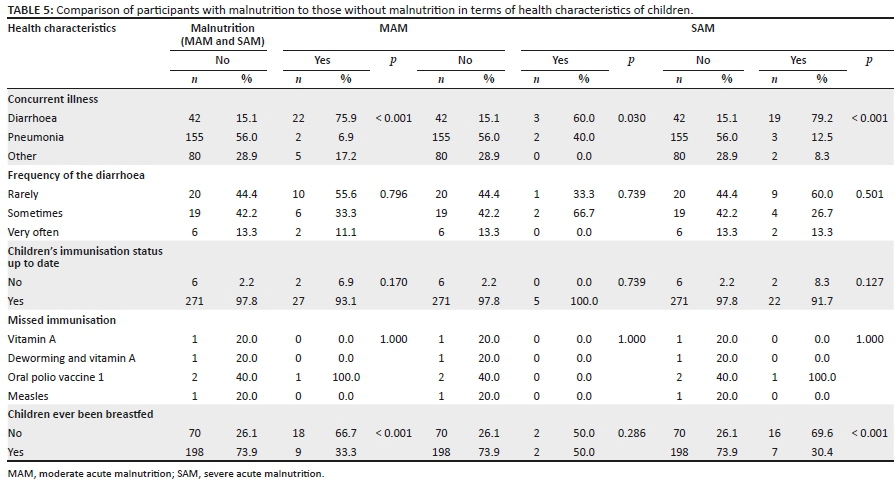
There were no significant differences between participants with or without malnutrition in terms of sex, age and birth weight. However, participants with employed fathers (p < 0.001) or mothers (p = 0.002), those breastfed (p < 0.01) and those from households with income > R2000 per month (p < 0.001) were significantly less likely to be admitted for any category of malnutrition. On the contrary, participants who presented with diarrhoea (p < 0.001) were significantly more likely to be admitted for malnutrition (Tables 4 and 5).
On tests of association, father's employment status (p < 0.01), mother's employment status (p = 0.02), household income (p < 0.01), child's breastfeeding status (p < 0.01) and presenting medical problem (p < 0.01) were significantly associated with admission for malnutrition.
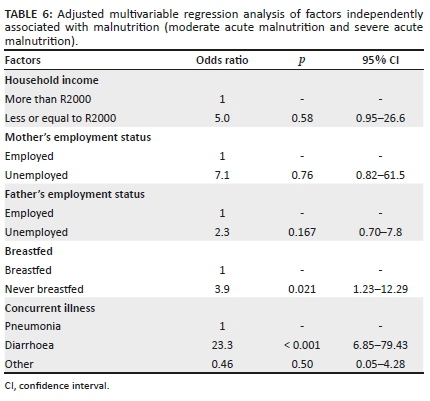
In the final multivariable regression analysis (Table 6), compared with others, participants who were not breastfed (odds ratio [OR] = 3.9; 95% CI: 1.23-12.29; p = 0.02) and those who presented with diarrhoea on admission (OR = 23.3; 95% CI: 6.85-79.43; p < 0.01) were significantly more likely to be admitted for any category of malnutrition. The strengths of these relationships were stronger for SAM only; compared with others, participants who were not breastfed (OR = 6.8; 95% CI: 1.93-23.89; p = 0.003) and those who presented with diarrhoea on admission (OR = 35.24; 95% CI: 8.10-153.25; p < 0.01) were significantly more likely to be admitted for SAM.
Discussion
This study revealed a high prevalence of acute malnutrition (9.4%) with most children affected (82.8%) suffering from SAM. In addition, the feeding practices offered to the children in the study were poor and placed them at significant risk of malnutrition. Although household income and parents' employment status appeared to influence malnutrition, having diarrhoea at presentation and a history of not being breastfed significantly increased the risk of malnutrition.
Although a prevalence of malnutrition of 26.0% has been reported in a study conducted in the same age group in Cape Town,129
That 70.2% of children in this study were breastfed at all is a welcome finding and may reflect the strength of the campaign on exclusive breastfeeding by the South African Department of Health.1213
Most participants had three meals on the average per day and, at best, an additional snack per day. This is not only inadequate to support normal childhood development; it falls far short of the daily requirement of six to eight meals recommended for the study population.1414
The relationship between poor household income (< R2000 per month) and malnutrition in this study reiterates findings of a previous study that showed parental unemployment linked to poor household income as a risk factor for malnutrition.15Tables 5 and 6) - suggesting a need for further studies to examine why this disparity in effect exists.
The strong association between diarrhoea and malnutrition (OR = 23.3; 95% CI: 6.85-79.43; p < 0.01) in this study is consistent with findings of other studies16,17
This study reports a very high immunisation coverage, including Rota virus, that has been associated with significant reduction in the incidence of diarrhoea.1718,19
This was a cross-sectional study and the associations found were only suggestive and not causal in nature. Considering that several study measures relied on self-reports, there is a potential for recall and information bias, with possible misclassifications. Intra-performer variability during anthropometric measurements could also have resulted in a margin of human error that might have affected some study estimates. However, the same researcher performed the anthropometric measurements and adhered strictly to the WHO guidelines. Notwithstanding these potential limitations, the findings of this multicentre study provide an understanding of malnutrition and its associated factors within the context of a typical South African peri-urban health district that are useful for informing interventions in this or similar settings.
Conclusion
A significant proportion of participants had malnutrition and was subjected to suboptimal feeding practices. Healthcare providers in primary care need to entrench dietary education and anthropometric screening in all clinic visits for children < 5 years old, particularly when they present with diarrhoea or are not being breastfed.
Competing interests
The authors have declared that no competing interest exists.
Authors' contributions
M.B.I. and Prof. O.B. Omole, as supervisors, contributed to the study.
Funding information
This research received no specific grant from any funding agency in the public, commercial or not-for-profit sectors.
Data availability statement
Data sharing is not applicable to this article as no new data were created or analysed in this study.
Disclaimer
The views and opinions expressed in this article are those of the authors and do not necessarily reflect the official policy or position of any affiliated agency of the authors.
Acknowledgements
The authors acknowledge the entire staff of the paediatric units of all three hospitals for their support and co-operation, and Dr Folajimi Fadahun for his assistance with data analysis.
References
-
1.United Nations Children's Fund, World Health Organisation, World Bank. Joint child malnutrition estimates [homepage on the Internet]. 2016 [cited 2018 Jan 10]. Available from: https://data.unicef.org/wpcontent/uploads/2016/09/UNICEF-Joint-Malnutrition-brochure.pdf
» https://data.unicef.org/wpcontent/uploads/2016/09/UNICEF-Joint-Malnutrition-brochure.pdf -
2.Faruque AS, Ahmed AM, Ahmed T, et al. Nutrition: Basis for healthy children and mothers in Bangladesh. J Health Popul Nutr. 2008;26(3):325-339. https://doi.org/10.3329/jhpn.v26i3.1899
» https://doi.org/10.3329/jhpn.v26i3.1899 -
3.Fentaw R, Bogale A, Abebaw D. Prevalence of child malnutrition in agropastoral households in Afar Regional State of Ethiopia. Nutr Res Pract. 2013;7(2):122-131. https://doi.org/10.4162/nrp.2013.7.2.122
» https://doi.org/10.4162/nrp.2013.7.2.122 -
4.South Africa. National Department of Statistics. South Africa demographic and health survey [homepage on the Internet]. 2016 [cited 2020 Aug 18]. Available from: http://www.statssa.gov.za/?page_id=6634
» http://www.statssa.gov.za/?page_id=6634 -
5.Manyike PC, Chinawa JM, Ubessie A, Obu HA, Odetunde OI, Chinawa AT. Prevalence of malnutrition among pre-school children in South-east Nigeria. Ital J Pediatr. 2014;40:75. https://doi.org/10.1186/s13052-014-0075-5
» https://doi.org/10.1186/s13052-014-0075-5 -
6.Saunders J, Smith T. Malnutrition: Causes and consequences. Clin Med. 2010;10(6):624-627. https://doi.org/10.7861/clinmedicine.10-6-624
» https://doi.org/10.7861/clinmedicine.10-6-624 -
7.Modjadji P, Madiba S. The double burden of malnutrition in a rural health and demographic surveillance system site in South Africa: A study of primary schoolchildren and their mothers. BMC Public Health. 2019;19(1):1087. https://doi.org/10.1186/s12889-019-7412-y
» https://doi.org/10.1186/s12889-019-7412-y -
8.South Africa. National Department of Health. Training modules for growth monitoring, counselling and promotion: The road to health [homepage on the Internet]. Department of Health; 2010 [cited 2017 Dec 28]. Available from: http://www.info.gov.za/view/DownloadFileAction?id=179901
» http://www.info.gov.za/view/DownloadFileAction?id=179901 - 9.Sedibeng District Health Services. DHIS Indicators, annual report. Vereeniging: Gauteng Province Department of Health; 2015.
-
10.Raosoft. Sample size calculator [homepage on the Internet]. 2017 [cited 2018 Jun 18]. Available from http://www.raosoft.com/samplesize.html
» http://www.raosoft.com/samplesize.html -
11.Kolbrek M. Malnutrition and associated factors in children aged 6-59 months in urban Indonesia. A quantitative study [master thesis]. 2011 [cited 2015 Jan 10]. Available from: https://www.duo.uio.no/bitstream/handle/10852/30045/Master-thesis-Malfrid-Kolbrek.pdf?sequence=2&isAllowed=y
» https://www.duo.uio.no/bitstream/handle/10852/30045/Master-thesis-Malfrid-Kolbrek.pdf?sequence=2& isAllowed=y -
12.Du Plessis L, Peerii N, Honikmaniii S, English R. Breastfeeding in South Africa: Are we making progress? [homepage on the internet]. SAHR. 2016 [cited 2020 Aug 18]. Available from http://worldbreastfeedingweek.org/pdf/wbw2016-cal
» http://worldbreastfeedingweek.org/pdf/wbw2016-cal -
13.Shifraw T, Worku A, Berhane Y. Factors associated exclusive breastfeeding practices of urban women in Addis Ababa public health centers, Ethiopia: A cross sectional study. Int Breastfeed J. 2015;10:22. https://doi.org/10.1186/s13006-015-0047-4
» https://doi.org/10.1186/s13006-015-0047-4 -
14.Anderson AK, Bignell W, Winful S, et al. Risk factors for malnutrition among children 5-years and younger in the Akuapim-North District in the Eastern Region of Ghana. Curr Res J Biol Sci. 2010;2(3):183-188. https://doi.org/10.1017/S1368980014000834
» https://doi.org/10.1017/S1368980014000834 -
15.Treas J, Tai T. Apron strings of working mothers: Maternal employment and housework in cross-national perspective. Soc Sci Res. 2012;41(4):833-842. https://doi.org/10.1016/j.ssresearch.2012.01.008
» https://doi.org/10.1016/j.ssresearch.2012.01.008 -
16.Livingston C. Zinc: Physiology, deficiency, and parenteral nutrition. Nutr Clin Pract. 2015;30(3):371-382. https://doi.org/10.1177/0884533615570376
» https://doi.org/10.1177/0884533615570376 -
17.Singh JB, Kumar M, Shahnawaz K, Krishna A. Diarrhoea and malnutrition in children: A study from Kishanganj District, Bihar. J Evol Med Dent Sci. 2014;3(14):3594-3599. https://doi.org/10.14260/jemds/2014/2326
» https://doi.org/10.14260/jemds/2014/2326 -
18.Verkerke H, Sobuz S, Ma JZ, et al. Malnutrition is associated with protection from rotavirus diarrhoea: Evidence from a longitudinal birth cohort study in Bangladesh. J Clin Microbiol. 2016;54(10):2568-2574. https://doi.org/10.1128/JCM.00916-16
» https://doi.org/10.1128/JCM.00916-16 -
19.Schlaudecker EP, Steinhoff MC, Mooreb SR. Interactions of diarrhoea, pneumonia, and malnutrition in childhood: Recent evidence from developing countries. Curr Opin Infect Dis. 2011;24(5):496-502. https://doi.org/10.1097/QCO.0b013e328349287d
» https://doi.org/10.1097/QCO.0b013e328349287d

Accepted: 14 Sept. 2020
Published: 27 Nov. 2020