Education for primary health care in Africa
Introduction
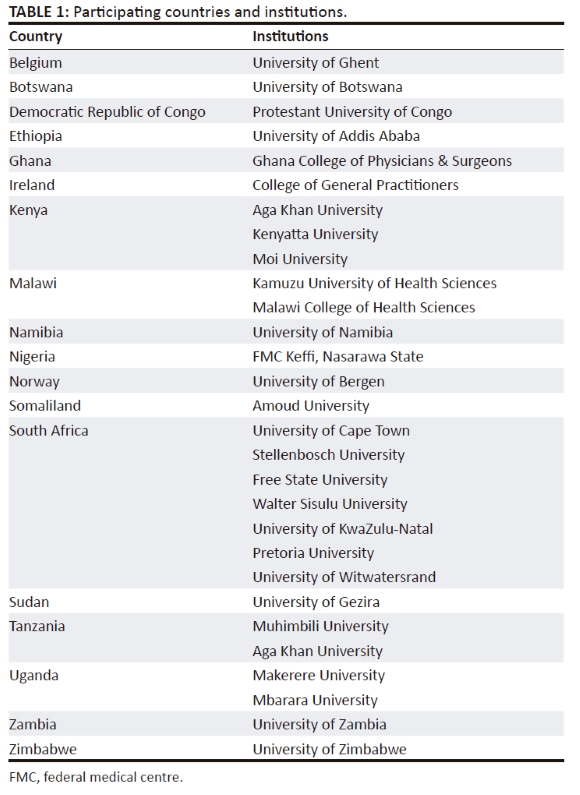
The Primary Care and Family Medicine (PRIMAFAMED) network held a conference in Malawi with the theme of 'Education for Primary Health Care in Africa' 18-19 October 2022.12Table 1).
State of postgraduate family medicine education in sub-Saharan Africa
The PRIMAFAMED network has previously rated the development of postgraduate family medicine education in sub-Saharan Africa according to the stages of change model.3
•Pre-contemplation: Not thinking about family medicine training in the near future.
•Contemplation: Key stakeholders (educational institutions, department of health, registration body) are debating whether to introduce family medicine training.
•Preparation and action: Family medicine training has started but with no or very few graduates as yet.
•Maintenance: Family medicine training is established and the focus is on further developing and consolidating the programmes.
•Relapse: Family medicine training programmes have collapsed or gone backwards.
•Permanent change: So well established that it is unlikely to relapse.
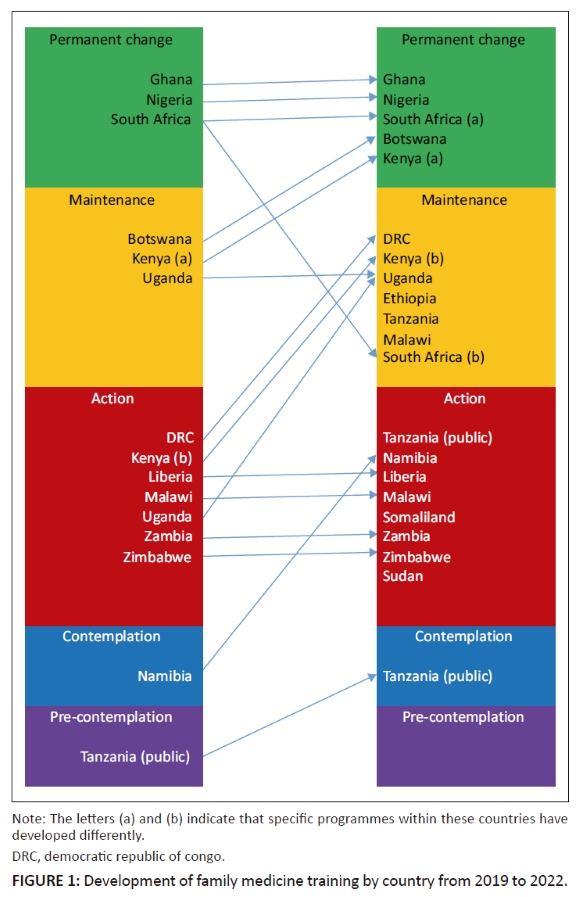
Figure 1 shows how participants self-assessed the development of family medicine training in their countries, and compares their assessment in 2022 with the assessment made in 2019.3
Namibia had increased its readiness to change and moved from contemplation to action phase. The Democratic Republic of Congo, Kenya and Uganda shifted from action phase to maintenance. The majority of the participants from Malawi and Zambia categorized these countries in the action phase, although others categorized them in the maintenance phase. This might suggest that there is progress in incorporating family medicine into the national health system in these countries. Some participants thought that some training programmes in Somaliland and South Africa might be at risk of relapse. This might indicate that incorporation of family medicine into the health system is dynamic and needs constant advocacy with different stakeholders and alignment to the country's health needs. Finally, Botswana has shifted from the maintenance stage into permanent change.
From this evaluation together with different presentations and workshops during this PRIMAFAMED meeting, we can acknowledge that several countries showed progress in the development of family medicine and the incorporation into their national health systems. Continuous evaluation, curricula development, faculty development and advocacy are needed to increase the readiness to change and incorporate family medicine into health systems.
Creating an East Central and Southern Africa College of Family Physicians
Participants supported the idea of creating an East, Central and Southern African College of Family Physicians.4
Creating World Health Organization collaborating centres for primary health care
Currently, the World Health Organization (WHO) has 14 collaborating centres for primary health care (PHC) (four in Europe, five in Asia, four in North America). There are none in Africa, and the University of Ghent's Unit for Family Medicine (itself a collaborating centre) has obtained a grant with Stellenbosch University to develop suitable candidates in the African region.
Dr. Anna Galle attended the conference and presented the opportunity. Such collaborating centres facilitate the set-up of capacity building programmes to strengthen the local health workforce, improve service delivery and disseminate expertise. They also play a role at the global level and can influence the global agenda of health priorities and challenges.
This opportunity is unfortunately limited to certain countries by the Flemish Interuniversity Council who are funding the initiative. These countries are Benin, Burundi, Democratic Republic of Congo, Ethiopia, Kenya, Rwanda, South Africa, Tanzania and Uganda.
Engaging with planetary health education and research
The PRIMAFAMED network is a founding member of the Climate Change, Migration and Health network.5
The CliMigHealth network explores the nexus between climate change, migration and health with a focus on research, education and public awareness. Stellenbosch University has also obtained a grant with the University of Ghent to work on climate change and PHC within this broader nexus. An initial scoping review has pointed towards 10 research priorities and there will be opportunities for PRIMAFAMED to collaborate on addressing some of these. In 2022, the African Journal of Primary Health Care and Family Medicine published a special collection of short reports on climate change and PHC, which should lead to a number of more in-depth case studies.678
The Primary Health Care Research Consortium
The PRIMAFAMED network is also a founding member of the Primary Health Care Research Consortium (PHCRC), which is championing low- and middle-income country (LMIC) led research to address global research priorities in PHC systems and services.9
•How are different LMICs implementing PHC team integration to support comprehensive PHC? A multi-country mixed methods study - Mexico, Uganda and India.
•Characterising the Use of Primary Health Care (PHC) Performance Information: A multiple case study in El Salvador, Lebanon and Malawi.
•An International Survey on the Integration of Public Health and Primary Care in coronavirus disease 2019 (COVID-19) Vaccination Campaigns (with Besrour Centre).
•Identifying effective primary health care service delivery models for integrated management of non-communicable chronic diseases in resource-constrained settings (with the Global Alliance on Chronic Diseases).
The Bill and Melinda Gates Foundation was the main funder and unfortunately its new strategy on PHC does not include support for the PHCRC. The consortium is now looking for new funding to take the work forward.
AfriWon Research Collaboration
The PRIMAFAMED network supported the second cycle of online training and e-mentorship for novice and early career researchers in the field of family medicine in the African region. This initiative has been led by the young family physicians in WONCA (called AfriWon) and had considerable support also from Boston University. The AfriWon Research Collaboration (ARC) developed 10 online modules that help mentees write a research proposal over a period of 6 months. During this period, they are also mentored by a small group that includes a faculty mentor (an experienced researcher) and a peer mentor (a less experienced researcher). The faculty mentor should mentor both the mentee and the peer mentor, as the peer mentor should also develop their capability in postgraduate supervision.
In the second cycle, only 7 out of the 20 mentees completed research proposals, while another seven developed incomplete proposals. Participants came from East, West and Southern Africa. Evaluation suggested the need to improve the management of the mentors, administration and logistics as well as to secure further funding. This remains a potentially useful initiative, especially for training programmes with a lack of postgraduate supervisors and expertise.
Strengthening education for primary health care in Malawi and Zambia
This conference was largely funded by the Norwegian programme for capacity development in higher education and research for development (NORHED) as part of their project on strengthening health systems through primary care leaders education (PRICE) in Malawi and Zambia. The project is primarily focused on improving education for the PHC and family medicine workforce with higher-quality graduates, higher-quality research and more inclusive higher education. The PRIMAFAMED network is a partner on the project and enables South-South visibility and collaboration for the work carried out in these two countries.
Applying the World Organization of Family Doctors postgraduate accreditation standards
Prof. Akye Essuman representing the WONCA Working Party on Education (WWPE) gave a plenary talk on the work of the Working Party and in particular the accreditation standards.10
Conclusion
The annual PRIMAFAMED meeting was a successful event and participants particularly enjoyed networking, interacting and building new relationships. Everyone had a chance to present an educational innovation or research findings11
References
-
1.Primafamed [homepage on the Internet]. No date [cited 2022 June 23]. Available from: https://primafamed.sun.ac.za/
» https://primafamed.sun.ac.za/ -
2.Maeseneer J. Twenty years of Primafamed Network in Africa: Looking back at the future. Afr J Prim Health Care Fam Med. 2017;9(1):a1603. https://doi.org/10.4102/phcfm.v9i1.1603
» https://doi.org/a1603» https://doi.org/10.4102/phcfm.v9i1.1603 -
3.von Pressentin KB, Besigye I, Mash R, Malan Z. The state of family medicine training programmes within the primary care and family medicine education network. Afr J Prim Health Care Fam Med. 2020;12(1):a2588. https://doi.org/10.4102/phcfm.v12i1.2588
» https://doi.org/a2588» https://doi.org/10.4102/phcfm.v12i1.2588 -
4.Ray S, Madzimbamuto FD. Proposal to set up a College of Family Medicine in East, Central and Southern Africa. Afr J Prim Health Care Fam Med. 2022;14(1):a3612. https://doi.org/10.4102/phcfm.v14i1.3612
» https://doi.org/a3612» https://doi.org/10.4102/phcfm.v14i1.3612 -
5.CliMigHealth. How climate change, migration and health interact [homepage on the Internet]. 2022 [cited 2022 Jun 23]. Available from: https://www.climighealth.com/about/
» https://www.climighealth.com/about -
6.African Journal of Primary Health Care and Family Medicine. Special collection of short reports on climate change [homepage on the Internet]. 2022 [cited 2022 Nov 08]. Available from: https://phcfm.org/index.php/phcfm/browseSearch/sections/view?sectionId=32
» https://phcfm.org/index.php/phcfm/browseSearch/sections/view?sectionId=32 -
7.Education for sustainable healthcare [homepage on the Internet]. The Southern African Association of Health Educationalists. [cited 2022 Nov 08]. Available from: https://saahe.org.za/education-for-sustainable-healthcare/
» https://saahe.org.za/education-for-sustainable-healthcare/ -
8.Global Family Doctor - WONCA Online: Working Group on the environment [homepage on the Internet]. [cited 2022 Nov 08]. Available from: https://www.globalfamilydoctor.com/groups/WorkingParties/Environment.aspx
» https://www.globalfamilydoctor.com/groups/WorkingParties/Environment.aspx -
9.Primary Health Care Research Consortium (PHCRC) [homepage on the Internet]. No date [cited 2022 Nov 08] Available from: https://phcrc.world/
» https://phcrc.world/ -
10.Global Family Doctor - WONCA online: Working group on education [homepage on the Internet]. [cited 2022 Nov 08]. Available from: https://www.globalfamilydoctor.com/groups/WorkingParties/Education.aspx
» https://www.globalfamilydoctor.com/groups/WorkingParties/Education.aspx -
11.Programme and abstracts of the Primafamed Conference; 2022 Oct 18-19. [cited 2022 Nov 23]. Available from https://primafamed.sun.ac.za/files/2022/11/Primafamed-Meeting-Abstracts-and-Programme2.pdf
» https://primafamed.sun.ac.za/files/2022/11/Primafamed-Meeting-Abstracts-and-Programme2.pdf

Accepted: 15 Feb. 2023
Published: 06 Apr. 2023