Legal duties, professional obligations or notional guidelines? Screening, treatment and referral of domestic violence cases in primary health care settings in South Africa
Abstract
BACKGROUND: Since 2013, approximately 4400 women have been murdered by their partners in South Africa. This is five times higher than the per capita global average. Domestic violence is known to be cyclical, endemic and frequently involves multiple victims. It also becomes progressively more dangerous over time and may lead to fatalities. In 2012, the Health Professions Council of South Africa released a domestic violence protocol for emergency service providers. This protocol, or screening guidelines, includes assessing future risk to domestic violence, providing physical and psychosocial care, documentation of evidence of abuse and informing patients of their rights and the services available to them. The extent to which these guidelines have been circulated and implemented, particularly by general health care practitioners (HCPs), is unknown AIM: We review international treaties to which South Africa is a signatory, as well as national legislation and policies that reinforce the right to care for victims of domestic violence, to delineate the implication of these laws and policies for HCPs METHOD: We reviewed literature and analysed national and international legislation and policies RESULTS: The 'norms' contained in existing guidelines and currently practiced in an ad hoc manner are not only compatible with existing statutory duties of HCPs but are in fact a natural extension of them CONCLUSION: Proactive interventions such as the use of guidelines for working with victims of domestic violence enable suspected cases of domestic violence to be systematically identified, appropriately managed, properly referred, and should be adopted by all South African HCPs
Introduction
Sandile Mantsoe,i Rameez Patel,ii DJ Donal Sebolai,iii Christopher Panayiotou,iv Thato Kutumelav and Oscar Pistoriusvi are all on trial or recently convicted for murdering their intimate partners in South Africa (SA). These cases received significant public attention, yet in the four-year span in which these notorious murders occurred, approximately 4400 women (three women daily) were also murdered by their partners in SA123,4,5,6 Whilst it is a form of violence that is known to be cyclical, endemic and frequently involving multiple victims, it is also progressively more dangerous over time and may lead to fatalities. A review of health sector initiatives in low and middle-income countries found that one of the key challenges to implementing successful DV interventions was health care systems' lack of clear policies on DV; conversely, in places where policies, protocols and procedures are clear and well integrated, services for victims of DV became an effective part of routine health care.7
The Health Professions Council of South Africa's (HPCSA) Annual Report for 2011-2012899
Bateman9
'… assessing the risk and identifying imminent danger, providing supportive bio-psycho-social care, documenting diligently any evidence of abuse, informing patients of their rights, services and legal remedies, 'talking through' the implications of DV (including the risk of HIV) and referring responsibility appropriately whilst identifying their support systems.' (p. 344)
The protocol also includes a diagrammatic representation of the screening process. In 2013, in the HPCSA Bulletin, Vinassa10
'Until the new guidelines were devised, there was no direct, unambiguous obligation for practitioners to screen routinely for abuse. Where, in the past, these practitioners were previously unprepared and poorly trained to deal with domestic violence, these guidelines will empower practitioners to intervene with the implementation of a prehospital protocol for domestic violence management.' (p. 30)
Vinassa10
'The HPCSA's professional Board for Emergency Care recognises that the right to health care intersects with the right to safety, and this intersection is apparent in the Health Professions Act, which indicates that practitioners have a duty to protect the safety of their patients.' (p. 30)
An exhaustive Internet search, including of the HPCSA website, finds no evidence of the extent to which the protocol has been disseminated amongst emergency health care practitioners (HCP), and other HCPs, since their publication. In the absence of this, we reviewed international and regional (African) treaties to which SA is a signatory or whose norms have been incorporated into SA's legal jurisprudence, as well as national legislation and policies that reinforce the rights of victims of DV, in order to delineate the implications for HCPs.
Through a qualitative systematic content analysis of these international and domestic laws and policies, it was found that these 'norms' are not only compatible with existing statutory duties of HCPs, but are in fact a natural extension of them. We further argue that proactive interventions, such as guidelines for working with victims of DV, not only enable suspected cases of DV to be identified, appropriately managed and properly referred, but that they may prevent the escalation of violence within domestic contexts and may go some way towards reducing the staggering levels of domestic homicide that South Africa is renowned for.
International and national norms and obligations
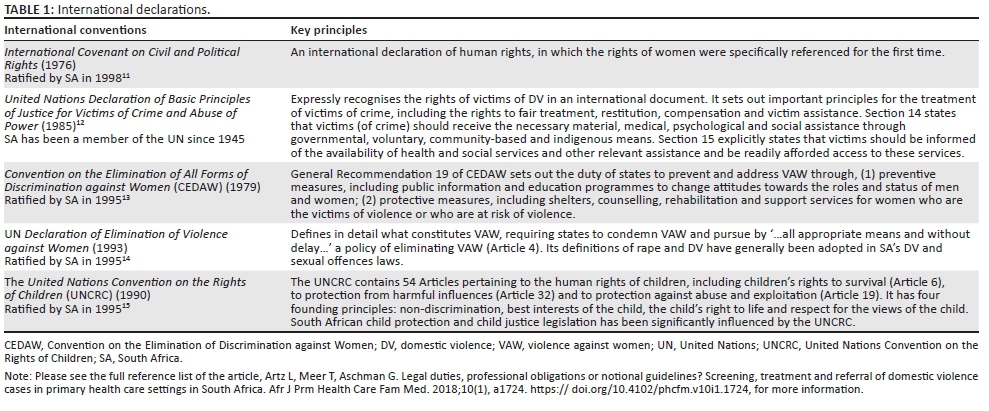
The South African government has made significant commitments with regards to protecting victims of violence through the ratification of international instruments. In terms of Chapter 14, Section 232, of the Constitution of South Africa (1996), '…customary international law is law in the republic unless it is inconsistent with the Constitution or an Act of Parliament'. The breadth of both international laws signed and/or ratified by SA and the development of important domestic legislation and policy has not, however, resulted in consistent implementation in either the health or criminal justice systems. Yet, these international norms are regularly referred to and reflected on in key South African human rights literature and legislative developments. The more recognised of these are presented in Table 1.11,12,13,14,15
Numerous international codes, including the World Health Organization's (WHO) briefing document on injury prevention,16Responding to Intimate Partner Violence and Sexual Violence against Women: WHO Clinical and Policy Guidelines,17
There are also several important regional instruments - including the Southern African Development Community's (SADC) Protocol on Gender and Development,18Addendum on Prevention and Eradication of Violence against Women and Children,19Protocol to the African Charter on Human and Peoples' Rights on the Rights of Women in Africa20
South African legislation
Various South African laws and policies either provide opportunities for HCPs to screen patients for DV or in themselves imply DV screening. Such legislation includes the Mental Health Care Act, 2002 (Act No. 17 of 2002),21National Health Act, 2003 (Act No. 61 of 2003),22International Health Regulations Act, 1974 (Act No. 28 of 1974),23Traditional Health Practitioners Act, 2007 (Act No. 22 of 2007)24Choice on Termination of Pregnancy Act, 1996 (Act No. 92 of 1996),25Domestic Violence Act (DVA), 1998 (Act No. 116 of 1998),26Children's Act (Act No. 38 of 2005)27Sexual Offences (and Related Matters) Amendment Act, 2007 (Act No. 32 of 2007).28,vii The HPCSA's Confidentiality: Protecting and Providing Information policy (HPCSA, 2007),29Guidelines for Good Practice in the Health Care Professions: General Ethical Guidelines for Reproductive Health,30Service Charter for Victims of Crime31Minimum Service Standards for Victims of Crime32
Whilst it would seem sensible that the DVA266
'The Domestic Violence Act … does not impose any positive legal duties on HCPs to screen for DV, make referrals or holistically treat DV-related injuries and other health-related consequences of DV according to a medico-legal protocol. The Act merely implies that HCPs have a responsibility to attend to DV victims (section 2[a]) where it states that 'any member of the SAPS must, at the scene of an incident of domestic violence or as soon thereafter as is reasonably possible, or when the incident of domestic violence is reported render such assistance to the complainant as may be required in the circumstances, including assisting or making arrangements for the complainant to find a suitable shelter and to obtain medical treatment.' (p. 52-53)
However, in the HPCSA's 2008 Guidelines for Good Practice in the Health Care Professions: General Ethical Guidelines for Reproductive Health,30
'Practitioners treating women therefore have an obligation to, (i) affirm women's rights to be free of physical and psychological violence, particularly sexual violence including sexual intercourse without consent within marriage, (ii) advocate for non-violent resolutions in relationships by enlisting the aid of social workers and other health care workers, where appropriate and (iii) make themselves and others, in particular men, aware of the harmful effects of the embedded discrimination against women in social systems.'
The Mental Health Care Act, 20022136
Under the Choice on Termination of Pregnancy Act, 1996,25
'… in the case of a pregnant minor, a medical practitioner or a registered midwife, or registered nurse, as the case may be, shall advise such minor to consult with her parents, guardian, family members or friends before the pregnancy is terminated' (s. 5.3) …
… an HCP could foreseeably discover abuse when inquiring why such a minor may choose not to disclose her pregnancy to others. Furthermore, given that there is ample evidence that pregnancy often leads to the onset or escalation of DV,33,34 screening young people and adults at this juncture may be crucial for maternal and foetal health.
The South African Service Charter for Victims of Crime31Minimum Service Standards for Victims of Crime.32
What does this mean for primary health care practitioners?
In the absence of specific guidelines to follow when a case of DV is identified, HCPs are often reluctant to screen for and treat DV.6,35,37 Health care practitioners providing services to victims of DV report feeling that intervening in DV is not their responsibility, that DV is too personal to discuss with patients, and that little can be done about preventing DV or helping victims.383935,37 Especially for HCPs involved in abusive relationships themselves, screening for DV amongst patients can be challenging.386
Patients themselves are also sometimes reluctant to disclose DV because of denial, feelings of shame and lack of trust in HCPs. Victims often (justly) fear perpetrators' reactions if they learn of the disclosure, and may fear that disclosure, even to non-legal service providers, will result in the involvement of the police, which may have several undesired consequences, such as the termination of the relationship, the break-up of the family and the loss of the primary breadwinner.396
Health care practitioners' reluctance to screen and patients' reluctance to disclose DV speak to the need for clear guidelines on where, when and how screening should take place, and specialised training on understanding DV, how to screen, how to encourage victims to disclose DV, and how to provide non-medical DV services and referrals. There are, of course, practical barriers to screening, including HCPs perceptions that screening for DV is invasive or 'inappropriate' or that it is not part of their health care provision obligations, the limited amount of time available to properly 'build rapport' before screening patients, apprehension of asking screening questions if domestic or intimate partner violence is not present in the patient's life, and the lack of privacy in some health care settings.6
The possibilities of domestic violence screening, treatment and referral
Whilst there is no existing legislation and no well-defined policies that directly compel HCPs to screen for DV as a part of wider health care provision, such screening should become a routine part of providing adequate, preventative care under existing law. Read together, the ratified international and regional instruments, SAs national legislation and the HPCSA guidelines and protocols impose certain duties on the state, and all HCPs, to identify DV, inform patients about their rights and options, provide protective measures and, in the case of children, report abuse and maltreatment to a designated authority.
Several countries - including Spain, Finland, Serbia, Germany, the United States and Vietnam - have developed guidelines, policies and laws encouraging or obliging HCPs to screen and provide interventions for DV; therefore, the precedent for introducing similar policies and practices in SA has been set. Of particular interest are Serbia, categorised with SA as an upper middle-income country, and Vietnam, a lower-middle-income country. Under the Special Protocol of the Ministry of Health of the Republic of Serbia on Protection and Treatment of Women Victims of Violence,4041
The International Planned Parenthood Federation (Western Hemisphere Region) ran a project to improve health care responses to gender-based violence, including DV, by working with local sexual and reproductive health care associations in the Dominican Republic, Peru and Venezuela.42,43 Standardised screening policies and protocols were implemented and new referral systems for counselling and legal assistance were developed. The rates of both screening and detection of gender-based violence increased in all participating facilities. Health care practitioners became more comfortable with conducting routine screening and came to see the value of screening, and clients interviewed as part of the programme evaluation reported feeling comfortable being asked screening questions. The acceptability of screening has also been found amongst women in a study conducted in Nigeria.44
The American Family Violence Prevention Fund also collaborated with two organisations in Mexico on gender-based violence screening programmes, both of which improved screening practices and increased DV-related interventions.43Alaide Foppa, policies and protocols on screening and training were developed and implemented, referral networks were established and a public education campaign was run to encourage victims of gender-based violence to seek help at health care facilities. A second partnership with Asesoría, Capacitación y Asistencia en Salud worked with state HCPs and indigenous traditional birth attendants to intervene in abuse during pregnancy, to reduce morbidity and mortality of pregnant women and their children. The programme developed and implemented a DV screening protocol and trained state HCPs and traditional birth attendants on how to screen for and respond to DV amongst pregnant women.4345
In SA, in 2003, Martin and Jacobs466
In addition to the successful policies and laws mandating or encouraging DV screening by HCPs coming out of developing countries, SA would not be starting from scratch. The screening tools already developed and tested by Martin and Jacobs4647
Conclusion
It is widely accepted that if victims of any form of gender-based violence report to any service sector, it will be to a health facility.663710
Competing interests
The authors' declare that they have no financial or personal relationships that may have inappropriately influenced them in writing this article.
Authors' contributions
L.A. led the conceptualisation of the article. L.A., T.M. & G.A. each wrote a section. L.A. revised and edited the manuscript or submission.
Acknowledgements
References
- 1. Mathews S, Abrahams N, Martin LJ, Vetten L, Van der Merwe L, Jewkes R. Every six hours a woman is killed by her intimate partner': A national study of female homicide in South Africa. MRC Policy Brief No. 5. Cape Town: Medical Research Council; 2004.
- 2. Watson J, Lopes C. Shelter services to domestic violence victims: Policy approaches to strengthening state responses. Cape Town: Heinrich Böll Stiftung Southern Africa and National Shelter Movement of South Africa; 2017.
- 3. Parenzee P, Artz L, Moult K. Monitoring the implementation of the domestic violence act: First research report, 2000-2001. Cape Town: Institute of Criminology, University of Cape Town; 2001.
-
4. Jewkes R, Levin J, Penn-Kekana L. Risk factors for domestic violence: Findings from a South African cross-sectional study. Soc Sci Med. 2002;55(9):1603-1617. https://doi.org/10.1016/S0277-9536(01)00294-5
» https://doi.org/10.1016/S0277-9536(01)00294-5 -
5. Krug EG, Mercy JA, Dahlberg LL, Zwi AB. The world report on violence and health. Lancet. 2002;360(9339):1083-1088. https://doi.org/10.1016/S0140-6736(02)11133-0
» https://doi.org/10.1016/S0140-6736(02)11133-0 - 6. Aschman G, Meer T, Artz L. Behind the screens: Domestic violence and health care practices. Agenda. 2012;26(2):51-64.
-
7. Colombini M, Mayhew S, Watts C. Health-sector responses to intimate partner violence in low- and middle-income settings: A review of current models, challenges and opportunities. Bull World Health Organ. 2008;86:635-642. https://doi.org/10.2471/BLT.07.045906
» https://doi.org/10.2471/BLT.07.045906 - 8. The Health Professions Council of South Africa. Annual report for 2011/12. Pretoria: Health Professions Council of South Africa; 2012.
-
9. Bateman C. 'Formulaic' gender-abuse guidelines seldom followed. S Afr Med J. 2012;104(6):343-345. https://doi.org/10.7196/SAMJ.5965
» https://doi.org/10.7196/SAMJ.5965 - 10. Vinassa A. In harm's way. Bulletin. Pretoria: HPCSA, 2013; p. 30-31.
-
11. UN General Assembly. International Covenant on Civil and Political Rights [homepage on the Internet]. 16 December 1966, United Nations. Treaty Series. Vol. 999, p. 171. [cited 2016 Nov 11] Available from: http://www.refworld.org/docid/3ae6b3aa0.html
» http://www.refworld.org/docid/3ae6b3aa0.html -
12. UN General Assembly. Declaration of basic principles of justice for victims of crime and abuse of power: Resolution/adopted by the General Assembly, 29 November 1985 [homepage on the Internet]. A/RES/40/34. [cited 2016 Nov 11]. Available from: http://www.refworld.org/docid/3b00f2275b.html
» http://www.refworld.org/docid/3b00f2275b.html -
13. UN General Assembly. Convention on the elimination of all forms of discrimination against women, 18 December 1979 [homepage on the Internet]. United Nations. Treaty Series. Vol. 1249, p. 13. [cited 2016 Nov 11]. Available from: http://www.refworld.org/docid/3ae6b3970.html
» http://www.refworld.org/docid/3ae6b3970.html -
14. UN General Assembly. Declaration on the elimination of violence against women, 20 December 1993 [homepage on the Internet]. A/RES/48/104. [cited 2016 Nov 11]. Available from: http://www.refworld.org/docid/3b00f25d2c.html
» http://www.refworld.org/docid/3b00f25d2c.html -
15. UN General Assembly. Convention on the rights of the child, 20 November 1989 [homepage on the Internet]. United Nations. Treaty Series. Vol. 1577, p. 3. [cited 2016 Nov 11]. Available from: http://www.refworld.org/docid/3ae6b38f0.html
» http://www.refworld.org/docid/3ae6b38f0.html -
16. World Health Organization. Violence prevention, the evidence: Reducing violence through victim identification, care and support programmes [homepage on the Internet]. Geneva: World Health Organization; 2009 [cited 2016 Nov 11]. Available from: http://www.who.int/violence_injury_prevention/violence/programmes.pdf
» http://www.who.int/violence_injury_prevention/violence/programmes.pdf -
17. World Health Organization. Responding to intimate partner violence and sexual violence against women: WHO Clinical and Policy Guideline [homepage on the Internet]. Geneva: World Health Organization; 2013 [cited 2015 Aug 19]. Available from: http://apps.who.int/iris/bitstream/10665/85240/1/9789241548595_eng.pdf
» http://apps.who.int/iris/bitstream/10665/85240/1/9789241548595_eng.pdf -
18. Southern African Development Community. Protocol on gender and development [homepage on the Internet]. 1997 [cited 2016 Nov 11]. Available from: https://www.sadc.int/files/8713/5292/8364/Protocol_on_Gender_and_Development_2008.pdf
» https://www.sadc.int/files/8713/5292/8364/Protocol_on_Gender_and_Development_2008.pdf - 19. Southern African Development Community. Addendum on prevention and eradication of violence against women and children. Gaborone: Southern African Development Community; 2008.
-
20. African Union. Protocol to the African charter on human and people's rights on the rights of women in Africa [homepage on the Internet]. 11 July 2003 [cited 2016 Nov 11]. Available from: http://www.refworld.org/docid/3f4b139d4.html
» http://www.refworld.org/docid/3f4b139d4.html - 21. Republic of South Africa. The Mental Health Care Act, 2002 (Act No. 17 of 2002). Cape Town: Republic of South Africa; 2002.
- 22. Republic of South Africa. National Health Act, 2003 (Act No. 61 of 2003). Cape Town: Republic of South Africa; 2003.
- 23. Republic of South Africa. International Health Regulations Act, 1974 (Act No. 28 of 1974). Pretoria: Republic of South Africa; 1974.
- 24. Republic of South Africa. Traditional Health Practitioners Act, 2007 (Act No. 22 of 2007). Cape Town: Republic of South Africa; 2007.
- 25. Republic of South Africa. Choice on Termination of Pregnancy Act, 1996 (Act No. 92 of 1996). Cape Town: Republic of South Africa; 1996.
- 26. Republic of South Africa. Domestic Violence Act, 1998 (Act No. 116 of 1998). Cape Town: Republic of South Africa; 1998.
- 27. Republic of South Africa. Children's Act, 2005 (Act No. 38 of 2005). Cape Town: Republic of South Africa; 2005.
- 28. Republic of South Africa. Sexual Offences (and Related Matters) Amendment Act, 2007 (Act No. 32 of 2007). Cape Town: Republic of South Africa; 2007.
-
29. Health Professionals Council of South Africa. Confidentiality: Protecting and providing information [homepage on the Internet]. 2nd ed. Booklet 11. Pretoria: HPCSA; 2007 [cited 2015 Aug 19]. Available from: http://www.hpcsa.co.za/downloads/conduct_ethics/rules/confidentiality_protecting_providing_info.pdfpolicy
» http://www.hpcsa.co.za/downloads/conduct_ethics/rules/confidentiality_protecting_providing_info.pdfpolicy - 30. Health Professionals Council of South Africa. Guidelines for good practice in the health care professions: General ethical guidelines for reproductive health. Booklet 13. Pretoria: HPCSA; 2008.
-
31. Department of Justice and Constitutional Development. Service charter for victims of crime in South Africa: The consolidation of the present legal framework relating to the rights of and services provided to victims of crime [homepage on the Internet]. 2004 [cited 2015 Aug 19]. Available from: http://www.justice.gov.za/vc/docs/vc/vc-eng.pdf
» http://www.justice.gov.za/vc/docs/vc/vc-eng.pdf -
32. Department of Social Development. Minimum standards on services for victims of crime [homepage on the Internet]. 2004 [cited 2015 Aug 19]. Available from: http://www.justice.gov.za/vc/docs/vcms/vcms-eng.pdf
» http://www.justice.gov.za/vc/docs/vcms/vcms-eng.pdf - 33. Artz L. An examination of the attrition of domestic violence cases in the criminal justice system in post-apartheid South Africa [PhD dissertation]. Belfast: Queen's University Belfast; 2008.
- 34. Mbokota M, Moodley J. Domestic abuse: An antenatal survey at King Edward VIII Hospital, Durban. S Afr Med J. 2003;93(6):455-457.
- 35. Martin L, Artz L. The health care practitioner's role in the management of violence against women in South Africa. Contin Med Educ. 2006;24(2):72-77.
-
36. Danielson K, Moffitt T, Caspi A, Silva P. Comorbidity between abuse of an adult and DSM-III-R mental disorders: Evidence from an epidemiological study. Am J Psychiatry. 1998;155(1):131-133. https://doi.org/10.1176/ajp.155.1.131
» https://doi.org/10.1176/ajp.155.1.131 - 37. Joyner K. Health care for intimate partner violence: Current standard of care and development of protocol management [PhD dissertation]. Stellenbosch: University of Stellenbosch; 2009.
- 38. Joyner K. Screening for domestic violence in the primary health care sector of the Western Cape - Research findings from doctoral work in progress. In: Tshwaranang Legal Advocacy Centre, the Centre for Health Policy, the School of Public Health, editors. Developing a health sector response to domestic violence - A roundtable discussion. Johannesburg: Tshwaranang Legal Advocacy Centre; 2008.
- 39. Kramer JF. Developing a health sector response to domestic violence. In: Tshwaranang Legal Advocacy Centre, the Centre for Health Policy, the School of Public Health, editors. Developing a health sector response to domestic violence - A roundtable discussion. Johannesburg: Tshwaranang Legal Advocacy Centre; 2008.
-
40. Republic of Serbia Ministry of Health. Special protocol of the Ministry of Health of the Republic of Serbia on Protection and Treatment of Women Victims of Violence [homepage on the Internet]. 2010 [cited 2015 Aug 19]. Available from: http://www.undp.org/content/dam/serbia/Publications%20and%20reports/English/UNDP_SRB_Republic_of_Serbia_Ministry_of_Health_Special_Protocol_for_the_Protection_and_Treatment_of_Women_Victims_of_Violence.pdf
» http://www.undp.org/content/dam/serbia/Publications%20and%20reports/English/UNDP_SRB_Republic_of_Serbia_Ministry_of_Health_Special_Protocol_for_the_Protection_and_Treatment_of_Women_Victims_of_Violence.pdf - 41. Spratt K, Trang TT. Public sector response to gender-based violence in Vietnam. AIDSTAR-One Case Study Series. Arlington, VA: USAID; 2012.
-
42. Bott S, Guedes A, Claramunt MC, Guezmes A. Improving the health sector response to gender-based violence: A resource manual for health care professionals in developing countries [homepage on the Internet]. New York: International Planned Parenthood Federation/Western Hemisphere Region; 2010 [cited 2015 Aug 19]. Available from: https://www.ippfwhr.org/sites/default/files/GBV_cdbookletANDmanual_FA_FINAL.pdf
» https://www.ippfwhr.org/sites/default/files/GBV_cdbookletANDmanual_FA_FINAL.pdf -
43. Guedes A. Addressing gender-based violence from the reproductive health/HIV sector. A literature review and analysis [homepage on the Internet]. Washington, DC: The Population Technical Assistance Project; 2004 [cited 2015 Aug 19]. Available from: http://www.prb.org/pdf04/addressGendrBasedViolence.pdf
» http://www.prb.org/pdf04/addressGendrBasedViolence.pdf -
44. John IA, Lawoko S, Oluwatosin A. Acceptance of screening for intimate partner violence, actual screening and satisfaction with care amongst female clients visiting a health facility in Kano, Nigeria. Afr J Prim Health Care Fam Med. 2011;3(1):174-179. https://doi.org/10.4102/phcfm.v3i1.174
» https://doi.org/10.4102/phcfm.v3i1.174 -
45. Kohler R, Sargsyan I. An expanded role for RH providers: Improving health sector response to violence against women [serial online]. Prime Pages. 2004 [cited 2015 Aug 19];4. Available from: http://www.prime2.org/prime2/page/home/47b949.html?article=379
» http://www.prime2.org/prime2/page/home/47b949.html?article=379 - 46. Martin L, Jacobs T. Screening for domestic violence: A policy and management framework for the health sector. Cape Town: Institute of Criminology, University of Cape Town; 2003.
- 47. Joyner K, Mash B. How to provide comprehensive, appropriate care for survivors of intimate partner violence. In: Joyner K, editor. Aspects of forensic medicine: An introduction for healthcare professionals. Cape Town: Juta, 2010; p. 87-100.

Accepted: 18 Apr. 2018
Published: 18 June 2018
ii. Accused of murdering his wife Feroz Patel in April 2016.
iii. Accused of murdering his girlfriend Dolly Tshabalala in June 2015.
iv. Accused of having his wife Jane Panayiotou murdered in April 2015.
v. Accused of murdering his girlfriend Zanele Khumalo in April 2014.
vi. Convicted of killing his girlfriend Reeva Steenkamp in February 2013.
vii. The Sexual Offences (and Related Matters) Amendment Act (28) has detailed regulations for the compulsory HIV testing of persons accused of rape (Section 27), the right of rape survivors to receive Post-Exposure Prophylaxis and other treatments for STIs at public health facilities (Section 28). The Department of Health's 2009 Health Directives guide HCPs in implementing the Act with respect to pre- and post-HIV-test counselling and the e-administration of post-exposure prophylaxis to rape survivors.