The perceived impact of family medicine leadership training on practice: A qualitative study
Abstract
BACKGROUND: Family physicians (FPs) play a crucial role in clinical governance within South Africa's District Health System, necessitating strong leadership skills AIM: To understand how the postgraduate Leadership and Governance module at the University of Cape Town (UCT) helped prepare qualified FPs working in the Western Cape province public sector for their leadership role SETTING: The UCT offers a 4-month Leadership and Governance module as part of its 4-year Master of Medicine in Family Medicine programme, aiming to prepare registrars for leadership roles METHODS: An exploratory qualitative study design was used. A total of 10 UCT alumni working in senior public sector roles were purposively sampled for online semi-structured interviews. Interviews were recorded, transcribed and analysed using the framework method. Data were coded deductively into themes, with new themes created for cohesive uncategorised data RESULTS: Findings revealed that FPs shared similar early experiences as clinical leaders and faced a transitional phase after completing their registrarship. While key leadership qualities aligned with existing literature, participants emphasised the importance of context-specific training and the value of community practice resources CONCLUSION: The module itself was not considered particularly helpful in preparing FPs for real-world leadership and governance challenges CONTRIBUTION: The study highlights gaps between theoretical training and practical leadership demands, indicating that the module must better address the realities faced by newly qualified FPs. This research contributes to understanding the limitations of current leadership training and underscores the need for more practical, contextually relevant education for FPs in leadership roles
leadership; clinical governance; qualitative evaluation; family medicine; fit for purpose
Introduction
Background
Family medicine (FM) has been recognised as an established specialist discipline by the Health Professions Council of South Africa (HPCSA) since 2007, with about two decades of various forms of postgraduate training preceding this date. The formal recognition of FM as a specialised discipline ushered in the 4-year registrar programme across nine universities in the country.12,3,4,5,66
South African (SA) training programmes adopted, as a core component of their curriculum, the teachings of Ian McWhinney, a Canadian professor of FM, who outlined the foundational principles of the discipline.7
Within South Africa, many challenges relating to persisting inequalities in the healthcare system stem from the political past. Even though progress is being made towards universal health coverage (UHC) outlined in policy,228,9
In the SA context, Mash continues to explore the latest contributions of FPs to health care and reports that the their role and contribution are still primarily clinical.10103,4
A systematic review of leadership within the healthcare system done by Mukwankungu et al. explains the numerous challenges clinicians encounter within the healthcare and managerial spheres.1111
Gilson and Daire outline three key leadership abilities that can transform health care:12
• The ability to use the extensive variety of information and data in decision-making to identify constraints within operations.
• Involve people in decision-making rather than imposing.
• Develop strong relationships with higher levels of political support and other resourceful parties outside the system.
The above-stated skills may seem to be in addition to clinical training and have been noted to be outside the scope of undergraduate programmes, but they are within the scope of a trained FP.
The idea of a lack of confidence regarding leadership was reiterated by Gallagher et al., who conducted a cross-sectional quantitative survey with junior registrars in Canada.1313
The proposed roles and expectations of the FP within the SA context are explored further in the latest position paper of the South African Academy of Family Physicians (SAAFP).9,10102,3,4,5,610
The national learning outcomes (NLOs) within the national portfolio of learning for FM training, which forms the basis of the Master of Medicine (MMed) programme to ensure uniformity across South Africa, have a specific outcome dedicated to leadership and governance.8,148810
The Leadership and Governance (L&G) module offered during the registrar training programme at the University of Cape Town (UCT) was revised in 2022 to align with the latest NLO published, as well as taking into consideration points raised in both publications by Mash et al.6,87,8
The key components of the updated 2022 L&G module are now presented over an expanded 12-session module and include sessions involving a group coaching approach dedicated to leadership development, sessions on clinical and corporate governance content, a leadership or personality style assessment measured by the Enneagram15,1612
The SAAFP has started a new initiative in 2021, the Next5 special interest group, to help newly qualified FPs develop in their roles and careers through mentoring and certain activities as determined by member needs.1717
Within South Africa, a few research papers have been written attempting to understand and evaluate different teaching interventions within FM. Many of these articles have been qualitative studies exploring experiences of various aspects of the FM post-graduate curriculum.18,19,2021
Although the need for clinical leadership in primary and district care services has been addressed within the curriculum, but more needs to be known about the effectiveness of formal leadership training. This represents a significant gap in the educational literature in relating training programmes to clinical platforms.
The study aimed to understand if and how the previous postgraduate L&G training module in the MMed curriculum at UCT helped prepare newly qualified FPs for the Western Cape province of South Africa's public sector. The main objectives were:
• To describe participants' experiences of the L&G module concerning their work.
• To identify learnings from the L&G module perceived as useful by participants.
• To describe competencies identified by workplace experience not covered in the curriculum.
• To identify additional resources participants used to enhance their leadership competence once practising.
• To identify perceptions of effective leadership attributes needed on the district clinical platform.
Research methods and design
Study design
A narrative analysis using an interpretive and exploratory strategy was adopted in this qualitative research design, as described by Mabuza et al.22
Setting
This study focused on FPs practising at the Department of Health (DOH) facilities. It primarily examined their educational exposure to the UCT module and tracked those FPs specifically based within the Western Cape province.
These facilities within the province can be divided into rural or metro sites. The Cape Metro health district has eight legislated sub-districts serving over 4.1 million people, according to the latest population statistics from 2018 to 2019. There are 152 primary health care facilities and 8 district hospitals. There are also tuberculosis (TB) hospitals, but they support the broader Western Cape in delivering TB inpatient services.232425
• Child health.
• Emergency medical services.
• Family planning.
• Forensic pathology services.
• Women's health.
• Tuberculosis and human immunodeficiency virus (HIV)/acquired immunodeficiency syndrome (AIDS).
• Men's health.
• Psychiatric services.
• Home-based care.
Study population and sampling strategy
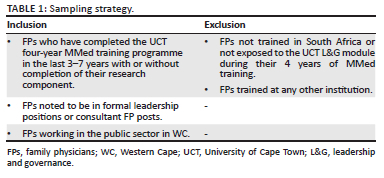
Participants were purposively sampled with specific inclusion and exclusion criteria, as shown in Table 1. A total of 13 FPs were invited to participate; however, data saturation determined the sample size. Participants were contacted via email requesting their voluntary participation in the study from an alumni list compiled by the Division of Family Medicine. Because of various challenges, including the availability of consultant posts after graduation and the response rate of participants to this study, specific criteria regarding the years following exposure to the MMed programme had to be extended to assist in recruiting participants.
Data collection
The research team consisted of the primary researcher and her two supervisors.
Data were collected through semi-structured interviews with an interview guide and an initial demographics portion (Appendix 1).26
The primary researcher conducted the interviews at the participants' convenience. All interviews took place online using the Zoom meeting platform. Interviews were conducted in English and recorded using the same platform. Professional transcription services manually transcribed the audio recordings. Before analysing the data, the transcriptions were checked for accuracy, and mistakes in transcription were corrected against the original recording.
Data analysis
The researchers familiarised themselves extensively with the data, listening to the audio recordings and reading the transcripts. This was done repeatedly and in a phased approach, as the transcriptions took time to generate following each interview.
The data were analysed deductively using the framework approach.27
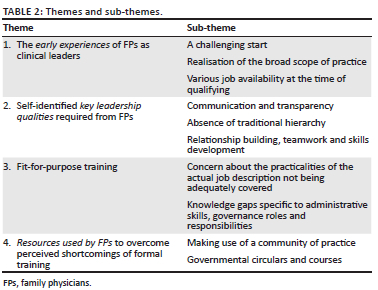
Categories were generated from this process that included two initial themes: 'key leadership qualities required' and 'fit-for-purpose training'. During coding, two further categories emerged, reported next, providing a framework with four categories, later termed themes because they contained data that provided a cohesive narrative. Initial codes were extracted from the data and categorised within the framework. Sub-themes and themes emerged from these codes. The primary researcher performed coding, and the rest of the team assisted with quality control as described next.
Quality control
Adhering to the Lincoln and Guba, trustworthiness criteria22,28
Member checking, also known as respondent validation, was performed by presenting the study's preliminary findings at a group forum attended by participants. The presentation and themes resonated well with the group, and no additional data were generated, indicating that data saturation had been achieved in the semi-structured interviews.
It is difficult to completely exclude selection bias in this study, as the participants were purposely sampled from a list compiled by the Division of Family Medicine. All participants who were contacted worked in the government sector per the inclusion criteria, but the number of participants who consented was out of the researcher's control.
Data were collected over an extended period using thick descriptions with a clear audit trail to achieve transferability. The interview guides were piloted, interviews were audio recorded and transcribed to ensure accurate records, and the analysis process was supervised following training in qualitative research analysis. This also helps ensure dependability.
Regarding reflexivity, the main researcher, currently in her final years of residency, has extensive experience in South Africa's primary and district health care systems. She acknowledges that intuitive knowledge helped inform her research question and that personal bias exists as she is embedded in the training programme. However, attempts were made to minimise this bias through conversations with the supervisors, personal reflections and the above-stated steps to help ensure the trustworthiness of this study. She approached the analysis methodically and engaged with only the data provided to manage subjectivity.
Ethical considerations
This study was guided by the Declaration of Helsinki on medical research involving human subjects.29
Results
Demographics
In all 13 FPs were invited to participate in the study. Two FPs did not respond despite several communication attempts, and one FP declined to participate in the study as she felt she was not in a typical FP role. A total of 10 participants were interviewed, of which 7 were male. The youngest participant was 34 years old, and the oldest was 53 years old. The years of graduation vary, with 50% of the candidates graduating between 2018 and 2022. Seven participants were in FP consultant posts, one was a clinical manager, and two were in medical officer (non-consultant) posts because of a scarcity of FP posts.30
Themes
The data were organised into sub-themes and themes (Table 2). Saturation was reached by the sixth interview. However, data collection continued to ensure that all 10 participants were interviewed.
The early experiences of family physicians as clinical leaders
A challenging start
During this study, it became evident that despite the differences in years of work experience between the participants, most still found their time as clinical leaders a positive experience. Many shared the sentiment of a challenging start, but usually, with time and experience, there was an improvement in both skill set and confidence within their role. One participant stated:
'It's been rewarding but an interesting rollercoaster. I think that first few years were really tough.' (1.28, 43 year, F)
Many expressed that even after completing their formal training, there were still many knowledge gaps regarding their leadership roles, many of which were filled with on-the-job training. One participant reported:
'It was very difficult in the beginning, like finding my feet, and there's a lot of things that are not taught that you kind of have to learn on the job.' (4.41, 39 year, F)
Realisation of the broad scope of practice
Upon reflection on their journeys to this point, many participants shared an overwhelming realisation and acceptance that their potential scope of practice is so vast. 'So … there is much that is involved in the role' (3.45, 47 year, M). Some participants embraced that challenge and utilised all their skills daily within their sphere of influence: 'Everything I have studied during registrarship really comes into fruition when you are actually in the role, like in the role because you do everything' (10.86, 39 year, F). While others still grapple with their roles and responsibilities, which are no longer primarily clinical: 'Administrative things that leadership people in the state sector should know about and that I found that I didn't know much about' (8. 126, 34 year, M). Senior participants expressed a more mature view towards previous expectations of a FP, stating that during their training, FPs were not considered to function as managers and that it was impossible to cover everything: 'We were brand new. So, look in, in, in all fairness, I don't think they knew what they were teaching us in the beginning anyway' (7.125, 47 year, M).
Various job availability at the time of qualifying
A driver that influences where FPs work, their work experience and subsequent roles as leaders is job availability at the time of graduating. Family physicians in all year groups have expressed different experiences of this with one of the more senior candidates stating: '… there were jobs available because we were the first lot to finish' (7.74, 47 year, M). Conversely, many of the junior FPs have had to find medical officer (non-specialist) posts while waiting for FP or clinical manager posts to open up: 'So I'm the medical officer … family physician … working as (in) a medical officer post' (6.24, 47 year, M). One participant, post-graduation, had to find work overseas because of job scarcity and found himself now with a different challenge being:
'I'm a senior doctor in the cruise industry … So, I work in the maritime healthcare space. I am a doctor at sea, but I still do locum work when I'm on holiday, in Emergency Rooms (ERs) in Cape Town … my biggest challenge now is that I haven't worked in a family physician post in South Africa.' (2.38, 47 year, M)
Self-identified key leadership qualities required from family physicians
Communication and transparency
Participants were able to reflect on their years of lived experience and draw on some of the key learning points about the leadership skills required: knowing and building up your team, transparency and communication. Participants were able to express a sense of self-awareness and awareness of their teams, and could acknowledge points that their teams valued. One of these was sharing information and transparency regarding the workings of the facility and staff members: 'So … whether that's integrity or transparency, but transparency also in this is how the system works' (1.371, 43 year, F).
Absence of traditional hierarchy
By using the bottom-up approach, they were able to create a culture which aims to decrease the old traditional hierarchies often present within the health sector and use what one participant describes as:
'I also think that bottoms-up approach … so … I think also the way that you need to be very open to innovation and change. Okay … [s]o, it's not meant to be a hierarchy.' (4.343, 39 year, F)
This practice aids in the FP getting to know their team members, more than just on a skills level. They can draw on team members' strengths as well as navigate and eventually work on their weaknesses, therefore building and strengthening the team up as a unit, with one participant reflecting: 'You need to know what the other people are doing and how you can lean on them, and how they can lean on you' (7.725, 47 year, M), and another participant similarly stating:
'You need to have, have an understanding of the system. You need, and I think that's why I think family physicians are, are, are quite good because we don't just look at a single speciality. You need to, you need to have a little bit of a bird's eye view of what's going on and be respectful and understanding of, you know, what's, what the nursing side is, what the, you know, the support services side because it's not just the doctor that makes a hospital run.' (7.260, 47 year, M)
Relationship building, teamwork and skills development
This emphasis on relationship building and respect for their team members is important because, as people, life continues to happen outside of the workspace. The importance of preserving the work-life balance among the team helps build resilience and creates the culture at work where people want to do more because they feel valued as team members. This sensitivity is reflected by one participant stating:
'… on the team that we have and having some small things, that sort of build resilience, but also its protective of, of people not burning out … Is key, and I mean that, that goes from like having a, a coffee club at work, having specific social events and a lot of, you know, sort of not building a culture of people working for each other … And that's sometimes challenging, but I think we are working on it.' (8.279, 34 year, M)
They were also able to make decisions using all available data and resources and, when appropriate, involve the team in this process, as reflected by one of the participant: 'The other thing is whenever a decision is being taken, it is important to seek the opinion, the view of the team as a whole' (3.183, 47 year, M). This teamwork in decision-making and policy implementation solidifies the sub-theme of doing away with traditional hierarchies, emphasising the importance of working well within and between teams, as one participant indicated:
'… so teamwork is, is also a very important attribute that you must, must, must have because you need to be able to work well with the other heads of departments and also work well with the staff and I feel if you don't have that teamwork, then it causes very poor work ethic in the workplace.' (4.351, 39 year, F)
Another quality of being a leader and a core value within FM is to upskill and capacitate the team. One participant reported that this is an enjoyable part of the job:
'Because like yes, we need to teach a lot, but we need to also be open to learning, like continuously learning. And then I think that I also … I love teaching. So, like teaching and training the staff to do the right thing.' (10.208, 39 year, F)
Investing in staff development, whether through in-service training or specific training, is highly valued, suggesting that the participants understand the needs of their team: 'I think being a trainer, so like, I think staff like to be upskilled. Staff like to be upskilled all the time' (4.357, 39 year, F).
Fit-for-purpose training
This is when training programmes ensure that local needs and context are being met with their curriculum, which includes both theoretical and practical knowledge and aims to better equip the graduate for their future role and responsibilities.31
Concern about the practicalities of the actual job description not adequately covered
Some participants expressed concerns that some of the practicalities of the job were not addressed in their formal training. Participants identified particular gaps linked to the knowledge of systems and human resource processes that they needed to be effective. Comparing their preconceived ideas about leadership and the actual experience thereof, one participant reflected that: 'I found that it was very different once we were in the real sort of life doing it' (8.85, 34 year, M).
For those participants who found the module useful, their perception of the module's value was heavily centred around personality or leadership style testing, which was a prominent feature throughout the various iterations of the module. Participants were able to think critically about what kind of leader they could be and how others may perceive their styles. Participants benefited from this self-reflection based on an established psychometric model with one of them stating:
'I really enjoyed the theory of what, of sort of stimulating what your own leadership style might be and, and doing, going through sort of thought process of thinking about what type of leader you want to be.' (8.78, 34 year, M)
These self-reflections and softer skills also helped in other areas like being able to connect with different team members and build relationships, as stated by one participant: '… that stuck with me was more personality profile that was done, and part of that was learning other personality profiles' (1.90, 43 year, F).
Knowledge gaps specific to administrative skills, governance roles and responsibilities
The knowledge gaps were mainly administrative, like managing grievances, complaints, patient safety incidents and difficult staff-related problems. The roles and responsibilities of FP at a management level, including human resource management processes such as progressive discipline, management of absenteeism and finances of a facility, were identified as a clear gap in the training, as indicated by one of participant: 'Complaint, progressive discipline. Managing absenteeism is something we were never exposed to' (3.106, 47 year, M). This was echoed across most interviews, especially where the participants were in FP posts, as shown in the following excerpt:
'I mean, some of the, you know, some of them were just learnt on the job and usually that was in the face of a crisis when it comes to management and that happened quite early on, and then, you know, one also learns and upskills a lot around rules and processes with, with respect to HR.' (5.183, 53 year, M)
Resources used by family physicians. FPs to overcome perceived shortcomings of formal training
Making use of a community of practice
As explored throughout the study, all the participants discussed various learning points from lived experience versus formal training, and all were able to identify specific knowledge gaps. Depending on their experience in the role, the perceived amount of time available and the importance of the subject matter, many have attempted to close these gaps through the relevant channels to function effectively as leaders within their space.
Participants instinctively learned from and leaned on their local team and other FPs for support during their earlier challenging years. A participant explicitly stated: 'To be able to learn from, from others, and so, yeah, I mean amongst us and particularly now, we, we have a, a couple of really excellent managers' (5.218, 53 year, M). A similar concept was stated by another participant: 'Asking people for help, so, knowing, knowing who my, my Cape Town based resources were' (9.184, 41 year, M). Some participants were also grateful that they felt well-supported despite being in a reasonably remote facility: 'We are five family physicians, and we meet monthly, and we also communicate quite often with each other' (10.220, 39 year, F). Participants often look to other local team members for support and guidance:
'It's been a very good learning curve but manageable in the way that there is a lot of support, a lot of senior people that has been … that has (have) experience.' (8.50, 34 year, M)
Governmental circulars and courses
Some participants could not attend specific courses because of time constraints and service delivery expectations. A participant stated that she was challenged in her time management to prioritise attending available training courses:
'I've always put it down in my skills plan that I would like to do management courses, but never actually got there. I think they are always quite time consuming.' (1.328, 43 year, F)
These participants made use of the DOH circulars and guidelines which were sent out frequently. 'Having access to resources, like typed up documents and specific things that they … that is available' (8.221, 34 year, M).
Other participants, with their line managers' support, could utilise courses through the DOH. 'Fortunately, the Northern Tygerberg basically allows us to choose courses or subjects we really want to develop ourselves in' (3.118, 47 year, M) while others sought private courses and diplomas provided externally to enhance their skills. 'So, subsequently, after family medicine had done like other things, and one of the things I did was the Oliver Tambo Fellowship Program at UCT' (4.84, 39 year, F). One participant even sought internationally accredited training: '… then I'm currently doing a leadership management course through the University of Washington' (1.350, 43 year, F).
Discussion
This study used qualitative methodology and framework analysis to describe how previous versions of the postgraduate L&G training module in the UCT MMed curriculum helped prepare newly qualified FPs for the public sector in the Western Cape province of South Africa. The key findings are summarised in four themes: 'early experiences of qualified FPs', 'key leadership qualities', 'fit-for-purpose training' and 'resources utilised by FPs'.
The results of this study displayed an appreciation of the rich data, given the diverse experiences of the FPs interviewed, the many possible variations of the training module that they were exposed to and how they utilised that information. The first key finding looked at the early experiences of the FP. This theme highlighted the collective lived experience of FPs, with many expressing similar challenges in their jobs. This challenging or 'teething' phase post registrar training has been explored in the literature. Morrow et al. undertook a qualitative cross-speciality study in the United Kingdom, looking specifically at the transition from registrar to consultant. This study highlighted similar learning gaps on leadership, service management, people management and exposure to the consultant role.32
Another notable finding from this study was the identification of key leadership qualities needed to work within the public sector, as reflected by the participants. Family physicians are not intended to be employed at regional or tertiary hospitals or as clinical managers, as outlined by the latest SAAFP position paper.1023312
Following a reflection on their formal training, participants were asked to look at the comprehensiveness of the module and identify strengths and knowledge gaps. A theme from these reflections was the concept of fit-for-purpose training. Reflecting on the importance and relevance of fit-for-purpose training in an editorial from 2011, Burch and Reid explored the many reasons within the SA context for which fit-for-purpose training is necessary.343135
As previously mentioned, participants also reflected on the shortcomings of formal training, and many raised the issue of not being exposed to dealing with daily governance or administrative problems during their registrar time. Participants appreciated the theoretical components of formal training but felt the knowledge gap when utilising these skills when ultimately in the role. This suggests that the formal training could be made fit for purpose by adding a service-learning component, which offers the opportunity for role-modelling clinical leadership. This could include leading morbidity and mortality case meetings, joining finance meetings, sitting on an interview panel or managing a patient safety incident under the guidance of an FP supervisor.
Using a community of practice (COP) to fill knowledge gaps within the clinical leadership role was a key finding. Wenger describes the concept of a COP as being composed of three things: it is a joint enterprise that continually receives input from its members, it functions through mutual engagement from members that bind them together as a society, and this helps them in turn to share and develop a vast number of communal resources. These are created and strengthened by the members around matters important to that society.36
Recommendations
The recommendations from this study would be to use the findings in a curriculum review and transformation process, as it pertains to leadership training. The relevant stakeholders could investigate developing a stronger, more dynamic and more relevant module that balances theoretical knowledge with practical skills.
Workplace exposure to the leadership role with different leaders, for example, clinical managers and FPs, could improve graduates' preparedness to deal with corporate and clinical governance activities and processes. Further research could also be done in other universities to see how they conduct this module and if their graduates have similar feedback. Research can also be undertaken across healthcare disciplines to assess if they run a similar course and then assess the perceived usefulness of the course once graduates are qualified and employed.
Health system leaders could also use these findings to strengthen support systems and resources, especially once FPs are already in management positions. This support package could be extended to all managers and include mandatory introductory courses and short courses on human resources processes that should be encouraged. This could create more confident leaders and managers within district health systems and decrease the time it takes to adjust to their new roles, while improving adherence to governance practices and regulations.
The SAAFP has a mentorship programme (Next5) that aligns with the COP concept and is currently aimed at junior consultants. However, it should also be aimed at final-year registrars so that they can also know their options going forward; this way, the SAAFP would offer holistic support to its members.
Limitations of the study
The small sample of participants resulted in findings that are not generalisable; however, it offers valuable insights into fit-for-purpose leadership training for FP. Purposive sampling was used; therefore, a wide range of views was not captured. The broad range of years of experience among candidates, coupled with multiple iterations of the L&G module, resulted in a group of study participants with different perspectives and reflections on their version of the module. The deductive approach with framework analysis limits the interpretation to specific themes.
Conclusion
This qualitative study employed semi-structured interviews to collect data from recently qualified FP consultants regarding their leadership training. The module itself was not viewed as particularly effective in preparing FPs for real-world leadership and governance challenges. The study identified key findings summarised into four themes: 'early experiences of qualified FPs', 'key leadership qualities', 'fit-for-purpose training' and 'resources utilised by FPs'. These themes helped to illustrate their leadership journeys, emphasising areas of the current training that could be improved. Future research should examine workplace-based leadership training models and the influence of leadership role-modelling and include ongoing assessments of fit-for-purpose training programmes.
Competing interests
The authors declare that they have no financial or personal relationships that may have inappropriately influenced them in writing this article.
Authors' contributions
S.D. conceptualised the study design, implemented the data collection, analysed the data and completed the final write-up. K.B.v.P. co-supervised the design, data collection and analysis, and provided reflections on the written article. T.R. co-supervised the conceptualisation, design, data collection, analysis, write-up and finalisation of the article. All authors, S.D., K.B.v.P. and T.R., approved the final version of the article.
Funding information
This research received no specific grant from any funding agency in the public, commercial or not-for-profit sectors.
Data availability
The data that support the findings of this study are not openly available because of reasons of sensitivity and are available from the corresponding author S.D. upon reasonable request.
Disclaimer
The views and opinions expressed in this article are those of the authors and are the product of professional research. The article does not necessarily reflect the official policy or position of any affiliated institution, funder or agency, or that of the publisher. The authors are responsible for this article's results, findings and content.
Acknowledgements
References
-
1. Hellenberg DA, Gibbs T, Megennis S, Ogunbanjo GA. Family medicine in South Africa: Where are we now and where do we want to be?. Eur J Gen Pract. 2005;11(3-4):127-130. https://doi.org/10.3109/13814780509178253
» https://doi.org/10.3109/13814780509178253 -
2. South African Government. National development plan 2030 [homepage on the Internet]. South African Government. 2013 [cited 2025 Jul 21]. Available from: https://www.gov.za/issues/national-development-plan-2030
» https://www.gov.za/issues/national-development-plan-2030 -
3. Moosa S, Downing R, Essuman A, Pentz S, Reid S, Mash R. African leaders' views on critical human resource issues for the implementation of family medicine in Africa. Hum Resour Health. 2014;12(1):1-10. https://doi.org/10.1186/1478-4491-12-2
» https://doi.org/10.1186/1478-4491-12-2 -
4. Moosa S, Mash B, Derese A, Peersman W. The views of key leaders in South Africa on implementation of family medicine: Critical role in the district health system. BMC Fam Pract. 2014;15(1):125. https://doi.org/10.1186/1471-2296-15-125
» https://doi.org/10.1186/1471-2296-15-125 -
5. Von Pressentin KB, Mash RJ, Baldwin-Ragaven L, Botha RPG, Govender I, Steinberg WJ. The bird's-eye perspective: How do district health managers experience the impact of family physicians within the South African district health system? A qualitative study. S Afr Fam Pract. 2018;60(1):13-20. https://doi.org/10.1080/20786190.2017.1348047
» https://doi.org/10.1080/20786190.2017.1348047 -
6. Ilori T, Awoonidanla KT, Adetunji AA. The contribution of family physicians to primary health care: Experiences from southwest Nigeria. Afr J Prim Health Care Fam Med. 2021;13(1):e1-e3. https://doi.org/10.4102/phcfm.v13i1.3218
» https://doi.org/10.4102/phcfm.v13i1.3218 - 7. McWhinney IR. Teaching the principles of family medicine. Can Fam Physician. 1981;27:801-804.
-
8. Mash R, Steinberg H, Naidoo M. Updated programmatic learning outcomes for the training of family physicians in South Africa. S Afr Fam Pract. 2021;63(1):a5342. https://doi.org/10.4102/safp.v63i1.5342
» https://doi.org/10.4102/safp.v63i1.5342 -
9. SAAFP. The contribution of family physicians to district health services in South Africa: A national position paper by the South African Academy of Family Physicians. S Afr Fam Pract. 2022;64(1):a5473. https://doi.org/10.4102/safp.v64i1.5473
» https://doi.org/10.4102/safp.v64i1.5473 -
10. Mash R, Gaede B, Hugo JF. The contribution of family physicians and primary care doctors to community-orientated primary care. S Afr Fam Pract. 2021;63(1):e1-e5. https://doi.org/10.4102/safp.v63i1.5281
» https://doi.org/10.4102/safp.v63i1.5281 -
11. Mukwakungu SC, Mabasa MD, Mbohwa C. A Review on the impact of leadership in healthcare: South African context [homepage on the Internet]. 2018 [cited 2022 Aug 02]. Available from: https://ujcontent.uj.ac.za/vital/access/services/Download/uj:29093/SOURCE1
» https://ujcontent.uj.ac.za/vital/access/services/Download/uj:29093/SOURCE1 - 12. Gilson L, Daire J. Leadership and governance within the South African health system. S Afr Health Rev. 2011;2011(1):69-80.
- 13. Gallagher E, Moore A, Schabort I. Leadership training in a family medicine residency programme: Cross-sectional quantitative survey to inform curriculum development. Can Fam Physician. 2017;63(3):e186-e192.
-
14. Mash R, Blitz J, Malan Z, Von Pressentin K. Leadership and governance: Learning outcomes and competencies required of the family physician in the district health system. S Afr Fam Pract. 2016;58(6):232-235. https://doi.org/10.1080/20786190.2016.1148338
» https://doi.org/10.1080/20786190.2016.1148338 -
15. Von Pressentin KB, De Sá A, Pampallis P, Ras T. Cultivating leaders for primary health care: A revised approach for transformative development. Afr J Prim Health Care Fam Med. 2024;16(1):a4410. https://doi.org/10.4102/phcfm.v16i1.4410
» https://doi.org/10.4102/phcfm.v16i1.4410 -
16. Hook JN, Hall TW, Davis DE, Van Tongeren DR, Conner M. The Enneagram: A systematic review of the literature and directions for future research. J Clin Psychol. 2021;77(4):865-883. https://doi.org/10.1002/jclp.23097
» https://doi.org/10.1002/jclp.23097 -
17. Van der Bijl C, Nair A, Von Pressentin KB. From the President's desk: Next5 - A new South African academy of family physicians initiative ('you didn't come this far, to only come this far'). S Afr Fam Pract. 2021;63(1):a5405. https://doi.org/10.4102/safp.v63i1.5405
» https://doi.org/10.4102/safp.v63i1.5405 -
18. De Villiers MR, Cilliers FJ, Coetzee F, Herman N, Van Heusden M, Von Pressentin KB. Equipping family physician trainees as teachers: A qualitative evaluation of a twelve-week module on teaching and learning. BMC Med Educ. 2014;14(1):1-10. https://doi.org/10.1186/1472-6920-14-228
» https://doi.org/10.1186/1472-6920-14-228 -
19. Ras T, Schweitzer B, Bresick G, Hellenberg D. Training family physicians: A qualitative exploration of experiences of registrars in a family medicine training programme in Cape Town, South Africa. S Afr Fam Pract. 2020;62(1):a5023. https://doi.org/10.4102/safp.v62i1.5023
» https://doi.org/10.4102/safp.v62i1.5023 -
20. Erumeda NJ, Jenkins LS, George AZ. Perceptions of postgraduate family medicine supervision at decentralised training sites, South Africa. Afr J Prm Health Care Fam Med. 2022;14(1):a3111. https://doi.org/10.4102/phcfm.v14i1.3111
» https://doi.org/10.4102/phcfm.v14i1.3111 -
21. Brits H, Bezuidenhout J, Van der Merwe LJ. A framework to benchmark the quality of clinical assessment in a South African undergraduate medical programmeme. S Afr Fam Pract. 2020;62(1):a5030. https://doi.org/10.4102/safp.v62i1.5030
» https://doi.org/10.4102/safp.v62i1.5030 -
22. Mabuza LH, Govender I, Ogunbanjo GA, Mash B. African primary care research: Qualitative data analysis and writing results. Afr J Prim Health Care Fam Med. 2014;6(1):a640. https://doi.org/10.4102/phcfm.v6i1.640
» https://doi.org/10.4102/phcfm.v6i1.640 -
23. Cape Metro District Health. Cape Metro District health plan 2018/19-2020/21, Page 6 and 11 [homepage on the Internet]. The Western Cape Department of Health. 2018 [cited 2022 Dec 06]. Available from: https://resource.capetown.gov.za/documentcentre/Documents/City%20strategies,%20plans%20and%20frameworks/Metro%20District%20Health%20Plan_2019-20.pdf
» https://resource.capetown.gov.za/documentcentre/Documents/City%20strategies,%20plans%20and%20frameworks/Metro%20District%20Health%20Plan_2019-20.pdf -
24. De Villiers MR, De Villiers PJT. Doctors' views of working conditions in rural hospitals in the Western Cape. S Afr Fam Pract. 2004;46(3):21-26. https://doi.org/10.1080/20786204.2004.10873056
» https://doi.org/10.1080/20786204.2004.10873056 -
25. Department of Health and Wellness: Services [homepage on the Internet]. Western Cape Government. 2024 [cited 2022 Dec 06]. Available from: https://d7.westerncape.gov.za/dept/health/services
» https://d7.westerncape.gov.za/dept/health/services -
26. DeJonckheere M, Vaughn LM. Semi structured interviewing in primary care research: A balance of relationship and rigour. Fam Med Community Health. 2019;7(2):e000057. https://doi.org/10.1136/fmch-2018-000057
» https://doi.org/10.1136/fmch-2018-000057 - 27. Ritchie J, Lewis J. Qualitative research practice: A guide for social science students and researchers. London: Sage; 2003.
-
28. Lincoln YS, Guba EG. But is it rigorous? Trustworthiness and authenticity in naturalistic evaluation. New Dir Programme Eval. 1986;1986(30):73-84. https://doi.org/10.1002/ev.1427
» https://doi.org/10.1002/ev.1427 - 29. Shrestha B, Dunn L. The Declaration of Helsinki on medical research involving human subjects: A review of seventh revision (Medical Education). J Nepal Health Res Counc. 2020;17(4):548-552.
-
30. Nash J, Ross AJ, Naidoo M, Ras T, Brits H, Mathew S. Health budget cuts will be paid for by the most vulnerable. S Afr Fam Pract. 2024;66(1):a5934. https://doi.org/10.4102/safp.v66i1.5934
» https://doi.org/10.4102/safp.v66i1.5934 - 31. Dudley L, Young T, Rohwer A, et al. Fit for purpose? A review of a medical curriculum and its contribution to strengthening health systems in South Africa. Afr J Health Prof Educ. 2015;7(1):81-85.
-
32. Morrow G, Illing J, Redfern N, Burford B, Kergon C. Are specialist registrars fully prepared for the role of consultant?. Clin Teach. 2009;6(2):87-90. https://doi.org/10.1111/j.1743-98X.2009.00272.x
» https://doi.org/10.1111/j.1743-98X.2009.00272.x -
33. Jacobs G, Mash RJ. The career pathways of new family physicians in South Africa from 2008 to 2022. S Afr Fam Pract. 2024;66(1):a5904. https://doi.org/10.4102/safp.v66i1.5904
» https://doi.org/10.4102/safp.v66i1.5904 -
34. Burch V, Reid S. Fit for purpose? The appropriate education of health professionals in South Africa. S Afr Med J. 2011;101(1):25-26. https://doi.org/10.7196/SAMJ.4695
» https://doi.org/10.7196/SAMJ.4695 -
35. Taber S, Akdemir N, Gorman L, Van Zanten M, Frank JR. A 'fit for purpose' framework for medical education accreditation system design. BMC Med Educ. 2020;20(S1):306. https://doi.org/10.1186/s12909-020-02122-4
» https://doi.org/10.1186/s12909-020-02122-4 -
36. Wenger E. Communities of practice and social learning systems. Organization. 2000;7(2):225-246. https://doi.org/10.1177/135050840072002
» https://doi.org/10.1177/135050840072002

Accepted: 29 June 2025
Published: 27 Aug. 2025