Patients' palliative care needs in rural health and a proposal for palliation services
Abstract
Few patients and their families receive palliative care (PC), and if provided, it is usually in the end stages of the disease. In the past, these services were rendered by non-governmental organisations (NGOs), but after the dedicated South African palliative care policy was released, the responsibility of PC service delivery is at the provincial level. Department of Health's National Policy Framework and Strategy on PC was a major step forward in palliation; however, the services are not yet reaching the rural areas in North West province. This article highlights the need for PC for patients and their families in rural health. A model is suggested to facilitate these services under the leadership of a family physician.
palliative care; rural; model for services; family physician; primary care; end of life care; social work; multidisciplinary team
Background
South Africa's healthcare system is overburdened with both infectious and non-communicable diseases in both rural and urban areas.12,3 It is estimated that globally, only 14% of people who require PC services will receive PC.42,3,5
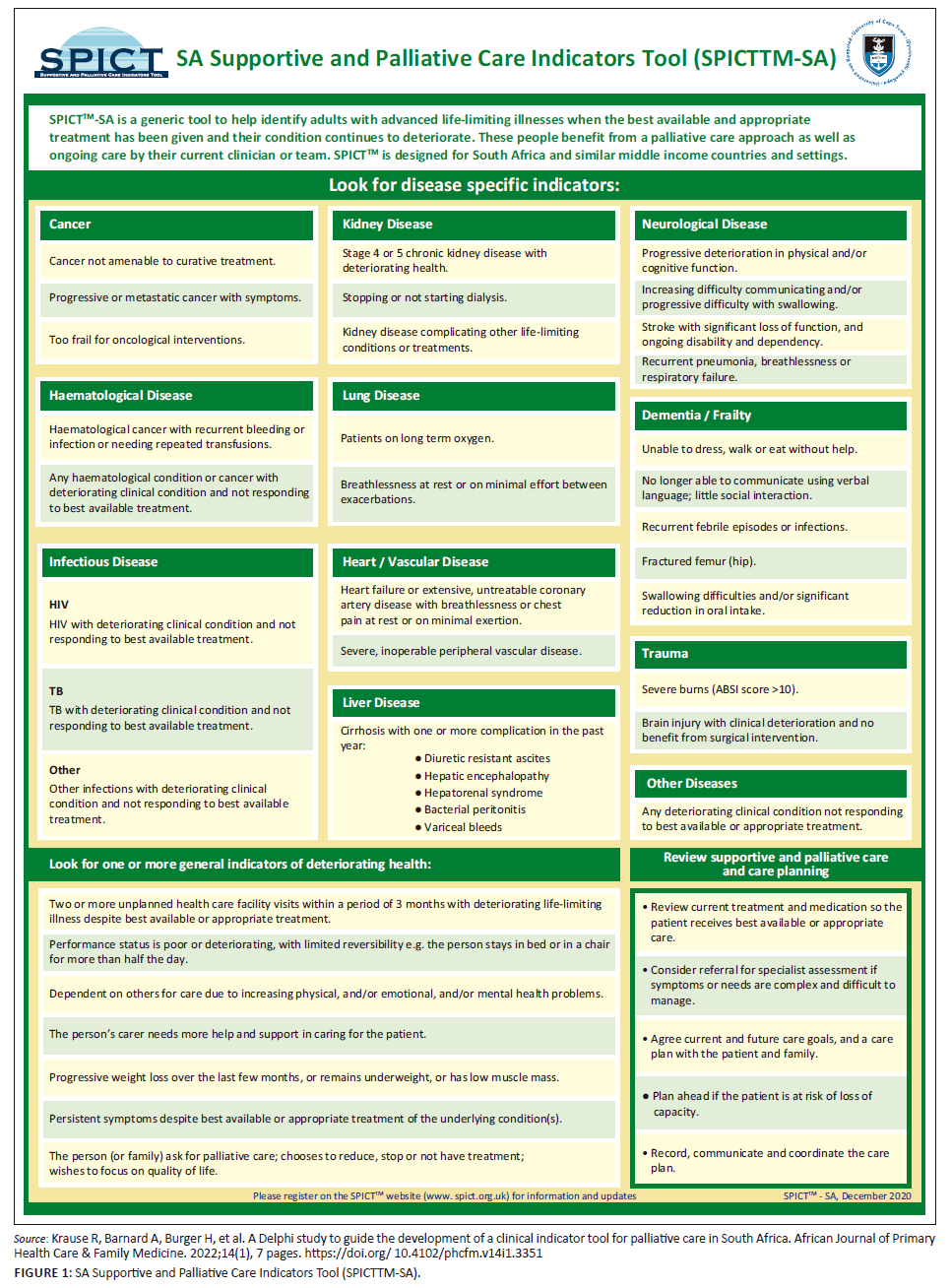
An expert advisory group in South Africa developed a tool SPICT SA to provide equitable access to PC (See Figure 1).6
Palliative care aims to improve the quality of life of persons and their families who are facing problems associated with life-limiting or life threatening illnesses.2,3,5 It prevents and relieves suffering through the early identification, impeccable assessment and treatment of pain and other problems, whether physical, psychosocial, or spiritual.42
Need assessment in a rural setting in North West province
Developed countries also experience that rural populations have higher mortality, low socio-economic status and seldom access to PC services.667,8 The North West province and health districts have autonomy on spending of budgets and initiate improvements favouring urban areas, which contributed to interprovincial variations in health outcomes.9
Despite the Department of Health's National Policy Framework and Strategy on PC 2017-2022 document,5112
In 2019, Mahole G.L. did a survey (Perceptions of terminally ill patients concerning the palliative care they receive in rural primary healthcare) in Ventersdorp and surrounding rural areas, using a researcher administered Problems and Needs in Palliative Care questionnaire - short version (PNPC-sv).1112n = 40), it clearly depicted the unmet needs of patients.121212p ≤ 0.027), and social assistance (p ≤ 0.019). Patients in professional care (old age home) did not express a need for professional help regarding autonomy or spiritual issues. The conclusion was that health services are failing patients in the rural areas of Ventersdorp, North West province. These patients were sent home to an impoverished area without resources or healthcare workers with optimal PC knowledge and experience.
Learning from other successful models was the first priority. Community-based programmes proved to be successful in rural areas across three states in the United States.6141010,14 This service is not available to people in Ventersdorp and surrounding rural areas.
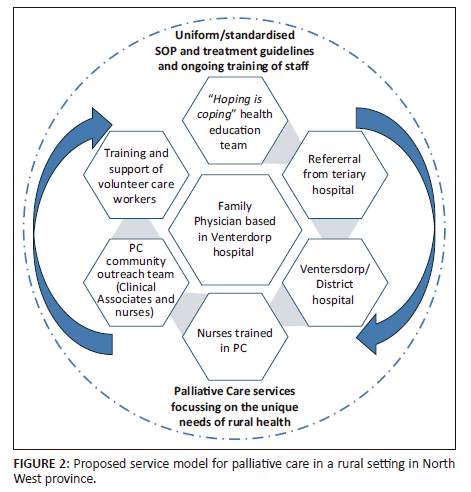
Based on the research outcome, a meeting was set with Ventersdorp subdistrict manager, District Director and Chief Director to address the issue of insufficient services to patients needing palliative care. The need for PC services is recognised, and there is a vision to provide the service. A suggestion was made to establish a palliative care unit at Ventersdorp District hospital. A combination of the community-based PC and integrated model was adopted as a palliative care service model (Figure 2). It will start with a SOP based on needs of the inhabitants of the rural area in and surrounding Ventersdorp (Figure 2). The plan is to bring political leadership on board as the planned PC unit would change service package at primary healthcare level and would also have financial implications. This would also require consultations with clinic and hospital boards as well as community representations to help with creating awareness regarding the need and development of the unit.
Proposed palliative care service model
The proposed model (Figure 2) has the family physician at the centre in a district hospital leading the PC programme and development of a specific SOP, both clinical management and referral, which will link the tertiary hospital services in the referral pathway of the patient to primary care services. A multidisciplinary team will be involved with the 'Hoping is Coping' programme to do health education and render support. This programme will be led by a clinical social worker and clinician where newly diagnosed patients and their families are orientated on the diagnosis, treatment modalities and where they can find help and support for challenges they may experience. The idea is that this already starts early in the diagnosis before the patient develops complications or reaches the end of life phase. When a patient is diagnosed late, the patient and family can still join such a group. Nurses trained in palliative care will monitor the patients in hospital but also supervise the community outreach teams. These outreach teams will not only deliver person-centred care but also train volunteers in home-based care.
Ethical Considerations
Ethical clearance to conduct this study was obtained from the University of the Witwatersrand Human Research Ethics Committee (No. M170107) and the Department of Health Ventersdorp Sub District dated 19 May 2017.
Conclusion
The advantages of this proposed service model focused on the needs of patients in rural settings are multidisciplinary support for the patient, community awareness and education, capacitating of carers and support for the healthcare team to decrease the risk for vicarious trauma. Department of Health prioritised PC. When staff is available, appointments can facilitate the implementation of PC services in rural areas.
The author, D.P., serves as an editorial board member of this journal. D.P. has no other competing interests to declare.
This article is partially based on the author L.G.M.s thesis titled "Perceptions of terminally ill patients concerning the palliative care they receive in rural primary health care" towards the degree of Master of Medicine in Family Medicine in the Faculty of Health Sciences, University of the Witwatersrand, South Africa in 2020, with supervisor Dr C. Lion- Cachet and Co-Supervisor: Mrs D. Pretorius. It is available here: https://wiredspace.wits.ac.za/items/83774d06-2060-4213-ae99-3980d75b2d1a/full.
References
-
1. Modjadji P. Communicable and non-communicable diseases coexisting in South Africa. Lancet Glob Health. 2021;9(7):e889-e890. https://doi.org/10.1016/S2214-109X(21)00271-0
» https://doi.org/10.1016/S2214-109X(21)00271-0 -
2. HPCSA Booklet-17. Ethics Guidelines on Palliative Care [homepage on the Internet]. [cited 2024 Nov 25]. Available from: https://www.hpcsa-blogs.co.za/wp-content/uploads/2019/09/HPCSA-Booklet-17-Ethics-Guidelines-on-Pallative-Care.pdf
» https://www.hpcsa-blogs.co.za/wp-content/uploads/2019/09/HPCSA-Booklet-17-Ethics-Guidelines-on-Pallative-Care.pdf -
3. WHO: Palliative care [homepage on the Internet]. 2020 [cited 2024 Nov 25]. Available from: https://www.who.int/news-room/fact-sheets/detail/palliative-care
» https://www.who.int/news-room/fact-sheets/detail/palliative-care -
4. Palliative care [homepage on the Internet]. 2023 [cited 2024 Nov 22]. Available from: https://www.who.int/europe/news-room/fact-sheets/item/palliative-care
» https://www.who.int/europe/news-room/fact-sheets/item/palliative-care -
5. National policy framework and strategy on palliative care 2017-2022 [homepage on the Internet]. [cited 2024 Nov 25]. Available from: https://www.health.gov.za/wpcontent/uploads/2020/11/NationalPolicyFrameworkandStrategyonPalliativeCare20172022.pdf
» https://www.health.gov.za/wpcontent/uploads/2020/11/NationalPolicyFrameworkandStrategyonPalliativeCare20172022.pdf -
6. Weng K, Shearer J, Grangaard Johnson L. Developing successful palliative care teams in rural communities: A facilitated process. J Palliat Med. 2022;25(5):734-741. https://doi.org/10.1089/jpm.2021.0287
» https://doi.org/10.1089/jpm.2021.0287 -
7. Harnischfeger N, Rath HM, Oechsle K, Bergelt C. Addressing palliative care and end-of-life issues in patients with advanced cancer: A systematic review of communication interventions for physicians not specialised in palliative care. BMJ Open. 2022;12(6):e059652. https://doi.org/10.1136/bmjopen-2021-059652
» https://doi.org/10.1136/bmjopen-2021-059652 -
8. Masoud B, Imane B, Naiire S. Patient awareness of palliative care: Systematic review. BMJ Support Palliat Care. 2023;13(2):136-142. https://doi.org/10.1136/bmjspcare-2021-003072
» https://doi.org/10.1136/bmjspcare-2021-003072 -
9. Achoki T, Sartorius B, Watkins D, et al. Health trends, inequalities and opportunities in South Africa's provinces, 1990-2019: Findings from the global burden of disease 2019 study. J Epidemiol Community Health. 2022;76(5):471-481. https://doi.org/10.1136/jech-2021-217480
» https://doi.org/10.1136/jech-2021-217480 -
10. APCC - Association of Palliative Care Centres of South Africa [homepage on the Internet]. The Association of Palliative Care Centres. 2025 [cited 2024 Nov 25]. Available from: https://apcc.org.za/
» https://apcc.org.za/ -
11. Osse BHP, Vernooij-Dassen MJFJ, Schadé E, Grol RPTM. A practical instrument to explore patients' needs in palliative care: The problems and needs in palliative care questionnaire short version. Palliat Med. 2007;21(5):391-399. https://doi.org/10.1177/0269216307078300
» https://doi.org/10.1177/0269216307078300 -
12. Mahole GL. Perceptions of terminally ill patients concerning the palliative care they receive in rural primary health care [homepage on the Internet]. 2021 [cited 2024 Nov 25]. Available from: https://hdl.handle.net/10539/32681
» https://hdl.handle.net/10539/32681 -
13. Hamilton-Baillie A, Jenkins LS, Munnings M, et al. Palliative care in a rural subdistrict in South Africa: A 4-year critical review. Afr J Prm Health Care Fam Med. 2024;16(1):a4047. https://doi.org/10.4102/phcfm.v16i1.4047
» https://doi.org/10.4102/phcfm.v16i1.4047 -
14. North West (Province, South Africa) - Population statistics, charts, map and location [homepage on the Internet]. [cited 2024 Nov 25]. Available from: https://www.citypopulation.de/en/southafrica/admin/6__north_west/
» https://www.citypopulation.de/en/southafrica/admin/6__north_west/ -
15. Krause R, Barnard A, Burger H, et al. A Delphi study to guide the development of a clinical indicator tool for palliative care in South Africa. African Journal of Primary Health Care & Family Medicine. 2022;14(1), 7 pages. https://doi.org/10.4102/phcfm.v14i1.3351
» https://doi.org/10.4102/phcfm.v14i1.3351

Accepted: 20 Feb. 2025
Published: 28 Apr. 2025