Is it just religious practice? Exploring patients' reasons for choosing a faith-based primary health clinic over their local public sector primary health clinic
Abstract
BACKGROUND: Person-centred, re-engineered primary health care (PHC) is a national and global priority. Faith-based health care is a significant provider of PHC in sub-Saharan Africa, but there is limited published data on the reasons for patient choice of faith-based health care, particularly in South Africa. AIM: The primary objective was to determine and explore the reasons for patient choice of a faith-based primary care clinic over their local public sector primary care clinic, and secondarily to determine to what extent these reasons were influenced by demography. SETTING: The study was conducted at Jubilee Health Centre (JHC), a faith-based primary care clinic attached to Jubilee Community Church in Cape Town, South Africa. METHODS: Focus groups, using the nominal group technique, were conducted with JHC patients and used to generate ranked reasons for attending the clinic. These were collated into the top 15 reasons and incorporated into a quantitative questionnaire which was administered to adult patients attending JHC. RESULTS: A total of 164 patients were surveyed (a response rate of 92.4%) of which 68.3% were female and 57.9% from the Democratic Republic of the Congo (DRC). Of patients surveyed, 98.2% chose to attend JHC because 'the staff treat me with respect', 96.3% because 'the staff are friendly' and 96.3% because 'the staff take time to listen to me'. The reason 'it is a Christian clinic' was chosen by 70.1% of patients. 'The staff speak my home language' was given as a reason by 61.1% of DRC patients and 37.1% of South African patients. 'The clinic is close to me' was chosen by 66.6% of Muslims and 40.8% of Christians. CONCLUSION: Patients chose to attend JHC (a faith-based primary care clinic) because of the quality of care received. They emphasised the staff-patient relationship and patient-centredness rather than the clinic's religious practices (prayer with patients). These findings may be important in informing efforts to improve public sector primary care.
Background
In 2009, the World Health Organization issued a World Health Report calling for the renewal of primary health care (PHC).1122
In this context, all aspects that contribute to the provision of holistic, person-centred PHC are vital, including that of faith-based institutions. Acknowledging faith-based preferences of patients can be considered a part of practising person-centredness.3,4567,8910
This realisation has led to an increased emphasis on research into faith-based health care, particularly in the developing world.10,11,129,10,11,13,14,15,16
There is a general perception in Africa, but little firm data, that faith-based health care facilities provide a better quality of care than state facilities.17187,8,18,19187820
While the assumption is that the religious aspect of faith-based health care is one of the main reasons for patient choice, recent research does not back this up. Research from Ghana suggests that only 6.3% of Christians and 12.5% of Muslims say that they chose to attend a faith-based health facility because of its religious affiliation.198
Research into faith-based health care in South Africa is vitally important, particularly given the context where 79.8% of the population identifies itself as being nominally Christian.212223
Very little research has been conducted on faith-based health care facilities in South Africa, and Cape Town specifically. This is partly because of the fact that South Africa was one of the African countries that integrated colonial era mission-based hospitals and public sector primary care and therefore no longer has an extensive network of faith-based health care facilities.2425
In summary, a reading of the literature suggests that despite this South African resurgence of faith-based care, there is still a lack of knowledge with regard to patients' preference for faith-based facilities over state facilities when presented with the choice. A better understanding of the reason behind patient preference will help to improve primary care services. This is aligned with the Healthcare 2030 policy document of the Western Cape Government, where the primary vision is that of 'access to person-centred quality care'.262627
Despite almost two decades of structural reform and a commitment to achieving the goals of PHC, a number of obstacles are preventing its full implementation in the South African context.2228,2930,313232
In response to the need for some of the above desired service features and the apparent lack of access to good quality, holistic health care, Jubilee Health Centre (JHC) was started in 2006.33333334
This study hopes to inform local public sector policy and practice by providing data with regard to users' preference for JHC. The results will provide JHC with valuable information about patient needs and preferences. The management of JHC has committed to using the results to assist them in improving the quality of their health care. The study results will also assist the local public sector clinics with regard to patient preference and highlight specific areas which they could improve on, thereby enabling them to deliver more person-centred care. The study will also provide a starting point for collaboration between JHC and the surrounding public sector clinics to the benefit of their patients.
This study seeks to determine whether the reasons why the users of JHC chose this primary care service reflect their need and expectation of person-centred care.
The primary objective was to determine and explore the reasons for the patients' choice to attend JHC over their local public sector primary health clinic. The secondary objective was to determine to what extent demography influences reasons for choosing JHC over their local public sector primary health clinic.
Research methods and design
Study design
This was a cross-sectional, descriptive study which made use of mixed methods. Three focus groups, based on the Nominal Group Technique (NGT),35
Setting
The study was conducted at JHC, a faith-based primary health clinic attached to Jubilee Community Church (an independent, non-denominational church), based in Observatory, Cape Town. This is a middle-to-lower income urban area, with a significant immigrant population. There is good access to public health care with a primary health clinic, a community health centre and an academic hospital all within 3 km.
Study population and sampling strategy
JHC has roughly 5000 patients on file. They do not have firm demographic data available but estimate that 65% of their patients are from Francophone central Africa. The majority of these are illegal immigrants or refugees and asylum seekers. The next largest demographic includes local patients from the Woodstock, Salt River, Observatory area. The majority of these patients self-identify as 'coloured' and speak English or Afrikaans as their first language.
Phase 1: Focus groups
The three focus groups were formed using convenient and purposive sampling with an attempt to have an element of homogeneity in each group. The first focus group comprised all the available JHC staff. The second focus group consisted of patients from Francophone Africa and the third focus group comprised South African patients. The sampling for the patient focus groups was focused on finding key informants recommended by the staff members as well as recruiting volunteers by advertising the focus groups in the clinic waiting area.
Inclusion criteria for the focus groups were that patients needed to be 18 years old or above, have attended JHC at least three times before, have attended a public health facility at least once and be fluent in English, Afrikaans, Xhosa or French and be able to provide consent. Because of the nature of the NGT method, patients also needed to be literate.
Phase 2: Survey
A sample size of 163 was calculated for the survey using a sample calculator for a descriptive study of a continuous variable. This was based on a confidence interval of 95%, a margin of error of 5% and an expected proportion of 10.4%. The expected proportion was determined as the proportion of patients who would cite the religion aspects of the clinic as a reason for attending JHC. This was derived from combined data from the two papers which met the criteria for the literature review.8,19
Sampling for the survey was consecutive as the questionnaire was offered to every patient attending JHC across a three-week period in November 2014. Consecutive sampling was used because of the limited time available for data collection and the relatively small number of patients attending JHC.
The inclusion criteria for the survey included patients aged 18 years and above, able to consent and fluent in English, Afrikaans, Xhosa or French. Literacy was not an inclusion criterion as the questionnaire was interviewer administered.
Data collection
Phase 1: Focus groups
The three focus groups were conducted using the NGT. They were conducted by the principal investigator and a trained assistant or translator. Each focus group was presented with the question 'what are some of the reasons why you have chosen to attend Jubilee Health Centre?' Individual participants were allowed to nominate as many answers as possible which were then collated and clarified. Each participant ranked his or her top five reasons of those collated, and these scores were combined to give a final group ranking.
Phase 2: Survey
The data generated by the focus groups were used to generate a questionnaire. The first section of the questionnaire was designed to obtain a variety of demographic data from the respondents. The second part of the questionnaire was informed by the focus group results. The top 10 ranked reasons from each focus group were combined to form 15 statements relating to why patients might choose to attend JHC. The respondents were then asked to agree or disagree with each statement by choosing an answer ranging from 'strongly disagree' to 'strongly agree' (including the option of 'unsure') based on a Likert scale for each of the 15 statements.
Data analysis
The survey consisted of a range of demographic data and the Likert scale based responses to the various statements of why patients chose to attend JHC. Responses were recorded and analysed by using Microsoft Excel. The Likert scale responses were converted into binary variables and used to establish proportions. 'Definitely' and 'maybe' responses were combined and interpreted as a positive response while 'maybe not', 'definitely not' and 'unsure' responses were combined and interpreted as a negative response. Because of the small size of some of the demographic samples, a Fisher's exact test was used to determine which demographic variables produced significantly different results for why patients chose to attend JHC.
Ethical consideration
As this was a descriptive study without an intervention, there was very little potential for risk or discomfort. The only potential risk was covered in the establishment of a distress protocol, should a patient have found the survey or focus group to be distressing.
Informed consent was obtained for both the focus group and the survey by either the principal investigator or a research assistant and was offered in English, Afrikaans, Xhosa or French. The survey was offered to each patient only after their consultation with the doctor or nurse.
The study included immigrants even though they are considered to be a vulnerable population. It was considered essential to include them as they make up the majority of the clinic patient population, and there will be significant future benefits for this sub-group as a result of this research. Their confidentiality and privacy were emphasised to them. They did not have to disclose their legal status, and no identifying data such as date of birth or actual physical addresses were recorded. As for all patients, it was emphasised that whether or not they participated in the research would in no way affect the health care they received at JHC or any other facility.
This study was approved by the University of Cape Town's Human Research Ethics Committee (HREC REF: 118/2014).
Results
Phase 1: Focus groups
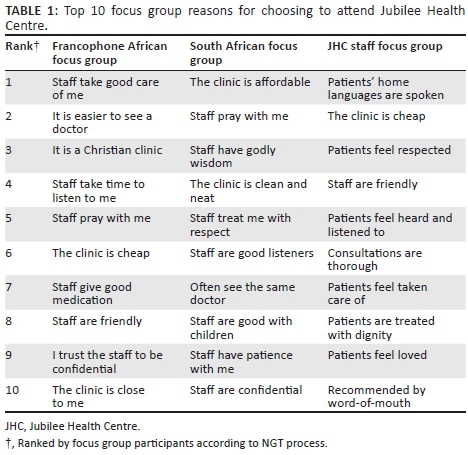
Six participants were recruited for the JHC staff focus group, 10 in the Francophone African focus group and 9 in the South African focus group. The staff focus group produced 28 responses to the question 'what are some of the reasons why you have chosen to attend Jubilee Health Centre?' The Francophone African focus group resulted in 19 responses and the South African focus group provided 36 responses. Table 1 shows the top 10 ranked answers from each focus group. These 30 reasons for choosing to attend JHC were collated to provide 15 statements which were used in the survey (see Table 3) to be agreed or disagreed with using a Likert scale.

Phase 2: Survey
A total of 185 patients were invited to participate in the survey. Of those, 14 declined to participate and 7 were excluded based on their inability to communicate effectively in English, Afrikaans, Xhosa or French. This left 164 participants who completed the questionnaire.
The patients surveyed were predominantly female, married and between the ages of 31 and 45 years. Only 21.3% of the patients were from the Republic of South Africa (RSA) with the majority (57.9%) from the Democratic Republic of the Congo (DRC). Accordingly, French, Lingala and Swahili were the most commonly spoken home languages. Those identifying with the Christian faith made up 86.6% of the patients (only 12.8% attending Jubilee Community Church) with a small but significant number of Muslim patients (12.8%). The average socioeconomic status is shown by the fact that 56.1% of patients were unemployed with the average, monthly household income between R1000 and R5000. The vast majority (82.9%) had attended a public sector clinic before, with Spencer Road Clinic (in Observatory) the most common closest public sector clinic. However, only 54.3% of patients were able to correctly name their closest public sector clinic. Based on residential suburbs (actual physical addresses were not recorded), it was calculated that on average, unemployed patients travel just over five times further to get to JHC (9.7 km) than would be needed to get to their closest public sector clinic (1.8 km), with 34.2 km the furthest distance travelled to get to JHC by an unemployed patient.
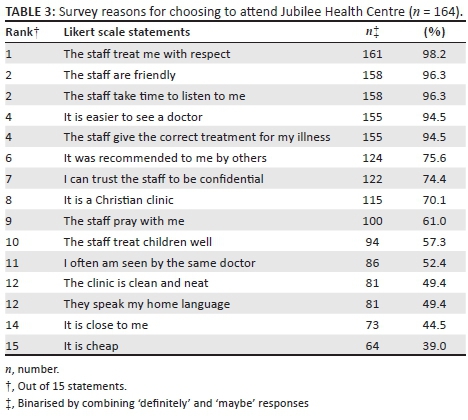
The second half of the questionnaire provided the results to the Likert scale responses to the various reasons for choosing to attend JHC. The responses were binarised by combining 'definitely' and 'maybe'. As seen in Table 3, the top five reasons were separated by only 3.7% (98.2% to 94.5%). 'The staff treat me with respect' was the highest ranked answer, followed by 'The staff are friendly', 'The staff take time to listen to me', 'It is easier to see a doctor' and 'The staff give the correct treatment for my illness'. Reasons related to the religious aspects of the clinic ('It is a Christian clinic' and 'The staff pray with me') rank seventh and eighth out of the 15 reasons (70.1% and 61%). The cost of clinic was the least chosen reason for attending JHC with 39%.
The reasons for choosing to attend JHC were further broken down with various demographics as shown in Table 4a-c. Patients from the DRC were compared with those from the RSA, and three reasons for attending JHC were found to have statistically significant differences. Almost two-thirds of Congolese patients said that they attended JHC because their home language was spoken as opposed to 37.1% of South African patients. Close to 100% of Congolese patients attended JHC because it was easier to see a doctor compared to 88.6% of South Africans. Roughly a quarter of patients from the RSA chose to attend JHC because their children were treated well, compared to about two-thirds of patients from the DRC.
When comparing patients who identified with Christianity as opposed to patients who identified with Islam, four statistically significant differences (p-value < 0.05 using the Fisher's exact test) were found in response to why patients chose to attend JHC. One-fifth of Muslim patients chose to come to JHC because 'The clinic is clean and neat' compared to just over half of those identifying with Christianity. The religious aspects of the clinic also recorded significant differences with 9.5% of Muslims choosing to attend JHC because it is a Christian clinic and 19% choosing to attend because they were prayed with. In comparison, almost 80% of Christians chose to attend JHC because of its religious affiliation and 66.9% agreed with the statement 'I chose to come to Jubilee Health Centre because the staff pray with me'. The final significantly different response was to the statement 'I chose to come to Jubilee Health Centre because it is close to me' with 66.6% of Muslims and 40.8% of Christians agreeing with it.
Those patients who were formally employed were also compared to those who were unemployed. Two statistically different responses were found. Of those patients formally employed, 84% said they came to JHC because they could trust the staff to be confidential compared to 68.5% of those who were unemployed. Just over half of the employed patients chose to come to JHC because it is cheap compared to just over a quarter of unemployed patients.
Discussion
The primary objective of this study was to determine and explore the reasons for patients' choice to attend JHC (a faith-based primary health clinic) over their local public sector primary health clinic. Although the patient focus groups gave high rankings to the religious aspects of the clinic (third and fifth in the Francophone African focus group and second and third in the South African focus group), the survey showed that the top three reasons for choosing to attend JHC were instead related to the quality of the care received, specifically with reference to the staff-patient relationship and the respect and attention paid to patients. The actual religious aspects of the clinic were not the predominant reasons for choosing the clinic, ranking eighth and ninth out of the top 15 reasons.
The secondary objective was to determine to what extent sociodemographic factors determine the reasons for choosing JHC. The significant demographic results were that almost 60% of the patients were from the DRC with South Africans comprising the next biggest population group (21.3%). Although patients from the DRC placed equal emphasis on quality of care, they also ranked the treatment of children, home language spoken and ease in seeing a doctor higher than the South African patients. Despite the availability of a French, Lingala and Swahili translator and the higher ranking of 'the staff speak my home language' (p = 0.0179), patients from the DRC still only ranked it ninth out of 15 reasons. Although it did not achieve statistical significance (p = 0.0690), it is interesting to note that more South African patients chose to attend JHC because 'the staff pray with me' than patients from the DRC (74.3% compared to 55.8%). Other statistically significant differences were that Muslim patients ranked faith-based reasons in the bottom two compared to Christians who ranked them sixth and ninth and employed patients ranked 'the clinic is cheap' higher than unemployed patients.
The results suggest that the reasons for the patients' choice to attend JHC are not related to religion but rather to the quality of the care provided. Respect, attention paid to patients and the friendliness of staff were particularly emphasised. Although there is a paucity of literature, these findings are in keeping with two previous studies from Ghana and Burkina Faso.8,19198
A potential divergence from the literature was the response rate to statements concerning the faith elements of the clinic. Shojo et al. found that only 6.3% of patients making use of Christian clinics mentioned religious aspects as reasons for choosing to attend,198
Limitations
The difference in response rates for religious factors when compared to the literature might be explained by the fact that this study was conducted on-site, a factor which is known to result in more favourable responses. Another possible explanation might be that the element of choice (compared to other countries where local public sector primary care clinics might not be as accessible) could have introduced a self-selection bias in favour of the religious features of JHC.
The difference in rankings between the patient focus groups and the results of the survey might be explained by focus group selection bias. Focus group participants were mostly considered key informants and either volunteered or were recommended by the JHC staff. This might have resulted in an over-sampling of Jubilee Community Church members or JHC advocates.
A possible reason for the overall higher proportions of the responses in the survey may be the use of Likert scale responses to determine reasons for choosing JHC, that is, patients were limited to a pre-determined range of options when responding to each of the 15 statements. Volunteering their own reasons (as in semi-structured interviews) may have yielded a different result. This may have resulted in the over-representation or over-reporting of various reasons but will hopefully not have affected the rankings or comparative proportions of the 15 reasons for choosing JHC.
The relatively small sample size of 164, especially when it comes to sub-group analysis by demographic variables (only 21 Muslim patients were surveyed), is also a limitation. The sample size calculation was based on the total number of respondents and not stratified by sub-group. This necessitated the use of Fisher's exact tests when comparing sub-groups.
Recommendations and implications
Despite these limitations, recommendations can be made from this study. Its increasing attendance figures and the distances patients are willing to travel to attend the clinic (up to a 68.4 km round trip) suggest an improvement in JHC's services compared to public sector clinics in the area. The implication of the results from the survey is that the quality of care provided by JHC is of a high standard and is attracting patients to the clinic. This reflects the need and expectation of patients for person-centred care increasingly referred to in current literature and policy statements.2,3626
Further investigation is needed to determine what the link is between increased quality of care and faith-based health providers. A Ugandan study found that staff in faith-based facilities had higher performance than those in public facilities, attributed to their motivation by the 'faith-based organisational ethos'.371512
This study also implied that faith-based aspects of care might be more important to South Africans than suggested in the literature,8,1912
Conclusion
This study found that although there was a higher response rate than in the literature, the religious features of JHC (its Christian identity and the prayer offered with every consultation) were not the main reasons that patients chose to attend the clinic. Rather, the results show that the quality of the care received, with emphasis on the staff-patient relationship and patient-centredness, determined patients' reasons for choosing JHC.
When exploring the demographic factors of the clinic population, it was found that almost two-thirds of patients were from the DRC. Although more Congolese patients chose to attend the clinic because they were addressed in their home language when compared to South Africans, their top reasons for choosing JHC were still those relating to quality of care.
This emphasis on quality of care is in alignment with the provincial, national and global focus on re-engineered, person-centred PHC. Further research into the role and importance of faith-based health care in South Africa, differences in satisfaction rates between public sector and faith-based health care, and possible avenues for collaboration, is recommended.
Competing interests
The primary author was previously a member of Jubilee Community Church.
Authors' contributions
J.P. is the primary author. The study formed the basis for his Master of Medicine in Family Medicine thesis at the University of Cape Town. G.B. was the principal investigator and supervisor and contributed to the writing of this manuscript.
Acknowledgements
The authors would like to thank the patients at JHC who agreed to participate in this study. They would also like to thank the staff from Jubilee Community Church and JHC who were very accommodating and helpful: Caryn Wilson, Rachel Lilliott, Valerie Hosila, Sara Cheese, Alex Mukidi, Jeremy Cons and Jo Loizides. In addition, they would like to thank Liz Gwyther and Jill Olivier for assistance with the initial topic and direction of the study. They would especially like to thank Mireille Porter for her invaluable input on research publication structure and data analysis. They would also like to thank the University of Cape Town's School of Public Health and Family Medicine for providing funding for the study.
References
- 1. World Health Organization. The world health report 2008: Primary health care (now more than ever). Geneva: WHO; 2009.
- 2. World Health Organization. People-centred health care. A policy framework. Geneva: WHO; 2007.
- 3. Barnard D, Dayringer R, Cassel C. Toward a person-centred medicine: Religious studies in the medical curriculum. Acad Med. 1995;70(9):806-813.
- 4. Cox J, Campbell A, Kulford B, editors. Medicine of the person: Faith, science and values in health care provision. London: Jessica Kingsley Publishers; 2007.
-
5. Chatters LM. Religion and health: Public health research and practice. Annu Rev Public Health. 2000;21(1):335-367. http://dx.doi.org/10.1146/annurev.publhealth.21.1.335
» http://dx.doi.org/10.1146/annurev.publhealth.21.1.335 -
6. Pew Research Centre's Religion & Public Life Project. Tolerance and tension: Islam and Christianity in Sub-Saharan Africa. 2010 [cited 2013 Aug 31]. Available from http://www.pewforum.org/2010/04/15/executive-summary-islam-and-christianity-in-sub-saharan-africa/.
» http://www.pewforum.org/2010/04/15/executive-summary-islam-and-christianity-in-sub-saharan-africa/ -
7. Olivier J, Shojo M, Wodon Q. Faith-inspired health care provision in Ghana: Market share, reach to the poor, and performance. Rev Faith Int Aff. 2014;12(1): 84-96. http://dx.doi.org/10.1080/15570274.2013.876735
» http://dx.doi.org/10.1080/15570274.2013.876735 - 8. Gemignani R, Wodon Q. How do households choose between health providers? Results from qualitative fieldwork in Burkina Faso. In: Olivier J, Wodon Q, editors. The comparative nature of faith-inspired health care providers in Sub-Saharan Africa. HNP Discussion Paper. Washington, DC: World Bank; 2012, p. 49-72.
- 9. Vitillo RJ. A faith-based response to HIV in Southern Africa: The choose to care initiative. Geneva: UNAIDS; 2006.
- 10. Bandy G, Crouch A, Haenni C, et al. Building from common foundations: The World Health Organization and faith-based organizations in primary healthcare. Geneva: World Health Organization; 2008.
- 11. Olivier J, Wodon Q. The role of faith-inspired health care providers in Sub-Saharan Africa and public-private partnerships. Strengthening the evidence for faith-inspired health engagement in Africa, volume 1. HNP Discussion Paper. Washington, DC: World Bank; 2012.
-
12. Olivier J, Tsimpo C, Gemignani R, et al. Understanding the roles of faith-based health-care providers in Africa: Review of the evidence with a focus on magnitude, reach, cost, and satisfaction. Lancet 2015;386:1765-1775. http://dx.doi.org/10.1016/S0140-6736(15)60251-3
» http://dx.doi.org/10.1016/S0140-6736(15)60251-3 - 13. Olivier J, Wodon Q. The comparative nature of faith-inspired health care provision in Sub-Saharan Africa. Strengthening the evidence for faith-inspired health engagement in Africa, volume 2. HNP Discussion Paper. Washington, DC: World Bank; 2012.
- 14. Olivier J, Wodon Q. Mapping, cost, and reach to the poor of faith-inspired health care providers in Sub-Saharan Africa. Strengthening the evidence for faith-inspired health engagements in Africa, volume 3. HNP Discussion Paper. Washington, DC: World Bank; 2012.
- 15. Schmid B, Thomas E, Olivier J, Cochrane JR. The contribution of religious entities to health in Sub-Saharan Africa. Cape Town: African Religious Health Assets Programme; 2008.
- 16. African Religious Health Assets Programme. Appreciating assets: The contribution of religion to universal access in Africa. Report for the World Health Organization. Cape Town: ARHAP; 2006.
-
17. Widmer M, Betran A, Merialdi M, et al. The role of faith-based organizations in maternal and newborn health care in Africa. Int J Gynaecol Obstet. 2011;114(3):218-222. http://dx.doi.org/10.1016/j.ijgo.2011.03.015
» http://dx.doi.org/10.1016/j.ijgo.2011.03.015 - 18. Olivier J, Wodon Q, Tsimpo C. Satisfaction with faith-inspired health care services in Africa: Review and evidence from household surveys. In: Olivier J, Wodon Q, editors. The comparative nature of faith-inspired health care providers in Sub-Saharan Africa. HNP Discussion Paper. Washington, DC: World Bank; 2012, p. 6-28.
- 19. Shojo M, Tsimpo C, Wodon Q. Satisfaction with and reasons for choosing faith-inspired health care provision in Ghana. In: Olivier J, Wodon Q, editors. The comparative nature of faith-inspired health care providers in Sub- Saharan Africa. HNP Discussion Paper. Washington, DC: World Bank; 2012, p. 73-88.
- 20. Bratton M. Are you being served? Popular satisfaction with health and education services in Africa. Cape Town: Afrobarometer; 2007.
- 21. Statistics South Africa. South African national census of 2001. Pretoria: Stats SA; 2002.
- 22. Kautzky K, Tollman S. A perspective on primary health care in South Africa. In: Barron P, Roma-Reardon J, editors. South African health review 2008. Durban: Health Systems Trust; 2008.
- 23. Kark S, Kark E. Promoting community health: From Pholela to Jerusalem. Johannesburg: Wits University Press; 2001.
- 24. Olivier J, Cochrane J, De Gruchy S. Mapping religious community health assets and initiatives: Lessons from Zambia and Lesotho. In: Olivier J, Wodon Q, editors. Mapping, cost, and reach to the poor of faith-inspired health care providers in Sub-Saharan Africa. HNP Discussion Paper. Washington, DC: World Bank; 2012, p. 52-61.
- 25. Thomas L, Schmid B, Gwele M, Ngubo R, Cochrane JR. 'Let us embrace': The role and significance of an integrated faith-based initiative for HIV and AIDS. Cape Town: African Religious Health Assets Programme; 2006.
- 26. Western Cape Department of Health. Healthcare 2030: The road to wellness. Cape Town: Western Cape Government; 2014.
- 27. Department of Health. National health insurance in South Africa. Policy paper. Pretoria: Department of Health, South Africa; 2011.
-
28. Fokazi S. I'd rather die than go back to that clinic. 2013 [cited 2013 May 28]; Available from http://www.iol.co.za/news/south-africa/western-cape/i-d-rather-die-than-go-back-to-that-clinic-1.1522952#.UwSW75GRPtY.
» http://www.iol.co.za/news/south-africa/western-cape/i-d-rather-die-than-go-back-to-that-clinic-1.1522952#.UwSW75GRPtY -
29. Barnes C. Clinic staff drunk on duty. 2011 [cited 2013 May 28]. Available from http://www.iol.co.za/capeargus/clinic-staff-drunk-on-duty-1.1148310.
» http://www.iol.co.za/capeargus/clinic-staff-drunk-on-duty-1.1148310 -
30. Mills A, Ataguba J, Akazili J, et al. Equity in financing and use of health care in Ghana, South Africa, and Tanzania: Implications for paths to universal coverage. Lancet. 2012;380(9837):126-133. http://dx.doi.org/10.1016/S0140-6736(12)60357-2
» http://dx.doi.org/10.1016/S0140-6736(12)60357-2 -
31. Goudge J, Gilson L, Russell S, et al. Affordability, availability and acceptability barriers to health care for the chronically ill: Longitudinal case studies from South Africa. BMC Health Serv Res. 2009;9(1):75. http://dx.doi.org/10.1186/1472-6963-9-75
» http://dx.doi.org/10.1186/1472-6963-9-75 - 32. Health Systems Trust. The national health care facilities baseline audit. National summary report. Westville: HST; 2012.
-
33. Jubilee Community Church. Jubilee Health Centre. 2015 [cited 2015 Oct 15]. Available from http://jubilee.org.za/social-justice/the-health-centre/
» http://jubilee.org.za/social-justice/the-health-centre/ -
34. Jubilee Community Church. Health Centre Commissioning - Stephen van Rhyn. 2015 [cited 2015 Oct 21]. Available from http://jubilee.org.za/podcast/health-centre-commissioning-stephen-van-rhyn/.
» http://jubilee.org.za/podcast/health-centre-commissioning-stephen-van-rhyn/ -
35. Van de Ven A, Delbecq A. The nominal group as a research instrument for exploratory health studies. Am J Public Health. 1972;62(3):337-342. http://dx.doi.org/10.2105/AJPH.62.3.337
» http://dx.doi.org/10.2105/AJPH.62.3.337 - 36. Royal College of General Practitioners. An inquiry into patient centred care in the 21st century. Implications for general practice and primary care. London: Royal College of General Practitioners; 2014.
- 37. Ritva R, Jakob S. Working for God? Evaluating service delivery of religious not-for-profit health care providers in Uganda. Policy Research Working Paper No. 3058. Washington, DC: World Bank; 2003.
Accepted: 26 Nov. 2016
Published: 29 June 2017