An audit of the screen-and-treat intervention to reduce cryptococcal meningitis in HIV-positive patients with low CD4 count
Abstract
BACKGROUND: HIV-associated cryptococcal meningitis (CCM) and related mortality may be prevented by the effective implementation of a screen-and-treat intervention. AIM: The aim of this study was to assess the effectiveness of the screen-and-treat intervention at a regional hospital in KwaZulu-Natal province, South Africa. METHOD: This was a descriptive study in which the records of patients seen in 2015 and 2016 with a CD4 count ≤ 100 cell/mm3 were retrieved from National Health Laboratory Service (NHLS) records and matched against patients admitted for HIV-associated CCM. RESULTS: A total of 5.1% (190 out of 3702) patients with CD4 count ≤ 100 cell/mm3 were cryptococcal antigen positive (CrAg +ve), of whom 22.6% (43 out of 190) were admitted with CCM. Patients who were CrAg +ve had significantly lower CD4 counts (mean CD4 = 38.9 ± 28.5) when compared to CrAg -ve patients (mean CD4 = 49.9 ± 37.4) with p = 0.0001. Only 2.6% (5 out of 190) of patients were referred for a lumbar puncture (LP) as part of the screen-and-treat intervention, whilst 38 who were CrAg +ve self-presented with CCM. Eighty-eight patients were admitted for suspected CCM: eight because of the screen-and-treat-intervention (none of whom had meningitis based on cerebrospinal fluid results) and 80 of whom self-presented and had confirmed CCM. The overall mortality of patients admitted with CCM was 30% (24 out of 80). CONCLUSION: The current ad-hoc screen-and-treat intervention was ineffective in detecting patients at risk of developing CCM. Systems need to be put in place to ensure that all CrAg +ve patients have an LP to detect subclinical CCM to improve the outcome for those with HIV-associated CCM.
Introduction
Cryptococcus meningitis is caused by Cryptococcus neoformans, an encapsulated yeast-like organism ubiquitous in the environment.1,2C. neoformans pathogens, most people with a normal immune system do not acquire this infection. However, those with a lowered immune response are susceptible to cryptococcal infection, which has a particular tropism for the central nervous system, frequently causing fatal cryptococcal meningitis (CCM).314,5,6
South Africa (SA) has the largest HIV epidemic in the world, with approximately 7.06 million South Africans living with the virus in 2017 (12.6% of the total South African population).78,9
Despite these ambitious goals and the increased coverage of ART in SA, the incidence of HIV-associated CCM remains high with a case-fatality rate ranging between 30% and 50%.2,4,10,11312,13314,15
In 2014, the South African Department of Health adopted the WHO recommendations,1416310,16
The aim of this study was to assess the effectiveness of the current screen-and-treat intervention for HIV-positive patients with a CD4 count ≤ 100 cells/mm3
Methods
Prince Mshiyeni Memorial Hospital (PMMH) is a 1200-bed regional hospital situated on the outskirts of Umlazi Township, Durban, and serves a population of approximately 2 million people with an estimated HIV prevalence of 16.9%.173
This study was divided into two parts, the first being a review of the data from the NHLS laboratory at PMMH of all those with a CD4 count ≤ 100 cells/mm3
Part A: National Health Laboratory Service data review
The data for all HIV-positive patients older than 12 years of age seen at PMMH or the clinics who had a CD4 count ≤ 100 cells/mm3
Part B: Hospital records
All of the ward admission books from all of the adult medical wards at PMMH were reviewed by the principal investigator. The records of all patients (≥ 12 years) admitted for suspected meningitis were retrieved from the hospital records and reviewed in detail. Only the files of those patients who had an LP for suspected symptomatic CCM, and those with a confirmed diagnosis based on the CSF results between June 2015 and May 2016, were included in the study. A standardised data collection sheet was used to record age, gender, weight, symptoms of meningitis, CD4 count, ARTs duration, previous conditions, symptomatic presentation or screening, CSF results, Amphotericin B duration, complications, outcome (death, discharge) and length of stay (recorded in days). The records were reviewed carefully to establish if patients were referred to the hospital because of the screening process or whether they presented to the hospital because of symptoms suggestive of CCM (self-presented to the hospital). Data were entered using a Microsoft Excel Software package and analysed descriptively using the IBM SPSS Statistical Software, version 25. The Fisher's exact test was used for categorical data and the independent sample T test was used for the numerical data with the level of significance being set at 0.05.
Ethical Considerations
Ethical approval for the study was granted by Biomedical Research Ethic Committee (BREC REF No: BE402/16) of the University of KwaZulu-Natal (UKZN). Permission to conduct the study was granted by Prince Mshiyeni Memorial Hospital (PMMH) management and National Health Laboratory Service (NHLS) management.
Results
Part A: National Health Laboratory Service data review
Based on the retrieved NHLS laboratory results, 3702 patients aged between 12 and 86 years with a CD4 count ≤ 100 cell/mm3p = 0.001. The CD4 counts ranged between 1 and 100 cells/mm3p = 0.003, a summary of those who were CrAg +ve and -ve being presented in Table 1. Patients who were CrAg +ve had significantly lower CD4 counts (mean CD4 = 38.9, SD 28.5) compared to the CrAg -ve patients (mean CD4 = 49.9, SD 37.4) with p = 0.0001.
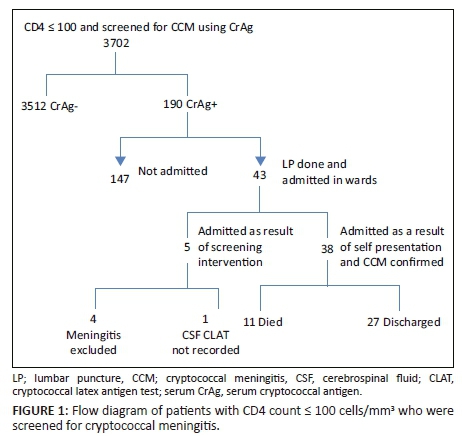
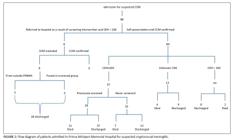
Figure 1 shows the flow of patients with a CD4 count ≤ 100 cells/mm33
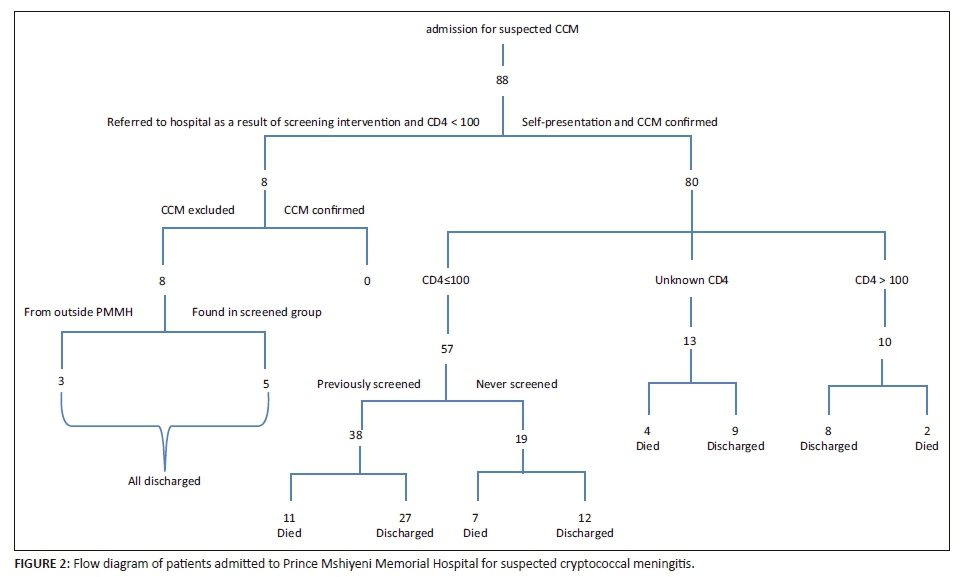
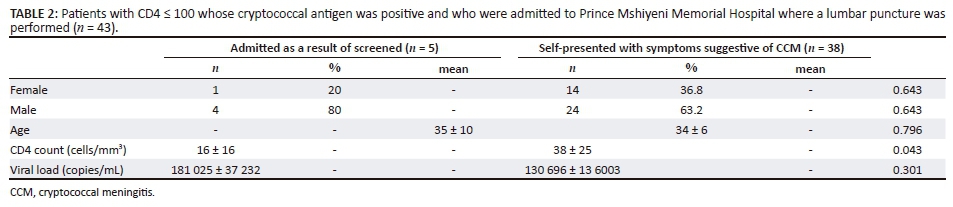
Based on the data collected from the NHLS at PMMH, only five patients (5 out of 43; 11.6%) with a CD 4 ≤ 100 cells/mm3Table 2), and all had LP evidence of CCM based on CSF Cryptococcal latex antigen test (CLAT) and/or culture results. These patients are included in the 80 patients who self-presented to the hospital (Figure 2). Although the laboratory and hospital records were extensively reviewed, no evidence could be found to indicate that any of the other 147 (77.4%) CrAg +ve patients had an LP or had been assessed for meningitis.
Part B: Review of hospital records
Between June 2015 and May 2016, 80 patients were admitted to PMMH (this includes the 38 patients in Figure 1 who self-presented) and treated for HIV-associated CCM of whom 57 (71.3%) had a CD4 count ≤ 100 cells/mm33Table 3). Most patients who were admitted complained of headache (88.6%), photophobia (60%) and/or confusion 30.7%.
The mean age of patients admitted with CCM was 34.6 ± 6.9 years (range 21-52 years). All patients with CSF evidence of CCM were treated with Amphotericin B (0.7 mg/kg-1 mg/kg) for two weeks together with a high dose of fluconazole. A plan for initiating ARTs four weeks post- discharge was made if patients were not already on ARTs. Besides the 80 patients who had confirmed CCM on CSF, eight were admitted as a result of the screen-and-treat intervention who had LPs. However, only five of these appeared in the PMMH NHLS CrAg results record, and it is possibly that the other three came from outside the PMMH catchment area. None of the screened patients had confirmed CCM on LP.
In total, 30% (24 out of 80) of patients admitted with CCM died, of those whose CD4 was ≤ 100 cell/mm333333p = 0.237 (see Table 4).
Discussion
In the NHLS component of the study, 3702 patients presented for care at PMMH and the 17 clinics between June 2015 and May 2016 with a CD4 ≤ 100 cells/mm39
In this study, only 5.1% (190 out of 3702) of the patients with a CD4 count of ≤ 100 cell/mm31819,20,2122223C. neoformans being ubiquitous in the environment, it is not clear why the percentage of patients with Cr antigenaemia varies widely between patients with a low CD4 count, and may have to do with the incidence of cryptococcal disease in the population being studied.18
Jarvis et al. reported that a negative CrAg was a 100% negative predictor for the development of CCM in patients with a low CD4 count.22,11,15182415,24
Cryptococcal antigen immunoassays have been shown to be effective in identifying patients at risk of developing subclinical cryptococcal infection before ART initiation.2,2515,2426
In this study, laboratory records show that only 2.6% (5 out of 190) of patients who were CrAg +ve had an LP at PMMH as part of the screening programme. In addition, no patient identified for an LP in this manner was diagnosed with CCM on LP, which suggests that clinicians were not effective in identifying patients with possible early onset of CCM. These results are very different from the findings from Gauteng province, where 41% (99 out of 244) of patients who were CrAg +ve were symptomatic, of whom 56 (57%) had an LP and 59% (33 out of 56) were diagnosed with CCM.2727
Alternative approaches to managing patients who are CrAg +ve include providing CrAg titres to help clinicians decide which patients require an LP,2,2425242327
Based on the review of hospital records, 20% (38 out of 190) of patients who had been identified as CrAg +ve presented to the hospital with symptoms of CCM had their diagnosis confirmed LP. This finding is consistent with the study in Thailand,2428,29182,25
Cryptococcal meningitis continues to have a significant mortality, despite the introduction of high-dose fluconazole into the South African treatment guidelines. Based on the data available at PMMH, the overall mortality in this study was 30%, which is consistent with other studies.6,11,18332,19,20,30
In the light of the high mortality associated with CCM, the challenges associated with early identification of subclinical CCM, the cost effectiveness of the screen-and-treat intervention (estimated to be cost-effective at a CrAg threshold of 0.6%),18,20,3024,27
Although this study is limited by the small numbers, with 20% mortality in those patients whose CD4 count ranged between 101 and 150 cells/mm3333,18
Limitations
Because of the design of this study, it was not possible to follow up with patients who had Cryptococcus antigenaemia. Only a few patients were admitted for an LP following the screen-and-treat intervention, and the results need to be treated with caution. It is possible that some patients were referred but never presented to PMMH for LP and that some symptomatic patients were seen and managed at other health institutions, although the referral system is designed so that clinics in the Umlazi area refer patients to PMMH.
Conclusions
The current ad-hoc system at busy public sector clinics does not appear to be effective identifying and/or referring patients with subclinical symptoms of CCM nor in reducing its associated mortality. Although screening for Cr antigenaemia is considered to be cost-effective, the benefits are currently not being realised. This may be because of the challenges associated with identifying patients with latent or early CCM as well as the challenges within the health care system that include large numbers of patients, overloaded staff and the failure of patients to return for follow-up. Although this is a small descriptive study limited to one location, it does provide data based on day-to-day practice with caution being advised when interpreting the data. Based on the findings of this research, we recommend that a system be considered to ensure that all patients with Cr antigenaemia are offered an LP to exclude CCM, and that the cut-off point for assessing Cr antigenaemia be increased to a CD4 count of 150 cells/mm3
It is also very important that all patients with a low CD4 count be fast-tracked onto ARTs so as to reduce the risk of developing CCM. Further research is needed to assess the impact of these recommendations, and the effectiveness of other interventions aimed at reducing the mortality from CCM. This includes the use of oral fluconazole in patients who have Cr antigenaemia but not CCM, and high-dose fluconazole in combination with Amphotericin B for the management of CCM.
Competing interests
The authors declare that they have no financial or personal relationships that may have inappropriately influenced them in writing this article.
Authors' contributions
N.E. was responsible for writing the protocol, collecting and analysing the data and writing the article. A.R. made conceptual contributions and helped with the article writing.
Acknowledgements
The authors would like to thank Prof. K.P. Mlisana (Associate Professor and Head of the Department of Medical Microbiology) and Z. Mkhize (National Health Laboratory Service [NHLS] manager at Prince Mshiyeni Memorial Hospital) who helped to access all data needed from NHLS.
References
-
1. Lee Y-C, Wang J-T, Sun H-Y, Chen Y-C. Comparisons of clinical features and mortality of cryptococcal meningitis between patients with and without human immunodeficiency virus infection. J Microbiol Immunol Infect. 2011;44(5):338-345. https://doi.org/10.1016/j.jmii.2010.08.011
» https://doi.org/10.1016/j.jmii.2010.08.011 -
2. Jarvis JN, Lawn SD, Vogt M, Bangani N, Wood R, Harrison TS. Screening for cryptococcal antigenemia in patients accessing an antiretroviral treatment program in South Africa. Clin Infect Dis. 2009;48(7):856-862. https://doi.org/10.1086/597262
» https://doi.org/10.1086/597262 -
3. Srikanta D, Santiago Tirado FH, Doering TL. Cryptococcus neoformans: Historical curiosity to modern pathogen. Yeast. 2014;31(2):47-60. https://doi.org/10.1002/yea.2997
» https://doi.org/10.1002/yea.2997 -
4. Abassi M, Boulware DR, Rhein J. Cryptococcal meningitis: Diagnosis and management update. Curr Trop Med Rep. 2015;2(2):90-99. https://doi.org/10.1007/s40475-015-0046-y
» https://doi.org/10.1007/s40475-015-0046-y -
5. Gaskell KM, Rothe C, Gnanadurai R, et al. A prospective study of mortality from cryptococcal meningitis following treatment induction with 1200 mg oral fluconazole in blantyre, Malawi. PLoS One. 2014;9(11):e110285. https://doi.org/10.1371/journal.pone.0110285
» https://doi.org/10.1371/journal.pone.0110285 -
6. Adeyemi BO, Ross A. Profile and acute mortality outcome of patients admitted with cryptococcal meningitis to an urban district hospital in KwaZulu-Natal, South Africa. South Afr Fam Pract. 2015;57(2):131-135. https://doi.org/10.1080/20786190.2014.976962
» https://doi.org/10.1080/20786190.2014.976962 -
7. Statistical release: Mid-year population estimates for 2017 [homepage on the Internet]. Stats SA. 2017 [cited 2017 July 31]. http://www.statssa.gov.za/publications/P0302/P03022017.pdf
» http://www.statssa.gov.za/publications/P0302/P03022017.pdf -
8. Avert. HIV and AIDS in South Africa [homepage on the Internet]. Avert; 2016 [updated 30/10/2017]. Available from: https://www.avert.org/professionals/hiv-around-world/sub-saharan-africa/south-africa [cited 2017 November 6]
» https://www.avert.org/professionals/hiv-around-world/sub-saharan-africa/south-africa - 9. Dorrington RE, Johnson LF, Moolla H. Progress towards the 2020 targets for HIV diagnosis and antiretroviral treatment in South Africa. South Afr J HIV Med. 2017;18(1):1-8.
-
10. Govender N, Dlamini S. Management of HIV-associated cryptococcal disease in South Africa. S Afr Med J. 2014;104(12) article summary p. 896. https://doi.org/10.7196/SAMJ.9070
» https://doi.org/10.7196/SAMJ.9070 -
11. Govender NP, Chetty V, Roy M, et al. Phased implementation of screening for cryptococcal disease in South Africa. S Afr Med J. 2012;102(12):914-917. https://doi.org/10.7196/SAMJ.6228
» https://doi.org/10.7196/SAMJ.6228 -
12. Jarvis JN, Harrison TS, Govender N, et al. Routine cryptococcal antigen screening for HIV-infected patients with low CD4+ T-lymphocyte counts: Time to implement in South Africa? S Afr Med J. 2011;101(4):232-234. https://doi.org/10.7196/SAMJ.4752
» https://doi.org/10.7196/SAMJ.4752 -
13. Cassim N, Schnippel K, Coetzee LM, Glencross DK. Establishing a cost-per-result of laboratory-based, reflex Cryptococcal antigenaemia screening (CrAg) in HIV+ patients with CD4 counts less than 100 cells/μl using a Lateral Flow Assay (LFA) at a typical busy CD4 laboratory in South Africa. PLoS One. 2017;12(2):e0171675. https://doi.org/10.1371/journal.pone.0171675
» https://doi.org/10.1371/journal.pone.0171675 - 14. Chetchotisakd PC, Kumarasamy N, Govender NP, et al. Rapid advice: Diagnosis, prevention and management of cryptococcal disease in HIV-infected adults, adolescents and children. WHO, 2011 Geneva Switzerland; p. 1-44.
-
15. Govender N, Meintjes G, Bicanic T, et al. Guideline for the prevention, diagnosis and management of cryptococcal meningitis among HIV-infected persons: 2013 update. South Afr J HIV Med. 2013;14(2):76-86. https://doi.org/10.4102/sajhivmed.v14i2.82
» https://doi.org/10.4102/sajhivmed.v14i2.82 -
16. DoH SA. National consolidated guidelines for the prevention of mother-to-child transmission of HIV (PMTCT) and the management of HIV in children, adolescents and adults. In: Health1, editor. Pretoria: South African Department of Health, 2014; p. 119. http://www.sahivsoc.org/Files/ART%20Guidelines%2015052015.pdf
» http://www.sahivsoc.org/Files/ART%20Guidelines%2015052015.pdf -
17. KZN. Universal Test-and-Treat 'A game changer in HIV prevention'. In: Health, editor. KwaZulu-Natal: KZNonline; 2016. http://www.kznonline.gov.za/hivaids/councils/Provincial-Councils-on-AIDS/2016/Universal%20Test%20&%20Treat%20Presentation.pdf
» http://www.kznonline.gov.za/hivaids/councils/Provincial-Councils-on-AIDS/2016/Universal%20Test%20&%20Treat%20Presentation.pdf -
18. Govender NP, Roy M, Mendes JF, Zulu TG, Chiller TM, Karstaedt AS. Evaluation of screening and treatment of cryptococcal antigenaemia among HIV-infected persons in Soweto, South Africa. HIV Med. 2015;16(8):468-576. https://doi.org/10.1111/hiv.12245
» https://doi.org/10.1111/hiv.12245 -
19. Liechty CA, Solberg P, Were W, et al. Asymptomatic serum cryptococcal antigenemia and early mortality during antiretroviral therapy in rural Uganda. Trop Med Int Health. 2007;12(8):929-935. https://doi.org/10.1111/j.1365-3156.2007.01874.x
» https://doi.org/10.1111/j.1365-3156.2007.01874.x -
20. Meya DB, Manabe YC, Castelnuovo B, et al. Cost-effectiveness of serum cryptococcal antigen screening to prevent deaths among HIV-infected persons with a CD4+ cell count≤ 100 cells/μ L who start HIV therapy in resource-limited settings. Clin Infect Dis. 2010;51(4):448-455. https://doi.org/10.1086/655143
» https://doi.org/10.1086/655143 -
21. Patel S, Shin GY, Wijewardana I, et al. The prevalence of cryptococcal antigenemia in newly diagnosed HIV patients in a Southwest London cohort. J Infect. 2013;66(1):75-79. https://doi.org/10.1016/j.jinf.2012.09.014
» https://doi.org/10.1016/j.jinf.2012.09.014 -
22. Oyella J, Meya D, Bajunirwe F, Kamya MR. Prevalence and factors associated with cryptococcal antigenemia among severely immunosuppressed HIV-infected adults in Uganda: A cross-sectional study. J Int AIDS Soc. 2012;15(1):15. https://doi.org/10.1186/1758-2652-15-15
» https://doi.org/10.1186/1758-2652-15-15 -
23. Micol R, Lortholary O, Sar B, et al. Prevalence, determinants of positivity, and clinical utility of cryptococcal antigenemia in Cambodian HIV-infected patients. J Acquir Immune Defic Syndr. 2007;45(5):555-559. https://doi.org/10.1097/QAI.0b013e31811ed32c
» https://doi.org/10.1097/QAI.0b013e31811ed32c -
24. Pongsai P, Atamasirikul K, Sungkanuparph S. The role of serum cryptococcal antigen screening for the early diagnosis of cryptococcosis in HIV-infected patients with different ranges of CD4 cell counts. J Infect. 2010;60(6):474-477. https://doi.org/10.1016/j.jinf.2010.03.015
» https://doi.org/10.1016/j.jinf.2010.03.015 -
25. Jarvis JN, Govender N, Chiller T, et al. Cryptococcal antigen screening and preemptive therapy in patients initiating antiretroviral therapy in resource-limited settings: A proposed algorithm for clinical implementation. JIAPAC. 2012;11(6):374-379. https://doi.org/10.1177/1545109712459077
» https://doi.org/10.1177/1545109712459077 -
26. Chang LW, Phipps WT, Kennedy GE, Rutherford GW. Antifungal interventions for the primary prevention of cryptococcal disease in adults with HIV. Cochrane Database Syst Rev. 2005;2005(3):1-24. https://doi.org/10.1002/14651858.CD004773.pub2
» https://doi.org/10.1002/14651858.CD004773.pub2 - 27. Walaza S. Cryptococcal screen-and-treat in Gauteng province, South Africa: Update from the first two years of implementation, 2012-2014. Pretoria: Gauteng Province; 2014.
-
28. Desmet P, Kayembe KD, De Vroey C. The value of cryptococcal serum antigen screening among HIV-positive/AIDS patients in Kinshasa, Zaire. AIDS (London, England). 1989;3(2):77-78. https://doi.org/10.1097/00002030-198902000-00004
» https://doi.org/10.1097/00002030-198902000-00004 -
29. Tassie JM, Pepper L, Fogg C, et al. Systematic screening of cryptococcal antigenemia in HIV-positive adults in Uganda. J Acquir Immune Defic Syndr. 2003;33(3):411-412. https://doi.org/10.1097/00126334-200307010-00019
» https://doi.org/10.1097/00126334-200307010-00019 -
30. Jarvis JN, Harrison TS, Lawn SD, Meintjes G, Wood R, Cleary S. Cost effectiveness of cryptococcal antigen screening as a strategy to prevent HIV-associated cryptococcal meningitis in South Africa. PLoS One. 2013;8(7):e69288. https://doi.org/10.1371/journal.pone.0069288
» https://doi.org/10.1371/journal.pone.0069288

Accepted: 05 May 2018
Published: 08 Aug. 2018