Facilitators and barriers to professional nurses implementing integrated services in urban primary health care clinics in Kavango East region, Namibia
Abstract
BACKGROUND: The World Health Organization (WHO) has advocated for the implementation of people-centred and integrated health services. Although there is growing evidence of integration's benefits for sexual and reproductive health, human immunodeficiency virus (HIV) and rights, health services face tremendous resource constraints when it comes to integrating these services. AIM: The aim of study was to explore and describe the facilitators and barriers to professional nurses implementing the person-centred model of integrated services in urban primary health care clinics in the Kavango East region, Namibia. SETTING: We interviewed professional nurses from urban primary health care clinics in low-resourced settings in Rundu health district, Kavango East region, Namibia. METHODS: This study employed a qualitative approach utilising an explorative, descriptive and contextual strategy. Semistructured interviews were used to collect the data. Fifteen participants were selected using a purposive sampling technique. The interviews were audio recorded, transcribed verbatim and coded, before the data were analysed using thematic analysis. RESULTS: The data analysis led to the emergence of the following four themes: understanding integrated services; facilitators for implementing integrated services; barriers to the implementation of integrated services; and improvement measures for implementing integrated services. CONCLUSION: Findings showed that the implementation of integrated services faces many barriers, which are related to lack of human resources skills, a lack of essential supplies and space constraints. These findings will hopefully create an awareness and understanding of the facilitators and barriers that professional nurses face in the implementation of integrated services for urban primary health care in the Namibian urban context. CONTRIBUTION: The study's findings can be used to develop strategies and ongoing interventions that focus on addressing the barriers professional nurses face in the implementation of integrated services in both urban and rural primary health care settings.
facilitators; barriers; implementation; person-centred model; integrated services; urban primary health care; professional nurses
Introduction
The World Health Organization's (WHO) global strategy on people-centred, integrated health services is a call for a fundamental paradigm shift in the way that health services are funded, managed and delivered.1234556
Health services face resource constraints in integrated services, particularly human resource shortages.6781
Namibia has a generalised, mature HIV epidemic with an HIV prevalence of 12.6%889869610
The barriers and facilitators to professional nurses implementing integrated services have been explored in developed countries; however, no such studies in Namibia have been documented. It is for this reason that the researchers of this study seek to explore the facilitators and barriers to professional nurses implementing integrated services at urban PHC facilities in Namibia. The findings from this study will hopefully create awareness and understanding of this topic in the Namibian urban context and will recommend the measures needed to improve the implementation of integrated services in Namibian PHC clinics.
Research aim
The aim of this study was to explore and describe the facilitators and barriers to professional nurses implementing integrated services in urban PHC clinics in Kavango East region, Namibia.
Framework of the study
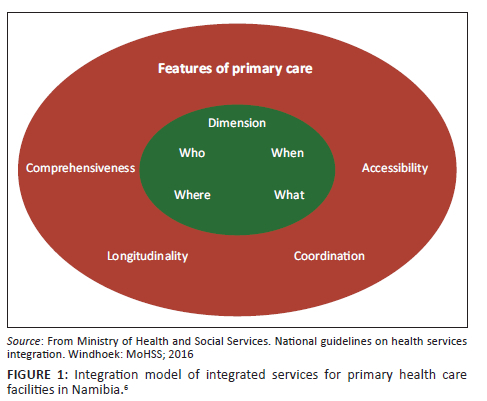
The current study was based on the Namibia integration model (Figure 1), also known as the main four features of primary care. In this model, a nurse will always sit in the consultation room and provide care to the same patient over time. The theory incorporates four features of primary care: accessibility, comprehensiveness, continuity or longitudinality and coordination. The first feature is accessibility, which is the first contact, access and use by addressing geographical, administrative, cultural and time barriers. The second feature, comprehensiveness, ensures that the nurse has all their needs catered for in the consulting room (register, equipment, medicines, etc.) in order to provide all the services that the patient needs within the same room. The third feature, continuity or longitudinality, sees the same nurse following the same patient over time and assuming responsibility for that patient. The last feature in this model is coordination among health care teams across different levels of the health care system. This model assumes a one-stop health care approach, with flexible facilitated referrals within and outside a facility.6
Research methods and design
A qualitative, explorative, descriptive and contextual research design was utilised1112131415
Context
The current study was conducted at five urban PHC facilities within Rundu health district in the north-east of Namibia. The integrated health services at these clinics focus mainly on sexual and reproductive health, HIV rights and related health services such as the integrated management of neonatal and childhood illnesses, wound dressing, antenatal and postnatal care, history taking, antiretroviral therapy, point of service assessment, HIV counselling and testing, emergencies, immunisations, FP and the integrated management of adolescent and adult illnesses in PHC facilities.616
Recruitment, sample and sampling technique
The study population comprised 15 professional nurses who were working at the five selected integrated PHC clinics in Rundu district. This study utilised a purposive nonprobability sampling technique, with the researchers selecting study participants who would provide rich data on the phenomenon of interest.17
Data collection
Data in this study were collected in August and September 2021. Participants were approached by the researcher, who explained the aim of the study, after which the participants who agreed to participate were asked to sign a consent form.18
• What are the facilitators to professional nurses implementing integrated services in urban PHC clinics in Kavango East region, Namibia?
• What are the barriers to professional nurses implementing integrated services in urban PHC clinics in Kavango East region, Namibia?
• What recommendation can be made to support the implementation of integrated services in urban PHC clinics in Kavango East region, Namibia?
Data analysis
The researchers transcribed the interviews verbatim before integrating their field notes. Data from the interviews were then analysed using Braun's six-step method of qualitative data analysis; that is: (1) organise and prepare the data; (2) develop a sense of all the data; (3) code the data following Tesch's nine steps; (4) identify and describe themes; (5) represent the findings; and (6) interpret the data.1920
Measures to ensure trustworthiness
Trustworthiness or rigour refers to the degree of confidence in the data, interpretation and methods used to ensure the quality of a study.1421
Credibility refers to the truthfulness of the data.14
Confirmability is the potential for data congruence in terms of accuracy, relevance or meaning. In this study, confirmability was ensured by obtaining informed consent from the participants after they were afforded the time to review the information letter. Their questions were also answered truthfully, and their freedom of expression was encouraged. Additionally, verbatim transcription of the interviews and rereading of these and the field notes enabled the researcher to get a better understanding of what the participants said about integrated services. According to Pescheny et al.,22
Ethical considerations
The research was conducted after approval was granted by the University of Namibia's School of Nursing Research and Ethics Committee of the Faculty of Health Sciences (ref. no. SoNREC 9/2021), the School of Nursing Ethic and Review Committee (ref. no. SoNERC 08/2021) and the Ministry of Health and Social Services (ref. no. JKH2021). Participation in this study was voluntary, and participants were informed that they were free to withdraw from the study at a given time with no repercussions. The researcher ensured that no data was linked to any participant, with participants being referred to by a number instead of their real name.
Findings and discussion
Participants' characteristics
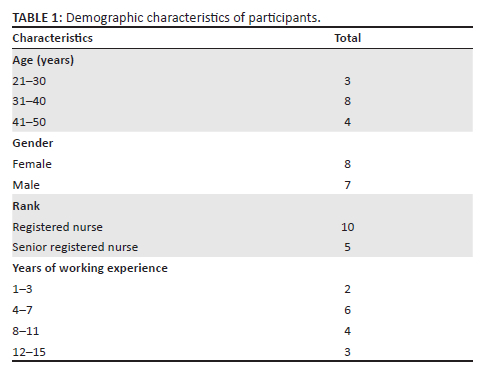
All participants were under 50 years of age, with the majority being between the ages of 31 and 40. The sample consisted of seven male and eight female nurses who were recruited from different clinics within Rundu district. Table 1 gives more information regarding the demographic characteristics of the participants.
Presentation of findings and discussion
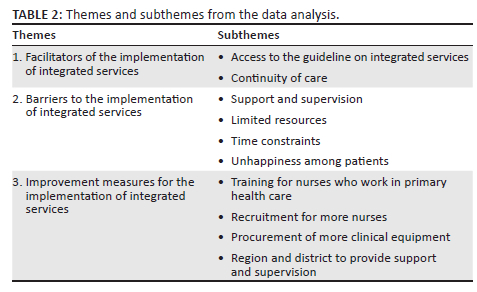
The three themes that emerged from the data analysis were: facilitators of the implementation of integrated services; barriers to the implementation of integrated services and improvement measures for implementing integrated services in Namibia. Table 2 gives a description of the themes and sub themes in the study.
Theme 1: Facilitators of the implementation of integrated services
This theme reflects the experiences of nurses regarding which facilitators enable the implementation of integrated services. The two subthemes that emerged from this theme were access to the guidelines on integrated services and continuity of care.
Subtheme 1: Access to the guidelines on integrated services
Participants noted that it was easy for everyone to follow the guidelines that the interventions were based on. A scenario where the structure, actions, roles and responsibilities are defined in the guidelines was found to be straightforward for the nurses.
One of the participants said:
'I think the guidelines have opened our eyes in such a way that we realised that we have been implementing integrated services in a wrong way and wasting valuable time. The guideline is clear; it tells what to do, whether to give drugs or to refer, and challenges are minimised by the guidance of the guidelines, and it feels that this has really helped us a lot.' (P8, 47 years, male, registered nurse)
Another participant noted:
'Even though you have your training, knowledge and skills, but the most important is the national guidelines next to you that have abreast information which guides you and that you can refer to when you are not sure of what you should do.' (P2, 31 years, female, registered nurse)
The provision of exemplary care, as described by the findings of the current study, is in line with a study conducted in South Africa on the barriers to integrated service delivery relating to physical and mental conditions, Kathol et al.2324
Subtheme 2: Continuity of care
The participants pointed out that quality of care for patients is easily monitored, especially among those who require follow-ups, as they are treated by the same health care worker.
One of the participants said:
'Patients don't have to go to another room to get any other services. We make use of the supermarket approach - now they can get everything they need at once, and this help you know all your patients.' (P1, 50 years, male, registered nurse)
Another participant added:
'Patients, especially postnatal mothers, feel a sense of holistic care when they bring their babies for immunisation and get rendered with services such as family planning and COVID-19 vaccination in one room.' (P4, 34 years, male, senior registered nurse)
This finding corresponds with the study conducted by Kathol et al.2325
Theme 2: Barriers to the implementation of integrated services
This theme incorporates all the aspects that nurses find to be a hindrance to the implementation of integrated services, that is, inadequate support and supervision; limited resources; time constraints and tensions with patients.
Subtheme 1: Support and supervision
The participants revealed that support and supervision are required, as it can enhance the delivery of effective integrated services:
'As you know, this model is new, and there is no one coming from the regional or district office to visit us at the clinic even once or twice to see the challenges we are facing on. Workshops and trainings are only given to in-charges and nurses at the district offices who never bring the much-needed information to us, the nurses working with the patients on a daily basis.' (P5, 30 years, female, registered nurse)
'When the project manager or supervisors are not aware of interventions and changes because of lack of proper supervision and support, to undertake all the coordination required for the programme may result in less effective and delayed implementation and delivery of integrated services initiatives.' (P13, 44 years, male, registered nurse)
This finding supports that of Holloway and Galvin,1826
Subtheme 2: Limited resources
The participants outlined that space constraints, financial constraints, increase in workloads and staff shortages are all barriers to the implementation of integrated services:
'The disadvantage here is that the equipments and supplies are not available in the right quality. For instance, here, we don't have tourniquet to draw of blood, not enough beds, measuring tape and other need materials.' (P9, 49 years, female, registered nurse)
'Nursing staff are having low morale because they are working so hard, doing the work of two people. Workload, we have got more than 300-400 patients a day here in our clinic. It is demotivating and demoralising the staff.' (P15, 33 years, female, senior registered nurse)
'The space is also one of the challenges; the facility lacks space for counselling of patients. This situation makes it difficult to assess or counsel a patient in privacy. The patient becomes shy to say their problems, as there is someone getting vaccinated behind the curtains in the same room.' (P6, 36 years, male, registered nurse)
The findings of this study are similar to those of Kathol et al.'s23
Subtheme 3: Time constraints
Lack of time seems to be the barrier experienced most by nurses. The results showed that not only is there not enough time to see patients, but certain procedures require a lot of time to complete, which leads to insufficient time to manage patients' needs and wishes.
One participant said that:
'Time that we have to treat patients feels not to be enough, so sometimes you will just rush to finish treating the patient in order for you to see others. I feel like some patients need more time than others, but the timeframe does not allow us.' (P6, 36 years, male, registered nurse)
Another nurse added:
'This time of 8 to 5 is not enough to cater [for] patients in this model, as some of the services, it can take 45 min - even up to 1 h - to see just one patient, so a requesting for over-time or time to be extended, even 7 to 7 and so, because this time is really not enough for integrated services.' (P8, 47 years, male, registered nurse)
This finding is similar to a study by Moore et al.,2728
Subtheme 4: Unhappiness among patients
Most of the participants reported that patients who receive little to no guidance about the availability of integrated services become frustrated, as they have to wait for a long time in queues.
One participant said that:
'Patient gets angry to nurses as they stay longer in the queues, which make them unhappy … in some situation, you will suddenly find yourself into conflict with a patient, even [while] you are trying to make something clear, as they are already angry.' (P11, 46 years, female, registered nurse)
Another one added:
'A lot of complaints arise from patient as others stay longer in the room, and this result of chaos in the clinic by confronting nurses.' (P7, 33 years, female, senior registered nurse)
Pescheny et al.'s22
Theme 3: Improvement measures for the implementation of integrated services
This section will present the participants' suggestions regarding what they wished could be done differently to improve integrated services in Namibia. The four subthemes which emerged from this theme were: train nurses who work in PHC; recruit more nurses; procure more clinical equipment and request that the region and district provide additional support and supervision.
Subtheme 1: Train nurses who work in primary health care
Some participants felt that the implementation of integrated services is not well initiated, or there is insufficient training, so they suggested that in the future, the government should ensure that nurses get the necessary training regarding the integrated services well before sending them out into the field. Currently, there are unnecessary delays in patient care and poor delivery of services.
One participant said that:
'They should change the strategy of training nurses on this service; instead of training once in a year, it must be at least twice. I feel like supervisors at the regional and district level must do monthly support visits to see if intergraded service method works best for that facility.' (P3, 34 years, female, senior registered nurse)
Another participant added:
'Service providers should all be trained in all programmes to provide holistic care to patients.' (P14, 40 years, male, registered nurse)
The recommendations from a study by Watt et al.242229
Subtheme 2: Recruit more nurses
The study participants suggested that the Ministry of Health and Social Services should provide more nurses so that service can be delivered to patients quickly and they can avoid keeping patients for so long.
One participant reported:
'The Ministry is requested to improve on the shortage of nurses so that we can cover all our patients as we can help each other by implementing … integrated services.' (P7, 33 years, female, senior registered nurse)
Another nurse added:
'Additional staff are required to allow us to work more collaboratively and to deliver appropriate interventions and to work in more effective ways, rather than a crisis-driven focus.' (P12, 35 years, female, senior registered nurse)
This recommendation is similar to that of Pescheny et al.'s221924
Subtheme 3: Procure more clinical equipment
Participants suggested an increase in the provision of equipment to the facility in order to reduce the problem of overcrowding at the points of service, thereby reducing waiting times while others are using equipment.
One participant recommended:
'The Ministry must provide equipment as is the beginning of it, because there is no way you can integrate when some of the rooms do not have beds and other equipment, as in some cases the bed used for examining sick patients is also used for palpating pregnant women.' (P5, 30 years, female, registered nurse)
Another participant added:
'This service is done at one site or area; therefore, there is a need for the Ministry to provide enough equipment to each clinic for integrated health service in order to improve its implementation.'(P2, 31 years, female, registered nurse)
The above findings are in line with those of Sandelowsky et al.,3019
Subtheme 4: Region and district to provide support and supervision
The participants suggested that additional involvement and visits by health officials to health facilities are likely to yield tangible outcomes.
One participant said that:
'Having the officials visiting at the clinic regarding the implementation of integrated service once or twice in a year will be better, because they will have a platform on which all the challenge they are facing are revealed.' (P10, 38 years, male, registered nurse)
Another one said:
'The participants noted that the support, commitment and regular visits by personnel from the regional or district level on behalf of the ministry may contribute positively towards the delivery of quality integrated health services.' (P3, 34 years, female, registered nurse)
The recommendations of this study regarding the involvement of health programme managers are similar to those of Busetto et al.,31
Limitations, strengths and areas for future research
This study had one limitation, namely that it was limited to urban PHC facilities situated within one district in the Kavango East region, Namibia. This limits the generalisation of the findings to other districts and regions. One major strength of this study is that the data were collected from participants who were all professional nurses with experience in PHC nursing and who had been working in PHC clinics for a minimum of two years, which enabled them to provide rich data that enhanced the trustworthiness of the study. This was also the first study to be conducted in the Namibian context on the subject; thus, it provides baseline data for integrated care programmes and future research. A mixed study comprising all PHC clinics in the region may be useful in providing more information regarding barriers to the implementation of integrated care in both urban and rural PHC clinics.
Conclusion
This study aimed to explore and describe the facilitators and barriers to the implementation of integrated health services in Rundu health district, Namibia. The findings of this study identified barriers related to human resources, essential resources and unhappiness among patients owing to time constraints. Facilitators identified in this study include accessibility of the guidelines on integrated service and their facilitation of continuity of care. The Ministry of Health and the relevant health divisions and subdivisions, in particular the PHC division, need to address the identified shortcomings to ensure that the future delivery of integrated health services will be successful. It is of paramount importance that all stakeholders in the integrated health services domain work collaboratively toward the common goal of having integrated services be fully implemented. The findings from this study will hopefully create awareness and understanding about the facilitators and barriers to the implementation of integrated services when it comes to urban PHC in the Namibian urban context. In addition, it provides recommendations to improve the implementation of integrated services in Namibian PHC clinics.
Competing interests
The authors have declared that no competing interest exists.
Authors' contributions
D.O.A. was involved in writing of the original draft, review and editing, visualisation and supervision; J.H. was involved in conceptualisation, methodology, writing of the original draft and formal analysis. Both authors approved the final version for publication.
Funding information
This research received no specific grant from any funding agency in the public, commercial or not-for-profit sectors.
Data availability
The raw data that support the findings of this study are available from the corresponding author, D.O.A., upon fair and reasonable request.
Disclaimer
The views and opinions expressed in this article are those of the authors and do not necessarily reflect the official policy or position of any affiliated agency of the authors and the publisher.
Acknowledgements
The authors wish to thank the research participants who accepted to be part of this research endeavour. Without their participation, this study would not have been possible. We also wish to thank the University of Namibia Ethics Review Committee and the Ministry of Health and Social Services research unit for granting us permission to conduct this study.
References
-
1.World Health Organization. People-centred and integrated health services: An overview of the evidence: Interim report [homepage on the Internet]. [cited 2022 Feb 24]. Available from: https://apps.who.int/iris/handle/10665/155004
» https://apps.who.int/iris/handle/10665/155004 -
2.Threapleton DE, Chung RY, Wong S, et al. Integrated care for older populations and its implementation facilitators and barriers: A rapid scoping review. Int J Qual Health Care. 2017;29(3):327-334. https://doi.org/10.1093/intqhc/mzx041
» https://doi.org/10.1093/intqhc/mzx041 -
3.Dudley L, Garner P. Strategies for integrating primary health services in low- and middle-income countries at the point of delivery. Cochrane Database Syst Rev. 2011;7:CD003318. https://doi.org/10.1002/14651858.CD003318.pub3
» https://doi.org/10.1002/14651858.CD003318.pub3 -
4.Nkrumah J, Abekah-Nkrumah G. Facilitators and barriers of patient-centered care at the organizational-level: A study of three district hospitals in the central region of Ghana. BMC Health Serv Res. 2019;19:900. https://doi.org/10.1186/s12913-019-4748-z
» https://doi.org/10.1186/s12913-019-4748-z -
5.Cueto M. The origins of primary health care and selective primary health care. Am J Public Health. 2004;94(11):1864-1874. https://doi.org/10.2105/ajph.94.11.1864
» https://doi.org/10.2105/ajph.94.11.1864 - 6.Ministry of Health and Social Services. National guidelines on health services integration. Windhoek: MoHSS; 2016.
-
7.Lloyd B, Elkins M, Innes L. Barriers and enablers of patient and family centred care in an Australian acute care hospital: Perspectives of health managers. Patient Exp J. 2018;5(3):55-64. https://doi:org/10.35680/2372-0247.1270
» https://doi:org/10.35680/2372-0247.1270 - 8.Ministry of Health and Social Services (MoHSS), Namibia. Namibia population-based HIV impact assessment (NAMPHIA) 2017: Final Report. Windhoek: MoHSS, Namibia; 2019.
-
9.Zapata T, Forster N, Campuzano P, et al. How to integrate HIV and sexual and reproductive health services in Namibia, the Epako clinic case study. Int J Integr Care. 2017;17(4):1. https://doi.org/10.5334/ijic.2488
» https://doi.org/10.5334/ijic.2488 -
10.Raus K, Mortier E, Eeckloo K. Challenges in turning a great idea into great health policy: The case of integrated care. BMC Health Serv Res. 2020;20:130. https://doi.org/10.1186/s12913-020-4950-z
» https://doi.org/10.1186/s12913-020-4950-z - 11.Creswell JW. A concise introduction to mixed methods research. Thousand Oaks, CA: Sage; 2014.
- 12.Botma Y, Greeff M, Mulaudzi FM, Wright SCD. Research in health sciences. Johannesburg: Heinemann; 2010.
- 13.Grove SK, Burns N, Gray J. The practice of nursing research: Appraisal, synthesis, and generation of evidence. St. Louis, MO: Elsevier Health Sciences; 2012.
- 14.Maree K. First steps in research. Pretoria: Van Schaik; 2016.
- 15.Green J, Thorogood N. Qualitative methods for health research. 4th ed. London: Sage; 2018.
-
16.UNAIDS. Namibia's City of Windhoek collaborates to strengthen HIV response 2012 [homepage on the Internet]. [cited 2015 Aug 27]. Available from: http://www.unaids.org/en/resources/presscentre/featurestories/2012/octob…
» http://www.unaids.org/en/resources/presscentre/featurestories/2012/octob -
» https://doi.org/10.1093/heapol/czw149 - 17.Polit DF, Beck CT. Nursing research: Generating and assessing evidence for nursing practice. Philadelphia: Lippincott Williams & Wilkins; 2017.
- 18.Holloway I, Galvin K. Qualitative research in nursing and healthcare. Chichester West Sussex: John Wiley & Sons; 2016.
-
19.Braun V, Clarke V. Reflecting on reflexive thematic analysis. Qual Res Sport Exerc Health. 2019;11(4):589-597. https://doi.org/10.1080/2159676X.2019.1628806
» https://doi.org/10.1080/2159676X.2019.1628806 - 20.Lincoln YS, Guba EG. Naturalistic inquiry. Newbury Park, CA: Sage; 1985.
-
21.Khumalo GE, Lutge E, Naidoo P, Mashamba-Thompson TP. Barriers and facilitators of rendering HIV services by community health workers in sub-Saharan Africa: A meta-synthesis protocol. BMJ Open 2020;10(10):e037876. https://doi.org/10.1136/bmjopen-2020-037876
» https://doi.org/10.1136/bmjopen-2020-037876 -
22.Pescheny JV, Pappas Y, Randhawa G. Facilitators and barriers of implementing and delivering social prescribing services: A systematic review. BMC Health Serv Res. 2018;18(1):86. https://doi.org/10.1186/s12913-018-2893-420
» https://doi.org/10.1186/s12913-018-2893-420 -
23.Kathol RG, Butler M, McAlpine DD, Kane RL. Barriers to physical and mental condition integrated service delivery. Psychosom Med. 2010;72(6):511-518. https://doi.org/10.1097/PSY.0b013e3181e2c4a0
» https://doi.org/10.1097/PSY.0b013e3181e2c4a0 -
25.Dlwati LV, Mavundla TR, Mbengo F. Facilitators for and barriers to the implementation of national tuberculosis management guidelines. Afr J Nurs Midwif. 2018;19(3):1-20. https://doi.org/10.25159/2520-5293/2862
» https://doi.org/10.25159/2520-5293/2862 -
26.Vennedey V, Hower KI, Hillen H, et al. Patients' perspectives of facilitators and barriers to patient-centred care: Insights from qualitative patient interviews. BMJ Open. 2020;10(5):e033449. https://doi.org/10.1136/bmjopen-2019-033449
» https://doi.org/10.1136/bmjopen-2019-033449 -
27.Moore L, Britten N, Lydahl D, Naldemirci Ö, Elam M, Wolf A. Barriers and facilitators to the implementation of person-centred care in different healthcare contexts. Scand J Caring Sci. 2017;31(4):662-673. https://doi.org/10.1111/scs.12376
» https://doi.org/10.1111/scs.12376 -
28.Alharbi T. Implementation of person-centered care-facilitators and barriers [homepage on the Internet]. Gothenburg: Kompendiet; 2014 [cited 2022 Feb 24]Available from: http://hdl.handle.net/2077/35939
» http://hdl.handle.net/2077/35939 -
29.De Jongh TE, Gurol-Urganci I, Allen E, Jiayue Zhu N, Atun R. Barriers and enablers to integrating maternal and child health services to antenatal care in low and middle income countries. BJOG Int J Obstet Gynaecol. 2016;123(4):549-557. https://doi.org/10.1111/1471-0528.13898
» https://doi.org/10.1111/1471-0528.13898 -
30.Sandelowsky H, Hylander I, Krakau I, Modin S, Ställberg B, Nager A. Time pressured deprioritization of COPD in primary care: A qualitative study. Scand J Prim Health Care. 2016;34(1):55-65. https://doi.org/10.3109/02813432.2015.1132892
» https://doi.org/10.3109/02813432.2015.1132892 -
31.Busetto L, Luijkx K, Calciolari S, Ortiz L, Vrijhoef H. Barriers and facilitators to workforce changes in integrated care. Int J Integr Care. 2018;18(2):17. https://doi.org/10.5334/ijic.3587
» https://doi.org/10.5334/ijic.3587

Accepted: 12 July 2022
Published: 19 Dec. 2022