Family Medicine for internally displaced persons in Mali: A training of trainers approach
Abstract
Mali is currently experiencing a polycrisis, characterised by the interplay of growing socio-political insecurity, massive population displacements and recurrent tensions in the functioning of the health system and the provision of care. In this context, the multidisciplinary teams of University Community Health Centres (CSCoM-Us), primary health care facilities, have expressed the desire to strengthen their skills to better meet the needs of the internally displaced persons who frequent their facilities. To address this demand, training workshops were co-constructed by a team of family physicians (FPs), combining the experiential knowledge of local teams with the expertise of partners from the Université de Sherbrooke. A Training of Trainer (ToT) programme, consisting of training provided by central-level trainers to local-level practitioners, was developed and deployed. Five priorities were identified by local partners: continuity of care, maternal health, gender-based violence, mental health and working with a language barrier. From 2022 to 2023, this training was implemented in Mali's seven CSCOM-Us, reaching 277 health professionals in five regions of the country. The outcomes include increased awareness of the challenges faced by internally displaced persons and strengthening local capabilities. This short report highlights the strategic role and leadership played by FP in improving the population's health, particularly in sub-Saharan Africa, through their versatility and community-oriented, holistic and patient-centred approach.
family medicine; primary health care; decentralised training; internally displaced persons; humanitarian crisis; co-construction; cascade training; multidisciplinary
Introduction
Mali is among the countries with the lowest rates of physicians per capita, and approximately 0.1 physician per 1000 inhabitants.1Projet d'appui à la formation des professionnels de la santé au Mali), a collaboration between Mali and Canada (2010-2018, 19.1 million CAN$, funded by Global Affairs Canada). By 2024, 75 Malian doctors, including 20 women, had obtained their FM & CM diploma and were practising in various regions and health facilities throughout the country.
In the context of a national shortage of health professionals, and in line with the World Health Organization's strategies for 'integrated, people-centred services',234
In Mali's current polycrisis context, family physicians (FPs) are key leaders who can act as agents of change in responding to existing and emerging needs of communities.5
The changing socio-political context in Mali and the impact on primary health care
Since 2012, Mali has been facing growing socio-political insecurity that is undermining social, health and education services.6789
At the health level, Mali faces a high burden of communicable diseases (CDs), including malaria, tuberculosis and HIV/AIDS. In 2021, 7.7 million cases of malaria were reported resulting in almost 20 000 deaths, while the mortality rate from tuberculosis has remained at 7.5 per 100 000 population from 2015 to 2021. In addition, approximately 56 194 people were receiving anti-retroviral treatment for HIV in 2021. In recent years, non-communicable diseases (NCDs) (such as cardiovascular diseases, chronic respiratory diseases, cancer and diabetes) have also emerged as significant contributors to the country's disease burden.10
The ongoing polycrisis in Mali exacerbates the disease burden in several ways. Internally displaced persons, living in overcrowded host families or shelters with limited access to basic services such as food, clean water and sanitation, face heightened risks of both CDs and NCDs. Violent attacks on civilians and recurrent gender-based violence (GBV) contribute to physical and mental trauma. As seen in other humanitarian crises, disruptions in the healthcare system significantly impact access, continuity and quality of care, leading to a deterioration in basic health conditions and a decline in childhood immunisation. For instance, the measles immunisation rate in Mali was 73% in 2023.11,12,13
Consequently, health professionals in primary health care facilities, particularly CSCom-Us, are increasingly called upon to intervene with the displaced populations. However, these patients present complex needs, and many feel inadequately trained to respond effectively. In this context, a group of Malian FP has designed a ToT programme as part of the Communautés locales d'enseignement pour des femmes et des filles en santé (CLEFS) project, aiming to support agents of change in providing comprehensive and more effective care to IDPs.
Mobilising family physician to respond to the internally displaced person crisis: A method for the training of trainer model and its evaluation
The objective of this project was to co-construct a training programme and deploy it through key strategic locally designed interventions. The ToT model14,15
The model's cost-effectiveness was recently demonstrated in a recent systematic review of ToT programmes implemented in low- and middle-income countries.14
The ToT model employed in this intervention was complemented by a participatory learning approach, in which the learners - health professionals - played an active role in shaping the content and focus of the training. This approach facilitated a more tailored and contextually relevant learning experience. In 2022, a training need prioritisation survey was distributed via email to healthcare professionals (family physicians, nurses and midwives) working across the seven CSCOM-Us in Mali. A total of 17 responses were collected. The programme design team, composed of five Malian FP with extensive clinical and teaching roles in their facilities, in collaboration with three partners from the Université de Sherbrooke with expertise in refugee health and health education, identified priorities after analysing the survey and consulting evidence-based best practices regarding health of people experiencing forced displacement.12
A participatory approach was also employed during the training of the first cohort of trainees, working in small groups and asking each participant to share ideas to develop core recommendations, which they would later teach at their respective health centres. This approach encourages active engagement from all participants in generating solutions. Although individual change was not quantitatively assessed through pre- and post-training questionnaires, participant satisfaction with the pedagogical tools employed was evaluated using a post-training evaluation survey.
Processes and results
Topics identified as priorities in the context of care for displaced persons in the Malian context included continuity of care, maternal health, GBV, mental health and working with a language barrier.
Five modular workshops were created, each corresponding to one of the identified themes. Training content was adapted from published guidelines16,17,18,19,20,21,22
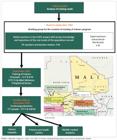
An initial 2-day training for trainers was held in Bamako in September 2022 with 12 participants, including doctors, nurses and midwives. At the end of the training sessions and interactive workshops, key recommendations for the care of IDPs in Mali's CSCOM-Us emerged, highlighting the experiential knowledge of participants in the field. The training was then extended to the seven CSCom-Us in Mali between 2022 and 2023, allowing knowledge transfer to five regions of the country and reaching different categories of health professionals, such as doctors, nurses, midwives, assistants, as well as residents and interns (Figure 1).
Impact and future challenges
Although co-development between actors from different practice backgrounds was challenging, evaluation surveys gathered from participants revealed a heightened awareness of the challenges faced by IDPs, both at the medical and psychosocial levels, and appreciation of the quality and diversity of pedagogical methods. The development of the training also led to the creation of a community of practice. This dynamic community of doctors, nurses and midwives is helping to strengthen clinical capacities of frontline resources, as well as local collaborative and transformational leadership in crisis-affected regions.
Future challenges include the adoption of the training by local actors as well as regional and ministerial decision-makers to ensure the sustainability and wider dissemination of the project. The evaluation of the mid- and long-term impact of the project will be key to a better regional and contextual adaptation in the future.
The training modules for IDPs care should also be adopted by medical institutions to ensure adequate guidance and awareness as part of the initial academic programme of future health professionals. Finally, while no specific strategies were implemented to address gender disparities in training access during this intervention, this issue should be prioritised in future efforts.
Conclusion
At a time when more and more stakeholders are emphasising the importance of family medicine in providing equitable and quality primary health care,23 this short report illustrates how FP can play a critical role in continuously improving the health of communities, especially those displaced and affected by crisis. Through a bottom-up, patient-centred, holistic and multidisciplinary approach deeply rooted in the community, FP emphasise prevention and integrate the social determinants of health in their care. In Mali, as elsewhere, it is critical to continue recognising and value the unique role of FP as local leaders in addressing the country's current challenges.
The authors would like to acknowledge all Malian partners for their commitment to this project and their communities. The authors would like to thank Michèle Rietmann, Johannie Lapierre, Mahamane M. Maïga and Sarah Stecko for their support in writing this short report. The authors would also like to thank the Faculty of Medicine and Odontostomatology (FMOS) of the University of Sciences, Techniques and Technologies in Bamako, as well as the Université de Sherbrooke, Cégep de Saint-Jérôme, and Centre de Coopération internationale en Santé et Développement (CCISD), now Santé Monde in Canada.
The authors reported that they received funding from Global Affairs Canada, which may be affected by the research reported in the enclosed publication. The authors have disclosed those interests fully and have implemented an approved plan for managing any potential conflicts arising from their involvement. The terms of these funding arrangements have been reviewed and approved by the affiliated university in accordance with its policy on objectivity in research.
This work was supported by the Communautés locales d'enseignement pour des femmes et des filles en santé (CLEFS) project, which is funded by Global Affairs Canada (Project number: P006775).
The authors confirm that the data supporting the findings of this study are available within the article, on the following website 'www.cidis.ca' or from the corresponding author, A.I.G., on reasonable request.
References
-
1. World Bank. Data bank [homepage on the Internet]. [cited 2024 Aug 11]. Available from: https://data.worldbank.org/indicator/SH.MED.PHYS.ZS?name_desc=true
» https://data.worldbank.org/indicator/SH.MED.PHYS.ZS?name_desc=true -
2. World Health Organization (WHO). Framework on integrated, people-centred health services [homepage on the Internet]. Report by the Secretariat; 2016 [cited 2024 Aug 11]. Available from: http://apps.who.int/iris/bitstream/10665/174536/1/9789241564977_eng.pdf?ua=1
» http://apps.who.int/iris/bitstream/10665/174536/1/9789241564977_eng.pdf?ua=1 -
3. Government of Canada. Les Centres de santé communautaire universitaires au Mali: Un partenariat entre communautés [homepage on the Internet]. 2018 [cited 2024 Aug 11]. Available from: https://www.international.gc.ca/world-monde/stories-histoires/2019/mali-university-universite.aspx?lang=fra
» https://www.international.gc.ca/world-monde/stories-histoires/2019/mali-university-universite.aspx?lang=fra -
4. Maïga MM, Blouin-Genest G, Couturier F, et al. The contribution of family medicine to community-orientated health services in Mali: A short report. Afr J Prim Health Care Fam Med. 2021;13(1):e1-e3. https://doi.org/10.4102/phcfm.v13i1.3047
» https://doi.org/10.4102/phcfm.v13i1.3047 -
5. World Health Organization (WHO). Primary health care: Now more than ever [homepage on the Internet]. 2008 [cited 2024 Aug 11]. Available from: https://www3.paho.org/hq/dmdocuments/2010/PHC_The_World_Health_Report-2008.pdf
» https://www3.paho.org/hq/dmdocuments/2010/PHC_The_World_Health_Report-2008.pdf -
6. World Economic Forum (WEF). The global risks report 2023 [homepage on the Internet]. 18th ed. 2023 [cited 2024 Aug 11]. Available from: https://www3.weforum.org/docs/WEF_Global_Risks_Report_2023.pdf
» https://www3.weforum.org/docs/WEF_Global_Risks_Report_2023.pdf -
7. World Economic Forum (WEF). Global gender gap [homepage on the Internet]. 2024 [cited 2024 Aug 12]. Available from: https://www.weforum.org/publications/gender-gap-report-2024/
» https://www.weforum.org/publications/gender-gap-report-2024/ -
8. United Nations. Human Development Index [homepage on the Internet]. Human Development Reports; 2024 [cited 2024 Aug 12]. Available from: https://hdr.undp.org/data-center/human-development-index#/indicies/HDI
» https://hdr.undp.org/data-center/human-development-index#/indicies/HDI -
9. International Organization for Migration (IOM). DTM Mali - Rapport sur les Mouvements de Populations [homepage on the Internet]. 2024 [cited 2024 Aug 12]. Available from: https://dtm.iom.int/fr/reports/mali-rapport-sur-les-mouvements-de-populations-mai-2024?close=true
» https://dtm.iom.int/fr/reports/mali-rapport-sur-les-mouvements-de-populations-mai-2024?close=true -
10. World Health Organization (WHO). Country Disease Outlook [homepage on the Internet]. Mali; 2023 [cited 2024 Dec 30]. Available from: https://www.afro.who.int/sites/default/files/2023-08/Mali.pdf
» https://www.afro.who.int/sites/default/files/2023-08/Mali.pdf -
11. International Organization for Migration (IOM). Mali crisis response plan 2023-2024 [homepage on the Internet]. 2023 [cited 2024 Dec 30]. Available from: https://crisisresponse.iom.int/response/mali-crisis-response-plan-2023-2024
» https://crisisresponse.iom.int/response/mali-crisis-response-plan-2023-2024 -
12. Humanitarian Practice Network (HPN). Public health in crisis-affected populations - A practical guide for decision-makers [homepage on the Internet]. 2007; p. 21 [cited 2024 Dec 30]. Available from: https://odihpn.org/wp-content/uploads/2008/05/networkpaper061.pdf
» https://odihpn.org/wp-content/uploads/2008/05/networkpaper061.pdf -
13. World Health Organization (WHO). Immunization dashboard [homepage on the Internet]. Mali; 2024 [cited 2024 Dec 30]. Available from: https://immunizationdata.who.int/dashboard/regions/african-region/MLI
» https://immunizationdata.who.int/dashboard/regions/african-region/MLI -
14. Snowden B, Lahiri S, Dutton R, Morton L. Achieving and sustaining change through capacity building train-the-trainer health initiatives in low- and middle-income countries: A systematic review. J Contin Educ Health Prof. 2023;43(2):96-103. https://doi.org/10.1097/CEH.0000000000000458
» https://doi.org/10.1097/CEH.0000000000000458 -
15. Harris P, Kirkland R, Masanja S, et al. Strengthening the primary care workforce to deliver high-quality care for non-communicable diseases in refugee settings: Lessons learnt from a UNHCR partnership. BMJ Global Health. 2022;7(suppl 5):e007334. https://doi.org/10.1136/bmjgh-2021-007334
» https://doi.org/10.1136/bmjgh-2021-007334 -
16. Domingo N, Leanza Y. Initiation au travail avec interprètes [homepage on the Internet]. Université Laval: Laboratoire psychologie et cultures; 2018 [cited 2024 Dec 30]. Available from: https://cerda.info/wp-content/uploads/2018/12/Interprete_webinaire_2018.05.28.pdf
» https://cerda.info/wp-content/uploads/2018/12/Interprete_webinaire_2018.05.28.pdf -
17. L'Agence des Nations Unies pour les réfugiés (UNHCR). La santé reproductive en situations de réfugiés: Manuel de terrain interorganisations [homepage on the Internet]. 2001 [cited 2024 Dec 30] Available from: https://www.unhcr.org/fr/media/la-sante-reproductive-en-situations-de-refugies-manuel-de-terrain-interorganisations
» https://www.unhcr.org/fr/media/la-sante-reproductive-en-situations-de-refugies-manuel-de-terrain-interorganisations -
18. Inter-Agency Working Group on Reproductive Health in Crises (IAWG). Le dispositif minimum d'urgence pour la santé sexuelle et reproductive [homepage on the Internet]. 2020 [cited 2024 Dec 30] Available from: https://www.unfpa.org/sites/default/files/resource-pdf/MISP-French-web.pdf
» https://www.unfpa.org/sites/default/files/resource-pdf/MISP-French-web.pdf -
19. L'Agence des Nations Unies pour les réfugiés (UNHCR). Évaluation et prise en charge des affections spécifiquement liées au stress: Module Guide d'intervention mhGAP [homepage on the Internet]. 2013 [cited 2024 Dec 30]. Available from: https://www.unhcr.org/fr/media/evaluation-et-prise-en-charge-des-affections-specifiquement-liees-au-stress
» https://www.unhcr.org/fr/media/evaluation-et-prise-en-charge-des-affections-specifiquement-liees-au-stress -
20. Organisation mondiale de la santé (OMS). Guide d'intervention humanitaire mhGAP (GIH-mhGAP): Prise en charge clinique des troubles mentaux, neurologiques et liés à l'utilisation de substances psychoactives dans les situations d'urgence humanitaire [homepage on the Internet]. 2015 [cited 2024 Dec 30] Available from: https://apps.who.int/iris/bitstream/handle/10665/180972/9789242548921_fre.pdf;sequence=1
» https://apps.who.int/iris/bitstream/handle/10665/180972/9789242548921_fre.pdf;sequence=1 -
21. L'Agence des Nations Unies pour les réfugiés (UNHCR). La violence sexuelle et sexiste contre les réfugiés, les rapatriés et les personnes déplacées: Principes directeurs pour la prévention et l'intervention [homepage on the Internet]. 2003 [cited 2024 Dec 30] Available from: https://www.unhcr.org/fr/media/la-violence-sexuelle-et-sexiste-contre-les-refugies-les-rapatries-et-les-personnes-deplacees
» https://www.unhcr.org/fr/media/la-violence-sexuelle-et-sexiste-contre-les-refugies-les-rapatries-et-les-personnes-deplacees -
22. Organisation mondiale de la santé (OMS). Ce qu'il faut faire et ne pas faire dans le cadre des programmes psychosociaux communautaires relatifs aux violences sexuelles dans les situations de conflit [homepage on the Internet]. 2012 [cited 2024 Dec 30] Available from: https://iris.who.int/bitstream/handle/10665/75176/WHO_RHR_HRP_12.16_fre.pdf;jsessionid=5AC8991117F564D2A6307C6299EC9D23?sequence=1
» https://iris.who.int/bitstream/handle/10665/75176/WHO_RHR_HRP_12.16_fre.pdf;jsessionid=5AC8991117F564D2A6307C6299EC9D23?sequence=1 -
23. Mash R, Reid S. The 2nd African Regional WONCA (World Organisation of Family Doctors) Conference, held in Rustenberg. Afr J Prim Health Care Fam Med [serial online]. 2010 [cited 2024 Aug 11];2(1). Available from: http://www.phcfm.org
» http://www.phcfm.org

Accepted: 31 Jan. 2025
Published: 12 Mar. 2025