Low metformin concentrations in obese people with HIV treated with dolutegravir
Introduction
With the success of antiretroviral therapy (ART), obesity and metabolic diseases are emerging concerns in people with HIV (PWH), especially in sub-Saharan Africa, where nearly a third are overweight or obese. Obesity disproportionately affects black African women with HIV, increasing their risk of dysglycaemia. Metformin, the cornerstone of dysglycaemia treatment, is often co-administered with the globally-recommended first-line ART, dolutegravir (DTG). However, the guideline recommendation limiting metformin to 1000 mg/day when used with DTG was based on data from non-obese healthy volunteers, who were mostly white and male. Primary healthcare clinicians also often struggle to control dysglycaemia in PWH with the metformin dose limitation. A study evaluated the pharmacokinetics of metformin and DTG in the target population of 15 obese black African women with HIV, finding markedly lower metformin exposures than previously reported. These findings led to the updated national South African Standard Treatment Guidelines, allowing metformin dosing up to 2000 mg/day with DTG.
The growing problem of obesity in people with HIV
In the era of potent antiretroviral therapy (ART), people with HIV (PWH) are experiencing near-normal life expectancy.122,345
This weight gain carries substantive health risks. In PWH, each 2.3 kg of weight gain translates into a 14% higher risk of developing type 2 diabetes mellitus (T2DM), versus an 8% increase in HIV-negative populations.678,9
The current evidence of the metformin-dolutegravir drug interaction
Globally, the first-line oral drug for dysglycaemia is metformin, as it is affordable, safe, and promotes weight neutrality or modest weight loss.101112,13
A 2016 study by Song et al. identified a significant pharmacokinetic (PK) interaction between metformin and DTG.1415
On the strength of this single study, major clinical guidelines161714181924
Challenging the status quo
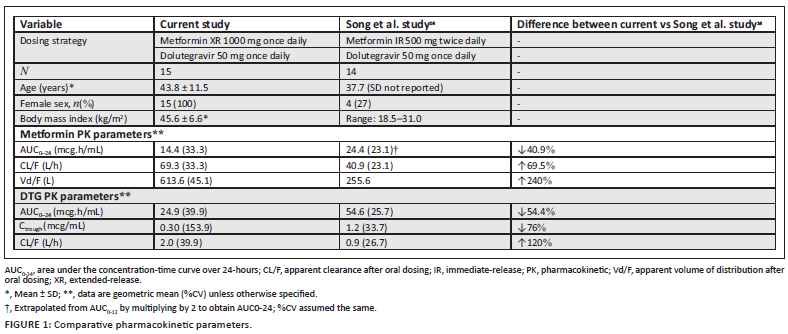
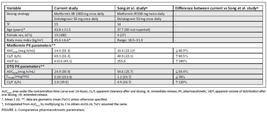
To investigate whether the Song findings hold true in the target population, we conducted an observational PK study in 15 black African WWH with class II-III obesity (mean BMI 45.6 kg/m220Figure 1): we found that the metformin AUC over 24-h (AUC0-24) was 40.9% lower than what was reported by Song. The DTG AUC0-24 was 54.4% lower compared to the findings of Song.
These findings directly challenge the rationale for a universal metformin cap of 1000 mg/day in obese PWH. The mechanism behind the lower metformin and DTG exposures is likely due to obesity inducing physiological changes that alter drug pharmacokinetics:21
• Increased clearance and volume of distribution: Body weight is strongly correlated with increased metformin and DTG clearance and expanded adipose tissue sequesters metformin, raising the volume of distribution.22,23,24
• Attenuated transporter inhibition: Lower DTG plasma concentrations reduce its inhibitory effect on renal OCT2 transporters, increasing metformin clearance.
In short, obese PWH experience both enhanced elimination of metformin and diminished DTG-mediated transporter blockade - netting lower metformin exposure despite the nominal drug interaction. As a result, obese PWH are likely being underdosed with metformin, despite the wide therapeutic range and established safety profile. Indeed, the clinical relevance of this interaction has been questioned by several others, in particular those in primary care.25,26,27
The way forward
Given metformin's broad safety margin and critical role in weight management and glycaemic control, capping the dose at 1000 mg/day in obese PWH may inadvertently compromise diabetes outcomes. Based on our findings, the South African National Department of Health's Standard Treatment Guidelines have been updated to increase the maximum metformin dose to 2000 mg/day when co-administered with DTG 50 mg/day, irrespective of BMI.2829
Conclusion
Our data showed that the uniform metformin dose restriction is inappropriate for PWH on DTG, given metformin's wide therapeutic index and established safety profile. Our data have led to the revision of the maximum metformin dose to 2000 mg/day when co-administered with DTG 50 mg/day, as amended in the updated South African National Department of Health's Standard Treatment Guidelines. Future studies should focus on incorporating a wider range of body mass indices and modelling approaches to establish the optimal metformin dose in obese PWH on DTG.
Competing interests
The authors reported that they received funding from Fogarty International Center at the National Institutes of Health, which may be affected by the research reported in the enclosed publication. The author has disclosed those interests fully and has implemented an approved plan for managing any potential conflicts arising from their involvement. The terms of these funding arrangements have been reviewed and approved by the affiliated university in accordance with its policy on objectivity in research.
R.v.R. declares that he is a section editor of the African Journal of Primary Health Care & Family Medicine.
Authors' contributions
All authors, R.v.R. and E.H.D. contributed equally to this article.
Funding information
This work was supported by the Fogarty International Center at the National Institutes of Health (Grant no. R21TW012185 to E.H.D. and Grant no. D43TW010937 to R.v.R.), and the South African Medical Research Council through its Division of Research Capacity Development under the Clinician Researcher Development Programme with funding received from the South African National Department of Health to RvR. R.v.R. was also supported with funding by the Discovery Foundation and the Harry Crossley Foundation. Metformin extended-release (XR) tablets were sponsored by Merck Healthcare for the parent SMART trial to E.H.D. Merck Healthcare had no input in the study design, conduct, analysis, results, or the decision to publish.
Data availability
Data sharing is not applicable to this article as no new data were created or analysed in this study.
Disclaimer
The views and opinions expressed in this article are those of the authors and are the product of professional research. It does not necessarily reflect the official policy or position of any affiliated institution, funder, agency, or that of the publisher. The authors are responsible for this article's results, findings, and content.
Acknowledgements
The article was originally published as a major article in The Journal of Infectious Diseases by Van Rensburg R, et al.20African Journal of Primary Health Care & Family Medicine by Roland van Rensburg.
References
-
1. Trickey A, Sabin CA, Burkholder G, et al. Life expectancy after 2015 of adults with HIV on long-term antiretroviral therapy in Europe and North America: A collaborative analysis of cohort studies. Lancet HIV. 2023;10(5):e295-e307. https://doi.org/10.1016/S2352-3018(23)00028-0
» https://doi.org/10.1016/S2352-3018(23)00028-0 -
2. Bailin SS, Gabriel CL, Wanjalla CN, et al. Obesity and weight gain in persons with HIV. Curr HIV/AIDS Rep. 2020;17(2):138-150. https://doi.org/10.1007/s11904-020-00483-5
» https://doi.org/10.1007/s11904-020-00483-5 -
3. Moyo-Chilufya M, Maluleke K, Kgarosi K, et al. The burden of non-communicable diseases among people living with HIV in Sub-Saharan Africa: A systematic review and meta-analysis. eClinicalMedicine. 2023;65:102255. https://doi.org/10.1016/j.eclinm.2023.102255
» https://doi.org/10.1016/j.eclinm.2023.102255 -
4. Gizamba JM, Davies J, Africa C, et al. Prevalence of obesity, hypertension and diabetes among people living with HIV in South Africa: A systematic review and meta-analysis. BMC Infect Dis. 2023;23(1):1-20. https://doi.org/10.1186/s12879-023-08736-5
» https://doi.org/10.1186/s12879-023-08736-5 -
5. Sax PE, Erlandson KM, Lake JE, et al. Weight gain following initiation of antiretroviral therapy: risk factors in randomized comparative clinical trials. Clin Infect Dis. 2020;71(6):1379-1389. https://doi.org/10.1093/cid/ciz999
» https://doi.org/10.1093/cid/ciz999 -
6. Herrin M, Tate JP, Akgün KM, et al. Weight gain and incident diabetes among HIV-infected veterans initiating antiretroviral therapy compared with uninfected individuals. J Acquir Immune Defic Syndr. 2016;73(2):228-236. https://doi.org/10.1097/QAI.0000000000001071
» https://doi.org/10.1097/QAI.0000000000001071 -
7. Asgedom YS, Kebede TM, Gebrekidan AY, et al. Prevalence of metabolic syndrome among people living with human immunodeficiency virus in sub-Saharan Africa: A systematic review and meta-analysis. Sci Rep. 2024;14(1):1-14. https://doi.org/10.1038/s41598-024-62497-y
» https://doi.org/10.1038/s41598-024-62497-y -
8. Boake M, Mash R. Diabetes in the Western Cape, South Africa: A secondary analysis of the diabetes cascade database 2015-2020. Primary Care Diabetes. 2022;16(4):555-561. https://doi.org/10.1016/j.pcd.2022.05.011
» https://doi.org/10.1016/j.pcd.2022.05.011 -
9. Pillay S, Mahomed F, Aldous C. A deadly combination-HIV and diabetes mellitus: Where are we now? S Afr Med J. 2016;106(4):378-383. https://doi.org/10.7196/SAMJ.2016.v106i4.9950
» https://doi.org/10.7196/SAMJ.2016.v106i4.9950 -
10. Solini A, Tricò D. Clinical efficacy and cost-effectiveness of metformin in different patient populations: A narrative review of real-world evidence. Diabetes Obes Metab. 2024;26(S3):20-30. https://doi.org/10.1111/dom.15729
» https://doi.org/10.1111/dom.15729 -
11. Nansseu JR, Bigna JJ, Kaze AD, et al. Incidence and risk factors for prediabetes and diabetes mellitus among HIV-infected adults on antiretroviral therapy. Epidemiology. 2018;29(3):431-441. https://doi.org/10.1097/EDE.0000000000000815
» https://doi.org/10.1097/EDE.0000000000000815 -
12. Grundlingh N, Zewotir TT, Roberts DJ, et al. Assessment of prevalence and risk factors of diabetes and pre-diabetes in South Africa. J Health Popul Nutr. 2022;41(1):1-12. https://doi.org/10.1186/s41043-022-00281-2
» https://doi.org/10.1186/s41043-022-00281-2 -
13. Magodoro IM, Okello S, Dungeni M, et al. Association between HIV and prevalent hypertension and diabetes mellitus in South Africa: Analysis of a nationally representative cross-sectional survey. Int J Infect Dis. 2022;121:217-225. https://doi.org/10.1016/j.ijid.2022.05.035
» https://doi.org/10.1016/j.ijid.2022.05.035 -
14. Song IH, Zong J, Borland J, et al. The effect of dolutegravir on the pharmacokinetics of metformin in healthy subjects. J Acquir Immune Defic Syndr. 2016;72(4):400-407. https://doi.org/10.1097/QAI.0000000000000983
» https://doi.org/10.1097/QAI.0000000000000983 -
15. Wang ZJ, Yin OQP, Tomlinson B, et al. OCT2 polymorphisms and in-vivo renal functional consequence: Studies with metformin and cimetidine. Pharmacogenet Genomics. 2008;18(7):637-645. https://doi.org/10.1097/FPC.0b013e328302cd41
» https://doi.org/10.1097/FPC.0b013e328302cd41 -
16. Médecins Sans Frontières. MSF medical guidelines: Dolutegravir (DTG oral) [homepage on the Internet]. cited 2024 Aug 13. Available from: https://medicalguidelines.msf.org/en/viewport/EssDr/english/dolutegravir-dtg-oral-38537537.html
» https://medicalguidelines.msf.org/en/viewport/EssDr/english/dolutegravir-dtg-oral-38537537.html -
17. Liverpool HIV Interactions. Dolutegravir (DTG)-metformin [homepage on the Internet]. [cited 2024 Aug 13]. Available from: https://www.hiv-druginteractions.org/interactions/81694
» https://www.hiv-druginteractions.org/interactions/81694 - 18. Simbayi LC, Zuma K, Zungu N, et al. South African national HIV prevalence, incidence, behaviour and communication survey, 2017. Cape Town: HSRC Press; 2019.
-
19. Country factsheet - South Africa. UNAIDS 2023 estimates [homepage on the Internet]. [cited 2024 Dec 19]. Available from: https://www.unaids.org/en/regionscountries/countries/southafrica.
» https://www.unaids.org/en/regionscountries/countries/southafrica. - 20. van Rensburg R, Kellermann T, Pillay-Fuentes Lorente V, et al. Reduced metformin concentrations in obese women with HIV treated with dolutegravir. J Infect Dis. 2025:jiaf305.
- 21. Berton M, Bettonte S, Stader F, et al. Repository Describing the Anatomical, Physiological, and Biological Changes in an Obese Population to Inform Physiologically Based Pharmacokinetic Models. Clin Pharmacokinet 2022;61(9):1251.
-
22. Van Rongen A, Van der Aa MP, Matic M, et al. Increased metformin clearance in overweight and obese adolescents: A pharmacokinetic substudy of a randomized controlled trial. Paediatr Drugs. 2018;20(4):365. https://doi.org/10.1007/s40272-018-0293-1
» https://doi.org/10.1007/s40272-018-0293-1 -
23. Bardin C, Nobecourt E, Larger E, et al. Population pharmacokinetics of metformin in obese and non-obese patients with type 2 diabetes mellitus. Eur J Clin Pharmacol. 2012;68(6):961-968. https://doi.org/10.1007/s00228-011-1207-0
» https://doi.org/10.1007/s00228-011-1207-0 -
24. Zhang J, Hayes S, Sadler BM, et al. Population pharmacokinetics of dolutegravir in HIV-infected treatment-naive patients. Br J Clin Pharmacol. 2015;80(3):502-514. https://doi.org/10.1111/bcp.12639
» https://doi.org/10.1111/bcp.12639 -
25. Cattaneo D, Resnati C, Rizzardini G, et al. Dolutegravir and metformin: A clinically relevant or just a pharmacokinetic interaction? AIDS. 2018;32:532-533. https://doi.org/10.1097/QAD.0000000000001720
» https://doi.org/10.1097/QAD.0000000000001720 -
26. Gervasoni C, Minisci D, Clementi E, et al. How relevant is the interaction between dolutegravir and metformin in real life? J Acquir Immune Defic Syndr. 2017;75:e24-e26. https://doi.org/10.1097/QAI.0000000000001292
» https://doi.org/10.1097/QAI.0000000000001292 -
27. Dawson E, Brehaut J, Giguere P. National survey assessing knowledge and management of the drug interaction between dolutegravir and metformin by Canadian HIV practitioners [homepage on the Internet]. 2017 [cited 2025 Jun 20]. Available from: https://tspace.library.utoronto.ca/handle/1807/80571.
» https://tspace.library.utoronto.ca/handle/1807/80571 -
28. South African National Department of Health Standard Treatment Guidelines, Hospital Level, Adults. Chapter 10: HIV and AIDS [homepage on the Internet]. [cited 2025 Jun 12] Available from: https://www.health.gov.za/wp-content/uploads/2024/12/Adult-Hospital-Chapter-10-HIV-and-AIDS-with-supporting-NEMLC-report-and-reviews-2020-4-Version-2.1-9-December-2024.pdf
» https://www.health.gov.za/wp-content/uploads/2024/12/Adult-Hospital-Chapter-10-HIV-and-AIDS-with-supporting-NEMLC-report-and-reviews-2020-4-Version-2.1-9-December-2024.pdf -
29. Liverpool HIV Interactions. Dolutegravir (DTG)-metformin [homepage on the Internet]. [cited 2025 Jun 12]. Available from: https://www.hiv-druginteractions.org/interactions/81694
» https://www.hiv-druginteractions.org/interactions/81694

Accepted: 28 June 2025
Published: 11 Sept. 2025