Re-imagining health professions education in the coronavirus disease 2019 era: Perspectives from South Africa
Abstract
BACKGROUND: The coronavirus disease 2019 (COVID-19) pandemic hit South Africa in March 2020, severely disrupting health services and health education. This fundamentally impacted the training of future health professionals and catalysed a significant response from across the health education sector. In 2020, the South African Association of Health Educationalists requested members to submit reflections on different aspects of their COVID-19 related educational responsesRESPONDING TO THE PANDEMIC: Seven vignettes focused specifically on clinical training in the context of primary care and family medicine. This short report highlights the key insights that emerged from these vignettes, considering what has been learnt in terms of health professions education and what we need to take forward. These insights include building on what was already in place, the student role, technology in the clinical learning context, taking workshops online, vulnerability and presence and the way going forward.DISCUSSION AND CONCLUSION: The contributions emphasised the value of existing relationships between the health services and training institutions, collaboration and transparent communication between stakeholders when navigating a crisis, responsiveness to the changed platform and dynamic environment and aligning teaching with healthcare needs. It is more important than ever to set explicit goals, have clarity of purpose when designing learning opportunities and to provide support to students. Some of these learning points may be appropriate for similar contexts in Africa. How we inculcate what we have learned into the post-pandemic period will bear testimony to the extent to which this crisis has enabled us to re-imagine health professions education.
COVID-19; health professions education; primary health; responsiveness; remote teaching; clinical training
Background
The coronavirus disease 2019 (COVID-19) pandemic hit South Africa (SA) in March 2020 and subsequently more than 1.6 million people contracted the virus.123,4 Whilst the work that has gone into refurbishing traditional 'theory' modules for online engagement cannot be underestimated, sustaining clinical training has provided unique challenges across most health professions.
In July 2020, the SA Association of Health Educationalists (SAAHE) requested members to submit reflections on different aspects of their COVID-19 related educational responses.5677
Responding to the pandemic: Seven vignettes
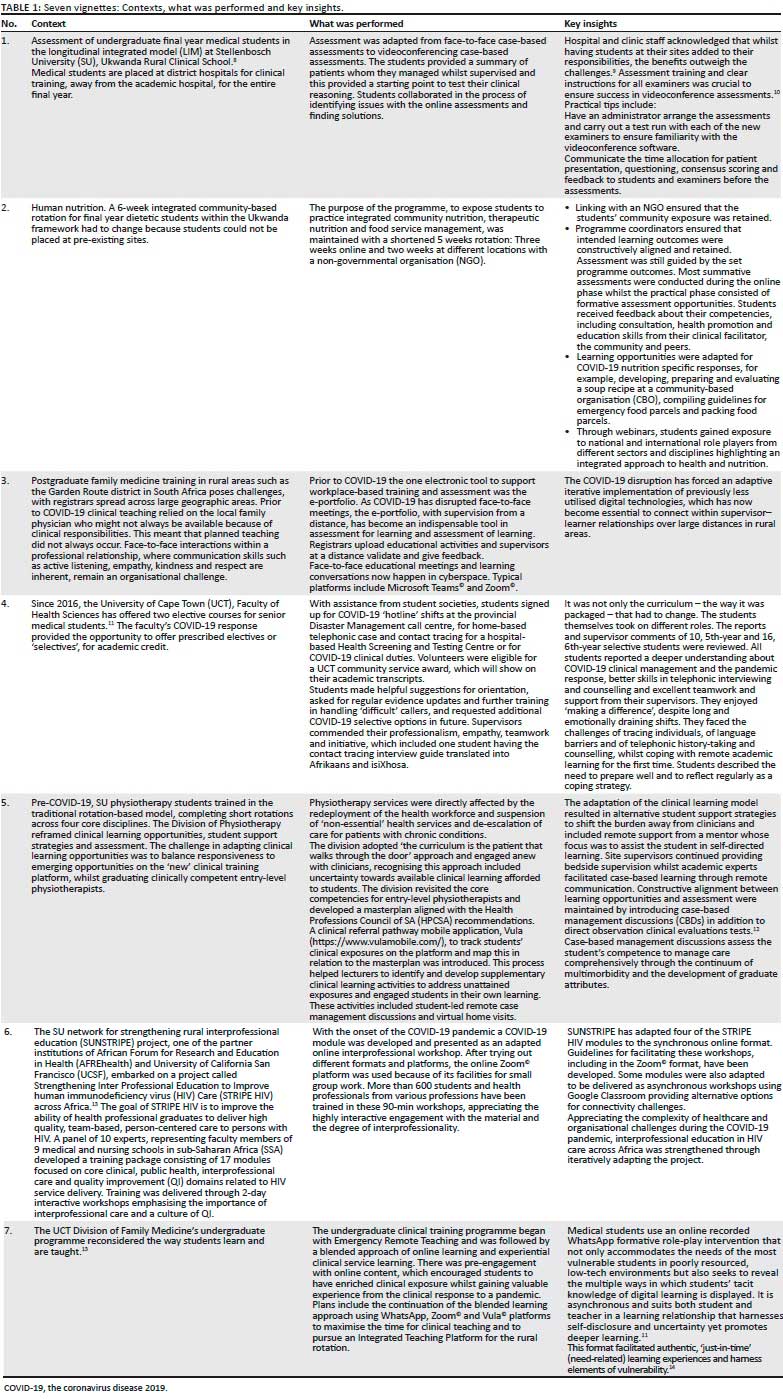
The different contexts, the adaptive iterative implementations during the COVID-19 disruptions and the key insights that were gained are summarised as a series of vignettes in Table 1.
Discussion
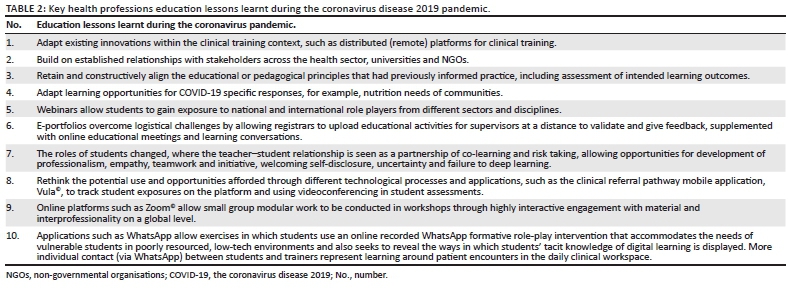
Clinical training should always be responsive to local healthcare needs to promote learning and complement service delivery.15Table 2. Although this rethinking came about in pressurised circumstances and often amounted to 'emergency remote teaching', we have presented some examples of innovations and lessons learnt that came about during the COVID-19 pandemic, which may provide solutions for others involved in health professions education in the post-COVID era.
Existing relationships between health institutions and the clinical service platform that have developed over many years have been invaluable in rapidly adapting the clinical environment to the global pandemic.16© and Vula©, which have now become essential to connect within supervisor-learner relationships over large distances in rural areas.171418,19
Conclusion
Over the past year, clinical educators across SA have collectively demonstrated their ability to adapt using innovative approaches whilst drawing on established, pre-existing relationships and whilst navigating the complex healthcare system. Much of what has happened has been influenced by technology. Online meetings have allowed participants (students, educators and clinicians) from far and wide to engage, without barriers of cost, travel or losing travel time. This has become a new way of collaborating, enabling participation across geographical borders, exposure to leaders in the field and disciplinary experts engaging one another. Whilst there previously might have been a reluctance by many clinical educators to move teaching and learning activities into the online learning environment, the combination of existing online activities and the pressures to increase their use that came with the COVID-19 pandemic allowed for a rapid adoption of these new modes of teaching. The COVID-19 crisis has emphasised the value of collaboration and communication between stakeholders in adapting to a changed clinical and learning platform and aligning teaching with community healthcare needs.
Competing interests
The authors declare that they have no financial or personal relationships that may have inappropriately influenced them in writing this article.
Authors' contributions
A.M.S.S., S.v.S. and L.J. conceptualised the article and wrote the first draft. All the authors submitted individual paragraphs, which contributed to subsequent drafts. All the authors reviewed and approved the final article.
Ethical considerations
No ethical approval was deemed necessary for this article, as no research on human or animal subjects was carried out.
Funding information
This article was funded by the Centre for Health Professions Education, Stellenbosch University.
Data availability
Data sharing is not applicable to this article, as no new data were created or analysed in this study.
Disclaimer
The views and opinions expressed in this article are those of the authors and do not necessarily reflect the official policy or position of any affiliated agency of the authors.
Acknowledgements
The authors would like to acknowledge the support from their various colleagues and departments.
References
-
1. National Department of Health. Covid-19 online resource and news portal [homepage on the Internet]. 2021 [cited 2021 May 25]. Available from: https://sacoronavirus.co.za/2021/05/23/update-on-covid-19-23rd-may-2021/
» https://sacoronavirus.co.za/2021/05/23/update-on-covid-19-23rd-may-2021/ -
2. Nordquist J, Hall J, Caverzagie K, Snell L, et al. The clinical learning environment. Med Teach. 2019;41(4):366-372. https://doi.org/10.1080/0142159X.2019.1566601
» https://doi.org/10.1080/0142159X.2019.1566601 -
3. Al-Balas M, Al-Balas HI, Jaber HM, et al. Distance learning in clinical medical education amid COVID-19 pandemic in Jordan: Current situation, challenges, and perspectives. BMC Med Educ. 2020;20(1):1-7. https://doi.org/10.1186/s12909-020-02428-3
» https://doi.org/10.1186/s12909-020-02428-3 -
4. Dhawan S. Online learning: A panacea in the time of COVID-19 crisis. J Educ Technol Syst. 2020;49(1):5-22. https://doi.org/10.1177/0047239520934018
» https://doi.org/10.1177/0047239520934018 -
5. The South African Association of Health Educationalists [homepage on the Internet]. Reflections on a pandemic. 2020 [cited 2021 May 25]. Available from: https://saahe.org.za/special-interest-groups/research/
» https://saahe.org.za/special-interest-groups/research/ -
6. Peiris D, Sharma M, Praveen D, et al. Strengthening primary health care in the COVID-19 era: A review of best practices to inform health system responses in low- and middle-income countries. WHO South East Asia J Public Health. 2021;10(Suppl S1):6-25. https://doi.org/10.4103/2224-3151.309867
» https://doi.org/10.4103/2224-3151.309867 -
7. Komashie A, Ward J, Bashford T, et al. Systems approach to health service design, delivery and improvement: A systematic review and meta-analysis. BMJ Open. 2021;11:e037667. https://doi.org/10.1136/bmjopen-2020-037667
» https://doi.org/10.1136/bmjopen-2020-037667 -
8. Van Schalkwyk SC, Bezuidenhout J, Conradie HH, et al. 'Going rural': Driving change through a rural medical education innovation. Rural Remote Health. 2014;14(2):38. https://doi.org/10.22605/RRH2493
» https://doi.org/10.22605/RRH2493 -
9. Van Schalkwyk S, Blitz J, Couper I, et al. Consequences, conditions and caveats: A qualitative exploration of the influence of undergraduate health professions students at distributed clinical training sites. BMC Med Educ. 2018;18(1):1-9. https://doi.org/10.1186/s12909-018-1412-y
» https://doi.org/10.1186/s12909-018-1412-y -
10. Wilkinson TJ, Smith JD, Margolis SA, Gupta TS, Prideaux DJ. Structured assessment using multiple patient scenarios by videoconference in rural settings. Medical Educ. 2008;42(5):480-487. https://doi.org/10.1111/j.1365-2923.2008.03011.x
» https://doi.org/10.1111/j.1365-2923.2008.03011.x -
11. Irlam J, Pienaar L, Reid S. On being agents of change: A qualitative study of elective experiences of medical students at the Faculty of Health Sciences, University of Cape Town, South Africa. Afr J Health Prof Educ. 2016;8(1):41-44. https://doi.org/10.7196/AJHPE.2016.v8i1.540
» https://doi.org/10.7196/AJHPE.2016.v8i1.540 -
12. Biggs J. What the student does: Teaching for enhanced learning. High Educ Res Dev. 2012;31(1):39-55. https://doi.org/10.1080/07294360.2012.642839
» https://doi.org/10.1080/07294360.2012.642839 -
13. Reid M, Suleman F, De Villiers M. The SARS-CoV-2 pandemic: An urgent need to relook at the training of the African health workforce. SAMJ: S Afr Med J. 2020;110(4):261. https://doi.org/10.7196/SAMJ.2020.v110i4.14713
» https://doi.org/10.7196/SAMJ.2020.v110i4.14713 - 14. Brantmeier EJ. Pedagogy of vulnerability: Definitions, assumptions, and applications. In: Lin J, Oxford R, Brantmeier EJ, editors. Re-envisioning higher education: Embodied pathways to wisdom and transformation. 2013; p. 95-106.
- 15. Lombardi MM. Authentic learning for the 21st century: An overview. Educause Learning Initiative. Charlotte, NC: Information Age, 2007; p. 1-2.
-
16. Mash B, Edwards J. Creating a learning environment in your practice or facility. S Afr Fam Pract. 2020;62(1):a5166. https://doi.org/10.4102/safp.v62i1.5166
» https://doi.org/10.4102/safp.v62i1.5166 -
17. De Swardt M, Jenkins LS, Von Pressentin KB, Mash R. Implementing and evaluating an e-portfolio for postgraduate family medicine training in the Western Cape, South Africa. BMC Med Educ. 2019;19:251. https://doi.org/10.1186/s12909-019-1692-x
» https://doi.org/10.1186/s12909-019-1692-x -
18. Mbembe A. Decolonizing knowledge and the question of the archive. Public lecture [homepage on the Internet]. Wits Institute for Social and Economic Research; 2015 [cited 2021 May 26]. Available from: https://wiser.wits.ac.za/system/files/Achille%20Mbembe%20-%20Decolonizing%20Knowledge%20and%20the%20Question%20of%20the%20Archive.pdf
» https://wiser.wits.ac.za/system/files/Achille%20Mbembe%20-%20Decolonizing%20Knowledge%20and%20the%20Question%20of%20the%20Archive.pdf -
19. Peters MA, Rizvi F, Mcculloch G, et al. Reimagining the new pedagogical possibilities for universities post-Covid-19: An EPAT collective project. Educ. Philos. Theory. 2020; 1-44. https://doi.org/10.1080/00131857.2020.1777655
» https://doi.org/10.1080/00131857.2020.1777655

Accepted: 31 May 2021
Published: 10 Aug. 2021