From separate streams to confluence: A framework for meaningful mixed methods integration in African primary care research
Abstract
Mixed methods research is becoming more common in African primary care studies, yet systematic reviews show most mixed methods studies demonstrate low methodological rigour in integrating qualitative and quantitative components. This integration failure undermines addressing complex health challenges facing African primary care systems, where medical pluralism, resource constraints, and diverse disease burdens demand sophisticated methodological synthesis. This article describes a framework for achieving meaningful mixed methods integration in African primary care research contexts, addressing key challenges and providing practical strategies for transformative synthesis. Drawing on recent methodological advances, including the Mixed Methods Integration Quality Framework, systematic reviews of African mixed methods studies, and exemplar cases from primary care research, the framework integrates theoretical foundations with practical applications in resource-constrained settings. The framework encompasses: temporal considerations for integration decisions; identification of interface points; practical strategies including joint displays and data transformation; team-based approaches to synthesis; and solutions to common integration pitfalls. It addresses epistemological tensions, institutional barriers, and resource constraints in African research contexts. The framework enables researchers to move from separate methodological streams to genuine confluence, generating transformative insights transcending individual methodological contributions. By addressing context-specific challenges while maintaining methodological rigour, it supports producing nuanced understanding necessary for strengthening African health systems. This framework addresses integration challenges in African primary care research, offering practical tools for doctoral researchers and established investigators navigating complex health phenomena in resource-constrained settings.
mixed methods; African health research; primary health care; integration framework; implementation research; health systems research
Introduction
While mixed methods research is common in health services, integrating findings from various approaches remains challenging. While researchers routinely combine quantitative and qualitative approaches, genuine synthesis that produces what Fetters and Freshwater term the '1+1=3' effect continues to elude many studies.12
Integration failure in mixed methods research represents more than methodological inadequacy; it constitutes a missed opportunity for generating a nuanced understanding necessary for effective health interventions. Recent evidence from sub-Saharan Africa reveals concerning patterns in mixed methods application, with systematic reviews finding that many studies fail to achieve integration at design, methods or interpretation levels despite the growing adoption of the mixed methods approach.34
Primary care settings in Africa present unique considerations that both necessitate and complicate mixed methods integration. Health systems operate within complex adaptive environments characterised by medical pluralism, where biomedical services coexist with traditional healing systems, creating multiple therapeutic landscapes requiring diverse methodological lenses.55
This article provides a comprehensive framework for achieving meaningful mixed methods integration specifically tailored to African primary care research contexts. Drawing on recent methodological advances, including the Mixed Methods Integration Quality Framework,6
Understanding integration: Beyond the rhetoric
Integration encompasses purposeful synthesis, generating transformative insights that transcend individual methodological contributions.678
Defining meaningful versus superficial integration
The Mixed Methods Integration Quality Framework distinguishes between presence and quality of integration.69
Recent evidence reveals concerning patterns. Systematic reviews find fewer than 20% of studies achieve meaningful integration.9103
The integration continuum: Implications for practice
Contemporary frameworks conceptualise integration along continuums reflecting methodological interdependence.74
This continuum holds particular relevance for resource-constrained contexts. African researchers demonstrate how constraints drive innovation.116
Misconceptions undermining integration quality
Contemporary literature identifies four persistent misconceptions.96
Technical misconceptions conflate procedural techniques with interpretive synthesis. While joint displays and visual tools can serve as powerful analytical mechanisms for achieving integration through iterative development and meta-inference generation,12,13985
Structural barriers to integration achievement
Integration failure emerges from interconnected barriers documented in systematic reviews.9,103
Epistemological tensions create reconciliation challenges across knowledge production assumptions. Despite pragmatism's promise, practical application remains challenging across disciplinary boundaries.75
Institutional structures systematically disadvantage integration. Publication constraints limit reporting space. Review processes lack mixed methods expertise.9811
Integration design decisions
Integration success depends on deliberate decisions about when and where to integrate methodologies throughout the research process.4
When to integrate: Temporal considerations
Design-phase integration establishes the foundation for meaningful synthesis. This involves crafting mixed methods research questions requiring both methodologies for complete answers, rather than questions addressable through single methods. African primary care researchers increasingly develop integrated conceptual frameworks bridging biomedical and socio-cultural perspectives from project inception, as Bekele et al. demonstrated in Ethiopian primary care.5
Sequential designs allow one method to inform another, particularly valuable when exploring unfamiliar phenomena. Convergent designs focus on bringing data or results together, often collecting data in similar time frames, which maximises efficiency in time-constrained settings but requires careful planning to ensure genuine integration rather than parallel implementation.6
Collection-phase integration creates opportunities for methodological dialogue while gathering evidence.8
Analysis-phase integration in African primary care research particularly values community validation sessions where interested parties interpret converging findings, ensuring analytical interpretations resonate with local realities and knowledge systems.5,117
Interpretation-phase integration synthesises findings into meta-inferences transcending individual methods.9
Where to integrate: Points of interface
Mixed methods research questions serve as primary integration points. Effective questions explicitly identify how methods work together, using formulations like 'how and to what extent' or 'what factors explain relationships'.6
Integrated sampling strategies create natural connection points. Nested sampling embeds qualitative samples within quantitative populations. Parallel sampling selects comparable samples. Sequential sampling uses findings from one method to identify participants for another. African researchers navigate challenges including mobile populations, multilingual contexts and varying literacy levels.
Transformation points occur where data changes form to enable comparison.4
Synthesis brings findings together through joint displays, integrated narratives or meta-inferences.7
Having established the critical decision points for integration, we now examine practical strategies for implementing these decisions in African primary care research contexts.
Practical integration strategies
Joint displays have evolved substantially beyond simple side-by-side tables to become sophisticated analytical tools that actively facilitate integration rather than merely presenting it.4111
The iterative construction process itself generates integration insights as researchers discover connections, contradictions and gaps while aligning findings from different methods.74614
Data transformation enables comparison across methodological boundaries through systematic conversion processes.7Quantitising transforms qualitative data into numerical form through approaches extending beyond simple frequency counts to include proximity scaling of conceptual distances between themes and intensity rating of expressed sentiments.9quantised implementation barriers by scoring perceived severity and frequency, enabling statistical comparison across facilities while preserving qualitative insights about barrier characteristics.5qualitising converts quantitative data into narrative form through case profiling and pattern narrativisation.158
Team-based integration approaches compensate for individual methodological limitations while generating collaborative insights unavailable to solo researchers.131417
Technology considerations significantly impact integration possibilities, though sophisticated software is not a prerequisite for meaningful synthesis.10741
A working framework for mixed methods researchers
Mixed methods researchers require systematic frameworks (Figure 1) that transform integration from aspiration to achievement. The step-by-step planning template presented here synthesises successful approaches from African primary care studies with recent methodological advances, providing structured guidance while maintaining flexibility for context-specific adaptation.61
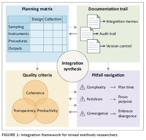
The integration planning matrix serves as the central organising tool throughout the research process, mapping integration points across temporal phases and methodological levels.414
Documentation strategies extend beyond the matrix to encompass comprehensive integration audit trails, capturing not just what decisions were made but how and why.710
Quality assessment requires criteria specifically addressing integration rather than separately evaluating quantitative validity and qualitative trustworthiness. The legitimation framework provides comprehensive criteria, though researchers need practical approaches for ongoing self-assessment rather than post-hoc evaluation.18141
Common pitfalls and solutions
Integration timing errors derail many mixed methods studies when researchers treat synthesis as an afterthought rather than a continuous process. Studies frequently complete quantitative and qualitative components in isolation, presenting them as independent rather than integrated,192021
Methodological dominance undermines integration when one approach overshadows another, typically with qualitative findings relegated to illustrative vignettes supporting quantitative results.22
Superficial mixing undermines the transformative potential of mixed methods research when integration becomes an afterthought.19
To illustrate how these strategies work in practice while avoiding common pitfalls, we present a detailed case example from Southern African primary care.
Case example from African primary care
The InterCARE study in Botswana exemplifies systematic mixed methods integration for adapting an integrated HIV and hypertension care model.23
Integration began with the Consolidated Framework for Implementation Research (CFIR), structuring both data collection and analysis across two clinics. The team collected facility assessments, 100 surveys (patients, treatment partners, healthcare providers, community leaders), and 10 key informant interviews. This framework-guided approach ensured methodological alignment while allowing each method to contribute complementary insights about intervention acceptability and necessary adaptations.
The sampling strategy demonstrated purposeful integration. Survey participants were consecutively recruited for representativeness, while interview participants were purposively selected from survey respondents to maximise perspective diversity. This nested approach enabled quantifying determinants broadly while exploring specific barriers in depth.
Analysis employed systematic convergent comparison organised by CFIR domains. Quantitative data revealed that while 90.3% of patients were taking antihypertensive medications, only 47.2% achieved blood pressure control. Facility assessments identified critical gaps, including non-functioning equipment and inconsistent electricity. These patterns gained meaning through qualitative insights: interviews revealed how 'a regular cut of electricity [meant] checking of blood pressure may be compromised', while treatment partners explained how medication stockouts forced patients to travel between multiple clinics.
The integration process identified critical convergence and divergence between data sources. Most interested parties agreed that InterCARE would successfully improve blood pressure control. However, divergence emerged regarding complexity: while 35% of providers surveyed thought adaptation would be difficult, interviews suggested services were already in place and integration would simply bring them together. This nuanced understanding emerged only through systematic comparison across methods.
Integration directly informed intervention adaptations. When both methods revealed insufficient staffing, the team added task-sharing strategies, splitting hypertension management between nurses and doctors. When treatment partners expressed needing additional support, expanded training materials were developed. The CFIR framework enabled mapping specific determinants to targeted implementation strategies. This systematic approach demonstrates that meaningful integration requires not just technical competence but deliberate planning throughout the research process to transform separate data streams into unified understanding.
InterCARE exemplifies the synergistic relationship between Implementation Science and mixed methods research. Implementation Science requires mixed methods to understand both whether interventions work (effectiveness) and how they work in real-world settings (implementation processes).2423
Conclusion
This framework demonstrates that meaningful mixed methods integration requires deliberate planning, methodological rigour and intellectual courage to synthesise diverse evidence. Moving from separate streams to confluence demands more than technical competence; it requires embracing complexity, valuing different ways of knowing and developing meta-inferences that transcend disciplinary boundaries. Health researchers must reject superficial mixing that merely satisfies journal requirements, instead pursuing transformative synthesis that generates actionable insights for strengthening health systems.
Future mixed methods research should prioritise capacity building in integration techniques, develop contextually appropriate frameworks that incorporate indigenous knowledge systems, and establish regional networks for sharing integration expertise. The ultimate test remains whether integration improves health outcomes for African communities through deeper understanding of complex health phenomena.
Competing interests
The authors reported that they received funding from the National Institute for Health and Care Research (NIHR), which may be affected by the research reported in the enclosed publication. The authors have disclosed those interests fully and have implemented an approved plan for managing any potential conflicts arising from their involvement. The terms of these funding arrangements have been reviewed and approved by the affiliated University in accordance with its policy on objectivity in research.
Authors' contributions
R.E.D. drafted the article, which was then edited and revised by K.B. and T.C.G. The authors used Claude Opus 4.1 (Anthropic, accessed August 2025) to refine academic language and improve clarity during initial drafting. All content was thoroughly reviewed, verified and approved by the authors, who take full responsibility for the final manuscript.
Funding information
This work was funded by the National Institute for Health and Care Research (NIHR) (Grant Number: NIHR158451) using UK international development funding from the UK Government to support global health research. The views expressed in this publication are those of the authors and not necessarily those of the NIHR or the UK Government. See: https://www.nihr.ac.uk/nihr-global-health-research-branding-guide.
Data availability
Data sharing is not applicable to this article as no new data were created or analysed in this study.
Disclaimer
The views and opinions expressed in this article are those of the authors and are the product of professional research. It does not necessarily reflect the official policy or position of any affiliated institution, funder, agency or that of the publisher. The authors are responsible for this article's results, findings and content.
Acknowledgements
References
-
1. Fetters MD, Freshwater D. The 1+1=3 integration challenge. J Mixed Methods Res. 2015;9(2):115-117. https://doi.org/10.1177/1558689815581222
» https://doi.org/10.1177/1558689815581222 -
2. Harrison RL, Reilly TM, Creswell JW. Methodological rigor in mixed methods: An application in management studies. J Mixed Methods Res. 2020;14(4):473-495. https://doi.org/10.1177/1558689819900585
» https://doi.org/10.1177/1558689819900585 -
3. De Allegri M, Sieleunou I, Abiiro GA, Ridde V. How far is mixed methods research in the field of health policy and systems in Africa? A scoping review. Health Policy Plan. 2018;33(3):445-455. https://doi.org/10.1093/heapol/czx182
» https://doi.org/10.1093/heapol/czx182 -
4. Guetterman TC, Fetters MD, Creswell JW. Integrating quantitative and qualitative results in health science mixed methods research through joint displays. Ann Fam Med. 2015;13(6):554. https://doi.org/10.1370/afm.1865
» https://doi.org/10.1370/afm.1865 -
5. Bekele A, Alem A, Seward N, et al. Barriers and enablers to improving integrated primary healthcare for non-communicable diseases and mental health conditions in Ethiopia: A mixed methods study. BMC Prim Care. 2024;25(1):211. https://doi.org/10.1186/s12875-024-02458-6
» https://doi.org/10.1186/s12875-024-02458-6 -
6. Fàbregues S, Younas A, Escalante-Barrios EL, Molina-Azorin JF, Vázquez-Miraz P. Toward a framework for appraising the quality of integration in mixed methods research. J Mixed Methods Res. 2024;18(3):270-280. https://doi.org/10.1177/15586898241257555
» https://doi.org/10.1177/15586898241257555 -
7. Bazeley P. Conceptualizing integration in mixed methods research. J Mixed Methods Res. 2024;18(3):225-234. https://doi.org/10.1177/15586898241253636
» https://doi.org/10.1177/15586898241253636 -
8. Guetterman TC, Manojlovich M. Grand rounds in methodology: Designing for integration in mixed methods research. BMJ Qual Saf. 2024;33(7):470-478. https://doi.org/10.1136/bmjqs-2023-016112
» https://doi.org/10.1136/bmjqs-2023-016112 -
9. Zhou Y, Wu M-L. Reported methodological challenges in empirical mixed methods articles: A review on JMMR and IJMRA. J Mixed Methods Res. 2022;16(1):47-63. https://doi.org/10.1177/1558689820980212
» https://doi.org/10.1177/1558689820980212 -
10. Howell Smith MC, Bazis PS. Conducting mixed methods research systematic methodological reviews: A review of practice and recommendations. J Mixed Methods Res. 2021;15(4):546-566. https://doi.org/10.1177/1558689820967626
» https://doi.org/10.1177/1558689820967626 -
11. Kane S, Kok M, Ormel H, et al. Limits and opportunities to community health worker empowerment: A multi-country comparative study. Soc Sci Med. 2016;164:27-34. https://doi.org/10.1016/j.socscimed.2016.07.019
» https://doi.org/10.1016/j.socscimed.2016.07.019 - 12. Fetters MD, Guetterman TC. Development of a joint display as a mixed analysis. In: Onwuegbuzie AJ, Johnson RB, editors. The Routledge reviewer's guide to mixed methods analysis. New York (NY): Routledge; 2021. p. 259-76.
- 13. Fetters MD. The mixed methods research workbook: Activities for designing, implementing, and publishing projects. Thousand Oaks, CA: Sage Publications; 2019.
-
14. O'Cathain A, Murphy E, Nicholl J. The quality of mixed methods studies in health services research. J Health Serv Res Policy. 2008;13(2):92-98. https://doi.org/10.1258/jhsrp.2007.007074
» https://doi.org/10.1258/jhsrp.2007.007074 -
15. Moran-Ellis J, Alexander VD, Cronin A, et al. Triangulation and integration: Processes, claims and implications. Qual Res. 2006;6(1):45-59. https://doi.org/10.1177/1468794106058870
» https://doi.org/10.1177/1468794106058870 -
16. Ivankova NV. Applying mixed methods in community-based participatory action research: A framework for engaging stakeholders with research as a means for promoting patient-centredness. J Res Nurs. 2017;22(4):282-294. https://doi.org/10.1177/1744987117699655
» https://doi.org/10.1177/1744987117699655 -
17. Tiruneh GT, Zemichael NF, Betemariam WA, Karim AM. Effectiveness of participatory community solutions strategy on improving household and provider health care behaviors and practices: A mixed-method evaluation. PLoS One. 2020;15(2):e0228137. https://doi.org/10.1371/journal.pone.0228137
» https://doi.org/10.1371/journal.pone.0228137 - 18. Onwuegbuzie AJ, Johnson RB. The validity issue in mixed research. Res Schools. 2006;13(1):48-63.
-
19. Bryman A. Barriers to integrating quantitative and qualitative research. J Methods Res. 2007;1(1):8-22. https://doi.org/10.1177/2345678906290531
» https://doi.org/10.1177/2345678906290531 -
20. Plano Clark VL. Meaningful integration within mixed methods studies: Identifying why, what, when, and how. Contemp Educ Psychol. 2019;57:106-111. https://doi.org/10.1016/j.cedpsych.2019.01.007
» https://doi.org/10.1016/j.cedpsych.2019.01.007 -
21. Van Hout MC, Zalwango F, Akugizibwe M, et al. Implementing integrated care clinics for HIV-infection, diabetes and hypertension in Uganda (INTE-AFRICA): Process evaluation of a cluster randomised controlled trial. BMC Health Serv Res. 2023;23(1):570. https://doi.org/10.1186/s12913-023-09534-0
» https://doi.org/10.1186/s12913-023-09534-0 -
22. Hesse-Biber S. Qualitative approaches to mixed methods practice. Qual Inq. 2010;16(6):455-468. https://doi.org/10.1177/1077800410364611
» https://doi.org/10.1177/1077800410364611 -
23. Gala P, Ponatshego P, Bogart LM, et al. A mixed methods approach identifying facilitators and barriers to guide adaptations to InterCARE strategies: An integrated HIV and hypertension care model in Botswana. Implement Sci Commun. 2024;5(1):67. https://doi.org/10.1186/s43058-024-00603-x
» https://doi.org/10.1186/s43058-024-00603-x -
24. Proctor E, Silmere H, Raghavan R, et al. Outcomes for implementation research: Conceptual distinctions, measurement challenges, and research agenda. Adm Policy Ment Health. 2011;38(2):65-76. https://doi.org/10.1007/s10488-010-0319-7
» https://doi.org/10.1007/s10488-010-0319-7

Accepted: 17 Oct. 2025
Published: 24 Nov. 2025