An illustrated booklet for reinforcing community health worker knowledge of tuberculosis and facilitating patient counselling
Abstract
BACKGROUND: Community health workers (CHWs) have facilitated the move to decentralise tuberculosis (TB) management, but lack access to information appropriate both for personal use and in patient interaction and education. AIM: To explore the impact of a pictorial-based TB booklet on reinforcing CHW knowledge and facilitating patient counselling. SETTING: This study was conducted in local primary health care clinics and the Hospice in Grahamstown, Eastern Cape Province in South Africa. METHODS: Quantitative and qualitative methods were used. A simple, 17-page, A5 booklet containing pictograms and simple text was designed in collaboration with CHWs who advised on preferred content. Its influence on knowledge was assessed in 31 CHWs using a 17-item questionnaire in a before-and-after study. The experiences of CHWs using the booklet were qualitatively explored using focus group discussions (FGD) and semi-structured interviews. RESULTS: Overall knowledge increased significantly from 70.6% to 85.3% (p < 0.001) with 8 of 17 questions significantly better answered at follow-up. These addressed meaning of side effects and side effect advice for patients, cause and prevention of TB, action if a dose is forgotten, timing of dose in relation to food intake and the possibility that not all patients are cured. Community health workers reported using the booklet during patient interactions, commenting that it enhanced their confidence in their own TB-related knowledge, improved recall of information and reduced uncertainty. They appreciated the simplicity of the text and its user-friendliness because of the inclusion of pictograms. The booklet was perceived to be valuable as a tool for both patient education as well as improved communication with patients. CONCLUSION: A simple, user-friendly TB booklet containing pictograms improved CHW knowledge and acted as a valuable tool in patient communication and education.
Introduction
Tuberculosis (TB) is a major public health concern with an estimate of 6.3 million new TB cases and 1.7 million people who died from the disease at the end of 2016.112345
Evidence of the potential of CHWs has been shown both globally and in South Africa, particularly their role in providing palliative care in HIV and AIDS programmes, acting as adherence supporters, linking communities with the health care system and contributing to social development of their local communities.6,7,8910,1112,13,14
Knowledge of the disease and its treatment and good communication skills are key components in ensuring quality patient education and communication,15,1617,18,1920,21,2217,18,19,23,2419
A number of reviews that identify features of successful CHW programmes advocate for ongoing training and support for CHWs, which ensures that their information needs are met; however, there is limited evidence of how this can be operationalised in the current settings.6,8,12,142525
Informed by an earlier phase of this research which identified unmet information needs of local CHWs for TB information materials,26
Method
Study site and population
The rural Eastern Cape, where 57% live in poverty,2728
Study design and questionnaire
A before-and-after quantitative knowledge assessment was conducted followed by qualitative interviews and discussions,2930,31,32,33
Baseline knowledge assessment
All 31 CHW interviews took place at PHC facilities or at Hospice. They were conducted in English by the principal investigator with an interpreter present to assist in translation to isiXhosa if required. Data collected during the individual CHW interviews included participant characteristics and TB knowledge in the following areas: TB disease, treatment, side effects, and multidrug-resistant (MDR) and extensively drug-resistant (XDR) TB.
Booklet design and distribution
Design of the booklet was informed by earlier project findings, which identified unmet information needs of CHWs enrolled in this study269
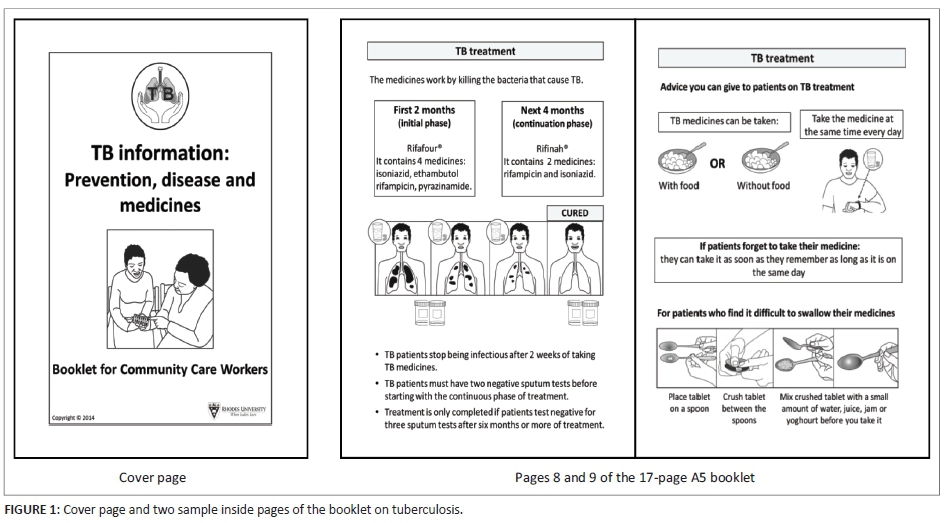
To enhance end-user readability, good information design principles were adopted.343535Figure 1). The booklet was A5 size, consisted of 17 pages, used a large font size for easy readability. It was translated into isiXhosa and Afrikaans using professional translators and back translated by a different translator.
Three weeks after the baseline knowledge assessment, information sessions were held with all CHWs in each facility during which the principle investigator systematically worked through the final booklet and actively encouraged CHWs to use it in their daily practice for the subsequent 3-month period.
Follow-up knowledge assessment and exploration of community health workers' perceptions of booklet
After 3 months, knowledge was re-assessed in all 31 CHWs using the same questionnaire. This was followed by three focus group discussions (FGDs with three to five CHWs) and four individual semi-structured interviews36
Data analysis
Knowledge scores were compared using the paired T-test. The association of selected variables (age, education, years as CHW, TB workshop attendance) with knowledge scores was investigated using Pearson chi-square tests. Statistical significance was set at 5%. Discussions were transcribed verbatim and data analysed thematically.37®.
Ethical considerations
Ethical approval was obtained from the Rhodes University Pharmacy Ethics Committee (PHARM 2014 - 10) and the Eastern Cape Department of Health.
Results
Demographics and knowledge results
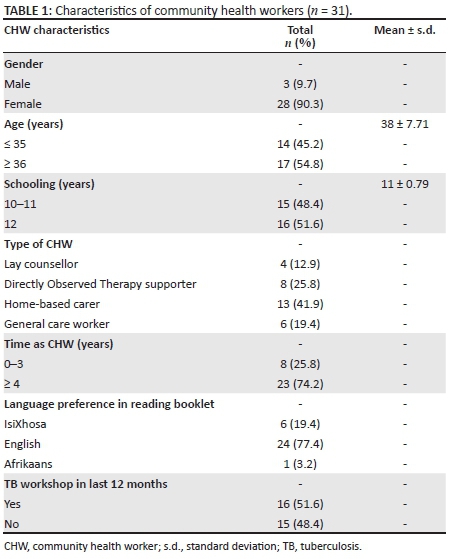
Only 3 of 31 CHWs were men and most participants had been working as CHWs for more than 4 years (Table 1). All could understand English and had isiXhosa as their first language, although 24 of 31 preferred to read the English booklet.
Knowledge at baseline and follow-up
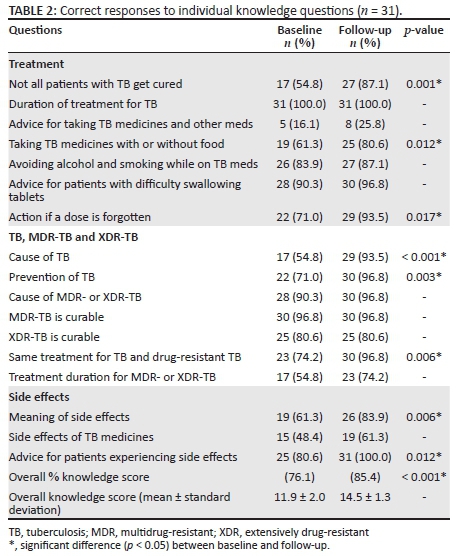
From Table 2, mean baseline knowledge was 70.6%, which increased significantly at follow-up to 85.3% (p < 0.001). Significant increases in knowledge at follow-up were observed for 8 of 17 questions. All CHWs knew the treatment duration of uncomplicated TB; however, knowledge regarding patients who may not get cured improved at follow-up. Follow-up knowledge of what patients should tell HCPs if taking other medicines remained poor (25.8%), while the timing of TB medication in relation to food intake was significantly (p = 0.012) better answered at follow-up (81.6% vs. 61.3%).
Disease-related knowledge pertaining to the cause of TB and its prevention improved significantly after exposure to the booklet. Although CHWs requested information regarding drug-resistant TB,26
The knowledge score was not significantly influenced by age, education, attendance of recent training courses, or length of time practising as a CHW.
Qualitative: community health workers' perception of the usefulness of the booklet
The themes that emerged from the semi-structured interviews and the focus group discussions were similar and have therefore been presented together. The four themes that emerged include use of the booklet in practice, role of the booklet in interactions with patients, CHW opinion of the booklet, suggested broader application for similar information materials.
Use of the booklet in practice
Most CHWs reported actively using the booklet, although a small minority reported no impact of the booklet on their knowledge or practice. The booklet was used in both clinic settings and home visits in different ways: to verify information and answer questions or using the information during counselling, especially for patients recently affected with TB. Many CHWs preferred showing the booklet to patients they were educating especially during home visits or support groups where everyone would have a chance to glance at the booklet. They also found the booklet to be extremely useful in serving as a screening tool for recalling (pictorial) signs and symptoms of TB and referring those in need of testing to the clinic. The pictograms available in the booklet were also mentioned to be a good tool to facilitate memory recall of TB information, which assisted CHWs in their practice.
'The first time I took it and read, I was so interested, then I show the clients here in front [waiting area] what I have and I educate them about TB.' (Participant 19, female, SSI 4)
'I use this book in a children support group… It's easy now to see the signs [signs of TB], like if I've noticed that the child is coughing a lot and losing weight.' (Participant 16, female, FGD 3)
'I meet … adults in the household so I will get together with them maybe in the front room or kitchen and then talk to them like that and then show them the booklet I have and they will understand things better.' (Participant 12, female, FGD 3)
Because CHWs are required to give daily health education talks at the clinic, they reported that patients often complained of being tired of listening to health talks when they were feeling ill. Community health workers therefore appreciated the booklet, which could be handed to patients to read at their own pace. It also relieved them of the pressure of talking for a long period of time and allowed them more time to spend on other tasks.
'I gave them while they were waiting [rather] than talk and talk … they read and read. Then when I have the time I go there and ask some questions.' (Participant 19, female, SSI 4)
Role of the booklet in interactions with patients
Community health workers acknowledged that the illustrated booklet with its attractive visuals facilitated memory recall and made the educational process more meaningful, as patients displayed heightened interest and eagerness to listen, resulting in improved CHW-patient interaction.
'It actually shows pictures … so with the pictures and us explaining to them the actual way of doing it, it's very easy to interact with people.' (Participant 4, male, FGD 1)
'It helped because I like the pictures, I read then I see in the pictures and I remember.' (Participant 17, female, SSI 2)
Lack of patient trust in verbal information was mentioned by CHWs, with patients appearing to have better trust in written information. The booklet proved a useful tool for offering reliable information, which was more readily received as explained by one CHW below:
'I am talking about TB, this is the booklet. What I am saying is written here so that they [patients and community members] can agree. Sometimes they don't trust us as CHWs, they want to see the real[ity].' (Participant 19, female, SSI 4)
Community health workers' opinion of the booklet
Community health workers described the booklet as simple and easy to understand for them as well as patients, who enjoyed it so much, that they wanted their own copy.
'They got a good understanding of what is happening there…. They said, "we going to keep this [booklet]". It's quite interesting for me because they want to show their children too because the time when we were around [at the home visit] the children was in school.' (Participant 12, female, FGD 3)
A CHW in charge of a child support group mentioned that the pictograms made it easier for children to comprehend the information.
'I use this in a children support group and it's easy for them to understand because there are pictures.' (Participant 16, female, FGD 3)
The availability of the booklet in different languages further improved understanding of information:
'… If a person can't read English you can give them the Xhosa booklet so they can … know what we are actually saying to them.' (Participant 16, female, FGD 3)
With the improvement in patient counselling, CHWs were excited about and enjoyed using the booklet. They appreciated the fact that it had been designed specifically for them, taking into account their needs and opinions, and they felt that it inspired them in their role as educators. They also commented that they would like to continue using information materials in their practice.
'You have … actually inspired us in a way we haven't expected and we would actually like to thank you for coming up with something like this … and we would like to keep it going not just for now.' (Participant 11, female, SSI 1)
Suggested broader application for similar information materials
Community health workers were adamant that patients would benefit from similarly designed information materials, as it would prompt patients to read the information and increase their knowledge and awareness about TB. They also identified others in community-based settings based on their interactions who would benefit from similar simple, illustrated TB information materials, including teachers in schools, carers in crèches and carers in old-age homes, as it would serve as a tool in informing and educating these groups.
'It can be useful if you are going to schools. You can leave this booklet with the teachers so the teachers can read it and they can use it.' (Participant 7, female, FGD 2)
Community health workers suggested that posters with selected information be placed in the patient waiting areas of clinics. This was advocated as a good idea to use as a reference source to assist in patient education, particularly for those patients who missed the health education talks.
'When we educate the client about TB you need to show the client that there is a poster. If you are still waiting [to see a health care professional], then you can just go around to look while we are doing education.' (Participant 1, female, FGD 1)
Discussion
This is the first reported study that has developed TB materials specifically for CHW use and assessed its impact on knowledge as well as perceptions of its usefulness in patient interactions. A simple, illustrated booklet tailored for use by CHW acted as a tool for personal knowledge acquisition as well as a patient communication and education tool. The booklet improved knowledge significantly, enhanced confidence in answering questions and facilitated communication with patients, supporting previous findings.17,18,23
Community health workers must have good knowledge to facilitate case finding and appropriate case management, the two foundations of TB prevention and control.3839,4039
It was concerning that, in a health care system often overwhelmed by patients with multiple conditions, CHWs were unaware of the valuable medicine-related advice they could offer to patients, for example co-administration with other medicines. Their knowledge regarding side effects was similarly poor. Patients with TB want side effect information as they feel it improves their understanding of the medication and, if aware of what to expect, can reduce the possibility of defaulting.41
The two areas of low baseline knowledge in drug-resistant TB were the meaning of XDR-TB (36%) and its treatment duration (55%). Given the increasing incidence of drug-resistant TB,2
The success of the booklet in appealing to CHWs is partly because of their central involvement in the design process, stimulating ownership of the final product and, as noted by others, ensuring the relevance of the intervention in their practice.421820,21,43433421
Health care professionals, including CHWs, need to be adequately trained to improve their communication skills when interacting with patients.10,181013
Research has found that the community may perceive the CHWs' knowledge, skills and overall abilities as being inferior, leading to general distrust.4244
Limitations include the limited generalisability of the quantitative findings, as CHWs were drawn from one district only. Despite recruiting all available local CHWs, the sample size was low which may have reduced the possibility of identifying significant relationships within the data. Future research could involve a follow-up large-scale intervention study to formally assess the impact of illustrated, simple materials on CHW practice. An additional focus on eliciting patient opinion within such a study would allow the voice of these often disempowered patients to be heard.
Conclusion
This study found that the use of a user-friendly, simple, pictorial-based booklet can improve CHW knowledge and contribute to enhanced confidence in their role as a CHW by facilitating better communication with patients and improving patient trust. Collaboration with the CHWs during the design process, careful consideration of booklet content and format, and the inclusion of well-designed pictograms emerged as factors influencing its ease of use, and therefore its acceptability. The booklet had a dual effect of improving their interpersonal relationship with patients because of improved communication within the dyad and of allowing for a more exciting and less difficult patient education process.
Competing interests
The authors declare that they have no financial or personal relationships that may have inappropriately influenced them in the writing of this article.
Authors' contributions
I.L.A.O. was the principal investigator who undertook the study as part of her Master's studies and was responsible for data collection, analysis and writing the draft manuscript. R.D. made conceptual contributions during study design, data analysis and interpretation of results, and was responsible for revising manuscript drafts.
Funding
The study was funded by a grant from Rhodes University.
Acknowledgements
We thank all the CHWs who participated in the study and shared their opinions, criticisms and views. We are most grateful to the facility managers at the clinics and at Hospice who gave us permission to conduct the study and assisted in organising the logistics of the interviews.
References
-
1. WHO. Global tuberculosis report 2017: Leave no one behind - Unite to end TB [homepage on the Internet]. 2017 [cited 2017 Nov 10]. Available from: http://www.who.int/tb/publications/global_report/gtbr2017_main_text.pdf?ua=1
» http://www.who.int/tb/publications/global_report/gtbr2017_main_text.pdf?ua=1 -
2. World Health Organization. Tuberculosis country profiles [homepage on the Internet]. 2016 [cited 2016 Sept 12]. Available from: http://www.who.int/tb/country/data/profiles/en/
» http://www.who.int/tb/country/data/profiles/en/ -
3. World Health Organization. Framework for effective tuberculosis control [homepage on the Internet]. 1994 [cited 2015 Jun 16]. Available from: http://whqlibdoc.who.int/hq/1994/WHO_TB_94.179.pdf
» http://whqlibdoc.who.int/hq/1994/WHO_TB_94.179.pdf -
4. South African National Department of Health. The South African national tuberculosis control programme practical guidelines [homepage on the Internet]. 2004 [cited 2015 Oct 21]. Available from: http://www.kznhealth.gov.za/chrp/documents/Guidelines/Guidelines National/Tuberculosis/SA TB Guidelines 2004.pdf
» http://www.kznhealth.gov.za/chrp/documents/Guidelines/Guidelines National/Tuberculosis/SA TB Guidelines 2004.pdf -
5. Mafigiri DK, McGrath JW, Whalen CC. Task shifting for tuberculosis control: A qualitative study of community-based directly observed therapy in urban Uganda. Glob Public Health. 2012;7(3):270-284. https://doi.org/10.1080/17441692.2011.552067
» https://doi.org/10.1080/17441692.2011.552067 -
6. Friedman I. CHWs and community caregivers towards a unified model of practice [homepage on the Internet]. 2005 [cited 2015 Mar 30]. Available from: http://www.healthlink.org.za/uploads/files/sahr05_chapter13.pdf
» http://www.healthlink.org.za/uploads/files/sahr05_chapter13.pdf -
7. Lehmann U, Gilson L. Actor interfaces and practices of power in a community health worker programme: A South African study of unintended policy outcomes. Health Policy Plan. 2013;28(4):358-366. https://doi.org/10.1093/heapol/czs066
» https://doi.org/10.1093/heapol/czs066 -
8. World Health Organization. Global experience of community health workers for delivery of health related millennium development goals: A systematic review, country case studies, and recommendations for integration into National Health Systems [homepage on the Internet]. 2010 [cited 2015 May 13]. Available from: http://www.who.int/workforcealliance/knowledge/resources/chwreport/en/
» http://www.who.int/workforcealliance/knowledge/resources/chwreport/en/ -
9. South African National Department of Health. National tuberculosis management guidelines [homepage on the Internet]. 2014 [cited 2015 Jun 02]. Available from: http://www.sahivsoc.org/upload/documents/NTCP_Adult_TBGuidelines 27.5.2014.pdf
» http://www.sahivsoc.org/upload/documents/NTCP_Adult_TBGuidelines 27.5.2014.pdf -
10. Mishra P, Hansen EH, Sabroe S, Kafle KK. Adherence is associated with the quality of professional-patient interaction in Directly Observed Treatment Short-course, DOTS. Patient Educ Couns. 2006;63(1-2):29-37. https://doi.org/10.1016/j.pec.2005.08.006
» https://doi.org/10.1016/j.pec.2005.08.006 -
11. Kok MC, Kea AZ, Datiko DG, et al. A qualitative assessment of health extension workers' relationships with the community and health sector in Ethiopia: Opportunities for enhancing maternal health performance. Hum Resour Health. 2015;13:80. https://doi.org/10.1186/s12960-015-0077-4
» https://doi.org/10.1186/s12960-015-0077-4 -
12. Lehmann U, Friedman I, Sanders D. Review of the utilisation and effectiveness of community-based health workers in Africa [homepage on the Internet]. 2004 [cited 2015 Jun 02]. Available from: http://www.rmchsa.org/wp-content/resources/resources_by_theme/MNCWH%26NSystemsStrengthening/ ReveiwUse%26EffectivenessOfCHWsInAfrica.pdf
» http://www.rmchsa.org/wp-content/resources/resources_by_theme/MNCWH%26NSystemsStrengthening/ ReveiwUse%26EffectivenessOfCHWsInAfrica.pdf -
13. Haines A, Sanders D, Lehmann U, et al. Achieving child survival goals: Potential contribution of community health workers. Lancet. 2007;369(9579):2121-2131. https://doi.org/10.1016/S0140-6736(07)60325-0
» https://doi.org/10.1016/S0140-6736(07)60325-0 - 14. Clarke M, Dick J, Lewin S. Community health workers in South Africa: Where in this maze do we find ourselves? S Afr Med J. 2008;98(9):680-681.
-
15. Ibrahim LM, Hadjia IS, Nguku P, et al. Health care workers' knowledge and attitude towards TB patients under Direct Observation of Treatment in Plateau state Nigeria, 2011. Pan Afr Med J. 2014;18(Suppl 1):8. https://doi.org/10.11694/pamj.supp.2014.18.1.3408
» https://doi.org/10.11694/pamj.supp.2014.18.1.3408 -
16. Chimbindi N, Bärnighausen T, Newell M-L. Patient satisfaction with HIV and TB treatment in a public programme in rural KwaZulu-Natal: Evidence from patient-exit interviews. BMC Health Serv Res. 2014;14(1):32. https://doi.org/10.1186/1472-6963-14-32
» https://doi.org/10.1186/1472-6963-14-32 -
17. Harvey SA, Jennings L, Chinyama M, et al. Improving community health worker use of malaria rapid diagnostic tests in Zambia: Package instructions, job aid and job aid-plus-training. Malar J. 2008;7(1):160. https://doi.org/10.1186/1475-2875-7-160
» https://doi.org/10.1186/1475-2875-7-160 -
18. Jennings L, Yebadokpo AS, Affo J, Agbogbe M. Antenatal counseling in maternal and newborn care: Use of job aids to improve health worker performance and maternal understanding in Benin. BMC Pregnancy Childbirth. 2010;10(1):75. https://doi.org/10.1186/1471-2393-10-75
» https://doi.org/10.1186/1471-2393-10-75 -
19. Jennings L, Yebadokpo AS, Affo J, et al. Task shifting in maternal and newborn care: A non-inferiority study examining delegation of antenatal counseling to lay nurse aides supported by job aids in Benin. Implement Sci. 2011;6(1):2. https://doi.org/10.1186/1748-5908-6-2
» https://doi.org/10.1186/1748-5908-6-2 -
20. Houts PS, Doak CC, Doak LG, Loscalzo MJ. The role of pictures in improving health communication: A review of research on attention, comprehension, recall, and adherence. Patient Educ Couns. 2006;61(2):173-190. https://doi.org/10.1016/j.pec.2005.05.004
» https://doi.org/10.1016/j.pec.2005.05.004 -
21. Dowse R, Ehlers MS. The evaluation of pharmaceutical pictograms in a low-literate South African population. Patient Educ Couns. 2001;45(2):87-99. https://doi.org/10.1016/S0738-3991(00)00197-X
» https://doi.org/10.1016/S0738-3991(00)00197-X -
22. Kenny T, Wilson RG, Purves IN, et al. A PIL for every ill? Patient information leaflets (PILs): A review of past, present and future use. Fam Pract. 1998;15(5):471-479. https://doi.org/10.1093/fampra/15.5.471
» https://doi.org/10.1093/fampra/15.5.471 -
23. Nelson BD, Ahn R, Fehling M, et al. Evaluation of a novel training package among frontline maternal, newborn, and child health workers in South Sudan. Int J Gynecol Obstet. 2012;119(2):130-135. https://doi.org/10.1016/j.ijgo.2012.05.019
» https://doi.org/10.1016/j.ijgo.2012.05.019 -
24. Rennie W, Phetsouvanh R, Lupisan S, et al. Minimising human error in malaria rapid diagnosis: Clarity of written instructions and health worker performance. Trans Roy Soc Trop Med Hyg. 2007;101(1):9-18. https://doi.org/10.1016/j.trstmh.2006.03.011
» https://doi.org/10.1016/j.trstmh.2006.03.011 -
25. Pakenham-Walsh N, Bukachi F. Information needs of health care workers in developing countries: A literature review with a focus on Africa. Hum Resour Health. 2009;30(7):13. https://doi.org/10.1186/1478-4491-7-30
» https://doi.org/10.1186/1478-4491-7-30 -
26. Okeyo I, Dowse R. Community care worker perceptions of their roles in tuberculosis care and their information needs. Health SA Gesondheid. 2016;21(1):245-252. https://doi.org/10.1016/j.hsag.2016.05.004
» https://doi.org/10.1016/j.hsag.2016.05.004 -
27. Human Sciences Research Council. State of poverty and its manifestation in the nine provinces of South Africa [homepage on the Internet]. 2014 [cited 2015 Jul 10]. Available from: http://www.nda.org.za/docs/ResearchRepor-Stateofpovertyin9provincesofSA.PDF
» http://www.nda.org.za/docs/ResearchRepor-Stateofpovertyin9provincesofSA.PDF -
28. Department of Health. Eastern Cape health annual report [homepage on the Internet]. 2012 [cited 2015 Jul 10]. Available from: http://pmg-assets.s3-website-eu-west-1.amazonaws.com/ecape_health_annual_report_cd.pdf
» http://pmg-assets.s3-website-eu-west-1.amazonaws.com/ecape_health_annual_report_cd.pdf -
29. Shenton AK. Strategies for ensuring trustworthiness in qualitative research projects. Educ Inform. 2004;22:63-75. https://doi.org/10.3233/EFI-2004-22201
» https://doi.org/10.3233/EFI-2004-22201 -
30. Haq Z, Hafeez A. Knowledge and communication needs assessment of community health workers in a developing country: A qualitative study. Hum Resour Health. 2009;7:59. https://doi.org/10.1186/1478-4491-7-59
» https://doi.org/10.1186/1478-4491-7-59 - 31. Kiefer EM, Shao T, Carrasquillo O, et al. Knowledge and attitudes of tuberculosis management in San Juan de Lurigancho district of Lima, Peru. J Infect Dev Ctries. 2009;3(10):783-788.
- 32. Chakaya JM, Meme H, Kwamanga D, et al. Planning for PPM-DOTS implementation in urban slums in Kenya: Knowledge, attitude and practices of private health care providers in Kibera slum, Nairobi. Int J Tuberc Lung Dis. 2005;9(4):403-408.
-
33. World Health Organization. Advocacy, communication and social mobilization for TB control. A guide to developin knowledge attitude and practice surveys [homepage on the Internet]. 2008 [cited 2015 Jul 10]. Available from: http://whqlibdoc.who.int/publications/2008/9789241596176_eng.pdf
» http://whqlibdoc.who.int/publications/2008/9789241596176_eng.pdf - 34. Dowling M. How to make manuals for health workers. World Health Forum. 1988;9:414-419.
-
35. Dowse R, Ramela T, Barford K-L, Browne S. Developing visual images for communicating information about antiretroviral side effects to a low-literate population. Afr J AIDS Res. 2010;9(3):213-224. https://doi.org/10.2989/16085906.2010.530172
» https://doi.org/10.2989/16085906.2010.530172 -
36. Harrel M, Bradley M. Data collection methods semi-structured interviews and focus groups [homepage on the Internet]. 2009 [cited 2015 Jul 10]. Available from: http://www.rand.org/content/dam/rand/pubs/technical_reports/2009/RAND_TR718.pdf
» http://www.rand.org/content/dam/rand/pubs/technical_reports/2009/RAND_TR718.pdf -
37. Attride-Stirling Jennifer. Thematic networks: An analytic tool for qualitative research. Qual Res. 2001;1(3):385-405. https://doi.org/10.1177/146879410100100307
» https://doi.org/10.1177/146879410100100307 -
38. Cambanis A, Yassin MA, Ramsay A, et al. Rural poverty and delayed presentation to tuberculosis services in Ethiopia. Trop Med Int Health. 2005;10(4):330-335. https://doi.org/10.1111/j.1365-3156.2005.01393.x
» https://doi.org/10.1111/j.1365-3156.2005.01393.x -
39. Minnery M, Contreas C, Perez R, et al. A cross sectional study of knowledge and attitudes towards tuberculosis amongst front-line tuberculosis personnel in high burden areas of Lima, Peru. PLoS One. 2013;8(9):e75698. https://doi.org/10.1371/journal.pone.0075698
» https://doi.org/10.1371/journal.pone.0075698 - 40. Hashim DS, Al Kubaisy W, Al Dulayme A. Knowledge, attitudes and practices survey among health care workers and tuberculosis patients in Iraq. East Mediterr Health J. 2003;9(4):718-731.
-
41. Auer C, Sarol J, Tanner M, Weiss M. Health seeking and perceived causes of tuberculosis among patients in Manila, Philippines. Trop Med Int Health. 2000;5(9):648-656. https://doi.org/10.1046/j.1365-3156.2000.00615.x
» https://doi.org/10.1046/j.1365-3156.2000.00615.x -
42. Jaskiewicz W, Tulenko K. Increasing community health worker productivity and effectiveness: A review of the influence of the work environment. Hum Resour Health. 2012;10:38. https://doi.org/10.1186/1478-4491-10-38
» https://doi.org/10.1186/1478-4491-10-38 -
43. Dowse R, Ehlers MS. Pictograms in pharmacy. Int J Pharm Pract. 1998;6(2):109-118. https://doi.org/10.1111/j.2042-7174.1998.tb00924.x
» https://doi.org/10.1111/j.2042-7174.1998.tb00924.x -
44. Zulliger R, Moshabela M, Schneider H. 'She is my teacher and if it was not for her I would be dead': Exploration of rural South African community health workers' information, education and communication activities. AIDS Care. 2014;26(5):626-632. https://doi.org/10.1080/09540121.2013.841839
» https://doi.org/10.1080/09540121.2013.841839

Accepted: 05 Feb. 2018
Published: 24 May 2018