Knowledge of cervical cancer, human papillomavirus and prevention among first-year female students in residences at the University of the Free State
Abstract
BACKGROUND: Cervical cancer is the second most common cancer among women in South Africa. One of the major risk factors for the development of cervical cancer is the human papillomavirus (HPV). AIM: To determine the knowledge of first-year female students living in residences on the main campus of the University of the Free State (UFS) regarding cervical cancer and HPV. SETTING: Female residences on the main campus of UFS. METHODS: A descriptive cross-sectional study was conducted on participants between the ages of 18 and 25 years using a non-random convenience sampling method. Seven residences were included. Anonymous self-administered questionnaires were distributed during the evening meetings to all first-year female students at the selected residences after an information session. Students had to complete the questionnaires immediately after the meeting. RESULTS: Most of the 373 respondents (85.8%) knew that cervical cancer arises from the cervix, but only 15.4% knew that it was caused by a virus. Of the 62.5% participants who knew that HPV was a cancer-causing virus, most correctly knew that HPV was contracted by unprotected sexual intercourse (81.1%) and that there is a vaccine to protect against HPV (73.1%). However, 62.0% knew that the vaccine was available in South Africa and only 31.0% knew the vaccine was free of charge. CONCLUSION: The study revealed that students had limited knowledge of cervical cancer, HPV and vaccine availability.
Introduction
Cervical cancer is one of the leading causes of death among women in South Africa.122
One of the major risk factors for the development of cervical cancer is the human papillomavirus (HPV). Other risks factors include immunosuppressive infections, long-term oral contraceptives and multiple pregnancies.3443,5
Cervical cancer can be prevented through primary and secondary preventative measures.2,67® and Gardasil®, available in South Africa for preventing HPV infections.7829
Secondary prevention focuses on screening and early detection, followed by treatment of precancerous lesions.10111212
Knowledge about cervical cancer and HPV is important for health promotion and prevention strategies. Studies3,5,6,13
Aim
To determine the knowledge of first-year female students living in residences on the main campus of the University of the Free State (UFS) regarding cervical cancer and HPV.
Research methods and design
Study design, sample population and strategy
A descriptive cross-sectional study was conducted on first-year female students 18-25 years of age, living in residences on the Bloemfontein campus of UFS during February 2017. At the time of the study, there were 810 first-year female students in the 11 female-only residences. Seven residences were included in the study using convenience sampling.
Data collection
Data were collected using a self-administered, anonymous questionnaire. To maintain anonymity, only the age of each participant had to be recorded. The questionnaire was designed by the researchers based on a questionnaire described in the literature3
To test the participants' knowledge of cervical cancer, questions on causes, risk factors, methods of detection and possible methods of prevention were included. Questions to test the knowledge of HPV included how the virus could be contracted and whether it could cause cervical cancer. Questions on the HPV vaccine, such as availability, cost and level of protection against cervical cancer, were also included. Questions were structured as multiple choices, 'Yes', 'No' or 'I don't know', or 'True' or 'False'.
Questionnaires were distributed during the evening meetings to all first-year female students at the selected residences after an information session. Students had to complete the questionnaires immediately after the meeting. Completion and handing in of the questionnaire was considered as informed consent. Questionnaires were collected in a box after completion.
Pilot study
The pilot study was conducted on 10 second-year medical students of the School of Medicine, UFS, using a non-random convenience sample. The participants completed the questionnaire and were asked to comment on how understandable and user-friendly the questionnaire was. The pilot study proved the questionnaire to be effective, easy to understand and that it took 10 min to complete. No changes were made to the questionnaire.
Data analysis
Data were analysed by the Department of Biostatistics, Faculty of Health Sciences, UFS, using SAS version 9.3. Results were summarised by frequencies and percentages.
Ethical considerations
The protocol was approved by the Health Sciences Research Ethics Committee, UFS (HSREC-S-30/2016). Permission to conduct the research on the campus was obtained from the Dean of Student Affairs and the Vice Rector Research. Participation in the study was voluntary.
Results
All 432 questionnaires distributed were collected from the participants, and 373 (86.3%) were used in the study. Questionnaires of participants under the age of 18 years (n = 57) were excluded, one participant did not fill in her age and one did not complete any of the questions. The participants' ages ranged between 18 and 25 years: 64.3% were 18 years of age, 22.5% were 19 years and 13.1% were between 20 and 25 years.
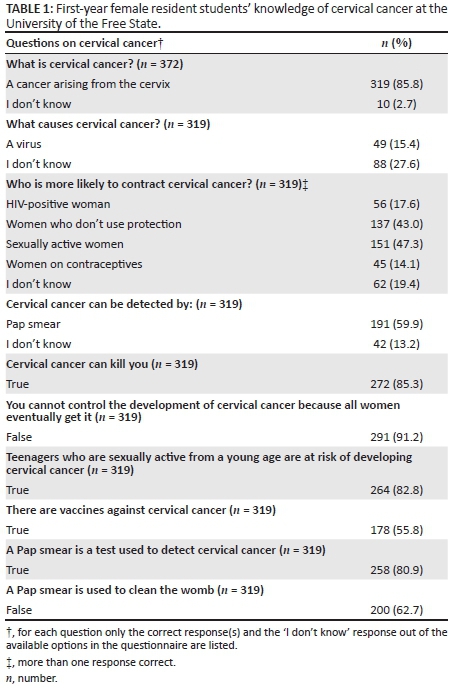
Table 1 indicates the percentages of participants who chose the correct options to the knowledge questions regarding cervical cancer, and the percentages who responded that they did not know. Most participants (85.8%) knew that cervical cancer arises from the cervix, but only 15.4% knew that it was caused by a virus. Almost half of the participants correctly noted that women who do not use protection (43.0%) and sexually active women (47.3%) were at risk to contract cervical cancer. Less than 20% knew that HIV-positive women (17.6%) and women on contraceptives (14.1%) are also more likely to contract cervical cancer.
Most participants knew that cervical cancer can be fatal (85.3%), that the development of cervical cancer can be controlled (91.2%), that sexually active teenagers are at risk (82.8%) and that a Pap smear is a test to detect cervical cancer (80.9%). Only 55.8% knew that there are vaccines available against cervical cancer.
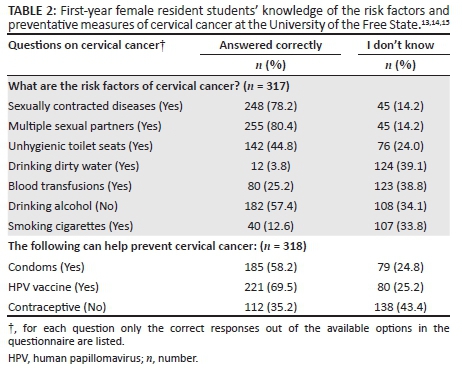
Most of the participants knew that sexually contracted diseases (78.2%) and multiple sexual partners (80.4%) were risk factors for cervical cancer (Table 2). Less than half of the participants (44.8%) knew that unhygienic toilet seats were a risk factor, while 25.2% knew that blood transfusions were a risk factor. Few participants correctly selected drinking dirty water (3.8%) and smoking cigarettes (12.6%) as risk factors. Almost 60% of the participants (57.4%) knew that drinking alcohol was not a risk factor.
A majority of participants (69.5%) knew that the HPV vaccine can help prevent cervical cancer compared to 58.2% who stated condoms as a preventative measure. Only 35.2% stated correctly that contraceptive does not help prevent cervical cancer.
Of the 319 participants who answered that cervical cancer arises from the cervix, 60.1% learned this while in school, 33.0% via the media, 10.4% from other sources, such as family, friends or physician, and 2.8% at UFS.
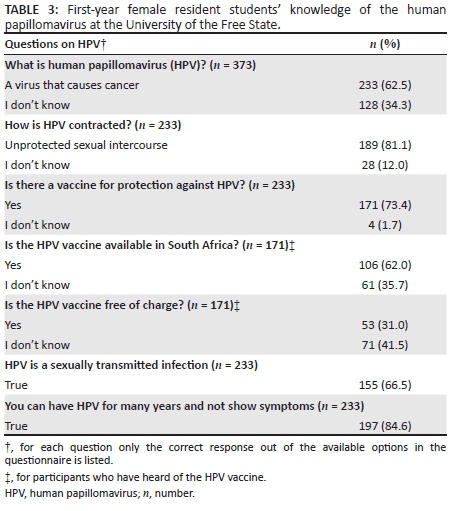
Table 3 indicates the percentages of participants who chose the correct options to the knowledge questions regarding HPV and the percentages who responded that they did not know. Of the 62.5% of participants who knew that HPV was a cancer-causing virus 81.1% correctly knew that HPV was contracted by unprotected sexual intercourse and 73.4% knew that there is a vaccine to protect against HPV. However, 62.0% knew that the vaccine was available in South Africa and only 31.0% knew the vaccine was free of charge.
In total, 200 participants knew what cervical cancer and HPV are. Of these, 71.0% knew that HPV causes cervical cancer, while 24.5% did not know. Similarly, 71.5% knew that the HPV vaccine did not 100% protect women against cervical cancer, while 23.5% did not know.
Of the 190 participants who answered the last section of the questionnaire, 136 (71.6%) did not believe they are at risk of developing cervical cancer, while 152 (81.3%) out of 187 participants did not believe they are at risk of contracting HPV.
Discussion
In a study conducted in 1997,162
Most of the participants (85.8%) were aware of what cervical cancer is. This is lower than the 95% found in a study performed at the University of the Witwatersrand,61718
According to the World Health Organization, approximately 30%-60% of all sexually active adults may contract HPV during their lifetime. In addition, young females are at risk as they are more inclined to be sexually active and have more sexual partners.1915
In this study, the participants correctly identified that having multiple sexual partners (80.4%) is a risk factor for developing cervical cancer. This is higher than the 52% reported by Kulua61713
Almost 81% of the participants selected Pap smear test as a method of detection of cervical cancer. Results from the Witwatersrand study found that 82% of the participants were aware of the test, but only 60% were aware that it was used for cervical cancer detection.6
Most (73.4%) of the participants who had heard about HPV were aware that a vaccine is available, but only 62.0% of these participants knew that the vaccine was available in South Africa. This shows a need for education about the vaccine to empower young women to protect themselves from contracting HPV.
Study limitations
The study has several limitations, suggesting that the results should be interpreted with some caution. The study used convenience sampling, which may result in selection bias. Another potential limitation of this study is the reliance on self-reported data. Therefore, responses to sensitive questions may be biased.
Some of the participants appeared to be helping each other in answering some of the questions and some questionnaires were incomplete. A number of participants did not answer the last few questions, as they did not see these on the back page of the questionnaire.
The fact that the study did not record the faculty where the participants study means that we cannot ascertain whether the overrepresentation of a faculty, such as Health Sciences, may have affected the results, nor can it be ascertained whether certain faculties' students are less knowledgeable, which makes targeted education impossible.
Conclusion
The study is consistent with other studies performed at universities in South Africa and internationally, which shows that female students have limited knowledge of cervical cancer, HPV and the important link between the two.
In conclusion, there is an urgent need for provision of sexual and women's reproductive health programmes on campus. The data from this study suggest that, in order to enhance knowledge about cervical cancer and HPV immunisation uptake, provision of information about HPV infection and its link to cervical cancer and risk factors is essential, with emphasis on high HPV infection rates, provision of assurance on safety and efficacy of the new vaccine and eliminating stigma associated with the prevention of sexually transmitted infections. Education on the prevention of cervical cancer needs to start at primary school level, where vaccination can be done from the age of 9 years. This needs to continue up to tertiary level, while also taking care of other preventative strategies such as abstinence, monogamous sexual relations and condom use.
Recommendations
Education about HPV and its relationship to cervical cancer can be included in university programmes such as UFS101, a core compulsory module for all first-year students at UFS, and in life orientation in high schools.
1. Education must include the use of condoms to prevent HPV and other sexually transmitted diseases.
2. Student health clinics and community organisations should raise awareness about cervical cancer, its prevention and early detection.
Competing interests
The authors declare that they have no financial or personal relationships that may have inappropriately influenced them in writing this article.
Authors' contributions
M.N., M.L., N.C., S.N. and Q.M. developed the protocol, performed data collection and did the initial write-up of this study. N.M. was the supervisor, had the idea and assisted with the protocol development, data collection and interpretation of data, and write-up of this study. G.J. assisted with the planning, performed the data analysis and assisted with the interpretation and write-up of this study.
Acknowledgements
The authors thank the participants for their support and willingness to complete the questionnaires, and Ms T. Mulder, medical editor, School of Medicine, UFS, for technical and editorial preparation of the manuscript.
References
-
1. Richter K. Implementation of HPV vaccination in South Africa [homepage on the Internet]. 2015 [cited 2017 Apr 18]. Public Health Association of South Africa. Available from: https://www.phasa.org.za/wp-content/uploads/2015/02/Richter_Implementation-of-HPV_article-4.pdf
» https://www.phasa.org.za/wp-content/uploads/2015/02/Richter_Implementation-of-HPV_article-4.pdf -
2. Bruni L, Barrionuevo-Rosas L, Albero G, et al. ICO Information Centre on HPV and Cancer (HPV Information Centre). Human Papillomavirus and Related Diseases in South Africa. Summary Report 27 July 2017 [homepage on the Internet]. 2017 [cited 2017 Sept 26]. Available from: http://www.hpvcentre.net/statistics/reports/ZAF.pdf
» http://www.hpvcentre.net/statistics/reports/ZAF.pdf -
3. Denny-Smith T, Bairan A, Page MC. A survey of female nursing students' knowledge, health beliefs, perceptions of risk, and risk behaviors regarding human papillomavirus and cervical cancer. J Am Acad Nurse Pract. 2006;18(2):62-69. https://doi.org/10.1111/j.1745-7599.2006.00100.x
» https://doi.org/10.1111/j.1745-7599.2006.00100.x - 4. Alves C, Alves L, Lunet N. [Epidemiology of cervical cancer]. Arquivos de Medicina. 2010;24(6):266-277.
- 5. Lopez R, McMahan S. College women's perception of knowledge of human papillomavirus (HPV) and cervical cancer. Calif J Health Promot. 2007;5(3):12-25.
- 6. Kalua EK. Knowledge about human papillomavirus, human papillomavirus vaccine and cervical cancer among female students at the University of Witwatersrand and their sexual practices [unpublished MMed thesis]. Johannesburg: University of the Witwatersrand; 2012.
- 7. Denny L. Cervical cancer in South Africa: An overview of current status and prevention strategies. Cont Med Educ. 2010;28(2):70-73.
-
8. Department of Health, Republic of South Africa. Human Papilloma Virus (HPV) programme [homepage on the Internet]. No date [cited 2017 May 31]. Available from: http://www.health.gov.za/index.php/gf-tb-program/336-human-papilloma-virus-hpv-programme
» http://www.health.gov.za/index.php/gf-tb-program/336-human-papilloma-virus-hpv-programme -
9. Centers for Disease Control and Prevention. Human Papillomavirus (HPV). Facts & Brochures. HPV Vaccine Information for Young Women [homepage on the Internet]. [updated 2017 Jan; cited 2017 Jul 24]. Available from: https://www.cdc.gov/std/hpv/stdfact-hpv-vaccine-young-women.htm
» https://www.cdc.gov/std/hpv/stdfact-hpv-vaccine-young-women.htm -
10. Southern Africa Litigation Centre. SALC Report. Tackling cervical cancer: Improving access to cervical cancer services for women in Southern Africa [homepage on the Internet]. 2012 [cited 2017 Apr 18]. Available from: http://salc.codefaktory.com/wp-content/uploads/2017/08/CERVICAL-CANCER-Report1.pdf
» http://salc.codefaktory.com/wp-content/uploads/2017/08/CERVICAL-CANCER-Report1.pdf -
11. Moss JL, McCarthy SH, Gilkey MB, Brewer NT. Application of the Carolina Framework for cervical cancer prevention. Gynecol Oncol. 2014;132(Suppl 1):S33-S40. https://doi.org/10.1016/j.ygyno.2013.12.004
» https://doi.org/10.1016/j.ygyno.2013.12.004 -
12. Botha H, Cooreman B, Dreyer G, et al. Cervical cancer and human papillomavirus: South African guidelines for screening and testing. S Afr J Gynaecol Oncol. 2010;2(1):23-26. https://doi.org/10.1080/20742835.2010.11441154
» https://doi.org/10.1080/20742835.2010.11441154 -
13. Pitts M, Clarke T. Human papillomavirus infections and risks of cervical cancer: What do women know? Health Educ Res. 2002;17(6):706-714. https://doi.org/10.1093/her/17.6.706
» https://doi.org/10.1093/her/17.6.706 -
14. American Cancer Society. What are the risk factors of cervical cancer? [homepage on the Internet]. [updated 2017 Nov; cited 2018 Jan 17]. Available from: https://www.cancer.org/cancer/cervical-cancer/causes-risks-prevention/risk-factors.html
» https://www.cancer.org/cancer/cervical-cancer/causes-risks-prevention/risk-factors.html -
15. Bosch FX, De Sanjosé S. Chapter 1: Human papillomavirus and cervical cancer - Burden and assessment of causality. J Natl Cancer Inst Monogr. 2003;31:3-13. https://doi.org/10.1093/oxfordjournals.jncimonographs.a003479
» https://doi.org/10.1093/oxfordjournals.jncimonographs.a003479 -
16. Koutsky L. Epidemiology of genital human papillomavirus infection. Am J Med. 1997;102(5A):3-8. https://doi.org/10.1016/S0002-9343(97)00177-0
» https://doi.org/10.1016/S0002-9343(97)00177-0 -
17. Hoque E, Hoque M. Knowledge of and attitude towards cervical cancer among female university students in South Africa. S Afr J Epidemiol Infect. 2009;24(1):21-24. https://doi.org/10.1080/10158782.2009.11441335
» https://doi.org/10.1080/10158782.2009.11441335 -
18. Cloete A. Youth culture, media and sexuality: What could faith communities contribute? HTS Teol Stud/Theol Stud. 2012;68(2):1-6. https://doi.org/10.4102/hts.v68i2.1118
» https://doi.org/10.4102/hts.v68i2.1118 -
19. World Health Organization. Human papillomavirus (HPV) and cervical cancer. Fact sheet [homepage on the Internet]. [updated 2016 Jun; cited 2017 Jul 24]. Available from: http://www.who.int/mediacentre/factsheets/fs380/en/
» http://www.who.int/mediacentre/factsheets/fs380/en/

Accepted: 20 Jan. 2018
Published: 24 May 2018