Antidiabetics and antihypertensive medications use in Morocco: A pharmacoepidemiological descriptive study
Abstract
BACKGROUND: In Morocco, and many other African countries, there is a paucity of antihypertensive and antidiabetics use amongst the general population. AIM: To investigate the epidemiological profile of antihypertensive and antidiabetics use and analysis their adverse reactions. SETTING: This study was conducted in the prefecture of Figuig, Morocco. METHODS: A cross-sectional descriptive study. Data was collected using semi-structured questionnaire about their pharmacological treatment and presented using descriptive statistical analysis RESULTS: Sample of 244 subjects, predominantly women 58.15% (p < 0.03) composed of diabetic patients 56.96% (n = 139) and hypertensive patients 43.03% (n = 105). After adjustments, 60.24% of all patients were under monotherapy. The diabetics were being treated using the Biguanide class (26.92%), insulin (20.0%) and sulfonylureas (10.0%) while hypertensive patients were treated by Calcium Channel Blockers (27.36%), Angiotensin Converting Enzyme Inhibitors (21.05%), Angiotensin T-Blockers (16.84%), Diuretics (7.36%) and β-adrenergic receptors blockers (3.15%). In total, 23.00% of all subjects have experienced negative side-effects, mostly, reported (90.38%) to health professionals and 23.52% of them have interrupted temporarily or try to change their treatment. Gastro-intestinal problems were the most adverse reactions reported (11.11%) followed by headache, dizziness and tinnitus (6.66%) and asthenia, feeling sick and feeling of faintness (5.33%). CONCLUSION: Managing diabetes and hypertension entails a lot of public challenges and requires more focus and interest, especially amongst the illiterate population in remote areas. Some of the suggested ways to help face the problem include the introduction of new innovative measures, systems of fellow-up and adverse reactions.
pharmacoepidemiology; antidiabetics; antihypertensive; Morocco; pharmacovigilance; medication safety
Introduction
Diabetes and hypertension remain the most common public health problems in the world and are the major risk factors for cardiovascular diseases that are the leading cause of death.123,45
Methods
Location
This study was conducted in the province of Figuig in south-eastern Morocco. This province has a semi-arid climate with an area of 55 990 km267289
Study design
This is a cross-sectional study funded by the Ministry of Health through a partnership with Ibn Tofail University. We followed the annual programme of medical caravans and medical visits to investigate diabetic and hypertensive subjects across different geographic locations of the prefecture. Patients aged 30 years and more who came for consultations were selected randomly and were screened using a semi-structured questionnaire, and their anthropometric and biological parameters were measured. Patients with advanced symptoms were transferred to specialised consultations, and those with medical prescriptions were directed to the pharmacy to be treated. Pregnant women, recently diagnosed patients (less than 1 year) and subjects not able to communicate were not included in this work.
Statistical analysis
Data were transferred from the questionnaire paper into an electronic database. We performed the analysis using Epi-Info software, and after adjustment we used univariate descriptive statistics to express the characteristics of patients. Our results were expressed as mean (±), standard deviation (s.d.), percentage (%) or as number of cases (n). We used the t-test to compare means and the χ2
Ethical consideration
The study received ethical clearance from Ibn Tofail University and Ministry of Health of Morocco on 01 December 2016 (ethical clearance number: P1-12/16-LGB-MH). A contract and partnership were formed between Ibn Tofail University and the Ministry of Health to support and authorise this study following the ethical standards. All procedures in this study were in accordance with the ethical standards of the National Committee and the 1964 Helsinki Declarations. Participants were asked to share their information for scientific research purposes; those who refused were screened for their medication and their data were not included. Participants were assured regarding the confidentiality of their information. The special terminologies and words have been accepted to express medical meanings to ensure the effectiveness of the communication, because most subjects were not well-versed with the local language. Considering the local traditions, wives were interviewed and screened in the presence of their husbands.
Results
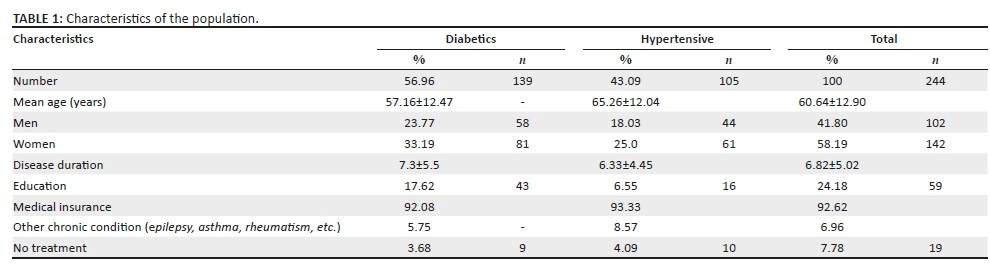
Our sample comprises 244 subjects with a mean age of 60.64 (s.d. ± 12.90) years which form a population of diabetic subjects (56.96%; n = 139) and hypertensive subjects (43.03%; n = 105) and were predominantly women (58.15%; n = 142) (p < 0.03) selected randomly from various geographic locations, rural areas (59.01%) and urban areas (40.98%) in one prefecture. Table 1 summarises the main characteristics of the population.
Pharmacotherapy antihypertensive and antidiabetics
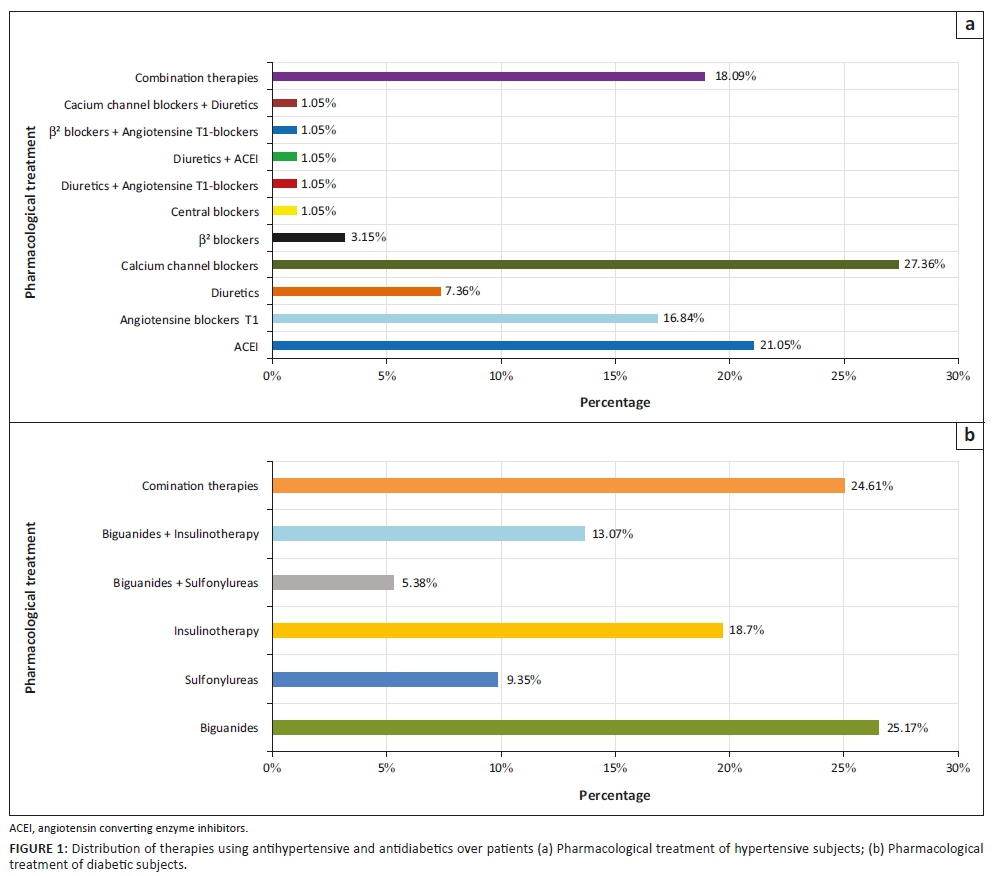
Most subjects had a medical insurance (92.62%) and low educational level (24.18%). Only 7.78% of all subjects were not following any pharmacological treatment for their chronic conditions. The distribution of pharmacological treatments over patients is shown in Figure 1.
Regarding their therapeutic conception and after adjustments, 60.24% of all patients were undergoing monotherapy (hypertension 29.91% (n = 73) and diabetes 30.32% (n = 74)) and the rest used combinations therapies for single or multiple chronic conditions. Several compounds from various pharmacological classes were employed to treat these conditions. Thus, for diabetes, the main compounds used in monotherapy are the biguanides (26.92%), insulin therapy (20.0%) and sulfonylureas (10.0%). Patients under bi-therapies (18.46%) were divided into two major associations: biguanides with insulin (13.07%) and biguanides with sulfonylureas (5.38%). The rest (24.61%) were under combinations of antidiabetics, antihypertensive medication, because they were affected simultaneously by diabetes and hypertension, with cholesterol lowering (statins) or with antithrombotic.
Hypertensive subjects use CCB (27.36%), ACEI (21.05%), angiotensin T-blockers (16.84%), diuretics (7.36%) and b-adrenergic receptors blockers (β-blockers) (3.15%) as part of the monotherapy treatment. The bi-therapy antihypertensive (4.21%) uses combinations of diuretics with ACEI, β-blockers with T-blockers, CCB with diuretics and diuretics with T-blockers. The rest (20.03%) uses combinations of antihypertensive, cholesterol lowering (statins), antithrombotic and antiarrhythmic drugs. The general prevalence of polypharmacy (drugs ≥ 5) is 1.22%; all of them were diabetics (2.15%) using combination therapies of antidiabetics, antihypertensives, cholesterol lowering drugs and antithrombotics.
Combination therapies include various therapies, such as antidiabetics, antihypertensive, cholesterol lowering, antithrombotic and antiarrhythmic drugs.
Pharmacovigilance
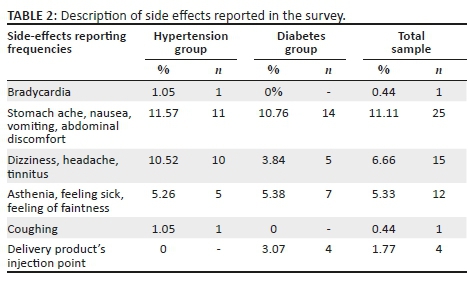
Almost 23.00% of all subjects have experienced negative side effects; this is distributed into 12.43% of diabetics and 10.66% of hypertensive patients. These adverse reactions were reported (90.38%) to health professionals and 23.52% of them had their treatments interrupted temporarily or changed. Interestingly, men report the side effects to health professionals more than women (100% vs. 86.11%) and interrupt the treatment or try to change their treatment more compared to women (33.33% vs. 19.44%) (p < 0.02).
Gastrointestinal problems were the most adverse reactions reported by 11.11% of subjects (11.57% in the hypertension group and 10.57% in the diabetes group). The second most reported side effects include headache, dizziness and tinnitus (6.66%) which are observed more frequently amongst the hypertension group than the diabetes group (10.52% vs. 3.84%). Side effects such as asthenia, feeling sick and a feeling of faintness were reported with a frequency of 5.33%. Table 2 describes the main side effects reported in the survey.
Discussion
This is the first observational pharmacoepidemiological investigation of antidiabetics and antihypertensives utilisation in one prefecture in Morocco.
In Morocco, since 2011, the generalisation of the basic healthcare insurance, especially amongst needy populations, has been improving the healthcare access, chiefly the pharmacological treatment.10
In terms of antidiabetics, our findings pointed out the widespread use of the biguanides, both in monotherapy and in association with various antidiabetic agents, and defined the same epidemiological pattern in other developing African countries.11,12,131415
Most of the antidiabetics described in our survey are available in public health facilities as part of the national health policy for managing chronic diseases (2012).1016p < 0.00001) as compared to the insulin group. Their main adverse reactions include nausea, abdominal discomfort and some diarrhoea.17161617
In Morocco, the use of antihypertensive drugs increased from 0.08 to 10.65 DDD/1000 inhabitants/day between 1991 and 2010 with a dominance of CCB drugs (82.09%) followed by ACEI drugs (48.29%).18
Our findings reveal that drugs acting on the renin-angiotensin aldosterone system (RAAS) are widely used in monotherapy (37.89%) represented by two major pharmacological classes: ACEI and T-blockers. Generally, they are considered as the first line and are quite effective in the management of hypertension.19202122232423,252426272829
The β-blockers are used as a second line of hypertension management, especially amongst patients who survived an acute myocardial infraction, heart failure and atrial fibrillation by reducing the heart's rhythm. When compared to ACEI, T-blockers and CCB, the β-blockers have a reduced action on hypertension.30,3132
In this survey, 6.9% of all participants have associated chronic conditions, such as asthma, rheumatism, psychological disorder and epilepsy which increase the complexity therapeutic not only for the subjects but also for health professionals as it increases the risk of drug-drug interactions. Our findings show an adjusted prevalence of polypharmacy33
1.Tolerability: Usually, antidiabetic and antihypertensive drugs have pharmacological actions and adverse reactions that are dose dependent, hence, low-dose initiations are always preferable.
2.Adherence: The subject's ability to respect the therapeutic guidelines, particularly, with multiple drugs that have to be taken at the same time and/or in increasing number of doses per day and amongst illiterate subjects which may affect patients' compliance negatively, who will try to change or interrupt its treatment. We found that 23.53% of subjects who did experience adverse reactions have interrupted temporarily or tried to change it by themselves without any medical consultations which exposed them to negative clinical outcomes and complications. Morocco has an advanced system of pharmacovigilance compared with other Arabic countries and full membership with the World Health Organization (WHO) Collaborating Center for International Drug Monitoring (WHO-Uppsala Monitoring Center). The system has a centric structure based on the National Center of Pharmacovigilance (launched in 1989) and the National Pharmacovigilance Committee.34
Limitation and perspectives
Our sample was representative of registered patients in the prefecture (nearly 10%); extrapolation to the general population should consider the ethnic diversity (Arabs and Amazigh) and the socioeconomic variations that characterise the Moroccan population and which may affect the lifestyles.
Further investigations are required to define new strategies of side effects of medication in long-term use.
Conclusion
Managing diabetes and hypertension still pose a lot of public health challenges and requires more focus and interest, especially amongst the illiterate population in remote areas. The management measure should include the introduction of new innovative measures, systems of follow-up and adverse reactions management, at the individual, regional and national levels.
Competing interests
The authors declare that no competing interests exist.
Authors' contributions
E.R., A.S., H.H. and M.A. were involved in study concept and design. R. E. was involved with the acquisition of data. The data collected were analysed and interpreted by all the authors, and everyone was involved in the critical revision of the results thus obtained. This study was supervised by A.S.
Funding information
This research received funds from the Ministry of Health of Morocco.
Data availability statement
The data sets generated during and/or analysed during the current study are available from the corresponding author on reasonable request.
Disclaimer
The views and opinions expressed in this article are those of the authors and do not necessarily reflect the official policy or position of any affiliated agency of the authors.
Acknowledgements
The authors thank Dr Abdallah Ouadie, the head of local authority of the Ministry of Health, and Mr Kabori Mohamed, prefectural economist in health authority in the prefecture of Figuig. The authors thank all the drivers affiliated to the prefectural hospital in Bouarfa and all health professionals in the prefecture of Figuig.
References
- 1.WHO. Global status report on noncommunicable diseases. Geneva: World Health Organization; 2014.
-
2.Bertram MY, Sweeny K, Lauer JA, et al. Investing in non-communicable diseases: An estimation of the return on investment for prevention and treatment services. Lancet. 2018;391(10134):2071-2078. https://doi.org/10.1016/S0140-6736(18)30665-2
» https://doi.org/10.1016/S0140-6736(18)30665-2 -
3.Diab M, Barhoosh HA, Daoudi B, et al. Prevention and screening recommendations in type 2 diabetes: Review and critical appraisal of clinical practice guidelines. Prim Care Diabetes. 2018;13(3):197-203. https://doi.org/10.1016/j.pcd.2018.11.014
» https://doi.org/10.1016/j.pcd.2018.11.014 - 4.Flack JM, Adekola B. Temporary removal: Blood pressure and the new ACC/AHA hypertension guidelines. Trends Cardiovas Med. 2019;29(4):191-248.
-
5.Pareek M, Bhatt DL. Oral antidiabetic agents and cardiovascular outcomes. Curr Probl Cardiol. 2018;43(3):111-126. https://doi.org/10.1016/j.cpcardiol.2017.07.003
» https://doi.org/10.1016/j.cpcardiol.2017.07.003 -
6.Kingdom of Morocco. Ministry of Interior Province of Figuig. Monograph of the prefecture of Figuig. Morocco (French). 2005 [cited 2019 May 19]. Availible from: http://www.oriental.ma/upload/MoDUle_1/File_1_99.pdf
» http://www.oriental.ma/upload/MoDUle_1/File_1_99.pdf -
7.Elyamani R, Soulaymani A, Serheir Z. Epidemiology of scorpion envenoming in the prefecture of figuig, Morocco. Int J Med Toxicol Forensic Med. 2019;9(1):17-24. https://doi.org/10.22037/ijmtfm.v9i1%20(Winter).23632
» https://doi.org/10.22037/ijmtfm.v9i1%20(Winter).23632 -
8.Kingdom of Morocco. Ministry of interior. General direction for local authorities. General monograph of the Eastern of morocco (French). [homepage on the Internet]. 2015. [cited 2019 May 20]. Available from: http://www.pncl.gov.ma/fr/Publication/Statistique/Pages/Monographie-des-r%C3%A9gions-.aspx
» http://www.pncl.gov.ma/fr/Publication/Statistique/Pages/Monographie-des-r%C3%A9gions-.aspx -
9.Kingdom of Morocco. High commissioner for the plan. Regional management of the Eastern. Key indicators for the province of figuig. [homepage on the Internet]. General census in Morocco; 2016 [cited 2019 May 22]. Available from: http://www.hcp.ma/region-oriental/docs/RGPH2014INDICATEURS/Indic2014_FIGUIG.pdf
» http://www.hcp.ma/region-oriental/docs/RGPH2014INDICATEURS/Indic2014_FIGUIG.pdf -
10.Kingdom of Morocco Ministry of Health. National health strategy by sector: 2012-2016. [homepage on the Internet]. [cited 2019 May 24]. Available from: https://www.sante.gov.ma/Pages/Dossiers.aspx
» https://www.sante.gov.ma/Pages/Dossiers.aspx -
11.Ekou F. CA-036: Pharmacoépidémiologie du diabète: Usage des antidiabétiques à l'Institut National de Santé Publique de Côte d'Ivoire (résultats préliminaires). Diabetes Metab. 2016;42(1):A44-A45. https://doi.org/10.1016/S1262-3636(16)30168-9
» https://doi.org/10.1016/S1262-3636(16)30168-9 -
12.Ntyonga-Pono MP. L'observance du traitement antidiabétique chez les patients diabétiques au Gabon : Données préliminaires. Med Maladies Metabol. 2015;9(2):198-202. https://doi.org/10.1016/S1957-2557(15)30043-2
» https://doi.org/10.1016/S1957-2557(15)30043-2 - 13.Tiéno H, Bouda M, Ouédraogo DD, Traoré R, Ouédraogo C, Drabo YJ. Observance du traitement antidiabétique dans un pays en développement: Le cas du Burkina Faso (Afrique subsaharienne). Med Maladies Metabol. 2010;4(2):207-211.
-
14.Mousannif S, Belaiche A, Cherrah Y, Ahid S. Trend in oral antidiabetics use among Moroccan patients. Value Health. 2016;19(3):A209. https://doi.org/10.1016/j.jval.2016.03.1270
» https://doi.org/10.1016/j.jval.2016.03.1270 - 15.Ajdi F, Khabbal Y, Amazian K. Profil épidémiologique des effets indésirables des antidiabétiques oraux. Rev Epidemiol Sante Publique. 2009;57(S1):6-7.
-
16.Schalliol LA, Pittman JA, Ray SD. Insulin and other hypoglycemic drugs. Side Eff Drugs Annu. 2018;40;537-546. https://doi.org/10.1016/bs.seda.2019.07.002
» https://doi.org/10.1016/bs.seda.2019.07.002 -
17.Varghese S. Noninsulin diabetes medications. Nurs Clin N Am. 2017;52(4):523-537. https://doi.org/10.1016/j.cnur.2017.07.003
» https://doi.org/10.1016/j.cnur.2017.07.003 -
18.El Azizi GB, Ahid S, Ghannam I, Belaiche A, Hassar M, Cherrah Y. Les médicaments génériques et l'évolution de la consommation des antihypertenseurs au Maroc. Therapies. 2014;68(5):303-312. https://doi.org/10.2515/therapie/2013048
» https://doi.org/10.2515/therapie/2013048 -
19.Charlton M, Thompson JP. Drugs acting on the heart: Antihypertensive drugs. Anaesth Intens Care Med. 2018;19(7):365-369. https://doi.org/10.1016/j.mpaic.2018.04.005
» https://doi.org/10.1016/j.mpaic.2018.04.005 -
20.Bavishi C, Bangalore S, Messerli FH. Renin angiotensin aldosterone system inhibitors in hypertension: Is there evidence for benefit independent of blood pressure reduction? Prog Cardiovasc Dis. 2016;59(3):253-261. https://doi.org/10.1016/j.pcad.2016.10.002
» https://doi.org/10.1016/j.pcad.2016.10.002 -
21.Arumugam S, Sreedhar R, Thandavarayan RA, et al. Angiotensin receptor blockers: Focus on cardiac and renal injury. Trends Cardiovasc Med. 2016;26(3):221-228. https://doi.org/10.1016/j.tcm.2015.06.004
» https://doi.org/10.1016/j.tcm.2015.06.004 -
22.Luño J, Varas J, Ramos R, et al. The combination of beta blockers and renin-angiotensin system blockers improves survival in incident hemodialysis patients: A propensity-matched study. Kidney Int Rep. 2017;2(4):665-675. https://doi.org/10.1016/j.ekir.2017.03.001
» https://doi.org/10.1016/j.ekir.2017.03.001 -
23.Chandra KS, Ramesh G. The fourth generation Calcium channel blocker: Cilnidipine. Indian Heart J. 2013;65(6):691-695. https://doi.org/10.1016/j.ihj.2013.11.001
» https://doi.org/10.1016/j.ihj.2013.11.001 - 24.Alun H. Calcium channel blockers. In: Alun H, editor. Hypertension: A companion to Braunwald's heart disease. 3rd ed. 2017; pp. 242-253.
- 25.Traylor K, Gurgle H, Brockbank J. Antihypertensive drugs. Side Eff Drugs Annu. 2018;40(1):263-267.
-
26.Rimoldi SF, Messerli FH, Chavez P, Stefanini GG, Scherrer U. Efficacy and safety of calcium channel blocker/diuretics combination therapy in hypertensive patients: A meta-analysis. J Clin Hypertens. 2015;17(3):193-199. https://doi.org/10.1111/jch.12462
» https://doi.org/10.1111/jch.12462 - 27.Vazir A, Sundaram V, Harper AR. Diuretic therapy. Encyclopedia of cardiovascular research and medicine. 2018; pp. 107-116.
- 28.Friedman-Jakubovics M, Fazylov R. Diuretics. Side Eff Drugs Annu. 2018;40(1):269-278.
-
29.DeFilippis EM, Desai AS. Treatment of hyperkalemia in heart failure. Curr Heart Fail Rep. 2017;14(4):266-274. https://doi.org/10.1007/s11897-017-0341-0
» https://doi.org/10.1007/s11897-017-0341-0 - 30.Akbar S, Alorainy MS. The current status of beta blockers' use in the management of hypertension. Saudi Med J. 2014;35(11):1307-1317.
-
31.Yamamoto K. β-Blocker therapy in heart failure with preserved ejection fraction: Importance of dose and duration. J Cardiol. 2015;66(3):189-194. https://doi.org/10.1016/j.jjcc.2015.02.004
» https://doi.org/10.1016/j.jjcc.2015.02.004 - 32.McHugh J, Pokhrel P, Barber K, Liu G. Beta-blockers in the management of cardiovascular diseases. Osteopathic Fam Phys. 2010;2(5):131-138.
- 33.Masnoon N, Shakib S, Kalisch-Ellett L, Caughey GE. What is polypharmacy? A systematic review of definitions. BMC Geriatr. 2017;17(230):1-10.
-
34.Alshammari TM, Mendi N, Alenzi KA, Alsowaida Y. Pharmacovigilance systems in Arab Countries: Overview of 22 Arab Countries. Drug Saf. 2019;42(7):1-20. https://doi.org/10.1007/s40264-019-00807-4
» https://doi.org/10.1007/s40264-019-00807-4

Accepted: 12 Mar. 2020
Published: 15 June 2020