Prevalence of intimate partner violence and associated factors amongst women attending antenatal care at Outapi clinic, Namibia: A descriptive survey
Abstract
BACKGROUND: Intimate partner violence (IPV) is a significant and largely hidden public health problem for all women and, during pregnancy, can have significant effects on the health of both mother and the unborn baby. Previous Namibian studies suggest rates of IPV as high as 36%, although few studies have been conducted in primary care. AIM: To determine the prevalence of IPV amongst women attending antenatal care. SETTING: Outapi primary care clinic, Namibia. METHODS: A descriptive survey administering a validated questionnaire to 386 consecutive participants. RESULTS: The mean age of the participants was 27.5 years (standard deviation = 6.8), 335 (86.8%) were unmarried, 215 (55.7%) had only primary school education and 237 (61.4%) were in their third trimester. Overall, 51 participants (13.2%) had HIV and 44 (11.4%) had teenage pregnancies. The reported lifetime prevalence of IPV was 39 (10.1%), the 12-month prevalence was 35 (9.1%) and the prevalence during pregnancy was 31 (8.0%). Emotional abuse was the commonest type of abuse in 27 (7.0%). The commonest specific abusive behaviour was refusing to provide money to run the house or look after the children whilst the partner spent money on his priorities (4.9%). Increased maternal age was associated with an increase in the occurrence of IPV. CONCLUSION: The reported lifetime prevalence of IPV was 10.1%, with emotional abuse being the commonest type of abuse. Increased age was associated with an increase in reported IPV. IPV is significant enough to warrant that healthcare providers develop guidelines to assist women affected by IPV in Namibia.
Introduction
Intimate partner violence (IPV) is widely recognised as an important public health problem, both because of the acute morbidity and mortality associated with assault and because of its longer term impact on women's and, indirectly, children's mental and physical health.123,4
In Namibia, over one-third of women have reported physical or sexual violence from an intimate partner.225,6
In Namibia, the destructive effects of IPV on maternal mental health have also been found in links to depression and suicide.778
Despite the problem being highlighted in the media, little research has been conducted to determine the current prevalence and range of violence in Namibia. In Windhoek, Namibia, the lifetime prevalence of IPV amongst women was found to be 36%.22,1010,11,12
In 2016, the World Health Assembly endorsed a global plan of action to strengthen the role of health systems within a national multisectoral response to address interpersonal violence, especially against women and children.13
The primary care facilities are usually the first point of entry for people presenting with a health problem. Antenatal care provides a potentially important window of opportunity for identifying IPV. For many women in low resource settings, this will be their only contact with healthcare providers. Ideally, women will be seen four times during a pregnancy and once postpartum, and the possibility of follow-up therefore offers an ideal opportunity for addressing issues of abuse.141515
This study aimed to determine the prevalence of IPV amongst women attending antenatal care at a primary care facility in Outapi district, Namibia. In addition, the study aimed to assess the relationship between the different types of IPV (physical, sexual, emotional and economical) and to evaluate the presence of known risk factors.
Methods
Study design
This was a descriptive survey amongst pregnant women attending Outapi primary care clinic.
Setting
The clinic is situated in the Outapi district near the major district hospital for the Omusati region in northern Namibia. It serves the local urban area and distant rural villages. According to 2011 census, Outapi town had an estimated population of 6437. The town comprises a range of white-collar and blue-collar workers, whereas the surrounding rural area consists mainly of village homesteads where most residents are unemployed. The clinic offers services such as antenatal care, postnatal care, family planning, mental health, child health and social work services. Because of the proximity of the clinic to Angola, some of the patients served are Angolans living along the Namibia-Angola border.
Sample size and selection
The sample size calculated was based on the prevalence of 49.7% obtained in Botswana.10
Women who had stayed in the catchment area of the clinic for at least six months were included regardless of nationality, race or ethnic group. Participants were selected consecutively as they attended the antenatal clinic. The research was conducted on antenatal care days over a five-week period. Pregnant women were seen in a private consultation room by two nurses who took a history and then performed an obstetric examination. During this consultation, the client was asked questions in order to ascertain whether she had experienced IPV or not. The clients who responded negatively were recorded as such together with the routine general socioeconomic information. The clients who responded affirmatively for experiencing IPV were invited to participate in the research. None of the women who responded affirmatively for experiencing IPV declined to participate in the study. Two consent forms were available, one in English and another in Oshiwambo, the local language. The women chose the language they were comfortable with and then made a voluntary decision to participate in the study.
Data collection
Data were collected using a modified version of a validated questionnaire that was previously utilised in an antenatal clinic study in Soweto, South Africa.12
Two female nurses with good interpersonal skills, an interest in IPV and fluency in Oshiwambo administered the questionnaire, whilst they concurrently performed routine antenatal care. Piloting of the questionnaire did not suggest the need for any additional changes.
Data analysis
Data were captured on an Excel sheet by a data clerk and checked for errors by the researcher. The data were analysed with the assistance of the Biostatistics Unit at Stellenbosch University. Determination of the relationship between demographic, clinical characteristics and IPV was done using the chi-square test. Otherwise, simple descriptive statistics were used to summarise the data.
Ethical considerations
The study was approved by the Health Research Ethics Committee (S15/07/140) at Stellenbosch University and by the Ministry of Health and Social Services of Namibia. Confidentiality was of great importance to this study, and care was taken to ensure that there was no recording of names, address or other personal details of the participants. Participants who required more assistance after taking part in the study were further assisted by a social worker. The study was conducted as per the WHO's ethical and safety recommendations for research on domestic violence against women.16
Results
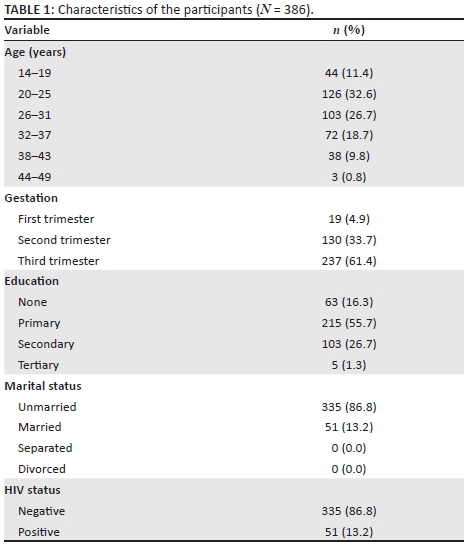
Altogether 386 pregnant women took part in the study, and their mean age was 27.5 years (standard deviation [SD] = 6.0). Table 1 shows the frequency distribution of the participants' characteristics. Most women were unmarried, although may have been co-habiting with their partners, had only primary school education and were attending in their third trimester of pregnancy. Out of the 386 participants, 44 (11.4%) were teenagers.
Prevalence of intimate partner violence
The reported lifetime prevalence of IPV was 39 (10.1%), the 12-month prevalence was 35 (9.1%) and the prevalence during pregnancy was 31 (8.0%). Table 2 shows the prevalence of different types of IPV and the mean number of times that abuse occurred. All women who disclosed their history of IPV completed the questionnaire. Emotional abuse was the commonest type of IPV amongst the participants overall as well as during pregnancy.
Forms of intimate partner violence
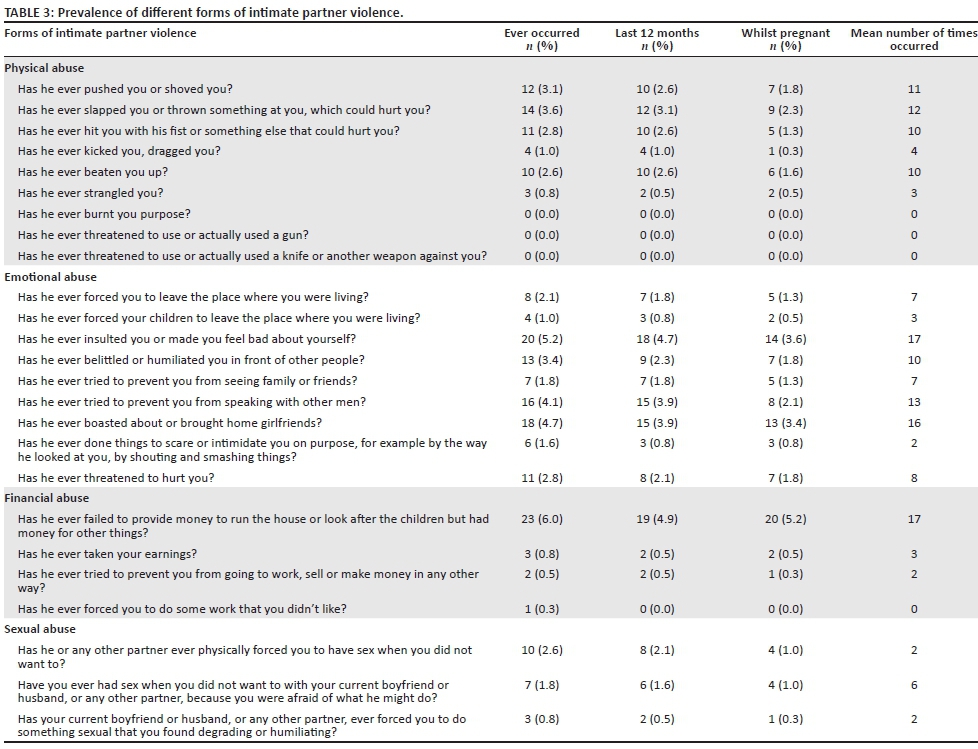
Within each category, different forms of IPV were assessed using specific questions. Table 3 shows the different forms of IPV. Failure to provide money to run the house or look after the children but having money for other things was the most common specific form of IPV, with 23 (6.0%) reporting it. Severe forms of physical abuse such as burning, threatening or using a gun were not reported by the participants.
Associated factors
There was no significant relationship between the prevalence of IPV and the level of education, gestation, HIV status or marital status. There was a significant association (p = 0.007) between IPV and older age with the mean age of those who had experienced IPV being 30.3 years (95% CI: 29.4-35.7) and those without an experience of IPV being 27.2 years (95% CI: 26.1-32.4).
Discussion
In this study, 10.1% of pregnant women had experienced IPV during their lifetime, 9.1% in the last 12 months and 8.0% during the current pregnancy. Emotional abuse was the most common type of IPV followed by financial, physical and then sexual abuse. Older pregnant women were more likely to have experienced IPV.
The lifetime prevalence of IPV was within the range of 2.0%-13.5% found in 19 other countries from Africa, Latin America, Europe and Asia.1410
The rate of physical abuse during pregnancy in this study was much lower than the prevalence obtained in Windhoek, Namibia, of 6.1%.22171818
In comparison with other African countries, the results are comparable to those obtained in Uganda and Malawi.14,1911,12,1312
By contrast, this study was conducted in one semi-rural facility. Similar studies in Botswana and Rwanda also had much higher IPV lifetime prevalence rates of 49.7% and 35.1%, respectively. The Botswana study was conducted in a semi-urban public hospital, whereas the Rwandan study was conducted in two rural settings.10,20
This study also assessed the different types of IPV experienced by pregnant women. Emotional abuse was the commonest type of abuse, which was mainly demonstrated by the partner insulting or otherwise making the woman feel bad about herself. This is in agreement with observations that during pregnancy non-physical forms of violence tend to increase.12
The study found that there was an association of reported IPV with an increase in age. This is in contrast with the data obtained by the Namibian DHS of 2013 which highlighted that IPV was more likely to be reported by younger women.921192022
The majority of participants were single (86.8%). This is not surprising as most Namibian women are involved in unmarried relationships.2321924
Limitations
Possible underreporting has already been discussed. The low level of education (none or primary) in the majority of women could also be a contributing factor. A Zambian study revealed that the average person who had not completed primary school was less likely to report a violent argument with a partner.21
Recommendations
Because of the significant mental and physical health risks for women and their children associated with IPV and the prevalence found in this study, health service providers should implement the WHO's clinical guidelines for IPV amongst women attending antenatal care.25,2627
Conclusion
The lifetime prevalence of IPV amongst pregnant women in a primary care setting in a semi-rural area of Namibia was 10.1%, 9.1% during the last 12 months and 8.0% during pregnancy. The study found that all types of IPV occurred during pregnancy, with emotional abuse being the commonest category (a common form of abuse being the partner insulting or making the woman feel bad about herself), followed by financial abuse. Overall the commonest specific abusive behaviour was failing to provide money for her to run the house or look after the children despite him having money for his priorities. Marital status, HIV status, gestational age and level of education did not demonstrate any association with IPV, although older pregnant women were more likely to have experienced IPV.
Competing interests
The authors declare that they have no financial or personal relationships that may have inappropriately influenced them in writing this article.
Authors' contributions
L.T.B. conducted this study for the Master of Medicine degree under the supervision of R.M. and the co-supervision of K.J. as subject specialist. L.T.B. was responsible for conceptualising the study, collecting data, analysing data and writing the final report. R.M. and K.J. assisted with the preparation of the manuscript for publication, and all authors approved the final version.
Acknowledgements
The authors would like to thank Dr Tonya Esterhuizen, Biostatistics Unit, Faculty of Medicine and Health Sciences, Stellenbosch University, who performed the data analysis; Ms Elizabeth Aulamba and Ms Susanna Kalipi, registered nurses, Outapi Clinic, Ministry of Health and Social Services, Namibia, who assisted in data collection; and Ms Victoria Akunda, data clerk, Outapi Clinic, Ministry of Health and Social Services, who captured data on Office Access for data analysis.
References
-
1. Dunkle KL, Jewkes RK, Brown HC, et al. Prevalence and patterns of gender-based violence and revictimization among women attending antenatal clinics in Soweto, South Africa. Am J Epidemiol. 2004;160(3):230-239. https://doi.org/10.1093/aje/kwh194
» https://doi.org/10.1093/aje/kwh194 -
2. García C, Jansen HAFM, Ellsberg M, Heise L, Watts C. WHO Multi-country study on women's health and domestic violence against women [homepage on the Internet]. 2005 [cited 2017 Mar 04]. Available from: http://www.who.int/reproductivehealth/publications/violence/24159358X/en/
» http://www.who.int/reproductivehealth/publications/violence/24159358X/en/ -
3. World Health Organization. Violence against women [homepage on the Internet]. [cited 2015 Feb 27]. Available from: http://www.who.int/mediacentre/factsheets/fs239/en/
» http://www.who.int/mediacentre/factsheets/fs239/en/ -
4. The 5 forms of domestic violence [homepage on the Internet]. [cited 2015 Mar 01]. Available from: http://www.woodbridgedvrt.org/pages/fiveforms.html
» http://www.woodbridgedvrt.org/pages/fiveforms.html -
5. Jejeebhoy SJ. Associations between wife-beating and fetal and infant death: Impressions from a survey in rural India. Stud Fam Plann. 1998;29(3):300-308. https://doi.org/10.2307/172276
» https://doi.org/10.2307/172276 -
6. Turner RE, Honikman S. Maternal mental health and the first 1000 days. S Afr Med J. 2016;106(12):1164-1167. https://doi.org/10.7196/SAMJ.2017.v106i12.12129
» https://doi.org/10.7196/SAMJ.2017.v106i12.12129 -
7. LAC: Gender Research & Advocacy Project. Seeking safety: Domestic violence in Namibia and the combating of domestic violence [homepage on the Internet]. 2012 [cited 2017 Mar 04]. Available from: http://photos.state.gov/libraries/namibia/19452/public/seeking-safety-domestic-violence-in-Namibia.pdf
» http://photos.state.gov/libraries/namibia/19452/public/seeking-safety-domestic-violence-in-Namibia.pdf -
8. Kouyoumdjian FG, Findlay N, Schwandt M, Calzavara LM. A systematic review of the relationships between intimate partner violence and HIV/AIDS. PLoS One. 2013;8(11):e81044. https://doi.org/10.1371/journal.pone.0081044
» https://doi.org/10.1371/journal.pone.0081044 -
9. The Namibia Ministry of Health and Social Services (MoHSS). The Namibia demographic and health survey 2013 [homepage on the Internet]. Windhoek: MoHSS; 2014 [cited 2017 Jan 19]. Available from https://dhsprogram.com/pubs/pdf/FR298/FR298.pdf
» https://dhsprogram.com/pubs/pdf/FR298/FR298.pdf -
10. Zungu LI, Salawu AO, Ogunbanjo GA. Reported intimate partner violence amongst women attending a public hospital in Botswana. Afr J Prim Health Care Fam Med. 2010;2(1):1-6. https://doi.org/10.4102/phcfm.v2i1.185
» https://doi.org/10.4102/phcfm.v2i1.185 - 11. Edward K, Hospital V, Mbokota M. Domestic abuse - An antenatal survey at King Edward VIII Hospital, Durban. S Afr Med J. 2003;93(6):455-457.
-
12. Shamu S, Abrahams N, Zarowsky C, Shefer T, Temmerman M. Intimate partner violence during pregnancy in Zimbabwe: A cross-sectional study of prevalence, predictors and associations with HIV. Trop Med Int Health. 2013;18(6):696-711. https://doi.org/10.1111/tmi.12078
» https://doi.org/10.1111/tmi.12078 -
13. Joyner K. How can we manage intimate partner violence better? S Afr Med J. 2016;106(10):961. https://doi.org/10.7196/SAMJ.2016.v106i10.11460
» https://doi.org/10.7196/SAMJ.2016.v106i10.11460 -
14. Devries KM, Kishor S, Johnson H, et al. Intimate partner violence during pregnancy: Analysis of prevalence data from 19 countries. Reprod Health Matters. 2010;18(36):158-170. https://doi.org/10.1016/S0968-8080(10)36533-5
» https://doi.org/10.1016/S0968-8080(10)36533-5 -
15. Joyner K, Mash R. Recognizing intimate partner violence in primary care: Western Cape, South Africa. PLoS One. 2012;7(1):1-5. https://doi.org/10.1371/journal.pone.0029540
» https://doi.org/10.1371/journal.pone.0029540 -
16. Putting women first: Ethical and safety recommendations for research on domestic violence against women [homepage on the Internet]. 2001 [cited 2017 Mar 04]. Available from: http://www.who.int/gender-equity-rights/knowledge/who_fch_gwh_01.1/en/
» http://www.who.int/gender-equity-rights/knowledge/who_fch_gwh_01.1/en/ -
17. Mills LG. Shame and intimate abuse: The critical missing link between cause and cure. Child Youth Serv Rev. 2008;30(6):631-638. https://doi.org/10.1016/j.childyouth.2008.01.010
» https://doi.org/10.1016/j.childyouth.2008.01.010 - 18. Jewkes R, Penn-Kekana L, Levin J, Ratsaka M, Schrieber M. Prevalence of emotional, physical and sexual abuse of women in three South African provinces. S Afr Med J. 2001;91(5):421-428.
-
19. Bazargan-Hejazi S, Medeiros S, Mohammadi R, Lin J, Dalal K. Patterns of intimate partner violence: A study of female victims in Malawi. J Inj Violence Res. 2013;5(1):38-50. https://doi.org/10.5249/jivr.v5i1.139
» https://doi.org/10.5249/jivr.v5i1.139 -
20. Ntaganira J, Muula AS, Masaisa F, Dusabeyezu F, Siziya S, Rudatsikira E. Intimate partner violence among pregnant women in Rwanda. BMC Womens Health. 2008;8(1):17. https://doi.org/10.1186/1472-6874-8-17
» https://doi.org/10.1186/1472-6874-8-17 -
21. Andersson N, Ho-Foster A, Mitchell S, Scheepers E, Goldstein S. Risk factors for domestic physical violence: National cross-sectional household surveys in eight Southern African countries. BMC Womens Health. 2007;7:1-13. https://doi.org/10.1186/1472-6874-7-11
» https://doi.org/10.1186/1472-6874-7-11 -
22. Dunkle KL, Jewkes RK, Brown HC, Gray GE, McIntryre JA, Harlow SD. Gender-based violence, relationship power, and risk of HIV infection in women attending antenatal clinics in South Africa. Lancet. 2004;363(9419):1415-1421. https://doi.org/10.1016/S0140-6736(04)16098-4
» https://doi.org/10.1016/S0140-6736(04)16098-4 -
23. Pazvakawambwa L, Indongo N, Kazembe LN. Explaining marital patterns and trends in Namibia: A regression analysis of 1992, 2000 and 2006 demographic and survey data. PLoS One. 2013;8(8):e70394. https://doi.org/10.1371/journal.pone.0070394
» https://doi.org/10.1371/journal.pone.0070394 -
24. Makayoto LA, Omolo J, Kamweya AM, Harder VS, Mutai J. Prevalence and associated factors of intimate partner violence among pregnant women attending Kisumu District Hospital, Kenya. Mater Child Health J. 2013;17(3):441-447. https://doi.org/10.1007/s10995-012-1015-x
» https://doi.org/10.1007/s10995-012-1015-x -
25. Sarkar NN. The impact of intimate partner violence on women's reproductive health and pregnancy outcome. J Obst Gynaecol. 2008;28(3):266-271. https://doi.org/10.1080/01443610802042415
» https://doi.org/10.1080/01443610802042415 -
26. WHO. Responding to intimate partner violence and sexual violence against women: WHO clinical and policy guidelines [homepage on the Internet]. 2013 [cited 2017 Mar 04]. Available from http://apps.who.int/iris/bitstream/10665/85240/1/9789241548595_eng.pdf
» http://apps.who.int/iris/bitstream/10665/85240/1/9789241548595_eng.pdf -
27. Joyner K, Mash B. A comprehensive model for intimate partner violence in South African primary care: Action research. BMC Health Serv Res. 2012;12(1):399. https://doi.org/10.1186/1472-6963-12-399
» https://doi.org/10.1186/1472-6963-12-399

Accepted: 10 Oct. 2017
Published: 06 Dec. 2017