Exploring healthcare workers' immunisation behaviour towards COVID-19 vaccines through psychological patterns
Abstract
BACKGROUND: The psychological approach can provide valuable insights into vaccination behaviour, especially in high-risk contexts. It offers new perspectives for effective interventions to improve vaccination behaviour AIM: To investigate key factors influencing stress related to vaccination in emergency situations among healthcare professionals SETTING: Eastern region of Morocco METHODS: We conducted a descriptive and analytical cross-sectional study involving 221 healthcare professionals in the Eastern region of Morocco. A snowball sampling method was used to select the participants who were administered a questionnaire. Logistic regression analysis was performed with p < 0.05 being the level of statistical significance RESULTS: The participants had a median age of 25.5 years (30-34.5) and were predominantly females (68.3%). Vaccination coverage stood at 84.6%, with a positive perception of 77.8%. The analysis of the Perceived Stress Scale (PSS) revealed that 51.6% (n = 114) of healthcare professionals experienced stress towards vaccination. Females were almost two times more susceptible to experiencing vaccination stress (p = 0.03). Furthermore, the analysis showed that vaccination profile (p = 0.02), accepting the vaccine for any reason other than its accessibility (p = 0.03) and having a previous coronavirus disease 2019 infection (p = 0.03), were significantly associated with stress. In contrast, healthcare professionals based at the university hospital had a significantly lower stress level (p = 0.01 CONCLUSION: Moroccan healthcare professionals exhibited high vaccine acceptance and positive perceptions, particularly among vaccinated individuals despite notable stress around immunisation CONTRIBUTION: These insights can guide governments and policymakers in developing strategies to enhance healthcare workers' awareness and understanding of vaccination
vaccination behaviour; stress; vaccination perception; COVID-19; healthcare workers; Morocco
Introduction
Throughout human history, numerous pandemics have occurred, and it is because of the concept of vaccination that entire populations have not been decimated. However, as Brewer et al. suggest, the great success of immunisation programmes has left many people unaware of, and unconcerned about, diseases they have never encountered.1
Despite its long history, the issue of reticence and resistance towards vaccination has been intensified over the past few decades, particularly during the development of vaccines against Severe acute respiratory syndrome coronavirus 2, the causative agent of the coronavirus disease 2019 (COVID-19).2,3,45,67
The accelerated development and rapid approval of the SARS-CoV-2 vaccines remain debatable among healthcare professionals, aiming to ensure increased security. This has a significant impact on public decision-making.8,910,11
Additionally, psychological science has the potential to offer significant insights into immunisation behaviour. Indeed, vaccination holds considerable benefits at both the individual and collective levels, particularly from a psychological perspective. The act of getting vaccinated is driven by a strong intention and a deliberate decision-making process. Within the framework of behavioural science, the concept of motivation is central to various psychological models.1,121,121
The aim of this study was to examine the major factors influencing stress related to vaccination in emergency situations among a population of healthcare professionals.
Research methods and design
Study design
A descriptive and analytical cross-sectional study was conducted from February 2022 to November 2022. The survey was undertaken among medical and paramedical staff in the Eastern region of Morocco, using a face-to-face questionnaire administered in French.
Setting
The study was conducted among medical and paramedical staff working in various healthcare facilities in the Eastern region of Morocco. These included Mohammed VI University Hospital, Regional Hospital Centre Al Farabi of Oujda, Provincial Hospital Centre Eddarak of Berkane, Provincial Hospital Centre Hassani of Nador as well as primary healthcare centres across the region.
Study population
The study population comprises of medical and paramedical staff working in hospitals in Morocco. This group comprised general practitioners, doctors in specialty training, specialists, supervisors, nurses and health technicians.
The criteria of inclusion in the study were: being medical or paramedical staff working in the hospitals of the Eastern region in Morocco, being of ≥ 18 years of age and irrespective of years of experience. Staff who refused to participate were not included in the study.
Sample
Sample calculation was performed online with the free and open-source software: 'Open Source Statistiques Épidémiologiques pour la Santé Publique'.13
For an error risk α = 2%, an estimated proportion of positive perception: P = 99%,14N = 2493 health professionals, in the Eastern region of Morocco, the minimum required number of participants for the present study is 184.
In this study, the selection of the participants was conducted using a snowball sampling method, which was particularly suited for reaching healthcare professionals.15
Initially, we identified a small group of healthcare workers who met the study's criteria and distributed the survey questionnaire to them. These initial participants were then asked to refer other healthcare professionals with similar characteristics. This process continued as referrals were made, allowing us to expand our sample within the healthcare sector. This method facilitated access to a network of professionals who might otherwise have been difficult to reach, thus providing a more comprehensive view of the target population.
Data collection
The questionnaire used in our study was specifically developed by the authors to address the unique needs and objectives of our research. It consists of nine parts. Part one describes the survey and its objectives, including the voluntary, anonymous and confidential nature of the questionnaire. The second part begins with a question on consent and covers demographic data such as sex, age, marital status, workplace location, occupational status, educational level, work's department, information on respondent's seniority and chronic disease investigations. Section three assesses perceptions of COVID-19, compliance with sanitary measures and source of information about the disease. The fourth part presents data specific to SARS-CoV-2 vaccination, notably the vaccination profile of healthcare workers. Section five examines the perception of immunisation against SARS-CoV-2 infection, including the perception of vaccines recommended, seasonal influenza immunisation profile and recommendations for vaccination before and after receiving the vaccine. Section six is reserved for providing information about the COVID-19 disease, including a personal antecedent of COVID-19.
The seventh part is devoted to the assessment of anxiety via the Zung Anxiety Self-Assessment Scale (SAS).16
The eighth part measures the level of perceived stress. The Perceived Stress Scale (PSS) is a classic instrument to evaluate perceived stress.17
The ninth part measures the severity of insomnia, using the Insomnia Severity Index (ISI).18
Statistical analysis
We expressed quantitative variables as median and interquartile range, while categorical variables were expressed as percentages.
The Chi-square (χ2p-value of less than 0.05 was considered statistically significant. Variables that met the significance threshold of p ≤ 0.05 were included in the backward stepwise logistic regression model, with the variable 'vaccination profile' included as a forced variable. The backward stepwise logistic regression method was chosen because of the large number of explanatory variables and the need to simplify the complex model by focusing on the most significant predictors. This approach allowed us to control for potential confounding factors and assess the independent effect of each explanatory variable on the variable of interest. The IBM SPSS Statistics software, Version 21.0, supported all statistical analyses.
Ethical considerations
The protocol of this study was examined and approved by the Ethics Review Committee for Biomedical Research of the Faculty of Medicine and Pharmacy of Oujda (CERBO) according to the guidelines of the Helsinki Declaration. The submission file is registered and approved under the order number: 44/2021.
Prior to the start of the survey, written consent was obtained from each participant. Respondents were informed about the aims of the study, its voluntary nature and therefore the anonymity and confidentiality of the data.
Results
Sociodemographic characteristics of the participants
Two hundred and twenty-one copies were gathered from 250 distributed, resulting in a response rate of 88.4%, most of which were from the Mohammed VI University Hospital Centre (CHU Mohammed VI).
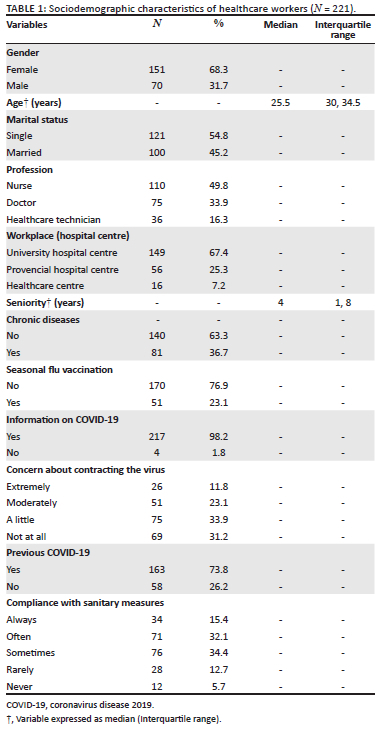
Around two-thirds of our participants were females (68.3%; n = 151), whereas males represented the remaining one-third (31.7%; n = 70), female to male ratio of 2.1. The median age of the participants was 25.5 years (30-34.5).
Among the 221 included in this survey, 49.8% (n = 110) were nurses, 26.7% (n = 59) were training residents, 16.3% (n = 36) were laboratory technicians, 3.6% (n = 8) were specialist physicians, 2.3% (n = 5) were general physicians and 1.4% (n = 3) were specialist physicians and university professors.
In terms of the distribution of healthcare professionals included according to the most common departments, 19.9% (n = 44) of them worked in the laboratory, 10.4% (n = 23) in neonatology, 8.1% (n = 18) in psychiatry, 7.7% (n = 17) in nephrology and 5.9% (n = 13) in the department of anaesthesia and intensive care.
Vaccination profile and perception of coronavirus disease 2019 vaccination
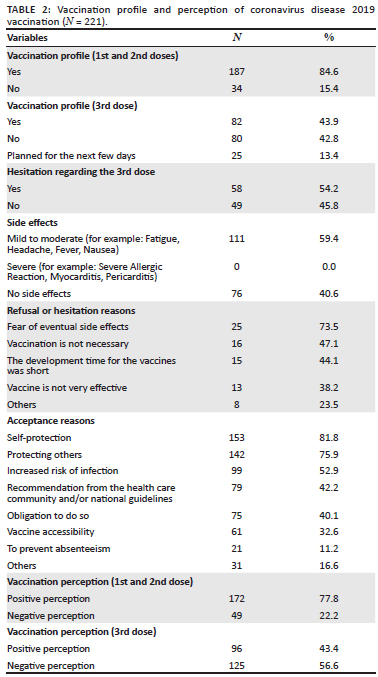
Vaccination coverage in the sample was rated at 84.6% (n = 187), of which 59.4% (n = 111) developed adverse events. Vaccinated participants who received the third dose of the vaccine, represented 42.8% (n = 80) of all immunised respondents. However, 15.4% (n = 34) did not receive any vaccine and are considered unvaccinated.
The positive perception of SARS CoV-2 vaccines decreased from 77.8% (n = 172) for the first two doses to 43.4% (n = 96) for the third dose. The population of vaccinated subjects expressed a better perception of the vaccine doses, with a positive perception for the 1st and 2nd doses of 90.4% (n = 169) and 51.3% (n = 96) for the 3rd dose. However, this perception of the first of the two doses did not exceed 10% for the non-vaccinated population (8.8%; n = 3) and who were all against the third dose.
Fear of eventual side effects was the most frequent reason cited for non-acceptance or hesitation regarding vaccination against COVID-19 (73.5%; n = 25). On the other hand, self-protection (81.8%; n = 153) and protecting others and/or patients (75.9%; n = 142) were the most frequently cited reasons to accept the vaccine.
Opinions and level of social responsibility regarding vaccination
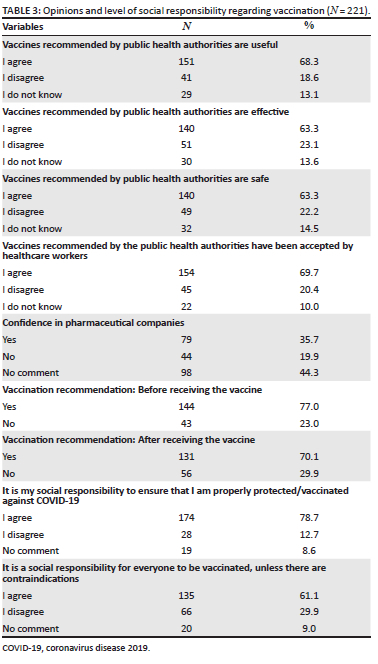
In order to understand the opinion of healthcare professionals on vaccines against COVID-19, the following investigations were conducted. With regard to the latter, 68.3% (n = 151) of respondents considered these vaccines to be useful, 63.3% (n = 140) assumed that they were effective, and 63.3% (n = 140) indicated that these vaccines were safe. Furthermore, 69.7% (n = 154) of the interviewees felt that the vaccines were well accepted by healthcare workers. With an additional aim of examining the degree of social responsibility among our healthcare professionals, the following questions were posed: 'It is my social responsibility to ensure that I am properly protected/vaccinated against COVID-19'; 'It is a social responsibility for everyone to be vaccinated, unless there are contraindications'. We note that 78.7% (n = 174) of healthcare professionals expressed their agreement with the first suggestion and 61.1% (n = 135) with the second.
Overview of the psychological aspects of vaccination
In terms of psychological aspects of vaccination, the scales used to measure the severity of anxiety, perceived stress and insomnia reported that 8.6% (n = 19) of participants had mild or moderate to severe anxiety, 51.6% (n = 114) had moderate to high stress and 14.5% (n = 32) had moderate to severe insomnia.
Table 1, Table 2 and Table 3 summarise the descriptive results of data distribution in our sample.
Factors of stress related to vaccination in emergency situations
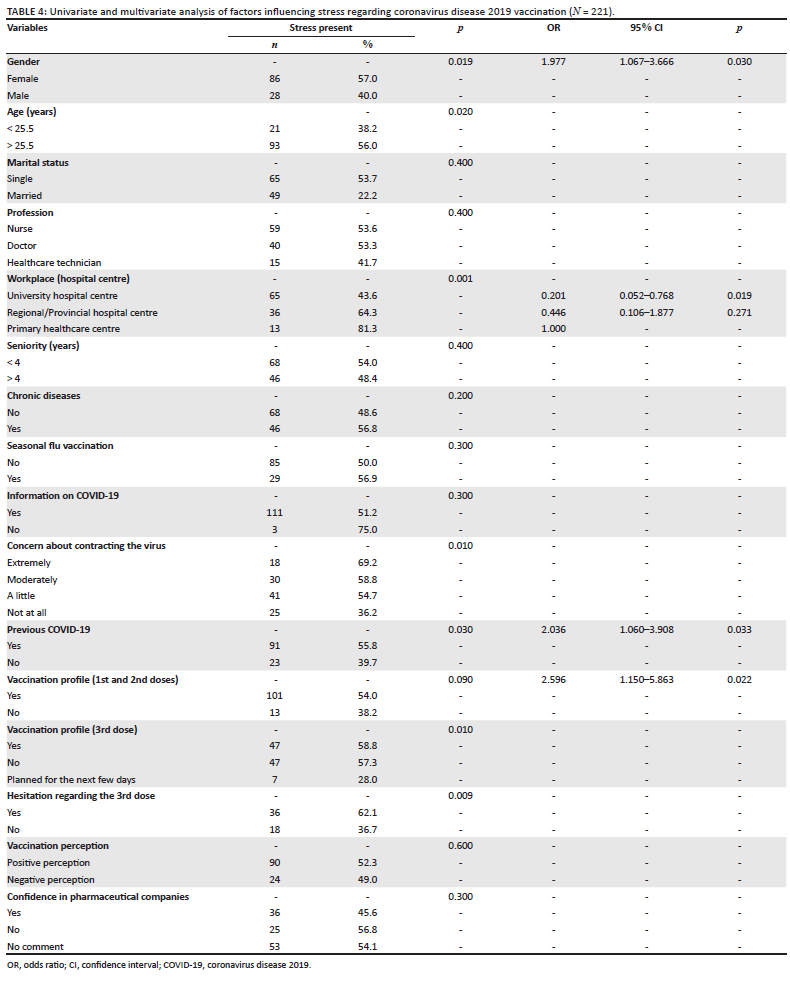
The analysis of participants' findings indicates that females were more susceptible to vaccine-related stress than males (57% vs. 40%, p = 0.019). Additionally, stressed subjects tended to be older than 25.5 years (56.0% vs. 38.2 %, p = 0.02). Participants who presented with a higher level of stress were mainly nurses (53.6%, p = 0.4) and unmarried participants (53.7%, p = 0.4). Yet, the observed differences are not sufficiently significant. On the other hand, healthcare professionals based in university hospital centre were significantly less stressed than those working in regional and/or provincial hospital centre or primary healthcare centre (43.6% vs. 64.3% vs. 81.3%, p = 0.001).
The relationship between healthcare professionals and the SARS-CoV-2 virus was marked by a significant level of stress, and this was true, in the group with a high level of fear towards the virus (69.2%, p = 0.01). Levels of stress decreased successively with the level of fear, and participants with no fear of contracting the virus were classified as the less stressed (36.2%). In the same way, the stress levels were higher among respondents who complied with sanitary measures than among those who did not. However, the difference was not significant (p = 0.1). In addition, participants with a previous COVID-19 infection expressed a higher level of stress than those who had not been contaminated (55.8% vs. 39.7%, p = 0.03).
With regard to vaccination profile, healthcare professionals who received their first two doses were declared to be more stressed than non-vaccinated professionals (p = 0.09). Furthermore, recipients of a third dose, were found to experience a higher level of perceived stress than non-recipients, or those who were interested in a third dose of the COVID-19 vaccine (p = 0.01). We note that participants who were reticent about the booster dose, were significantly more stressed (62.1%, p = 0.009).
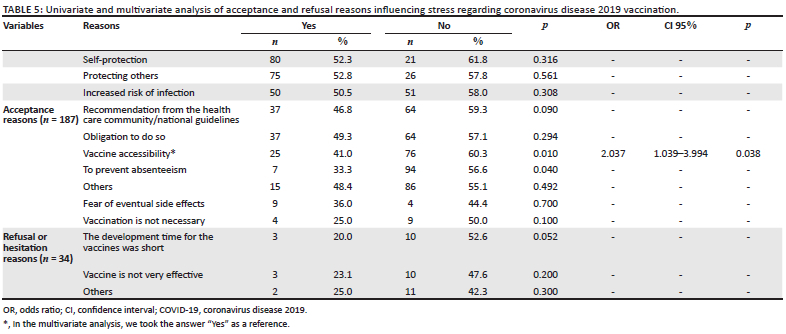
The acceptance reasons, for which differences were significant, with the least stress were: vaccine accessibility (p = 0.01), preventing absenteeism (p = 0.04), and vaccine recommendation from the healthcare community and/or national guidelines (p = 0.09). In the same way, the proportion of healthcare professionals who declined to be vaccinated and who considered the vaccine development time was brief expressed significantly less stress than the others (p = 0.052).
Based on the perception section, respondents with a positive attitude towards the first two doses of the vaccine expressed a higher level of stress than those with a negative perception. On the other hand, the proportion of healthcare professionals with a negative perception of the booster dose was higher in the category of stressed respondents. Nevertheless, the differences observed are largely non-significant (p = 0.6, p = 0.8).
No significant association was observed between the degree of social responsibility of healthcare professionals and stress regarding vaccination.
Binary logistic regression analysis findings
The binary logistic regression results indicated that females were 1.98 times more susceptible to experiencing vaccination stress (95% confidence interval [CI]: [1.067-3.666], p = 0.03). Furthermore, vaccination profile (OR: 2.596, 95% CI: [1.150-5.863], p = 0.02), having a previous COVID-19 infection (OR: 2.036, 95% CI: [1.060-3.908], p = 0.03), and accepting the vaccine for any reason other than its accessibility (OR: 2.037, 95% CI: [1.039-3.994], p = 0.03), were significantly associated with stress. In contrast, healthcare professionals based at the university hospital had a significant lower stress level (OR: 0.201, 95% CI: [0.052-0.768], p = 0.01).
Table 4 and Table 5 summarise the findings of the binary logistic regression analysis of stress-related risk factors in relation to vaccination.
Discussion
The decision to vaccinate is a behavioural intention, based on a series of behavioural and social factors. According to Brewer and his collaborators, there are two main possible motivational factors for vaccination.1
We carried out this survey to understand the interactions between various factors influencing immunisation compliance. The component related to vaccination confidence among healthcare professionals was examined, as the quality of care depends on the health of the caregivers.
Gender, rather than sex, was considered in this study in order to determine the socio-cognitive factors influencing healthcare professionals' attitudes and behaviour.19
According to the analysis of the findings, gender had a significant impact on vaccination stress level. Indeed, female healthcare workers developed more significant stress (p = 0.019). Such a divergence in terms of mental health between the two genders has been observed in the literature.20,21,22,23242421121225,26212721
Age was another socio-demographic variable significantly associated with vaccination stress. From our analytical data, older healthcare professionals included in this study tended to be more stressed than younger ones. Previous studies, with divergent results, had pointed to the relationship between age and vaccination behaviour.21,23,28,292930
Additional demographic variables were identified in this study that seem to be associated with psychological aspects of immunisation behaviour, such as occupation and workplace. Indeed, while not significant, laboratory technicians were the least stressed group compared with doctors and nurses. This observation is in line with previous surveys, in which nurses and doctors were more reticent about vaccines.23,31,321532
On the other hand, healthcare professionals practicing in the university hospital centre presented a significant lower stress level, compared with that developed within the regional/provincial centres and the primary healthcare centres. Since the start of the pandemic in Morocco, the majority of COVID-19 patients have been hospitalised in university hospitals. This allowed healthcare professionals in the university hospitals to become more accustomed to COVID-19 infections, while reducing their concerns about the virus. This practice may have allowed them to familiarise with sanitary measures to protect themselves, including vaccination, and therefore to develop a positive vaccination behaviour. This highlights the need to offer psychological support to healthcare professionals in other centres to improve immunisation coverage.
Other interesting outcomes identified in this study include the impact of concern about the SARS-CoV-2 virus on the level of stress associated with vaccination. Such an association has previously been reported in previous studies, emphasising the effect of complacency as one of five psychological antecedents susceptible to influence an individual's decision to vaccinate.33,34,3533
Results from this study have also highlighted the impact of a previous history of COVID-19 on the level of stress associated with vaccination. Indeed, participants with a previous COVID-19 infection expressed a more remarkable stress. These results are consistent with a previous study conducted among healthcare professionals, where the cumulative anxiety score was significantly higher in the group of healthcare providers with a positive history of COVID-19 infection.3637,38,39,403933
The impact of the vaccination profile on stress levels towards vaccination was evaluated. According to the results, vaccinated healthcare professionals had a slightly higher level of stress than non-immunised ones (p = 0.09). The difference was more significant for the booster dose, and the vaccinated group remained the most stressed (p = 0.01), with a higher stress level among the reluctant group (p = 0.009). We note that vaccination rate went from 84.6% for the first two doses, to 43.9% for the booster dose, with a decline of more than 50%. Such an outcome was not expected from healthcare professionals, given their profession and experience and as they assumed that the vaccines recommended by the public health authorities were useful, effective and safe. These observations are consistent with the findings of a previous study carried out among young adults in Morocco, where the percentage of stressed participants within the group vaccinated with the third dose was significantly higher.2941
Furthermore, no significant association was reported between immunisation perception and stress towards SARS-CoV-2 vaccines. Nevertheless, our findings indicate that stress was higher among healthcare workers with a positive perception of vaccination. Previous research has revealed the link between the psychology of vaccination behaviour, as well as vaccine perception and acceptance.29,36364243,44454647,48
The data also highlighted a significantly lower level of stress, among participants who agreed to be vaccinated because of its accessibility (p = 0.01), to avoid absenteeism (p = 0.04) and because the vaccine is recommended by the healthcare community and/or national guidelines (p = 0.09). A survey of Moroccan healthcare professionals identified self-protection, others and patients protection as the most cited reasons for vaccine acceptance.4950,5129
Vaccine recommendation by the healthcare community and/or national guidelines appeared among the reasons for acceptance with the least association with stress. Previous investigations indicate that healthcare workers are more motivated to vaccinate when the vaccine is recommended by doctors as well as healthcare and public health authorities.49,52
Participants who considered that immunisation could contribute to prevent absenteeism also expressed a lower level of stress. This result is in line with the conclusions of a critical review, which suggested that healthcare professionals have a more altruistic attitude to vaccination.51
In the same way, the refusal reason with the least association with stress was the rapid development and approval of COVID-19 vaccines. Previous studies indicated that fear of potential side effects and complacency were cited as the main reasons for hesitation and/or refusal regarding vaccination.33,49
Limitations of the study
We are conscious of the limitations of our investigation as the cross-sectional nature of the study design may not allow the establishment of causality between stress and its relationship with vaccine willingness and actual future vaccination. Furthermore, snowball sampling, while effective for reaching hard-to-access populations, has notable limitations. It may introduce sampling bias because of its reliance on participants recruiting acquaintances, potentially resulting in a sample that lacks diversity and does not fully represent the broader population. This method can also lead to a homogeneous sample in terms of social or professional characteristics, which may limit generalisability. In addressing the limitations of the psychological scales used to measure anxiety and stress in our study, it is important to acknowledge that these tools, while widely used, have certain constraints that may impact the results. For instance, the validity and reliability of these scales can vary, potentially influencing the consistency and generalisability of the findings. The measurement tools used in our study might not fully capture the complexity of stress and anxiety, leading to potential underestimation or overestimation of these psychological states. Furthermore, the timing of the study could also lead to errors, as the perception of vaccination could change with the pandemic health situation.
Nevertheless, given the absence of studies examining the potential factors associated with vaccination stress among Moroccan healthcare professionals, the findings of the present study remain of considerable significance.
Conclusion
This survey revealed that Moroccan healthcare professionals exhibited a high level of vaccine acceptance and positive perceptions, especially among those who were vaccinated, despite experiencing relatively high levels of stress related to immunisation. It challenges the common misconception that healthcare workers, because of their scientific and medical training, automatically hold positive attitudes towards vaccinations. These findings underscore the need for governments and policymakers to develop targeted interventions that not only enhance healthcare workers' awareness and knowledge about the value of vaccination but also address their mental health and stress levels associated with immunisation.
To improve vaccination strategies among healthcare workers, public health policies should include comprehensive educational programs that address both the benefits of vaccination and strategies to mitigate stress and anxiety related to immunisation. Furthermore, there is a need for institutional support systems to promote a positive vaccination culture within healthcare settings.
Future research should explore the specific cultural, social and psychological factors contributing to stress towards vaccination among healthcare professionals. To advance our understanding of the relationship between vaccination behaviour and stress regarding immunisation, future longitudinal research should be conducted to elucidate the causal mechanisms and temporal dynamics of this interaction. Additionally, studies could assess the effectiveness of targeted interventions in reducing stress and improving vaccination uptake and attitudes. By addressing these broader implications, our findings provide a foundation for informed public health strategies that support healthcare workers' well-being and promote higher vaccination rates within this critical group.
Competing interests
The authors declare that they have no financial or personal relationships that may have inappropriately influenced them in writing this article.
Authors' contributions
N.E.H.B. designed the study, distributed the questionnaire and wrote the manuscript. S.R. and H.K. reviewed and edited the manuscript. B.O. validated psychological scale. N.A. and A.L. analysed data. Y.B. supervised the survey. N.E.H.B., S.R., H.K. and A.L., B.O., N.A. and Y.B. revised the manuscript. N.E.H.B., S.R., H.K., A.L., N.A, B.O. and Y.B. read and approved the final manuscript.
Funding information
This research received no specific grant from any funding agency in the public, commercial or not-for-profit sectors
Data availability
The data that support the findings of this study are available from the corresponding author, N.E.H.B. upon reasonable request.
Disclaimer
The views and opinions expressed in this article are those of the authors and are the product of professional research. It does not necessarily reflect the official policy or position of any affiliated institution, funder, agency or that of the publisher. The authors are responsible for this article's results, findings and content.
Acknowledgements
The authors would like to extend their heartfelt appreciation to Rim Benkaddour, for her invaluable assistance in refining the English language used in this manuscript. All the people who have actively contributed to this work have been cited. We would like to thank all the Moroccan healthcare workers who answered the questionnaire, and we express our deep gratitude to all the resident doctors in the laboratory of Epidemiology, Clinical Research and Public Health. This work is supported by CNRST Morocco under an excellence research grant.
References
-
1. Brewer NT, Chapman GB, Rothman AJ, Leask J, Kempe A. Increasing vaccination: Putting psychological science into action. Psychol Sci Public Interest. 2017;18(3):149-207. https://doi.org/10.1177/1529100618760521
» https://doi.org/10.1177/1529100618760521 -
2. Rancher C, Moreland AD, Smith DW, et al. Using the 5C model to understand COVID-19 vaccine hesitancy across a National and South Carolina sample. J Psychiatr Res. 2023;160:180-186. https://doi.org/10.1016/j.jpsychires.2023.02.018
» https://doi.org/10.1016/j.jpsychires.2023.02.018 -
3. Betsch C, Korn L, Sprengholz P, et al. Social and behavioral consequences of mask policies during the COVID-19 pandemic. Proc Natl Acad Sci U S A. 2020;117(36):21851-21853. https://doi.org/10.1073/pnas.2011674117
» https://doi.org/10.1073/pnas.2011674117 -
4. Wilson SL, Wiysonge C. Social media and vaccine hesitancy. BMJ Glob Health. 2020;5(10):e004206. https://doi.org/10.1136/bmjgh-2020-004206
» https://doi.org/10.1136/bmjgh-2020-004206 -
5. Neumann-Böhme S, Varghese NE, Sabat I, et al. Once we have it, will we use it? A European survey on willingness to be vaccinated against COVID-19. Eur J Health Econ. 2020;21(7):977-982. https://doi.org/10.1007/s10198-020-01208-6
» https://doi.org/10.1007/s10198-020-01208-6 -
6. Sun Y, Dai H, Wang P, et al. Will people accept a third booster dose of the COVID-19 vaccine? A cross-sectional study in China. Front Public Health. 2022;10:914950. https://doi.org/10.3389/fpubh.2022.914950
» https://doi.org/10.3389/fpubh.2022.914950 -
7. Chew NWS, Cheong C, Kong G, et al. An Asia-Pacific study on healthcare workers' perceptions of, and willingness to receive, the COVID-19 vaccination. Int J Infect Dis. 2021;106:52-60. https://doi.org/10.1016/j.ijid.2021.03.069
» https://doi.org/10.1016/j.ijid.2021.03.069 -
8. Gagneux-Brunon A, Detoc M, Bruel S, et al. Intention to get vaccinations against COVID-19 in French healthcare workers during the first pandemic wave: A cross-sectional survey. J Hosp Infect. 2021;108:168-173. https://doi.org/10.1016/j.jhin.2020.11.020
» https://doi.org/10.1016/j.jhin.2020.11.020 -
9. Kabamba Nzaji M, Kabamba Ngombe L, Ngoie Mwamba G, et al. Acceptability of vaccination against COVID-19 among healthcare workers in the Democratic Republic of the Congo. Pragmat Obs Res. 2020;11:103-109. https://doi.org/10.2147/POR.S271096
» https://doi.org/10.2147/POR.S271096 -
10. Reiter PL, Gilkey MB, Brewer NT. HPV vaccination among adolescent males: Results from the National Immunization Survey-Teen. Vaccine. 2013;31(26):2816-2821. https://doi.org/10.1016/j.vaccine.2013.04.010
» https://doi.org/10.1016/j.vaccine.2013.04.010 -
11. Reiter PL, McRee AL, Pepper JK, Gilkey MB, Galbraith KV, Brewer NT. Longitudinal predictors of human papillomavirus vaccination among a national sample of adolescent males. Am J Public Health. 2013;103(8):1419-1427. https://doi.org/10.2105/AJPH.2012.301189
» https://doi.org/10.2105/AJPH.2012.301189 - 12. Klein O, Yzerbyt V. Psychologie de la vaccination. Éditions de Université de Bruxelles; 2023.
-
13. Open Source Statistiques Épidémiologiques pour la Santé Publique. Taille d'échantillon pour une étude proportionnelle ou descriptive. 2013 [cited 2021 Nov 26]. Available from : http://www.openepi.com/SampleSize/SSPropor.htm
» http://www.openepi.com/SampleSize/SSPropor.htm -
14. Blanc P. Opdédpds. Vaccins: convaincre et innover pour mieux protéger [Internet]. Rapport n° 476. 2006-2007 [cited n.d.]. Available from: http://www.senat.fr/noticerap/2006/r06-476-notice.html
» http://www.senat.fr/noticerap/2006/r06-476-notice.html -
15. Parker C, Scott S, Geddes A. Snowball Sampling. London: Sage; 2019 [cited 2024 Oct 13]. Available from: https://methods.sagepub.com/foundations/snowball-sampling
» https://methods.sagepub.com/foundations/snowball-sampling -
16. Zung WW. A rating instrument for anxiety disorders. Psychosomatics. 1971;12(6):371-379. https://doi.org/10.1016/S0033-3182(71)71479-0
» https://doi.org/10.1016/S0033-3182(71)71479-0 -
17. Cohen S, Kamarck T, Mermelstein R. A global measure of perceived stress. J Health Soc Behav. 1983;24(4):385-396. https://doi.org/10.2307/2136404
» https://doi.org/10.2307/2136404 - 18. Morin CM. Insomnia: Psychological assessment and management. Guilford Press, New York, NY; 1993.
-
19. Verger P, Scronias D, Dauby N, et al. Attitudes of healthcare workers towards COVID-19 vaccination: A survey in France and French-speaking parts of Belgium and Canada, 2020. Euro Surveill. 2021;26(3):2002047. https://doi.org/10.2807/1560-7917.ES.2021.26.3.2002047
» https://doi.org/10.2807/1560-7917.ES.2021.26.3.2002047 -
20. Chi L, Zhao G, Chen N, et al. Comparison of predictors of COVID-19 vaccination intention between healthcare workers and non-healthcare workers in China. J Multidiscip Healthc. 2021;14:3597-3606. https://doi.org/10.2147/JMDH.S341326
» https://doi.org/10.2147/JMDH.S341326 -
21. Nur MI, Al-Mamun F, Yasmin F, et al. Psychological benefits of the COVID-19 vaccination: A Bangladeshi comparative study. Health Sci Rep. 2023;6(7):e1346. https://doi.org/10.1002/hsr2.1346
» https://doi.org/10.1002/hsr2.1346 -
22. Sandal A, Karadoğan D, Telatar TG, et al. Perceived need for mental health services among healthcare workers during the coronavirus disease-19 pandemic in Turkey: A multicenter cross-sectional study. Balkan Med J. 2023;40(4):262-270. https://doi.org/10.4274/balkanmedj.galenos.2023.2022-12-5
» https://doi.org/10.4274/balkanmedj.galenos.2023.2022-12-5 -
23. Sirikalyanpaiboon M, Ousirimaneechai K, Phannajit J, et al. COVID-19 vaccine acceptance, hesitancy, and determinants among physicians in a university-based teaching hospital in Thailand. BMC Infect Dis. 2021;21(1):1174. https://doi.org/10.1186/s12879-021-06863-5
» https://doi.org/10.1186/s12879-021-06863-5 -
24. Alam MD, Paul SK, Momi M, Ni L, Xu Y. Factors associated with psychological outcomes among vaccinated and unvaccinated health care workers against COVID-19 infection in Bangladesh. Front Med (Lausanne). 2022;9:852922. https://doi.org/10.3389/fmed.2022.852922
» https://doi.org/10.3389/fmed.2022.852922 -
25. Furman D, Hejblum BP, Simon N, et al. Systems analysis of sex differences reveals an immunosuppressive role for testosterone in the response to influenza vaccination. Proc Natl Acad Sci U S A. 2014;111(2):869-874. https://doi.org/10.1073/pnas.1321060111
» https://doi.org/10.1073/pnas.1321060111 -
26. Klein SL, Jedlicka A, Pekosz A. The Xs and Y of immune responses to viral vaccines. Lancet Infect Dis. 2010;10(5):338-349. https://doi.org/10.1016/S1473-3099(10)70049-9
» https://doi.org/10.1016/S1473-3099(10)70049-9 -
27. Mesch GS, Schwirian KP. Social and political determinants of vaccine hesitancy: Lessons learned from the H1N1 pandemic of 2009-2010. Am J Infect Control. 2015;43(11):1161-1165. https://doi.org/10.1016/j.ajic.2015.06.031
» https://doi.org/10.1016/j.ajic.2015.06.031 -
28. Shekhar R, Sheikh AB, Upadhyay S, et al. COVID-19 vaccine acceptance among health care workers in the United States. Vaccines (Basel). 2021;9(2):119. https://doi.org/10.3390/vaccines9020119
» https://doi.org/10.3390/vaccines9020119 -
29. Benkaddour NEH, Khalil H, Lekfif A, Abda N, Oneib B, Bentata Y. A psychological insight of Moroccan adults' immunisation behaviour towards emergency vaccines. Afr J Prim Health Care Fam Med. 2024;16(1):e1-e10. https://doi.org/10.4102/phcfm.v16i1.4353
» https://doi.org/10.4102/phcfm.v16i1.4353 -
30. Kerekes S, Ji M, Shih SF, et al. Differential effect of vaccine effectiveness and safety on COVID-19 vaccine acceptance across socioeconomic groups in an international sample. Vaccines (Basel). 2021;9(9):1010. https://doi.org/10.3390/vaccines9091010
» https://doi.org/10.3390/vaccines9091010 -
31. Browne SK, Feemster KA, Shen AK, et al. Coronavirus disease 2019 (COVID-19) vaccine hesitancy among physicians, physician assistants, nurse practitioners, and nurses in two academic hospitals in Philadelphia. Infect Control Hosp Epidemiol. 2022;43(10):1424-1432. https://doi.org/10.1017/ice.2021.410
» https://doi.org/10.1017/ice.2021.410 -
32. Ahamed SHR, Shakil S, Lyu H, Zhang X, Luo J. Doctors vs. nurses: Understanding the great divide in vaccine hesitancy among healthcare workers. Proc IEEE Int Conf Big Data. 2022;2022:5865-5870. https://doi.org/10.1109/bigdata55660.2022.10020853
» https://doi.org/10.1109/bigdata55660.2022.10020853 -
33. Abdou MS, Kheirallah KA, Aly MO, et al. The coronavirus disease 2019 (COVID-19) vaccination psychological antecedent assessment using the Arabic 5c validated tool: An online survey in 13 Arab countries. PLoS One. 2021;16(11):e0260321. https://doi.org/10.1371/journal.pone.0260321
» https://doi.org/10.1371/journal.pone.0260321 -
34. Omer I, Alhuzali A, Aletani T, Althagafi Z, Ghulam E, Awadh A. Vaccine hesitancy among medical students at a tertiary hospital-affiliated medical school. Healthcare (Basel). 2023;11(4):461. https://doi.org/10.3390/healthcare11040461
» https://doi.org/10.3390/healthcare11040461 -
35. Wang H, Huang YM, Su XY, et al. Acceptance of the COVID-19 vaccine based on the health belief model: A multicenter national survey among medical care workers in China. Hum Vaccin Immunother. 2022;18(5):2076523. https://doi.org/10.1080/21645515.2022.2076523
» https://doi.org/10.1080/21645515.2022.2076523 -
36. Alalawi M, Makhlouf M, Hassanain O, Abdelgawad AA, Nagy M. Healthcare workers' mental health and perception towards vaccination during COVID-19 pandemic in a Pediatric Cancer Hospital. Sci Rep. 2023;13(1):329. https://doi.org/10.1038/s41598-022-24454-5
» https://doi.org/10.1038/s41598-022-24454-5 -
37. Abate BB, Tilahun BD, Yayeh BM. Global COVID-19 vaccine acceptance level and its determinants: An umbrella review. BMC Public Health. 2024;24(1):5. https://doi.org/10.1186/s12889-023-17497-4
» https://doi.org/10.1186/s12889-023-17497-4 -
38. Wang Q, Yang L, Jin H, Lin L. Vaccination against COVID-19: A systematic review and meta-analysis of acceptability and its predictors. Prev Med. 2021;150:106694. https://doi.org/10.1016/j.ypmed.2021.106694
» https://doi.org/10.1016/j.ypmed.2021.106694 -
39. Shakeel CS, Mujeeb AA, Mirza MS, Chaudhry B, Khan SJ. Global COVID-19 vaccine acceptance: A systematic review of associated social and behavioral factors. Vaccines (Basel). 2022;10(1):110. https://doi.org/10.3390/vaccines10010110
» https://doi.org/10.3390/vaccines10010110 -
40. Sallam M. COVID-19 vaccine hesitancy worldwide: A concise systematic review of vaccine acceptance rates. Vaccines (Basel). 2021;9(2):160. https://doi.org/10.3390/vaccines9020160
» https://doi.org/10.3390/vaccines9020160 -
41. Alalawi M, Alsalloum MA, Garwan YM, et al. COVID-19 vaccine hesitancy among healthcare workers in Arab Countries: A systematic review and meta-analysis. PLoS One. 2024;19(1):e0296432. https://doi.org/10.1371/journal.pone.0296432
» https://doi.org/10.1371/journal.pone.0296432 -
42. Betsch C, Schmid P, Heinemeier D, Korn L, Holtmann C, Böhm R. Beyond confidence: Development of a measure assessing the 5C psychological antecedents of vaccination. PLoS One. 2018;13(12):e0208601. https://doi.org/10.1371/journal.pone.0208601
» https://doi.org/10.1371/journal.pone.0208601 -
43. Al-Sanafi M, Sallam M. Psychological determinants of COVID-19 vaccine acceptance among healthcare workers in Kuwait: A cross-sectional study using the 5C and vaccine conspiracy beliefs scales. Vaccines (Basel). 2021;9(7):701. https://doi.org/10.3390/vaccines9070701
» https://doi.org/10.3390/vaccines9070701 -
44. Leung CLK, Li KK, Wei VWI, et al. Profiling vaccine believers and skeptics in nurses: A latent profile analysis. Int J Nurs Stud. 2022;126:104142. https://doi.org/10.1016/j.ijnurstu.2021.104142
» https://doi.org/10.1016/j.ijnurstu.2021.104142 -
45. Christou-Ergos M, Wiley KE, Leask J. Association between traumatic life events and vaccine hesitancy: A cross-sectional Australian study. Public Health. 2023;216:1-6. https://doi.org/10.1016/j.puhe.2022.12.008
» https://doi.org/10.1016/j.puhe.2022.12.008 -
46. Wu Z, Wang X, Zhang S, et al. Do attitudes, mental health status, and interpersonal factors predict COVID-19 vaccine hesitancy at the early phase of the pandemic? A longitudinal study in Chinese college students. Front Psychol. 2022;13:876116. https://doi.org/10.3389/fpsyg.2022.876116
» https://doi.org/10.3389/fpsyg.2022.876116 -
47. Szilagyi PG, Thomas K, Shah MD, et al. National trends in the US public's likelihood of getting a COVID-19 vaccine-April 1 to December 8, 2020. JAMA. 2020;325(4):396-398. https://doi.org/10.1001/jama.2020.26419
» https://doi.org/10.1001/jama.2020.26419 - 48. MacDonald NEJV. Vaccine hesitancy: Definition, scope and determinants. Vaccine. 2015;33(34):4161-4164.
-
49. Khalis M, Hatim A, Elmouden L, et al. Acceptability of COVID-19 vaccination among health care workers: A cross-sectional survey in Morocco. Hum Vaccin Immunother. 2021;17(12):5076-5081. https://doi.org/10.1080/21645515.2021.1989921
» https://doi.org/10.1080/21645515.2021.1989921 -
50. Burrowes SAB, Casey SM, Dobbins S, et al. Healthcare workers' perspectives on the COVID-19 vaccine and boosters for themselves, their patients, and their communities: A mixed methods study. Z Gesundh Wiss. 2024;32:123-136. https://doi.org/10.1007/s10389-022-01793-1
» https://doi.org/10.1007/s10389-022-01793-1 -
51. Yaqub O, Castle-Clarke S, Sevdalis N, Chataway J. Attitudes to vaccination: A critical review. Soc Sci Med. 2014;112:1-11. https://doi.org/10.1016/j.socscimed.2014.04.018
» https://doi.org/10.1016/j.socscimed.2014.04.018 -
52. Huang Y, Su X, Xiao W, et al. COVID-19 vaccine hesitancy among different population groups in China: A national multicenter online survey. BMC Infect Dis. 2022;22(1):153. https://doi.org/10.1186/s12879-022-07111-0
» https://doi.org/10.1186/s12879-022-07111-0

Accepted: 17 Oct. 2024
Published: 24 Jan. 2025