Barriers and facilitators of incorporating Ubuntu principles in the integrated management of childhood illness
Abstract
BACKGROUND: Success in incorporating Ubuntu principles in the integrated management of childhood illness (IMCI) requires collaboration between health professionals and families and assistance from their communities. Despite this, the literature reviewed is silent about exploring caregivers' perspectives regarding the barriers and facilitators of incorporating Ubuntu principles in managing childhood illness. AIM: The study explored and described the barriers and facilitators of incorporating Ubuntu principles in managing childhood illness. SETTING: The study was conducted in selected primary healthcare settings, community health centres and clinics in the Mafikeng sub-district of the North West province. METHODS: The study was conducted using exploratory descriptive contextual, qualitative design. The 36 participants were selected using purposeful sampling. Data were collected through focus group discussions, and thematic analysis was used to analyse the data RESULTS: The study revealed three themes: the negative attitude of professional nurses, communication barriers and facilitators enhancing the incorporation of Ubuntu into IMCI. The findings indicated that health education of caregivers is crucial, the right allocation of nurses will facilitate the inclusion of Ubuntu into IMCI and the unannounced visit of government authorities will also facilitate the incorporation. CONCLUSION: The study illustrated that caregivers face several barriers hindering the incorporation of Ubuntu in IMCI. These findings support the need for healthcare providers to prioritise the incorporation of Ubuntu principles for better management of childhood illness for children under the age of five. CONTRIBUTION: This is the first study to report the barriers and facilitators of incorporating Ubuntu principles into IMCI.
barriers; caregivers; facilitators; IMCI; Ubuntu
Introduction
Globally, efforts are needed to reduce childhood mortality and foster children's optimal growth and development rather than solely emphasising access to healthcare. To achieve this, the World Health Organization (WHO), the United Nations Children's Fund (UNICEF) and other partners developed the Integrated Management of Childhood Illness (IMCI) in the mid-1990s.1233umuntu umuntu ngabantu, which means 'a human being is through their relationship with others'. This best expresses the emphasis on communal relationships.4ubuntu, which means being human, in Southern Nguni languages, and it is common among, including amaZulu, amaXhosa, MaSwati and amaNdebele. Bapedi, Basotho and Batswana have a similar phrase 'botho'.
Ubuntu philosophy has different principles.5657
Ubuntu principles have been incorporated into different interventions to promote quality care among Africans.48957
Contrary to these, studies have revealed somewhat toxic relations between nurses and patients. The current study was conducted at a time when there were reports about nurses neglecting patients' needs and dehumanising patients, especially in primary healthcare settings in public healthcare facilities.101111
Research methods and design
Study design
A qualitative exploratory descriptive contextual design was followed to explore and describe the caregiver's perspectives on the barriers and facilitators of incorporating Ubuntu principles in management of childhood illness. In order to further grasp the nature of the problem, an exploratory research methodology was employed.1213
Study setting
The study was conducted in public primary healthcare (PHC) facilities, which are two community health care (CHC) centres and three clinics in the Mafikeng sub-district region of the North West province. The researchers choose these facilities because they have high headcounts on children under the age of five. The two CHC centres operate for 24 h, and the three clinics operate for 8 h a day. The study was conducted in the setting preferred by caregivers because, during the planning of the data collection, they indicated that it would be advantageous for the researcher to collect data where those under 5 years old are cared for at their convenience as those clinics and CHC centres are near their homes.
Study population and sampling strategy
The target population of the study consisted of caregivers of children under 5 years old seeking care in PHC facilities. The inclusion criteria included any caregivers and/or guardians caring for a child under 5 years old and consulting in nearby clinics or CHC centres in Mafikeng sub-districts. Non-probability purposive sampling was used to sample eligible caregivers who would participate in the study. The caregivers who had just given birth and nursing children for less than a month were excluded from participating in the study. The sample size was achieved through data saturation after conducting six focus group discussions (FGDs) with 36 caregivers in different facilities.
Data collection
The researcher used FGDs with more than eight caregivers in each facility to collect data. Identification and engagement of caregivers as a first step was achieved. The caregivers were 18 years and older, and brought their children for immunisation services at the identified PHC facilities in the Mafikeng sub-district. The purpose of the study was explained to the caregivers in their language of preference, which mainly was Setswana. The researcher then explained to the caregivers the questions that would be asked. A research question emerged from the caregivers answers based on their concerns even though the researcher had a research question in mind. The informed consent was obtained from caregivers, and the information sheet was written in Setswana. This was to ensure that caregivers understand their rights, roles and the implications of their participation in the study, allowing them to make more informed decisions. The central question posed was: what are caregivers' views on barriers to incorporating Ubuntu principles in IMCI.
Focus group discussion (FGD) as a technique to collect data was chosen collectively. Throughout the FGDs, the researcher employed interview skills by probing, paraphrasing and asking questions to clarify issues.13
Data analysis
Data were analysed using thematic data analysis methods. Thematic analysis is a qualitative data analysis method that involves searching a data set for repeated patterns and analysing and reporting on them.1415
Trustworthiness
In this study, the researchers adhered to the trustworthiness criteria through credibility, dependability, confirmability, transferability and authenticity to ensure quality.141616
Ethical considerations
Ethical clearance to conduct the study was obtained from the University of Pretoria, Faculty of Health Sciences Research Ethics Committee (REC) (No. 617/2022). Written permission was obtained from the North West Department of Health (NWDoH). Permission was also obtained from the operational managers of CHC clinics and clinics of the Mafikeng sub-district in the North West province. The caregivers in the study voluntarily agreed to participate and were given an informed consent form to sign. The purpose of the study was fully explained to the caregivers. The informed consent form explained that their participation was voluntary and that they could withdraw from the study without being punished or discriminated against. For anonymity, privacy and confidentiality, caregivers were told that no names would be used, whereby only alphabets were used. The researcher gave caregivers cards with alphabets representing them to avoid using names, thus adhering to the principle of anonymity. The FGD was held in a quiet boardroom within the building, and a 'do not disturb' sign was placed on the door during the procedure. The use of tape recorder was explained to the caregivers.
Results
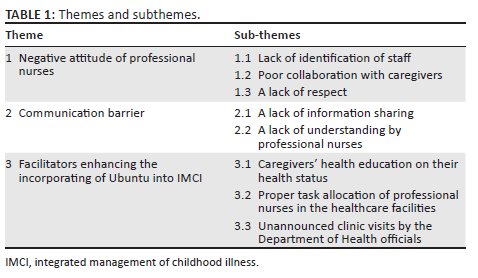
The study focussed on the perceptions of 36 caregivers who were divided into focus groups across five healthcare facilities. The FGDs were based on the caregivers' views on incorporating Ubuntu principles into IMCI. The results of this study are presented under themes and sub-themes (see Table 1), with quotations of the participants to support the findings of this study.
Theme 1: Negative attitude of professional nurses
The findings of this study illustrated that professional nurses' negative attitude towards caregivers is one of the barriers hampering the incorporation of Ubuntu into IMCI. This theme had three sub-themes: lack of identification of staff, poor collaboration with the caregivers and lack of respect. The sub-themes that emerged from the negative attitude of professional nurses are described next, supported by quotations from the caregivers.
Sub-theme 1.1 Lack of identification of staff
One of the aspects that the caregivers noticed as barriers hampering the inclusion of Ubuntu is the lack of privacy while receiving care. The caregivers highlighted that while patients are receiving care, other healthcare providers would be present in the consultation room, and it is unclear what their responsibilities are. This lack of privacy results in concerns for caregivers as they feel uncomfortable and, as a result, impedes the quality of treatment they receive. The following direct quotations confirm the finding:
'There's no privacy, and you are not given the feeling of comfort. Sometimes, other mothers are in the room, and you cannot answer some of the questions and end up withholding.' (Caregiver 8, female, 36, student FGD2)
'And there are always many nurses in the room, and we do not know their role …' (Caregiver 6, female, 32, unemployed FGD2)
Sub-theme 1.2 Poor collaboration with caregivers
The caregivers expressed frustration and indicated that professional nurses would attend, examine the baby and not include them in the examination. The nurses would keep quiet and not update the mother on what they found on the child or what was wrong with the child. They would continue as if the mother or caregiver was not present. They indicated that this is one of the barriers hampering the incorporation of Ubuntu into IMCI. They elaborated:
'… and a nurse would just take your child a mo tlhatlhobe (Examines the baby) and won't even tell you as a mother what s/he saw or found on your child and how to further care for the baby when at home.' (Caregiver 2, female, 27, unemployed FGD2)
'Nurses don't give you a chance as a mother to ask questions about your child's health when they are done examining the child. The way I see it, they think we are questioning them.' (Caregiver 7, female, 34, unemployed FGD3)
Sub-theme 1.3 A Lack of respect
The findings of this study illustrated that caregivers experience disrespectful communication from professional nurses when they bring their children for IMCI to healthcare facilities. Professional nurses mainly shout and blame them when they make mistakes with their children. The caregiver expressed the following:
'They will shout at you, looking at your child/baby with disrespect or a belittled look. You end up not talking about your problems. When you ask for that help, they shout at you, and when you greet them, they don't answer.' (Caregiver 5, female, 29, unemployed FGD1)
'On the other hand, the nurses haven't been the same since I've been at this clinic. I remember one instance where I showed up on time, then got delayed as I waited in the queue and received assistance or service around 13:00. They were shouting at me, refusing to acknowledge their mistake. We argued.' (Caregiver 1, female, 26, unemployed FGD4)
'They shouted at me the other time when I brought my baby to the clinic, and the baby made a poop while on the scale. The professional nurse blamed me as if I said my son must do that. They must respect us. They won't greet you or introduce themselves.' (Caregiver 5, female, 40, unemployed FGD4)
The caregivers indicated that professional nurses are uninterested and cannot comprehend the circumstances or reasons behind caregivers' actions. Healthcare providers are quick to judge, and some event resort to yelling at them. In most cases, they ignore caregivers and some do not even respond to greetings.
Theme 2: Communication Barrier
The second theme in incorporating Ubuntu into IMCI was the communication barrier. The following two sub-theme emerged from this theme: a lack of information sharing and a lack of patience and understanding of caregivers by professional nurses.
Sub-theme 2.1 A lack of information sharing
The caregivers highlighted that they hardly get enough information concerning their children's health. Nurses do not educate caregivers on issues concerning their children, and because of a lack of communication, they are usually afraid to ask when they have a concern:
'Sometimes we skip the dates for immunisations because the importance is not well explained, and I wish nurses would share updates on my baby's condition without me having to ask.' (Caregiver 7, female, 29, cashier FGD4)
Another caregiver added:
'I often feel left in the dark about my child's treatment options. Clear information from nurses would help me feel in control as a mother.' (Caregiver 7, female, 30, unemployed FGD2)
Sub-theme 2.2 A lack of understanding by professional nurses
The caregivers further highlighted that professional nurses lack understanding when caring for children who are under 5 years old, and this practice hinders the incorporation of Ubuntu in IMCI. In addition to affecting them and their child's care, carers emphasised that social factors may cause them to miss vaccination or follow-up appointments. Therefore, professional nurses should be patient and understanding when explaining their circumstances. The participants stated the following in this regard:
'Nurses, when it is lunchtime, they don't consider that we came very early, and some of us live far from the clinic, and we walk. All of them take a break at the same time without considering us.' (Caregiver 7, female, 30, unemplyed FGD3)
'What I find frustrating is that they don't get the difficulties we face as mothers - financial and social challenges that affect our clinic attendance or return visits. For example, if the grandma is taking care of the child while I am out looking for a job, she might be unable to take the child to the clinic because of their age. They should be aware of these difficulties when we clarify that sometimes there are valid reasons.' (Caregiver 8, female, 33, unemployed FGD1)
The above-stated quotations illustrate that the negative attitudes displayed by professional nurses impact the services provided to caregivers and their children and hamper the incorporation of Ubuntu principles in IMCI.
Theme 3: Facilitators enhancing the incorporation of Ubuntu into integrated management of childhood illness
The facilitators improving the incorporation of Ubuntu into IMCI have been identified as a theme. The following sub-themes emerged to support the main theme: caregiver's health education on their health status, proper task allocation of professional nurses in the healthcare facilities and unannounced clinic visits by the Department of Health officials.
Sub-theme 3.1 Caregiver's health education on their health status
Health education by professional nurses to caregivers was emphasised as one aspect that would enhance Ubuntu in IMCI. The caregivers expressed the need for health information on their health status and how they are expected to care for their children at home. There is a need for information concerning the health card. They were concerned, as they did not know the importance of this card. What they knew was that it was for immunisations. The following statements confirm this:
'[W]e will appreciate at least if one nurse can educate us on the health issues of children under five while outside and waiting in the queue. It will show they care, and we can benefit…mmh.' (Caregiver 5, female, 29, unemployed FGD1)
'In addition, health talks will benefit us, and they should allow us to ask questions when we don't understand issues concerning our children's health because this will help us see change and seek help on time.' (Caregiver 3, female, 26, temporary employed FGD1)
Sub-theme 3.2 Proper task allocation of professional nurses in the healthcare facilities
Proper daily task allocation to different programmes in the facility was referred to as one of the enablers of the incorporation of Ubuntu in IMCI. Caregivers mentioned that professional nurses often appear unhappy with the task allocation. To attend to sick children, they get irritated by minor things such as a crying baby, the nurse will then shout at the mother and say the baby is making noise. In other instances, the professional nurse will not be gentle towards their babies during vaccination. This is evident from the following direct quotation:
'Every nurse must be placed or allocated to a task or section within the clinic according to their ability and passion because they will do their best and work harmoniously with patients. I feel a nurse who is not compassionate about children should not be placed at the child clinic as they become impatient with our children and complain that our kids are crying a lot.' (Caregiver 4, female, 38, unemployed FGD1)
'[A] nurse will attend to our children passionately because when someone does something that bores her/him, she gets irritated. You can even see how they handle our babies when we bring them for immunisation.' (Caregiver 7, FGD 1)
'Let nurses do what they enjoy and love so that they can enjoy working with people. Nurses will [provide your child with undivided attention when assigned to their preferred activities]'. (Caregiver 2, female, 24, unemployed FGD5)
Sub-theme 3.3 Unannounced clinic visits by the Department of Health officials
Caregivers reflected that they have never seen government officials visiting the facilities to ensure quality care and address patients' issues with the clinic staff. Their visit must be unannounced so that it is not biased and will truly reflect what is happening. The caregivers believed that government officials' frequent visits would enable professional nurses to provide quality care to children under 5 years old. They further indicated that this will ensure the incorporation of Ubuntu principles into the care. The following quotations are the reflection of what was said by the caregivers:
'I sometimes wish people from the Department of Health could come and see what is happening in this clinic. I see a complaint box, but we don't know if the complaints are addressed. Even if you can complain verbally, it is the same as the issues are not addressed. If officials can check if it is happening or if things are running smoothly… I believe these visits will make nurses practice Ubuntu, such as respecting and giving us information.' (Caregiver 5, female, 40, unemployed FGD6)
'And when they come, they must not announce their visit. It must be a surprise because if they get a call, they are coming, and everything will be done to provide care promoting human dignity. We are afraid to complain verbally because they end up victimising you, so if we can have an observer outside the clinic to see how we are treated.' (Caregiver 1, female, 29, unemployed FGD2)
The aforementioned quotations illustrated that the enablers enhancing the incorporation of Ubuntu into IMCI are necessary to provide quality care to children under 5 years old. The enablers will facilitate caregivers' engagement in decision making and collaboration on their children's health. By employing these facilitators, the healthcare industry would improve its care offerings and successfully improve patient outcomes and employee satisfaction.
Discussion
The study aimed to explore and describe the barriers and facilitators of incorporating Ubuntu principles in managing childhood illnesses.17171811
According to the caregivers, healthcare professionals treat them disrespectfully, are indifferent and impatient, and do not engage them. Since Ubuntu ethics demands free and informed consent regardless, respecting an individual is essential to maintaining their dignity.9192021222324
In order to improve the care experience in healthcare facilities, ethical issues are critical in shaping the quality of patient care, the well-being of healthcare workers and the overall effectiveness of the healthcare system. Nurses experiencing burnout may exhibit anger, fail to complete assigned tasks and appear incompetent in patient care. Patients may perceive these actions as contradicting the values of caring and compassion in the Ubuntu philosophy.17
Ngondo and Klyueva specified that individuals may reject Ubuntu if they do not feel they will not benefit from a collective action.25926
The study also found that incorporating Ubuntu principles into IMCI is hampered by communication gaps. Caregivers reported that professional nurses do not share enough information with them or adequately educate them on health related issues. They also emphasised that professional nurses do not comprehend the financial and social circumstances that caregivers face.
In addition to a heavy workload, professional difficulties and conflicts put pressure on nurses to interact and communicate poorly with patients.102727
The findings of the study further highlight facilitators that can enhance the incorporation of Ubuntu principles in IMCI. The caregivers mentioned that health education on their status, treatment plans, medication and any relevant information concerning their health will benefit them and their children. Proper daily task allocation for nurses incorporating Ubuntu will improve professional nurses' attitudes.
Ngubane and Makua argue that based on the values of Ubuntu philosophy, respect, caring, sharing and compassion, Ubuntu does not necessarily focus on sharing what you have; instead, respecting fellow human beings in the community brings harmony. Respect brings about cooperation among people.5112811
The findings suggest a need to include enablers to facilitate the incorporation of Ubuntu principles in IMCI, as this would necessitate professional nurses reflecting on the history of caring. Nurses providing Ubuntu care are relational, providing a suitable environment to interact with their patients and allowing them to converse within safe boundaries.29
Strengths and limitations of the study
This study provided a broader understanding and insight into barriers and facilitators incorporating Ubuntu principles in IMCI. The findings support the incorporation of Ubuntu principles into the healthcare system. The limitation of the study is that findings cannot be generalised to a broader population as it was conducted in specific clinics in the Mafikeng sub-district of the North West province. Only one sub-district in the province was used to gather data and contextualise the study. Although the conclusions of the study cannot be generalised, they can be used in other contexts to enhance the implementation of IMCI.
Recommendations
The recommendations were made in the context of nursing practice, nursing education and nursing research.
It is recommended that the clinical practice environments adopt the incorporation of Ubuntu principles in the management of childhood illness. All healthcare workers should be required to receive ongoing ethics, compassion, and cultural competency training and certification from government health bodies and professional nursing associations. Ethical concerns regarding nursing care, compassion, Ubuntu and research on practitioners' perspectives must be addressed to ensure that both care providers and recipients experience an environment of mutual respect, dignity and fairness.
Nursing schools should revise and expand their curricula to include more comprehensive training in ethics, compassion and Ubuntu. This includes not only theoretical knowledge but also practical case studies, role-playing and reflective practices that prioritise empathy, shared responsibility and patient-centred care including IMCI.
The study recommends that the success stories of incorporation of Ubuntu principles in the management of childhood illness should be documented. As a result, it is recommended that more research could investigate the impact of incorporating Ubuntu principles into nursing care. Researchers can look into how Ubuntu's emphasis on interconnectedness, empathy and collective well-being affects healthcare professionals' attitudes and behaviours, particularly in terms of patient-centred care.
Conclusion
The study showed barriers to incorporating Ubuntu in IMCI. It also demonstrated that the incorporation of Ubuntu in IMCI is essential. The findings of the study support the need for healthcare providers to prioritise the Ubuntu principles for the better management of childhood illness for children under 5 years old. The study further outlined the facilitators for incorporating Ubuntu principles into IMCI. The study also supports the creation of favourable environments that can make institutional changes to support holistic, community centred care for children under 5 years old based on Ubuntu principles. Facilitators such as emphasis on community care, holistic health and empathy can help overcome some of these barriers, resulting in improved health outcomes for children under 5 years old, particularly when traditional and healthcare practices are aligned. Efforts to integrate Ubuntu principles would necessitate education, collaboration and changes across the system to bridge the gap between various healthcare philosophies and promote children's well-being in a more inclusive and holistic way. Nursing personnel must be educated and trained more on important topics such as ethics, compassion and Ubuntu in order to create a more holistic and patient-centred healthcare environment. Furthermore, understanding the perspectives of healthcare practitioners through research is critical for creating an environment in which Ubuntu principles can be more effectively integrated into care practices.
This article is based on phase one results of the study which the first author is still studying towards the degree of PhD in Nursing Science in the Nursing Department, University of Pretoria, South Africa, with supervisors Prof. Fhumulani Mavis Mulaudzi and Prof. Nombulelo Veronica Sepeng. The author is doing PhD by publication, and is developing strategies to incorporate Ubuntu principles into integrated management of childhood illness.
Competing interests
The authors declare that they have no financial or personal relationships that may have inappropriately influenced them in writing this article.
Authors' contributions
F.O.M. conducted the study and drafted the article. F.M.M. and N.V.S. supervised the project, provided support during the research and edited the article.
Funding information
The authors reported that they received funding from UCDP grant and the National Research Foundation (NRF) under the Ubuntu community model in nursing in South Africa, which may be affected by the research reported in the enclosed publication. The authors have disclosed those interests fully and has implemented an approved plan for managing any potential conflicts arising from their involvement. The terms of these funding arrangements have been reviewed and approved by the affiliated university in accordance with its policy on objectivity in research.
Data availability
The raw data used to support the findings of this study are included in this article.
Disclaimer
The views and opinions expressed in this article are those of the authors and are the product of professional research. The article does not necessarily reflect the official policy or position of any affiliated institution, funder, agency or that of the publisher. The authors are responsible for this article's results, findings and content.
Acknowledgements
The authors would like to thank the Department of Health, North West, for allowing the researcher to conduct the study in their facilities and the University of Pretoria for ethical approval. Special thanks to the Operational Managers and co-researchers of the selected facilities for being part of this study and for their active participation during the discussions.
References
-
1.Reñosa MD, Dalglish S, Bärnighausen K, McMahon S. Key challenges of health care workers in implementing the integrated management of childhood illnesses (IMCI) program: A scoping review. Glob Health Act. 2020;13(1):1732669. https://doi.org/10.1080/16549716.2020.1732669
» https://doi.org/10.1080/16549716.2020.1732669 - 2.Mnanzana SM. Experiences of integrated management of childhood illness (IMCI) trained professional nurses on implementation of the strategy. Johannesburg: University of Johannesburg (South Africa); 2020.
-
3.Meno FO, Makhado L, Matsipane M. Factors inhibiting implementation of integrated management of childhood illnesses (IMCI) in primary health care (PHC) facilities in Mafikeng sub-district. Int J Afr Nurs Sci. 2019;11:100161. https://doi.org/10.1016/j.ijans.2019.100161
» https://doi.org/10.1016/j.ijans.2019.100161 -
4.Mbokazi N, Van Pinxteren M, Murphy K, Mair FS, May CR, Levitt NS. Ubuntu as a mediator in coping with multimorbidity treatment burden in a disadvantaged rural and urban setting in South Africa. Soc Sci Med. 2023;334:116190. https://doi.org/10.1016/j.socscimed.2023.116190
» https://doi.org/10.1016/j.socscimed.2023.116190 -
5.Ngubane N, Makua M. Ubuntu pedagogy-transforming educational practices in South Africa through an African philosophy: From theory to practice. Inkanyiso J Human Soc Sci. 2021;13(1):1-12. https://doi.org/10.4102/ink.v13i1.9
» https://doi.org/10.4102/ink.v13i1.9 - 6.Mugumbate JR, Chereni A. Now, the theory of Ubuntu has its space in social work. Afr J Soc Work. 2020;10(1):5-17.
- 7.Mulaudzi F, Gundo R. Perspective chapter: Ubuntu model of health care- re-envisioning nursing practice in the digital era. London: IntechOpen; 2024.
- 8.Louw DJ. Rethinking Ubuntu. In: Ogude J, editor. Ubuntu and the reconstitution of community. Bloomington, Indiana: Indiana University Press, 2019; p. 114-130.
- 9.Amugongo LM, Bidwell NJ, Corrigan CC, editors. Invigorating Ubuntu Ethics in AI for healthcare: Enabling equitable care. Proceedings of the 2023 ACM Conference on Fairness, Accountability, and Transparency; 2023 Jun 26-30. ACM: New York; 2023.
-
10.Kwame A, Petrucka PM. Communication in nurse-patient interaction in healthcare settings in sub-Saharan Africa: A scoping review. Int J Afr Nurs Sci. 2020;12:100198. https://doi.org/10.1016/j.ijans.2020.100198
» https://doi.org/10.1016/j.ijans.2020.100198 -
11.Mulaudzi F, Sepeng N, Moeta M, Ramavhoya T, Rikhotso S. Improving research outputs for a university nursing department using Mutingati: An Ubuntu perspective. Afr J Dev Stud. 2022;12(1):89-110. https://doi.org/10.31920/2634-3649/2022/v12n1a5
» https://doi.org/10.31920/2634-3649/2022/v12n1a5 -
12.Klopper H. The qualitative research proposal. Curationis. 2008;31(4):62-72. https://doi.org/10.4102/curationis.v31i4.1062
» https://doi.org/10.4102/curationis.v31i4.1062 - 13.Hennink M, Hutter I, Bailey A. Qualitative research methods. London: Sage; 2020.
-
14.Kiger ME, Varpio L. Thematic analysis of qualitative data: AMEE Guide No. 131. Med Teach. 2020;42(8):846-854. https://doi.org/10.1080/0142159X.2020.1755030
» https://doi.org/10.1080/0142159X.2020.1755030 - 15.Terry G, Hayfield N, Clarke V, Braun V. Thematic analysis. In: Flowers P, Smith CL, Clarke V, Braun V, edtiors. The SAGE handbook of qualitative research in psychology. Vol. 2. London: SAGE Publications, 2017; p. 17-37, 25.
-
16.Ahmed MF, Ali K, Mann M, Sibbald SL. Thematic analysis of using visual methods to understand healthcare teams. Qual Rep. 2024;6(29):1. https://doi.org/10.46743/2160-3715/2024.6618
» https://doi.org/10.46743/2160-3715/2024.6618 -
17.Mulaudzi FM, Anokwuru RA, Mogale R, Moloko-Phiri SS, DuPlessis MA. Perceptions of retired nurses on factors preventing younger professional nurses from applying the ethos of Ubuntu in professional care. SAGE Open Nurs. 2022;8:23779608221091072. https://doi.org/10.1177/23779608221091072
» https://doi.org/10.1177/23779608221091072 -
18.Muhammad-Lawal AT, Anokwuru RA, Bhana-Pema V, Mulaudzi FM. Ubuntu as an instrument to foster holistic nursing: The views of South African student nurses. J Holistic Nurs. 2023;41(3):303-309. https://doi.org/10.1177/08980101221129721
» https://doi.org/10.1177/08980101221129721 - 19.Galletta M, Portoghese I, Gonzales CIA, et al. Lack of respect, role uncertainty and satisfaction with clinical practice among nursing students: the moderating role of supportive staff. Acta Bio Med Atenei Parmensis. 2017;88(Suppl 3):43.
-
20.Clucas C. Understanding self-respect and its relationship to self-esteem. Pers Soc Psychol Bull. 2020;46(6):839-855. https://doi.org/10.1177/0146167219879115
» https://doi.org/10.1177/0146167219879115 -
21.Castellanos M, Castillo J, García MaM, et al. Inflammation-mediated damage in progressing lacunar infarctions: A potential therapeutic target. Stroke. 2002;33(4):982-987. https://doi.org/10.1161/hs0402.105339
» https://doi.org/10.1161/hs0402.105339 -
22.Adugna MB, Nabbouh F, Shehata S, Ghahari S. Barriers and facilitators to healthcare access for children with disabilities in low and middle income sub-Saharan African countries: A scoping review. BMC Health Serv Res. 2020;20:1-11. https://doi.org/10.1186/s12913-019-4822-6
» https://doi.org/10.1186/s12913-019-4822-6 -
23.Tshivhase L, Madumo MM, Govender I. Challenges facing professional nurses implementing the integrated management of childhood illness programme in rural primary health care clinics, Limpopo Province, South Africa. S Afr Fam Pract. 2020;62(1 part 2):a5060. https://doi.org/10.4102/safp.v62i1.5060
» https://doi.org/10.4102/safp.v62i1.5060 -
24.Hosseini Choupani SS, Ghaffari S, Jafari H, Bazarafshan M, Gholampour MH. Professional ethics and ethical challenges related to nurses and patients: A narrative review. J Nurs Rep Clin Pract. 2024;3(4):383-389. https://doi.org/10.32598/JNRCP.2403.1055
» https://doi.org/10.32598/JNRCP.2403.1055 -
25.Ngondo PS, Klyueva A. Toward an ubuntu-centered approach to health communication theory and practice. Rev Commun. 2022;22(1):25-41. https://doi.org/10.1080/15358593.2021.2024871
» https://doi.org/10.1080/15358593.2021.2024871 -
26.Hagedoorn EI, Keers JC, Jaarsma T, Van der Schans CP, Luttik MLA, Paans W. The association of collaboration between family caregivers and nurses in the hospital and their preparedness for caregiving at home. Geriatr Nurs. 2020;41(4):373-380. https://doi.org/10.1016/j.gerinurse.2019.02.004
» https://doi.org/10.1016/j.gerinurse.2019.02.004 -
27.Waghid Y. Towards an Ubuntu philosophy of higher education in Africa. Stud Philos Educ. 2020;39(3):299-308. https://doi.org/10.1007/s11217-020-09709-w
» https://doi.org/10.1007/s11217-020-09709-w -
28.Nyandeni S, Raliphaswa N, Musie M, et al. Exploring maternal and child healthcare projects in South African communities through Ubuntu lens: An appreciative inquiry. BMC Nurs. 2024;23(1):619. https://doi.org/10.1186/s12912-024-02267-3
» https://doi.org/10.1186/s12912-024-02267-3 -
29.Mulaudzi FM, Gundo R. The views of nurses and healthcare users on the development of Ubuntu community model in nursing in selected provinces in South Africa: A participatory action research. Nurs Outlook. 2024;72(6):102269. https://doi.org/10.1016/j.outlook.2024.102269
» https://doi.org/10.1016/j.outlook.2024.102269

Accepted: 06 Mar. 2025
Published: 03 June 2025