An evaluation of the emergency care training workshops in the province of KwaZulu-Natal, South Africa
Abstract
BACKGROUND: Emergency care in South Africa is both complex and complicated which is further compromised by inadequately trained healthcare workers. Academic disciplines at the University of KwaZulu-Natal have run emergency care workshops for doctors and nurses providing primary emergency care, in the province for the last 14 years. This delivery of such training has evolved over time. OBJECTIVES: The aim of this study was to evaluate the feedback and knowledge of participants attending the last nine workshops. METHODS: An evaluation questionnaire asked participants to assess the workshops held in the province and to rate their perceived improvement in knowledge. A multiple choice questionnaire was conducted in the last few workshops and was administered pre- and post-workshop. The data were extracted onto an Excel spreadsheet and analysed in Stata version 13. Outcome measures were generated using percentages. A paired t-test was used to compare knowledge scores. Open-ended questions were also used to identify areas for future improvement. RESULTS: The majority (89.4%) of the participants worked in the primary emergency care setting. All participants found the quality of training, the facilitators and the training material good or excellent. Participants' perceived improvement in knowledge and skills and the objective measure of knowledge improved significantly (p < 0.001). CONCLUSION: Emergency care education using a combination of inter-professional simulation and lecture-based teaching has the potential of contributing towards better educational outputs in both undergraduate and postgraduate curricula.
Background
In the province of KwaZulu-Natal (KZN), South Africa, there are 41 district hospitals, 11 regional hospitals and 3 tertiary hospitals that are expected to provide emergency medicine (EM) services to patients accessing care in the public sector.1233
Since 2002, the Department of Family Medicine at the University of KwaZulu-Natal (UKZN) has had a programme aimed at improving the skills of doctors and nurses providing primary emergency care in the province. From 2002 until 2011, the programme consisted of lectures followed by emergency skills training in the clinical skills laboratory at UKZN. However, in 2011 clinicians from the disciplines of Family Medicine, Emergency Medicine, Nursing, Paediatrics and Trauma Surgery collaborated to put together a modular based programme using a combination of short PowerPoint presentations and simulation-based training using low-fidelity methods because of the resource constraints that exist in the public healthcare environment. The idea behind the training was to identify and train two medical practitioners and two EC nurses based at hospitals and community healthcare centres (CHCs) providing primary emergency care. This method of teaching has been evaluated as having a moderate quality of evidence by the World Health Organization (WHO) which strongly recommends that simulation-based teaching be introduced into health worker curricula.44
Both these training methods were employed when developing the 10 modules for the 2-day programme. The 2-day programme was developed in 2011 after a group of three family physicians, three emergency care physicians, a surgeon and a nurse reviewed the existing programme and decided to focus on 10 core areas that make up the bulk of morbidity presenting to emergency departments in KZN. Different members of the team were asked to develop the core PowerPoint presentation lasting between 20 and 45 minutes and also develop the skills and simulation scenarios with checklists. The programme was developed along similar lines as the ESMOE (Essential Steps in the Management of Obstetric Emergencies) programme.56
The aim of this study was to evaluate the feedback of participants attending the last nine workshops and to assess the written test administered pre- and post-workshops. To the author's best knowledge, no such evaluation of workshops has been provided to HCWs in the primary emergency care setting in South Africa.
Methods
Participants who were present for the entire workshop and who agreed to participate in the evaluation completed an evaluation questionnaire at the end of each workshop from 2013. Participants consisted of doctors and nurses providing emergency care at tertiary, regional and district hospitals as well as CHCs and primary healthcare clinics (PHCs). The feedback was used to improve the content of subsequent courses. Since 2015, a pre- and post-course knowledge test in the form of a multiple choice questionnaire (MCQ) was administered. The evaluation questionnaire was based on the ESMOE evaluation tool and the MCQ test was developed by the course coordinator based on the content of the module.
The evaluation questionnaire asked participants to assess the quality of training, the trainers, the course material, their confidence in using the course material in running similar courses in their own institutions, the content of the course and a perceived improvement in knowledge and skills pre- and post-course attendance. The MCQ consisted of 10 questions based on each module of the course. The questions were in a true and false format. A retrospective review of the responses of the evaluation questionnaires and the results of pre- and post-test written examination was performed.
The data were extracted onto an Excel spreadsheet and analysed in Stata version 13. Outcome measures generated included means, standard deviations and percentages. A paired t-test was used to compare perceived improvement in knowledge based on a rating scale and the knowledge scores from the MCQ test pre- and post-workshop. Significance was set at the 5% level, that is, p < 0.05. Open-ended questions in the evaluation questionnaire were analysed and the commonest responses were thematically presented based on the responses received. Not all participants responded to these questions.
Results
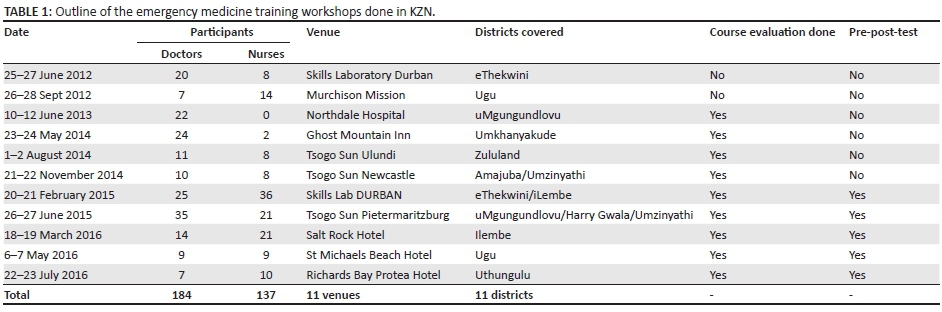
Eleven 2-day workshops were held in various districts in KZN and 321 HCWs were trained. Between 61.56% (n = 135) and 86.6% (n = 278) completed various elements of the evaluation questionnaire. Seventy-two percent (n = 135) out of an eligible 187 participants completed the MCQ test. Some of the workshops involved HCWs from more than one district. Table 1 presents an outline of the various workshops held in the province over the last 5 years.
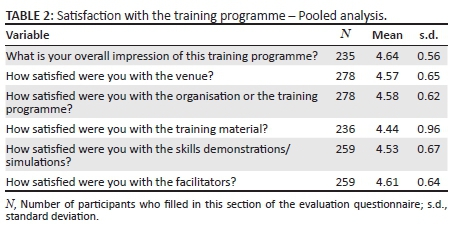
HCWs consisted of emergency room nurses and doctors and clinical or nursing managers. The majority of the staff (65%) worked at district hospitals, 11.5% of staff were based at CHCs and PHCs and the remainder of the staff worked at regional or tertiary hospitals and the district office. Participation from HCWs based in rural districts were poor and this was often ascribed to poor staffing and long distances that needed to be travelled to get to the workshop. The majority (89.4%) of the participants who completed the questionnaire worked in the primary emergency care setting as the regional hospitals were all combination regional-district hospitals that provided a primary emergency care service. HCWs evaluated the programme using a scale between 1 and 5, with a score of 1 rated as poor, 2 as fair, 3 as average, 4 as good and 5 rated as excellent. Table 2 depicts the mean scores.
Most participants found the quality of training, the facilitators and the training material good or excellent. Participants expressed a willingness to use their new found knowledge by implementing changes in their own institutions either by training others or by changing their current practice. Responses to questions on whether they would train others in their institution revealed that 92.64% (N = 231) found the course comprehensive enough to provide them with the confidence to train others at their institutions and 93.51% (N = 231) stated that they will be doing EM training at their own institutions.
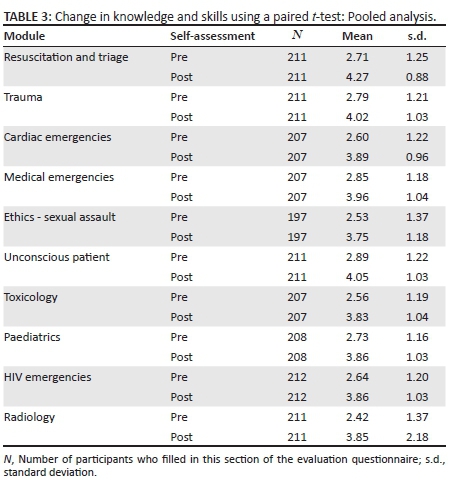
Participants were asked to assess their improvement in knowledge and skills after attending the workshop. A paired t-test was used to analyse responses based on a scale of 0 (I have no knowledge or skill) to 5 (I can do this and I can teach others). Results are shown in Table 3.
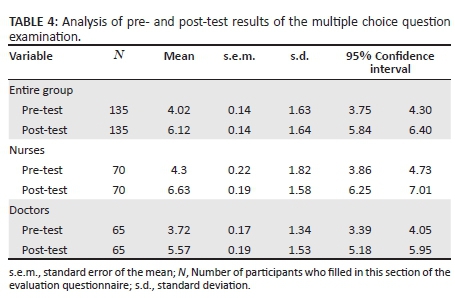
The pooled results from all the workshops indicate that participants' felt that their knowledge and skills improved significantly across all modules (p < 0.001). The mean difference across all modules pre-workshop compared to post-workshop was -1.22 (95% confidence interval: -1.45; -0.99), which was statistically significant. The results obtained via an MCQ administered at the last five workshops are listed in Table 4.
Knowledge improved significantly post-workshops for both doctors and nurses with the mean score of nurses being higher than the mean score for doctors. The MCQ examination had 10 questions and the maximum mark was 10.
Participants were asked to list any suggestions they may have on how their knowledge and skills could be improved. The most common suggestions were (number of responses in brackets) the following:
Thank you, well done, I gained lots of knowledge. (94)
Simulations should be done in the workplace to reinforce knowledge and skills. (42)
Simulations should be done weekly. (20)
Please provide accommodation. (15)
These workshops should be conducted at each hospital. (13)
Please conduct the workshop more often. (13)
Develop an emergency care workshop for PHC nurses. (13)
Add the skill of sub-cutaneous pacing. (10)
More time is needed for this workshop. (10)
Add a section on dermatology. (9)
Ethical consideration
Ethical approval to publish the findings of this evaluation was obtained from the UKZN Biomedical Research Ethics Committee (Reference BE 427/15). Funding for the training was obtained from the UKZN Medical Education Partnership Initiative (MEPI).
Discussion
The main study findings were participants rating the overall workshop as good or excellent and a significant improvement in knowledge and skills.
The bulk of the participants were from institutions which provided primary emergency care and this may have been achieved because of the decentralised programme. Although the project used a decentralised district-based model for training, the participation from rural districts was poor because of distances that needed to be travelled to get to the venue as well as poor staffing levels at rural district hospitals. The centralised model of training that is being used by the ESMOE programme in KZN may be a better suited model.7
The use of low-fidelity simulations was appreciated by all participants in contrast with the perception that simulation-based training is expensive.89899910111010
The majority of the participants rated the overall workshop as good to excellent with similar sentiments made on the quality of the logistics, the facilitators, the simulations and the resource material provided. These findings are consistent with those of Mugford and colleagues121313
Participants' subjective assessment of their perceived knowledge showed significant improvement, which was then ratified when the pre- and post-test questionnaires were administered during the last few workshops. Based on Pratt's14158911151647
The baseline mean and post-test mean knowledge score for nurses was higher than that of doctors and this may be because of the fact that nurses tend to be employed in the public sector for much longer periods than doctors,1718
The inter-professional approach to training not only mimics the real work environment but also contributes towards improved teamwork and collaboration.111911
Limitations of the study
The workshop content followed an evaluation, analysis and modification throughout the 4 years between 2012 and 2015. In addition, the first few workshops were held at venues within the hospital and this created problems with participation and no formal evaluation was done of these courses. The programme was evaluated by the administrator of the course, and despite being anonymously filled in, one would expect that an element of bias may exist. No long-term assessment of an improvement in knowledge and skills was performed to indicate if the new knowledge would be retained. The impact on work place-based practice and on patient outcomes was also not evaluated.
Conclusion
Emergency care education using a combination of inter-professional simulation and lecture-based teaching has the potential of contributing towards better educational outputs for nurses and doctors working in the primary emergency care setting. It is recommended that such training be introduced in both undergraduate and postgraduate curricula. A recommendation would be that future workshops be run at centralised venues as these attract better participation and if funds permit, accommodation be provided for participants from remote and rural sites. The recommendation of developing an emergency care workshop specifically designed for PHC nurses has been actioned and is being rolled out in the eThekwini district. A follow-up study is being contemplated to contact participants to establish if the training led to changes in clinical practice.
Competing interests
The author declares that there has been no financial or personal relationships that may have inappropriately influenced the writing of this article.
Acknowledgements
This work was made possible by grant number: 5R24TW008863 from the President's Emergency Plan for AIDS Relief and the National Institutes of Health, U.S. Department of Health and Human Services. Its contents are solely the responsibility of the University of KwaZulu-Natal (UKZN) Medical Education Partnership Initiative (MEPI) programme and do not necessarily represent the official views of the government. Acknowledgement is also made to the various individuals from the Discipline of Family Medicine, Emergency Medicine Nursing, Surgery and Paediatrics at the University of KwaZulu-Natal and the KwaZulu-Natal Department of Health. Special thanks go to Dr M. Muzigaba and Ms A Sevakran for their assistance with data capture and analysis.
References
-
1. Department: Health Province of Kwazulu-Natal. Provincial hospitals listed by district Pietermaritzburg [homepage on the Internet]. 2016 [cited 2016 Feb 15 ]. Available from: http://www.kznhealth.gov.za/district1.htm
» http://www.kznhealth.gov.za/district1.htm -
2. Hanewinckel R, Jongman HP, Wallis LA, Mulligan TM. Emergency medicine in Paarl, South Africa: A cross-sectional descriptive study. Int J Emerg Med. 2010;3(3):143-150. https://doi.org/10.1007/s12245-010-0185-9
» https://doi.org/10.1007/s12245-010-0185-9 -
3. Naicker B, Maharaj R. HIV in acute care: A review of the burden of HIV-associated presentations to an Emergency Department. S Afr Fam Pract. 2015;58:1-5. https://doi.org/10.1080/20786190.2015.1079027
» https://doi.org/10.1080/20786190.2015.1079027 -
4. World Health Organization. Transforming and scaling up health professionals' education and training [homepage on the Internet]. Geneva: World Health Organisation Press; 2013 [cited 2016 Feb 15]. Available from: http://apps.who.int/iris/bitstream/10665/93635/1/9789241506502_eng.pdf
» http://apps.who.int/iris/bitstream/10665/93635/1/9789241506502_eng.pdf - 5. Frank K, Lombaard H, Pattinson RC. Does completion of the Essential Steps in Managing Obstetric Emergencies (ESMOE) training package result in improved knowledge and skills in managing obstetric emergencies? S Afr J Obstet Gynaecol. 2009;15(3):94-99.
-
6. Gottschalk SB, Wood D, DeVries S, Wallis LA, Bruijns S, Cape Triage G. The cape triage score: A new triage system South Africa. Proposal from the Cape Triage Group. Emerg Med J. 2006;23(2):149-153. https://doi.org/10.1136/emj.2005.028332
» https://doi.org/10.1136/emj.2005.028332 -
7. Moran NF, Naidoo M, Moodley J. Reducing maternal mortality on a countrywide scale: The role of emergency obstetric training. Best Pract Res Clin Obstet Gynaecol. 2015;29(8):1102-1118. https://doi.org/10.1016/j.bpobgyn.2015.08.002
» https://doi.org/10.1016/j.bpobgyn.2015.08.002 -
8, Al-Elq AH. Simulation-based medical teaching and learning. J Family Community Med. 2010;17(1):35-40. https://doi.org/10.4103/1319-1683.68787
» https://doi.org/10.4103/1319-1683.68787 -
9. Reznek M, Harter P, Krummel T. Virtual reality and simulation: Training the future emergency physician. Acad Emerg Med. 2002;9(1):78-87. https://doi.org/10.1111/j.1553-2712.2002.tb01172.x
» https://doi.org/10.1111/j.1553-2712.2002.tb01172.x -
10. Okuda Y, Bond W, Bonfante G, et al. National growth in simulation training within emergency medicine residency programs, 2003-2008. Acad Emerg Med. 2008;15(11):1113-1116. https://doi.org/10.1111/j.1553-2712.2008.00195.x
» https://doi.org/10.1111/j.1553-2712.2008.00195.x -
11. McLaughlin SA, Doezema D, Sklar DP. Human simulation in emergency medicine training: A model curriculum. Acad Emerg Med. 2002;9(11):1310-1318. https://doi.org/10.1111/j.1553-2712.2002.tb01593.x
» https://doi.org/10.1111/j.1553-2712.2002.tb01593.x - 12. Martin A, Owen H, Mugford B. Simulation training in emergency medicine: An important need for primary care training. Aust Fam Physician. 2004;33(4):279.
-
13. Bond WF, Lammers RL, Spillane LL, et al. The use of simulation in emergency medicine: A research agenda. Acad Emerg Med. 2007;14(4):353-363. https://doi.org/10.1111/j.1553-2712.2007.tb02021.x
» https://doi.org/10.1111/j.1553-2712.2007.tb02021.x - 14. Pratt DD. Five perspectives on teaching in adult and higher education. ERIC, Melbourne: Krieger Publishing Co; 1998.
-
15. Maddry JK, Varney SM, Sessions D, et al. A comparison of simulation-based education versus lecture-based instruction for toxicology training in emergency medicine residents. J Med Toxicol. 2014;10(4):364-368. https://doi.org/10.1007/s13181-014-0401-8
» https://doi.org/10.1007/s13181-014-0401-8 -
16. Norcini JJ. ABC of learning and teaching in medicine - Work based assessment. BMJ. 2003;326(7392):753-755. https://doi.org/10.1136/bmj.326.7392.753
» https://doi.org/10.1136/bmj.326.7392.753 -
17. Chopra M, Lawn JE, Sanders D, et al. Achieving the health Millennium Development Goals for South Africa: Challenges and priorities. Lancet. 2009;374(9694):1023-1031. https://doi.org/10.1016/S0140-6736(09)61122-3
» https://doi.org/10.1016/S0140-6736(09)61122-3 -
18. Ross A, Reid S. The retention of community service officers for an additional year at district hospitals in KwaZulu-Natal and the Eastern Cape and Limpopo provinces. S Afr Fam Pract. 2009;51(3):249-253. https://doi.org/10.1080/20786204.2009.10873856
» https://doi.org/10.1080/20786204.2009.10873856 -
19. Shapiro M, Morey J, Small S, et al. Simulation based teamwork training for emergency department staff: Does it improve clinical team performance when added to an existing didactic teamwork curriculum? Qual Saf Health Care. 2004;13(6):417-21. https://doi.org/10.1136/qshc.2003.005447
» https://doi.org/10.1136/qshc.2003.005447

Accepted: 27 Nov. 2016
Published: 30 Mar. 2017