Vision-related quality of life and associated factors in individuals with vision impairment
Abstract
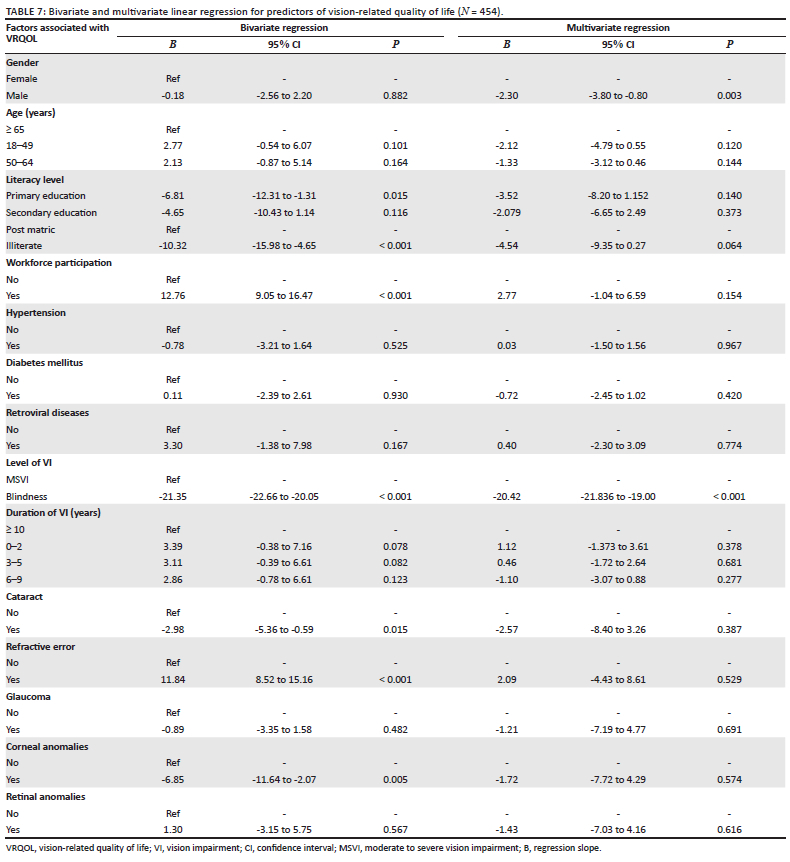
BACKGROUND: Vision impairment (VI) limits the ability of affected individuals to achieve optimal functioning and impacts their quality of life AIM: This study assesses the vision-related quality of life (VRQOL) and its associated factors in individuals with VI SETTING: The study was conducted at selected public hospitals in Limpopo province, South Africa METHODS: A cross-sectional, quantitative study was conducted between January and August 2023 across 29 public hospitals, utilising a semi-structured questionnaire. Data obtained from the participants' responses were analysed to assess their VRQOL RESULTS: The study sample consisted of 454 participants, 57.0% female. The participants' ages ranged from 18 to 82 years. The mean composite score was 22.50 ±13.01 (range: 4.0-55.7). Factors associated with increased risk of poorer VRQOL included illiteracy (B: -10.32; p < 0.001), primary level education (B: -6.81; p = 0.015) and male gender (B: -3.80; p = 0.003). Regarding VI severity and aetiology, blindness (B: -21.35; p < 0.001), cataracts (B: -2.98; p = 0.015) and corneal diseases (B: -6.85; p = 0.005) were associated with risk of poor VRQOL. Conversely, employment (B: 12.76; p < 0.001) and refractive error (B: 11.84; p < 0.001) were associated with improved VRQOL outcomes CONCLUSION: The VRQOL among individuals with VI attending public hospitals in Limpopo province is relatively low. The main causes of VI were largely preventable or correctable, indicating the need to strengthen comprehensive eye care services. Enhancing these services may significantly improve the quality of life for individuals with VI in the province CONTRIBUTION: The study fills the knowledge gap regarding the impact of VI on VRQOL in individuals seeking care at public hospitals in Limpopo province
vision impairment; quality of life; vision-related quality of life; National Eye Institute Visual Functioning Questionnaire-39; comprehensive eye care services
Introduction
Vision impairment (VI) is a major cause of disability globally and contributes to a substantial public health challenge.1,23141,5,61,7
Vision-related quality of life (VRQOL) refers to an individual's overall satisfaction with living conditions, functioning and how VI affects daily life.2,81,3,9,10,111,2,7,121,3,7,13,141,3,5
The prevalence of VI in Limpopo province is relatively high, and the provision of comprehensive VI services is severely constrained in public hospitals of the region.15,16,17,1819,20
Research methods and design
Study design
The study utilised a descriptive, quantitative, cross-sectional design to assess VRQOL and identify its associated factors in individuals with VI attending public hospitals in Limpopo province, South Africa.
Study site and sampling
The study was conducted at selected public hospitals delivering eye care services in Limpopo province, South Africa. Between January and September 2023, 37 public hospitals in the province provided eye care services. These included 30 primary-level hospitals, five secondary-level hospitals and two tertiary-level hospitals. The services offered were relatively uniform across the hospitals in terms of patient screening, assessment, diagnosis and disease management. However, ophthalmology services were available exclusively at three public hospitals. Data were collected from 29 out of the 37 public hospitals, representing approximately 80% of the total public hospitals providing eye care services in the province. Because of the limited number of secondary and tertiary hospitals, a saturated sampling approach was applied for these levels, including those offering ophthalmology services. For the selection of primary hospitals, simple random sampling was employed to select the 22 hospitals across the various districts, ensuring each primary hospital had an equal chance of inclusion. Convenience sampling was used to recruit participants from all the selected public hospitals included in this study. Patients accessing eye care services were either self-referred or referred by outreach optometrists from district clinics and schools, or by medical doctors and other health care practitioners within the province.
Study population
The study population consisted of individuals aged 18 years and older who had been diagnosed with VI (presenting visual acuity less than 6/18 to no light perception) for at least 3 months and were presenting for eye care services at public hospitals in Limpopo province.
Sample size
The sample size was calculated using the following formula in equation 1:

where:
n = sample size;
z = the upper point of the standard normal distribution, which is 1.96 constant when using a 95% confidence interval (CI);
d = the clinically acceptable margin of error of 5% (0.05);
p = the expected prevalence and q = 1-p.21
Taking into consideration the highest reported prevalence of VI found in a review of the literature as 41.3% (0.413) and d = 0.05 (the absolute precision, taken as 0.05), the sample size was determined in equation 2:
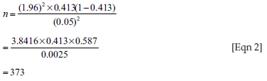
To account for potential attrition, the required minimum sample size was adjusted by increasing it by 10%, resulting in a total of 411 participants.
Inclusion and exclusion criteria
Participants aged 18 years and older, who had been diagnosed with VI for a minimum duration of 3 months and provided consent, were included in the study. The age criterion was established to ensure that participants had the cognitive capacity to comprehend and respond accurately during the interviews. The 3-month post-diagnosis period was selected under the assumption that participants had received adequate therapeutic interventions and had been fully informed of their diagnosis and prognosis. Each participant was sampled once, with follow-up visits and reviews excluded to prevent duplication, and individual participants were assigned unique codes for verification. Exclusion criteria included refusal to provide consent, participants under the age of 18 years, those unable to communicate and caregivers.
Data collection
Data were collected using an interviewer-administered National Eye Institute Visual Functioning Questionnaire-39 (NEI VFQ-39), an internationally validated tool designed to assess the quality of life in patients with VI.2223
Data analysis
The data were manually collected and entered into Microsoft Excel, after which they were analysed using the Statistical Package for Social Sciences (IBM SPSS version 29). Before analysis, the scoring of the NEI VFQ-39 was performed according to the guidelines outlined in the NEI VFQ scoring algorithm manual.2424
Descriptive statistics, including frequencies, percentages, means, standard deviation (s.d.), medians and interquartile range (IQR), were employed to summarise categorical variables such as age, gender and severity of VI. The normality of the data was evaluated using the Kolmogorov-Smirnov test. Comparisons between risk factors and the outcome of interest were explored by conducting independent sample t-tests and analysis of variance (ANOVA). The association between socio-demographic variables and causes of VI with VRQOL were assessed using bivariate and multivariate linear regression analysis. All risk factors clinically and statistically significant with the outcome of interest were included in a multivariate model to determine the outcome variable independent factors. This approach was previously recommended in clinical research studies.25,26
Ethical considerations
Ethical clearance to conduct this study was obtained from the University of Kwazulu-Natal Humanities and Social Science Research Ethics Committee (No. HSSREC/00004472/2022). Subsequently, gatekeeper permission was obtained from the Limpopo Provincial Department of Health (No. LP_2022-12-004) as well as from Pietersburg and Mankweng hospitals, permitting the use of their facilities for data collection. To maintain participant anonymity, unique identification codes were assigned to each participant.
Results
Demographic characteristics
The study sample consisted of 454 participants, with a higher proportion of females (n = 259, 57.0%) compared with males (n = 195, 43.0%). The ages of the participants ranged from 18 to 82 years, with a median of 69 (IQR: 60-78). The majority were aged 65 years and older (n = 292, 64.3%), followed by those aged 50-64 years (n = 101, 22.2%) and those aged 18-49 years (n = 61, 13.4%). In terms of educational attainment, most participants had completed primary-level education (n = 204, 44.9%), while a substantial proportion was illiterate (n = 129, 28.4%). A smaller group had completed secondary education (n = 110, 24.2%) and a minority had obtained post-matric qualifications (n = 11, 2.4%). The sample was predominantly African (n = 453, 99.8%). For workforce participation, (n = 206, 45.4%) had never been employed, (n = 209, 46.0%) had a previous employment history, (n = 26, 5.7%) were active in the workforce and (n = 13, 2.9%) had discontinued employment because of their VI.
Clinical characteristics of participants
The majority of participants (n = 331, 73%) reported having chronic illnesses, with (n = 152, 33.5%) of these individuals presenting with two or more chronic conditions. Over half of the participants (n = 245, 54.0%) were diagnosed with MSVI, while (n = 209, 46.0%) were classified as blind. The duration of VI among participants varied: (n = 147, 32.4%) had experienced VI for 3-5 years, (n = 130, 28.6%) for 6-9 years, (n = 102, 22.5%) for 2 years or less and (n = 75, 16.5%) for 10 years or more. The leading causes of VI were cataracts (n = 192, 42.3%), glaucoma (n = 169, 37.2%), refractive error (n = 46, 10.1%), corneal diseases (n = 17, 3.7%) and retinal diseases (n = 30, 6.6%).
Vision-related quality of life among participants
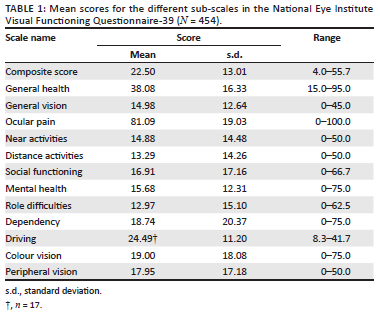
Table 1 displays the mean, s.d. and range of scores for the various sub-scales of the NEI VFQ-39, along with the composite score for all the participants. The mean (s.d.) scores across individual sub-scales varied, with role difficulties registering the lowest at 12.97 (15.10) and ocular pain the highest at 81.09 (19.03). Several sub-scales, including general vision, near activities, distance activities, social functioning, mental health, role difficulties, dependency, colour vision and peripheral vision, demonstrated mean scores below 20.00. The overall mean (s.d.) composite score was 22.50 (13.01). The sub-scale 'Driving' was consistently an outliner and non-significant in the findings because of the small sample of participants driving from the study sample.
Vision-related quality of life comparison based on gender
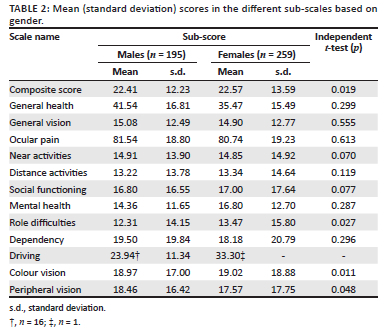
Table 2 presents a comprehensive comparison of the mean (s.d.) scores between male and female participants across the sub-scale items of the NEI VFQ-39. The composite score mean (s.d.) was 22.57 (13.59) for females and 22.41 (12.23) for males. Sub-scale scores for males ranged from 12.31 (14.15) for role difficulties to 81.54 (18.80) for ocular pain, whereas scores for females ranged from 13.34 (14.64) for distance activities to 80.74 (19.23) for ocular pain. Statistically significant differences (p < 0.05) between genders were observed for the composite score, role difficulties, colour vision and peripheral vision sub-scales (Table 2).
Vision-related quality of life based on age
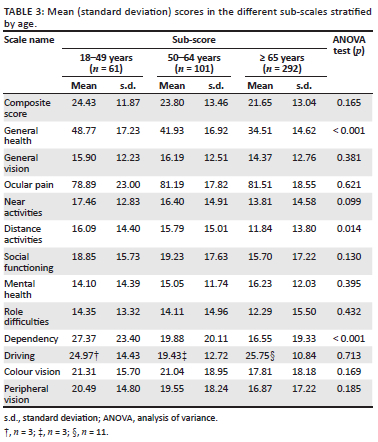
Table 3 presents the mean (s.d.) scores for each sub-scale, stratified by age group. The composite scores for participants aged 18-49 years, 50-64 years and 65 years and older were 24.43 (11.87), 23.80 (13.46) and 21.65 (13.04), respectively. Among participants aged 18-49 years, the mean scores ranged from 14.10 (14.39) for the mental health subscale to 78.89 (23.00) for the ocular pain subscale. In the 50-64 age group, scores ranged from 14.11 (14.96) for role difficulties to 81.19 (17.82) for ocular pain. Participants aged 65 years and older exhibited scores ranging from 11.84 (13.80) for distance activities to 81.51 (18.55) for ocular pain. A significant difference (p < 0.05) was found for the general health, distance activities and dependency subscales among the three age categories (Table 3).
Vision-related quality of life based on level of vision impairment
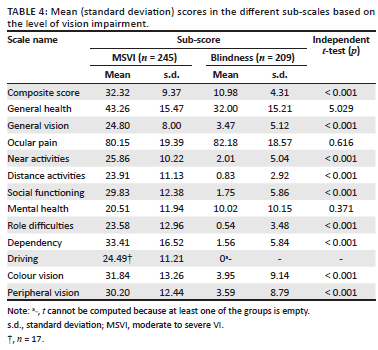
Table 4 provides a detailed comparison of mean (s.d.) scores in the different sub-scales in the NEI VFQ-39 in the two VI groups. The mean (s.d.) composite score for 32.32 (9.37) for individuals with MSVI and 10.98 (4.31) for those classified as blind. Sub-scale scores for the MSVI group ranged from 20.51 (11.94) for mental health to 80.15 (19.39) for ocular pain. In the blindness group, sub-scale scores varied from 0.54 (3.48) for role difficulties to 82.18 (18.57) for ocular pain. A statistically significant difference (p < 0.05) was found between the MSVI and blindness groups for the composite score and the sub-scales of general vision, near activities, distance activities, social functioning, role difficulties, dependency, colour vision and peripheral vision.
Vision-related quality of life comparison based on literacy level
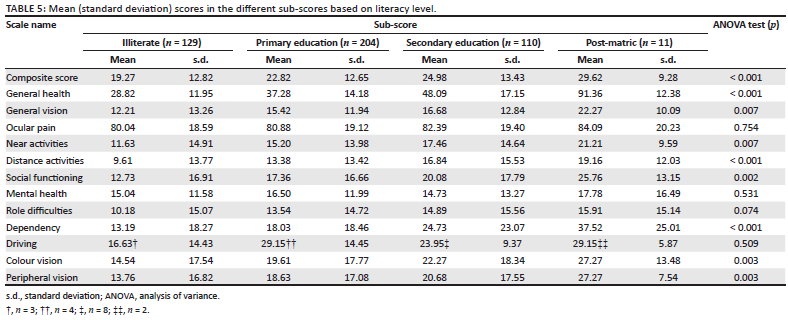
Table 5 presents the mean (s.d.) scores of participants, categorised by literacy level. Participants with post-matric qualifications exhibited the highest composite score, 29.62 (9.28), followed by those with secondary education at 24.98 (13.43), primary education at 22.82 (12.65) and illiterate participants at 19.27 (12.82). Within the illiterate group, sub-scale scores ranged from 9.61 (13.77) for distance activities to 80.04 (18.59) for ocular pain. Among participants with primary education, scores ranged from 13.38 (13.42) for distance activities to 80.88 (19.12) for ocular pain. For those with secondary qualifications, scores varied from 14.73 (13.27) for mental health to 82.39 (19.40) for ocular pain. In participants with post-matric qualifications, the scores ranged from 15.91 (15.14) for role difficulties to 91.36 (12.38) for general health. Significant differences (p < 0.05) were observed across the four literacy levels in the sub-scales of general health, general vision, near activities, distance activities, social functioning, dependency, colour vision and peripheral vision.
Vision-related quality of life based on the cause of vision impairment
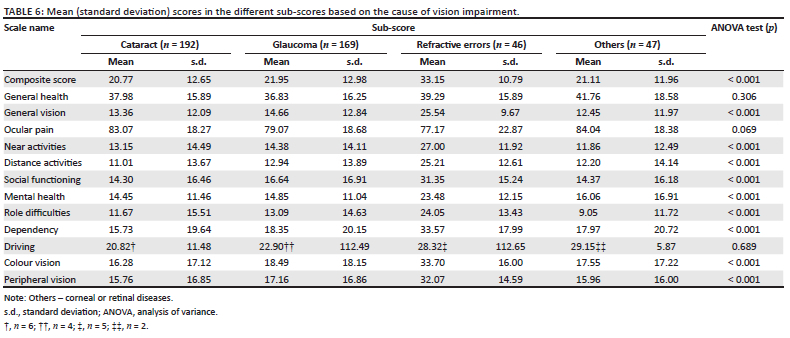
Table 6 summarises the mean (s.d.) scores of participants, classified according to the underlying cause of VI. Participants with VI because of refractive error exhibited a higher composite score of 33.15 (10.79) compared to those with glaucoma 21.95 (12.98), other diseases (corneal or retinal diseases) 21.11 (11.96) and cataracts 20.77 (12.65). Among participants with cataracts, sub-scale scores ranged from 11.00 (13.67) for distance activities to 83.07 (18.26) for ocular pain. Participants with glaucoma showed sub-scale scores ranging from 12.94 (13.89) for distance activities to 79.07 (18.68) for ocular pain. For participants with refractive error, scores ranged from 23.48 (12.15) for mental health to 77.17 (22.87) for ocular pain. Those with other diseases (e.g. corneal or retinal conditions) had scores varying from 9.05 (11.72) for role difficulties to 84.04 (18.38) for ocular pain. A significant difference (p < 0.05) was found between the causes of VI and the sub-scales of general vision, near activities, distance activities, social functioning, mental health, role difficulties, dependency, colour vision and peripheral vision (Table 6).
Factors associated with vision-related quality of life
Table 7 shows the bivariate and multivariate linear regression analysis for VRQOL. The bivariate regression analysis showed that illiterate participants (B: -10.32; 95% CI: -15.98 to -4.65; p < 0.001), and those with primary level education (B: -6.81; 95% CI: -12.31 to -1.31; p = 0.015) had significantly increased risk of poor VRQOL. Participation in the workforce (B: 12.76; 95% CI: 9.05 to 16.47; p < 0.001) was significantly associated with reduced risk of poor VRQOL. In terms of the level of VI, blindness (B: -21.35; 95% CI: -22.66 to -20.05; p < 0.001) was significantly associated with an increased risk of poor VRQOL. About the causes of VI, the presence of cataracts (B: -2.98; 95% CI: -5.36 to -0.59; p = 0.015) and corneal diseases (B: -6.85; 95% CI: -11.64 to -2.07; p = 0.005) were significantly associated with increased risk of poor VRQOL. However, the presence of refractive error (B: 11.84; 95% CI: 8.52 to 15.16; p < 0.001) was significantly associated with improved VRQOL outcomes. In the multivariate regression analysis, male gender (B: -2.30; 95% CI: -3.80 to -0.80; p = 0.003) and blindness (B: -20.42; 95% CI: -21.84 to -19.00; p < 0.001) were significantly associated with increased risk of poor VRQOL.
Discussion
Vision impairment limits affected individuals from achieving their full functional potential, hinders educational attainment, reduces productivity in employment and compromises independence in daily life. This study aimed to assess the VRQOL and its associated factors in individuals with VI attending public hospitals in Limpopo province.
Participants in this study exhibited relatively low scores across all subscales, including the composite score (Table 1), indicating poor functioning in multiple domains of VRQOL. The poor VRQOL may be attributed to factors such as the characteristics of the sample population, the onset of VI, access to VI-related services and socio-demographic factors known to influence VRQOL.1,2,7,122,12,27,282,27,291,3,5,3015,16,18,31
The bivariate regression analysis indicated that participants with low literacy levels and those diagnosed with blindness were significantly associated with an increased risk of poorer VRQOL. The low literacy levels may have contributed to a lack of awareness, reduced health-seeking behaviours and limited utilisation of eye care services among these individuals, as compared to their counterparts.1,2,12,32Table 5). The poorer VRQOL observed in participants with blindness was anticipated, as a significantly reduced level of VI typically leads to greater restrictions on functional ability and participation in daily activities.1,3,5Table 4). The findings of this study align with those from previous research,2,27,29,33,34,35
In relation to the cause of VI, the presence of cataracts and corneal diseases exhibited a significant association with diminished VRQOL. This could be attributed to differences in the onset, progression and severity of these conditions. For example, individuals with VI because of age-related cataracts may experience gradual and substantial vision deterioration as the condition advances, which impairs their ability to perform daily tasks and consequently impacts their quality of life. This could be associated with the lower mean scores for distance activities and role difficulties among participants with VI because of cataracts (Table 6). Furthermore, the severity and/or complications associated with corneal diseases, compounded by limited access to effective therapeutic interventions, may result in chronic VI, increasing dependency among affected individuals. The reduced risk of poor VRQOL because of refractive error may be because people with refractive errors tend to adjust to their working distances compared to other visual disabling conditions.
Moreover, participation in the workforce was significantly associated with improved VRQOL outcomes. This finding is consistent with reports,27,331
Although the bivariate and multivariate analysis showed no significant association between age and VRQOL, increasing age was associated with an increased risk of poor VRQOL, with participants aged 18-49 years old exhibiting reduced risk of poor VRQOL compared to participants aged 50-64 years and 65 years and older, respectively (Table 7). This could be attributed to the sample population in this study. For instance, almost 65% of participants from this study were 65 years and older and at increased risk of developing VI because of age-related eye diseases including cataracts and glaucoma, which significantly reduce the quality of life of affected individuals.1,5Table 3). This demonstrates the effect of VI on the psychological well-being of affected individuals and its impact on daily activities.
The multivariate regression analysis revealed that male gender and blindness were significantly associated with an increased risk of poorer VRQOL. The lower VRQOL scores observed among males in this study may be attributed to their reduced performance in the 'role difficulties' subscale, indicating functional limitations (Table 2). This finding could be related to difficulties in adopting new coping mechanisms and concerns over loss of independence. Similar results were reported by Jammal et al.,121,5
Despite these findings, the experience and adaptation to living with VI are influenced by factors such as the onset and severity of the condition, socio-economic status, psycho-social well-being and the availability and accessibility of preventive, treatment and vision rehabilitation services.1,3,5
Strength and limitations
The strengths of this study include the use of the internationally validated NEI VFQ-39 questionnaire, which enhances the comparability of findings with other research. The questionnaire was translated into the predominant languages spoken in the Limpopo province, ensuring that participants were interviewed in their preferred language. Although this process was essential, we acknowledge that certain words may not have been fully translatable in the local context. A limitation of the study is its hospital-based design, which may limit the generalisability of the results. Additionally, recall bias may have affected the findings, as certain questions relied on participants' recollections of past experiences. The study included a limited number of participants who engaged in driving, likely because of their recruitment from public hospitals located in a socio-economically disadvantaged province, coupled with VIs that restricted their eligibility for driving. Consequently, the findings related to driving should be interpreted with caution. Despite these limitations, this study provides valuable insights for policymakers, health authorities and eye care professionals, facilitating the effective planning of comprehensive eye care services. It also offers a foundation for future research.
Conclusion
The VRQOL in individuals with VI attending public hospitals in Limpopo province was found to be suboptimal. The results indicate that VI significantly impacts psychosocial functioning, limits individuals' participation in daily activities and leads to a diminished overall quality of life. These findings suggest the need to prioritise the reduction of avoidable VI and improve access to comprehensive eye care services, which are essential for enhancing the full participation and functioning of affected individuals in their daily lives.
Competing interests
The author reported that they received funding from KwaZulu-Natal's College of Health Sciences, which may be affected by the research reported in the enclosed publication. The author has disclosed those interests fully and has implemented an approved plan for managing any potential conflicts arising from their involvement. The terms of these funding arrangements have been reviewed and approved by the affiliated University in accordance with its policy on objectivity in research.
Authors' contributions
M.M.L., N.R. and K.P.M. conceptualised the project and the design. M.M.L. wrote the original draft while N.R. and K.P.M. supervised the project, guiding and reviewing all drafts leading to the final article.
Funding information
Funding for the fieldwork was received from the University of KwaZulu-Natal's College of Health Sciences Scholarship fund.
Data availability
The data that support the findings of this study are available from the corresponding author, M.M.L., upon reasonable request.
Disclaimer
The views and opinions expressed in this article are those of the authors and are the product of professional research. It does not necessarily reflect the official policy or position of any affiliated institution, funder, agency or that of the publisher. The authors are responsible for this article's results, findings and content.
Acknowledgements
This article is partially based on the author's thesis entitled 'The development of a vision impairment model of care in the public hospitals of Limpopo province, South Africa' towards the degree of Doctor of Philosophy in the Discipline of Optometry, at the University of KwaZulu-Natal, South Africa, with supervisors Dr. N. Rampersad and Prof. K.P. Mashige.
References
-
1. World Health Organisation. Blindness and vision impairment [homepage on the Internet]. WHO; 2021 [cited 2024 Apr 19]. Available from: https://www.who.int/news-room/fact-sheets/detail/blindness-and-visual-impairment
» https://www.who.int/news-room/fact-sheets/detail/blindness-and-visual-impairment -
2. Yibekal BT, Alemu DS, Anbesse DH, Alemayehu AM, Alimaw YA. Vision-related quality of life among adult patients with visual impairment at University of Gondar, Northwest Ethiopia. J Ophthalmol. 2020;2020:9056097. https://doi.org/10.1155/2020/9056097
» https://doi.org/10.1155/2020/9056097 - 3. Bourne R, Steinmetz JD, Flaxman S, et al. Trends in the prevalence of blindness and distance and near vision impairment over 30 years: An analysis for the global burden of disease study. Lancet Glob Health. 2021;9(2):e130-e143.
-
4. Statistics South Africa. Profiling the socio-economic status and living arrangements of persons with disabilities in South Africa, 2011-2022 [homepage on the Internet]. Pretoria: Stats SA; 2024 [cited 2024 Aug 28]. Available from: https://www.statssa.gov.za/publications/Report-No-03-01-37/Report-No-03-01-372022.pdf
» https://www.statssa.gov.za/publications/Report-No-03-01-37/Report-No-03-01-372022.pdf - 5. Bourne RR, Steinmetz JD, Saylan M, et al. Causes of blindness and vision impairment in 2020 and trends over 30 years, and prevalence of avoidable blindness in relation to VISION 2020: The right to sight: An analysis for the Global Burden of Disease Study. Lancet Glob Health. 2021;9(2):e144-e160.
-
6. Xulu-Kasaba ZN, Kalinda C. Prevalence of the burden of diseases causing visual impairment and blindness in South Africa in the period 2010-2020: A systematic scoping review and meta-analysis. Trop Med Infect Dis. 2022;7(2):34. https://doi.org/10.3390/tropicalmed7020034
» https://doi.org/10.3390/tropicalmed7020034 - 7. Welp A, Woodbury RB, McCoy MA, et al. The impact of vision loss. Vol. 3. National Academies of Sciences, Engineering, and Medicine; Health and Medicine Division; Board on Population Health and Public Health Practice; Committee on Public Health Approaches to Reduce Vision Impairment and Promote Eye Health; Making Eye Health a Population Health Imperative: Vision for Tomorrow. Washington, DC: National Academies Press (US); 2016.
-
8. Asaoka R, Crabb DP, Yamashita T, Russell RA, Wang YX, Garway-Heath DF. Patients have two eyes: Binocular versus better eye visual field indices. Invest Ophthalmol Vis Sci. 2011;52(9):7007-7011. https://doi.org/10.1167/iovs.11-7643
» https://doi.org/10.1167/iovs.11-7643 -
9. World Health Organisation. Universal eye health: A global action plan 2014-2019 [homepage on the Internet]. WHO; 2013 [cited 2024 Apr 23]. Available from: https://www.iapb.org/wp-content/uploads/2020/09/Universal-Eye-Health_A-Global-Action-Plan-2014-2019.pdf
» https://www.iapb.org/wp-content/uploads/2020/09/Universal-Eye-Health_A-Global-Action-Plan-2014-2019.pdf -
10. Ovenseri-Ogbomo GO, Osafo-Agyei H, Akpalaba REU, Addy J, Ovenseri EO. Impact of low vision services on the quality of life of low vision patients in Ghana. Afr Vis Eye Health. 2016;75(1):a19. https://doi.org/10.4102/aveh.v75i1.19
» https://doi.org/10.4102/aveh.v75i1.19 - 11. Firouzeh F, Tabatabaee SM. Can low vision aids improve the quality of life of low vision patients? J Eye Dis Disord. 2018;3(1):1000122.
-
12. Jammal HM, Khader Y, Kanaan SF, et al. The effect of visual impairment and its severity on vision-related and health-related quality of life in Jordan: A comparative cross-sectional study. J Multidiscip Health. 2023;16:3043-3056. https://doi.org/10.2147/JMDH.S431159
» https://doi.org/10.2147/JMDH.S431159 -
13. Marques AP, Ramke J, Cairns J, Butt T. Estimating the global cost of vision impairment and its major causes: Protocol for a systematic review. BMJ Open. 2020;10(9):36689. https://doi.org/10.1136/bmjopen-2019-036689
» https://doi.org/10.1136/bmjopen-2019-036689 -
14. Assi L, Chamseddine F, Ibrahim P, et al. A global assessment of eye health and quality of life: A systematic review of systematic reviews. JAMA Ophthalmol. 2021;139(5):526-541. https://doi.org/10.1001/jamaophthalmol.2021.0146
» https://doi.org/10.1001/jamaophthalmol.2021.0146 -
15. Maake MM, Oduntan OA. Prevalence and causes of visual impairment in patients seen at Nkhensani Hospital Eye Clinic, South Africa. Afr J Prim Health Care Fam Med. 2015;7(1):728. https://doi.org/10.4102/phcfm.v7i1.728
» https://doi.org/10.4102/phcfm.v7i1.728 -
16. Mabaso RG, Oduntan OA. Risk factors for visual impairment and blindness amongst black adult diabetics receiving treatment at government healthcare facilities in Mopani District, Limpopo Province, South Africa. Afr J Prim Health Care Fam Med. 2014;6(1):e1-e8. https://doi.org/10.4102/phcfm.v6i1.623
» https://doi.org/10.4102/phcfm.v6i1.623 -
17. Magakwe TSS, Xulu-Kasaba ZNQ, Hansraj R. Prevalence and distribution of visual impairment and refractive error amongst school-going children aged 6-18 years in Sekhukhune District (Limpopo, South Africa). Afr Vision Eye Health. 2020;79(1):a551. https://doi.org/10.4102/aveh.v79i1
» https://doi.org/10.4102/aveh.v79i1 -
18. Leshabane MM, Rampersad N, Mashige KP. Prevalence, causes and factors associated with vision impairment in Limpopo province. Afr Vision Eye Health. 2024;83(1):a956. https://doi.org/10.4102/aveh.v83i1.956
» https://doi.org/10.4102/aveh.v83i1.956 -
19. Ntsoane MD, Oduntan OA, Mpolokeng BL. Utilisation of public eye care services by the rural community residents in the Capricorn district, Limpopo Province, South Africa. Afr J Prim Health Care Fam Med. 2012;4(1):412. https://doi.org/10.4102/phcfm.v4i1.412
» https://doi.org/10.4102/phcfm.v4i1.412 -
20. Statistics South Africa. Statistical release P0302: Mid-year population estimates [homepage on the Internet]. Department of Statistics SA, Republic of South Africa; 2019 [cited 2021 Oct 08]. Available from: https://www.statssa.gov.za/publications/P0302/P03022019.pdf
» https://www.statssa.gov.za/publications/P0302/P03022019.pdf -
21. Israel GD. Determining sample size [homepage on the Internet]. Institute of Food and Agricultural Sciences, University of Florida; 2012 [cited 2021 Oct 08]. Available from: https://www.psycholosphere.com/Determining%20sample%20size%20by%20Glen%20Israel.pdf
» https://www.psycholosphere.com/Determining%20sample%20size%20by%20Glen%20Israel.pdf -
22. National Eye Institute Visual Functioning Questionnaire-25 (VFQ-25) version 2000: Interviewer administered format [homepage on the Internet]. RAND; 1996 [cited 2022 Feb 23]. Available from: https://www.rand.org/content/dam/rand/www/external/health/surveys_tools/vfq/vfq25survey_intadmin.pdf
» https://www.rand.org/content/dam/rand/www/external/health/surveys_tools/vfq/vfq25survey_intadmin.pdf -
23. Owen CG, Rudnicka AR, Smeeth L, Evans JR, Wormald RPL, Fletcher AE. Is the NEI VFQ- 25 a useful tool in identifying visual impairment in an elderly population? BMJ Ophthalmol. 2006;6:24. https://doi.org/10.1186/1471-2415-6-24
» https://doi.org/10.1186/1471-2415-6-24 -
24. Carol M, Mangione MD. The National Eye Institute 25-Item Visual Function Questionnaire (VFQ-25) [homepage on the Internet]. NEI VFQ Scoring Algorithm; 2000 [cited 2023 Mar 20]. Available from: https://www.rand.org/content/dam/rand/www/external/health/surveys_tools/vfq/vfq25_manual.pdf
» https://www.rand.org/content/dam/rand/www/external/health/surveys_tools/vfq/vfq25_manual.pdf -
25. Katz MH. Multivariable analysis: A primer for readers of medical research. Ann Intern Med. 2003;138(8):644-650. https://doi.org/10.7326/0003-4819-138-8-200304150-00012
» https://doi.org/10.7326/0003-4819-138-8-200304150-00012 -
26. Bursac Z, Gauss CH, Williams DK, Hosmer DW. Purposeful selection of variables in logistic regression. Source Code Biol Med. 2008;3:17. https://doi.org/10.1186/1751-0473-3-17
» https://doi.org/10.1186/1751-0473-3-17 -
27. Bonsaksen T, Brunes A, Heir T. Quality of life in people with visual impairment compared with the general population. J Public Health. 2023;33(1):23-31. https://doi.org/10.1007/s10389-023-01995-1
» https://doi.org/10.1007/s10389-023-01995-1 -
28. Crews JE, Chou C, Zack MM, et al. The association of health-related quality of life with severity of visual impairment among people aged 40-64 years: Findings from the 2006-2010 behavioral risk factor surveillance system. Ophthalmic Epidemiol. 2016;23(3):145-153. https://doi.org/10.3109/09286586.2016.1168851
» https://doi.org/10.3109/09286586.2016.1168851 -
29. Ezeh EI, Ezeh RN. Vision-related quality of life among adult patients with visual impairment at a tertiary eye centre, South-South Nigeria. Asian J Med Health. 2020;18(8):37-48. https://doi.org/10.9734/ajmah/2020/v18i830229
» https://doi.org/10.9734/ajmah/2020/v18i830229 -
30. Bogart KR. The role of disability self-concept in adaptation to congenital or acquired disability. Rehabil Psychol. 2014;59(1):107-115. https://doi.org/10.1037/a0035800
» https://doi.org/10.1037/a0035800 -
31. Khoza LB, Nunu WN, Tshivhase TSM, et al. Survey on prevalence of cataract in selected communities in Limpopo province of South Africa. Sci Afr. 2020;8:e00352. https://doi.org/10.1016/j.sciaf.2020.e00352
» https://doi.org/10.1016/j.sciaf.2020.e00352 -
32. Guchi GS, Mersha GA, Alimaw YA, Assem AS, Fekadu SA. Vision-related quality of life and associated factors among an adult population with glaucoma attending a comprehensive specialized hospital, Northwest Ethiopia. Clin Ophthalmol. 2023;17:225-237. https://doi.org/10.2147/OPTH.S397775
» https://doi.org/10.2147/OPTH.S397775 -
33. Adigun K, Oluleye T, Ladipo MMA, Olowookere SA. Quality of life in patients with visual impairment in Ibadan: A clinical study in primary care. J Multidiscipl Healthc. 2014;7:173-178. https://doi.org/10.2147/JMDH.S51359
» https://doi.org/10.2147/JMDH.S51359 -
34. Park Y, Shin JA, Yang SW, et al. The relationship between visual impairment and health-related quality of life in Korean adults: The Korea National Health and Nutrition Examination Survey (2008-2012). PLoS One. 2015;10(7):e0132779. https://doi.org/10.1371/journal.pone.0132779
» https://doi.org/10.1371/journal.pone.0132779 -
35. Rajabpour M, Kangari H, Pesudovs K, et al. Refractive error and vision related quality of life. BMC Ophthalmol. 2024;24(1):83. https://doi.org/10.1186/s12886-024-03350-8
» https://doi.org/10.1186/s12886-024-03350-8
Accepted: 10 Dec. 2024
Published: 28 Feb. 2025