Distribution of cervical abnormalities detected by visual inspection with acetic acid in Swaziland, 2011-2014: A retrospective study
Abstract
BACKGROUND: Cervical cancer is the fourth most common cancer worldwide among women, with the number of new cases increasing from 493 243 in 2002 to 527 000 in 2012. These numbers are likely to be underestimated because given the lack of registration resources, cervical cancer deaths are usually under-reported in low-income countries. AIM: To describe the distribution of and trends in visual inspection with acetic acid (VIA) to detected cervical abnormalities in Swaziland by reviewing records of VIA examinations performed at two main hospitals in Swaziland between 2011 and 2014. SETTING: Mbabane Government Hospital and Realign Fitkin Memorial (RFM). METHODS: Records of cervical screening using VIA at the Mbabane government hospital and RFM hospital between 2011 and 2014 were retrieved. Positivity rates (PRs) of VIA with 95% confidence intervals (95% CI) were calculated and used as proxies of cervical abnormalities. Odds ratios of the association between VIA-detected cervical abnormalities and human immunodeficiency virus (HIV) status were estimated using logistic regressions. RESULTS: VIA was positive in 1828 of 12 151 VIA records used for analysis (15%, 95% CI: 14.4-15.7). VIA was positive in 9% (36 of 403) women under the age of 20, in 15.5% (1714 of 11 046) of women aged 20-49 years and in 11.1% (78 of 624) of women aged 50-64 years. A decreasing trend of VIA positivity was observed over time at both screening centres (p for trend < 0.001). Of 2697 records with Papanicolaou results, 20% (67 of 331) VIA-positives and only 5% (114 of 2366) VIA negatives had high-grade squamous intraepithelial lesion. Among 4578 women with reported HIV status, 1702 were HIV-positive (37.2%, 95% CI: 35.8-38.6). The prevalence of HIV in VIA-positive women was 62.5% (95% CI: 58.7-66.2), almost double that among VIA-negative women (33.0%, 95% CI: 31.6-34.5) and that among all women screened (p < 0.001). HIV-positive women were 3.4 times more likely to have cervical abnormalities on VIA than HIV-negative women (OR: 3.4, 95% CI: 2.8-4.0, p < 0.01. CONCLUSION: The high VIA PRs observed over four years in this study may reflect the prevalence of cervical abnormalities, in particular, in HIV-positive women. VIA is not a robust screening test, but it can play a major role in strengthening and expanding cervical cancer screening prevention programmes in resource-limited countries.
Introduction
Cervical cancer is the fourth most common cancer worldwide among women, with the number of new cases increasing from 493 243 in 2002 to 527 000 in 2012, and the number of deaths slowly decreasing from 274 000 in 2002 to 265 000 in 2008.1,23
Over 90% of all cervical cancer cases are caused by persistent infection with high-risk human papillomaviruses (hr-HPV),3,45
Co-infection with human immunodeficiency virus (HIV) in the sub-Saharan African countries increases the burden of cervical abnormalities because hr-HPV infections are more prevalent and persistent among HIV-positive women.66
About 80% of cervical cancers in developing countries like Swaziland are diagnosed at an advanced stage, resulting in poor prognosis.7
The use of Papanicolaou (Pap) smears for early detection of cervical cancer over the past 50 years has led to more than a 70% decrease in the mortality rates in high-income countries, compared to a 19% decrease in low-income countries.899,1011,12
Visual inspection of the cervix after the application of acetic acid (VIA) is a more attractive and feasible screening strategy for cervical cancer precursors detection than cytology in low-income countries where high-quality cytology-based programmes are difficult to establish or maintain.13
Cervical cancer screening and management programme in Swaziland
In 1983, the government of the Kingdom of Swaziland (Ministry of Health) introduced the Pap smear for cervical cancer screening at the National Referral Laboratory, which remains the only functional cytology laboratory in the country. This laboratory receives cervical smears of mainly symptomatic women attending health institutions from all over the country.
However, many international researches and programmes have presented evidence of the feasibility and cost-effectiveness of 'screen-and-treat' approaches for cervical cancer prevention in countries of scarce resources. Visual inspection of the cervix after the application of acetic acid is a more attractive and feasible screening approach for cervical cancer precursors detection than cytology in developing countries where high-quality cytology-based programmes are hard to institute or sustain.131414
Therefore, we conducted a retrospective study to describe the distribution and trends of VIA-detected cervical abnormalities over four years in two hospitals that pioneered the implementation of the VIA programme in Swaziland.
Materials and methods
Records of cervical screening using VIA at the Mbabane Government Hospital and the Realign Fitkin Memorial (RFM) hospital between 2011 and 2014 were retrieved. Visual inspection with acetic acid visits are recorded on designed record books. Nurses performing VIA registered their results themselves and transfer the data to an Excel database with some clerical support.
Following the Ministry of Health guidelines,14
Visual inspection with acetic acid records include the date and result of screening, as well as the age and area of residence of women screened at both centres. No histology data were available from either centre. Age was categorised into five groups: 15-19, 20-29, 30-39, 40-49 and 50-64, and records with ages less than 15 and over 64 years were excluded from the analyses. As the number of screened women younger than 20 years was small, this group was merged with those 20-29 years, or age was split into two groups, less than 30 years and 30-64 years, for certain analyses.
In addition, information on Pap smears and the HIV status from women screened at the Mbabane hospital was retrieved from hospital clinical records whenever available. Papanicolaou results were classified following the Bethesda system15
HIV status collected from clinical data could be based on recorded ART prescriptions or could be self-reported at the time of screening. None of these data were available for the RFM hospital.
Visual inspection with acetic acid positivity included positive and suspicious for invasive cancer results. Positivity rates (PRs) of VIA with 95% confidence intervals (95% CI) were calculated and used as proxies of cervical abnormalities, overall, by age, by Pap results, by screening centre and by year and month of screening. Visual inspection with acetic acid PRs by these characteristics was compared using the t-test for proportions, or the score test for trends as appropriate.
The prevalence of HIV (with 95% CI) was estimated overall by VIA result and age. Odds ratios of HIV status for VIA result (positive vs. negative) were estimated overall and by age using logistic regressions. Potential interactions were evaluated using the likelihood ratio test (LRT). Statistical analysis was carried out using Stata 14.0 SE.
Ethical consideration
This study was approved by the Scientific Ethics Committee of Swaziland (SEC) (reference no.: MH599C/FW00015267/IRB0009688) and the Biomedical Research Ethics Committee of the University of KwaZulu-Natal (BREC) (reference no.: BE 242/14). As the study was a retrospective study, consent to participate was not applicable.
Results
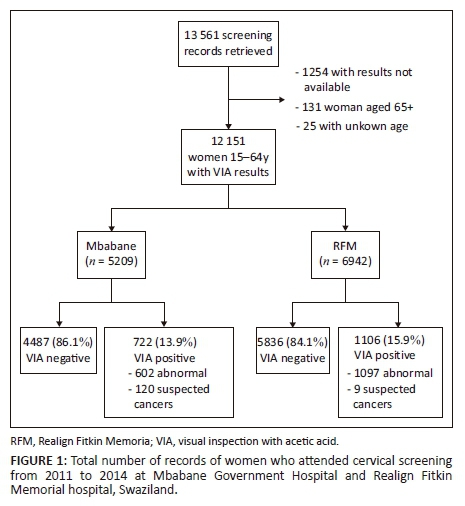
A total of 13 561 records of women who attended cervical screening from January 2011 to October 2014 at the Mbabane Government Hospital and up to June 2014 at the RFM hospital were reviewed. Records without conclusive VIA results (n = 1254) and those from women outside the age range of 15-64 years (n = 156) were excluded (Figure 1).
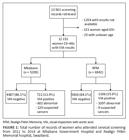
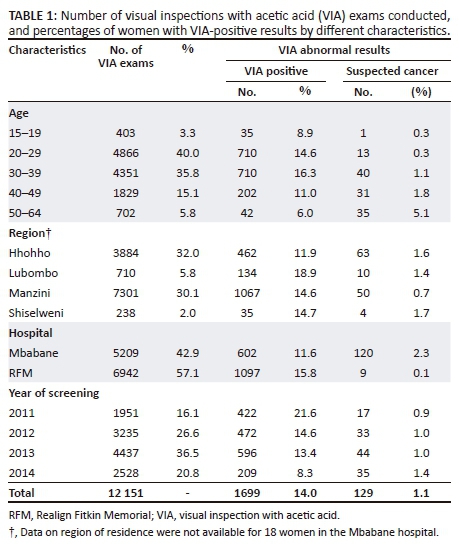
Table 1 shows the main characteristics of women screened with VIA, overall, and separately by VIA abnormal results: positive or suspected cancer. Of the 12 151 VIA exams considered for analysis, 76% were performed in women aged 20-39 years, 60% in women from the Manzini region, 32% in those from Hhohho, 6% in women from Lubombo and 2% in those from Shiselweni. The number of exams per month at Mbabane over 2011 was very small, while at RFM, more than 100 VIAs were performed monthly from March 2011 onwards; a larger proportion (37%) of VIA exams were conducted in 2013 than in other years.
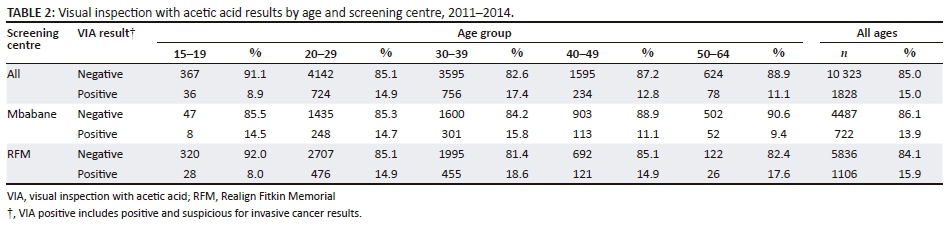
Table 2 shows the VIA PR overall by hospital and by age. The overall VIA PR was 15% (1828 of 12 151 women aged 15-64 years) with 1.1% of the exams classified as suspicious for cancer. The overall VIA PR at RFM was 2% higher than that of Mbabane (15.9%, 95% CI: 15.1%-16.8% at RFM, 13.9%, 95% CI: 12.9-14.8 at Mbabane, p = 0.02); and this was mainly because of higher rates in women aged 30 and above (17.5%, 95% CI: 16.4-19.0 at RFM vs. 13.4%, 95% CI: 12.3-14.6 for those aged 30-64 at Mbabane, p < 0.001). No significant overall trend of VIA PRs by age was observed (p for trend=0.15). Visual inspection with acetic acid PRs were about 15% in women less than 40 and then decreased to 9% in those 50-64 years attending the Mbabane hospital, while VIA PRs at RFM overall increased from 8% in women aged 15-19 years to 18% again in those 50 years and older.
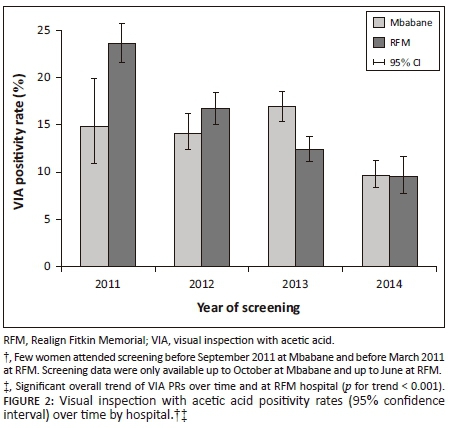
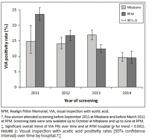
Figure 2 shows the distribution of VIA PRs over time by hospital, while VIA PRs at RFM decreased clearly over time from 23.6% in 2011 to 9.5% in 2014, such a trend was not evident in exams conducted at Mbabane. However, after excluding months when less than 100 VIAs were performed, the PRs at Mbabane decreased from 14.8% in 2011 to 9.7% in 2014.
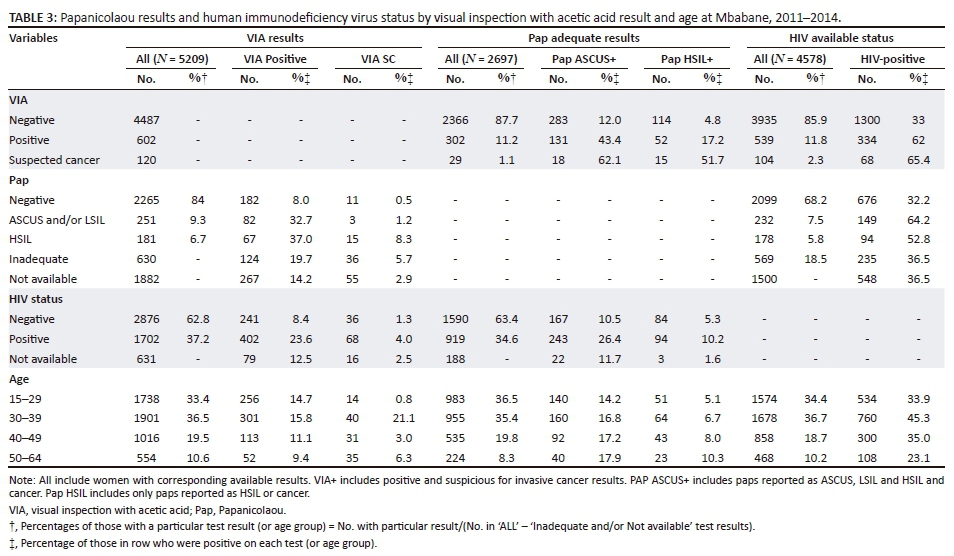
There were 3327 Pap smears with results at Mbabane over the four years; 630 (18.9%) were unsatisfactory and among 2697 satisfactory smears, 84% of them were negative, 251 (9%) were ASCUS and/or LSIL and 181 (7%) were HSIL or worse (HSIL+). Visual inspection with acetic acid was positive in only 182 (8%) women with negative Pap smears, but 11 (6% of 182) exams were considered suspicious for cancer. Among 432 women with abnormal cytology, 34% (149) were VIA positive; in particular, of 181 women with HSIL, 67 (37%) were positive on VIA, and 15 (8%) were considered suspected cancers. The percentage of Pap HSIL increased with age from 5% in women less than 30 years to 10% in women less than 50 years and older and a similar trend was observed for VIA classified as suspicious for cancers which increased from 0.8% in the youngest age group to 6% in the older one (Table 3).
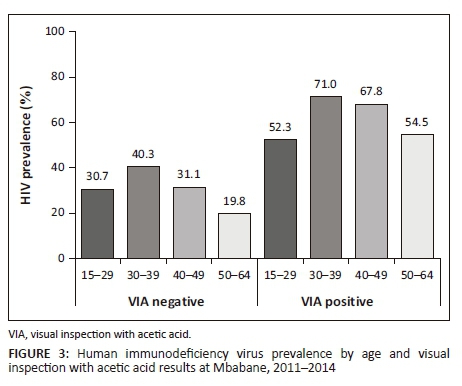
Of 4578 women with known HIV status, 1702 (37.2%, 95% CI: 35.8-38.6) were HIV-positive; VIA was positive in 8% of HIV-negative women and in 24% of HIV-positive women. The highest HIV prevalence was observed among women of 30-39 years (45%), HIV prevalence decreased afterwards, independently of VIA result (Supplementary Figure 3).
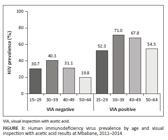
LSIL, low-grade squamous intraepithelial lesion; HSIL, high-grade squamous intraepithelial lesion; Pap, Papanicolaou; VIA, visual inspection with acetic acid; HIV, human immunodeficiency virus.
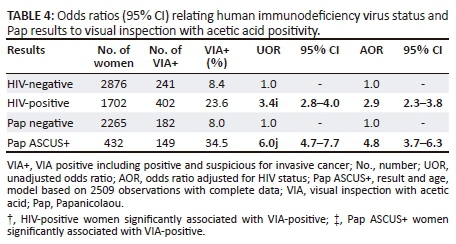
There were 2509 women with adequate Pap smears and known HIV status, 410 (10%) of them had abnormal cytology (232 ASCUS and/or LSIL and 178 HSIL) and 243 (59% of 410) were HIV-positive.
In the absence of histology results, assuming PAP HSIL+ as a proxy of high-grade cervical disease and therefore as gold standard, the sensitivity and specificity of VIA to detect Pap HSIL were 37% (95% CI: 30.0-44.5) and 89.5% (95% CI: 88.2-90.7), while the positive and negative predictive values of VIA were 20.2% (95% CI: 16.0-25.0) and 95.2% (95% CI: 94.2-96.0).
In a multivariate logistic model including age, cytology abnormalities (Pap ASCUS+) and HIV positivity, after adjusting for the other two factors, HIV-positive women were 2.9 times more likely to have a positive VIA (OR: 2.9, 95% CI: 2.3-3.8) than HIV-negative women, similarly, compared to women with normal Pap smears; those with abnormal cytology were 4.8 times more likely to be VIA-positive (Table 4).
Discussion
In this retrospective study, we summarised the distribution of cervical abnormalities based on VIA results among 13 561 women who attended cervical screening in two main hospitals of Swaziland from 2011 to 2014, following the implementation of VIA in 2009 as part of the national cervical screening programme. Despite not having data for some months in 2014, it was observed that after the introduction of VIA in each hospital, the number of VIA exams increased annually from 1951 in 2011 to 4437 in 2013, when the largest proportion of VIA exams were conducted (38.8% at Mbabane, 34.8% at RFM).
Our study showed an overall VIA PR of 15% (95% CI: 14.4-15.7) among women aged 15-64 years with 1.1% of VIA exams classified as suspicious for cervical cancer. In addition, there was a much smaller proportion of VIA classified as suspected cancer in RFM than at Mbabane (0.1% v 2.3%). These differences could be explained by differences in the criteria used to classify exams and by observer variability. Visual inspection with acetic acid exams were conducted by one single nurse in each centre, both of them were trained at the same time by experts in Zambia; therefore, it is unlikely that differences are because of VIA positivity definition. In addition, there are potential issues of overcall versus under-call between the two nurses. It is known that VIA PRs vary largely compared to other screening test results and that VIA heavily depends on human judgement.1617,18,19
The prevalence of HIV was 37.2% among 4578 women aged 15-64 years with known HIV status (self-reported or based on clinical records) attending the Mbabane hospital. Even though HIV status was only available for one hospital, the results are likely to be representative of all women in Swaziland, as they are similar to those reported by the 2011 Swaziland HIV Incidence Measurement Survey (SHIMS), in which the HIV prevalence in women aged 18-49 years was 39%.20
It is clear that cervical abnormalities are more prevalent among HIV-positive women than among HIV-negative women. A review of studies published before 2007 that evaluated the association between HIV infection, HPV infection and cervical neoplasia, and the impact of using highly active ART (HAART) on the association, reported ratios of the prevalence of HPV infection, LSIL and HSIL in HIV-positives compared to HIV-negatives.21212122
A subset of 2697 records retrieved from the Mbabane hospital contained Pap results. The overall percentage of cytological abnormalities was 16% (95% CI: 14.7-17.5); 3% of them were ASCUS and/or AGUS, 6% LSIL and 7% HSIL or cancer). In a previous report of 12 323 smears read at the Central Public Health Laboratory (CPHL), the proportion of cytological abnormalities was 44%, almost threefold ours9
To our knowledge, this study represents the first evaluation of VIA results after its introduction in the Swaziland National Cervical Screening programme. The main strength of our study relies on the large number of VIA screens performed in women, residents from all political regions of the country, who attended two major hospitals over four years. However, although the records retrieved, we assumed, were representative of all women in Swaziland, we cannot rule out potential information and reporting bias, as we have used routine-collected data. Therefore, we accept that biases may have been greater because this is an analysis based on routine-collected data, that is, we did not have any control over the data collection. In fact, we were able to retrieve data on Pap smears and HIV-reported status only from a small subset of women. In addition, although we can assume that at least in the two hospitals included in this report adherence to the screen-and-treat protocol was high, and that the majority of VIA positives eligible for cryotherapy were treated, we were unable to retrieve data to confirm this. Another major limitation of our study is the lack of colposcopy and histological confirmation of disease, which was non-existent, as only recently two pathologists have been appointed in the country. We still estimated the performance of VIA using Pap HSIL as gold standard; in this scenario, it is of concern the very low sensitivity of VIA, 37%, highlighting that there may be a number of women with cervical disease left untreated. Such may be because of challenges of implementing screening such as the low number of health service providers and limited training opportunities.
There is overwhelming evidence that human papillomavirus (HPV) DNA testing is more sensitive than cytology and VIA for the detection of high-grade cervical lesions.23,24
Conclusion
In conclusion, based on our findings, cervical abnormalities represent a public health problem that needs to be addressed urgently by strengthening, and expanding the existing cervical cancer screening in the country, with a priority among HIV-positive women. Lobbying and advocating for the development of a cervical cancer screening policy, as well as the introduction of HPV vaccine at national level is needed to implement a comprehensive cervical cancer prevention programme. The results found in this retrospective study call for improved health education programmes on cervical cancer screening and potential-associated risk factors such as sexually transmitted infections, in particular HPV, among high-risk groups. It also calls for the evaluation of alternative screening schemes that include HPV testing that can offer further reassurance to screened negatives of not developing cervical cancer for several years. Nonetheless, population-based screening using low cost VIA, if followed by treatment of VIA positives, is currently the best screening alternative in limited-resourced settings until a validated HPV test becomes affordable.
Competing interests
The authors declare that there are no conflicts of interest with regard to the writing of this article.
Authors contributions
T.G. designed the study, carried out the analyses and wrote the article. B.S. and A.M. assisted in analyses and supervised the analyses and wrote the article. D.X. and J.M.T. supervised the study and analyses, wrote the article, reviewed and modified with their contributions to the original manuscript. All authors have read and approved the final version of the manuscript.
Acknowledgements
We thank the Kingdom of Swaziland Ministry of Health for allowing us to implement the study, and the support from the International Agency for Research on Cancer (IARC), WHO-Swaziland local office, Ministry of Health Epidemiology Unit and Sexually Reproductive Health Unit (SRH). We are so thankful with the support of HPV-Cancer Study Team.
References
-
1. Parkin DM. The global health burden of infection-associated cancers in the year 2002. Int J Cancer. 2006;118(12):3030-3044. https://doi.org/10.1002/ijc.21731
» https://doi.org/10.1002/ijc.21731 -
2. Ferlay J, Soerjomataram I, Ervik M, et al. GLOBOCAN 2012 v1.0, Cancer Incidence and Mortality Worldwide: IARC Cancer Base No. 11 [homepage on the Internet]. Lyon, France: International Agency for Research on Cancer; 2013 [cited 2016 May 10]. Available from: http://globocan.iarc.fr
» http://globocan.iarc.fr -
3. Moscicki AB, Schiffman M, Kjaer S, Villa LL. Chapter 5: Updating the natural history of HPV and anogenital cancer. Vaccine. 2006;24(Suppl 3):42-51. https://doi.org/10.1016/j.vaccine.2006.06.018
» https://doi.org/10.1016/j.vaccine.2006.06.018 -
4. Bruni L, Diaz M, Castellsague X, Ferrer E, Bosch FX, de Sanjose S. Cervical human papillomavirus prevalence in 5 continents: Meta-analysis of 1 million women with normal cytological findings. J Infect Dis. 2010;202(12):1789-1799. https://doi.org/10.1086/657321
» https://doi.org/10.1086/657321 -
5. Ntekim A. Cervical cancer in sub Sahara Africa. In: Rajkumar R, editor. Obstetrics and gynecology 'Topics on Cervical Cancer With an Advocacy for Prevention'. InTech, 2012. Available from: http://bezak.umms.med.umich.edu/CIRHT/Content/Gynaeco logy%20and%20Obstetrics%20-%20Open%20Textbooks//Book-InTech-Topics%20on%20Cervical%20Cancer-CC-BY.pdf
» http://bezak.umms.med.umich.edu/CIRHT/Content/Gynaeco logy%20and%20Obstetrics%20-%20Open%20Textbooks//Book-InTech-Topics%20on%20Cervical%20Cancer-CC-BY.pdf -
6. Bratcher LF, Sahasrabuddhe VV. The impact of antiretroviral therapy on HPV and cervical intraepithelial neoplasia: Current evidence and directions for future research. Infect Agents Cancer. 2010;5:8. https://doi.org/10.1186/1750-9378-5-8
» https://doi.org/10.1186/1750-9378-5-8 - 7. Word Health Organization, Institut Catala d'Oncologia. Human Papillomavirus and related cancers. Geneva; 2010.
-
8. Gakidou E, Nordhagen S, Obermeyer Z. Coverage of cervical cancer screening in 57 countries: Low average levels and large inequalities. PLoS Med. 2008;5(6):e132. https://doi.org/10.1371/journal.pmed.0050132
» https://doi.org/10.1371/journal.pmed.0050132 -
9. Okonda S, Wright C, Michelow P. The status of cervical cytology in Swaziland, Southern Africa: A descriptive study. Cytojournal. 2009;6:14. https://doi.org/10.4103/1742-6413.54916
» https://doi.org/10.4103/1742-6413.54916 - 10. Fonn S, Bloch B, Mabina M, et al. Prevalence of pre-cancerous lesions and cervical cancer in South Africa - A multicentre study. S Afr Med J. 2002;92(2):148-156.
-
11. Lacey CJ, Lowndes CM, Shah KV. Chapter 4: Burden and management of non-cancerous HPV-related conditions: HPV-6/11 disease. Vaccine. 2006;24(Suppl 3):35-41. https://doi.org/10.1016/j.vaccine.2006.06.015
» https://doi.org/10.1016/j.vaccine.2006.06.015 -
12. Campos NG, Kim JJ, Castle PE, et al. Health and economic impact of HPV 16/18 vaccination and cervical cancer screening in Eastern Africa. Int J Cancer. 2012;130(11):2672-2684. https://doi.org/10.1002/ijc.26269
» https://doi.org/10.1002/ijc.26269 - 13. Alliance for Cervical Cancer Prevention. New evidence on the impact of cervical cancer screening and treatment using HPV DNA test, visual inspection, or cytology. Cervical Cancer Prevention Fact Sheet. 2009.
- 14. The Kingdom of Swaziland. Cervical cancer screening guidelines. Edited by Unit SRH. Mbabane: Ministry of Health; 2013.
-
15. Solomon D, Davey D, Kurman R, et al. The 2001 Bethesda System: Terminology for reporting results of cervical cytology. JAMA. 2002;287(16):2114-2119. https://doi.org/10.1001/jama.287.16.2114
» https://doi.org/10.1001/jama.287.16.2114 -
16. Almonte M, Ferreccio C, Luciani S, et al. Visual inspection after acetic acid (VIA) is highly heterogeneous in primary cervical screening in Amazonian Peru. PLoS One. 2015;10(1):e0115355. https://doi.org/10.1371/journal.pone.0115355
» https://doi.org/10.1371/journal.pone.0115355 -
17. Arbyn M, Sankaranarayanan R, Muwonge R, et al. Pooled analysis of the accuracy of five cervical cancer screening tests assessed in eleven studies in Africa and India. Int J Cancer. 2008;123(1):153-160. https://doi.org/10.1002/ijc.23489
» https://doi.org/10.1002/ijc.23489 -
18. Martin CE, Tergas AI, Wysong M, Reinsel M, Estep D, Varallo J. Evaluation of a single-visit approach to cervical cancer screening and treatment in Guyana: Feasibility, effectiveness and lessons learned. J Obstet Gynaecol Res. 2014;40(6):1707-1716. https://doi.org/10.1111/jog.12366
» https://doi.org/10.1111/jog.12366 -
19. Fallala MS, Mash R. Cervical cancer screening: Safety, acceptability, and feasibility of a single-visit approach in Bulawayo, Zimbabwe. Afr J Prim Health Care Fam Med. 2015;7(1):1-7. https://doi.org/10.4102/phcfm.v7i1.742
» https://doi.org/10.4102/phcfm.v7i1.742 -
20. Bicego GT, Nkambule R, Peterson I, et al. Recent patterns in population-based HIV prevalence in Swaziland. PLoS One. 2013;8(10):e77101. https://doi.org/10.1371/journal.pone.0077101
» https://doi.org/10.1371/journal.pone.0077101 -
21. De Vuyst H, Lillo F, Broutet N, Smith JS. HIV, human papillomavirus, and cervical neoplasia and cancer in the era of highly active antiretroviral therapy. Eur J Cancer Prev. 2008;17(6):545-554. https://doi.org/10.1097/CEJ.0b013e3282f75ea1
» https://doi.org/10.1097/CEJ.0b013e3282f75ea1 -
22. Anderson J, Wysong M, Estep D, et al. Evaluation of cervical cancer screening programs in Cote d'Ivoire, Guyana, and Tanzania: Effect of HIV status. PLoS One.2015;10(9):e0139242. https://doi.org/10.1371/journal.pone.0139242
» https://doi.org/10.1371/journal.pone.0139242 -
23. Gravitt PE, Paul P, Katki HA, et al. Effectiveness of VIA, Pap, and HPV DNA testing in a cervical cancer screening program in a peri-urban community in Andhra Pradesh, India. PLoS One. 2010;5(10):e13711. https://doi.org/10.1371/journal.pone.0013711
» https://doi.org/10.1371/journal.pone.0013711 -
24. Benevolo M, Vocaturo A, Caraceni D, et al. Sensitivity, specificity, and clinical value of human papillomavirus (HPV) E6/E7 mRNA assay as a triage test for cervical cytology and HPV DNA test. J Clin Microbiol. 2011, 49(7):2643-2650. https://doi.org/10.1128/JCM.02570-10
» https://doi.org/10.1128/JCM.02570-10

Accepted: 15 Aug. 2018
Published: 18 Oct. 2018