Husbands' participation in birth preparedness and complication readiness and associated factors in Wolaita Sodo town, Southern Ethiopia
Abstract
BACKGROUND: The poor emphasis on the role of husbands in birth preparedness and complication readiness (BPCR) is a major factor that should be addressed in tackling maternal mortality. AIM: To assess the level of husbands' participation in BPCR and associated factors. SETTING: Wolaita Sodo town, Southern Ethiopia. METHODS: A community based cross-sectional study was conducted among 608 husbands of pregnant women and nursing mothers. Multivariate logistic regression model was used for the analysis. RESULTS: Forty-five per cent of husbands studied had poor participation in BPCR. Out of the total husbands studied, 40% (235) did not identify transportation, 49% (291) did not accompany their wives to antenatal care (ANC) clinic, 59% (350) did not identify skilled birth attendant, 26% (155) did not identify health facility for delivery and 30% (179) did not save money for emergency. Only 42% (250) of husbands had awareness of emergency conditions, while 75% (444) did not make postpartum plan. Husbands who knew the place of birth of the baby [adjusted odds ratio (AOR) = 7.23; 95% confidence interval (CI): 2.98-17.54] and those who discussed with their wives about birth preparedness (AOR = 2.03; 95% CI: 1.37-3.02) were significantly more likely to participate in BPCR compared to those who did not. CONCLUSION: Participation of husbands in BPCR was poor in the study area. The level of participation in relation to selection of service provider and health facility, financial and transportation planning for delivery and identifying blood donor needs attention to achieve better husband participation in BPCR.
Introduction
Maternal mortality is one of the most sensitive indicators of health disparity among low-, middle- and high-income countries and remains largely a major contributor to unmet public health concerns globally. Remarkable disparities in maternal deaths exist between and within countries, with wide variations between the rich and the poor, and urban and rural areas.1,23
Estimates from 2015 indicated that 546 maternal deaths per 100 000 live births were recorded in sub-Saharan Africa compared to 216 maternal deaths per 100 000 live births worldwide.1,311,41,4256
A number of strategies used a framework based on the primary healthcare principles where primary prevention (preventing a condition from occurring through education and services) was distinguished from secondary (detection and treatment of conditions early) and tertiary (treatment of conditions to reduce case fatality) preventions.7
Although husbands have an important role to play in BPCR, the systematic review by Mittenburg and colleagues in 2015 found that previous studies and interventions on BPCR focused mainly on the mothers. Although a few interventions have targeted husbands and mothers-in-law, most studies exclusively evaluated women's behaviour as the primary outcome.8910
Attention has long been drawn to the absence of men from previous reproductive health initiatives, although men play a major role in influencing women's reproductive health, both positively and negatively.11,121314,151617,18
Hence, involvement of male partner becomes even more critical in patriarchal societies if considerable improvement in maternal health outcome is to be realised. Strategies for involving men in maternal health services ought to aim at raising their awareness about emergency obstetric conditions and engaging them in BPCR.197,20,21
Ethiopia continues to have one of the highest maternal mortality rates in the world, with an estimated maternal mortality of 353 per 100 000 live births in 2015.22woreda health setup that encompasses firstly the health centre and health post, secondly the district hospital and lastly the referral hospital. The number of ANC visits that the Government of Ethiopia recommends is the same as that of the World Health Organisation (WHO) recommendation, which is at least four. There is no cost for the ANC services provided for pregnant women.23242526,27,28
Research methods and design
Study area and setting
A community-based cross-sectional study was conducted in Wolaita Sodo town, located in Southern Nations, Nationalities, and Peoples' Region (SNNPR), which is 327 km from Addis Ababa, the capital of Ethiopia. It has three sub-city administrations consisting of 11 districts. The population of the town was estimated to be 100 755 in 2015, and it has one teaching referral hospital, a non-governmental hospital, seven private medium clinics and three governmental health centres.282930
Sample size and sampling procedure
The sample size was determined by using a formula for estimation of single population proportion with the assumption of 95% confidence level, an error margin of 5% and the prevalence of husbands' participation in BPCR (60%) - taken from a previous study in a rural area.2
Data collection
Data were collected by a pretested structured questionnaire, adopted from JHPIEGO,8
Eight data collectors, based on their previous experience, were recruited and trained for data collection, and two trained public health officers supervised collection of the data. The research assistants read out the questions loudly and the husbands answered every question accordingly. If prospective participants (husbands of pregnant women or nursing mothers from identified households) were not found at home during the first visit, the data collectors made a second visit the next day to administer the questionnaire. Prior to data collection, all of the study subjects were oriented and well informed about the purpose of the study and their right to accept or refuse to participate in the interview.
Data quality management and entry
Before the actual data collection, the questionnaire was pretested on a similar setting outside the study area. The data collectors and supervisors were trained for 2 days on principles, ethical considerations, procedures and details of the questionnaire. The principal investigator closely monitored the data collection process. Completed questionnaires were checked for their consistency and completeness every day and then entered into EPi-Info version 3.5.4 statistical software, and finally the data were exported to another statistical software package SPSS, version 20.0, for further cleaning and analysis. Statistical significance was set at p < 0.050 and 95% confidence interval (CI).
Operational definition
Outcome variable
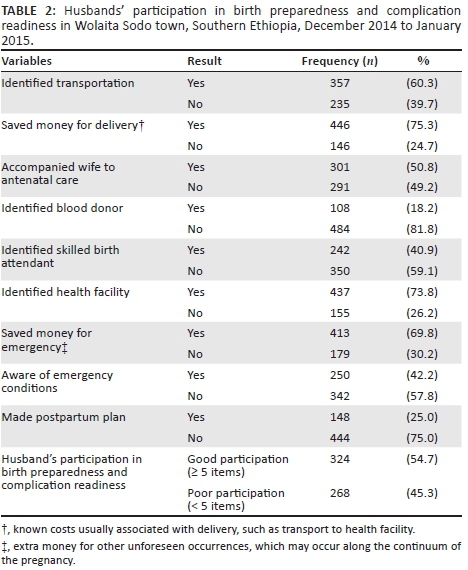
Husbands' participation in BPCR was measured by nine items. For each item, those who responded 'Yes' scored 1 and those who responded 'No' scored 0. Then the mean score was computed as being four out of the nine items.
Good participation in BPCR: Those husbands who practised at least five elements of nine items (Table 2).
Poor participation in BPCR: Those husbands who practised at most four elements of nine items (Table 2). That means husbands who practised four or fewer elements of nine items were categorised as having poor participation in BPCR.
Socio-demographic variables
Husband's age in years was categorised as '20-30 years', '31-40 years' and '41-50 years'.
Religion was categorised as 'Protestant', 'Orthodox', 'Catholic' and 'Muslim'. Husband's education was classified into four categories: 'no formal education', 'primary education', 'secondary education' and 'college degree or diploma'. Husband's occupation was categorised as 'farmer', 'merchant', 'daily labourer', 'government employed' and 'other (taxi driver, farmer)'. Wife's age in years was categorised as '< 20 years', '20-29 years' and '30-39 years'. Wife's education was classified into four categories, similar to husband's education. Wife's occupation was classified as 'housewife', 'merchant', 'daily labourer', 'government employed' and 'other (traditional spinning)'.
Family's monthly income in Ethiopian birr (ETH birr): family income was classified into three categories (< 500, 500-1000, > 1000 ETH birr) using percentiles. The source of information on BPCR was indicated as radio, television, newspaper and discussions with wives, neighbours and health professionals.
Ethical consideration
Ethical clearance was obtained from the Research and Ethical Committee of Wolaita Sodo University, School of Public Health. Informed verbal consent was obtained from each study subject prior to data collection, and the purpose of the study was explained to the respondents in advance. Confidentiality of the information and privacy of the respondents were maintained. During data collection, each of the study participants was communicated that their participation would be voluntary and that they can quit from the study at any time even after the interview has started.
Results
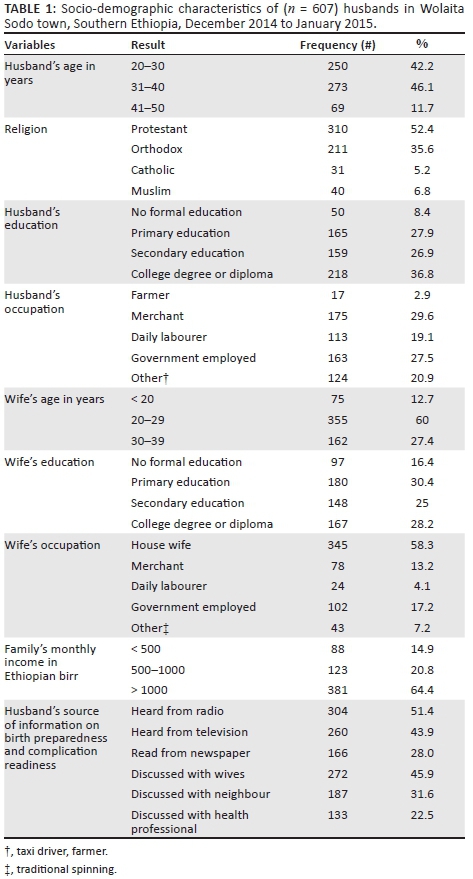
A total of 592 subjects participated in the study, yielding a response rate of 98%. Forty-six per cent of husbands (273) were in the age range of 31-40 years, while slightly above half (52%, 310) were followers of Protestant Christianity. Only 37% (218) of husbands attained educational level of a college degree or diploma, while 28% (163) were government employed by occupation. Regarding socio-demographic characteristics of wives, 60% (355) were aged 20-29 years, 58% (345) were housewives by occupation and 30% (180) had attended primary education. About 64% (381) of the households had income more than 1000 Ethiopian birr (≈ 45 USD) per month. Regarding husbands' sources of information about BPCR, about half of the husbands (51.4%, 304) had heard about it from radio, whereas 43.9% (260) had heard about it from television. Moreover, only 28.0% (166) of the husbands had read about BPCR from newspapers, while 45.9% (272) reported discussing BPCR with their wives. Nearly one-third of the husbands (31.6%) reported discussing with their neighbours, while nearly one-quarter (22.5%) reported discussing BPCR with a health professional (Table 1).
Twenty-five per cent (146) of the husbands did not save money for delivery and postpartum and only one in five (108) husbands identified blood donor. Among the husbands studied, 45% (268) had poor participation in BPCR during pregnancy, delivery and postpartum period. Out of the total husbands studied, 40% (235) did not identify transportation, 49% (291) did not accompany their wives to ANC clinic, 59% (350) did not identify skilled birth attendants, 26% (155) did not identify health facility for delivery and 30.2% (179) did not save money for emergency, and only 42% (250) had awareness of emergency condition, while 75% (444) did not make postpartum plan (Table 2).
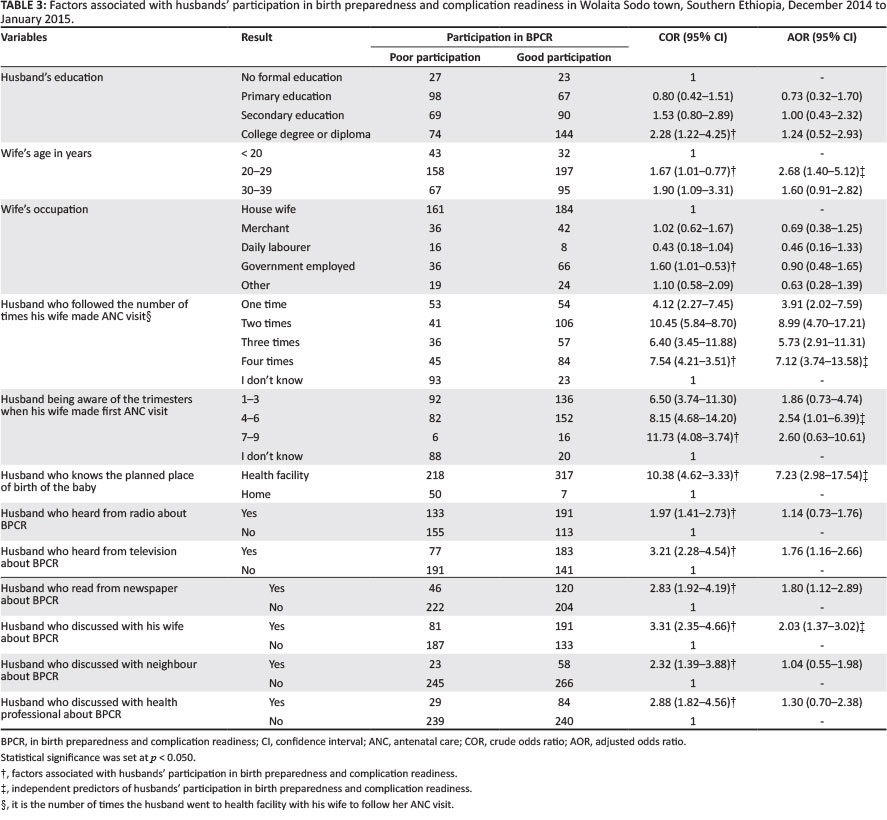
Socio-demographic characteristics such as husband's education (college degree or diploma) and wife's age (20-29 years) and occupation (being government employed) were found to be statistically significantly associated with increased husbands' participation in BPCR in the bivariate analysis. Among these variables, only having wives aged 20-29 years was (adjusted odds ratio [AOR] = 2.68; 95% CI: 1.40-5.12) found to be significantly associated with increased husbands' participation in BPCR in the multivariate analysis. Regarding husbands' participation, those who accompanied wives for ANC visits (AOR [for husbands who followed their wives' ANC visits four times] = 7.12; 95% CI: 3.74-13.58), those who became aware of their wives' ANC visit in the second trimesters (AOR = 2.54; 95% CI: 1.01-6.39) and those who planned the place of birth of the baby (AOR = 7.23; 95% CI: 2.98-17.54) were significantly more likely to participate in BPCR.
Sources of information and husbands' participation in BPCR were found to be significantly associated in the bivariate analysis, but only husbands who discussed with their wives about BPCR showed an association in multivariate analysis (AOR = 2.03; 95% CI: 1.37-3.02) (Table 3).
Discussion
This study has shown that approximately half of the husbands were either not participating at all or had poor participation in BPCR as they were practising four or less elements of the nine items during pregnancy, delivery and postpartum period. This finding indicates higher percentage of husbands not participating in BPCR compared with the study conducted in Mekele town, Northern Ethiopia, in which the husbands who participated in BPCR constituted 40%.3132133
Every two out of five husbands did not identify transportation, which implies that during emergency it becomes problematic to transport the mother in time to avoid birth complications or even death. Half of the husbands did not accompany their wives, making them visit the ANC clinic unaccompanied. This is higher compared to the study conducted in Northern Ethiopia.3134,35
About a quarter of the husbands did not save money for emergency, which could indicate not only poor financial planning but also inadequate financial resources to enable saving for such emergencies. Lack of financial resources in emergency situations coupled with lack of other BPCR factors such as having made no pre-arrangements for transport, not being aware of emergencies and having no postpartum plan could form a cluster of risk factors that could eventually lead to the death of the mother because of prolongation of the first two delays in the continuum of care: delay in deciding to seek care and delay in reaching health care facility. Hence, saving money for transportation and essential expenses for delivery and postpartum as well as for unforeseen occurrences as early as possible can save the woman's life. Thus, interventions that support husbands to make such preparations could also help to save the life of the mother.
This study also examined factors associated with husbands' participation in BPCR. Husbands with wives younger than 20 years were less likely to participate in BPCR as compared to husbands with wives aged 20-29 years and 30-39 years. This finding is consistent with a study conducted in Kinshasa.36371
Association between sources of information and husbands' participation in BPCR was investigated and all the variables showed an association in the bivariate analysis. However, in the multivariate analysis, only husbands who discussed with their wives about BPCR were found to be significantly more likely to participate (Table 3). This could be because of lack of provision of health information to husbands regarding the utilisation of maternity care and also a lack of open discussion between husbands and wives related to their reduced BPCR. Moreover, usually husbands are the major decision makers in most household issues. Thus, discussion with the husbands regarding the need to be prepared for the birth and subsequent emergencies could have a positive influence on the women's maternity care services. Unfortunately, in this study, slightly less than half of the husbands did not discuss BPCR with their wives.
Strength and limitations of the study
This study presents a unique perspective to BPCR by evaluating it from the husbands' perspective. The use of standard tool, pretesting of the questionnaire before actual data collection and training and supervision to control quality of the data add to the strength of this study. Nearly all the subjects were involved in the study.
This study utilised a cross-sectional design, which may present difficulties in ascertaining the direction of causality between the variables analysed. Therefore, caution needs to be taken in the interpretation of the findings with regard to causality. The study might be vulnerable to reporting bias, response bias and selection bias. Social desirability bias could arise from the fact that most men in this context would want to uphold or affirm social norms and masculinity values regarding the role of men as providers for the family and are potentially more likely to overreport their preparedness and readiness prior to delivery. However, we do not think that this would be a big problem in our study because we used a standardised questionnaire with multiple questions to assess BPCR. The lack of adjustment for unknown potential confounders in the multivariate regression analysis is also a limitation. This study was conducted in a town (urban setting), which limits its generalisability to rural and similar settings.
Conclusion
Participation of husbands in BPCR was poor in the study area. In relation to the level of preparation and participation, saving money for delivery and identifying blood donor were the lowest. Therefore, interventions should be targeted towards improving male participation through promoting targeted policies and advocacies across all relevant stakeholders' levels, including community education for men and women. Efforts should be made by the health care system to assist and welcome both men and women at ANC and delivery care.
Competing interests
The authors declare no competing interest. They also declare no funding support for this research.
Authors' contributions
M.T. had a principal role and was involved in the conception of ideas, development of methodologies and writing of the article. A.T.B. and B.O.A. were involved in the analysis and interpretation of findings, and writing of the article. All authors read and approved the final version of the manuscript.
Acknowledgements
The authors would like to thank the Wolaita Sodo town health office, the supervisors, data collectors, study participants, Wolaita Sodo University, College of Health Sciences and Medicine, and School of Public Health for their support and participation in the study.
References
-
1. WHO. World Health Statistics [homepage on the Internet]. 2016 [cited 2016 Aug 04]. Available from: http://www.who.int/gho/publications/world_health_statistics/2016/en/
» http://www.who.int/gho/publications/world_health_statistics/2016/en/ -
2. Kassebaum NJ, Bertozzi-Villa A, Coggeshall MS, et al. Global, regional, and national levels and causes of maternal mortality during 1990-2013: A systematic analysis for the Global Burden of Disease Study 2013. Lancet. 2014;384(9947):980-1004. https://doi.org/10.1016/S0140-6736(14)60696-6
» https://doi.org/10.1016/S0140-6736(14)60696-6 -
3. Alkema L, Chou D, Hogan D, et al. Global, regional, and national levels and trends in maternal mortality between 1990 and 2015, with scenario-based projections to 2030: A systematic analysis by the UN Maternal Mortality Estimation Inter-Agency Group. Lancet. 2016;387(10017):462-474. https://doi.org/10.1016/S0140-6736(15)00838-7
» https://doi.org/10.1016/S0140-6736(15)00838-7 -
4. Buor D, Bream K. An analysis of the determinants of maternal mortality in sub-Saharan Africa. J Womens Health. 2004;13(8):926-938. https://doi.org/10.1089/jwh.2004.13.926
» https://doi.org/10.1089/jwh.2004.13.926 -
5. Yargawa J, Leonardi-Bee J. Male involvement and maternal health outcomes: Systematic review and meta-analysis. J Epidemiol Community Health. 2015;69(6):604-612. https://doi.org/10.1136/jech-2014-204784
» https://doi.org/10.1136/jech-2014-204784 -
6. Miltenburg AS, Roggeveen Y, Shields L, et al. Impact of birth preparedness and complication readiness interventions on birth with a skilled attendant: A systematic review. PLoS One. 2015;10(11):e0143382. https://doi.org/10.1371/journal.pone.0143382
» https://doi.org/10.1371/journal.pone.0143382 -
7. Bullough C, Meda N, Makowiecka K, Ronsmans C, Achadi EL, Hussein J. Current strategies for the reduction of maternal mortality. BJOG. 2005;112(9):1180-1188. https://doi.org/10.1111/j.1471-0528.2005.00718.x
» https://doi.org/10.1111/j.1471-0528.2005.00718.x - 8. JHPIEGO. Monitoring birth preparedness and complication readiness tools and indicators for maternal and newborn health. Baltimore, MD: JHPIEGO; 2004; p. 14-18.
-
9. Kakaire O, Kaye DK, Osinde MO. Male involvement in birth preparedness and complication readiness for emergency obstetric referrals in rural Uganda. Reprod Health. 2011;8(1):1. https://doi.org/10.1186/1742-4755-8-12
» https://doi.org/10.1186/1742-4755-8-12 -
10. Collumbien M, Hawkes S. Missing men's messages: Does the reproductive health approach respond to men's sexual health needs? Cult Health Sex. 2000;2(2):135-150. https://doi.org/10.1080/136910500300769
» https://doi.org/10.1080/136910500300769 -
11. Dudgeon MR, Inhorn MC. Men's influences on women's reproductive health: Medical anthropological perspectives. Soc Sci Med. 2004;59(7):1379-1395. https://doi.org/10.1016/j.socscimed.2003.11.035
» https://doi.org/10.1016/j.socscimed.2003.11.035 -
12. United Nations Report of the International Conference on Population and Development [homepage on the Internet], Cairo, September 5-13, 1994 [cited 2009 Dec 02]. Available from: http://www.un.org/popin/icpd/conference/offeng/poa.html
» http://www.un.org/popin/icpd/conference/offeng/poa.html -
13. Singh D, Lample M, Earnest J. The involvement of men in maternal health care: Cross-sectional, pilot case studies from Maligita and Kibibi, Uganda. Reprod Health. 2014;11(1):1. https://doi.org/10.1186/1742-4755-11-68
» https://doi.org/10.1186/1742-4755-11-68 -
14. Kululanga LI, Sundby J, Chirwa E. Striving to promote male involvement in maternal health care in rural and urban settings in Malawi-a qualitative study. Reprod Health. 2011;8(1):1. https://doi.org/10.1186/1742-4755-8-36
» https://doi.org/10.1186/1742-4755-8-36 -
15. Ditekemena J, Koole O, Engmann C, et al. Determinants of male involvement in maternal and child health services in sub-Saharan Africa: A review. Reprod Health. 2012;9(1):1. https://doi.org/10.1186/1742-4755-9-32
» https://doi.org/10.1186/1742-4755-9-32 -
16. Kwambai TK, Dellicour S, Desai M, et al. Perspectives of men on antenatal and delivery care service utilisation in rural western Kenya: A qualitative study. BMC Pregnancy Childbirth. 2013;13(1):1. https://doi.org/10.1186/1471-2393-13-134
» https://doi.org/10.1186/1471-2393-13-134 -
17. Babalola S, Fatusi A. Determinants of use of maternal health services in Nigeria-looking beyond individual and household factors. BMC Pregnancy Childbirth. 2009;9(1):1. https://doi.org/10.1186/1471-2393-9-43
» https://doi.org/10.1186/1471-2393-9-43 - 18. Iliyasu Z, Abubakar IS, Galadanci HS, Aliyu MH. Birth preparedness, complication readiness and fathers' participation in maternity care in a northern Nigerian community. Afr J Reprod Health. 2010;14(1):21-32.
-
19. Thaddeus S, Maine D. Too far to walk: Maternal mortality in context. Soc Sci Med. 1994;38(8):1091-1110. https://doi.org/10.1016/0277-9536(94)90226-7
» https://doi.org/10.1016/0277-9536(94)90226-7 - 20. JHPIEGO, Maternal and Neonatal Health (MNH) Program. Birth preparedness and complication readiness. A matrix of shared responsibilities. In: Maternal and Neonatal Health. Baltimore, MD: JHPIEGO, 2001; p. 23-31.
- 21. WHO. Trends in maternal mortality: 1990 to 2015: Estimates by WHO, UNICEF, UNFPA, World Bank Group and the United Nations Population Division. Geneva: WHO; 2015.
- 22. Federal Democratic Republic of Ethiopia Ministry of Health. Health Sector Development Program IV. 2010/11 - 2014/15. Addis Ababa: Ministry of Health; 2010.
-
23. Gebremariam A, Addissie A. Intention to use long acting and permanent contraceptive methods and factors affecting it among married women in Adigrat town, Tigray, Northern Ethiopia. Reprod Health. 2014;11(1):1. https://doi.org/10.1186/1742-4755-11-24
» https://doi.org/10.1186/1742-4755-11-24 -
24. Gebrehiwot H, Gebregziabher W, Gidey G. Assessment of husbands participation on birth preparedness and complication readiness in Enderta Woreda, Tigray Region, Ethiopia, 2012. J Womens Health Care. 2013;3:140. http://dx.doi.org/10.4172/2167-0420.1000140
» http://dx.doi.org/10.4172/2167-0420.1000140 -
25. Belda SS, Gebremariam MB. Birth preparedness, complication readiness and other determinants of place of delivery among mothers in Goba District, Bale Zone, South East Ethiopia. BMC Pregnancy Childbirth. 2016;16(1):1. https://doi.org/10.1186/s12884-016-0837-8
» https://doi.org/10.1186/s12884-016-0837-8 -
26. Hailu M, Gebremariam A, Alemseged F, Deribe K. Birth preparedness and complication readiness among pregnant women in Southern Ethiopia. PLoS One. 2011;6(6):e21432. https://doi.org/10.1371/journal.pone.0021432
» https://doi.org/10.1371/journal.pone.0021432 -
27. Markos D, Bogale D. Birth preparedness and complication readiness among women of child bearing age group in Goba woreda, Oromia region, Ethiopia. BMC Pregnancy Childbirth. 2014;14(1):1. https://doi.org/10.1186/1471-2393-14-282
» https://doi.org/10.1186/1471-2393-14-282 - 28. Wolaita Zone Central Statistics Agency. Strategic plan. Wolaita Sodo: Wolaita Zone Central Statistics Agency; 2013.
- 29. Wolaita Zone Health Department. Health sector development plan. Wolaita Sodo: Wolaita Zone Health Department; 2016.
-
30. Mitchell W, Tienke V, Floris B, et al. Emergency Obstetric Care Provision in Southern Ethiopia: A facility based survey. BMJ Open. 2017;7(11):e018459. https://doi.org/10.1136/bmjopen-2017-018459
» https://doi.org/10.1136/bmjopen-2017-018459 -
31. Weldearegay HG. Determinant factors of male involvement in birth preparedness and complication readiness at Mekelle town; a community based study. Sci J Public Health. 2015;3(2):175-180. https://doi.org/10.11648/j.sjph.20150302.14
» https://doi.org/10.11648/j.sjph.20150302.14 -
32. Ononge S, Mirembe F, Wandabwa J, Campbell OM. Incidence and risk factors for postpartum hemorrhage in Uganda. Reprod Health. 2016;13(1):1. https://doi.org/10.1186/s12978-016-0154-8
» https://doi.org/10.1186/s12978-016-0154-8 -
33. Haeri S, Dildy GA. Maternal mortality from hemorrhage. Semin Perinatol. 2012;36(1):48-55. https://doi.org/10.1053/j.semperi.2011.09.010
» https://doi.org/10.1053/j.semperi.2011.09.010 - 34. Graham WJ, Bell JS, Bullough CH. Can skilled attendance at delivery reduce maternal mortality in developing countries. Stud Health Serv Organ Policy. 2001;17:97-130.
-
35. Rogo KO, Oucho J, Mwalali P. Maternal mortality. In: Jamison DT, Feachem RG, Makgoba MW, et al., editors. Disease and mortality in sub-Saharan Africa. 2nd ed. [homepage on the Internet]. Washington, DC: The International Bank for Reconstruction and Development/The World Bank; 2006. [cited 2017 February 15]; p. 223-236. Available from: https://www.ncbi.nlm.nih.gov/books/NBK2288/
» https://www.ncbi.nlm.nih.gov/books/NBK2288/ -
36. Ditekemena J, Matendo R, Koole O, et al. Male partner voluntary counselling and testing associated with the antenatal services in Kinshasa, Democratic Republic of Congo: A randomized controlled trial. Int J STD AIDS. 2011;22(3):165-170. https://doi.org/10.1258/ijsa.2010.010379
» https://doi.org/10.1258/ijsa.2010.010379 -
37. Tweheyo R, Konde-Lule J, Tumwesigye NM, Sekandi JN. Male partner attendance of skilled antenatal care in Peri-urban Gulu district, Northern Uganda. BMC Pregnancy Childbirth. 2010;10(1):1. https://doi.org/10.1186/1471-2393-10-53
» https://doi.org/10.1186/1471-2393-10-53

Accepted: 04 Dec. 2017
Published: 11 Apr. 2018