Perceptions of young men at the Free State School of Nursing with regards to teenage pregnancy
Abstract
BACKGROUND: Teenage pregnancy is a socio-economic challenge and a serious public health problem for communities in South Africa. It is, therefore, imperative that effective interventions and programmes be implemented to address this problem. A number of research studies have been conducted on teenage pregnancy in South Africa, but their focus was mainly on teenage girls excluding young men's involvement in teenage pregnancy AIM: The aim of the study was to determine the perceptions of young men between the ages of 18 and 23 years towards teenage pregnancy METHODS: A qualitative, explorative semi-structured interview descriptive design was used to conduct the study. The study was guided by the Johnson's Behavioral System Model. Purposive sampling was used to select 10 participants with whom semi-structured interviews were conducted. Thematic analysis of data were performed SETTING: The study was conducted in Free State School of Nursing's two main campuses RESULTS: The findings of this study revealed that young men were not involved in reproductive health programmes aiming to prevent teenage pregnancies. Father and son's poor communication on issues related to sex and teenage pregnancy contributes to unprotected sexual intercourse resulting in teenage pregnancy. Cultural and traditional practices such as the withdrawal method, not using contraceptives, and misleading teachings at the initiation schools contribute to risk factors of teenage pregnancy CONCLUSION: There is still a gap in reproductive health that needs to be filled by involving young men to reduce teenage pregnancies. Involving young men in reproductive health programmes could lead to a decreased number of teenage pregnancies. Factors, such as cultural and traditional practices, and father and son sexual health education, need to be taken into consideration to prevent teenage pregnancies
Introduction and background information
Teenage pregnancy rates in South Africa remain high, as around 30% of 15-19-year olds have reportedly ever been pregnant.1221
The National Department of Education (NDE) embarked on a Sexual Education Programme (SEP) that formed part of the Life Orientation learning area during 2002.33444
Because of the behavioural underpinnings of teenage pregnancy, the Johnson's555
· Attachment or affiliation: This is regarded as the first response of an individual's system. It allows social inclusion, intimacy, formation and maintenance of a strong bond and provides an individual with a sense of security.
· Dependency: This involves an individual's attainment of approval, attention, recognition or physical assistance from others.
· Ingestive: This involves the biological behaviour surrounding the intake of food and what is socially acceptable in a given culture.
· Elimination: This involves the physical behaviour surrounding the excretion of waste products from the body.
· Sexual: This involves psychological behaviour related to procreation, attraction and fulfilment of expectations associated with one's sexuality, caring for others and to be cared for by others.
· Aggression: This involves the emotional behaviour concerned with protection and self-preservation that generate defence responses when an individual's life or territory is threatened.
· Achievement: It provokes behaviours that attempt to control the environment.
In this study, attachment, achievement, dependency, aggression and sexual system were used to explore and describe the factors that play a critical role in teenage pregnancy which are in line with Johnson's Behavioral System Model. These factors are as follows:
· poor communication, especially father-to-son communication
· misinterpretation of cultural and traditional sexual practices
· involvement of young men in reproductive health and sex education.
Problem statement
Teenage pregnancy at schools remains a problem across South Africa.267
Sex is a topic that is not often addressed by family members with their teenagers, especially not with young men.8883
Aim of the study
The aim of the study was to determine the perceptions of young men between the ages of 18 and 23 years at the Free State School of Nursing with regard to teenage pregnancy.
Objectives of the study
The objectives of the study were to: identify the roles played by young men in teenage pregnancy, the risk factors influencing young men's perceptions, and preventative practices regarding teenage pregnancy.
Research method
Study design
A qualitative research design was used to explore and describe the perceptions of young men regarding teenage pregnancy.
Study setting
The Free State School of Nursing consists of the Eastern, Northern and Southern campuses situated within the Free State Province. The study was conducted at two main campuses of the school, which are the Northern and the Southern Free State School of Nursing.
Sample and sampling technique
The two main campuses namely, Northern and Southern Free State School of Nursing, were used to select the participants. The Eastern Free State School of Nursing campus participants formed part of the pilot study, therefore, they were excluded from the main study population. This was followed by purposive sampling of a total of 10 young men enrolled in the Diploma in General Nursing (Community, Psychiatry) and Midwifery course at both campuses. The young men; who met the inclusion criteria and agreed to participate in the study, were included.
Inclusion and exclusion criteria
The study included young men who were between the ages of 18 and 23 years, currently registered as student nurses at Free State School of Nursing studying towards a four-year comprehensive Diploma in Nursing. Female students and all young male students below the age of 18 years and above 23 years of age studying at the Free State School of Nursing were excluded from the study.
Pretesting of the interview guide
A pretest was conducted at the Eastern Campus Free State School of Nursing in order to determine the feasibility of the study and the relevance of the interview guide. Two participants, who met the inclusion criteria, were purposefully selected to be included in the pretesting of the interview guide. A semi-structured interview was conducted with the first participant, and the results were confirmed by conducting a semi-structured interview with a second participant. The pretest participants understood the questions, although the researcher had to probe to obtain more information from their responses. Data were analysed and interpreted. No changes were made to the study processes and the interview guide. The pretest site, the participants and the results, were not included in the main study.
Data collection
Semi-structured interviews with young men; were conducted at Free State School of Nursing in a private room at each campus. Data were collected from the beginning of November 2014 - December 2014. Data collection focused on the following themes and were guided by Johnson's Behavioral System Model:
· Demographic data such as; participants' age, race, marital status and number of own biological children were collected in order to determine the dependency to the environment.
· Participants' perceptions regarding teenage pregnancy to determine their perceptions regarding sexual activities and their roles in teenage pregnancies.
· Participants' opinions regarding the following risk factors were explored and described:
o alcohol, smoking cigarettes, marijuana and the use of other drugs
o cultural and traditional beliefs about sexual practices
o socio-economic status
o knowledge and use of contraceptives
o sex education taught by parents at home and teachers at schools.
· This was performed to determine young men's behaviours such as: aggression, attachment, achievement and dependency caused by these factors that lead to teenage pregnancies.
· Participants' culture, traditional practices and beliefs that lead to misconceptions and misinterpretations about sex and teenage pregnancies.
· Participants' comments and suggestions regarding teenage pregnancies, in order to identify measures to prevent teenage pregnancy.
Data analysis
Data were analysed thematically.10
Ethical considerations
Approval for the study was obtained from the ethics committees of the institutions (REC 53/14). Letter of information was issued to all the participants, and all the participants who agreed to participate in the study had to sign an informed consent form. Permission to record the interviews was obtained from all the participants before data collection commenced.
Research study findings
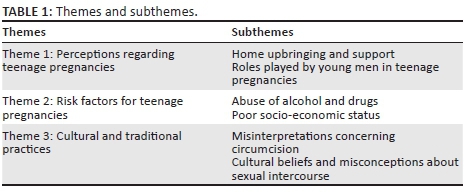
After analysed data, the findings revealed several themes and subthemes that emerged as evident from Table 1.
Theme 1: Perceptions regarding teenage pregnancies
The findings under this theme were varied but pointed on the issues pertaining how they were brought up at home and the support they receive from their parents as young men regarding sex-related issues.
Home upbringing and support
Most of young men were of opinion that the type of family structure and support they receive at home and from the community were imperative in their upbringing. However, there was lack of father-to-son communication when coming to issues related to sexual education. One participant noted:
'… my father never discussed any issues related to sex topic with me' (Participant 4, 20 years old, black person).
Their expressions were that there was a lack of communication on issues related to availability and use of contraceptives including discussion about sex topics, as they were regarded as taboo in most family dwellings:
'Sex education or talks with parents does not exist especially when you are raised by a grandmother. Sometimes you need some sort of support and guidance on issues related to sex but you don't know who to turn to.' (Participant 1, 22 years old, black person)
Roles played by young men in teenage pregnancies
Young men reported that when coming to reproductive health, they felt left out as this was still regarded as a female domain. They strongly believed that they also played a crucial role in teenage pregnancies as they took part in conception of the baby. They expressed their views by stating that:
'I have an active role to play in teenage pregnancy prevention as an initiator of the relationship. When I date a girl, if we agreed to wait until we are married before we engage in sexual intercourse, it is my role to stick to the agreement and respect her not to pressurise her to have sex with me.' (Participant 6, 21 years old, black person)
Other young men believed that they experience pressure from their friends to engage in sexual intercourse and that could lead to teenage pregnancy or contracting sexually transmitted diseases including Human Immunodeficiency Virus (HIV). This was captured in this response:
'In most case we are being pressurised by our friends to engage in an unprotected sex with our girlfriends putting ourselves at risk of impregnating them and sometimes contracting sexually transmitted diseases including being HIV positive. But it is our role and responsibility to refuse to do things to please our friends.' (Participant 2, 22 years old, mixed race person)
Theme 2: Risk factors for teenage pregnancies
Several risk factors were raised by young men that might influence them to engage in unprotected sexual intercourse; exposing them to risks of contracting sexually transmitted diseases and causing unplanned teenage pregnancies.
Abuse of alcohol and drugs
Most young men indicated that the use of alcohol and drugs were the main contributing factors for engaging in unprotected sex leading to teenage pregnancies. They alluded that when one is under the influence of alcohol and drugs, one's mind becomes clouded. This impacts negatively one's rational decision-making capabilities. Therefore, chances of using protection at this point are limited. This was expressed in the following excerpt:
'When you are drunk or used drugs, you do not think rationally. You end up picking any other drunken girl in the tavern and have sexual intercourse with her without using the condom, the next thing she is pregnant, and you may also be infected with sexually transmitted diseases.' (Participant 8, 20 years old, black person)
Poor socio-economic status
The participants indicated that they were brought up in various life challenges, which includes, among others, poor socio-economic environments. These circumstances had an impact on their upbringing including their sexual practices. Some indicated that their home conditions affected them psychologically as they induced stress to them. Hence, engaging in sexual activities was their escape in dealing with stressful situations at home. Participants expressed this:
'Growing up in a poverty-stricken home is very difficult. I was raised by a single parent mother and financially we were struggling. This put so much pressure and stress on me. Therefore, to relive this sometimes I ended up engaging in sexual intercourse to distress.' (Participant 9, 22 years old, black person)
Fathering a child was seen as another way of financial freedom to young men as they will share the child social grant money with their girlfriends to support them at home. One participant narrated the following:
'… some of my friends stated that they make kids with their girlfriends to share the child grant to support their parents.' (Participant 10, 21 years old, black person)
Theme 3: Cultural and traditional practices
Participants were concerned about cultural and traditional practices they undergo at the initiation schools which groom them to become men.
Misinterpretations concerning circumcision
Young men indicated; that some of the teachings they received at the initiation schools were misleading. These teachings were mostly given by elders who believed that talking about sex-related topics were taboo. The meaning of these teachings was believed to be leaving young men with many unanswered questions; which they were afraid to ask from the elders at the initiation schools.
This was captured in this verbatim:
'Do not have sexual intercourse immediately after leaving the initiation school, but you are a man now. They do not tell you when to resume sexual intercourse, how to use protection and if the sexual intercourse will still be the same as before circumcision. Hence, most boys engage in unprotected sexual intercourse to validate this.' (Participant 1, 22 years old, black person)
Although other participants narrated that after being circumcised by the elders at the initiation schools, they had preconceived ideas that they would be taught about sex and the use of contraceptives; including how to prevent teenage pregnancies and sexually transmitted diseases. This was the expectation they had about the initiation schools which could have filled the gap left by their parents regarding these issues:
'I was expecting to be taught about various issues concerning sexual intercourse, how to protect myself from sexually transmitted diseases including avoiding teenage pregnancy since my mother never talked to me about such issues.' (Participant 1, 22 years old, black person)
Cultural beliefs and misconceptions about sexual intercourse
Most cultures believe that pregnancy can be prevented by abstaining from engaging in sexual activities. Young men agreed to this notion, but they were concerned that their parents do not engage with them about such teachings. Mostly sexual abstinence was emphasised to girls, that they should preserve their virginity until they get married. This was what the participant had to say:
'… sexual abstinence is only discussed and encouraged to be practiced by girls. They are taught to preserve their virginity until they get married. Whereas with boys our parents do not talk about how we should preserve our virginity and the benefits thereof. Hence boys tend to compete with one another to have unprotected sex with virgins as this practice is perceived as an achievement, but this could lead to teenage pregnancy and contraction of sexually transmitted diseases.' (Participant 7, 20 years old, black person)
Some of the participants mentioned, that there were several cultural practices that could lead to misconceptions about sexual intercourse. Cultural sexual practices; such as the withdrawal method, could pose a threat to young men's lives in believing that practicing the withdrawal method during sexual intercourse will prevent teenage pregnancy. The misconception of this cultural sexual practices influences young men to indulge in unprotected sexual intercourse. This practice does not only pose the danger of impregnating girls but also expose both young men and their partners to the risk of contracting sexually transmitted diseases including HIV. This was illustrated by the following excerpt:
'It is believed by many boys that if you engage in sexual intercourse and practise withdrawal method you will not cause unplanned teenage pregnancy. This is very risky as many boys believe in and practice this unreliable cultural sex method which can lead to teenage pregnancy including contraction of sexually transmitted diseases.' (Participant 2, 22 years old, mixed race person)
Discussion
The finding of the study revealed that there were various factors that contributed to young men engaging in unprotected sexual intercourse. These factors range from young men's home upbringing and support received from parents, roles played by young men in teenage pregnancy prevention, use of alcohol and drugs, socio-economic status including cultural and traditional practices. These findings are discussed as follows:
Perceptions regarding teenage pregnancies
It became evident from the study's findings, that the home environment plays an important role in the upbringing of the child as it gives a state of dependency. According to Johnson's51112
Young men believed that they have a crucial role to play in the prevention of teenage pregnancy if they were actively involved in reproductive health issues. Traditionally, family planning and reproductive health services have been female-focused.613
Risk factors for teenage pregnancies
Young men perceived alcohol and drug use as the most contributing factors to teenage pregnancies. They narrated that these substances have an impact on the physiological level of functioning. The findings revealed that the intoxication effects caused by these substances affect the thinking level of the user; exposing one to the risk of engaging in unprotected sexual intercourse with random girls picked from the clubs. It was cautioned that the psychoactive effects of alcohol and drugs are thought to increase sexual arousal and desire, decrease inhibition and tenseness, diminish decision-making capacity, judgement and sense of responsibility.14
Among other risk factors identified from the study findings, poor socio-economic status was one of the main points of concern. The findings indicated that most participants' home environments which they grew up in were very stressful because of poverty. In the study conducted in the Capricorn District of the Limpopo province, approximately 44% of the households depended on single mothers' income, 16% depended on child support grants and 8% were living on their grandparents' pension grants.1516
Young men are faced with different life challenges as they grow up, including peer pressure. Peer pressure plays an important role in their social development as it provides them with the sense of belonging and security. This is a form of attachment as described by Johnson's517
Cultural and traditional practices
Culture plays a significant role in perpetuating the values and norms of a society, yet also offers important opportunities for creativity and change.181920
Traditionally, abstinence is a worldwide practice whereby elders encourage teenagers to preserve their virginity until they get married. Although this practice is encouraged to be practised worldwide, it is more emphasised to girls than boys. The findings of this study attested to this notion that abstinence to sexual intercourse was more focused on girls than young men. Abstinence was the major cause of declining birth and teenage pregnancy among girls; hence, this decline in teenage pregnancy could increase if abstinence was also filtrated to young men.21
Limitations of the study
The study was conducted at two main campuses of the Free State School of Nursing situated in the Free State Province; therefore, these findings are not transferable to other provinces or to other schools of nursing. The interviews were conducted only with the young men between the ages of 18 and 23 years enrolled for a 4-year comprehensive diploma course in nursing (R425). Other students were not included in the sample, although young men who are not student nurses might have different perceptions about teenage pregnancies.
Recommendations
Young men need to be actively involved in reproductive health. There should be open communication channels with their parents especially their fathers or any male figure that could impart knowledge regarding sex and its consequences. Single parents raising boys should form support groups to deal with issues that pertain to young men so that they can be able to give sexuality education to their sons without feeling embarrassed or believing that it is taboo. There should be collaboration between health care workers, elders at the initiation schools, parents and school teachers to facilitate sexuality education for all children including young men. Policies developed by the Department of Health regarding reproductive health need to be revised to include men's involvement in reproductive health and family planning issues. Traditional initiation schools need to be regulated by the Department of Health in order to guide the initiators towards giving guidance to young men about safe sexual practices after initiation.
Conclusion
It was clear from this study that there is still a gap in reproductive health that needs to be filled by involving young men to reduce teenage pregnancies. Young men play active roles in teenage pregnancies; therefore, it is important that they are included in programmes concerning reproductive health care. This will assist them to gain more knowledge regarding sex-related issues so that they can be able to take sound decisions before engaging in unprotected sexual activities. The findings of this study make a valuable contribution to reproductive health care by making an effort to fill the gaps in existing literature on teenage pregnancy.
Competing interests
The authors declare that they have no financial or personal relationships that may have inappropriately influenced them in writing this article.
Authors' contributions
S.T.M. was the principal investigator, M.N.S. was the supervisor and T.S.P.N. was the co-supervisor. Both M.N.S. and T.S.P.N. provided expert guidance throughout this research study.
Acknowledgments
The authors would like to express their appreciation to the Free State Department of Health, Free State School of Nursing and male student nurses who unreservedly participated in this study.
References
-
1. Jewkes R, Morrell R, Christofides N. Empowering teenagers to prevent pregnancy: Lessons from South Africa. Cult Health Sex. 2009;11(7):675-688. https://doi.org/10.1080/13691050902846452
» https://doi.org/10.1080/13691050902846452 - 2. Statistics South Africa. General household survey. Pretoria: Government Printer; 2012.
- 3. Department of Education. Measures for the prevention and management of learners' pregnancy: Choose a brighter future. Pretoria: Government Printer; 2007.
- 4. Adams A, Holt W. Effects of gender and sociosexual orientation on perceptions of casual sex [unpublished master's dissertation]. Hanover, IN: Hanover College; 2011.
- 5. Johnson DE. The behavioral systems model for nursing. In: Roy C, editor. Conceptual models for nursing practice. New York: Appleton-Century-Crofts, 1980; pp. 207-216.
-
6. Becker R. Theories and approaches. Male involvement and adolescent pregnancy prevention [homepage on the Internet]. 2000 [cited 2015 Jun 13]. Available from: http://www.etr.org/recapp/theories/mip/index.htm
» http://www.etr.org/recapp/theories/mip/index.htm - 7. Martinez G, Abma J, Casey C. Educating teenagers about sex in the United States. Hyattsville: Vol. 44. MD: National Centre for Health Statistics Data Brief; 2010, pp. 1-30.
-
8. Poulsen MN, Miller KS, Lin C, et al. Facts associated with parent-child communication about HIV and AIDS in the United States and Kenya: A cross-cultural comparison. AIDS Behav. 2010;14(5):1083-1094. https://doi.org/10.1007/s10461-009-9612-4
» https://doi.org/10.1007/s10461-009-9612-4 - 9. Lincoln Y, Guba E. Naturalistic inquiry. London: Sage; 1985.
- 10. Schmidt AA, Brown JM. Evidence based practice for nurses: Appraisal and application of research. London: Jones & Bartlett; 2009.
- 11. Eastin JF. Impact of absent father figure on male subjects and the correlation to juvenile delinquency: Findings and implications [unpublished master's dissertation]. Denton, TX: University of North Texas; 2003.
- 12. Sekela MS. Parents' involvement in sex education at schools [unpublished dissertation]. Pretoria: University of South Africa; 2001.
- 13. Stolberg SG. Men's reproductive health gets new emphasis: Health and fitness. New York Times 2002 Mar 19;132-133.
- 14. Panday S, Makiwane M, Ranchod C, Letsoalo T. Teenage pregnancy in South Africa with specific focus on school-going learners. Pretoria: Human Sciences Research Council; 2009.
- 15. Mothiba TM, Maputle MS. Factors contributing to teenage pregnancy in the Capricorn District of the Limpopo Province [unpublished master's dissertation]. Limpopo: University of Limpopo; 2012.
-
16. Wang RH, Wang HH, Hsu MT. Factors associated with adolescent pregnancy: A sample of Taiwanese female adolescents. Public Health Nurse. 2003;20(1):33-41. https://doi.org/10.1046/j.1525-1446.2003.20105.x
» https://doi.org/10.1046/j.1525-1446.2003.20105.x - 17. Bezuidenhout FJ. Teenage pregnancy. Pretoria: Van Schaik; 2013.
- 18. Giddens A. Sociology. 4th ed. Cambridge: Blackwell Science; 2001.
- 19. Vincent L. Cutting traditions. The political regulation of traditional circumcision rites in South Africa's liberal democratic order [unpublished master's dissertation]. Grahamstown: Rhodes University; 2008.
-
20. Maluleke TX. The youth's perception of sexuality in the Limpopo Province of South Africa. Health SA Gesondheid. 2007;12(3):13-16. https://doi.org/10.4102/hsag.v12i3.260
» https://doi.org/10.4102/hsag.v12i3.260 -
21. Pardue MA. Increased absence causes a large drop in teen pregnancy. Policy research analysis [homepage on the Internet]. USA: The Heritage Foundation; 2003 [cited 2017 Dec 12]. Available from: http://www.heritage.org./research/family
» http://www.heritage.org./research/family

Accepted: 18 Apr. 2018
Published: 14 June 2018