Maternal and child health service readiness among primary health care facilities in Ekiti, Nigeria
Abstract
BACKGROUND: The availability of adequate infrastructure, diagnostic medical equipment, medicines and commodities and well-trained medical personnel are essential for the effective delivery of health care services. AIM: This study assessed maternal and child health (MCH) services' specific readiness by type and location of the health facility and compared the readiness between urban and rural primary health care (PHC) facilities in Ekiti State, Nigeria. SETTING: The study was conducted amongst the heads (officers in charge) of PHC facilities in Ekiti State, Nigeria between August 2020 and October 2020. METHODS: A descriptive cross-sectional study in which all PHC facilities were conducted and data were collected with the aid of the Service Availability and Readiness Assessment (SARA) tool using the KoboCollect app. Data were cleaned and coded on Microsoft Excel 2016 and exported to Stata SE 12 for analysis. The level of significance was set at p < 0.05. RESULTS: Overall, the MCH readiness score amongst PHC facilities was 47% (0.47 ± 0.18). About half (52%) of the facilities had necessary and relevant equipment. Health facilities located in urban areas had more medicines and commodities compared with those of rural areas (0.51 ± 0.16 vs 0.45 ± 0.17, p < 0.05). Primary health care facilities in Ekiti North I had an overall higher service readiness score (0.63 ± 0.19) compared with other federal constituencies (p < 0.001). CONCLUSION: The overall MCH-specific service readiness in Ekiti State was relatively low. Strategies to address the identified gaps for a smooth journey towards the achievement of Universal Health Coverage (UHC) are recommended.
maternal and child health; primary health care facilities; service readiness; Ekiti State; Nigeria
Introduction
Progressive efforts are in place towards the reduction in maternal and child mortality in the world.112,3456
Access to adequate infrastructure, diagnostic equipment, drugs and well-trained medical personnel are essential for the delivery of health care services.77
[T]he principle of UHC reemphasizes distributional equity and efficiency in healthcare service delivery, through the provision of technical and financial support to healthcare facilities at all levels. These include the provision of services which are directly associated with the realization of several health-related targets in the SDG.7
The principle of UHC as part of the 2015 SDG makes countries set a goal to ensure that quality health services are available to everyone, everywhere, without catastrophic expenditure by the year 2030, and this goal can only be achieved through effective primary health care (PHC).8
Primary health care was defined at the 1978 Declaration of Alma-Ata as:
[E]ssential health care based on practical, scientifically sound and socially acceptable methods and technology made universally accessible to individuals and families in the community through their full participation and at a cost that the community and country can afford to maintain at every stage of their development in the spirit of self-reliance and self-determination.7,9
Primary health care is the first point of contact for health services provision and a point of entry for the entire health system. Research has shown that access to PHC services is linked to better health outcomes.910
One of the main functions of a health system is to ensure access to quality health services. Different components of service access include availability, affordability and acceptability.11affordability refers to how the service provider's charges correspond to the client's ability and willingness to pay for services, whilst service acceptability refers to the extent to which the client is comfortable with the more incommutable characteristics of the provider and vice versa. These characteristics include the age, gender, social class and ethnicity of the provider (and of the client), including the diagnosis and type of coverage of the client.12
Service readiness, which is a prerequisite for service quality, is defined as the availability of mechanisms required to provide services in five domains that denote general service readiness. This refers to the overall capacity of health facilities to offer general health services that include possession of basic amenities, basic equipment, standard precautions for infection prevention, diagnostic capacity and essential medicines. On the other hand, specific-service readiness denotes the ability of health facilities to provide a particular service, and the ability to provide such service is measured through consideration of some tracer items which include trained staff, guidelines, equipment, diagnostic capacity, medicines and commodities.13
Nigeria operates a three-tiered health care delivery system, with a large percentage of health care delivery vested at the PHC level. The government has continued its efforts to decentralise healthcare services to the PHC centres to ensure that health services are located closer to the people and are also more affordable. This is expected to lead to the improvement of a wide range of health indices that affect the quality of life of the citizens.141516,177
To achieve UHC, it is essential to assess the facility for service availability and readiness. Different researchers used different tools to collect the required information. Hence, the World Health Organization (WHO) developed a uniform and complete facility assessment tool titled Service Availability and Readiness Assessment (SARA), available in different countries.18
Methods
Study setting
Ekiti State is one of the 36 states in Nigeria, created on 01 October 1996. It lies south of Kwara and Kogi States, east of Osun State and limited by Ondo State in the east. Ekiti State has 16 local government areas (LGA), with a population of 3 270 798 (in 2016), a 2.3% annual growth rate and an area of 5887.89 square km.192021
Study design, population, sample size determination and data collection
This was a descriptive cross-sectional study conducted amongst the administrative heads (officers in charge) of primary health centres and primary health clinics in Ekiti State, Nigeria. The Ward Minimum Health Care Package (WMHCP) was developed to address the current strategy to deliver PHC services. Based on the ward health system in Nigeria, the three recognised facility types are health post, primary health clinic and PHC centre; however, health posts are not included amongst those qualified for the basic healthcare provision fund.22
Respondents for this study were officers who had been in charge of each of the facilities for at least six months. Each facility was also assessed using an observer checklist. The observer checklist was a component of the SARA tool, an instrument used to observe the availability of equipment in PHC facilities, and it was physically observed by the trained research assistants. The MCH components of the WHO SARA1323
Data management
Completed questionnaires were cleaned and coded using Microsoft Excel 2016 and were exported to Stata SE 12 (StataCorp LLC, College Station, TX, United States) for analysis. A score of 1 was awarded for a relevant item required for service delivery observed and 0 for its absence. Percentage and frequency distribution were used to present the various MCH services available at PHC facilities. The domain (basic equipment, diagnostics, staff training and guideline, medicine and commodities) score for each facility was carried out using the formula:

where n is the total number of an item available in each facility and the denominator is the number of indicator tracer items for each of the domains. Each tracer item for an individual facility was scored: yes = 1, otherwise = 0. The overall score for MCH service readiness was derived from this formula: the average score of the domains/number of domains.24t-tests between the four domains across the urban and rural areas were used to assess the relationship between MCH-specific service readiness amongst health facilities in the urban and rural areas, whilst one-way analysis of variance (ANOVA) and independent t-tests were used to assess the association between the overall MCH-specific service readiness score across the different facility types, federal constituencies and urban or rural areas. The state and local government area headquarters were referred to as urban areas. The level of significance was set at a p-value less than 0.05.
Ethical considerations
Ethical approval for the study was obtained from the Health Research and Ethics Committee of Lagos State University Teaching Hospital (ref. no. LREC/06/10/1424). Written informed consent was obtained from each respondent with an assurance of confidentiality of the information and their right to withdraw from the study at any point in time. They were made to understand that involvement was voluntary and had nothing to do with their employer.
Results
Distribution of primary health care facilities in Ekiti state
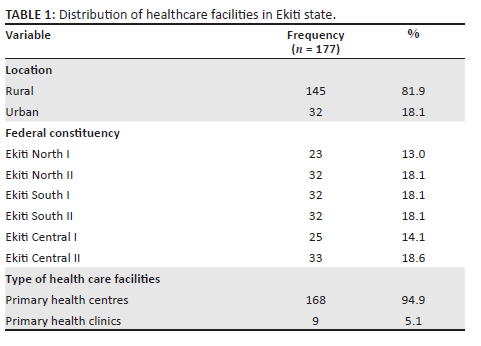
The majority (81.9%) of the PHC facilities were located in rural areas. About 18.6% were located in Ekiti Central II constituency and 94.9% were primary health centres (Table 1).
Frequency of service-specific availability in primary health care facilities in Ekiti state
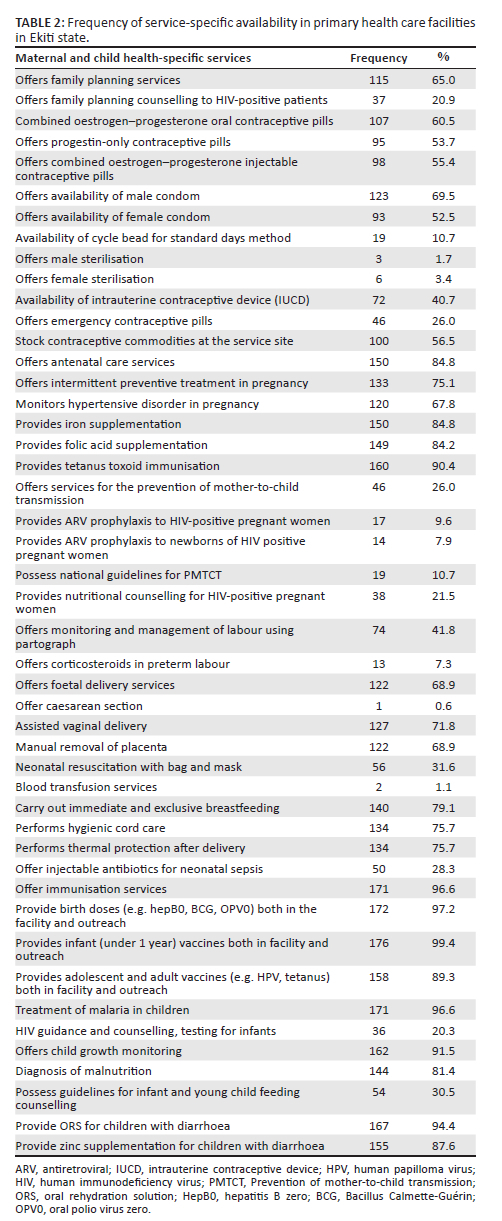
About two-thirds of the facilities (65%) offered family planning services, more than half (56.5%) stocked contraceptives at the service site, the majority (84.8%) offered antenatal care services and 68.9% offered foetal delivery services. Most (71.8%) offered assisted vaginal delivery services and about 79.1% carried out immediate and exclusive breastfeeding. About 10.7% of the facilities had national guidelines for prevention of mother to child transmission (PMTCT) services, 0.6% offered caesarean section and 1.1% had blood transfusion services. About 75.7% carried out hygienic cord care, a majority (96.6%) offered immunisation services and about 30.5% had guidelines for infant and young child feeding counselling (Table 2).
Availability of medicines in primary health care facilities in Ekiti state
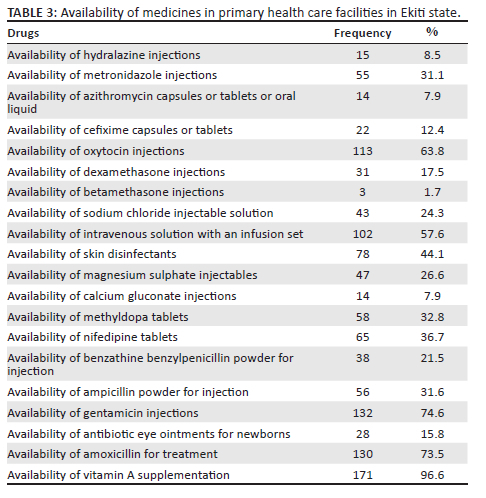
Vitamin A supplementation was the most readily available in almost all facilities in the present study, followed by gentamicin injection, amoxicillin and oxytocin injection (Table 3).
Specific-service readiness scores at primary health care facilities in Ekiti state
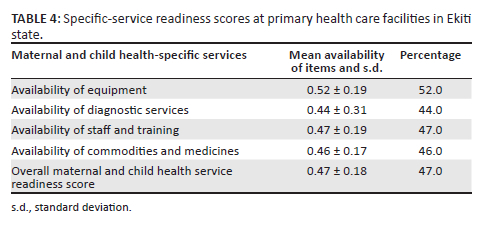
Overall, the MCH service readiness score amongst the facilities was 47% (0.47 ± 0.18). About half (52%) of the facilities had necessary and relevant equipment (Table 4).
Comparison of domain scores for maternal and child health-specific services readiness amongst primary health care facilities in urban and rural areas of Ekiti state
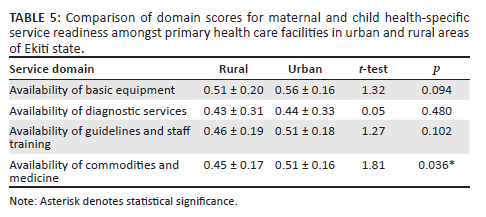
Primary health facilities located in the urban areas had more medicines and commodities compared with the rural areas (0.51 ± 0.16 vs 0.45 ± 0.17), with a statistically significant difference (p < 0.05) (Table 5).
Comparison of maternal and child health service readiness scores across types and locations of primary health care facilities
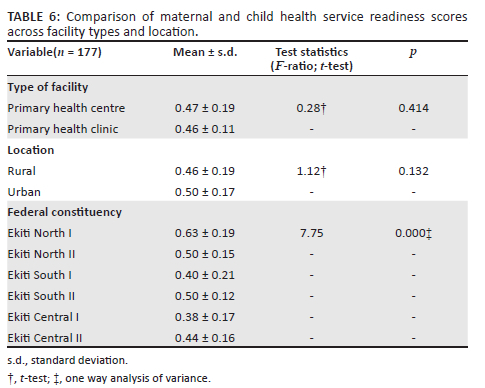
The health facilities in Ekiti North I had an overall higher service readiness mean score (0.63 ± 0.19) compared with others, with a statistically significant difference (p < 0.05) (Table 6).
Discussion
The study assessed MCH service's specific readiness by type and location of the health facility with the comparison between urban and rural PHC centres in Ekiti State, Nigeria. The study found that most of the PHC facilities were in the rural areas of the state, with an almost equitable distribution amongst the federal constituencies. This distribution of the PHC facilities may be a step in the right direction towards the prevention of MCH deaths in rural areas. Studies in Nigeria have reported a higher incidence of maternal mortality in rural parts of the country as compared with urban areas.25,26
Some of the reasons that have been documented for the higher rate of maternal mortality in rural areas of Nigeria include the scantiness of healthcare infrastructure and health personnel for emergencies, especially during and post delivery.17,27,28,2917,30
One of the principles of UHC and health for all is to reach the most vulnerable persons and communities globally, with vital information and services to improve MCH and reduce the mortality rate.11,31
Immunisation was the most frequently available service provided at the PHC facilities, and the majority of facilities had necessary vaccines in this study. This finding corroborates that of a similar study in Enugu State, Nigeria, which reported that newborn care and immunisation were the most frequently available services across facilities.1132
Less than three-quarters of the facilities in this study provided family planning services. This finding is similar to a study in Bangladesh, which reported low family planning services.611
Only a few of the PHC facilities in this study offered HIV guidance and counselling testing for infants and PMTCT. Only 10.7% had national guidelines for PMTCT, and 21.5% provided nutritional counselling for HIV positive pregnant women. The study in Enugu, Nigeria, found that HIV testing services were available in 68.0% of PHC centres, but only a quarter offered HIV treatment.113334
The overall MCH service readiness score for the four domains in this study was low at 47.0%. This was true for most domains: availability of diagnostic services (44.0%), availability of commodities and medicines (46.0%), availability of staff and training (47.0%) and availability of basic equipment (52.0%). This finding revealed wide gaps in the PHC facilities' service delivery, which needs to be improved upon in Ekiti State, to enable the attainment of UHC for MCH care as globally envisaged. Bridging the gaps will help to improve the quality of MCH service delivery, leading to a reduction in mortality rate.
Comparing the domain scores for MCH-specific service readiness amongst PHCs in urban and rural areas in this study, the PHC facilities in the urban areas of the state had more medicines and commodities. Similarly, the specific-service readiness scores were higher in urban than in rural PHC facilities. The study in Enugu, Nigeria, reported a similar rural-urban disparity between PHC centres, with PHCs in rural areas five times less likely to have at least half of the recommended infrastructure or basic amenities and equipment compared with urban PHC centres. The study also documented low availability of medicine and supplies in rural PHC centres for maternal health services.11235
The study shows comparability of readiness by type of facility, with no statistically significant difference between the primary health centre and primary health clinic. However, we found a statistically significant difference in the overall mean of MCH-specific service readiness scores by federal constituencies. These regional differences between Ekiti North I and others may be explained by the fact that some primary health facilities in Ekiti North I enjoy collaboration with the Federal Medical Centre and State Hospital located in the same LGA for service availability and delivery.
This study uncovered critical gaps in service readiness and corroborated some findings of studies in Nigeria which showed major deficiencies in the PHC system. Previous studies had indicated deficiencies in various PHC facilities in Nigeria, from nonfunctional equipment for MCH services2363738
Limitation
The cross-sectional nature of the study made it difficult to establish causality. However, this study is the first one known to us that has used the SARA tool (designed as a systematic approach for yearly validation of service delivery at the facility level) in the assessment of PHC facilities for MCH readiness in Ekiti State, Nigeria.
Conclusion and recommendation
The overall MCH-specific service readiness in Ekiti State was relatively low. The low score was demonstrated in the domains of availability of diagnostic services and commodities and medicines in PHC facilities, with a statistically significant difference in medicines and commodities between rural and urban facilities. This gap demonstrated in the MCH-specific service readiness in Ekiti State requires the attention of policymakers and other stakeholders to devise strategies for successful and sustainable implementation of MCH services towards the achievement of UHC and SDG.
Competing interests
The authors declare that they have no financial or personal relationships that may have inappropriately influenced them in writing this article.
Authors' contributions
O.E.O. was responsible for concept, design, data analysis, manuscript draft and revision. A.A. was responsible for concept, design, data acquistion and manuscript revision. C.F.C. participated in data analysis and manuscript review. O.Y.O. was responsible for editing and manuscript review. M.R.A. was responsible for editing and manuscript review. M.M.I. was responsible for editing and manuscript review. B.A.O. was responsible for editing and manuscript review. O.Q.B. was responsible for editing and manuscript review. All the authors approved the final version of the manuscript.
Funding information
This research received no specific grant from any funding agency in the public, commercial or not-for-profit sectors.
Data availability
The data that support the findings of this study are available on request from the corresponding author (O.E.O.). The data are not publicly available because of restrictions, e.g. their containing information that could compromise the privacy of research participants.
Disclaimer
The views and opinions expressed in this article are those of the authors and do not necessarily reflect the official policy or position of any affiliated agency of the authors.
Acknowledgements
We appreciate the Primary Healthcare Development Agency, Ekiti State, and the medical officers of health for their physical support in this research. We thank the respondents for being part of the study.
References
-
1.Alkema L, Chou D, Hogan D, et al. Global, regional, and national levels and trends in maternal mortality between 1990 and 2015, with scenario-based projections to 2030: A systematic analysis by the UN maternal mortality estimation inter-agency group. Lancet. 2016;387(10017):462-474. https://doi.org/10.1016/S0140-6736(15)00838-7
» https://doi.org/10.1016/S0140-6736(15)00838-7 -
2.Gage AJ, Ilombu O, Akinyemi AI. Service readiness, health facility management practices, and delivery care utilization in five states of Nigeria: A cross-sectional analysis. BMC Pregnancy Childbirth. 2016;16(1):297. https://doi.org/10.1186/s12884-016-1097-3
» https://doi.org/10.1186/s12884-016-1097-3 -
3.Sheffel A, Karp C, Creanga AA. Use of service provision assessments and service availability and readiness assessments for monitoring quality of maternal and newborn health services in low-income and middle-income countries. BMJ Glob Health. 2018;3(6):e001011. https://doi.org/10.1136/bmjgh-2018-001011
» https://doi.org/10.1136/bmjgh-2018-001011 - 4.National Population Commission, Abuja Nigeria and IRM. The Federal Republic of Nigeria. Nigeria demographic and health survey 2018. Abuja: National Population Commission; 2019.
-
5.Idris SH, Sambo MN, Ibrahim MS. Barriers to utilization of maternal health services in a semiurban community in northern Nigeriation of matern' perspective. Niger Med J. 2013;54(1):27-32. https://doi.org/10.4103/0300-1652.108890
» https://doi.org/10.4103/0300-1652.108890 -
6.Aftab A, Hasan M. Facility assessment for maternal and child health services in Bangladesh using service availability and readiness assessment (SARA) tool: A cross-sectional pilot study. Public Health Indones. 2017;3(3):77-88. https://doi.org/10.36685/phi.v3i3.125
» https://doi.org/10.36685/phi.v3i3.125 -
7.Oyekale AS. Assessment of primary health care facilities' service readiness in Nigeria. BMC Health Serv Res. 2017;17(1):172. https://doi.org/10.1186/s12913-017-2112-8
» https://doi.org/10.1186/s12913-017-2112-8 -
8.Stigler FL, Macinko J, Pettigrew LM, Kumar R, Van Wheel C. No universal health coverage without primary health care. Lancet. 2016;387(10030):1811. https://doi.org/10.1016/S0140-6736(16)30315-4
» https://doi.org/10.1016/S0140-6736(16)30315-4 - 9.World Health Organisation. Alma-Ata 1978: Primary health care. Geneva: World Health Organisaton; 1978.
-
10.Starfield B, Shi L, Macinko J. Contribution of primary care to health systems and health. Milbank Q. 2005;83(3):457-502. https://doi.org/10.1111/j.1468-0009.2005.00409.x
» https://doi.org/10.1111/j.1468-0009.2005.00409.x -
11.Ekenna A, Itanyi IU, Nwokoro U, Hirschhorn LR, Uzochukwu B. How ready is the system to deliver primary healthcare? Results of a primary health facility assessment in Enugu state, Nigeria. Health Policy Plan. 2020;35(suppl. 1):i97-i106. https://doi.org/10.1093/heapol/czaa108
» https://doi.org/10.1093/heapol/czaa108 -
12.McLaughlin CG, Wyszewianski L. Access to care: Remembering old lessons. Health Serv Res. 2002;37(6):1441-1443. https://doi.org/10.1111/1475-6773.12171
» https://doi.org/10.1111/1475-6773.12171 -
13.World Health Organization (WHO). Service availability and readiness assessment (SARA): An annual monitoring system for service delivery - Reference manual, version 2.2 [homepage on the Internet]. Geneva: World Health Organization; [cited 2022 Feb 11]. Available from: http://www.who.int/healthinfo/systems/sara_reference_manual/en/
» http://www.who.int/healthinfo/systems/sara_reference_manual/en/ - 14.Umunna ZI. Exploring the factors that contribute to poor utilization of primary health care services: A study of two primary health care clinics in Nasarawa state, Nigeria. [A mini thesis submitted in partial fulfillment of the requirement for the degree of masters in public health (MPH)]. Cape Town: University of the Western Cape, Faculty of Community and Health Sciences School of Public Health; 2012.
- 15.Aigiremolen AO, Alenoghena I, Eboreime E, Abejegah C. Primary health care in Nigeria: From conceptualization to implementation. J Med Appl Biosci. 2014;6(2):35-43.
-
16.Okonofua F, Ntoimo L, Ogungbangbe J, Anjorin S, Imongan W, Yaya S. Predictors of women's utilization of primary health care for skilled pregnancy care in rural Nigeria. BMC Pregnancy Childbirth. 2018;18(1):106. https://doi.org/10.1186/s12884-018-1730-4
» https://doi.org/10.1186/s12884-018-1730-4 -
17.Ntoimo LFC, Okonofua FE, Igboin B, Ekwo C, Imongan W, Yaya S. Why rural women do not use primary health centres for pregnancy care: Evidence from a qualitative study in Nigeria. BMC Pregnancy Childbirth. 2019;19(1):277. https://doi.org/10.1186/s12884-019-2433-1
» https://doi.org/10.1186/s12884-019-2433-1 -
18.Acharya K, Paudel YR. General health service readiness and its association with the facility level indicators among primary health care centers and hospitals in Nepal. J Glob Health Rep. 2019;3: e2019057. https://doi.org/10.29392/joghr.3.e2019057
» https://doi.org/10.29392/joghr.3.e2019057 -
19.About Ekiti state, Nigeria [homepage on the Internet]. [cited 2022 Jan 18] Available from: https://www.citypopulation.de/php/nigeriaadmin.php?adm1id=NGA013
» https://www.citypopulation.de/php/nigeriaadmin.php?adm1id=NGA013 -
20.Ekiti state Government Federal Constituencies [homepage on the Internet]. [cited 2022 May 07]. Available from: https://www.ekitistate.gov.ng/about-ekiti/#geopolitical-arrangement
» https://www.ekitistate.gov.ng/about-ekiti/#geopolitical-arrangement -
21.Ekiti state: About Ekiti - Ekiti [homepage on the Internet]. [cited 2022 May 07]. Available from: https://ekitistate.gov.ng/about-ekiti/.
» https://ekitistate.gov.ng/about-ekiti/ -
22.National Primary Healthcare Development Agency (NPHCDA): Minimum standards for primary healthcare in Nigeria [homepage on the Internet]. Department of Planning, Research and Statistics; 2012 [cited 2022 Feb 11]. Available from: http://ngfrepository.org.ng:8080/jspui/handle/123456789/3153
» http://ngfrepository.org.ng:8080/jspui/handle/123456789/3153 -
23.Islam MR, Laskar SP, Macer D. A study on science availability and readiness assessment of non-communicable diseases using the WHO tool for Gazipur district in Bangladesh. Bangladesh J Bioeth. 2016;7(2):1-13. https://doi.org/10.3329/bioethics.v7i2.30785
» https://doi.org/10.3329/bioethics.v7i2.30785 - 24.Service Availability and Readiness Assessment (SARA). An annual monitoring system service delivery. Reference manual version 2.2. WHO/HIS/2014.5Rev.1. Geneva: World Health Organization; 2015.
- 25.Adebowale S, Fagbamigbe F, Bamgboye E. Rural-urban differential in maternal mortality estimate in Nigeria, sub-Saharan Africa. J Med Appl Biosci. 2010;2:74-91.
-
26.Adeyanju O, Tubeuf S, Ensor T. Socio-economic inequalities in access to maternal and child healthcare in Nigeria: Changes over time and decomposition analysis. Health Policy Plan. 2017;32(8):1111-1118. https://doi.org/10.1093/heapol/czx049
» https://doi.org/10.1093/heapol/czx049 -
27.Ononokpono DN, Odimegwu CO. Determinants of maternal health care utilization in Nigeria: A multilevel approach. Pan Afr Med J. 2014;17(suppl. 1):2. https://doi.org/10.11604/pamj.supp.2014.17.1.3596
» https://doi.org/10.11604/pamj.supp.2014.17.1.3596 -
28.Fagbamigbe AF, Idemudia ES. Barriers to antenatal care use in Nigeria: Evidences from non-users and implications for maternal health programming. BMC Pregnancy Childbirth. 2015;15(1):95. https://doi.org/10.1186/s12884-015-0527-y
» https://doi.org/10.1186/s12884-015-0527-y - 29.Katung P. Socio-economic factors responsible for poor utilisation of the primary health care services in a rural community in NIgeria. Niger J Med. 2001;10(1):28-29.
-
30.Azuh DE, Azuh AE, Iweala EJ, Adeloye D, Akanbi M, Mordi RC. Factors influencing maternal mortality among rural communities in southwestern Nigeria. Int J Womens Health. 2017;2017(9):179-188. https://doi.org/10.2147/IJWH.S120184
» https://doi.org/10.2147/IJWH.S120184 - 31.World Health Organization. Every woman, every child, every adolescent: Achievements and prospects: The final report of the independent expert review group on information and accountability for women's and children's health. Geneva: World Health Organization; 2015.
-
32.Mohammed AS, Idowu IE, Kuyinu YA. Structure of primary health care: Lessons from a rural area in South-West Nigeria. Niger J Clin Med. 2010;3(1):37-44. https://doi.org/10.4314/njcm.v3i1.56576
» https://doi.org/10.4314/njcm.v3i1.56576 - 33.World Health Organization. Universal health coverage for sexual and reproductive health. Geneva: World Health Organization; 2020.
- 34.MOHSW. 'Tanzania service availability and readiness assessment (SARA) 1012'. Ifakara Health Institute. Ministry of Health and Social Welfare. Directorate of Policy and Planning, Monitoring and Evaluation Unit. Dar es Salaam, Tanzania: Ifakara Health Institute; 2012.
-
35.Kanyangarara M, Chou VB, Creanga AA, Walker N. Linking household and health facility surveys to assess obstetric service availability, readiness, and coverage: Evidence from 17 low- and middle-income countries. J Glob Health. 2018;8(1):010603. https://doi.org/10.7189/jogh.08.010603
» https://doi.org/10.7189/jogh.08.010603 -
36.Okoli U, Abdullahi MJ, Pate MA, Abubakar IS, Aniebue N, West C. Prenatal care and basic emergency obstetric care services provided at primary healthcare facilities in rural Nigeria. Int J Gynaecol Obstet. 2012;117(1):61-65. https://doi.org/10.1016/j.ijgo.2011.11.014
» https://doi.org/10.1016/j.ijgo.2011.11.014 - 37.Ijadunolal KT, Fatusi AO, Orji EO, et al. Unavailability of essential obstetric care services in a local government area of south-west Nigeria. J Health Popul Nutr. 2007;25(1):94-100.
-
38.Erim DO, Kolapo UM, Resch SC. A rapid assessment of the availability and use of obstetric care in Nigerian healthcare facilities. PLoS One. 2012;7(6):e39555. https://doi.org/10.1371/journal.pone.0039555
» https://doi.org/10.1371/journal.pone.0039555
Accepted: 10 June 2022
Published: 19 Aug. 2022