
 Contributions of family physicians to health care services in Nigeria
Abstract
In Nigeria, family physicians are doctors with specialised training to manage a broad range of clinical conditions and pathologies when they first present, considering the psychosocial, economic, cultural and environmental context of the individual and his or her family. In Nigeria, family physicians may be found at district hospitals but are more likely to be located at tertiary health care facilities, where their roles in medical education, research and clinical services cannot be overemphasised. Many patients present to tertiary facilities with primary-care problems, bypassing primary and secondary care. They are often seen initially by family physicians in general outpatient clinics, where 70% of all problems are managed without referral to other specialists. These physicians are also in charge of most of the National Health Insurance Scheme (NHIS) clinics nationwide. They are thus the gatekeepers to the majority of tertiary hospital services.
family physicians; health care; general outpatient clinics; NHIS; contributions; Nigeria
Introduction
Family physicians (FPs) in Nigeria provide patient-centred, comprehensive, coordinated, integrated, longitudinal and holistic care to patients irrespective of their age, gender or disease presentation, in the context of their family, culture and environment.12
Family physicians in district hospitals
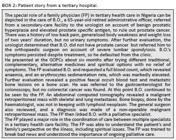
Although most doctors in district hospitals (private, central and general hospitals) do not have specialist training in family medicine,31,4 The relevance of FPs in district hospitals can be depicted by the clinical experience of one of the authors (Box 1).

Family medicine educators have also helped to improve the impact of family medicine in district hospitals through the introduction of a Diploma in Family Medicine programme by the National Postgraduate Medical College of Nigeria.5
Family physicians in tertiary health care facilities
Tertiary hospitals (national hospital, teaching hospitals, federal medical centres and specialist hospitals) are health care facilities where different specialists render clinical services. Tertiary facilities are referral centres for most district hospitals in Nigeria, especially for complicated cases. However, in Nigeria, many patients present to tertiary hospitals directly for primary care, mainly because of a dearth of primary- and secondary-care facilities as well as human resources for health.
General outpatient clinics
There are over 50 tertiary hospitals in the country,64Box 2.
National health insurance scheme
Health expenditure in Africa is mainly out-of-pocket spending.711
Medical training and research
Family physicians in tertiary hospitals also serve as researchers and educators/trainers of both undergraduates and postgraduates in Family Medicine. Acknowledging the significant contributions of family medicine to health care services in the country, the National Universities Commission and the Medical and Dental Council of Nigeria, which are charged with regulating university education and medical practice in the country, respectively, incorporated the teaching of family medicine into the undergraduate medical curriculum.8,9 This measure has ensured that nearly all medical graduates from Nigeria are taught the principles of family medicine in patient management.10
Other contributions
Family physicians have also strengthened the health system through their contributions to emergency, rehabilitative, geriatric and well-person care. They lead the accident and emergency units of some tertiary hospitals in the country. Their role in overseeing and coordinating the care of the elderly in the very few geriatric centres in the country cannot be overemphasised.11 The FP plays a key role in ensuring a multidisciplinary approach in care of the elderly, by coordinating other stakeholders involved in elder care, such as family members, nurses and other specialists. Despite these important roles, there has been a progressive decline in the numbers of FPs and trainees in Nigeria because of migration overseas.
Conclusion
The contributions of FPs to health services in Nigeria are invaluable. There is a need to train and retain FPs at all levels of health care in the country, including tertiary health institutions, where coordination of care and postgraduate medical training in Family Medicine are essential. Furthermore, there should be greater political will to engage the services of FPs at district hospitals and in support of PHC as we work towards universal health coverage.
Competing interests
The authors declare that they have no financial or personal relationships that may have inappropriately influenced them in writing this article.
Authors' contributions
T.I.A.O. conceived the manuscript. T.I.A.O., T.O.S. and A.J.F. wrote the draft and edited and validated the final manuscript.
Ethical considerations
This article followed all ethical standards for research without direct contact with human or animal subjects.
Funding information
This research received no specific grant from any funding agency in the public, commercial or not-for-profit sectors.
Data availability
Data sharing is not applicable to this article as no new data were created or analysed in this study.
Disclaimer
The views and opinions expressed in this article are those of the authors and do not necessarily reflect the official policy or position of any affiliated agency of the authors.
Acknowledgements
References
-
1. Jamoulle M, Resnick M, Vander Stichele R, Ittoo A, Cardillo E, Vanmeerbeek M. Analysis of definitions of general practice, family medicine, and primary health care: A terminological analysis. BJGP Open. 2017;1(3):bjgpopen17X101049. https://doi.org/10.3399/bjgpopen17X101049
» https://doi.org/10.3399/bjgpopen17X101049 -
2. Oyedeji R, Abimbola S. How tertiary hospitals can strengthen primary health care in Nigeria. Niger Med J 2014;55(6):519-520. https://doi.org/10.4103/0300-1652.144715
» https://doi.org/10.4103/0300-1652.144715 -
3. Von Pressentin KB, Mash RJ, Baldwin-Ragaven L, Botha RPG, Govender I, Steinberg WJ. The bird's-eye perspective: How do district health managers experience the impact of family physicians within the South African district health system? A qualitative study. S Afr Fam Pract. 2018;60(1):13-20. https://doi.org/10.1080/20786190.2017.1348047
» https://doi.org/10.1080/20786190.2017.1348047 -
4. Jimbo M. Family medicine: Its core principles and impact on patient care and medical education in the United States. Keio J Med. 2004;53(2):69-73. https://doi.org/10.2302/kjm.53.69
» https://doi.org/10.2302/kjm.53.69 -
5. Ajayi AO. The history of the Faculty of General Medical Practice, National Postgraduate Medical College of Nigeria (1980-2005). A paper delivered at the International Conference to mark the 25th Anniversary of the GMP Faculty; 2005 Nov 3 [cited 2021 Feb 8]. Available from: http://ifrs-rural.com/HistoryofFamilyMedicineinNigeria.pdf
» http://ifrs-rural.com/HistoryofFamilyMedicineinNigeria.pdf -
6. Healthcare resource guide: Nigeria. 2016 [cited 2021 Feb 14]. Available from: https://2016export.gov/industry/health/healthcareresourceguide/
» https://2016export.gov/industry/health/healthcareresourceguide/ -
7. Mash R, Howe A, Olayemi O, et al. Reflections on family medicine and primary healthcare in sub-Saharan Africa. BMJ Glob Health. 2018;3(Suppl 3):e000662. https://doi.org/10.1136/bmjgh-2017-000662
» https://doi.org/10.1136/bmjgh-2017-000662 - 8. Federal Ministry of Health of Nigeria, Health Systems 20/20 Project. Nigeria undergraduate medical and dental curriculum template, 2012. Bethesda, MD: Health Systems 20/20 Project, Abt Associates Inc.; 2012.
- 9. Medical and Dental Council of Nigeria. Guidelines on minimum standards of medical and dental education in Nigeria. The Red Book. Revised ed. Abuja: Medical and Dental Council of Nigeria; 2006.
- 10. Okokon IB, Ogbonna UK, Asibong UE, Aluka TM, Dienye PO. Teaching family medicine in medical schools: The perspective from a Nigerian Medical School. Nigerian J Fam Pract. 2012;2(2):1-6.
-
11. Nigeria Health Watch. Ageing but not infirm: Getting geriatric care right in Nigeria. 2018 [cited 2021 Mar 16]. Available from: https://nigeriahealthwatch.com/ageing-but-not-infirm-getting-geriatric-care-right-in-nigeria/
» https://nigeriahealthwatch.com/ageing-but-not-infirm-getting-geriatric-care-right-in-nigeria/
Accepted: 01 Apr. 2021
Published: 19 May 2021
