Integrating emergency medical services and palliative care: A nominal group technique
Abstract
BACKGROUND: The need for integrated healthcare has been increasingly recognised because of mounting challenges associated with the proliferation of injuries and noncommunicable diseases. A developing example of integration is between Emergency Medical Services (EMS) and palliative care. Despite recommendations for integration in South Africa (SA), these services remain segregated AIM: This study aimed to develop and prioritise approaches facilitating EMS and palliative care system integration within SA SETTING: An online meeting was held with SA EMS and palliative care experts METHODS: A nominal group technique was employed to answer the question, 'What do you think should be done to most effectively integrate EMS and palliative care services in SA?' Answers were categorised, awarded scores by participants, and ranked according to impact and feasibility RESULTS: The following categories were generated: Awareness, Education, Community Engagement, Communication and Information Sharing, Stakeholder Collaborations, Alternative Pathways and Approaches, Research, Funding, Policy Development and Governance. The top five individual approaches were: (1) enable EMS to administer already prescribed medications, (2) Emergency Medical Services undergraduate training in palliative care, (3) improve EMS recognition of signs of dying at the end-of-life, (4) palliative care awareness for the EMS community, and (5) palliative care awareness for in-hospital healthcare providers, particularly those in emergency medicine CONCLUSION: The categories developed in this study should be used to guide EMS and palliative care integration in SA. Future research should aim at establishing the safety and efficacy of these interventions CONTRIBUTION: This study provides a structured approach to integrating EMS and palliative care in SA, enhancing holistic care for patients with palliative needs
paramedic; ambulance; EMS; palliative care; end-of-life; person-centred care; healthcare system integration; South Africa
Introduction
The need for integrated healthcare has been increasingly recognised as health systems face mounting challenges from ageing populations, unhealthy lifestyles, urbanisation and subsequent proliferation of injuries and noncommunicable diseases (NCDs).112134
A developing example of healthcare integration is collaboration between Emergency Medical Services (EMS) and palliative care.5678,9,10,11
In SA, these benefits have been noted by EMS12131412,13,14
Research methods and design
Design
A nominal group technique (NGT), involving EMS and palliative care experts, was employed. A complex adaptive system (CAS) theory of healthcare underpins the study.15,1615,16
Setting
The SA health system, including EMS, is divided into private and state sectors. The state sector, operated by the government, provides healthcare to all citizens. The private sector is restricted to those with medical insurance or other financial means. Emergency Medical Services care is provided using a paramedic-led rather than a physician-led approach.1217via nongovernmental organisations, although there has been significant growth in state sector palliative care provision.18,1920
Study population and sampling strategy
Emergency Medical Services and palliative care experts meeting inclusion criteria were purposefully sampled. 'Palliative care experts' were qualified medical nurses and doctors with a minimum of 5 years postgraduate experience and a postgraduate HE qualification in a palliative care-related field (i.e. Postgraduate Diploma in Palliative Care). 'EMS experts' were advanced life support (ALS) providers with HE qualifications (National Diploma, Bachelor of Technology, Bachelor of Health Sciences in Emergency Medical Care), a minimum of 5 years postgraduate EMS experience and a postgraduate HE qualification in an EMS or palliative care-related field (i.e. Postgraduate Diploma in Palliative Care or Emergency Medicine). The EMS and palliative care experts without experience and qualifications in SA were not included. A minimum postgraduate experience of 5 years was selected to ensure adequate experience and expert-level insights. Participants were individually invited to the study via email. A brief study description and a proposed meeting time were presented and willing participants signed a consent form.
Data collection
One virtual nominal group meeting was performed using Microsoft Teams (Microsoft Corporation, United States) with audio-recording and transcription functions enabled. A single meeting was held for logistical feasibility and as limited information is available to guide data analysis when multiple meetings are used in a single study.21
Prior to the meeting, prereading was sent to participants via email introducing the study topic, aim, question and an explanation of the study process. The CG facilitated the meeting with WS and LG assisting. As described by McMillan et al.,21
• Silent Idea Generation: As prereading had been sent, participants were given 5 min to silently and individually record as many answers as possible to the question, 'what do you think should be done to most effectively integrate EMS and palliative care services in SA?' During this time, the research team remained silent.
• Round Robin Discussion: Participants individually presented a single answer at a time in a round robin fashion until all ideas were exhausted. Answers were not discussed but simply recorded by CG for all participants to see. Answers were placed into predefined categories (Online Appendix 2) based on previous SA research,12,13,1422
• Clarification: In this phase, 1 h was allocated for discussion concerning each answer. Participants were given the opportunity to ask questions about the submitted answers and clarify their meaning. Based on the discussions, similar answers were combined, some were excluded, and new answers were recorded. After each answer was discussed, a final list of answers was produced.
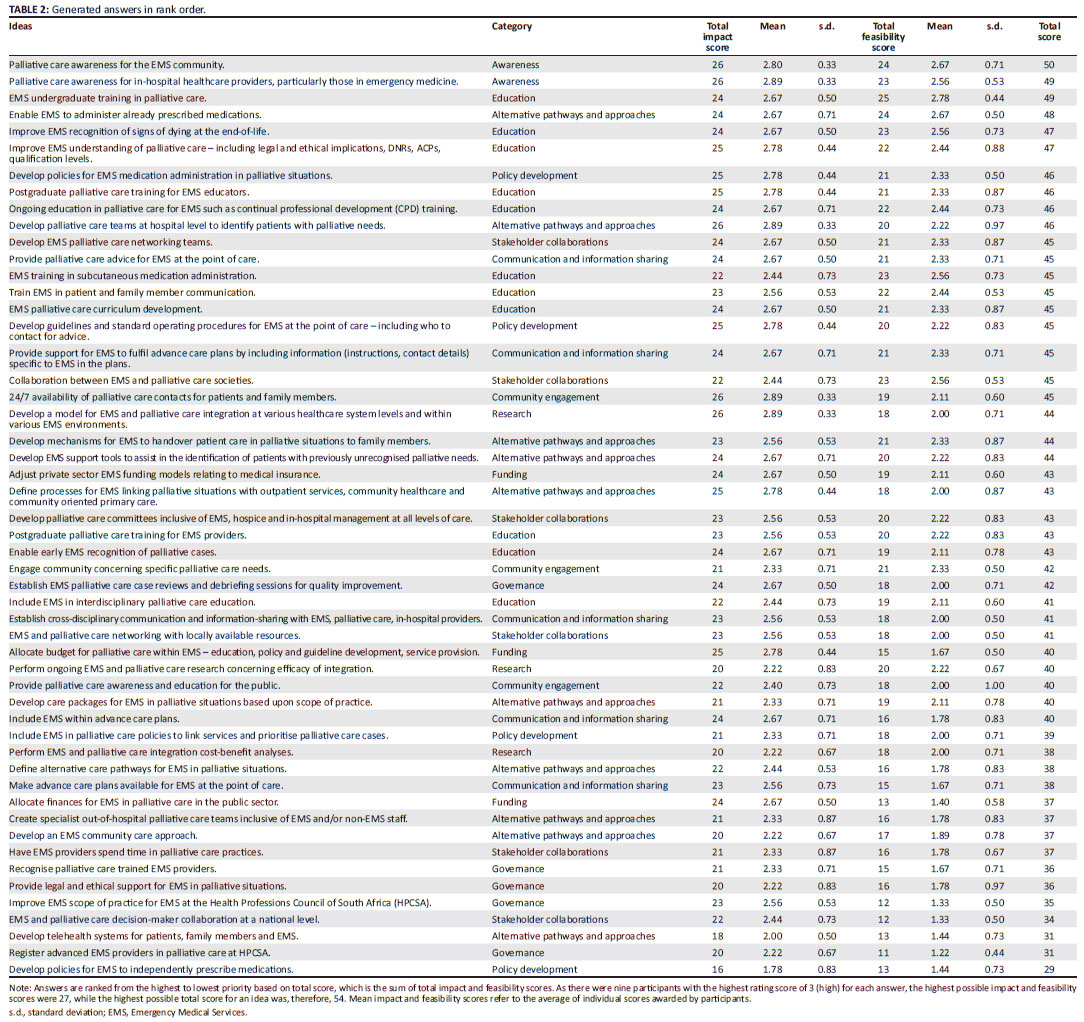
• Ranking: Participants were asked to individually rank each answer according to its impact and feasibility in the SA setting. This was done via email with a link to a Microsoft Forms (Microsoft Corporation, United States) survey (Online Appendix 3). Impact and feasibility were divided into low, moderate and high, which were awarded scores of 1, 2 and 3, respectively. Thus, for example, an idea could be ranked as having high impact (3) but low feasibility (1). Scores were then totalled across all participants, and ideas arranged from highest to lowest score, producing a prioritised list. Average impact and feasibility scores were also calculated to place ideas in final categories of low, moderate or high. For example, if an idea averaged a score of 2.6 for impact, this was rounded to 3, and the idea was placed in the high-impact category. For the purposes of this study, impact referred to the effectiveness of an approach in integrating EMS and palliative care, and feasibility referred to ease of implementation in the SA context. Thus, a high-impact approach would be very effective and a highly feasible approach would be easily implementable.
Data analysis
Data analysis was performed according to the recommendations of McMillan et al.21
• Descriptive Analysis of Raw Data: Answers and their priorities were descriptively analysed in terms of participant scoring.
• Categorical Analysis of Raw Data: The answers generated by participants were coded into categories by CG. Researcher triangulation was performed between the authorship where codes and categories were discussed, refined and finalised. Member checking of these categories was performed to ensure the intended meaning of the participants was retained.
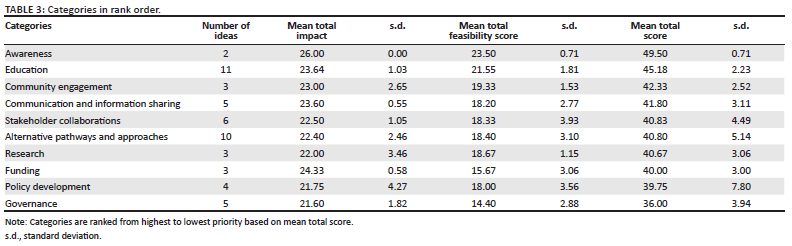
• Analysis of Secondary Coded Data: Categories were ranked by averaging the total scores of answers within each category.
• Qualitative Analysis: The transcript of the meeting was deductively analysed according to the developed categories to provide further context, such as reasons for answers.
Summary descriptive statistics (means, standard deviations) were used to calculate individual answer and category scores using SPSS Statistics for Windows version 28.0 (IBM Corp., United states).
Ethical considerations
Ethical clearance to conduct this study was obtained from the University of Cape Town's Human Research Ethics Committee (HREC) (No. 453/2024).
Results
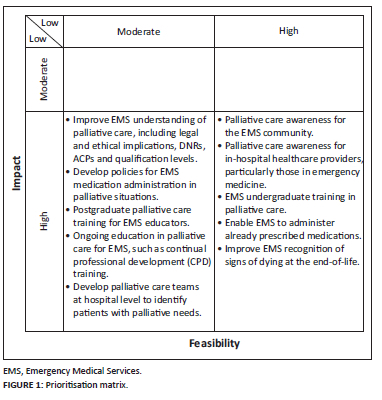
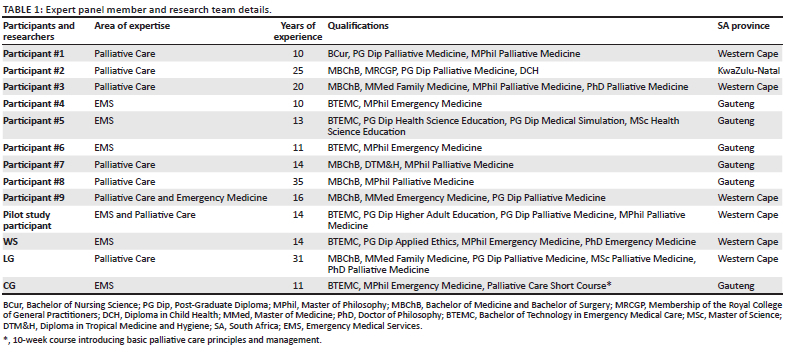
Nine experts participated in the meeting (Table 1), which lasted 2 h 27 min. Seven participants knew CG from the previous research participation in EMS1213Table 2). Answers fell into 10 categories, as demonstrated in Table 3. Based on average impact and feasibility scores, ideas were plotted on a prioritisation matrix (Figure 1).
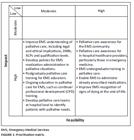
This figure includes the top 10 ranked ideas. A complete figure may be found in Online Appendix 4 Table A4-1.
Awareness
Participants suggested palliative care awareness for both EMS and in-hospital healthcare providers. These approaches were awarded the highest impact scores and perceived as highly feasible. Thus, the awareness category was ranked as the highest overall priority in this study, as participants observed the lack of palliative care knowledge even among medical providers:
'We need to define palliative care a bit better in the prehospital setting … If we [EMS] think palliative care, we just think about the stage four cancer getting morphine. That's essentially EMS's knowledge of palliative care.' (Participant #6, EMS, Gauteng)
Education
Ranked second overall, educational approaches to integration formed the largest category of discussion. Participants recommended palliative care training for EMS at all levels (undergraduate, postgraduate and ongoing professional development) and emphasised the need for curriculum development. As part of this curriculum, specific items, such as subcutaneous medication administration, were highlighted. The highest ranked educational approaches, prioritised as high impact, high feasibility, were EMS undergraduate training in palliative care and to improve EMS recognition of signs of dying at the end-of-life:
'The training and the education of the [EMS] providers is so important … at an undergraduate level. I think it must start there.' (Participant #8, Palliative Care, Gauteng)
'So [EMS] education around recognising the signs of dying, and … using the subcutaneous route instead of intravenous access.' (Participant #1, Palliative Care, Western Cape)
Community engagement
Engaging with local communities was recommended by participants to identify specific palliative care needs. Palliative care awareness and education within local communities was also recommended, as participants found that many communities often misunderstood palliative care. Overall, the ideas within this category were ranked as having moderate impact and moderate feasibility. The highest ranked approach was 24/7 availability of palliative care contacts for patients and family members:
'[W]ith the awareness and community, I think a lot of patients and family sees it [palliative care] as you giving up. Let them understand it's not you're giving up … it's just a different type of care …' (Participant #4, EMS, Gauteng)
'So they must have a way for the patient to communicate with [the palliative care team] … if they don't, they are going to phone EMS because there's no one else to phone … in hours and then after hours.' (Participant #9, Palliative Care and Emergency Medicine, Western Cape)
Communication and information sharing
Several ideas developed by participants involved enhancing communication and information sharing between EMS and palliative care systems. Significant emphasis was placed on the inclusion of EMS within advance care planning as a support tool for EMS providers at the point of care. All approaches within this category were ranked as high impact, moderate feasibility. The highest ranked approaches were to provide palliative care advice for EMS at the point of care and to provide support for EMS to fulfil advance care plans by including information specific to EMS in the plans:
'It's developing the culture of conversation within the EMS spaces and … not just within the EMS space … because palliative care is gonna happen across multiple different spaces and that would require loads of communication …' (Participant #5, EMS, Gauteng)
'The advanced care planning documents and recognition of those documents when they do exist is really important … We've had quite a few cases where there are documents in place … and then when they [EMS] arrive … the patient still ends up going to hospital.' (Participant #1, Palliative Care, Western Cape)
Stakeholder collaborations
Various collaborations between EMS and palliative care stakeholders were recommended to promote integration. Stakeholders included EMS, palliative care, hospice and in-hospital healthcare providers, managers, national decision-makers and societies. These collaborations were recommended at all levels, from individual providers to national stakeholders. The top ranked approaches within this category were collaboration between EMS and palliative care societies and to develop EMS palliative care networking teams. Each of these fell into the high impact, moderate feasibility section of the prioritisation matrix:
'So what I would like to see is perhaps at a district level the development of palliative care committees … Representatives from district hospitals, from the EMS, from pharmacy, from hospice services from … the hospital management.' (Participant #2, Palliative Care, KwaZulu Natal)
'[S]o when you talk about stakeholder engagement … we need all levels of care to be involved here.' (Participant #7, Palliative Care, Gauteng)
Alternative pathways and approaches
This category was the second largest and referred to differing approaches to patient care within EMS and palliative care systems than the current norm. For example, one approach was to develop mechanisms for EMS hand over of patient care in palliative situations to family members. Currently, EMS providers are obligated to handover care to a medical provider and no appropriate mechanism exists for treatment without conveyance.13
'I like to call it, not an on-scene discharge … but handover of care to family and the home-based care team who might not be on premises, but you are still handing over care to them.' (Participant #9, Palliative Care and Emergency Medicine, Western Cape)
Research
The need for ongoing research was emphasised by participants as important to monitor the efficacy of integration. The need for cost-benefit analyses was specifically highlighted. The top ranked approach within this category was to develop a model for EMS and palliative care integration at various healthcare system levels and within various EMS environments. This was ranked as high impact, moderate feasibility:
'I think [research is] important for us as work starts with the integration … to be able to start documenting lessons that we are learning because we are going to have to probably have a model that might work in [some] areas and not work in others, so there's going to be a lot of contextualisation.' (Participant #7, Palliative Care, Gauteng)
Funding
Participants recommended adjusting current EMS funding models and allocating funds for education, policy development and service provision in both state and private sectors to assist integrative efforts. The top ranked approach in this category was to adjust private sector EMS funding models relating to medical insurance. Currently, in SA, medical insurance companies do not reimburse EMS in instances of patient nonconveyance. While each idea in this category ranked highly in terms of impact, feasibility scores were relatively low, particularly for the allocation of funds in the state sector:
'Let's be very specific about where the budget allocations need to be. It needs to be for education, for service provision, for policy development.' (Participant #3, Palliative Care, Western Cape)
Policy development
The need for policies, guidelines and standard operating procedures for EMS providers in palliative situations was discussed by participants with a focus on medication administration and EMS linking patients with other services (i.e. hospice). It was also noted that existing palliative care policies do not mention EMS. The highest ranked approach for policy development was to develop policies for EMS medication administration in palliative situations. While this category was ranked low overall, this was primarily because of the low overall score of developing policies for EMS to independently prescribe medications:
'[G]uidelines would be very key … we've got a lot of policies, I don't even think our palliative care policies have actually recognised the need for us to … link together with EMS.' (Participant #7, Palliative Care, Gauteng)
Governance
This category largely consisted of macrolevel approaches involving specialist EMS provider registration with the Health Professions Council of South Africa (HPCSA), legal frameworks and increasing EMS scope of practice for palliative situations. Because of moderate and low feasibility scores of ideas within this category, governance was ranked last overall. The highest ranked approach within this category with a high impact, moderate feasibility score, was to establish EMS palliative care case reviews and debriefing sessions for quality improvement:
'[T]hose EMS providers that have had advanced training in palliative care need to be recognised by the boards or their councils.' (Participant #3, Palliative Care, Western Cape)
Discussion
Healthcare integration literature has identified several components within integration frameworks: Funding, Colocation, Communication, Community Engagement, Context, Culture, Governance, Defining Roles and Shared Goals, Stakeholder Management, Technological Connectivity, Awareness and Education.2214,23
The approaches developed in our study may be achieved at macro- (national systems and policies), meso- (regional, district and organisational) and micro- (individual provider) levels (see Online Appendix 5 Table A5-1).4,24242424
Considering the resource-limited LMIC context of SA, there is a need to focus on feasible, high impact and low-cost approaches to integration. Experts in this study identified several such approaches, which we highly recommend for immediate implementation: (1) enable EMS to administer already prescribed medications, (2) EMS undergraduate training in palliative care, (3) improve EMS recognition of signs of dying at the end-of-life, (4) palliative care awareness for the EMS community, and (5) palliative care awareness for in-hospital healthcare providers, particularly those in emergency medicine.
Currently, EMS providers do not typically administer medications that have already been prescribed, particularly if these medications fall outside of their scope of practice.2526,2728,2930
Educational approaches facilitating EMS and palliative care integration are the most frequently emphasised in the literature5,31,32,332313231423
Spreading awareness of palliative care among EMS and other healthcare providers, represents a simple, low-cost approach to service integration. One area in which EMS require assistance is identifying palliative situations.34,3512vice versa. We recommend each of these opportunities for awareness be explored and further innovations be developed.
While we recommend these highly impactful and feasible approaches, it should be recognised that even within SA, varying contexts exists between regions as some areas contain greater EMS and palliative care resources than others.36,37,3814
While discussing the integration of EMS and palliative care, participants cautioned against palliative care services simply 'passing on their work' to EMS. South Africa EMS providers have likewise cautioned against performing palliative care in isolation.123940,4112,1342panacea, but rather as part of an approach to improve palliative care provision in the country.39
Our findings align with the WHO IPCHS strategy which recommends empowering and engaging people, strengthening governance and accountability, reorienting the model of care and coordinating services.114316,4416,44
Limitations
This study contains limitations involving generalisability as a purposive sampling strategy was employed, resulting in a small group of participants largely from two provinces within SA. However, these participants work in diverse contexts within their provinces in both private and state sectors, including HE, management and patient-facing roles. While experts from other provinces were unable to take part because of scheduling constraints, the high proportion of participants from the Gauteng and Western Cape provinces are reflective of the greater EMS and palliative care resources in these areas.37,38 Study's findings, including these contextual differences, have been discussed considering previous local and international research. Researcher bias may be present as the meeting facilitator knew many participants from the previous research and may have unintentionally influenced the group discussion through subconscious demonstration of personal opinions. However, researcher triangulation and member checking were performed to mitigate this. Finally, this study placed time constraints on participants and the findings of this study may not be comprehensive. Nevertheless, these findings align well with health system integration literature, represent the considerations of highly experienced SA providers, and therefore, remain applicable.
Conclusion
Through use of a nominal group, consisting of experts from both EMS and palliative care, this study aimed to develop and prioritise approaches facilitating EMS and palliative care system integration within SA, thereby providing guidance for implementation in the country. We recommend the following highest ranked approaches as a practical starting point for EMS and palliative care integration in the country: (1) enable EMS to administer already prescribed medications, (2) EMS undergraduate training in palliative care, (3) improve EMS recognition of signs of dying at the end-of-life, (4) palliative care awareness for the EMS community, and (5) palliative care awareness for in-hospital healthcare providers, particularly those in emergency medicine. These approaches represent high impact, low-cost interventions, which are needed in the LMIC setting of SA. The implementation of these approaches will bring together currently siloed EMS and palliative care systems to enhance holistic care for those with palliative needs. Future research should aim at establishing the safety and efficacy of these interventions.
Competing interests
The authors declare that they have no financial or personal relationships that may have inappropriately influenced them in writing this article.
Authors' contributions
C.H.G. conceptualised the study, performed data collection and analysis and compiled the initial draft of the article. L.G. and W.S. contributed to the study conceptualisation and data collection and were supervisors for the study. J.A., J.B., L.H., K.E., R.K., K.L., D.L., K.P., M.R.-M. and C.S. contributed towards the data collection. All authors revised and approved the version to be published and agreed to be accountable for all aspects of the work.
Funding information
This research received no specific grant from any funding agency in the public, commercial, or not-for-profit sectors.
Data availability
The authors confirm that the data supporting the findings of this study are available within the article and its online appendices.
Disclaimer
The views and opinions expressed in this article are those of the authors and do not necessarily reflect the official policy or position of any affiliated agency of the authors, or that of the publisher. The authors are responsible for this article's results, findings, and content.
Acknowledgements
References
-
1. World Health Organization. Global strategy on people-centred integrated health services: Interim report [homepage on the Internet]. 2015 [cited 2024 Dec 20]. Available from: https://apps.who.int/iris/handle/10665/155002
» https://apps.who.int/iris/handle/10665/155002 -
2. Malekzadeh A, Michels K, Wolfman C, et al. Strengthening research capacity in LMICs to address the global NCD burden. Glob Health Action. 2020;13(1):1846904. https://doi.org/10.1080/16549716.2020.1846904
» https://doi.org/10.1080/16549716.2020.1846904 -
3. Martin L, Knowles EE. Model for an integrated health system. J Integr Care. 2020;28(2):161-170. https://doi.org/10.1108/JICA-08-2019-0034
» https://doi.org/10.1108/JICA-08-2019-0034 -
4. Valentijn PP, Schepman SM, Opheij W, Bruijnzeels MA. Understanding integrated care: A comprehensive conceptual framework based on the integrative functions of primary care. Int J Integr Care. 2013;13:e010. https://doi.org/10.5334/ijic.886
» https://doi.org/10.5334/ijic.886 -
5. Gage CH, Stander C, Gwyther L, Stassen W. Emergency medical services and palliative care: A scoping review. BMJ Open. 2023;13(3):e071116. https://doi.org/10.1136/bmjopen-2022-071116
» https://doi.org/10.1136/bmjopen-2022-071116 -
6. World Health Organisation. Palliative care [homepage on the Internet]. 2020 [cited 2024 Dec 20]. Available from: https://www.who.int/cancer/palliative/definition/en/
» https://www.who.int/cancer/palliative/definition/en/ -
7. World Heath Organization. NCD response [homepage on the Internet]. 2023 [cited 2024 Dec 20]. Available from: https://www.who.int/news-room/fact-sheets/detail/noncommunicable-diseases
» https://www.who.int/news-room/fact-sheets/detail/noncommunicable-diseases -
8. Carter AJE, Arab M, Rsw MSW, et al. Paramedics providing palliative care at home: A mixed-methods exploration of patient and family satisfaction and paramedic comfort and confidence. CJEM. 2020;21(4):513-522. https://doi.org/10.1017/cem.2018.497
» https://doi.org/10.1017/cem.2018.497 -
9. Burnod A, Lenclud G, Ricard-Hibon A, et al. Collaboration between prehospital emergency medical teams and palliative care networks allows a better respect of a patient's will. Eur J Emerg Med. 2012;19(1):46-47. https://doi.org/10.1097/MEJ.0b013e328347fa9c
» https://doi.org/10.1097/MEJ.0b013e328347fa9c -
10. Surakka LK, Peake MM, Kiljunen MM, et al. Preplanned participation of paramedics in end-of-life care at home: A retrospective cohort study. Palliat Med. 2020;35(3):584-591. https://doi.org/10.1177/0269216320981713
» https://doi.org/10.1177/0269216320981713 -
11. Dent T, Tipping I, Anderson R, Daniels C. Hospice advice and rapid response service for ambulance clinicians. BMJ Support Palliat Care. 2020;10(3):296-299. https://doi.org/10.1136/bmjspcare-2019-001911
» https://doi.org/10.1136/bmjspcare-2019-001911 -
12. Gage CH, Geduld H, Stassen W. South African paramedic perspectives on prehospital palliative care. BMC Palliat Care. 2020;19(1):153. https://doi.org/10.1186/s12904-020-00663-5
» https://doi.org/10.1186/s12904-020-00663-5 -
13. Gage CH, Gwyther L, Stassen W. South African palliative care provider perspectives on emergency medical services in palliative situations. Afr J Emerg Med. 2024;14(4):231-239. https://doi.org/10.1016/j.afjem.2024.08.007
» https://doi.org/10.1016/j.afjem.2024.08.007 - 14. Gage CH, Gwyther L, Stassen W. The Dynamic of Control: A Qualitative Analysis of the Perspectives of Patients and Family Members with Palliative Care Needs on Emergency Medical Services. Currently under peer review.
-
15. Edgren L, Barnard K. Complex adaptive systems for management of integrated care. Leadersh Health Serv. 2012;25(1):39-51. https://doi.org/10.1108/17511871211198061
» https://doi.org/10.1108/17511871211198061 -
16. Tsasis P, Evans JM, Owen S. Reframing the challenges to integrated care: A complex-adaptive systems perspective. Int J Integr Care. 2012;12:e190. https://doi.org/10.5334/ijic.843
» https://doi.org/10.5334/ijic.843 -
17. Health Professions Council of South Africa. Board for emergency care [homepage on the page]. 2024 [cited 2024 Dec 20]. Available from: https://www.hpcsa.co.za/?contentId=0&menuSubId=45&actionName=ProfessionalBoards
» https://www.hpcsa.co.za/?contentId=0&menuSubId=45&actionName=ProfessionalBoards -
18. Gwyther E. South Africa: The status of palliative care. J Pain Symptom Manage. 2002;24(2):236-238. https://doi.org/10.1016/s0885-3924(02)00455-4
» https://doi.org/10.1016/s0885-3924(02)00455-4 -
19. Gwyther L, Krause R, Cupido C, et al. The development of hospital-based palliative care services in public hospitals in the Western Cape, South Africa. S Afr Med J. 2018;108(2):86. https://doi.org/10.7196/SAMJ.2017.v108i2.12524
» https://doi.org/10.7196/SAMJ.2017.v108i2.12524 -
20. McMillan TA, Hutton L, Jenkins L. Doctors' knowledge, attitudes and practices of palliative care in two South African districts. Afr J Prim Health Care Fam Med. 2024;16(1):1-8. https://doi.org/10.4102/phcfm.v16i1.4503
» https://doi.org/10.4102/phcfm.v16i1.4503 -
21. McMillan SS, Kelly F, Kendall E, et al. Using the Nominal Group Technique: How to analyse across multiple groups. Health Serv Outcomes Res Methodol. 2014;14(3):92-108. https://doi.org/10.1007/s10742-014-0121-1
» https://doi.org/10.1007/s10742-014-0121-1 -
22. Piquer-Martinez C, Urionagüena A, Benrimoj SI, et al. Theories, models and frameworks for health systems integration. A scoping review. Health Policy. 2024;141:104997. https://doi.org/10.1016/j.healthpol.2024.104997
» https://doi.org/10.1016/j.healthpol.2024.104997 -
23. Juhrmann M, Butow P, Platts C, et al. Health professionals' and caregivers' perspectives on improving paramedics' provision of palliative care in Australian communities: A qualitative study. BMJ Open. 2024;14(9):e086557. https://doi.org/10.1136/bmjopen-2024-086557
» https://doi.org/10.1136/bmjopen-2024-086557 -
24. Juhrmann ML, Butow PN, Simpson P, et al. Development of a palliative paramedicine framework to standardise best practice: A Delphi study. Palliat Med. 2024;38(8):853-873. https://doi.org/10.1177/02692163241234004
» https://doi.org/10.1177/02692163241234004 -
25. Health Professions Council of South Africa. List of capabilities and medications [homepage on the Internet]. [cited 2124 Dec 20]. Available from: https://www.hpcsa.co.za/Content/upload/professional_boards/emb/guidelines/List_of_Capabilities_and_Medications_April_2022.pdf
» https://www.hpcsa.co.za/Content/upload/professional_boards/emb/guidelines/List_of_Capabilities_and_Medications_April_2022.pdf -
26. Waldrop DP, Clemency B, Lindstrom HA, Clemency Cordes C. "We Are Strangers Walking Into Their Life-Changing Event": How prehospital providers manage emergency calls at the end of life. J Pain Sympt Manage. 2015;50(3):328-334. https://doi.org/10.1016/j.jpainsymman.2015.03.001
» https://doi.org/10.1016/j.jpainsymman.2015.03.001 -
27. Kamphausen A, Roese H, Oechsle K, et al. Challenges faced by prehospital emergency physicians providing emergency care to patients with advanced incurable diseases. Emerg Med Int. 2019;2019(1):1-11. https://doi.org/10.1155/2019/3456471
» https://doi.org/10.1155/2019/3456471 -
28. Ratshikana-Moloko M, Ayeni O, Tsitsi JM, et al. Spiritual care, pain reduction, and preferred place of death among advanced cancer patients in Soweto, South Africa. J Pain Sympt Manage. 2020;60(1):37-47. https://doi.org/10.1016/j.jpainsymman.2020.01.019
» https://doi.org/10.1016/j.jpainsymman.2020.01.019 -
29. Juhrmann ML, Vandersman P, Butow PN, Clayton JM. Paramedics delivering palliative and end-of-life care in community-based settings: A systematic integrative review with thematic synthesis. Palliat Med. 2021;36(3):405-421. https://doi.org/10.1177/02692163211059342
» https://doi.org/10.1177/02692163211059342 -
30. Gage CH, Spies B, Crombie K, et al. A spatiotemporal analysis of emergency medical services use for palliative situations in Cape Town, South Africa. S Afr Med J 2025;115(4):e2506. https://doi.org/10.7196/SAMJ.2025.v115i4.2506
» https://doi.org/10.7196/SAMJ.2025.v115i4.2506 -
31. Rogers IR, Shearer FR, Rogers JR, et al. Paramedics' perceptions and educational needs with respect to palliative care. Aust J Paramed. 2015;12:1-8. https://doi.org/10.33151/ajp.12.5.218
» https://doi.org/10.33151/ajp.12.5.218 -
32. Pentaris P, Author C, Lecturer S, Mehmet N, Lecturer S. Attitudes and perceptions of paramedics about end-of-life care: A literature review. J Paramed Pract. 2019;11(5):206-215. https://doi.org/10.12968/jpar.2019.11.5.206
» https://doi.org/10.12968/jpar.2019.11.5.206 -
33. Eaton-Williams P, Barrett J, Mortimer C, Williams J. A national survey of ambulance paramedics on the identification of patients with end of life care needs. Br Paramed J. 2020;5(3):8-14. https://doi.org/10.29045/14784726.2020.12.5.3.8
» https://doi.org/10.29045/14784726.2020.12.5.3.8 -
34. Gage CH, Spies B, Crombie K, et al. The use of emergency medical services for palliative situations in Western Cape Province, South Africa: A retrospective, descriptive analysis of patient records. 2023;113(11):41-46. https://doi.org/10.7196/SAMJ.2023.v113i11.1136
» https://doi.org/10.7196/SAMJ.2023.v113i11.1136 -
35. Pesonen E, Vuorinen P, Surakka L, et al. Palliative care patients in the emergency medical service: A retrospective cohort study from Finland. BMC Health Serv Res. 2024;24(1):543. https://doi.org/10.1186/s12913-024-10905-4
» https://doi.org/10.1186/s12913-024-10905-4 -
36. Association of Palliative Care Centres [home page on the Internet]. 2024 [cited 2024 Dec 20]. Available from: https://apcc.org.za/.
» https://apcc.org.za/ -
37. Tiwari R, Naidoo R, English R, Chikte U. Estimating the emergency care workforce in South Africa. Afr J Prim Health Care Fam Med. 2021;13(1):1-9. https://doi.org/10.4102/phcfm.v13i1.3174
» https://doi.org/10.4102/phcfm.v13i1.3174 -
38. The Association of Palliative Care Practitioners of South Africa. Find a provider [homepage on the Internet]. [cited 2024 Dec 20]. Available from: https://palprac.org/palliative-care/find-a-provider/
» https://palprac.org/palliative-care/find-a-provider/ -
39. Eastwood K, Johnson M, Williams J, et al. Paramedicine: An evolving identity. Paramedicine. 2023;20(6):177-180. https://doi.org/10.1177/27536386231203401
» https://doi.org/10.1177/27536386231203401 -
40. Singer SJ, Kerrissey M, Friedberg M, Phillips R. A comprehensive theory of integration. Med Care Res Rev. 2020;77(2):196-207. https://doi.org/10.1177/1077558718767000
» https://doi.org/10.1177/1077558718767000 -
41. Tsasis P, Evans JM, Forrest D, Jones RK. Outcome mapping for health system integration. J Multidiscip Healthc. 2013;6:99-107. https://doi.org/10.2147/JMDH.S41575
» https://doi.org/10.2147/JMDH.S41575 -
42. Juhrmann ML, Grindrod AE, Gage CH. Emergency medical services: The next linking asset for public health approaches to palliative care? Palliat Care Soc Pract. 2023;17:1-11. https://doi.org/10.1177/26323524231163195
» https://doi.org/10.1177/26323524231163195 -
43. Plsek PE, Greenhalgh T. Complexity science: The challenge of complexity in health care. BMJ. 2001;323(7313):625-628. https://doi.org/10.1136/bmj.323.7313.625
» https://doi.org/10.1136/bmj.323.7313.625 -
44. Ratnapalan S, Lang D. Health care organizations as complex adaptive systems. Health Care Manag (Frederick). 2020;39(1):18-23. https://doi.org/10.1097/HCM.0000000000000284
» https://doi.org/10.1097/HCM.0000000000000284

Accepted: 09 Apr. 2025
Published: 24 June 2025