A survey of perceptions and behavioural responses towards the COVID-19 pandemic in South Africa
Abstract
BACKGROUND: The South African response to the Severe acute respiratory syndrome coronavirus 2 (SARS-CoV-2) virus was swift and assertive, although it came with economic and social costs. An understanding of the pandemic experiences of different population groups is integral to enhancing disease control AIM: The aim of this study was to identify behavioural responses and public perceptions relating to the coronavirus disease 2019 (COVID-19) pandemic SETTING: The study was conducted in South Africa METHODS: In June 2022, a national online survey (N = 3018) was conducted among adults (> 18 years). Logistic regression was used to examine the factors associated with adherence to government measures and vaccination. Structural equation modelling (SEM) was applied to examine the direct and indirect relationship of socioeconomic status (SES) with protective behaviours RESULTS: Data showed no direct association between SES and vaccination uptake, but SES was indirectly and positively associated with vaccination uptake. Socioeconomic status was also indirectly and positively associated with adherence to government measures through pathways mediated by access to the Internet, access to local news, government trust and positive government experiences CONCLUSION: This study highlights the complexity of government measures and vaccination adoption and the socioeconomic barriers affecting these CONTRIBUTION: Results from this study should be used to inform future pandemic preparedness plans. In particular, policymakers should consider the importance of providing scientific information through channels accessible to each socioeconomic group to promote positive behavioural changes, as well as the need to adapt pandemic responses to different socioeconomic groups
COVID-19; behaviour; perception; future pandemics; South Africa; survey
Introduction
The coronavirus disease 2019 (COVID-19) pandemic significantly impacted the lives of individuals around the world. To contain the spread of the virus, governments called on citizens to adjust their social behaviours by putting into place preventative measures such as school and business closures, restrictions on movement, stay-at-home orders and restrictions on gatherings.123456,7
In South Africa, the response to the Severe acute respiratory syndrome coronavirus 2 (SARS-CoV-2) virus was swift, effective and assertive, with the government implementing stringent lockdowns, with large economic costs.89810
An understanding of the experiences of different population groups with the pandemic and how they perceive government responses to COVID-19, both generally and on specific responsibilities, is essential for identifying potential obstacles to achieving disease control objectives. As such, there have been numerous survey studies conducted in South Africa about the COVID-19 pandemic. These include the National Income Dynamics Survey - Coronavirus Rapid Mobile Survey (NIDS-CRAM, https://cramsurvey.org) to better understand the socioeconomic impact of the pandemic as well as the complexity of vaccine distrust and vaccine hesitancy.1112,1312,1311
Results from a qualitative study at the peak of the Omicron wave (December 2021) in South Africa provided more in-depth insights.1010
Therefore, the aim of this study was to identify behavioural responses and public perceptions relating to the COVID-19 pandemic, specifically perceptions of technology and media, sources of information, trust in national and international bodies, COVID-19 restrictions, COVID-19 vaccination, and overall wellbeing and experience of COVID-19.
Methods
Study design
A national online survey was conducted in June 2022.
Setting
The study setting was South Africa. South Africa is an upper-middle-income country, characterised by a range of urban and rural settings, multiple languages (12 official), as well as a diversity of cultures and ethnicities. The country still has vast inequities between economic groups, because of the legacies of apartheid and colonialism, and common socioeconomic challenges experienced include high rates of unemployment, poverty and food insecurity.
Study population and sampling strategy
To access a diverse sample of participants for the survey we partnered with MoyaResearch (https://moya.app/research-panel/) with a national database of potential participants (~135 000 individuals, recruited from the larger MoyaApp audience of 6.5 million monthly active users). MoyaApp is a 'data free' super-app based in South Africa, which has amassed a large audience mainly because of the fact that the majority of services on the application do not require the user to have a positive mobile data balance to engage with them. Furthermore, even if a user has a positive mobile data balance, the app does not consume the user's mobile data, but rather MoyaApp covers the data costs - similar to the concept of 'toll-free' calling. Because of the data-free nature of MoyaApp, the barrier to engaging with the digitally hard-to-reach (e.g. in low-income settings) has been lowered, thus, allowing researchers the opportunity to collect data from users who would normally experience mobile data issues when engaging with an electronic survey. The database of MoyaApp includes adults across all age groups, from all nine provinces in South Africa (urban and rural areas), covering a range of education levels, ethnicities, socioeconomic status and economic status.
Participants were contacted through the usual contacting procedures on the MoyaApp. Proportional quota sampling was used to ensure that respondents were demographically representative of the South African public, with quotas based on age, gender, province and socioeconomic status. Respondents were required to be 18 years or older and to speak English. Socioeconomic status was determined by the Living Standards Measure (LSM),14
Data collection
Information about the survey was sent out electronically by MoyaResearch to all potential participants in their national database. After reading the respondent information, consent was implied if the person completed the survey and submitted it via the MoyaResearch website. A total of 3018 participants ultimately participated in the survey. Anonymised data were stored on the MoyaResearch platform and shared with the research team.
The survey questions covered participants' behavioural responses and public perceptions relating to the COVID-19 pandemic, specifically perceptions of technology and media, sources of information, trust in national and international bodies, COVID-19 restrictions, COVID-19 vaccination and overall wellbeing and experience of COVID-19. Details of the survey are outlined in the Online Appendix Table 1-A1.
Data analysis
Continuous data were tested for normality by visual inspection of Q-Q plots and histograms, and the Shapiro-Wilk test. Normally distributed data are expressed as means ± standard deviation (s.d.); non-normally distributed data are expressed as medians (interquartile range [IQR]). Discrete data were represented with the number count and percentage (N%). Multivariable logistic regression was used to examine the factors associated with adherence to government measures and vaccination. Models were constructed with the use of block stepwise regression whereby variables were entered into the model in blocks in order of anticipated importance using the authors' judgement. None of the included variables showed multicollinearity, with variance inflation factors < 2 for each model.
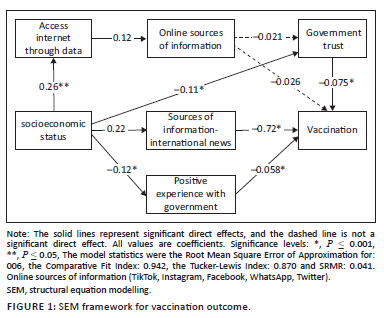
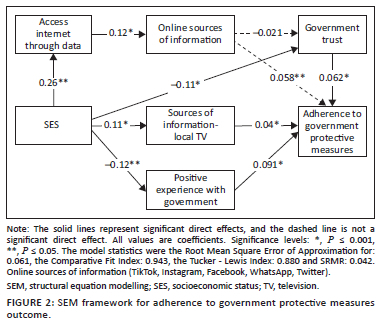
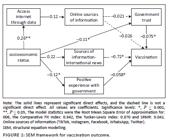
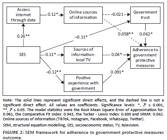
Structural equation modelling (SEM) was applied to examine the specific causal models and assess the comparative strength of direct and indirect relationships among independent variables with vaccination and adherence to government measures. Structural equation modelling was the analysis of choice as it allows for a pictographic representation of hypothesis-driven relationships between variables such as potential mediators, confounders and latent variables.15a priori model (Figure 1 and Figure 2), based on expert knowledge and literature. Bold lines represent statistically significant paths while dotted lines represent paths that were not statistically significant. We then hypothesised relationships a priori among the variables. From this framework, SEM was used to estimate the associations in the different pathways between access to devices (Wi-Fi and data), access to information (online and television sources), government trust, government experience, perception of government protective measures, perception of vaccination socioeconomic status factors and the two outcomes vaccination and adherence to government measures. Direct, indirect and total effects were calculated using nonlinear combination estimates.
To evaluate the best fitting model for our data, we reported goodness of fit indices including root mean squared error of approximation (RMSEA), comparative fit index (CFI), Tucker-Lewis index (TLI) and standardised root mean squared residual (SRMR). All data analyses were performed using Stata statistical software, version 14.1 (StataCorp, College Station, TX: Stata Corporation).
Ethical considerations
Ethical approval for the study was obtained from the University of the Witwatersrand Human Research Ethics Committee (Non-Medical, reference no.: H21/10/06). Anonymised data were kept confidential on the secure MoyaResearch system.
Results
Characteristics of participants
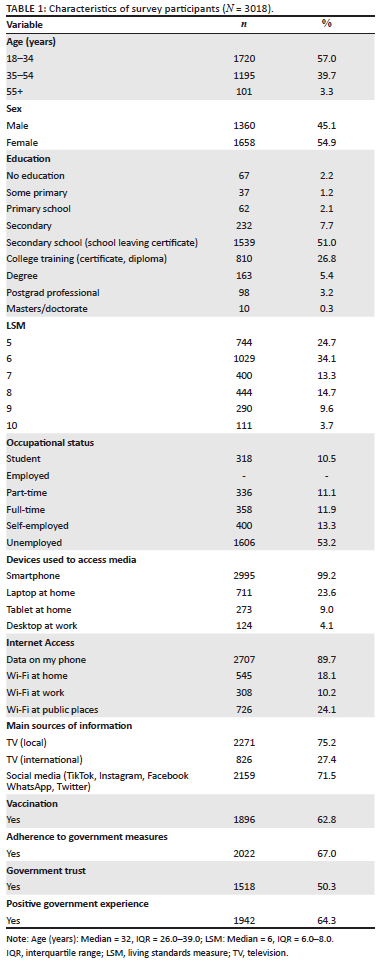
The characteristics of participants in the study sample are presented in Table 1. Over the study time period, 3018 participants completed the survey. The median age of the participants was 32 years (IQR: 26-39), with 54.9% of participants identifying as female. The majority of participants were middle-income earners represented by a median LSM of 6 (IQR: 6-8). The highest level of education for most participants was a school leaving certificate (51.0%), with 13.2% having lower than secondary school education and 35.7% having a post-secondary school qualification. A total of 53.2% of participants were unemployed and 10.5% of participants were students. To access media 99.2% of participants used a smartphone, with 89.7% of participants accessing the internet using mobile data. The main sources of information were local news (75.2%), followed by social media (71.2%). More than half of the participants reported vaccination (62.8%) and 67.0 % of participants reported adhering to government measures (e.g. wearing a mask and physical distancing). Half the participants (50.3%) reported trust in the government, and the majority of participants (64.3%) reported positive previous experiences with the government.
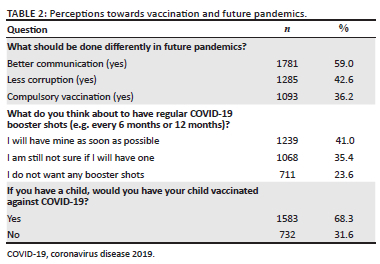
Participants' perceptions towards vaccination and future pandemics are presented in Table 2. When asked what should be done differently in the next pandemic, more than half of the participants (59.0%) said better government communication, 42.2% said less corruption and 36.2% reported that mandatory vaccination should be implemented. The majority of participants (68.3%) indicated that they were either unsure about booster shots or would not get them. Child vaccination acceptance was high with 68.3% of parents indicating that they would vaccinate their children if the vaccine was made available to them.
Multivariable logistic regression
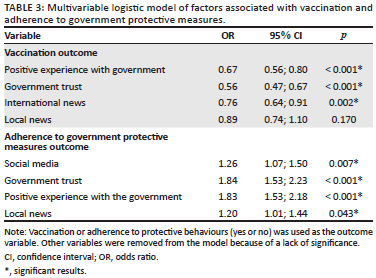
Table 3 depicts the results of a multivariable logistic regression model for factors associated with adherence to government measures and vaccination. Those who reported government trust were 0.5 times less likely to vaccinate (odds ratio [OR]: 0.56 [confidence interval {CI}: 0.47, 0.67] p < 0.001). Likewise, those who reported positive government experiences (OR: 0.67 [CI: {0.56, 0.80}] p < 0.001) and international news (OR: 0.76 [CI: 0.64, 0.9] p = 0.002) were less likely to vaccinate. Those who reported government trust (OR: 1.84 [CI: 1.53, 2.23] p < 0.001) and positive government experience (OR: 1.83 [1.53, 2.18] p < 0.001) were almost twice as likely to adhere to government measures. Those who used social media (OR: 1.26 [1.07, 1.5] p = 0.007) and local news (OR: 1.20 [1.01, 1.44] p = 0.043) as a source of information were more likely to adhere to government measures.
Structural equation modelling: Vaccination outcome
Results from the SEM analyses regarding the association between socioeconomic status (SES), access to devices, access to information, government trust, government experience and the outcome of vaccination are shown in Online Appendix Table 2-A1 and Figure 1. There was no direct association between SES and the outcome of vaccination uptake, but SES was indirectly and positively associated with vaccination uptake ([0.021] p ≤ 0.001) through pathways mediated by positive government experiences, access to international news and government trust. Positive, direct associations were observed between SES and the following: access to the Internet ([0.28] p ≤ 0.001), access to online sources ([0.037] p ≤ 0.001) and accessing international news ([0.22] p ≤ 0.001). Socioeconomic status was negatively associated with positive government experiences ([0.12] p ≤ 0.001) and government trust ([0.12] p ≤ 0.001). Government experiences ([−0.052] p ≤ 0.001), international news ([−0.72] p ≤ 0.001), trust in government ([−0.075] p ≤ 0.001) and government experiences ([−0.11] p ≤ 0.001) were directly and negatively associated with vaccination. Government trust and positive government experience were strongly associated ([0.69] p ≤ 0.001).
Structural equation modelling adherence to government measures outcome
Results from the SEM analyses for the association between SES, access to devices, access to information, government trust, government experience and the outcome adherence to government measures are shown in Online Appendix Table 3-A1 and Figure 2. Positive government experience was positively directly ([0.091] p ≤ 0.001) and indirectly ([0.043] p ≤ 0.001) associated with adherence to government measures, with a total association of ([0.13] p ≤ 0.001). Government trust was positively and directly associated with adherence to government measures ([0.062] p ≤ 0.001), while SES was indirectly and positively associated with adherence to government measures ([0.023] p ≤ 0.001). Local news was positively and directly associated with adherence to government measures ([0.04] p ≤ 0.05).
Discussion
This study reports on the perceptions and behaviour responses (e.g. adhering to restrictions and vaccination uptake) of the South African adult population at a later stage in the pandemic, as the South African government began to ease restrictions. Government trust, positive previous government experiences and sources of information increased the likelihood of adhering to government measures. However, in contrast, government trust, positive government experiences and sources of information did not appear to positively influence self-reported vaccination but instead were associated with reduced likelihood of vaccination. A surprising finding, given that adherence to government measures and vaccination, are both preventative measures; hence, it is probable that the behaviour surrounding them would be similar; however, this is not the case. A study in Kenya found similar results where adherence to government measures was linked to reduced willingness to vaccinate.1611,12,131718,19
The results of the present study highlighted the positive association between socioeconomic status and vaccination uptake. South Africa is a highly inequitable country with a history of socioeconomic-related health inequality;20,2122,23,24,2510,2627
Similarly, the results also showed that adherence to government protective measures such as social distancing and mask-wearing were indirectly and positively associated with socioeconomic status. This is in agreement with another South African study carried out by Swart et al. who reported higher adherence to protective measures among high-income earners.282930,313210,33
Although some studies have reported on the harmful effects of misinformation being propagated on social media,34,35,36,37
As reported by other studies, government trust was reported to influence adherence to government protective measures.38,39,40,414243,4445
Implications and recommendations
This study has contributed to the literature highlighting the complexity of issues such as adherence to government measures and vaccine uptake in relation to a pandemic and has identified the role of socioeconomic status in these issues. The implications of this are that future pandemic preparedness cannot be a 'one-size-fits-all' approach in a country as diverse as South Africa, particularly given the vast inequities that persist between income groups. It is therefore imperative that pandemic responses do not further widen these inequities. Findings relating to government trust emphasise that this should also be a key consideration in pandemic preparedness and response.
While COVID-19 presented a somewhat unique opportunity to study these issues in the context of a global pandemic, these learnings apply to other public health measures that require the support and cooperation of individuals and communities. These too should be contextually relevant and equity-promoting, drawing on a nuanced understanding of the complexity of human behaviour.
Strengths and limitations
The use of online survey methodologies has specific advantages during a pandemic when there is a need to collect information quickly, and when there may be challenges to the safe conduct of in-person community surveys. Our Internet-based sampling strategy and survey dissemination via an online panel to a large number of respondents enabled the rapid deployment of a survey to track responses in near real-time, allowing us to study risk perception and behavioural changes during the pandemic. However, a limitation of this approach is the trade-off in terms of population representativeness. As access to devices is limited, we were unable to recruit individuals from the lowest income groups for whom this access would be lowest.
Conclusion
Results from this study should be used to inform future pandemic preparedness plans. In particular, policymakers should consider the importance of providing scientific information through channels accessible to each socioeconomic group to promote positive behavioural changes, as well as the need to adapt pandemic responses to different socioeconomic groups. As adherence to protective behaviours is linked to government trust, there is a need for government to deal with corruption decisively as this will ensure that it remains a trusted entity.
Competing interests
The authors reported that they received funding from the DSI-NRF Centre of Excellence in Human Development at the University of Witwatersrand which may be affected by the research reported in the enclosed publication. The authors have disclosed those interests fully and have implemented an approved plan for managing any potential conflicts arising from their involvement. The terms of these funding arrangements have been reviewed and approved by the affiliated university in accordance with its policy on objectivity in research.
Authors' contributions
T.M.S., C.E.D. and S.A.N. contributed to the initial conceptualisation of the manuscript and designed the survey. T.M.S. conducted the data analyses and prepared the first draft of the manuscript. C.E.D. and S.A.N. conducted critical reviews and revisions of the drafts of the manuscript. T.M.S., C.E.D. and S.A.N. approved the final manuscript for submission.
Funding information
The study was funded by the DSI-NRF Centre of Excellence in Human Development at the University of the Witwatersrand, Johannesburg, South Africa. The funders had no role in study design, data collection and analysis, decision to publish or preparation of the manuscript. C.E.D. is supported by the South African Medical Research Council.
Data availability
The data that support the findings of this study are available upon reasonable request from the corresponding author, C.E.D.
Disclaimer
The views and opinions expressed in this article are those of the authors and are the product of professional research. It does not necessarily reflect the official policy or position of any affiliated institution, funder, agency or that of the publisher. The authors are responsible for this article's results, findings and content.
Acknowledgements
The authors thank the participants who participated in this study and the Moya App administrators.
References
-
1. Anderson RM, Heesterbeek H, Klinkenberg D, Hollingsworth TD. How will country-based mitigation measures influence the course of the COVID-19 epidemic? Lancet. 2020;395(10228):931-934. https://doi.org/10.1016/S0140-6736(20)30567-5
» https://doi.org/10.1016/S0140-6736(20)30567-5 -
2. Lai S, Ruktanonchai NW, Zhou L, et al. Effect of non-pharmaceutical interventions to contain COVID-19 in China. Nature. 2020;585(7825):410-413. https://doi.org/10.1038/s41586-020-2293-x
» https://doi.org/10.1038/s41586-020-2293-x - 3. Fetzer TR, Witte M, Hensel L, et al. Global behaviors and perceptions at the onset of the COVID-19 pandemic. Cambridge, MA: National Bureau of Economic Research; 2020.
-
4. McFadden SM, Malik AA, Aguolu OG, Willebrand KS, Omer SB. Perceptions of the adult US population regarding the novel coronavirus outbreak. PLoS One. 2020;15(4):e0231808. https://doi.org/10.1371/journal.pone.0231808
» https://doi.org/10.1371/journal.pone.0231808 -
5. Wolf MS, Serper M, Opsasnick L, et al. Awareness, attitudes, and actions related to COVID-19 among adults with chronic conditions at the onset of the US outbreak: A cross-sectional survey. Ann Intern Med. 2020;173(2):100-109. https://doi.org/10.7326/M20-1239
» https://doi.org/10.7326/M20-1239 -
6. Buheji M, Da Costa Cunha K, Beka G, et al. The extent of covid-19 pandemic socio-economic impact on global poverty. a global integrative multidisciplinary review. Am J Econ. 2020;10(4):213-224. https://doi.org/10.5923/j.economics.20201004.02
» https://doi.org/10.5923/j.economics.20201004.02 - 7. Shahyad S, Mohammadi MT. Psychological impacts of Covid-19 outbreak on mental health status of society individuals: A narrative review. J Mil Med. 2020;22(2):184-192.
-
8. Arndt C, Davies R, Gabriel S, et al. Covid-19 lockdowns, income distribution, and food security: An analysis for South Africa. Glob Food Secur. 2020;26:100410. https://doi.org/10.1016/j.gfs.2020.100410
» https://doi.org/10.1016/j.gfs.2020.100410 - 9. World Bank Group. Overcoming poverty and inequality in South Africa: An assessment of drivers, constraints and opportunities. Washington, DC: World Bank; 2018.
-
10. Silubonde TM, Knight L, Norris SA, Van Heerden A, Goldstein S, Draper CE. Perceptions of the COVID-19 pandemic: A qualitative study with South African adults. BMC Public Health. 2023;23(1):684. https://doi.org/10.1186/s12889-023-15450-z
» https://doi.org/10.1186/s12889-023-15450-z - 11. Ingle K, Brophy T, Daniels R. National Income Dynamics Study - Coronavirus Rapid Mobile Survey (NIDS-CRAM) panel user manual. Version 2. Cape Town: Southern Africa Labour and Development Research Unit; 2020.
-
12. Sewpaul R, Sifunda S, Gaida R, Mokhele T, Naidoo I, Reddy SP. Vaccine hesitancy and related factors among South African adults in 2021: Unpacking uncertainty versus unwillingness. Front Public Health. 2023;11:1233031. https://doi.org/10.3389/fpubh.2023.1233031
» https://doi.org/10.3389/fpubh.2023.1233031 - 13. Runciman C, Roberts B, Alexander K, Bohler-Muller N, Bekker M. Willingness to take a COVID-19 vaccine: A research briefing. UJ-HSRC COVID-19 Democr Surv. 2021;25:1-18.
- 14. Ncube M, Serumaga-Zake P. Measuring living standards in South Africa. J Green Econ Dev. 2015;1(2):1-18.
-
15. Lei P, Wu Q. Introduction to structural equation modeling: Issues and practical considerations. Educ Meas Issues Pract. 2007;26(3):33-43. https://doi.org/10.1111/j.1745-3992.2007.00099.x
» https://doi.org/10.1111/j.1745-3992.2007.00099.x -
16. Oyekale AS. Compliance indicators of COVID-19 prevention and vaccines hesitancy in Kenya: A random-effects endogenous probit model. Vaccines. 2021;9(11):1359. https://doi.org/10.3390/vaccines9111359
» https://doi.org/10.3390/vaccines9111359 -
17. Wiysonge CS, Ngcobo NJ, Jeena PM, et al. Advances in childhood immunisation in South Africa: Where to now? Programme managers' views and evidence from systematic reviews. BMC Public Health. 2012;12:1-9. https://doi.org/10.1186/1471-2458-12-578
» https://doi.org/10.1186/1471-2458-12-578 -
18. Siegfried N, Wiysonge CS, Pienaar D. Too little, too late: Measles epidemic in South Africa. Lancet. 2010;376(9736):160. https://doi.org/10.1016/S0140-6736(10)61100-2
» https://doi.org/10.1016/S0140-6736(10)61100-2 - 19. Schoub BD. Lessons from the 2009 measles epidemic in South Africa. South Afr Med J. 2011;101(8):519.
-
20. Ataguba JE, Akazili J, McIntyre D. Socioeconomic-related health inequality in South Africa: Evidence from General Household Surveys. Int J Equity Health. 2011;10:1-10. https://doi.org/10.1186/1475-9276-10-48
» https://doi.org/10.1186/1475-9276-10-48 -
21. Van Rensburg HC. South Africa's protracted struggle for equal distribution and equitable access-still not there. Hum Resour Health. 2014;12:1-16. https://doi.org/10.1186/1478-4491-12-26
» https://doi.org/10.1186/1478-4491-12-26 -
22. Jarolimova J, Yan J, Govere S, et al. Medical mistrust and stigma associated with COVID-19 among people living with HIV in South Africa. AIDS Behav. 2021;25(12):3967-3977. https://doi.org/10.1007/s10461-021-03307-8
» https://doi.org/10.1007/s10461-021-03307-8 -
23. Moll T. Medical mistrust and enduring racism in South Africa. J Bioethical Inq. 2021;18(1):117-120. https://doi.org/10.1007/s11673-020-10072-1
» https://doi.org/10.1007/s11673-020-10072-1 -
24. Latkin CA, Dayton L, Yi G, Konstantopoulos A, Boodram B. Trust in a COVID-19 vaccine in the US: A social-ecological perspective. Soc Sci Med. 2021;270:113684. https://doi.org/10.1016/j.socscimed.2021.113684
» https://doi.org/10.1016/j.socscimed.2021.113684 -
25. Cooper S, Van Rooyen H, Wiysonge CS. COVID-19 vaccine hesitancy in South Africa: How can we maximize uptake of COVID-19 vaccines? Expert Rev Vaccines. 2021;20(8):921-933. https://doi.org/10.1080/14760584.2021.1949291
» https://doi.org/10.1080/14760584.2021.1949291 - 26. Sitto K, Lubinga E. A disease of privilege? Social representations in online media about COVID-19 among South Africans during lockdown. Pap Soc Represent. 2020;29(2):6-1.
-
27. Dhama K, Sharun K, Tiwari R, et al. COVID-19 vaccine hesitancy-reasons and solutions to achieve a successful global vaccination campaign to tackle the ongoing pandemic. Hum Vaccines Immunother. 2021;17(10):3495-3499. https://doi.org/10.1080/21645515.2021.1926183
» https://doi.org/10.1080/21645515.2021.1926183 - 28. Galvin M, Kim AW, Bosire E, et al. Community perceptions and experiences of the South African Government's response to the first wave of the COVID-19 pandemic in Johannesburg, South Africa. Soc Health Sci. 2023;22(2):18pp.
-
29. Lim JM, Tun ZM, Kumar V, et al. Population anxiety and positive behaviour change during the COVID-19 epidemic: Cross-sectional surveys in Singapore, China and Italy. Influenza Other Respir Viruses. 2021;15(1):45-55. https://doi.org/10.1111/irv.12785
» https://doi.org/10.1111/irv.12785 -
30. Griffin RJ, Neuwirth K, Dunwoody S, Giese J. Information sufficiency and risk communication. Media Psychol. 2004;6(1):23-61. https://doi.org/10.1207/s1532785xmep0601_2
» https://doi.org/10.1207/s1532785xmep0601_2 -
31. Choi DH, Yoo W, Noh GY, Park K. The impact of social media on risk perceptions during the MERS outbreak in South Korea. Comput Hum Behav. 2017;72:422-431. https://doi.org/10.1016/j.chb.2017.03.004
» https://doi.org/10.1016/j.chb.2017.03.004 -
32. World Bank. Poverty and equity brief: South Africa [homepage on the Internet]. 2020 [cited n.d.]. Available from: https://databankfiles.worldbank.org/public/ddpext_download/poverty/33EF03BB-9722-4AE2-ABC7-AA2972D68AFE/Global_POVEQ_ZAF.pdf
» https://databankfiles.worldbank.org/public/ddpext_download/poverty/33EF03BB-9722-4AE2-ABC7-AA2972D68AFE/Global_POVEQ_ZAF.pdf -
33. Saied SM, Saied EM, Kabbash IA, Abdo SAE. Vaccine hesitancy: Beliefs and barriers associated with COVID-19 vaccination among Egyptian medical students. J Med Virol. 2021;93(7):4280-4291. https://doi.org/10.1002/jmv.26910
» https://doi.org/10.1002/jmv.26910 -
34. Enders AM, Uscinski JE, Klofstad C, Stoler J. The different forms of COVID-19 misinformation and their consequences. Harv Kennedy Sch Misinformation Rev. 2020;1(8). https://doi.org/10.37016/mr-2020-48
» https://doi.org/10.37016/mr-2020-48 -
35. Diseases TLI. The COVID-19 infodemic. Lancet Infect Dis. 2020;20(8):875. https://doi.org/10.1016/S1473-3099(20)30565-X
» https://doi.org/10.1016/S1473-3099(20)30565-X -
36. Chong YY, Cheng HY, Chan HYL, Chien WT, Wong SYS. COVID-19 pandemic, infodemic and the role of eHealth literacy. Int J Nurs Stud. 2020;108:103644. https://doi.org/10.1016/j.ijnurstu.2020.103644
» https://doi.org/10.1016/j.ijnurstu.2020.103644 -
37. Tasnim S, Hossain MM, Mazumder H. Impact of rumors and misinformation on COVID-19 in social media. J Prev Med Pub Health. 2020;53(3):171-174. https://doi.org/10.3961/jpmph.20.094
» https://doi.org/10.3961/jpmph.20.094 -
38. Pagliaro S, Sacchi S, Pacilli MG, et al. Trust predicts COVID-19 prescribed and discretionary behavioral intentions in 23 countries. PLoS One. 2021;16(3):e0248334. https://doi.org/10.1371/journal.pone.0248334
» https://doi.org/10.1371/journal.pone.0248334 -
39. Clark C, Davila A, Regis M, Kraus S. Predictors of COVID-19 voluntary compliance behaviors: An international investigation. Glob Transit. 2020;2:76-82. https://doi.org/10.1016/j.glt.2020.06.003
» https://doi.org/10.1016/j.glt.2020.06.003 -
40. Shanka MS, Menebo MM. When and how trust in government leads to compliance with COVID-19 precautionary measures. J Bus Res. 2022;139:1275-1283. https://doi.org/10.1016/j.jbusres.2021.10.036
» https://doi.org/10.1016/j.jbusres.2021.10.036 - 41. Dryhurst S, Schneider CR, Kerr J, et al. In: Wardman JK, Löfstedt R, editors. COVID-19: Confronting a new world risk. Milton Park: Routledge, 2022; p. 162-174.
- 42. Ramaphosa C. Escalation of measures to combat Coronavirus COVID-19 pandemic. Pretoria: South Afr Gov; 2020.
- 43. Mathiba G. Corruption, public sector procurement and COVID-19 in South Africa: Negotiating the new normal. J Public Adm. 2020;55(4):642-661.
-
44. Farzanegan MR, Hofmann HP. A matter of trust? Political trust and the COVID-19 pandemic. Int J Sociol. 2022;52(6):476-499. https://doi.org/10.1080/00207659.2022.2086729
» https://doi.org/10.1080/00207659.2022.2086729 - 45. Mlambo VH, Masuku MM. Governance, corruption and COVID-19: The final nail in the coffin for South Africa's dwindling public finances. J Public Adm. 2020;55(3-1):549-565.

Accepted: 12 Dec. 2024
Published: 17 Jan. 2025