The merit of rural point-of-care ultrasound: Carotid pseudoaneurysm case report
Abstract
INTRODUCTION: Extracranial carotid artery aneurysms and pseudoaneurysms are rare, comprising less than 4% of all peripheral artery aneurysms. Rural primary health care facilities often face significant challenges because of limited access to formal imaging. Point-of-care ultrasound (PoCUS) has the potential to bridge this gap, accelerating timely diagnosis and management in remote settings PATIENT PRESENTATION: A 19-year-old male presented to a rural primary health care clinic in the Western Cape of South Africa with a 3-week history of left-sided neck swelling and recent odynophagia. Physical examination revealed a firm, pulsatile mass with an audible bruit MANAGEMENT AND OUTCOME: Formal imaging was unavailable for several months, delaying surgical advice. However, the clinic's newly procured mobile ultrasound allowed for PoCUS, which identified a pulsatile vascular lesion consistent with a carotid pseudoaneurysm. Computed tomography angiography confirmed the diagnosis, and the patient was referred for tertiary care where the lesion was repaired. He had vasculitis on histology and exhibited inconclusive features of a connective tissue disorder, but a definitive cause was not found. Despite multiple attempts, he could not be contacted for follow-up CONCLUSION: This case highlights how PoCUS can accelerate definitive management in resource-limited settings CONTRIBUTION: Point-of-care ultrasound is potentially an effective, cost-efficient diagnostic tool in rural healthcare settings but requires significant investment in equipment and training. Further research is needed to evaluate its feasibility in South African rural health systems
PoCUS; ultrasound; pseudoaneurysm; carotid; primary care; imaging; GP; clinic; rural
Introduction
Background: Primary health care and imaging access
We report a case of a young man who received prompt diagnosis and management for a carotid pseudoaneurysm because of point-of-care ultrasound (PoCUS) capability at his local primary health care clinic.
Extracranial carotid artery aneurysms and pseudoaneurysms are rare and make up less than 4% of all peripheral artery aneurysms.12,3
This case was initially managed at a rural primary health care clinic in the Western Cape of South Africa. The clinic serves approximately 5000 patients per month with a staff complement of 12 nurses, one medical officer and an intern doctor. HIV, lifestyle diseases and tuberculosis are the predominant chronic diseases seen there.
Emergency cases are assessed and stabilised before referral to the secondary-level hospital situated 30 km away.
All patients are referred for basic radiology investigations. The waiting period is seven days for plain radiographs and in excess of three months for ultrasound examinations. Computed tomography (CT) is a limited resource that can only be ordered by in-hospital physicians. The secondary hospital covers a 40 129 km24
Ethical considerations
Ethical clearance to conduct this study was obtained from the Stellenbosch University Health Research Ethics Committee (No. C24/12/034). The patient consented verbally but was later not reachable for written consent.
Patient presentation: A young man with neck swelling
A 19-year-old male presented to the clinic with a three-week history of a left-sided neck swelling, accompanied by odynophagia for the previous two days. He reported no preceding trauma, chronic illnesses, previous surgeries or notable family history. His only prior contact with the clinic was two months earlier when he received empiric antibiotic treatment for a sexually transmitted infection (STI). Sexually transmitted infections are treated without bacterial confirmation in this setting as per local protocols.
His vital signs were within normal limits. Systemic examination revealed a unilateral, left-sided, firm and pulsatile mass at the base of his neck. It was approximately 6 cm × 4 cm in size with an audible bruit. No lymphadenopathy was present. Further cardiovascular examination was normal. Other systemic examinations were unremarkable. He exhibited no signs of trauma or infection and appeared clinically well. Rapid tests for HIV and syphilis (done as per local protocol) were negative at the time; further blood tests were deferred to the secondary level.
Diagnosis, referral and management
The case was discussed with the surgery team at the secondary hospital. A vascular lesion was deemed unlikely, and they suspected the mass was a lymph node with transmitted pulsation from an underlying vessel. Admission for emergency imaging was denied, and elective ultrasound was advised.
The next available formal ultrasound appointment was five months away because of system-related resource constraints. However, a mobile ultrasound machine was procured in this health subdistrict six months prior, for use at the clinic level. Arrangements were made by the primary clinician to bring the machine to the clinic the next day.
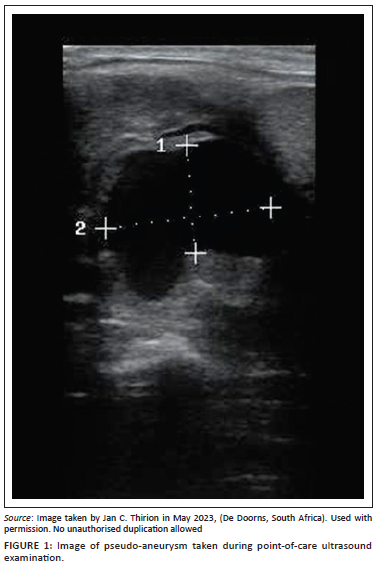
The primary health care clinician performed a PoCUS examination, which revealed a large pulsating vascular lesion communicating with the bifurcation of the left carotid artery (Figure 1). A carotid pseudoaneurysm was suspected.
The patient was re-discussed with the secondary hospital and was promptly accepted for an urgent CT angiogram, which confirmed the diagnosis of a carotid pseudoaneurysm. Admission bloods were normal; creatinine 75 umol/L, white cell count 7.23 × 1099
Management and outcome
Recovery, follow-up and aetiological considerations
Six months after the second surgery, the patient was doing well and had experienced no ill effects of the original pathology.
He was evaluated for a connective tissue disorder but did not fully meet the criteria for Marfan syndrome, although Ehlers-Danlos syndrome remained an unexplored possibility.
He did not attend subsequent appointments, including an appointment for genetic screening, after relocating to pursue his tertiary education. Despite several attempts, contact with the patient could not be re-established.
The exact cause of the pseudoaneurysm could not be established. The potential existence of a connective tissue disorder or links to the previously suspected STI could not be confirmed.
Discussion
The role and limitations of point-of-care ultrasound in primary health care
Primary health care PoCUS capability improved the management of this case by expediting admission and avoiding potentially dangerous delays. This reduction in time-to-diagnosis is a known benefit of PoCUS, as demonstrated in emergency centres.5
South Africa faces inequitable distribution of formal imaging services in its government facilities,67897
However, PoCUS is not without its own drawbacks. Widespread adoption of PoCUS would be an inherently expensive undertaking because of the costs of equipment and additional training required for primary health care doctors. This effort can be justified, given the benefits and cost-effectiveness PoCUS has shown in other health systems.10,111179
More research in the context of primary health care in South Africa is needed to determine whether expanding rural PoCUS capability should be prioritised.
Competing interests
The authors declare that they have no financial or personal relationships that may have inappropriately influenced them in writing this article.
Authors' contributions
D.J.V.H. reviewed the data, edited the final paper, provided invaluable advice, suggestions and assistance as a contributor and advisor to create a viable manuscript. J.C.T. is the guarantor and contributed towards the conceptualisation, investigation, writing, reviewing and editing of the original draft.
Funding information
This research received no specific grant from any funding agency in the public, commercial or not-for-profit sectors.
Data availability
The data that support the findings of this study are available on reasonable request from the corresponding author, J.C.T.
Disclaimer
The views and opinions expressed in this article are those of the authors and do not necessarily reflect the official policy or position of any affiliated agency of the authors.
Acknowledgements
References
-
1. Ucaroglu ER, Tahtabasi M. Surgical treatment of extracranial internal carotid artery pseudoaneurysm in an infant due to falling from height: An unusual case. Int Med Case Rep J. 2023;16:667-672. https://doi.org/10.2147/imcrj.s433360
» https://doi.org/10.2147/imcrj.s433360 -
2. Zhong Y, Feng JP, Luo H, Gong X, Wei ZH. Spontaneous internal carotid artery pseudoaneurysm complicated with ischemic stroke in a young man: A case report and review of literature. World J Clin Cases. 2022;10(22):8025-8033. https://doi.org/10.12998/wjcc.v10.i22.8025
» https://doi.org/10.12998/wjcc.v10.i22.8025 -
3. Sueyoshi E, Sakamoto I, Nakashima K, Minami K, Hayashi K. Visceral and peripheral arterial pseudoaneurysms. Am J Roentgenol. 2005;185(3):741-749. https://doi.org/10.2214/ajr.185.3.01850741
» https://doi.org/10.2214/ajr.185.3.01850741 -
4. Statistics South Africa | Census Dissemination [homepage on the Internet]. census.statssa.gov.za. [cited 2023 Oct 10]. Available from: https://census.statssa.gov.za/#/province/1/2
» https://census.statssa.gov.za/#/province/1/2 -
5. Smallwood N, Dachsel M. Point-of-care ultrasound (POCUS): Unnecessary gadgetry or evidence-based medicine? Clin Med. 2018;18(3):219-224. https://doi.org/10.7861/clinmedicine.18-3-219
» https://doi.org/10.7861/clinmedicine.18-3-219 -
6. Kabongo JM, Nel S, Pitcher RD. An analysis of licensed South African diagnostic imaging equipment. Pan Afr Med J. 2015;22:57. https://doi.org/10.11604/pamj.2015.22.57.7016
» https://doi.org/10.11604/pamj.2015.22.57.7016 -
7. Kornelsen J, Ho H, Robinson VP, Frenkel O. Rural family physician use of point-of-care ultrasonography: Experiences of primary care providers in British Columbia, Canada. BMC Prim Care. 2023;24(1):183. https://doi.org/10.1186/s12875-023-02128-z
» https://doi.org/10.1186/s12875-023-02128-z -
8. Abrokwa SK, Ruby LC, Heuvelings CC, Bélard S. Task shifting for point of care ultrasound in primary healthcare in low- and middle-income countries - A systematic review. EClinicalMedicine. 2022;45:101333. https://doi.org/10.1016/j.eclinm.2022.101333
» https://doi.org/10.1016/j.eclinm.2022.101333 -
9. Balmuth EA, Luan D, Jannat-Khah D, Evans A, Wong T, Scales DA. Point-of-care ultrasound (POCUS): Assessing patient satisfaction and socioemotional benefits in the hospital setting. PLoS One. 2024;19(2):e0298665. https://doi.org/10.1371/journal.pone.0298665
» https://doi.org/10.1371/journal.pone.0298665 -
10. Lentz B, Fong T, Rhyne R, Risko N. A systematic review of the cost-effectiveness of ultrasound in emergency care settings. Ultrasound J. 2021;13(1):16. https://doi.org/10.1186/s13089-021-00216-8
» https://doi.org/10.1186/s13089-021-00216-8 -
11. Andersen CA, Holden S, Vela J, Rathleff MS, Jensen MB. Point-of-care ultrasound in general practice: A systematic review. Ann Fam Med. 2019;17(1):61-69. https://doi.org/10.1370/afm.2330
» https://doi.org/10.1370/afm.2330

Accepted: 01 June 2025
Published: 23 July 2025