Knowledge, adherence and control among patients with hypertension attending a peri-urban primary health care clinic, KwaZulu-Natal
Abstract
BACKGROUND: Despite hypertension being a common condition among patients attending primary health care (PHC) clinics, blood pressure (BP) control is often poor. Greater insight into patient-related factors that influence the control of hypertension will assist in the development of an intervention to address the issues identified. AIM: The aim of the study was to assess patient-related variables associated with hypertension control among patients attending a peri-urban PHC clinic. SETTING: The setting for this study was a peri-urban PHC clinic in KwaZulu-Natal. METHOD: This was an observational, descriptive and cross-sectional study with 348 patients selected over a 1-month period. A validated questionnaire was used to collect data on patients' hypertension knowledge and self-reported adherence, and BP recordings from their medical record were recorded to ascertain control. RESULTS: Of the 348 participants, only 49% had good BP control and 44% (152/348) had concurrent diabetes mellitus. The majority of patients had moderate levels of knowledge on hypertension and exhibited moderate adherence. There was a significant relationship between knowledge and reported adherence, between reported adherence and control, but not between reported knowledge and control. CONCLUSION: Despite over 90% of the study population having moderate knowledge, and 62% with moderate reported adherence, BP was well controlled in only less than 50% of the study population. These findings suggest a need to emphasise adherence and explore new ways of approaching adherence.
Introduction
Developing countries, faced with a high burden of communicable and non-communicable diseases, are struggling to provide adequate health care services to their population.12344
In South Africa (SA), it is estimated that a quarter of the population between the ages of 15 and 64 suffer from hypertension, which equates to over 6.2 million people if a BP measurement of ≥ 140/90 mm Hg is used as indicative of hypertension.56,7,8,9,10,114
Hypertension is a complex chronic condition often referred to as a 'silent killer' and a key contributor to the development of cardiovascular and cerebrovascular diseases.21211,13,1484,6,10,15,16,17
Most of the studies on hypertension have been based in urban or rural areas,6,7,8,9,10115,181920
Method
The study design was an observational, descriptive, cross-sectional study conducted at a peri-urban PHC clinic in KwaZulu-Natal. At this clinic, hypertensive patients were mainly cared for by nurses with referral to a doctor for review if the BP was uncontrolled or complications occurred. The catchment population of the clinic was 27 276 people, with an average of 1197 patients with hypertension being treated at the clinic each month. Data were collected between May and June 2015. Inclusion criteria were patients with hypertension above the age of 18 years who had been collecting hypertensive medication from the PHC clinic for at least 1 year. People under 18 years and those not willing to participate were excluded. A sample size of 350 patients was deemed adequate after calculation and discussion with a statistician (95% confidence level and 5% confidence interval).21
Data sources were twofold. (1) Clinical information about BP recordings was obtained from patients' records. (2) Other data were collected during patient interviews by a research assistant who was fluent in English and isiZulu, which was the first language of the majority of patients in this context. The interviews were structured in a closed-ended questionnaire which comprised five sections. Section One captured the socio-demographic data of participants (including variables such as gender, age, educational level, race, employment status, marital status and comorbid chronic disease). Section Two comprised 18 questions sourced and modified from a Hypertension Fact Questionnaire (HFQ) previously validated by Saleem et al.222223
Data were captured and analysed using Epi info version number 7.1.5.2. Results were summarised by frequencies and percentages (for categorical variables). Comparisons between independent variables and outcome variables were carried out using the Fisher's exact test. A p-value of < 0.05 was considered to be statistically significant.
Ethical consideration
Ethical permission for this study was provided by the Biomedical Research Ethics Committee of the University of KwaZulu-Natal (Ref: 330/14). Permission was also obtained from the KwaZulu-Natal Provincial Department of Health and PHC clinic management team. All patients who participated in the study signed informed consent after being given an information sheet informing them of the purpose of the study.
Results
A total of 348 patients participated in the study. Results are presented as follows: (1) demographic characteristics, (2) knowledge levels, (3) reported adherence level, (4) BP control and (5) associations between variables.
Demographic characteristics
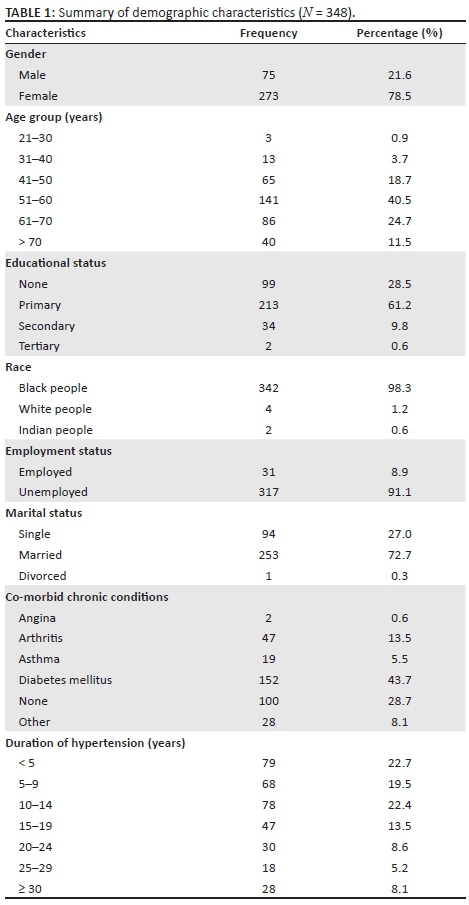
Female participants represented the majority of the respondents, with most being black Africans and also married. Just over 40% were in the age group of 51- 60 years with over half having only primary education and < 1% having tertiary education. The majority was unemployed and diabetes mellitus was the commonest co-morbidity. Most participants had been on treatment for hypertension for > 5 years. The demographic characteristics are shown in greater detail in Table 1.
Knowledge of hypertension
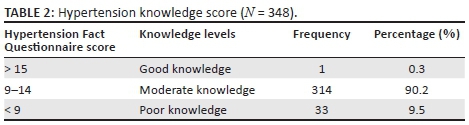
Most patients achieved a 'moderate knowledge-level' score (314; 90%), with an average knowledge score of 10.36 Table 2 summarises the hypertension knowledge score of participants. Only one patient achieved a 'good knowledge-level' score. Participants scored poorly when answering questions relating to (1) normal and target BP values and (2) if medication alone was enough to ensure good BP control. Only one participant correctly mentioned the expected BP targets. Participants scored high around questions relating to lifestyle modification and all participants knew that poor hypertension control could lead to life-threatening complications. Over 95% did not know the names of their antihypertensive medication, whereas 99.7% were able to identify their medication from sample packets presented to them.
Reported adherence
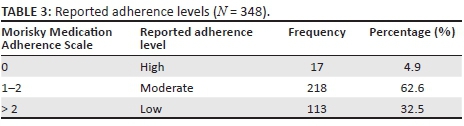
The self-reported adherence level to the antihypertensive medications of the studied population was moderate (218; 63%) - see Table 3 for details. Most participants reported that they forget to take medication sometimes and do not engage in regular prescribed exercise on most days.
Recorded blood pressure
Only 49% of participants had optimal-level BP as measured over their last three visits to the PHC clinic.
Associations between variables
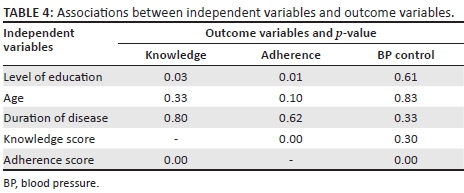
Table 4 highlights the association between variables, with significant association found between participants' level of education and their knowledge of hypertension (p = 0.03), between patients' education level and their reported adherence level (p = 0.01), between knowledge and reported adherence (p < 0.00) and between reported adherence, knowledge and BP control (p < 0.00).
Discussion
This study provides a snapshot of hypertension knowledge, adherence and control at a peri-urban PHC clinic. The study is consistent with other studies which have demonstrated poor hypertension control,6,7,8,9,11
Participants in this study were mainly African and female which is similar to other South African studies on hypertension.7,8,101313
Most participants in this study had only primary-level education. This has significant implications for control of hypertension in this population; educational materials must be delivered in a form that can be understood by those with lower literacy levels. Educational materials must be available in the first language of most of the participants. Visual education methods may prove useful as most participants could not name their medications but knew what they looked like. Dennison has shown that tailored education is important in increasing patient understanding of hypertension and contributes to improved control of hypertension.11
This study showed that the vast majority of participants (314/348; 90.2%) had moderate hypertension knowledge which was an encouraging finding. An association was found between a higher level of education and better hypertension knowledge and better reported adherence. In addition, there was a significant association between knowledge and reported adherence, a finding similar to a study done by Gaili et al.24825
There was no statistically significant association between age group and duration of hypertension with regard to knowledge, adherence and control. It was of concern that increased duration of hypertension was not associated with increased knowledge, adherence to antihypertensive medication or hypertension control as would perhaps be expected. This is in contrast to a study which has shown that with increasing duration of disease, patients' knowledge about the disease increases through regular and active health education.14
This study found a significant association between adherence and BP control. This is not an unexpected finding, as adherence to medication should be associated with better BP control. This suggests a need to focus on an approach that promotes adherence as a behaviour change strategy in the control of BP. A study in Pakistan in 2011 demonstrated that continual reinforcement of education and responding to queries around adherence lead to improved, sustained adherence.2226222728
Limitations of the study
A limitation of the study is the convenient method of sample selection. An additional limitation is that the data collection instrument considered self-reported adherence, and this was not verified in any way. The study only considered patient-related variables that impact on BP control without considering other factors, including health care-related factors, which could affect BP control.
Conclusion
It was of concern that half of the study population has less than optimally controlled hypertension and 43% of the study population had concurrent diabetes. The hypertension-knowledge and self-reported adherence rates were found to be only moderate. There is thus an immediate opportunity for improving both knowledge and adherence. However, any intervention must consider the unique characteristics of a peri-urban South African population. Further study is required around the gendered nature of hypertension in this study and most importantly around why hypertension control levels are so low. Research must also move beyond the patients to consider the role of the health care provider, the health care facility and the health care system in promoting greater adherence to antihypertensive medication.
Competing interests
The authors declare that they have no financial or personal relationships which may have inappropriately influenced them in writing this article.
Authors' contributions
O.A.O. developed and wrote the protocol, collected and analysed the data and wrote the article. A.J.R. made inputs during the protocol development and critically reviewed and revised article drafts.
Acknowledgements
References
-
1. Boutayeb A. The double burden of communicable and non-communicable diseases in developing countries. Trans Roy Soc Trop Med Hyg. 2006;100(3):191-9. https://doi.org/10.1016/j.trstmh.2005.07.021
» https://doi.org/10.1016/j.trstmh.2005.07.021 -
2. World Health Organization. A global brief on Hypertension-Silent killer, global public health crisis: WHO [homepage on the Internet]. 2013 [cited 2016 Sept 30]. Available from: http://ish-world.com/data/uploads/global_brief_hypertension.pdf
» http://ish-world.com/data/uploads/global_brief_hypertension.pdf -
3. Chockalingam A, Campbell NR, Fodor JG. Worldwide epidemic of hypertension. Can J Cardiol. 2006;22(7):553-5. https://doi.org/10.1016/S0828-282X(06)70275-6
» https://doi.org/10.1016/S0828-282X(06)70275-6 -
4. Addo J, Smeeth L, Leon DA. Hypertension in sub-Saharan Africa: A systematic review. Hypertension. 2007;50(6):1012-18. https://doi.org/10.1161/HYPERTENSIONAHA.107.093336
» https://doi.org/10.1161/HYPERTENSIONAHA.107.093336 -
5. Rayner B. What is prevalence of hypertension: Health24 [homepage on the Internet]. 2013 [updated Nov 2010; cited 2017 Mar 07]. Available from: http://www.health24.com/Medical/Hypertension/Overview/What-is-the-prevalence-of-hypertension-20130205
» http://www.health24.com/Medical/Hypertension/Overview/What-is-the-prevalence-of-hypertension-20130205 -
6. Onwukwe SC, Omole OB. Drug therapy, lifestyle modification and blood pressure control in a primary care facility, south of Johannesburg, South Africa: An audit of hypertension management. S Afr Fam Pract. 2012;54(2):156-61. https://doi.org/10.1080/20786204.2012.10874196
» https://doi.org/10.1080/20786204.2012.10874196 - 7. Van Deventer C, Couper I, Sondzaba N. Chronic patient care at North West Province clinics: African. J Primary Health Care Fam Med. 2009;1(1):1-5.
- 8. Adebolu FA, Naidoo M. Blood pressure control amongst patients living with hypertension presenting to an urban district hospital outpatient clinic in Kwazulu-Natal. Afr J Primary Health Care Fam Med. 2014;6(1):1-6.
-
9. Folb N, Timmerman V, Levitt NS, et al. Multimorbidity, control and treatment of non-communicable diseases among primary healthcare attenders in the Western Cape, South Africa. S Afr Med J. 2015;105(8):642-7. https://doi.org/10.7196/samjNEW.8794
» https://doi.org/10.7196/samjNEW.8794 -
10. Duncan P, Howe L, Manakusa Z, Purdy S. Determinants of blood pressure control in rural KwaZulu-Natal, South Africa. S Afr Fam Pract. 2014;56(6):297-304. https://doi.org/10.1080/20786190.2014.975481
» https://doi.org/10.1080/20786190.2014.975481 - 11. Dennison CR, Peer N, Steyn K, Levitt NS, Hill MN. Determinants of hypertension care and control among peri-urban Black South Africans: The HiHi study. Ethn Dis. 2007;17(3):484-91.
- 12. Brown MT, Bussell JK. Medication adherence: Who cares? Mayo Clin Proc. 2011;86(4):304-14.
-
13. Galdas PM, Cheater F, Marshall P. Men and health help-seeking behaviour: Literature review. J Adv Nurs. 2005;49(6):616-23. https://doi.org/10.1111/j.1365-2648.2004.03331.x
» https://doi.org/10.1111/j.1365-2648.2004.03331.x -
14. Oliveria SA, Chen RS, McCarthy BD, Davis CC, Hill MN. Hypertension knowledge, awareness, and attitudes in a hypertensive population. J Gen Intern Med. 2005;20(3):219-25. https://doi.org/10.1111/j.1525-1497.2005.30353.x
» https://doi.org/10.1111/j.1525-1497.2005.30353.x -
15. Kayima J, Wanyenze RK, Katamba A, Leontsini E, Nuwaha F. Hypertension awareness, treatment and control in Africa: A systematic review. BMC Cardiovasc Disord. 2013;13(1):54. https://doi.org/10.1186/1471-2261-13-54
» https://doi.org/10.1186/1471-2261-13-54 -
16. Magadza C, Radloff SE, Srinivas SC. The effect of an educational intervention on patients' knowledge about hypertension, beliefs about medicines, and adherence. Res Soc Admin Pharm. 2009;5(4):363-75. https://doi.org/10.1016/j.sapharm.2009.01.004
» https://doi.org/10.1016/j.sapharm.2009.01.004 -
17. Steyn K, Levitt NS, Patel M, Gwebushe N, Lombard C, Everett K. Hypertension and diabetes: Poor care for patients at community health centres. J Endocrinol Metab Diabet S Afr. 2008;13(2):64-70. https://doi.org/10.1080/22201009.2008.10872172
» https://doi.org/10.1080/22201009.2008.10872172 -
18. Schröder H, Schmelz E, Marrugat J. Relationship between diet and blood pressure in a representative Mediterranean population. Eur J Nutr. 2002;41(4):161-7. https://doi.org/10.1007/s00394-002-0372-4
» https://doi.org/10.1007/s00394-002-0372-4 -
19. Oldewage-Theron W, Kruger R. Dietary diversity and adequacy of women caregivers in a peri-urban informal settlement in South Africa. Nutrition. 2011;27(4):420-7. https://doi.org/10.1016/j.nut.2010.05.013
» https://doi.org/10.1016/j.nut.2010.05.013 -
20. Hoffman M, Pick WM, Cooper D, Myers JE. Women's health status and use of health services in a rapidly growing peri-urban area of South Africa. Soc Sci Med. 1997;45(1):149-57. https://doi.org/10.1016/S0277-9536(96)00328-0
» https://doi.org/10.1016/S0277-9536(96)00328-0 -
21. Sample size calculator [homepage on the Internet]. [cited 2017 Mar 15]. Available from: http://www.surveysystem.com/sscalc.htm
» http://www.surveysystem.com/sscalc.htm -
22. Saleem F, Hassali MA, Shafie AA, Awad AG, Bashir S. Association between knowledge and drug adherence in patients with hypertension in Quetta, Pakistan. Trop J Pharmaceutical Res. 2011;10(2):125-32. https://doi.org/10.4314/tjpr.v10i2.66552
» https://doi.org/10.4314/tjpr.v10i2.66552 -
23. Morisky DE, Green LW, Levine DM. Concurrent and predictive validity of a self-reported measure of medication adherence. Med Care. 1986;24(1):67-74. https://doi.org/10.1097/00005650-198601000-00007
» https://doi.org/10.1097/00005650-198601000-00007 - 24. Gaili AA, Al-Ebraheem SQ, Metwali ZM, Abdalla N, Al-Akshar S. The relationship between knowledge and drug adherence in hypertensive patients: A cross sectional study in UAE. Am J Adv Drug Deliv. 2016;4(1):01-11.
-
25. Kilic M, Uzunçakmak T, Ede H. The effect of knowledge about hypertension on the control of high blood pressure. Int J Cardiovasc Acad. 2016;2(1):27-32. https://doi.org/10.1016/j.ijcac.2016.01.003
» https://doi.org/10.1016/j.ijcac.2016.01.003 - 26. Vallis M, Piccinini-Vallis H, Sharma AM, Freedhoff Y. Modified 5 As Minimal intervention for obesity counseling in primary care. Can Fam Physician. 2013;59(1):27-31.
-
27. Viera AJ, Cohen LW, Mitchell CM, Sloane PD. High blood pressure knowledge among primary care patients with known hypertension: A North Carolina Family Medicine Research Network. J Am Board Fam Med. 2008;21(4):301-8. https://doi.org/10.3122/jabfm.2008.04.070254
» https://doi.org/10.3122/jabfm.2008.04.070254 -
28. Krousel-Wood M, Thomas S, Muntner P, Morisky D. Medication adherence: A key factor in achieving blood pressure control and good clinical outcomes in hypertensive patients. Curr Opin Cardiol. 2004;19(4):357-62. https://doi.org/10.1097/01.hco.0000126978.03828.9e
» https://doi.org/10.1097/01.hco.0000126978.03828.9e

Accepted: 20 June 2017
Published: 19 Oct. 2017