The perception and knowledge about episiotomy: A cross-sectional survey involving healthcare workers in a low- and middle-income country
Abstract
BACKGROUND: Episiotomy was introduced into clinical practice without clear evidence of its benefits.The knowledge and understanding of episiotomy guidelines and practice by healthcare workers is substandard in our setting; hence, the injudicious use of this procedure have led to high ratesAIM: To assess the knowledge, perception and practice of episiotomy by healthcare workersSETTING: Research was conducted in a Pietermaritzburg complex, South AfricaMETHODS: A questionnaire-based survey was conducted amongst healthcare workers regarding episiotomy practice. In addition to providing demographic data, the participants were requested to respond to 35 proposed statements regarding episiotomy practice. Data were analysed using SPSS (Statistical Package for the Social Sciences) softwareRESULTS: One hundred and forty-two midwives and 66 medical practitioners completed the questionnaires. There were variations in responses to several statements on episiotomy practice by medical practitioners and nurses based on their level of experience. This study found that the majority of HCWs did not have access to a protocol or policy on episiotomy practice in their units; furthermore, nor knowledge of the South African guidelines for maternity care on episiotomy practice. Significantly, more medical practitioners felt a need for more in-service training and an increase in the number of episiotomies performed under supervision. The commonly reported reason for performing an episiotomy by both medical practitioners and midwives was to reduce 3rd - 4th degree perineal tearsCONCLUSION: Healthcare workers in our setting displayed poor knowledge about the practice of episiotomy and were not aware of existing national guidelines on episiotomy practice
questionnaire; healthcare workers; episiotomy; obstetricians; professional nurses
Introduction
Although episiotomy has become one of the most commonly performed procedures in obstetrics, it was introduced into clinical practice without strong scientific evidence of its benefits and hence, it is the subject of much debate.123,4 These differences could also result from varying personal opinions regarding the benefits of episiotomy and an inconsistency in their acquaintance with the reports from the literature. A Cochrane review has found that a selective episiotomy policy has more benefits compared to routine episiotomy use.156,7 Current literature suggests that a policy of restricted episiotomy use is preferable,8
Methodology
This was a cross-sectional observational descriptive survey of HCWs providing intrapartum care at public health facilities in the Pietermaritzburg Metropolitan hospitals (Greys hospital, Edendale hospital and Northdale hospital) and 3 clinics with delivery units with the help of a structured questionnaire on episiotomy practice. The study population was stratified into two groups: medical practitioners (interns, medical officers, registrars and specialist obstetricians) and midwives (advanced and registered).
All the medical practitioners and midwives registered in the department of obstetrics and gynaecology at Greys hospital, Edendale hospital, Northdale hospital and 3 clinics with delivery units volunteered to participate in the study. A survey cover sheet explaining the study was attached to the questionnaire and the participants who gave informed consent went to the next step of questionnaire completion. Subject identifiers were not used in the questionnaire and hence, confidentiality was maintained. A research nurse volunteered to enrol all the willing participants and returned to the principal investigator.
The questionnaires included demographic data including their experience and rankings and statements of episiotomy practice. Midwives and medical practitioners who provided care for women at the time of delivery and had the opportunity to perform episiotomies were eligible to participate.
Data collection
A pretested and structured self-administered questionnaire was used for data collection. The collected data were checked for completeness and consistency by the principal investigator and supervisor. As per the guidelines, experts in research methodology, obstetrics and gynaecology and oncology further confirmed the validity of the questionnaire before the pilot study. The instrument was pretested on 10 study participants who were working in other health facilities that were not part of the actual study. Findings from the pre-test were used to modify the instrument in terms of clarifying the questions. Minimal changes were required to the survey following pilot testing (e.g. additional options were added to the reasons for episiotomy use), so it was decided that re-piloting was not necessary. The questionnaire was divided into 2 main parts, first dealing with the socio-demographic profile characteristics, professional status of the respondents and knowledge about episiotomy practice. The questionnaire was conducted in English.
A structured questionnaire including 35 statements regarding episiotomy practice was used in this study. Information collected on participant characteristics included profession (medical practitioners or midwife), gender and years of experience in maternity care. The practice questions included the frequency of episiotomy use amongst nulliparous and multiparous women, type of episiotomy used (midline/median, mediolateral or mediolateral) and the reasons for episiotomy use (including the main reason). The questionnaire was divided into two sections. The first section of the questionnaire focused on background demographic data, whilst the second section focused on perception and knowledge about episiotomy. A multiple choice questionnaire was used where participants could choose one or more appropriate answers. Selection of these statements was based on international literature and national guidelines9,10 and their validity was evaluated by a feedback from HCWs.
Statistical analysis
Data were entered into Statistical Package for the Social Sciences (SPSS) version 25 for analysis and a p value < 0.05 was considered to be statistically significant. Subgroup analysis was performed for medical practitioners versus midwives and professional experience (≤ 8 years vs. > 8 years). A descriptive statistical analysis of the data was performed using the above software.
Ethical considerations
Ethical clearance was obtained from the Biomedical Research and Ethics Committee (BREC) of the University of KwaZulu-Natal and the KwaZulu-Natal Provincial Department of Health (BE088/18).
Results
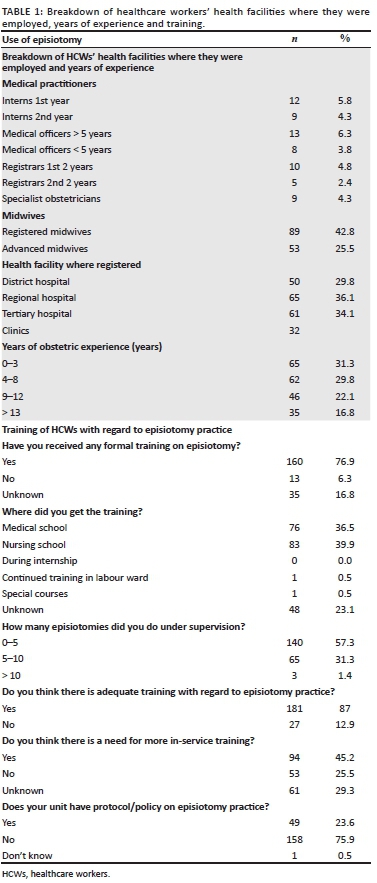
All 208 obstetricians and midwives who provide delivery care at Greys hospital, Edendale hospital, Northdale hospital and clinics with delivery units were eligible to complete a questionnaire about their perception and knowledge towards episiotomy use. The response rate was 100% (208/208). Two hundred and eight HCWs participated in the study, 66 HCWs (31.7%) were medical practitioners, which included interns, medical officers, registrars and specialist obstetricians, and 142 HCWs (68.3%) were midwives, which included advanced and registered midwives with different durations of experience in obstetrics. Most participants were female with up to 8 years of experience in providing maternity care. Their years of obstetric experience ranged from 0 to 3 years to > 13 years with the majority (31.3%) having 0-3 years of experience (Table 1).
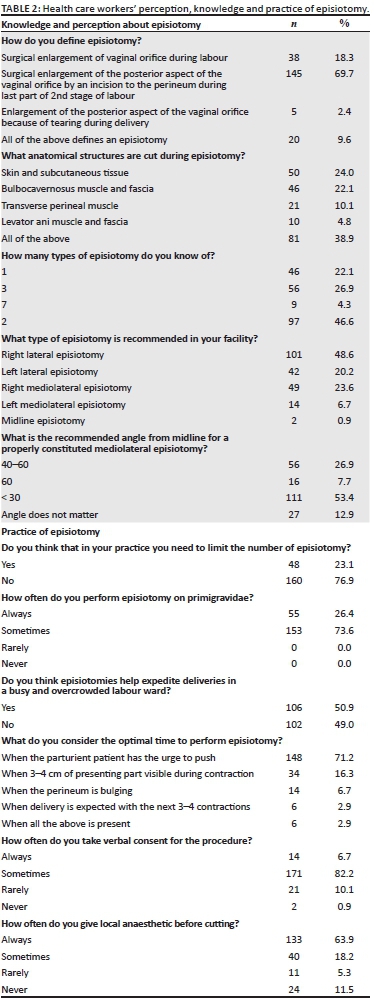
A total of 69.7% of the participants, including 30.3% of the medical doctors, defined episiotomy as surgical enlargement of the posterior aspect of the vaginal orifice by an incision to the perineum during the expulsive phase of the 2nd stage of labour. More than 60% (67.3%) of the HCWs had performed at least 5 episiotomies under supervision. The majority (75.9%) of HCWs stated that their obstetric unit did not have a protocol or policy on episiotomy practice. When asked to pinpoint the most important obstacle to reducing episiotomy rates, both medical practitioners and midwives reported lack of training (Table 1 and Table 2).
The knowledge of HCWs regarding the episiotomy procedure varied, with only 38.9% being able to identify all the structures that are incised during the procedure. Knowledge about different types of episiotomy was poor, with 48.6% of HCWs responding that the right lateral episiotomy was recommended at their centre. More than 50% of the HCWs stated that less than 30 degree from the midline is the recommended angle for a properly constituted mediolateral episiotomy (Table 2).
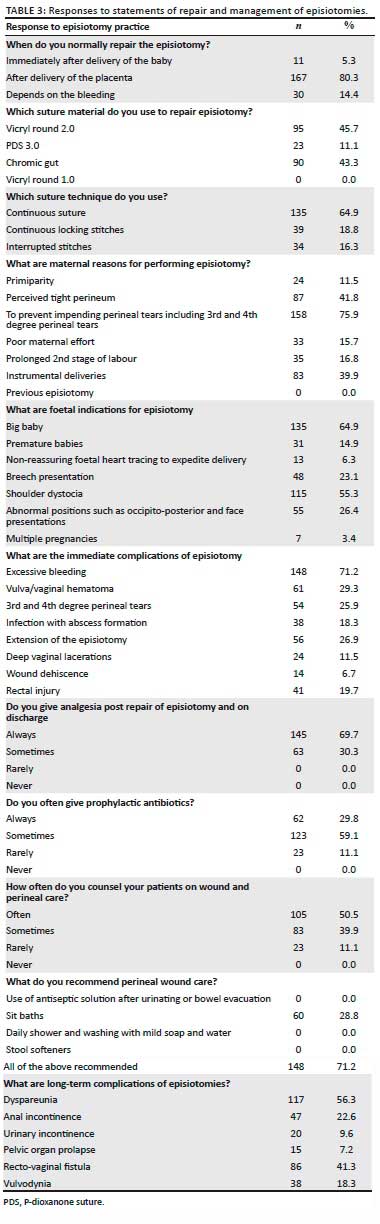
Episiotomies were not routine on primigravidae but performed sometimes by 73.6% of the HCWs. More than 50% of the HCWs responded that episiotomies help expedite deliveries in a busy and overcrowded labour ward. The majority (71.2%) of HCWs responded that the parturient's urge to push was the optimal time to perform episiotomy. The response to taking verbal consent for the procedure varied from never to always, but most HCWs (82.2%) would sometimes take verbal consent with 63.9% of HCWs administering local anaesthetic prior to the procedure. Aiming to reduce 3rd - 4th degree perineal tears was the most commonly identified reason for performing an episiotomy by both medical practitioners and midwives. The second most frequent main reason for performing episiotomies reported by medical practitioners was operative delivery, but this was infrequently reported as a main reason by midwives who do not perform operative deliveries, whilst 64.9% considered a big baby as the foetal indication. The majority (69.7%) of HCWs would give analgesia post-repair of episiotomy, and on discharge, 59.1% would sometimes give prophylactic antibiotics and 50.5% would counsel patients on wound and perineal care post-episiotomy, whilst 71.2% would follow all recommendations stated in the guidelines (Table 3).
Discussion
In this study, we sought to describe the perception knowledge and practice of medical practitioners and midwives regarding episiotomy use in the greater Pietermaritzburg area. We found that medical practitioners and midwives differ with regard to perception and knowledge towards episiotomy. The use of our classification of medical practitioners and midwives makes it possible to distinguish episiotomy practices amongst these HCWs.
There are many different opinions in the literature about using episiotomy restrictively or routinely. The repeated Cochrane collaboration meta-analysis of randomised controlled trials together1,8 with the American College of Obstetricians and Gynaecologists,111213141011
Whilst the current local and international consensus favours a restrictive episiotomy policy,1415
In our study, a majority of HCWs felt that there was no need to limit the number of episiotomies. Another recent study reported that 35.4% of the midwives and 44.4% of the obstetricians agreed with the expression 'that episiotomy should be performed routinely at every birth'.161717181917
In our study, 51% of HCWs thought that episiotomy helped expedite deliveries but did not show a preference for suturing episiotomy rather than irregular large tears. Celibi and Guler in their study in 2018 found that the vast majority of HCWs did not see a need to take consent when performing an episiotomy.15
Earlier studies on the effects of episiotomy do not specify the type of episiotomy and mediolateral episiotomies are mainly preferred in Europe although lateral episiotomies are used in Finland.18,19,20 Our findings show that the most common type of episiotomy practised was right lateral episiotomy, and the SA maternity guidelines recommend mediolateral type. In our study, 53.4% of HCWs obtained the angle at which they will perform the episiotomy wrong, with 48.6% performing right lateral episiotomies compared to only 23.6% who were performing right mediolateral episiotomy. It is evident that there is confusion about mediolateral and lateral episiotomies in clinical practice.21,22 Additional research comparing mediolateral with lateral episiotomies to avert the confusion in clinical practice is needed. A survey from Nordic countries showed that the majority of obstetricians opted to perform a lateral episiotomy, but 64% called it a mediolateral episiotomy.23
Concerns about 3rd - 4th degree tears were both the most commonly reported reason and the primary reason for episiotomy for both medical practitioners and midwives and lack of training in delivering women with an intact perineum was reported as a major obstacle to reducing episiotomy rates.
In our study, there were variations in responses to several statements on episiotomy practice by HCWs based on their level of experience. Significantly, more medical practitioners felt that there was a need for more in-service training and the need to increase the number of episiotomies performed under supervision. Similarly, wide variations in episiotomy practice exist around the world as an expression of the difference in routine episiotomy use between countries and within countries and amongst midwives and obstetricians with the same level of experience in obstetric care.24,25
In addition, our study showed that episiotomy indications were subjective, not consistent with international practice guidelines,2026,27 and dependent on the type of obstetrical staff involved.2720
The implementation of evidence-based practices remains a significant challenge that requires comprehensive approaches at different levels.28,29 As shown by Althabe et al. reducing a common practice such as episiotomy is difficult.30
The main limitation of this study was the small number of HCWs included in the study and the relatively small numbers of each subgroup surveyed means that the study was not adequately powered to allow us to be certain that such differences do not exist (a beta error). A larger study would be required to confirm this. Self-assessment does not always reflect well on actual knowledge and ability.
Conclusion
Healthcare workers in our low- and middle-income setting displayed poor knowledge about the practice of episiotomy and were not aware of the Republic of South Africa (RSA) existing national guidelines on episiotomy practice. The findings in our study are in line with studies carried out in other centres, including those in high-income countries.
Recommendations
Routine episiotomies are no longer recommended. Still, the procedure is sometimes needed. It is mandatory that HCWs need to be familiar with existing RSA guidelines on episiotomy practice.
Competing interests
The authors declare that they have no financial or personal relationships which may have inappropriately influenced them in writing this article.
Authors' contributions
C.M.M. and T.D.N. contributed to the design and implementation of the research, to the analysis of the results and to the writing of the manuscript.
Funding information
This research received no specific grant from any funding agency in the public, commercial or not-for-profit sectors.
Data availability
Data sharing is not applicable to this article as no new data were created or analysed in this study.
Disclaimer
The views and opinions expressed in this article are those of the authors and do not necessarily reflect the official policy or position of any affiliated agency of the authors.
Acknowledgements
The authors would like to acknowledge all healthcare workers who participated in this questionnaire-based study and the statistician for data analysis.
References
-
1. Carroli G, Mignini L. Episiotomy for vaginal birth. Cochrane Database Syst Rev. 2009;(1):CD000081. https://doi.org/10.1002/14651858.CD000081.pub2
» https://doi.org/10.1002/14651858.CD000081.pub2 -
2. Goueslard K, Cottenet J, Roussot A, et al. How did episiotomy rates change from 2007 to 2014? Population-based study in France. BMC Pregnancy Childbirth. 2018;18:208. https://doi.org/10.1186/s12884-018-1747-1748
» https://doi.org/10.1186/s12884-018-1747-1748 -
3. Piro SS, Ahmed HM. Midwives' perspectives regarding episiotomy practice in Kurdistan region/Iraq. Zanco J Med Sci. 2016;20(1):1233-1240. https://doi.org/10.15218/zjms.2016.0014
» https://doi.org/10.15218/zjms.2016.0014 -
4. He S, Jiang H, Qian X, et al. Women's experience of episiotomy: A qualitative study from China. BMJ Open. 2020;10:e033354. https://doi.org/10.1136/bmjopen-2019-033354
» https://doi.org/10.1136/bmjopen-2019-033354 -
5. Kartal B, Kızılırmak A, Calpbinici P, et al. Retrospective analysis of episiotomy prevalence. J Turk Ger Gynecol Assoc. 2017;18(4):190-194. https://doi.org/10.4274/jtgga.2016.0238
» https://doi.org/10.4274/jtgga.2016.0238 -
6. Oluwasola TAO, Folasade A. Knowledge and perception of pregnant women to episiotomy in Ibadan. J Basic Clin Reprod Sci. 2017;6(2):1-5. https://doi.org/10.4103/2278-960X.194508
» https://doi.org/10.4103/2278-960X.194508 -
7. Zaidan A, Hindi M, Bishara A, et al. The awareness regarding the episiotomy procedure among women in Saudi Arabia. Mater Sociomed. 2018;30(3):193-197. https://doi.org/10.5455/msm.2018.30.193-197
» https://doi.org/10.5455/msm.2018.30.193-197 -
8. Jiang H, Qian X, Carroli G, et al. Selective versus routine use of episiotomy for vaginal birth. Cochrane Syst Rev. 2017;(2):CD000081. https://doi.org/10.1002/14651858.CD000081.pub3
» https://doi.org/10.1002/14651858.CD000081.pub3 - 9. World Health Organization. WHO recommendation on episiotomy policy. Geneva: World Health Organization 2018.
- 10. World Health Organization. WHO recommendations: Intrapartum care for a positive childbirth experience. Geneva: World Health Organization, 2018; p. 150-155.
-
11. American College of Obstetricians and Gynaecologists. ACOG practice bulletin: Episiotomy. Clinical management guidelines for obstetrician-gynaecologists. Obstet Gynecol. 2006;107(4):957-962. https://doi.org/10.1097/00006250-200604000-00049
» https://doi.org/10.1097/00006250-200604000-00049 -
12. National Institute for Health and Care Excellence (NICE). Delay and complications in second stage of labour [homepage on the Internet]. 2015 [cited 2019 July]. Available from: pathways.nice.org.uk/pathways/intrapartum-care
» pathways.nice.org.uk/pathways/intrapartum-care -
13. Bergendahl S, Ankarcrona V, Leijonhufvud Å, et al. Lateral episiotomy versus no episiotomy to reduce obstetric anal sphincter injury in vacuum-assisted delivery in nulliparous women: Study protocol on a randomised controlled trial. BMJ Open. 2019;9:e025050. https://doi.org/10.1136/bmjopen-2018-025050
» https://doi.org/10.1136/bmjopen-2018-025050 -
14. South African maternity care guidelines [homepage on the Internet]. National Department of Health; 2019 [cited 2019 July]. Available from: https://www.knowledgehub.org.za/elibrary/guidelines-maternity-care-south-africa
» https://www.knowledgehub.org.za/elibrary/guidelines-maternity-care-south-africa -
15. Borghi J, Fox-Rushby J, Bergel E, et al. The cost-effectiveness of routine versus restrictive episiotomy in Argentina. Am J Obstet Gynecol. 2002;186(2):221-228. https://doi.org/10.1067/mob.2002.119632
» https://doi.org/10.1067/mob.2002.119632 -
16. Celebi N, Guler H. Opinions of midwives and obstetricians about the episiotomy. IOSR J Nurs Health Sci (IOSR-JNHS). 2018;7(3):41-47. https://doi.org/10.9790/1959-0703014147
» https://doi.org/10.9790/1959-0703014147 -
17. Diniz SG, Chacham AS. 'The cut above' and 'the cut below': The abuse of caesareans and episiotomy in São Paulo, Brazil. Reprod Health Matters. 2004;12(23):100-110. https://doi.org/10.1016/S0968-8080(04)23112-3
» https://doi.org/10.1016/S0968-8080(04)23112-3 -
18. Ith P, Dawson A, Homer C. Quality of maternity care practices of skilled birth attendants in Cambodia Int J Evid Based Healthc. 2012;10(1):60-67. https://doi.org/10.1111/j.1744-1609.2012.00254.x
» https://doi.org/10.1111/j.1744-1609.2012.00254.x -
19. Schantz C, Sim KL, Ly EM, et al. Reasons for routine episiotomy: A mixed-methods study in a large maternity hospital in Phnom Penh, Cambodia. Reprod Health Matters. 2015;23(45):68-77. https://doi.org/10.1016/j.rhm.2015.06.012
» https://doi.org/10.1016/j.rhm.2015.06.012 -
20. Blondel B, Alexander S, Bjarnadóttir RI, et al. Variations in rates of severe perineal tears and episiotomies in 20 European countries: A study based on routine national data in Euro-Peristat project. Acta Obstet Gynecol Scand. 2016;95(7):746-754. https://doi.org/10.1111/aogs.12894
» https://doi.org/10.1111/aogs.12894 -
21. Räisänen SH, Vehviläinen-Julkunen K, Gissler M, et al. Lateral episiotomy protects primiparous but not multiparous women from obstetric anal sphincter rupture. Acta Obstet Gynecol Scand. 2009;88(12):1365-1372. https://doi.org/10.3109/00016340903295626
» https://doi.org/10.3109/00016340903295626 -
22. Murphy DJ, Macleod M, Bahl R, et al. A randomised controlled trial of routine versus restrictive use of episiotomy at operative vaginal delivery: A multicentre pilot study. Br J Obstet Gynecol. 2008;115(13):1695-1703. https://doi.org/10.1111/j.1471-0528.2008.01960.x
» https://doi.org/10.1111/j.1471-0528.2008.01960.x -
23. Tincello DG, Williams A, Fowler GE, et al. Differences in episiotomy technique between midwives and doctors. Br J Obstet Gynecol. 2003;110(12):1041-1044. https://doi.org/10.1111/j.1471-0528.2003.03030.x
» https://doi.org/10.1111/j.1471-0528.2003.03030.x -
24. Lund NS, Persson LK, Jangö H, et al. Episiotomy in vacuum-assisted delivery affects the risk of obstetric anal sphincter injury: A systematic review and meta-analysis. Euro J Obstet Gynecol Reprod Biol. 2016;207:193-199. https://doi.org/10.1016/j.ejogrb.2016.10.013
» https://doi.org/10.1016/j.ejogrb.2016.10.013 -
25. Clesse C, Lighezzolo-Alnot J, De Lavergne S, et al. Statistical trends of episiotomy around the world: Comparative systematic review of changing practices. Health Care Women Int. 2018;39(6):644-662. https://doi.org/10.1080/07399332.2018.1445253
» https://doi.org/10.1080/07399332.2018.1445253 -
26. Sagi-Dain L, Sagi S. Indications for episiotomy performance - A cross-sectional survey and review of the literature. J Obstet Gynaecol. 2016;36(3):361-365. https://doi.org/10.3109/01443615.2015.1065233
» https://doi.org/10.3109/01443615.2015.1065233 -
27. Raisanen S, Vehvilainen-Julkunen K, Gisler M, et al. A population-based register study to determine indications for episiotomy in Finland. Int J Gynaecol Obstet. 2011;115(1):26-30. https://doi.org/10.1016/j.ijgo.2011.05.008
» https://doi.org/10.1016/j.ijgo.2011.05.008 -
28. Zimmo K, Laine K, Fosse E, et al. Episiotomy practice in six Palestinian hospitals: A population-based cohort study among singleton vaginal births. BMJ Open. 2018;8(7):e021629 https://doi.org/10.1136/bmjopen-2018-021629
» https://doi.org/10.1136/bmjopen-2018-021629 -
29. Grol R, Grimshaw J. From best evidence to best practice: Effective implementation of change in patients' care. Lancet. 2003;362(9391):1225-1230. https://doi.org/10.1016/S0140-6736(03)14546-1
» https://doi.org/10.1016/S0140-6736(03)14546-1 -
30. Althabe F, Buekens P, Bergel E, et al. A behavioral intervention to improve obstetrical care. N Engl J Med. 2008;358(18):1929-1940. https://doi.org/10.1056/NEJMsa071456
» https://doi.org/10.1056/NEJMsa071456

Accepted: 04 Feb. 2021
Published: 28 Apr. 2021