Exploring cancer knowledge and sources of information among the public: An analytical study
Abstract
BACKGROUND: Malawi faces a heavy cancer burden because of high incidence and late-stage diagnoses, largely driven by low public awareness of cancer risk factors and early warning signs AIM: This study aimed to explore the cancer knowledge of cancer risk factors and early warning signs, and sources of information among the public SETTING: This study was conducted in four districts within the Southern Region of Malawi METHODS: The study used a cross-sectional approach to elicit knowledge of cancer and sources of cancer information among a sample of 305 participants. Data were collected using a previously standardised Cancer Awareness Measure (CAM). Statistical data analyses were conducted using IBM® SPSS® statistics version 22 RESULTS: Awareness of cancer risk factors and early warning signs was found to be low, indicating a significant lack of public knowledge about cancer. The radio emerged as the most common medium of cancer information through which Malawians receive cancer information, followed by clinics and hospitals. Interestingly, many individuals perceived clinics - not the radio - as the primary source where they gained a clearer understanding of cancer information CONCLUSION: The study concludes that public knowledge of cancer in Southern Malawi is low and although radio is the main information source, clinics are more effective because of expert guidance CONTRIBUTION: This study identifies critical gaps in cancer awareness and understanding in Malawi, highlighting the need for improved and targeted communication strategies, particularly among vulnerable populations
cancer; knowledge; communication; risk factors; early warning signs
Introduction
Cancer is one of the leading killer diseases in the world and it kills more people in sub-Saharan Africa than HIV/AIDS, tuberculosis and malaria combined.123456,7
Knowledge of cancer risk factors is an important aspect in developing cancer risk perceptions and influencing the participation of health protection behaviours such as cancer screening, avoiding smoking and following a low-fat, high-fibre diet.8910,11
For people to be aware of cancer and its risk factors, they need to be exposed to relevant information that can influence them to take action towards their health protection. Health information does not always need to be generated and exchanged in clinics and hospitals. Other channels such as the radio, TV and schools are equally vital for health education and promotion. Research shows that mass media plays an essential role in influencing the public's awareness and perception of cancer.12413,14159
To our knowledge, studies addressing the awareness of cancer risk factors, early warning signs and sources of information in Malawi appear to be rare. Most previous relevant studies concentrated on either cancer awareness,610,1116,171819
Research methods and design
Study design, aim and objectives
The study employed a quantitative cross-sectional approach to assess public knowledge of cancer risk factors and early warning signs, as well as the sources of cancer information in Malawi.
Setting
The study was conducted in the southern region of Malawi and the four chosen districts were Blantyre, a commercial city and three other rural districts, namely, Chikwawa, Thyolo and Chiradzulu. The southern region was particularly selected for this research because it registered the highest cancer incidence in a nationwide cancer registry.17
Study population and sampling strategy
The study population consisted of all men and women, aged 15 and older, not diagnosed with any type of cancer. A systematic random sampling approach was used to identify a heterogeneous sample of 310 participants (154 from Blantyre and 156 participants from the three rural districts - approximately 52 participants from each district) to participate in the survey.
Data collection
For data collection, previously standardised and published Cancer Awareness Measure (CAM) with an overall internal reliability of Cronbach's alpha 0.7720
Data analysis
Statistical data analyses were conducted using IBM® SPSS® statistics version 22. Before the data analysis, the collected data were screened for accuracy and missing values. To ensure the instruments' internal consistency on the current sample, reliability analysis using Cronbach's alpha was calculated and reported. Pearson correlations were calculated to establish the association between variables assessed in the study. Descriptive statistics for all the tested variables were realised and tabulated from raw data. To test if there were disparities in the studied variables between and among population sub-groups, independent samples t-test, Chi-square and the Analysis of Variance (ANOVA) were used (p < 0.05).
Ethical considerations
Before the survey was conducted, the research protocol adhered to key ethical standards aimed at safeguarding participants' lives, privacy, and confidentiality. Ethical clearance to conduct this study was obtained from the Ministry of Health and Population, National Health Sciences Research Committee (NHSRC) (No. 1881). Authorisation to carry out the study in Blantyre, Thyolo, Chikwawa, and Chiradzulu districts was granted by the respective District Commissioners and Traditional Chiefs. Verbal and written informed consent were secured from all participants. To ensure anonymity, no identifying personal information was collected during the study. Due to the limited cancer-related vocabulary in the local language and the participants' likely unfamiliarity with cancer terms, trained interviewers, guided by Oncology professionals, administered the questionnaire and helped clarify complex terms and expressions.
Results
Out of a sample of 310, only 5 respondents (1.6%) indicated that they had never ever heard about cancer and were excluded from the survey. A total number of 305 southern region residents participated in this study and they all completed the survey. There was a good balance between male (n = 143) and female (n = 162) participants, and those from urban (n = 154) and rural (n = 151) areas. Regarding the age-range, the majority were young participants (15-30 years n = 137; 31-40 years n = 97; 41-50 n = 42; 51 and above n = 29). Concerning marital status, the majority were married (n = 169), seconded by those who were single (n = 87), followed by divorced (n = 28) and widowed (n = 21). On education status, the majority were those with secondary education (n = 116), then tertiary (87), primary (n = 81) and none (n = 21). Regarding employment status, most participants were self-employed (n = 110), followed by unemployed (n = 84), employed (n = 73) and students (n = 38). The CAM demonstrated good internal reliability, with a Cronbach's alpha of 0.72.
Knowledge of cancer's early warning signs and risk factors
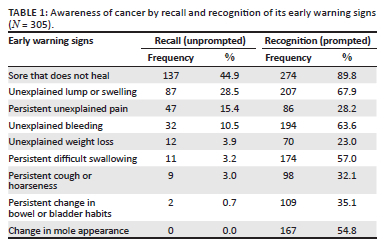
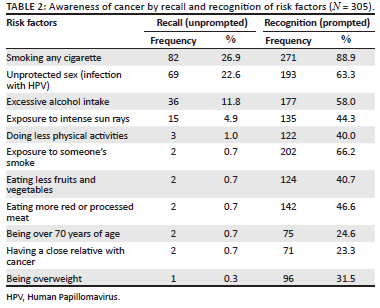
Responses to the open (recall) and closed (recognition) questions about early warning signs and risk factors are shown separately in Table 1 and Table 2. In the recall (unprompted) format, where respondents were asked to recall their knowledge of cancer, few respondents were able to mention common early warning signs and risk factors of cancer. For instance, some items were mentioned by far fewer respondents as in the case of 'persistent change in bowel or bladder habits' (0.7%), and others, no respondent mentioned as in the case of 'change in mole appearance' (0.0%). In the recognition (prompted) format, where respondents were asked to recognise a given common early warning sign and risk factor of cancer, respondents' recognition was higher than recall, as expected.
To test if there were significant differences between the total mean number of early warning signs and risk factors on recall and recognition, one-way repeated measures of ANOVA were used. Using the uncorrected results denoted as 'Sphericity Assumed', the F-test results indicate that early warning signs and risk factors were not recalled equally (F[1304] = 40.65, p < 0.001), which indicates that the total mean number of early warning signs (M = 1.10) was significantly higher than risk factors (M = 0.71). The F-test results also show that early warning signs and risk factors were not recognised equally (F[1304] = 28.83, p < 0.001); the total mean number of risk factors (M = 5.27) was significantly higher than early warning signs (M = 4.52).
Demographic differences in cancer knowledge
Chi-square (χ2222p < 0.01) with ages of 41-50 (85.7%) recalling it the most.
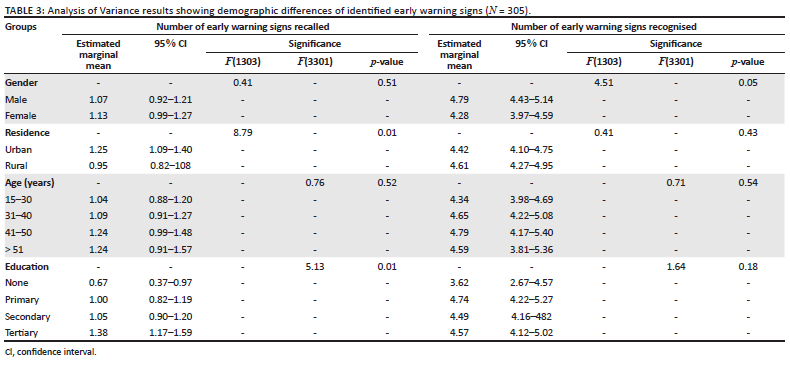
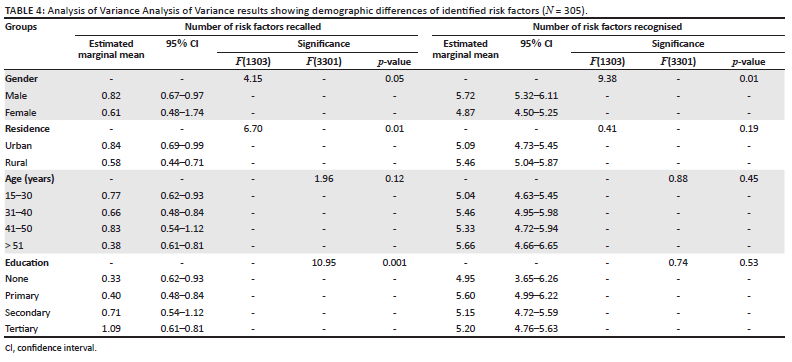
To assess how different sub-groups recalled and recognised early warning signs and risk factors of cancer in total, a one-way ANOVA was used. Analysis of Variance results regarding recall of early warning signs revealed that there were significant differences within categories of residence (F[1303] = 8.79, p < 0.01) and education (F[3301] = 5.13, p < 0.01). Urban residents (M = 1.25) and participants with tertiary education (M = 1.38) recalled more early warning signs than their rural residents (M = 0.95) and those with either no or low formal education (none [M = 0.67]; primary [M = 1.00]; secondary [M = 1.05]), respectively. Similarly, concerning the recall of risk factors, there were significant differences within categories of gender (F[1303] = 4.15, p < 0.05), residence (F[1303] = 6.70, p < 0.01) and education (F[3301] = 10.95, p < 0.001). Male participants (M = 0.82), urban residents (M = 0.84) and participants with tertiary education (M = 1.09) mentioned more risk factors than female participants (M = 0.61), rural residents (M = 0.58) and those with either no or low formal education (none [M = 0.33]; primary [M = 0.40]; secondary [M = 0.71]), respectively. Table 3 and Table 4 show ANOVA results in detail, focusing on demographic differences in cancer awareness by recall and recognition of its early warning signs and risk factors.
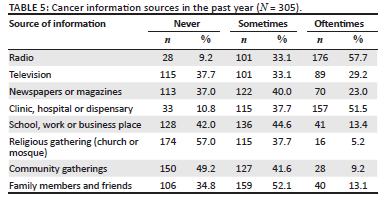
During closed-ended questions, respondents were asked to endorse where and how often they get cancer information, and the responses are shown in Table 5. The most commonly endorsed source of cancer information where respondents 'oftentimes' get cancer information was the radio (57.7%) seconded by clinics, hospitals or dispensaries (operationally defined here as 'the clinic'; 51.5%). The least-endorsed source of information was religious gathering (5.2%). Chi-square results, especially on the commonly accessed sources of cancer information, namely the radio and the clinic, revealed that there were no significant differences between demographic subgroups with regard to the radio. However, a significant difference was noticed regarding the clinic, χ2p = 0.05, with 56.2% females accessing it against 46.2% males.
Using an open-ended question, respondents were also asked to indicate the source from which they thought they understood most of the information, and provide the reasons. The most-endorsed source was the clinic with 53.8%, followed by the radio with 25.9%. Other sources, such as family and friends, and religious gatherings were the least mentioned with lower endorsement of 2.3% and 1.3%, respectively. Regardless of the source of information, the most cited reasons, which aided their better understanding were 'clear explanations' (32.1%) and 'health experts speaking' (25.2%). Other reasons such as 'availability of the medium' (17%), 'freedom to ask questions' (10.2%) and 'availability of illustrations and testimonies' (7.5%) were also mentioned, but by a few participants. Cross-tabulation results showed that for the clinic alone, the most frequent reasons participants cited were 'health experts speaking' (40.9%) and 'clear explanations' (29.9%); and for the radio alone, the most frequent reasons respondents mentioned were 'availability of the medium' (39.2%). Especially on the radio, the majority (71%) of participants described the messages as very brief and monotonous; the radio keeps on broadcasting the same messages with little substance in it.
Discussion
In cancer care, health communication is essential for prevention, early detection, psychological support, treatment guidance and end-of-life care. This study investigated the awareness of cancer risk factors and early warning signs, and sources of information among the general public in Malawi. Results of the study revealed that there is low awareness of risk factors and early warning signs. Especially with the open-ended questions (recall format), scores were relatively poor for all risk factors (0.3% < 27%) and all early warning signs (0.00% < 29%) except for 'a sore that does not heal', which was recalled by only 44.9% of the respondents. However, recognition scores of risk factors and early warning signs were higher with 'smoking any cigarette' (a risk factor) and 'a sore that does not heal' (an early warning sign) being identified by 88.9% and 89.8% of the respondents, respectively. Interestingly, even in the recognition format, most respondents were able to recognise only three to four early warning signs or risk factors. This study postulates a strong indication that there is limited knowledge of cancer among the general public in Malawi. These results have significant implications given the high incidence of cancer in the country.
Concerning the limited knowledge, our findings support previous related studies conducted in Malawi,21,2223,2425,2617,21,22191927
Differences between some demographic groups were noticed, highlighting particular gaps in awareness. According to the IM theory, these demographic factors affect cancer awareness and influence behaviour. The findings suggest that cognitive models of cancer, and especially the understanding of early warning signs and risk factors, may vary between groups, possibly because of the different demographic attributes that exist among groups. However, it should also be observed that these differences between groups do overlap because, for instance, one participant might be male, educated and may live in an urban area. Regarding education status, consistent with other studies,28,2930
Place of residence and gender were also noticed to influence participants' cancer knowledge. Regarding place of residence, poorer knowledge was observed for participants living in rural areas. Urban residents might have taken advantage of the wide variety of communication media, such as newspapers and TV, to advance their cancer knowledge. People in rural settings are what Kreps4,92531
Concerning cancer information sources, findings indicate that the radio is the most common source of cancer information for most Malawians, followed by the clinic. This trend is consistent across both rural and urban areas, highlighting the radio's widespread reach because of its portability, simplicity and low cost, especially in regions with unreliable electricity. Several studies15,32,3328,34
Interestingly, while the radio is widely used, people find the clinic to be more effective for understanding health information because of the presence of health experts and clear explanations. Research28,34,3536,374
Findings from this research provide empirical evidence on the centrality of health communication in cancer prevention and highlight the need for strategic awareness communication, which, according to Kreps,4,999
Limitations
There are a few constraints of this study and conclusions drawn from this analysis must be interpreted with some considerations of the highlighted limitations. To begin with, the findings of this study are based on survey interviews from four districts of Blantyre, Chikwawa, Thyolo and Chiradzulu, all located in the Southern Region of the country. Because of the large target study population for the study (the public), the sample recruited in this study, therefore, may not adequately represent the larger population (nationwide). The country has diverse demographic factors, such as culture among different regions. Therefore, the interpretation of the findings from the study may be limited to the southern region from which data were gathered. The research process and design used for the study, however, may still provide a framework for understanding, exploring, and fostering cancer communication in other contexts. Future comprehensive studies need to concentrate on a nationwide sampling that may be fully representative of the entire country on the general public's level of cancer knowledge and where they get cancer information.
Furthermore, this was a cross-sectional study, where data were collected and analysed at one point in time. This means that because of its cross-sectional nature, the study did not investigate whether cancer awareness and health behaviours change over time. As individuals are dynamic, their attitudes, beliefs and behaviours towards their health and well-being may change over time. Future studies should aim at investigating the stability of the general public regarding what they know about cancer and their sources of information. Finally, another key limitation of this study is that it focused solely on measuring cancer awareness using the CAM without assessing attitudes and behaviours related to cancer prevention and early detection (CAM-Plus). As a result, the findings provide insights into knowledge levels but do not capture whether awareness translates into proactive health-seeking behaviours or changes in perception. Future research should incorporate CAM-Plus to explore the relationship between awareness, attitudes and behaviours, providing a more comprehensive understanding of cancer-prevention efforts.
Recommendations
To address the low public awareness of cancer risk factors and early warning signs in Malawi, targeted interventions should be implemented through awareness campaigns, community engagement and policy enhancements. Awareness campaigns should leverage radio as the most widely accessed information source, and social media and mobile-based messaging (for the younger demographics), incorporating interactive discussions, expert interviews and survivor testimonies to enhance public understanding. Community engagement should be strengthened through health outreach programmes using clinics, hospitals, community health workers, schools, religious institutions and local leaders, to provide face-to-face education to dispel myths and encourage early screening. At the policy level, cancer awareness should be integrated into national health education programmes, and healthcare workers should receive training in effective cancer communication. In addition, the government should establish community-based cancer screening initiatives and strengthen partnerships with Non-governmental organisations (NGOs) and international health agencies to secure sustainable funding for long-term awareness efforts. By implementing these recommendations, Malawi can improve public knowledge of cancer, promote early detection, and ultimately reduce its cancer burden.
Conclusion
This study offers significant insights for culturally relevant health promotion in Malawi, particularly regarding cancer awareness. The findings emphasise a critical need for clear, accessible cancer information to encourage informed health decisions and address widespread misconceptions. Public health professionals are responsible for providing comprehensive yet simplified information on cancer risk factors, symptoms and preventive measures, helping to demystify and destigmatise the topic, which is often associated with fear and confusion. Effective communication must consider the emotional impact of cancer information and aim to avoid causing fear or alienation among the public, particularly among vulnerable populations.
The study also highlights the role of radio and clinics in delivering cancer messages. With its broad reach, the radio should convey persuasive messages that motivate protective health behaviours, as current brief, repetitive messages lack impact. Meanwhile, clinics are identified as key sources of comprehensible information, where the presence of health professionals fosters trust and understanding. This underscores the value of healthcare professionals in health promotion, suggesting that both mass media and interpersonal channels should include expert involvement. Interactive programmes, such as radio call-ins, could further bridge the gap between providers and the public, enhancing message effectiveness and fostering consumer confidence in cancer prevention.
Competing interests
The authors declare that they have no financial or personal relationships that may have inappropriately influenced them in writing this article.
Authors' contributions
F.F.N., led the project's conceptualisation, methodology, formal analysis, project management, supervision and visualisation, as well as writing the original draft. L.K. contributed to the conceptualisation, methodology, investigation, review and editing. W.K., participated in validation, investigation, original draft writing, review and editing. J.M. contributed to the formal analysis, investigation and visualisation.
Funding information
This research received no specific grant from any funding agency in the public, commercial or not-for-profit sectors.
Data availability
The data sets generated and analysed during the study are available from the corresponding author, F.F.N. upon reasonable request.
Disclaimer
The views and opinions expressed in this article are those of the authors and do not necessarily reflect the official policy or position of any affiliated agency of the authors. The authors are responsible for this article's results, findings, and content.
Acknowledgements
This research was made possible through the invaluable support of the District Commissioners (DCs) and Traditional Chiefs (TC) in the districts of Blantyre, Thyolo, Chikwawa and Chiradzulu who permitted us to conduct this study. The authors are deeply grateful to the participants in these districts who generously consented to participate in interviews, sharing their experiences and insights, which greatly contributed to the findings of this study.
References
- 1. Mansson J. The role of communication in cancer consultations: An exploratory study of doctor-patient-family caregiver communication in Uganda and Ethiopia. Master's thesis. University of Gothenburg; 2015.
-
2. The World Bank. Malawi data [homepage on the Internet]. The World Bank; 2023 [cited 2024 Jul]. Available from: https://data.worldbank.org/country/malawi
» https://data.worldbank.org/country/malawi -
3. Nzangaya A. Companies encouraged to support the Malawi Cancer Unit at QECH [homepage on the Internet]. Malawi24; 2024 [cited 2024 Jun]. Available from: https://malawi24.com/2024/04/30/companies-encouraged-to-support-the-malawi-cancer-unit-at-qech/
» https://malawi24.com/2024/04/30/companies-encouraged-to-support-the-malawi-cancer-unit-at-qech/ -
4. Kreps GL. Strategic use of communication to market cancer prevention and control to vulnerable populations. Health Mark Q. 2008;25(1-2):204-216. https://doi.org/10.1080/07359680802126327
» https://doi.org/10.1080/07359680802126327 -
5. Petersen PE. Oral cancer prevention and control - The approach of the World Health Organization. Oral Oncol. 2009;45:454-460. https://doi.org/10.1016/j.oraloncology.2008.05.023
» https://doi.org/10.1016/j.oraloncology.2008.05.023 -
6. Ngwira FF, Zuo B, Mkandawire J, Kondowe W. Cancer awareness in Malawi: A comprehensive analysis of news coverage on mass media. Adv J Commun. 2020;8(4):117-130. https://doi.org/10.4236/ajc.2020.84009
» https://doi.org/10.4236/ajc.2020.84009 -
7. Phiri L, Li WHC, Phiri PGMC, et al. Experiences of caregivers of children with cancer in Malawi: A qualitative study. Cancer Med. 2024;13(2):e6963. https://doi.org/10.1002/cam4.6963
» https://doi.org/10.1002/cam4.6963 -
8. Kreps GL. The impact of communication on cancer risk incidence, morbidity, mortality, and quality of life. Health Commun. 2003;15:161-169. https://doi.org/10.1207/S15327027HC1502_4
» https://doi.org/10.1207/S15327027HC1502_4 - 9. Kreps GL. Strategic communication for cancer prevention and control: Reaching and influencing vulnerable audiences. In: Georgakilas AG, editor. Cancer prevention - From mechanisms to translational benefits. London: InTech; 2012.
-
10. Chirwa GC. Explaining socioeconomic inequality in cervical cancer screening uptake in Malawi. BMC Public Health. 2022;22:1376. https://doi.org/10.1186/s12889-022-13750-4
» https://doi.org/10.1186/s12889-022-13750-4 -
11. Kamanga P, Zhang B, Stones W. Factors associated with low utilisation of cervical cancer screening among urban women in Lilongwe, Malawi: A cross-sectional study. BMC Womens Health. 2023;23:183. https://doi.org/10.1186/s12905-023-02324-0
» https://doi.org/10.1186/s12905-023-02324-0 -
12. Aggarwal A, Batura R, Sullivan R. The media and cancer: Education or entertainment? An ethnographic study of European cancer journalists. Ecancer. 2014;8:423. https://doi.org/10.3332/ecancer.2014.423
» https://doi.org/10.3332/ecancer.2014.423 -
13. Kreps GL, Sivaram R. Strategic health communication across the continuum of breast cancer care in limited-resource countries. Cancer. 2008;113(8):2331-2337. https://doi.org/10.1002/cncr.23832
» https://doi.org/10.1002/cncr.23832 -
14. Keller PA, Lehmann DR. Designing effective health communications: A meta-analysis. Am Mark Assoc. 2008;27(2):117-130. https://doi.org/10.1509/jppm.27.2.117
» https://doi.org/10.1509/jppm.27.2.117 -
15. Randolph W, Viswanath K. Lessons learned from public health mass media campaigns: Marketing health in a crowded media world. Ann Rev Public Health. 2004;25:419-437. https://doi.org/10.1146/annurev.publhealth.25.101802.123046
» https://doi.org/10.1146/annurev.publhealth.25.101802.123046 -
16. Moyo C, Dzamalala C, Chasimpha S, Parkin DM. Cancer incidence in Malawi: An analysis of population-based cancer registry data 2007-2017. Eur J Cancer Care (Engl). 2021;30(1):e13350. https://doi.org/10.1111/ecc.13350
» https://doi.org/10.1111/ecc.13350 -
17. Msyamboza K, Dzamalala C, Mdokwe C, et al. Burden of cancer in Malawi: Common types, incidence and trends. BMC Res Notes. 2012;5:149. https://doi.org/10.1186/1756-0500-5-149
» https://doi.org/10.1186/1756-0500-5-149 -
18. Mwafongo AA, Rosenberg NE, Ng'ambi W, et al. Treatment outcomes of AIDS-associated Kaposi's sarcoma under a routine antiretroviral therapy program in Lilongwe, Malawi: Bleomycin/Vincristine compared to Vincristine monotherapy. PLoS One. 2014;9(3):e91020. https://doi.org/10.1371/journal.pone.0091020
» https://doi.org/10.1371/journal.pone.0091020 -
19. Fishbein M, Yzer MC. Using theory to design effective health interventions. Commun Theor. 2003;13:164-183. https://doi.org/10.1111/j.1468-2885.2003.tb00287.x
» https://doi.org/10.1111/j.1468-2885.2003.tb00287.x -
20. Stubbings S, Robb K, Waller J, et al. Development of a measurement tool to assess public awareness of cancer. Br J Cancer. 2009;101:13-17. https://doi.org/10.1038/sj.bjc.6605385
» https://doi.org/10.1038/sj.bjc.6605385 -
21. Mkandawire J, Ngwira FF, Maseko FC. Knowledge of cervical cancer and prevalence of the screening services among HIV-infected women in Blantyre, Malawi. Health. 2020;12(11):1496-1510. https://doi.org/10.4236/health.2020.1211109
» https://doi.org/10.4236/health.2020.1211109 -
22. Msyamboza KP, Phiri T, Sichali W, Kwenda W, Kachale F. Cervical cancer screening uptake and challenges in Malawi from 2011 to 2015: A retrospective cohort study. BMC Public Health. 2016;16:806. https://doi.org/10.1186/s12889-016-3530-y
» https://doi.org/10.1186/s12889-016-3530-y -
23. Lingwood RJ, Boyle P, Milburn A, et al. The challenge of cancer control in Africa. Nat Rev Cancer. 2008;8:398-403. https://doi.org/10.1038/nrc2372
» https://doi.org/10.1038/nrc2372 -
24. Gyorki DE, Muyco A, Kushner AL, Brennan MF, Kingham TP. Cancer surgery in low-income countries. Arch Surg. 2012;147(12):1135-1140. https://doi.org/10.1001/archsurg.2012.1265
» https://doi.org/10.1001/archsurg.2012.1265 -
25. Robb K, Stubbings S, Ramirez A, et al. Public awareness of cancer in Britain: A population-based survey of adults. Br J Cancer. 2009;101(S2):18-23. https://doi.org/10.1038/sj.bjc.6605386
» https://doi.org/10.1038/sj.bjc.6605386 -
26. Waller J, Robb K, Stubbings S, et al. Awareness of cancer symptoms and anticipated help-seeking among ethnic minority groups in England. Br J Cancer. 2009;101(S2):24-30. https://doi.org/10.1038/sj.bjc.6605387
» https://doi.org/10.1038/sj.bjc.6605387 -
27. Ngwira FF, Zuo B, Mkandawire J, Kondowe W. Cancer awareness in Malawi: A comprehensive analysis of news coverage on mass media. Adv J Commun. 2020;8:117-130. https://doi.org/10.4236/ajc.2020.84009
» https://doi.org/10.4236/ajc.2020.84009 -
28. Abiodun OA, Fatungase OK, Awosile JO. An assessment of women's awareness and knowledge about cervical cancer and screening and the barriers to cervical screening in Ogun State, Nigeria. IOSR J Dent Med Sci. 2013;10(3):52-58. https://doi.org/10.9790/0853-1035258
» https://doi.org/10.9790/0853-1035258 - 29. Olivia M, Ramalivhana NJ, Augustine NPN, Maxwell M. Knowledge, attitudes and practices of HIV-infected women on cervical cancer screening at a church-affiliated hospital. IOSR J Dent Med Sci. 2016;15(4):119-126.
- 30. Peterson NB, Dwyer KA, Mulvaney SA, Dietrich MS, Rothman RL. The influence of health literacy on colorectal cancer screening knowledge, beliefs, and behaviour. J Natl Med Assoc. 2007;99(10):1105-1112.
-
31. Robertson S, Cassity E, Kunkwenzu E. Girls' primary and secondary education in Malawi: Sector review. Final report [homepage on the Internet]. 2017 [cited 2024 Jun]. Available from: https://research.acer.edu.au/cgi/viewcontent.cgi?article=1031&context=monitoring_learning
» https://research.acer.edu.au/cgi/viewcontent.cgi?article=1031&context=monitoring_learning - 32. Okorie N, Salawu A. Effective use of media awareness campaigns for breast cancer care among women: A comparative study. J Int Women's Stud. 2016;17(4):160-173
-
33. Jones KO, Denham BE, Springston JK. Effects of mass and interpersonal communication on breast cancer screening: Advancing agenda-setting theory in health contexts. J Appl Commun Res. 2006;34(1):94-113. https://doi.org/10.1080/00909880500420242
» https://doi.org/10.1080/00909880500420242 -
34. Belete N, Tsige YM. Willingness and acceptability of cervical cancer screening among women living with HIV/AIDS in Addis Ababa, Ethiopia: A cross-sectional study. Gynecol Oncol Res Pract. 2015;2:6. https://doi.org/10.1186/s40661-015-0012-3
» https://doi.org/10.1186/s40661-015-0012-3 -
35. Hami MY, Ehlers VJ, Van der Wal DM. Women's perceived susceptibility to and utilization of cervical cancer screening in Malawi. Health SA Gesondheid. 2014;19(1):1-8. https://doi.org/10.4102/hsag.v19i1.787
» https://doi.org/10.4102/hsag.v19i1.787 -
36. Catalán-Matamoros D. The role of mass media communication in public health. In: Smigorski K, editor. Health management - different approaches and solutions [homepage on the Internet]. InTech; 2011 [cited 2024 Apr]. Available from: http://www.intechopen.com/books/health-management-different-approaches-and-solutions/the-role-of-mass-media-communication-in-public-health
» http://www.intechopen.com/books/health-management-different-approaches-and-solutions/the-role-of-mass-media-communication-in-public-health -
37. Okorie N. Mass media strategies for creating awareness of breast cancer. Public Knowl J [serial online]. 2011 [cited 2024 Mar];3(1):1-18. Available from: https://repository.covenantuniversity.edu.ng/items/8169e6a7-5cee-4e64-8514-bc0cc3bbeb27
» https://repository.covenantuniversity.edu.ng/items/8169e6a7-5cee-4e64-8514-bc0cc3bbeb27

Accepted: 29 Apr. 2025
Published: 07 July 2025