Family medicine internship support during the COVID-19 pandemic in Cape Town, South Africa - A narrative report
Abstract
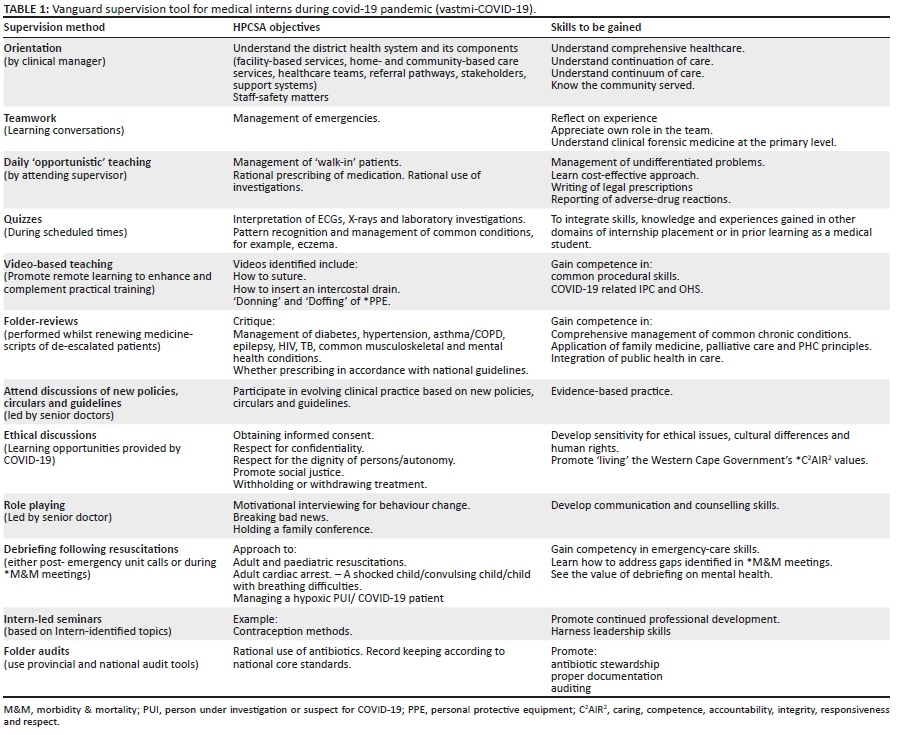
The health-service redesign that came with the preparation for the surge of COVID-19 had a potential of disrupting the Family Medicine internship programme like it did to many other health and academic programmes. A team of Cape-Town based Community Health Centre (CHC) doctors mitigated this challenge by designing an innovative tool that facilitated ongoing supervision of the interns in order to achieve the outcomes of the Health Professions Council of South Africa (HPCSA).
medical-interns; supervision; COVID-19; pandemic; Cape Town
Background
In South Africa (SA), internship of newly qualified medical doctors is considered part of medical training. It is a 2-year post that is followed by 1-year community service before doctors can work independently as general practitioners or follow the stream of training further in a specialty of their choice. Both internship and community-service are compulsory and are remunerated. The supervision of SA-medical interns during a Family Medicine rotation is based on the premise that the accredited training platforms have the capacity to expose interns to a full package of primary care services within a community.11
The COVID-19 surge became apparent in SA in March 2020. It necessitated significant service-redesign and a massive de-escalation of 'non-essential' services, for the purpose of increasing the capacity to manage patients and to improve infection control.
COVID-19 pandemic not with standing, a cadre of competent primary care clinicians is still going to be required to support the journey of SA towards Healthcare 2030234
Innovation
A team comprising of medical officers (experienced in rendering primary care), community-service doctors (who completed their internship at the end of 2019) and a Family Physician (well-versed in the primary-healthcare approach) participated in the development of the Vanguard Supervision Tool for Medical Interns (VaSTMI-COV19) using a modified Delphi approach. This approach is a communication process of experts over multiple rounds of deliberations, which allows them to reach a consensus about a framework they are developing. The participants started the process by examining the Health Professions Council of South Africa (HPCSA) logbook for the desired outcomes of training.1
Conclusion
Feedback from interns suggests that this alternative supervision method is enjoyable, promotes supportive relations between interns and supervisors and creates opportunities to learn from each other. Regarding supervisors, we observed some of their previously unknown strengths emerging organically during VaSTMI-COV19 led processes, with one colleague, for example, ending-up as a 'natural' training co-ordinator and another as an information-technology 'consultant'. The Covid-19 pandemic has afforded all healthcare workers to learn and 'figure out' new things together that are related to the pandemic, and the training tool facilitated that interns be part of that experience. A formal qualitative study will be required to assess whether this tool is able to produce 'good interns' with attributes described by De Villiers et al.5 We are hopeful that this tool will serve as a template that can be adjusted by others for use in their setting during this pandemic and perhaps beyond.
Competing interests
The authors have declared that no competing interest exists.
Authors' contributions
All authors contributed equally to this work.
Ethical consideration
This article followed all ethical standards for a research study without a direct contact with human or animal subjects.
Funding information
This research received no specific grant from any funding agency in the public, commercial or not-for-profit sectors.
Data availability statement
Data sharing is not applicable to this article as no new data were created or analysed in this study.
Disclaimer
The views and opinions expressed in this article are those of the authors and do not necessarily reflect the policy or position of any affiliated agency of the authors.
Acknowledgements
During the pilot phase, the tool was tested on the following Family-medicine interns (with interns giving feedback on the process and content): Timothy Adam, Jessica Barell, Nina Barell, Lina Hahle, Zahra Logday, Sambesini Mfenyana, Olga Lombard and Kayla Marshall.
References
-
1.Health Professions Council of South Africa. Medical and Dental Professions Board's Handbook on Internship Training [homepage on the Internet]. 2017 [cited 2020 Mar 03]; p. 32. Available from: https://www.hpcsa-blogs.co.za/wp-content/uploads/2017/04/2017-IN-Handbook-Part-I-and-II.pdf%0D
» https://www.hpcsa-blogs.co.za/wp-content/uploads/2017/04/2017-IN-Handbook-Part-I-and-II.pdf%0D -
2.Department of Health,Western Cape Province SA. Healthcare 2030: The road to wellness [homepage on the Internet]. 2014 [cited 2020 Apr 03]; p. 2-38. Available from: https://www.westerncape.gov.za/assets/departments/health/healthcare2030.pdf
» https://www.westerncape.gov.za/assets/departments/health/healthcare2030.pdf - 3.Rispel LC, Shisana O, Dhai A, et al. Achieving high-quality and accountable universal health coverage in South Africa: A synopsis of the Lancet National Commission Report. South African Health Report; 2019.
-
4.Bola S, Trollip E, Parkinson F. The state of South African internships: A national survey against HPCSA guidelines. South African Med J. 2015;105(7):535-539. https://doi.org/10.7196/SAMJnew.7923
» https://doi.org/10.7196/SAMJnew.7923 -
5.De Villiers M, Van Heerden B, Van Schalkwyk S. 'Going the extra mile': Supervisors' perspectives on what makes a 'good' intern. South African Med J. 2018;108(10):852-857. https://doi.org/10.7196/SAMJ.2018.v108i10.13052
» https://doi.org/10.7196/SAMJ.2018.v108i10.13052

Accepted: 14 Aug. 2020
Published: 06 Nov. 2020