Undiagnosed tuberculosis in patients with HIV infection who present with severe anaemia at a district hospital
Abstract
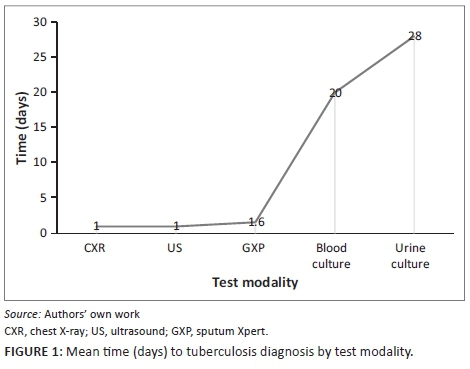
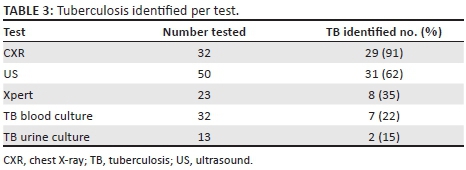
BACKGROUND: Tuberculosis (TB) is a major cause of severe anaemia in patients with human immunodeficiency virus (HIV) infection in South Africa. However, TB can be difficult to diagnose as it may be extra pulmonary and paucibacillary. AIM: The aim of this study was to investigate undiagnosed TB in patients with HIV infection and severe anaemia and to identify the optimal investigations for diagnosing TB. SETTING: Mthatha General Hospital, a district hospital. METHODS: The study was a case series. RESULTS: Haemoglobin levels ranged from 3.6 g/dL to 7.9 g/dL, the mean CD4 count was 176 cells/μL and 80% of patients had a positive TB symptom screen. Forty-three (86%) patients had either clinical or bacteriologically proven TB of whom 33 had pulmonary TB, 34 had extra pulmonary TB and 24 had both types. The diagnostic yield for TB was: chest X-ray (CXR) 91%; ultrasound (US) abdomen pericardium and lower chest 62%; sputum Xpert MTB/RIF 35%; TB blood culture 21% and TB urine culture 15%. Blood and urine cultures did not identify any additional cases over those identified by CXR and US. The laboratory turnaround times were as follows: sputum Xpert, 1.6 days; blood culture, 20 days and urine culture, 28 days. CXR and US were done within one day of initial patient assessment. CONCLUSIONS: The majority of HIV patients with severe anaemia had TB disease, and extra pulmonary TB was as prevalent as pulmonary TB. CXR, US and sputum Xpert were the optimum tests for rapid diagnosis of TB. South African national TB/HIV guidelines should incorporate these specific tests to diagnose TB in patients with HIV and severe anaemia.
Introduction
Tuberculosis (TB) is the most common cause of death among people living with human immunodeficiency virus (HIV) infection, accounting for about one in three AIDS-related deaths globally.12,34,54,6,789510,11
TB in patients with HIV infection can present in many forms, including anaemia.1213141516
In patients with HIV infection and severe anaemia, defined as a haemoglobin level less than 8 g/dL,1718121920
The aims of this study were to determine the prevalence of undiagnosed TB in HIV-positive patients with severe anaemia presenting at a district hospital in the Eastern Cape province and to identify the optimal investigations for diagnosing TB in these patients.
Research methods
Study design
This study was a prospective case series.
Setting
The study was conducted in the Emergency and Outpatient Departments of Mthatha General Hospital. The hospital serves an estimated population of 451 712 that is predominantly rural, of low socio-economic status2122
Study population and sampling procedure
A case was defined as a patient aged 18 years or older with HIV infection and severe anaemia who after treatment by the doctors on duty was not investigated for TB. Patients on TB treatment or who had active or recent haemorrhage (within the last three months) were excluded. A convenience sample of 50 consecutive patients was chosen.
Operational procedures and data collection
Each patient had an automated full blood count using an ADVIA® 2120 Haematology Analyser (Siemens, Munich, Germany). A symptom screen was undertaken for TB, namely, presence or absence of a cough (of any duration), unintentional weight loss, night sweats and fever2324
A clinical diagnosis of TB was made on clinical evidence without bacteriological confirmation of disease. The clinical diagnosis of TB on CXR was the opinion of the radiologist; and for US examination, the clinical diagnosis was the opinion of family physicians experienced in US examination using the following criteria: for TB abdomen, one or more of: intra-abdominal lymph nodes ≥ 1.5 cm in diameter, hypo-echoic areas 0.5 cm-2.0 cm diameter (consistent with micro-abscesses) in the spleen, and ascites in the absence of clinical evidence of another possible cause.24® assay, smear microscopy or culture. All laboratory tests were performed by the National Health Laboratory Service (NHLS).
Data analysis
Data were captured and coded in Microsoft Excel 2010 (Microsoft Corporation, Seattle, WA, USA) and analysed using Stata 14.1 (Stata Corp LP, College Station, TX, USA). Numerical data were explored using the Shapiro-Wilk test for distribution. Numerical data that were not normally distributed were reported on using the median and interquartile range and data that were normally distributed were reported on using parametric statistics (mean, range and standard deviation). The two-sample t-test (parametric) or the Wilcoxon sum-rank test (non-parametric) was conducted depending on whether the data were normally distributed or not. This was done to compare the equality of two medians or means. Categorical variables were presented using frequency tables and percentages. Differences between two proportions were measured using the two-sample t-test of proportions. The level of significance for hypothesis testing was p ≤ 0.05. For observer variability, the kappa coefficient was used as an index of agreement between two categorical variables.
Ethical consideration
Informed written consent was obtained from each participant before inclusion. If TB was diagnosed by the researchers, then patients were started on treatment immediately. The researchers referred patients to a haematologist when further investigations were needed. Ethical approval to conduct this study was obtained from Walter Sisulu University Research Ethics and Bio-safety Committee (protocol number 046/2013) and permission to do the study was obtained from the Eastern Cape Department of Health.
Results
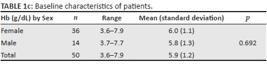
Fifty consecutive participants were recruited. Of these participants, 72% were females and the remaining 28% were males. The baseline characteristics of participants are shown in Table 1a-c. The median age of 35.5 years for males was higher compared with 32 years for females but the difference was not significant. Table 1a-c also shows that the haemoglobin levels ranged from 3.6 to 7.9 g/dL with no statistical difference between the median Hb of males and females (p = 0.692).

Forty-six participants had CD4 count results. While 25% of females had CD4 counts ≤ 60 cells/μL, 75% of females had CD4 counts ≤ 156 cells/μL. Similarly, for males, 25% had CD4 counts of ≤ 57 cells/μL and only 25% of participants had CD4 counts ≥ 190 cells/μL. Males were, however, found to have higher median CD4 counts (143 cells/μL) as compared with females (95 cells/μL), but this was not statistically significant (p = 0.558). Even though 25% of males had a viral load that was not detectable while 25% of females had a viral load that was ≤ 164.5, there was no statistical difference in the median viral loads of males and females (p = 0.541).
Anaemia was characterised as follows in 46 patients: normocytic, 63%; macrocytic, 20% and microcytic, 17% (normal ranges mean corpuscular volume [MCV]: females, 78.9 fL-98.5 fL and males, 83 fL-101 fL). In four patients, Hb was diagnosed by a rapid test without a full blood count. The mean of all values for the mean corpuscular haemoglobin concentration (MCHC) was 30 g/d for males and 29 g/dL for females, and was low for both sexes (normal ranges: females 32.7 g/dL-34.9 g/dL and males 31.5 g/dL-34.5 g/dL). The mean Red Cell Distribution Width (RDW) of 20% was high (normal ranges: female 12.4% - 17.3% and males 11.6% - 14%).
Tuberculosis symptom screen
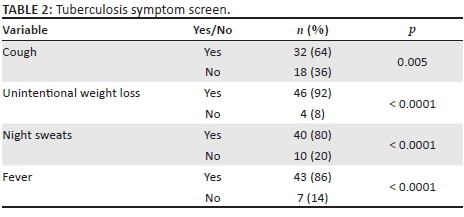
Of the participants, 40 (80%) had a positive TB symptom screen with one or more symptoms (see Table 2). The majority of participants (64%) were significantly more likely to have been coughing (p = 0.005). Unintentional weight loss, night sweats and pyrexia were significantly likely to be found in 92%, 80% and 86%, respectively (p < 0.0001).
Physical examination
Six (12%) patients had one or more signs suggestive of EPTB on physical examination, namely lymphadenopathy (4), pleural effusion (2) and meningitis (1). Of these, five had clinically diagnosed or bacteriologically proven TB and one had cryptococcal meningitis.
Prevalence of tuberculosis
The overall prevalence of TB was 86%: 43 patients (86%) had either or both bacteriological and clinical TB, 42 (84%) had clinical TB and 14 (28%) had bacteriologically proven TB.
Tuberculosis yield per test
Table 3 shows the yield of TB per diagnostic investigation, that is, the number identified with TB per test. CXR, US and sputum Xpert had the highest yield.
Time to diagnosis per test
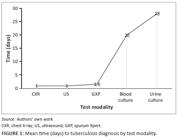
Figure 1 shows the mean time (days) to diagnosis of TB per test. The tests with the highest diagnostic yield and the shortest period to diagnosis were CXR, US and sputum Xpert.
Yield from other diagnostic modalities
Of 13 patients who had urine TB cultures, two had positive results. These two patients also had clinical TB on US and one patient had a CXR that also indicated clinical TB. Overall, urine culture did not identify any additional TB cases over those identified by CXR and US. Seven of 30 patients had bacteriologically proven TB on blood culture. All seven had clinical TB on CXR and US. Blood culture did not identify any additional TB cases over those identified by CXR and US.
Site of tuberculosis
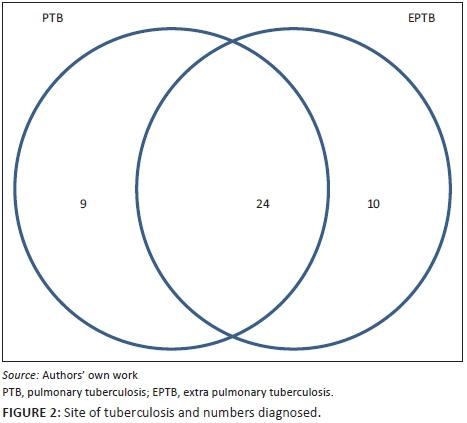
Of 43 patients diagnosed with TB, 33 (77%) had PTB, 34 (79%) had EPTB and 24 (56%) had both types. See Figure 2. Of those with EPTB, 31 were identified by US, 2 by CXR (pleural effusions) and 1 by blood culture. US findings were as follows: abdominal TB, 29; combined abdominal TB and pericardial effusion, 1; and pleural effusion, 1.
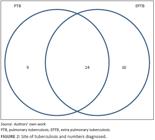
Seven patients had EPTB on more than one diagnostic modality; of these, one patient had TB on US, blood and urine culture, five patients had TB on US and blood culture and one patient had TB on US and urine culture. Of the three patients with pleural effusions, one had a positive TB blood culture.
Inter-rater agreement for chest X-ray reading by radiologist and family physicians
Of 32 patients who had a CXR, 29 (91%) had probable TB when assessed by the radiologist. The total CXRs available for comparison by the radiologist and the two family physicians was 31. When the CXRs were assessed by two family physicians, agreement with the radiologist for the presence of TB was 77% for Family Physician 1 and 26% for Family Physician 2. For Family Physicians 1 and 2, the kappa results were, respectively, 0.537 (95% CI 0.162-0.912) representing moderate agreement and 0.0719 (95% CI 0.0183-0.162) representing slight agreement.25
Discussion
A high prevalence (86%) of undiagnosed TB in patients with HIV infection and severe anaemia was found in this study. This finding is consistent with other studies from sub-Saharan Africa. In Malawi, 43% of 77 patients with HIV infection and severe anaemia admitted to a general medical ward had TB (bacteriological and clinical).1215261827
Patients in this study were predominantly females (72%) and the proportion in the reproductive age group of 15-49 years was 86%. Similarly, of the patients with severe anaemia and HIV in the study in Cape Town, 59% were females.1822
In this study, 34 (79%) had EPTB. This compares with estimates of more than 50% EPTB in patients with HIV infection in a review by Sharma and Mohan.202852930
The optimal combination of tests to rapidly diagnose TB in HIV-infected patients with severe anaemia in this study was CXR, US (abdomen, pericardium and lower chest) and sputum Xpert. These can readily be done in a district hospital. Blood and urine tests did not identify any additional cases over those identified by CXR and US, and they have a lower yield and take longer to obtain results. However, they are important for a bacteriological diagnosis, particularly to exclude drug-resistant TB. An estimated 2.8% of TB cases in South Africa have multidrug-resistant TB (MDR-TB) and 4.9% have isoniazid mono-resistance.3127
While the CXRs in this study gave a high yield of TB, they were read by a radiologist. In district hospitals, there are no radiologists and X-ray reports are read by general medical officers and family physicians. CXRs in patients with HIV and low CD4 counts can be difficult to interpret as changes from TB can be subtle and atypical.11,32,3334,353637,3837,39
The results of this study show that 80% of patients had a positive TB symptom screen. However, the doctors who initially assessed the patients did not investigate for TB. National guidelines recommend symptom screening for TB in all HIV-infected patients at every contact with healthcare providers and investigation for TB if there is one or more symptom.23
an Hb < 8 g/dL with no clear cause should generally trigger additional investigations; usually there is an underlying serious OI [opportunistic infection], often TB, and this requires urgent diagnosis and treatment.19
Based on the high prevalence of TB found in this and other studies, the guidelines should be modified to mandate specific tests to exclude PTB and EPTB.
Six patients had physical signs suggestive of EPTB that were not noted by the doctors who first assessed the patients. This is not unexpected as there is a wide variation in doctors' ability to discern physical signs and interpret tests.2540
The majority of patients had a normocytic anaemia. Lewis et al.1212,18
The MCHC was low for both sexes and is consistent with hypochromia as a result of severe anaemia.414243
Strengths and limitations of the study
The results of this study are not generalisable. The sample was non-random. Available results for urine culture were few; this precluded sufficient data for inferential statistical analysis. While there are methods for minimising the impact of missing data, for example, multiple imputation,44
The strength of this study is that it has a high clinical relevance on the approach to anaemia in HIV-infected patients in district hospitals.
Conclusion
The majority of HIV patients with severe anaemia had TB disease and EPTB was as prevalent as PTB. CXR, US (abdomen, pericardium and chest) and sputum Xpert were the optimum tests for rapid diagnosis of TB. It is advised that South African national TB/HIV guidelines incorporate these specific tests to diagnose TB in patients with HIV and severe anaemia.
Competing interests
The authors declare that they have no financial or personal relationships that may have inappropriately influenced them in writing this article.
Authors' contributions
M.M. conceptualised the topic, reviewed the literature, collected and analysed data and compiled the article. D.O. assisted in the conception and design. D.O. and S.M. assisted in the writing and submission of the article. S.M. assisted in the statistical analysis. K.A.F.N. assisted in the interpretation of radiographs and quality assurance.
Acknowledgements
The authors thank the patients who consented to partake in the study, the family physicians and staff of Mthatha General Hospital for their help in this study.
References
- 1. UNAIDS. Global HIV statistics. Fact Sheet November 2016. Geneva, Switzerland: The Joint United Nations Programme on HIV/AIDS (UNAIDS); 2016.
-
2. Holtz TH, Kabera G, Mthiyane T, et al. Use of a WHO-recommended algorithm to reduce mortality in seriously ill patients with HIV infection and smear-negative pulmonary tuberculosis in South Africa: An observational cohort study. Lancet Infect Dis. 2011;11:533-540. https://doi.org/10.1016/S1473-3099(11)70057-3
» https://doi.org/10.1016/S1473-3099(11)70057-3 -
3. Peter JG, Zijenah LS, Chanda D, et al. Effect on mortality of point-of-care, urine-based lipoarabinomannan testing to guide tuberculosis treatment initiation in HIV-positive hospital inpatients: A pragmatic, parallel-group, multicountry, open-label, randomised controlled trial. Lancet. 2016;387:1187-1197. https://doi.org/10.1016/S0140-6736(15)01092-2
» https://doi.org/10.1016/S0140-6736(15)01092-2 -
4. Kufa T, Mngomezulu V, Charalambous S, et al. Undiagnosed tuberculosis among HIV clinic attendees: Association with antiretroviral therapy and implications for intensified case finding, isoniazid preventive therapy, and infection control. J Acquir Immune Defic Syndr. 2012;60:e22-e28. https://doi.org/10.1097/QAI.0b013e318251ae0b
» https://doi.org/10.1097/QAI.0b013e318251ae0b -
5. Wong EB, Omar T, Setlhako GJ, et al. Causes of death on antiretroviral therapy: A post-mortem study from South Africa. PLoS One. 2012;7:e47542. https://doi.org/10.1371/journal.pone.0047542
» https://doi.org/10.1371/journal.pone.0047542 -
6. Bassett IV, Wang B, Chetty S, et al. Intensive tuberculosis screening for HIV-infected patients starting antiretroviral therapy in Durban, South Africa. Clin Infect Dis. 2010;51:823-829. https://doi.org/10.1086/656282
» https://doi.org/10.1086/656282 -
7. Lawn SD, Brooks SV, Kranzer K, et al. Screening for HIV-associated tuberculosis and rifampicin resistance before antiretroviral therapy using the Xpert MTB/RIF assay: A prospective study. PLoS Med. 2011;8:e1001067. https://doi.org/10.1371/journal.pmed.1001067
» https://doi.org/10.1371/journal.pmed.1001067 -
8. Gupta RK, Lucas SB, Fielding KL, Lawn SD. Prevalence of tuberculosis in post-mortem studies of HIV-infected adults and children in resource-limited settings: A systematic review and meta-analysis. AIDS. 2015;29:1987-2002. https://doi.org/10.1097/QAD.0000000000000802
» https://doi.org/10.1097/QAD.0000000000000802 -
9. Cohen T, Murray M, Wallengren K, Alvarez GG, Samuel EY, Wilson D. The prevalence and drug sensitivity of tuberculosis among patients dying in hospital in KwaZulu-Natal, South Africa: A postmortem study. PLoS Med. 2010;7:e1000296. https://doi.org/10.1371/journal.pmed.1000296
» https://doi.org/10.1371/journal.pmed.1000296 - 10. Davies P, Pai M. The diagnosis and misdiagnosis of tuberculosis. Int J Tuberc Lung Dis. 2008;12:1226-1234.
-
11. Allen CM, Al-Jahdali HH, Irion KL, Al Ghanem S, Gouda A, Khan AN. Imaging lung manifestations of HIV/AIDS. Ann Thorac Med. 2010;5:201-216. https://doi.org/10.4103/1817-1737.69106
» https://doi.org/10.4103/1817-1737.69106 -
12. Lewis DK, Whitty CJM, Walsh AL, et al. Treatable factors associated with severe anaemia in adults admitted to medical wards in Blantyre, Malawi, an area of high HIV seroprevalence. Trans R Soc Trop Med Hyg. 2005;99:561-567. https://doi.org/10.1016/j.trstmh.2005.01.002
» https://doi.org/10.1016/j.trstmh.2005.01.002 -
13. Belperio PS, Rhew DC. Prevalence and outcomes of anemia in individuals with human immunodeficiency virus: A systematic review of the literature. Am J Med. 2004;116(Suppl 7A):27S-43S. https://doi.org/10.1016/j.amjmed.2003.12.010
» https://doi.org/10.1016/j.amjmed.2003.12.010 -
14. Bolge SC, Mody S, Ambegaonkar BM, McDonnell DD, Zilberberg MD. The impact of anemia on quality of life and healthcare resource utilization in patients with HIV/AIDS receiving antiretroviral therapy. Curr Med Res Opin. 2007;23:803-810. https://doi.org/10.1185/030079907X178775
» https://doi.org/10.1185/030079907X178775 -
15. Kerkhoff AD, Wood R, Vogt M, Lawn SD. Predictive value of anemia for tuberculosis in HIV-infected patients in Sub-Saharan Africa: An indication for routine microbiological investigation using new rapid assays. J Acquir Immune Defic Syndr. 2014;66:33-40. https://doi.org/10.1097/QAI.0000000000000091
» https://doi.org/10.1097/QAI.0000000000000091 -
16. Kerkhoff AD, Wood R, Cobelens FG, Gupta-Wright A, Bekker L-G, Lawn SD. Resolution of anaemia in a cohort of HIV-infected patients with a high prevalence and incidence of tuberculosis receiving antiretroviral therapy in South Africa. BMC Infect Dis. 2014;14:3860. https://doi.org/10.1186/s12879-014-0702-1
» https://doi.org/10.1186/s12879-014-0702-1 - 17. World Health Organization. Haemoglobin concentrations for the diagnosis of anaemia and assessment of severity. Vitamin and mineral nutrition information system. WHO/NMH/NHD/MNM/11.1. Geneva, Switzerland: World Health Organization; 2011.
-
18. Kerkhoff AD, Lawn SD, Schutz C, et al. Anemia, blood transfusion requirements and mortality risk in human immunodeficiency virus-infected adults requiring acute medical admission to hospital in South Africa. Open Forum Infect Dis. 2015;2:ofv173. https://doi.org/10.1093/ofid/ofv173
» https://doi.org/10.1093/ofid/ofv173 - 19. Department of Health. National consolidated guidelines for the prevention of mother-to-child transmission of HIV (PMTCT) and the management of HIV in children, adolescents and adults. Pretoria: Department of Health; 2015.
- 20. Sharma S, Mohan A. Extrapulmonary tuberculosis. Indian J Med Res. 2004;120:316-353.
- 21. Stats SA. Census 2011 Municipal Report Eastern Cape. Report No. 03-01-50. Pretoria: Statistics South Africa; 2012.
- 22. Shisana O, Rehle T, Simbayi LC, et al. South African national HIV prevalence, incidence and behaviour survey, 2012. Cape Town: HSRC Press; 2014.
- 23. Department of Health. National tuberculosis management guidelines 2014. Pretoria: Department of Health; 2014.
-
24. Heller T, Wallrauch C, Goblirsch S, Brunetti E. Focused assessment with sonography for HIV-associated tuberculosis (FASH): A short protocol and a pictorial review. Crit Ultrasound J. 2012;4:21. https://doi.org/10.1186/2036-7902-4-21
» https://doi.org/10.1186/2036-7902-4-21 -
25. McGinn T, Wyer PC, Newman TB, et al. Tips for learners of evidence-based medicine: 3. Measures of observer variability (kappa statistic). CMAJ. 2004;171:1369-1373. https://doi.org/10.1503/cmaj.1031981
» https://doi.org/10.1503/cmaj.1031981 -
26. Kerkhoff AD, Wood R, Cobelens FG, Gupta-Wright A, Bekker L-G, Lawn SD. The predictive value of current haemoglobin levels for incident tuberculosis and/or mortality during long-term antiretroviral therapy in South Africa: A cohort study. BMC Med. 2015;13:70. https://doi.org/10.1186/s12916-015-0320-9
» https://doi.org/10.1186/s12916-015-0320-9 - 27. World Health Organization. Global tuberculosis report 2015. Geneva: World Health Organization; 2015.
- 28. World Health Organization. Consolidated guidelines on the use of antiretroviral drugs for treating and preventing HIV infection. Recommendations for a public health approach. 2nd ed. Geneva, Switzerland: World Health Organization; 2016.
-
29. Martinson NA, Karstaedt A, Venter WD, et al. Causes of death in hospitalized adults with a premortem diagnosis of tuberculosis: An autopsy study. AIDS. 2007;21:2043-2050. https://doi.org/10.1097/QAD.0b013e3282eea47f
» https://doi.org/10.1097/QAD.0b013e3282eea47f -
30. Kerkhoff AD, Wood R, Vogt M, Lawn SD. Prognostic value of a quantitative analysis of lipoarabinomannan in urine from patients with HIV-associated tuberculosis. PLoS One. 2014;9:e103285. https://doi.org/10.1371/journal.pone.0103285
» https://doi.org/10.1371/journal.pone.0103285 - 31. National Institute for Communicable Diseases. South African tuberculosis drug resistance survey 2012-14. Johannesburg, South Africa: National Institute for Communicable Diseases; 2016.
-
32. Perlman DC, El-Sadr WM, Nelson ET, et al. Variation of chest radiographic patterns in pulmonary tuberculosis by degree of human immunodeficiency virus-related immunosuppression. Clin Infect Dis. 1997;25:242-246. https://doi.org/10.1086/514546
» https://doi.org/10.1086/514546 -
33. Huang L. Pulmonary Manifestations of HIV [homepage on the Internet]. San Francisco, CA: University of California. c2009. [updated 2009 Jan; cited 2016 Dec 21]. Available from: http://hivinsite.ucsf.edu/InSite?page=kb-04-01-05
» http://hivinsite.ucsf.edu/InSite?page=kb-04-01-05 -
34. Reid MJA, Shah NS. Approaches to tuberculosis screening and diagnosis in people with HIV in resource-limited settings. Lancet Infect Dis. 2009;9:173-184. https://doi.org/10.1016/S1473-3099(09)70043-X
» https://doi.org/10.1016/S1473-3099(09)70043-X - 35. Zellweger J, Heinzer R, Touray M, Vidondo B, Altpeter E. Intra-observer and overall agreement in the radiological assessment of tuberculosis. Int J Tuberc Lung Dis. 2006;10:1123-1126.
- 36. Dawson R, Masuka P, Edwards D, et al. Chest radiograph reading and recording system: Evaluation for tuberculosis screening in patients with advanced HIV. Inter J Tuberc Lung Dis. 2010;14:52-58.
- 37. Dresang LT, Rodney WM, Rodney KM. Prenatal ultrasound: A tale of two cities. J Natl Med Assoc. 2006;98:167-171.
- 38. Molokwu J. Obstetrics and gynecology ultrasound topics in family medicine resident training. Donald School J Ultrasound Obstet Gynecol. 2014;8:31-34.
- 39. Keith R, Frisch L. Fetal biometry: A comparison of family physicians and radiologists. Fam Med. 2001;33:111-114.
-
40. Benbassat J, Baumal R. Narrative review: Should teaching of the respiratory physical examination be restricted only to signs with proven reliability and validity? J Gen Intern Med. 2010;25:865-872. https://doi.org/10.1007/s11606-010-1327-8
» https://doi.org/10.1007/s11606-010-1327-8 - 41. Greer JP, Arber DA, Glader B, et al. Wintrobe's clinical hematology. 13th ed. Philadelphia, PA: Lippincott, Williams & Wilkins; 2014.
- 42. Lippi G, Targher G, Montagnana M, Salvagno GL, Zoppini G, Guidi GC. Relation between red blood cell distribution width and inflammatory biomarkers in a large cohort of unselected outpatients. Arch Pathol Lab Med. 2009;133:628-632.
-
43. Gallego ML, Pérez-Hernández IA, Palacios R, et al. Red cell distribution width in patients with HIV infection. Open J Internal Med. 2012;2:7-10. https://doi.org/10.4236/ojim.2012.21002
» https://doi.org/10.4236/ojim.2012.21002 -
44. Dong Y, Peng C-YJ. Principled missing data methods for researchers. SpringerPlus. 2013;2:222. https://doi.org/10.1186/2193-1801-2-222
» https://doi.org/10.1186/2193-1801-2-222
Accepted: 09 Apr. 2017
Published: 30 June 2017