Final-year medical students' reflections on types of significant events in primary care
Abstract
BACKGROUND: Adverse events are considered a universal challenge and a burden in the provision of healthcare. For that reason, significant event analysis (SEA) is a critical undertaking in primary health care (PHC), particularly in South Africa where 84% of the population relies on the public health system for their care. AIM: The study aimed to describe the types of perceived significant events medical students experienced during an integrated primary care block placement. SETTING: Eighteen PHC settings included clinics, community health centres and district hospitals across three provinces in Gauteng, Mpumalanga and the North West. METHODS: Using a qualitative descriptive design with purposeful sampling and maximum variation, structured reflection reports were retrieved from logbooks of final-year medical students studying at a South African university in 2014. Conventional content analysis was used to record the relevant facets of secondary data from 124 logbooks that contained a recording of a significant event using MAXQDA software version 2020.4. RESULTS: An iterative process revealed three major themes of significant events that were prevalent in PHC settings. These comprised medication and prescription errors, diagnostic errors and suboptimal patient management. CONCLUSION: Significant event analysis became a critical quality improvement reflective learning tool. Logbooks offered an opportunity for medical students to explore significant events as a strategic way towards addressing quality and safe practices in PHC settings. CONTRIBUTION: This study demonstrated medical students' ability to identify incidents in the care of patients using the SEA approach and their role in assessing patient safety issues in PHC settings.
adverse events; medical students; patient safety; primary health care settings; significant events analysis
Introduction
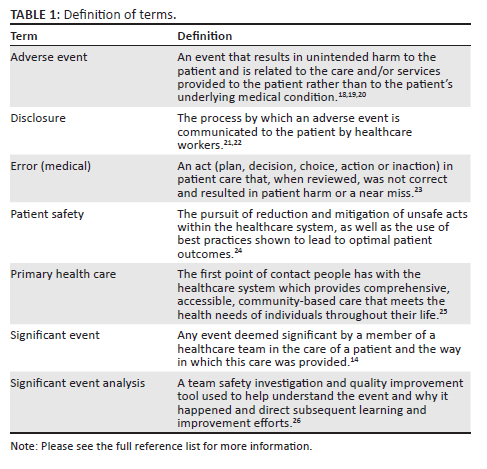
Adverse events in medical care present a challenge in the provision of public healthcare as this experience tends to compromise patient safety (Table 1). Accordingly, Slawomirsk and colleagues reported that for every 10 patients presenting in outpatient and primary health care (PHC) facilities worldwide, four experience harm.12345,6789,10
This maldistribution and burden of disease in South Africa emphasise the need for a health system to deliver quality health services to the people who need them the most.11121314
Medical students' involvement in SEA provides insights into approaches to managing errors in practice.15161517
To our knowledge, there is no documented literature yet on medical students' experiences of a significant event in South Africa's PHC settings. As such, the aim of this article is to report on findings from a study undertaken as part of a master's degree in public health that explored medical students' reflections on perceived significant events during their Integrated Primary Care (IPC) block placement in PHC settings. This article describes the types of significant events experienced by medical students studying at a South African university.
Research methods and design
Study design
This was a secondary data analysis study based on a section of the IPC block logbook focusing on medical student reflections on a significant event. A qualitative descriptive research design was used to portray the significant events in PHC facilities.27,28,293031
Study setting and participants
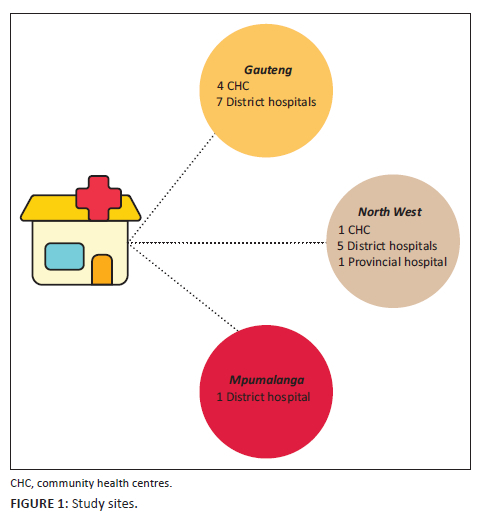
In 2014, participants in this study were final-year Wits medical students based in 18 rural and urban healthcare facilities in Gauteng, Mpumalanga and North West provinces (Figure 1) as part of their IPC block 6-week placement. Primary healthcare facilities included district hospitals and community health centres (CHCs) with their supporting clinics in all three provinces.32
Data collection
As part of the IPC block, 228 medical students documented in their logbooks reflections on exposure to different aspects of PHC. Each student was required to complete a pre-structured reflective diary with six open-ended questions about a significant event they had either 'witnessed or were involved in at their site during the 6-week clinical rotation where management of the patient was sub-optimal, an adverse event occurred, or a patient died'. Although this formed part of the logbook, like portfolios,33n = 124) and eliminated those who described significant events they had observed from a distance or overheard the event discussed by colleagues.34,35
Data analysis
In preparing for analysis, secondary data were exported to a Microsoft Word document; its quality was assessed and organised to ensure that it aligned with the aims of the study.3637
Ethical considerations
Ethical clearance to conduct this study was obtained from the University of the Witwatersrand Human Research Ethics Committee (Medical) (No. M170853). Written informed consent was obtained from all final-year medical students prior to participation in the study allowing the Wits Centre for Rural Health to use their logbook reflections during the IPC rotation for research purposes. To ensure confidentiality, no names were collected from the logbooks and data were kept in a password-protected laptop. The research team did not have access to the participant's personal information.
Results
The analysis revealed three major themes that outlined the types of significant events witnessed during clinical rotations, namely medication and prescription errors, patient diagnosis errors and suboptimal patient management. Many of the perceived significant events were reported in the emergency medicine rooms and in the maternity and labor wards of the PHC facilities where participants were based for their IPC block.
Theme one: Medication and prescription errors
For these perceived significant events, participants recorded incidences where patients received wrong medication or instances where there were prescription errors. Some participants reported that patients received an incorrect treatment regimen for the condition they presented with:
'A patient was diagnosed with MDR-TB, but he was put on first-line regimen regardless. After 6/12 he was obviously not better, so after investigating, the sisters in the TB clinic at [name of facility withheld] picked up the mistake in his management.' (Participant 7, Rotation 3, Facility 2)
Participants indicated that some healthcare workers did not take medication contraindications into account. This highlighted the poor prescribing habits of some healthcare workers, especially for patients with chronic conditions:
'Although many such incidents occurred like this, it will describe the poor prescribing habits of some doctors in the chronic clinic … a patient with severe gout being dosed on allopurinol and put on Hydrochlorothiazide [HCTZ] for two years.' (Participant 77, Rotation, 1, Facility 2)
Patient identity mix-ups were a common occurrence, especially where patients had similar names. Consequently, patients got the wrong medication that was not necessarily prescribed for their condition:
'Patients with the same names were attending chronic patient clinic. Both had hypertension, but only the one had schizophrenia as a co-morbidity. When finding the EDL packets, the psych patient's injection was given to the HPT patient wrongly. Patient did not think she was wrongly being medicated.' (Participant 34, Rotation 4, Facility 7)
Theme two: Patient diagnosis errors
Some participants highlighted wrong patient diagnosis and missed diagnosis as areas of concern that resulted in perceived significant events during their clinical rotations.
Disagreements among healthcare workers on patient diagnosis and course of treatment were perceived as significant events, which resulted in suboptimal care of the patient:
'A patient came in with a snake bite rumoured to be a black mamba bite. Doctor in charge delayed care as they weren't certain if it was a black mamba and the patient deteriorated. Nurse disagreed with the treatment.' (Participant 29, Rotation 5, Facility 14)
Some participants perceived that their suggestions for the diagnosis and management of patients were not taken into account as they were students:
'A patient presented during my mini-CEX with the doctor at the clinic with a history of persistent cough and occasional blood stains and night sweats. He had a contact with a similar problem. I was concerned that he had TB, but the doctor believed he had interstitial lung disease due to the fact that he worked in the mines. He was sent home with Prednisone, Beclomethasone and Asthavent.' (Participant 46, Rotation 4, Facility 11)
This could have resulted in poor patient care as students could not contradict and voice their own opinions against their seniors.
Theme three: Suboptimal patient management
Healthcare workers' attitudes, poor communication, poor management of assault cases and labour cases all resulted in poor patient care. Health workers' attitudes towards patients, in the form of physical and verbal abuse, were ongoing concerns:
'… When trying to lift the patient off the wheelchair onto the bed, the nurse got irritated that the patient was not carrying her own weight and began hitting her and pulling at the patient's clothes and shouting at her.' (Participant 28, Rotation 5, Facility 3)
Some participants recorded poor management of physical and sexual assault cases as significant events that affected patients' access to quality healthcare. This was cited as a problem also because at times healthcare workers were not clear about who should complete and sign J88 forms:
'The patient had come in following having been assaulted by an adult [patients was 8 years old]. The family of the patient wanted a J88 filled so as to lay charges. The attending doctor had me fill out the form and sign - when I signed, then the attending doctor countersigned the document.' (Participant 59, Rotation 2, Facility 3)
Inadequate monitoring and suboptimal management of patients in the labour wards were perceived as a cause for concern by a majority of the participants. Perceived significant events were recorded of women giving birth unattended and sometimes in corridors mostly because of delayed allocation of beds or poor monitoring:
'In the labour ward during one of my weeknight calls a gravida 1, para 2 who had arrived in the morning was sitting on the bench in the admission cubicle as no bed had yet been allocated to her despite abundant availability of beds at that time. At about 20h00 she began shouting for a sister, saying that her baby was coming. The sister in charge of her came eventually, ambled to her cubicle, and discovered that the baby was crowning significantly. She shouted at the woman to get on the bed and then left immediately to get a delivery pack. While she was gone the baby was delivered and this occurred quickly, while the woman was still struggling to climb onto the bed.' (Participant 88, Rotation 1, Facility 11)
Discussion of results
This study is the first of its kind to describe the type of significant events that were observed and witnessed by medical students in PHC settings in South Africa. In related studies, medical students were based in high-income countries in academic teaching hospitals in Australia151638393840
Another significant event according to the participants was diagnostic errors. The most common diagnostic errors mentioned in this study included missed and wrong diagnoses.4140414243
In this study, inadequate patient management, a concern shared by Dapaah,44454546444747
In this study, poor clinical records resulted in poor decision-making in the diagnosis, treatment, management and prescription of medication to patients. According to Mathioudakis et al.,4849
Limitations of the study
Significant event analysis data used in the study were based on medical students' recordings of what they perceived as significant events. There was no objective validation of these events. Triangulation using students' reflections and a review of significant events reported in the healthcare facilities would have strengthened the study. Data employed in this study were drawn from reflections of the 2014 final year class and therefore open to time bias.
Conclusion
In conclusion, this study highlights the pressing challenges faced by South Africa's PHC facilities in instituting effective management of significant events. The findings underscore the critical need for improving medication safety protocols, enhancing diagnostic capabilities and providing adequate support and training of healthcare workers. Addressing these issues can lead to better patient outcomes, reduce medical errors and implement a more patient-centred and efficient healthcare system. Additionally, emphasising the importance of maintaining accurate clinical records can ensure continuity of healthcare and effective communication among healthcare professionals. Collaborative efforts among stakeholders and policymakers are essential to bring about the necessary improvements in the country's PHC settings.
Contribution
The study demonstrated medical students' ability to identify incidents in the care of patients using the SEA approach and their role in assessing patient safety issues in PHC settings.
Competing interests
The authors declare that they have no financial or personal relationship(s) that may have inappropriately influenced them in writing this article.
Authors' contributions
S.D. prepared the initial draft of the article. M.M. and N.O.M. contributed during the writing phase of the study and all the authors read and approved the final manuscript.
Funding information
This research received no specific grant from any funding agency in the public, commercial or not-for-profit sectors.
Data availability
The data that support the findings of this study are available in the library at the University of the Witwatersrand; https://hdl.handle.net/10539/33443.
Disclaimer
The views and opinions expressed in this article are those of the authors and do not necessarily reflect the official policy or position of any affiliated agency of the authors.
Acknowledgements
The authors would like to extend their gratitude to the HOD and colleagues in the Department of Family Medicine and Primary Care at the University of Witwatersrand. They are equally grateful to the 2014 class of final-year medical students, without whom the study would not have been possible.
References
- 1.Slawomirski L, Auraaen A, Klazinga N. The economics of patient safety in primary and ambulatory care: Flying blind. Paris: OECD Health Working Papers; 2018.
- 2.Luke Slawomirski & Ane Auraaen & Nicolaas S. Klazinga. The economics of patient safety: Strengthening a value-based approach to reducing patient harm at national level. OECD Health Working Papers 96, OECD Publishing; 2017.
-
3.Jha AK, Larizgoitia I, Audera-Lopez C, Prasopa-Plaizier N, Waters H, Bates DW. The global burden of unsafe medical care: Analytic modelling of observational studies. BMJ Qual Saf. 2013;22(10):809 LP-815. https://doi.org/10.1136/bmjqs-2012-001748
» https://doi.org/10.1136/bmjqs-2012-001748 - 4.National Academies of Sciences, Engineering and Medicine, Health and Medicine Division, Board on Health Care Services, Board on Global Health, Committee on Improving the Quality of Health Care Globally. Crossing the global quality chasm: Improving health care worldwide. Washington, DC: National Academies Press; 2018.
-
5.Samra R, Car J, Majeed A, Vincent C, Aylin P. How to monitor patient safety in primary care? Healthcare professionals' views. JRSM Open. 2016;7(8):1-8. https://doi.org/10.1177/2054270416648045
» https://doi.org/10.1177/2054270416648045 -
6.Sheikh A, Panesar SS, Larizgoitia I, Bates DW, Donaldson LJ. Safer primary care for all: A global imperative. Lancet Global Health. 2013;1(4):E183-E183. https://doi.org/10.1016/S2214-109X(13)70030-5
» https://doi.org/10.1016/S2214-109X(13)70030-5 -
7.The Health Foundation. Evidence scan - Levels of harm [homepage on the Internet]. 2011 [cited n.d.]. Available from: http://www.health.org.uk/publications/levels-of-harm
» http://www.health.org.uk/publications/levels-of-harm - 8.Ibrahim A, Garba ES, Asuku ME. Challenges in disclosure of adverse events and errors in surgery; perspectives from sub-Saharan Africa. Pan Afr Med J. 2012;12:82.
-
9.Malakoane B, Heunis JC, Chikobvu P, Kigozi NG, Kruger WH. Public health system challenges in the Free State, South Africa: A situation appraisal to inform health system strengthening. BMC Health Serv Res. 2020;20(1):58. https://doi.org/10.1186/s12913-019-4862-y
» https://doi.org/10.1186/s12913-019-4862-y - 10.La Pietra L, Calligaris L, Molendini L, Quattrin R, Brusaferro S. Medical errors and clinical risk management: State of the art. Acta Otorhinolaryngol Italy. 2005;25(6):339-346.
-
11.Ataguba JE, Akazili J, McIntyre D. Socioeconomic-related health inequality in South Africa: Evidence from General Household Surveys. Int J Equity Health. 2011;10(1):48. https://doi.org/10.1186/1475-9276-10-48
» https://doi.org/10.1186/1475-9276-10-48 -
12.Van Rensburg HCJ. South Africa's protracted struggle for equal distribution and equitable access - Still not there. Hum Resour Health. 2014;12(1):1-6. https://doi.org/10.1186/1478-4491-12-26
» https://doi.org/10.1186/1478-4491-12-26 -
13.Mayosi BM, Benatar SR. Health and health care in South Africa - 20 years after Mandela. N Engl J Med. 2014;371(14):1344-1353. https://doi.org/10.1056/NEJMsr1405012
» https://doi.org/10.1056/NEJMsr1405012 -
14.McKay J, Bradley N, Lough M, Bowie P. A review of significant events analysed in general practice: Implications for the quality and safety of patient care. BMC Fam Pract. 2009;10(1):1-1. https://doi.org/10.1186/1471-2296-10-61
» https://doi.org/10.1186/1471-2296-10-61 -
15.Martinez W, Lo B. Medical students' experiences with medical errors: An analysis of medical student essays. Med Educ. 2008;42(7):733-741. https://doi.org/10.1111/j.1365-2923.2008.03109.x
» https://doi.org/10.1111/j.1365-2923.2008.03109.x -
16.Swamy L, Badke C, Suguness A, McKeegan J, Kirkham K, Borges NJ. Student perceptions of clinical quality and safety. Am J Med Qual. 2016;31(6):601. https://doi.org/10.1177/1062860616669753
» https://doi.org/10.1177/1062860616669753 - 17.Gold K. Medical students' exposure and response to error on the wards. New Haven: Yale University; 2009.
- 18.Kohn L, Corrigan J, Donaldson M. To err is human: Building a safer health system. Committee on Quality of Health Care in America. Institute of Medicine. Washington, DC: National Academies Press; 2000.
-
19.Brennan TA, Leape LL, Laird NM, et al. Incidence of adverse events and negligence in hospitalized patients: Results of the Harvard Medical Practice Study I. Qual Saf Health Care. 2004;13(2):145-151. https://doi.org/10.1136/qshc.2002.003822
» https://doi.org/10.1136/qshc.2002.003822 -
20.Leape LL, Brennan TA, Laird N, et al. The nature of adverse events in hospitalized patients: Results of the Harvard Medical Practice Study II. N Engl J Med. 1991;324(6):377-384. https://doi.org/10.1056/NEJM199102073240605
» https://doi.org/10.1056/NEJM199102073240605 -
21.Peterson KA, Rutherford M, Drvol D, et al. Disclosure of adverse events: A guide for clinicians. Pediatr Qual Saf. 2019;4(4):e185. https://doi.org/10.1097/pq9.0000000000000185
» https://doi.org/10.1097/pq9.0000000000000185 -
22.Wu AW, Boyle DJ, Wallace G, Mazor KM. Disclosure of adverse events in the United States and Canada: An update, and a proposed framework for improvement. J Public Health Res. 2013;2(3):32. https://doi.org/10.4081/jphr.2013.e32
» https://doi.org/10.4081/jphr.2013.e32 - 23.Wachter R. Understanding patient safety. 2nd ed. New York, NY: McGraw-Hill Medical; 2012.
-
24.Canadian Patient Safety Institute. Patient safety and incident management toolkit. 2016, Available from: https://www.healthcareexcellence.ca/en/resources/patient-safety-and-incident-management-toolkit
» https://www.healthcareexcellence.ca/en/resources/patient-safety-and-incident-management-toolkit - 25.Kheir N. Pharmacy practice in Qatar. In: Fathelrahman A, Mohamed I, Ibrahim M, Wertheimer A, editors. Pharmacy practice in developing countries: Achievements and challenges. Cambridge Massachusetts Academic Press, 2016; p. 233-252.
-
26.Bowie P, Pope L, Lough M. A review of the current evidence base for significant event analysis. J Eval Clin Pract. 2008;14(4):520-536. https://doi.org/10.1111/j.1365-2753.2007.00908.x
» https://doi.org/10.1111/j.1365-2753.2007.00908.x - 27.Polit DF, Hungler BP. Nursing research: Principles and methods. Lippincott Williams & Wilkins; 1999.
-
28.Caelli K, Ray L, Mill J. 'Clear as Mud': Toward greater clarity in generic qualitative research. Int J Qual Methods. 2003;2(2):1-3. https://doi.org/10.1177/160940690300200201
» https://doi.org/10.1177/160940690300200201 -
29.Bradshaw C, Atkinson S, Doody O. Employing a qualitative description approach in health care research. Glob Qual Nurs Res. 2017;4:2333393617742282. https://doi.org/10.1177/2333393617742282
» https://doi.org/10.1177/2333393617742282 - 30.Lambert V, Lambert C. Qualitative descriptive research: An acceptable design. Pac Rim Int J Nurs Res Thail. 2012;16(4):255-256.
-
31.Doyle L, McCabe C, Keogh B, Brady A, McCann M. An overview of the qualitative descriptive design within nursing research. J Res Nurs. 2020;25(5):443-455. https://doi.org/10.1177/1744987119880234
» https://doi.org/10.1177/1744987119880234 -
32.Mapukata NO, Dube R, Couper I, Mlambo MG. Factors influencing choice of site for rural clinical placements by final year medical students in a South African university. Afr J Prim Health Care Fam Med. 2017;9(1):1-6. https://doi.org/10.4102/phcfm.v9i1.1226
» https://doi.org/10.4102/phcfm.v9i1.1226 -
33.Mapukata-Sondzaba N, Dhai A, Tsotsi N, Ross E. Developing personal attributes of professionalism during clinical rotations: Views of final year bachelor of clinical medical practice students. BMC Med Educ. 2014;14(1):1-0. https://doi.org/10.1186/1472-6920-14-146
» https://doi.org/10.1186/1472-6920-14-146 - 34.Patton M. Qualitative research & evaluation methods: Integrating theory and practice. 4th ed. Thousand Oaks, CA: Sage; 2015.
-
35.Guetterman TC. Descriptions of sampling practices within five approaches to qualitative research in education and the health sciences. Forum: Qualitative Social Research. 2015;16(2):a25. https://doi.org/10.17169/fqs-16.2.2290
» https://doi.org/10.17169/fqs-16.2.2290 -
36.Long-Sutehall T, Sque M, Addington-Hall J. Secondary analysis of qualitative data: A valuable method for exploring sensitive issues with an elusive population? J Res Nurs. 2011;16(4):335-344. https://doi.org/10.1177/1744987110381553
» https://doi.org/10.1177/1744987110381553 -
37.Hsieh HF, Shannon SE. Three approaches to qualitative content analysis. Qual Health Res. 2005;15(9):1277-1288. https://doi.org/10.1177/1049732305276687
» https://doi.org/10.1177/1049732305276687 -
38.Truter A, Schellack N, Meyer JC. Identifying medication errors in the neonatal intensive care unit and paediatric wards using a medication error checklist at a tertiary academic hospital in Gauteng, South Africa. S Afr J Child Health. 2017;11(1):5-10. https://doi.org/10.7196/SAJCH.2017.v11i1.1101
» https://doi.org/10.7196/SAJCH.2017.v11i1.1101 - 39.Cox SJ, Holden JD. A retrospective review of significant events reported in one district in 2004-2005. Br J Gen Pract. 2007;57(542):732-736.
-
40.Steinhardt LC, Chinkhumba J, Wolkon A, et al. Patient-, health worker-, and health facility-level determinants of correct malaria case management at publicly funded health facilities in Malawi: Results from a nationally representative health facility survey. Malar J. 2014;13(1):1-1. https://doi.org/10.1186/1475-2875-13-64
» https://doi.org/10.1186/1475-2875-13-64 -
41.Reid S, Mash B, Thigiti J, et al. Names and roles for the generalist doctor in Africa. Afr J Prim Health Care Fam Med. 2010;2(1):1-5. https://doi.org/10.4102/phcfm.v6i1.562
» https://doi.org/10.4102/phcfm.v6i1.562 -
42.Visagie S, Schneider M. Implementation of the principles of primary health care in a rural area of South Africa. Afr J Prim Health Care Fam Med. 2014;6(1):1-10. https://doi.org/10.4102/phcfm.v6i1.562
» https://doi.org/10.4102/phcfm.v6i1.562 -
43.Singh R, Singh A, Fish R, McLean D, Anderson DR, Singh G. A patient safety objective structured clinical examination. J Patient Saf. 2009;5(2):55-60. https://doi.org/10.1097/PTS.0b013e31819d65c2
» https://doi.org/10.1097/PTS.0b013e31819d65c2 -
44.Dapaah JM. Attitudes and behaviours of health workers and the use of HIV/AIDS health care services. Nurs Res Pract. 2016;2016(5172497):1-9. https://doi.org/10.1155/2016/5172497
» https://doi.org/10.1155/2016/5172497 -
45.Marchon SG, Mendes Junior WV, Pavão ALB. Characteristics of adverse events in primary health care in Brazil. Public Health Notebooks. 2015;31:2313-2330. https://doi.org/10.1590/0102-311X00194214
» https://doi.org/10.1590/0102-311X00194214 -
46.Zitha E, Mokgatle MM. Women's views of and responses to maternity services rendered during labor and childbirth in maternity units in a semi-rural district in South Africa. Int J Environ Res Public Health. 2020;17(14):1-12. https://doi.org/10.3390/ijerph17145035
» https://doi.org/10.3390/ijerph17145035 -
47.Jina R, Jewkes R, Christofides N, Loots L. Knowledge and confidence of South African health care providers regarding post-rape care: A cross-sectional study. BMC Health Serv Res. 2013;13(1):1-7. https://doi.org/10.1186/1472-6963-13-257
» https://doi.org/10.1186/1472-6963-13-257 -
48.Mathioudakis A, Rousalova I, Gagnat AA, Saad N, Hardavella G. How to keep good clinical records. Breathe. 2016;12(4):371-375. https://doi.org/10.1183/20734735.018016
» https://doi.org/10.1183/20734735.018016 -
49.Shihundla RC, Lebese RT, Maputle MS, Lebese R. Effects of increased nurses' workload on quality documentation of patient information at selected Primary Health Care facilities in Vhembe District, Limpopo Province. Curationis. 2016;39(1):a1545. https://doi.org/10.4102/curationis.v39i1.1545
» https://doi.org/10.4102/curationis.v39i1.1545

Accepted: 10 Aug. 2023
Published: 01 Nov. 2023