Understanding the organisational culture of district health services: Mahalapye and Ngamiland health districts of Botswana
Abstract
BACKGROUND: Botswana has a shortage of health care workers, especially in primary health care. Retention and high performance of employees are closely linked to job satisfaction and motivation, which are both highest where employees' personal values and goals are realised. AIM: The aim of the study was to evaluate employees' personal values, and the current and desired organisational culture of the district health services as experienced by the primary health care workers. SETTING: The study was conducted in the Ngamiland and Mahalapye health districts. METHOD: This was a cross sectional survey. The participants were asked to select 10 values that best described their personal, current organisational and desired organisational values from a predetermined list. RESULTS: Sixty and 67 health care workers completed the survey in Mahalapye and Ngamiland districts, respectively. The top 10 prevalent organisational values experienced in both districts were: teamwork, patient satisfaction, blame, confusion, job insecurity, not sharing information and manipulation. When all the current values were assessed, 32% (Mahalapye) and 36% (Ngamiland) selected by health care workers were potentially limiting organisational effectiveness. The organisational values desired by health care workers in both districts were: transparency, professional growth, staff recognition, shared decision-making, accountability, productivity, leadership development and teamwork. CONCLUSIONS: The experience of the primary health care workers in the two health districts were overwhelmingly negative, which is likely to contribute to low levels of motivation, job satisfaction, productivity and high attrition rates. There is therefore urgent need for organisational transformation with a focus on staff experience and leadership development.
Abstract
CONTEXTE: Le Botswana a une pénurie de personnel de santé, surtout dans les soins de santé primaire. La fidélisation et la bonne performance des employés sont étroitement liées à la satisfaction et à la motivation au travail, qui sont le plus élevées quand les valeurs personnelles et les objectifs des employés sont atteints. OBJECTIF: Le but de l'étude était d'évaluer les valeurs personnelles des employés, ainsi que la culture organisationnelle actuelle et voulue des services de santé de district vécue par le personnel de santé primaire. LIEU: L'étude a été menée dans les districts de santé de Ngamiland et Mahalapye. MÉTHODE: C'était une étude transversale. On a demandé aux participants de choisir dix valeurs qui décrivent le mieux leurs valeurs organisationnelles personnelles actuelles et désirées à partir d'une liste prédéterminée. RÉSULTATS: Soixante des 67 membres du personnel de santé ont complété le sondage dans les districts de Mahalapye et Ngamiland, respectivement. Les dix valeurs organisationnelles les plus importantes dans les deux districts étaient : le travail d'équipe, la satisfaction des patients, les reproches, la confusion, l'insécurité professionnelle, la non communication des informations et la manipulation. Quand toutes les valeurs actuelles ont été évaluées, on a noté que 32% (Mahalapye) et 36% (Ngamiland) des valeurs sélectionnées par le personnel de santé pouvait limiter l'efficacité organisationnelle. Les valeurs organisationnelles désirées par le personnel de santé des deux districts étaient: la transparence, le développement professionnel, la reconnaissance du mérite des employés, le partage des prises de décision, la responsabilité, la productivité, le développement du leadership et du travail d'équipe. CONCLUSIONS: L'expérience des travailleurs de santé primaire dans les deux districts sanitaires était largement négative, ce qui probablement contribue aux faibles niveaux de motivation, de satisfaction professionnelle, de productivité et aux taux d'attrition élevés. Il est donc urgent de faire des transformations organisationnelles en mettant l'accent sur l'expérience du personnel et le développement du leadership.
Introduction
Primary health care has been identified as an essential part of the health system when countries strive to provide universal access to quality cost effective health services.12,3,4,5,6
Job satisfaction and motivation are strongly associated with retention and high performance of health care workers.5,7,8 Motivation, however, is complex as it is influenced by multiple intrinsic and extrinsic factors.5,7,8,9 Nevertheless, employees are known to have higher levels of productivity, commitment and creativity in organisations where their personal values and goals can be expressed or realised. These workers are said to have a kind of 'psychological contract' with the organisation.10,11 Successful organisations therefore will highly value their employee's satisfaction and experience in order to enhance their engagement, retention and the organisation's performance.10,11,12
Botswana's national health policy (2010) and the 10 year Integrated Health Services Plan (2010-2020) seek to ensure that there is 'an appropriately skilled, motivated, well distributed and productive workforce for the provision of quality health services effectively and efficiently, to all the people living in Botswana.'13,14 The two policies subscribe to the following core values: 'ethics, equity, ownership, evidence base, innovation, gender equity, client satisfaction, skilled staff retention and circulation and partnership'. The national Ministry of Health, which is the custodian and driver of policy and strategic planning, has the following core values: 'customer focus (consistently meeting customer expectations), botho [providing service with respect, kindness in a friendly manner], timeliness (always delivering services on time to clients), equity (equal service delivery to all regardless of religion, social status or geographical location), teamwork (working together for a common goal) and accountability (responsible, liable and answerable for one's actions)'.13
Shortage of health care workers and their inequitable distribution were identified as major bottlenecks to the delivery of quality health services in Botswana.6,14 The health workers, especially doctors, are also more concentrated in urban areas and hospital services compared to rural areas and primary care clinics.2,6,14 The government has used training (both in and outside the country), recruitment of expatriate workers as well as bilateral agreements with China and Cuba to address the shortage of health professionals in the public health system. Conversely, many Batswana (citizens of Botswana) health professionals trained in other countries have remained in the host countries on completion of their training.2,6,14 In addition, a significant number of those who returned, and a number of those trained locally have migrated from the public to the private or non-governmental sectors or have left the country.6
Administratively, Botswana is divided into 28 health districts, and primary health care is provided through a network of 265 primary care clinics (101 with maternity beds), 343 health posts and 861 mobile clinic sites.2
Ineffective human resources and health care management systems, and inadequate supportive supervision that does not focus on improving staff satisfaction and experience have been identified as important determinants of low health worker motivation and retention in Botswana's public health service.6
Methods
Study design
A cross sectional survey of personal values, current organisational culture and desired future organisational culture, from the health workers' perspective, was conducted in Ngamiland and Mahalapye health districts.
The values assessment was based on a conceptual framework that recognised the interrelation between the individual personality and character on the one hand and the organisational culture and structures or systems on the other (Table 1).11
Organisations therefore, like individuals, are living systems which possess internal values and external behaviours.11,12 The survey tools supplied by the Barrett's Value Centre make the internal individual and collective values visible and allow an assessment of the alignment between the four quadrants shown in Table 1.11,12 Highly functioning organisations have greater alignment or congruence between the four quadrants of this model. Personal alignment refers to the degree of congruence between one's individual values and behaviour, whilst structural alignment refers to the alignment between organisational values and structures or procedures. Values alignment refers to the extent to which individual values are congruent with organisational values and mission alignment refers to how well individual behaviour is congruent with organisational behaviour and procedures.10121115
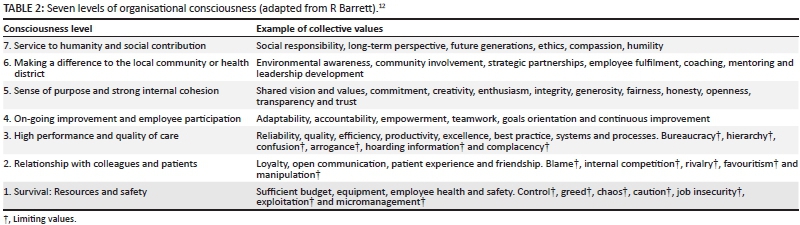
In the model developed by Richard Barrett the values selected in the survey can also be assigned to seven different levels of organisational consciousness (Table 2). The seven levels of consciousness were originally developed from Maslow's hierarchy of needs, and the distribution of values provides insight into what the organisation currently needs from its employees and what the employees need the organisation to focus on in the future. A well-functioning organisation will have positive values across all the levels.11,12,15 In the bottom three levels there can be both limiting as well as positive values. Limiting values are values which are usually detrimental to the functioning of the organisation and limit the organisation's performance. In the model the total percentage of all values chosen that are potentially limiting values corresponds to the organisational entropy, which is a measure of the amount of dysfunction and wasted energy in the system.12,15
Setting
The research was performed in the health districts of Ngamiland (population: 96 356) and Mahalapye (population: 117 492), which are serviced by 29 and 40 primary care facilities (clinics and health posts) respectively. According to the 2011 National Health Policy, 80% of the Botswana population use public health services.13
The DHMT is led by a head, who is usually a doctor with public health training, with heads of preventive, curative and corporate services reporting to him or her, whilst he or she reports to the Deputy permanent secretary, clinical services. The clinic clusters are managed by cluster heads who are nursing officers based at the larger clinics. Each clinic in turn is managed by a nursing sister-in-charge, who reports to the cluster heads. The majority of the HCWs employed at these clinics and health posts are nurses and midwives with small numbers of pharmacy technicians, social workers, health education assistants and medical officers (generalist doctors). The doctors are based at the larger clinics and support the smaller facilities through regular outreach.
Study population
All the primary HCWs in Ngamiland and Mahalapye health districts were eligible to participate in the survey, whereas support staff, such as drivers and cleaners and HCWs based in hospitals, were excluded. The research teams visited most primary care facilities to deliver the survey forms and for those facilities that were not visited the forms were given to the cluster heads. The plan was to recruit all consenting health workers on duty in the facilities during the two weeks of data collection. All the HCWs on duty during the two weeks of data collection were invited to complete the survey. Cluster heads were also invited to complete the survey as they are also based in the primary health care facilities.
Data collection
The questionnaire was a standardised and validated tool developed by the Barrett Value Centre.16
Data analysis
The Barrett's Value Centre analysed the data and provided the study team with the results and a report. The results were descriptive and provided the numbers and frequencies for the selected values. The results were presented in figures and words and mapped to the seven levels of organisational consciousness.
The results were presented to the HCWs in each district in order to explore the meanings of the selected values. They were also presented to the Ngamiland District Health Management Team and cluster heads as part of the input into the cooperative inquiry process.
Ethical consideration
Approval to conduct the study was given by the University of Botswana Institutional Review Board, the Ngamiland District Ethics Committee, the Stellenbosch University Health Research Ethics Committee (Protocol Number: S13/03/051) and the Botswana Ministry of Health, Health Research Development Committee (Reference No: PPME 13/18/1 V11 (368)). Written consent was obtained from each study participant.
Results
Demographical data
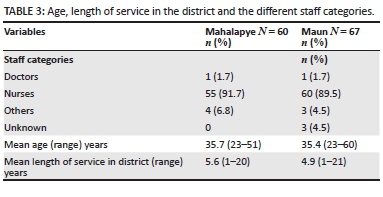
In Mahalapye, 60 primary HCWs on duty during the data collection period completed the survey compared to 67 in Ngamiland (Table 3). All those on duty during the data collection period agreed to participate in the survey, although one form from Mahalapye and five from Ngamiland were incomplete and therefore excluded from the data analysis. The health workers were recruited from 25 of Mahalapye's 40 (63%) clinics and health posts and 19 of Ngamiland's 29 (66%) primary care facilities. The majority of participants were female in Ngamiland (64%) and Mahalapye (66%).
Most of the HCWs in primary care in these districts were nurses (Table 3). The staff category labelled 'others' included social workers, pharmacists and health education assistants. Health education assistants are specifically trained for 18 months to be a link between primary care facilities and the community.
Ngamiland health district values
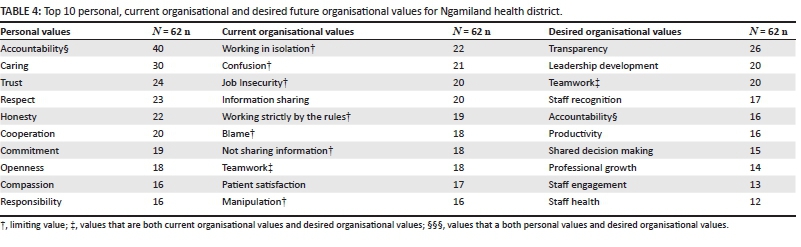
Table 4 shows the top 10 values in rank order for the Ngamiland respondents' personal values, current experience of the organisation and desired future experience of the organisation. The values in italics are personal values that were also desired organisational values and those in bold were current organisational values that health workers wanted to continue to experience in the future. None of the personal values were currently experienced in the organisation.
Seven of the top 10 current organisational values were potentially limiting (marked with L) and only three were positive (Table 4). When all the limiting values were analysed there was a cultural entropy rate of 36%, which is a high level of entropy 'requiring cultural and structural transformation, and leadership development'.10
There were no limiting values amongst the top 10 desired organisational values. These include only one currently experienced organisational value, teamwork, and one personal value, accountability (Table 4).
Mahalapye health district values
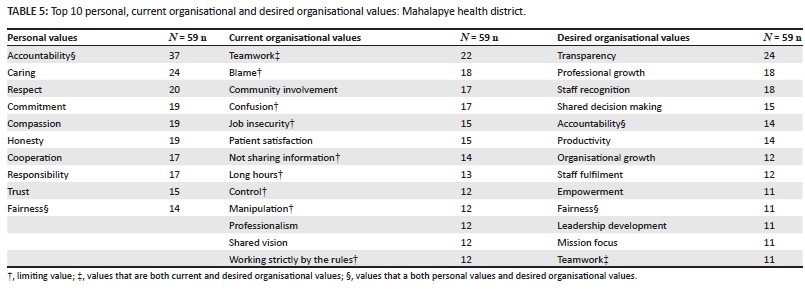
Table 5 shows the top 10 values in rank order for the Mahalapye respondents' personal values, current organisational and desired future organisational values. The values in italics were personal values that were also desired organisational values and those in bold were current organisational values that health workers wanted to continue to experience in the future. None of the personal values were currently experienced in the organisation.
Eight of the current organisational values were potentially limiting (marked with L) and five were positive. When all the limiting values are analysed there was a high cultural entropy rate of 32%.
None of the top 10 desired organisational values were potentially limiting. Teamwork was the only desired value currently experienced in the organisation. Two of the top 10 personal values, accountability and fairness, were desired for the future organisation (Table 5).
Comparison of Mahalapye and Ngamiland health district values
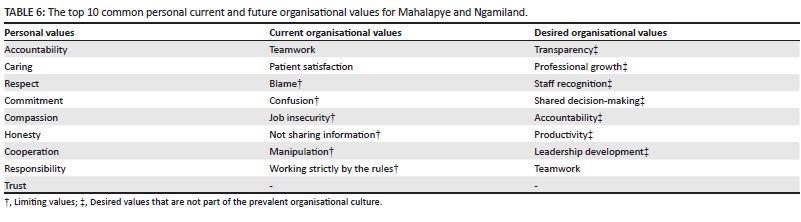
Primary HCWs in Mahalapye and Ngamiland share nine common personal values (Table 6) and two dissimilar values, namely, fairness (Mahalapye) and openness (Ngamiland).
Eight of the top 10 values in the current culture were also shared by the two districts. These included two positive values and six limiting values, as shown in Table 6. Working in isolation was another potentially limiting value currently experienced in Ngamiland whilst long hours and control were experienced in Mahalapye. Furthermore, Mahalapye had the following positive values: community involvement, shared vision and professionalism compared with information sharing for Ngamiland. None of the personal values of the health workers were experienced in either district.
The primary HCWs in Ngamiland and Mahalapye also shared 8 of the top 10 desired organisational values (Table 6). These included seven new (bold) values and one that is currently experienced in both districts. Moreover, Mahalapye health workers also selected the following desired values: organisational growth, staff fulfilment, empowerment, fairness and mission focus, whilst those in Ngamiland chose staff health and staff engagement.
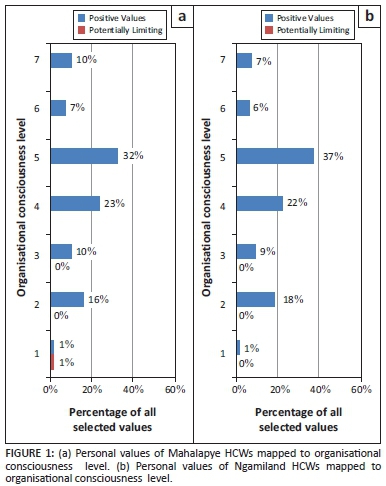
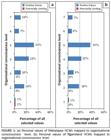
Figure 1 shows the percentages of all personal values of HCWs in Mahalapye and Ngamiland according to the level of organisational consciousness. HCWs in the two districts had almost identical distributions of personal values that were concentrated at Level 5 followed by Levels 4 and 2.
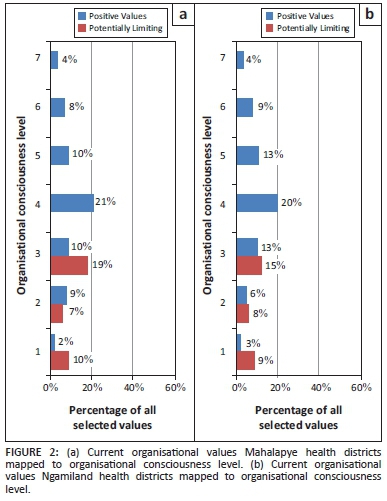
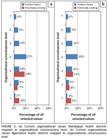
The distribution of current organisational values for the two districts was concentrated at Level 3 (Figure 2). The employees' experience of the organisations at this level was largely negative. The organisations were experienced as bureaucratic and people felt confused, isolated and needed more information. This was followed by Level 4 with an organisational emphasis on teamwork and Level 2 with a positive focus on relationships with patients, but a negative experience of relationships in the organisation due to a sense of being both blamed and manipulated. At Level 1 there was also a concern about job security.
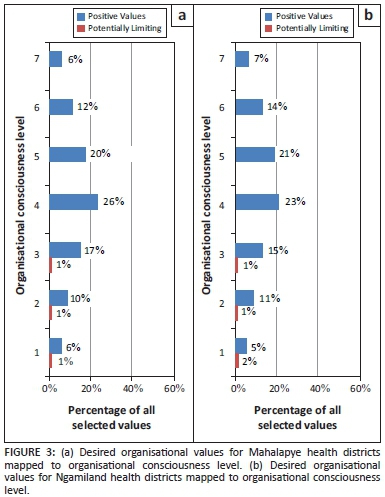
The distribution of the desired values for the two districts was similarly concentrated at Level 4 with a need for more accountability and shared decision-making, followed by Level 5 with a call for more transparency to build alignment and internal cohesion (Figure 3). Level 3 represented a positive commitment to improved productivity and professional growth. The other levels suggested a need for more attention to staff welfare and more recognition of the work they were doing as well as a call for development of the leadership within the organisation.
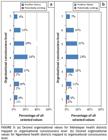
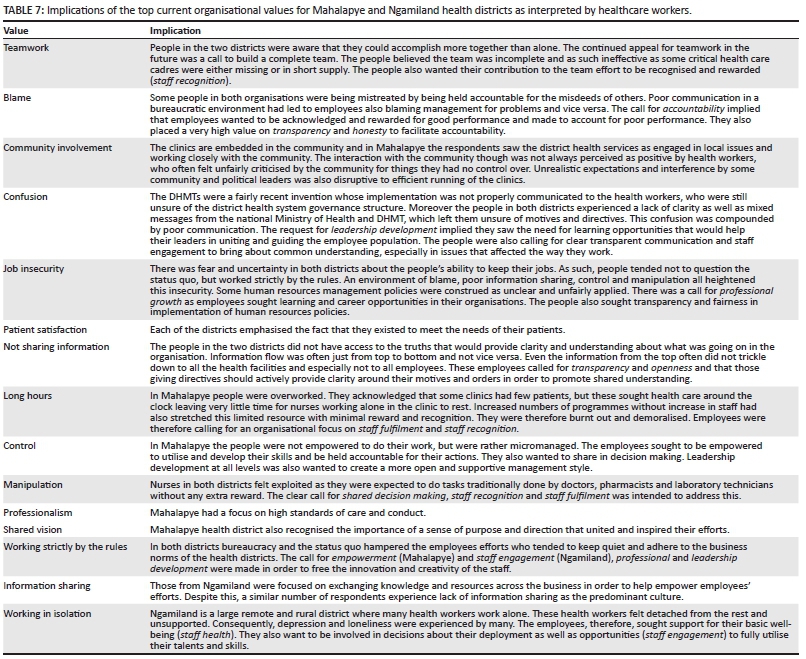
Table 7 summarises the feedback from the health workers in both districts on their interpretation of the values seen in the current organisational culture. 'The current organisational values reflect the employees' perceptions of what their organisation focuses on and how it behaves. These attributes provide a picture of the working environment, the positive aspects of the business, and its potential problem areas. These are a description of what the situation is between these groups at this point in time'.11,12
Discussion
This study has investigated the personal values of the HCWs in the Mahalapye and Ngamiland health districts as well as the perceived current and desired organisational culture of the health districts. Organisational culture has been strongly linked to employee satisfaction and organisational commitment and hence their retention.17
The results of this study showed that the HCWs' personal values were focused on demonstrating ownership for their actions, being truthful and trustworthy. They also placed emphasis on fostering kind and supportive interactions with the people around them. The prevailing culture in the districts, on the other hand, was predominantly perceived as potentially limiting and likely to cause frustration amongst employees and hinder organisational performance. None of the personal values of the HCWs were currently experienced in either district where a culture of blame, control, manipulation, poor communication and working strictly by the rules dominated. HCWs in both districts additionally experienced high levels of job insecurity. It is also notable that more than a third of the current organisational values were perceived as constraining organisational performance. The incongruence between personal and organisational values is likely to negatively affect job satisfaction, performance and organisational commitment.12,17
The personal values of the primary HCWs in the two health districts in Botswana were almost identical to their counterparts in the Cape Town primary care services where the primary health care services were also equally experienced as negative with levels of entropy above 30%.18 19
With the exception of teamwork and customer focus (patient satisfaction), the current organisational values were not aligned to the espoused values of the national Ministry of Health and district health services of botho [kindness, compassion, respect], integrity, timeliness and accountability.14208,10,11,12
Primary care workers in the two districts desire organisational transformation that concentrates on building a sense of shared purpose, internal community and employee participation. They were in agreement that a more supportive and innovative culture with a focus on transparency, professional growth, staff recognition, shared decision-making, accountability, productivity and leadership development should replace the current largely limiting culture. The HCWs also wanted to see teamwork continue as part of the future culture of the district health services. A more supportive and innovative culture together with considerate supportive supervisors has been associated with increased job satisfaction and organisational commitment.172122 18
Botswana's human resources for health are heavily skewed towards cities and hospital care, displaying an 'inverse care law,'23,24 despite the national Ministry of Health and the district health systems espoused value of equity.14
The response rates were relatively low, but the study captured the views of all the different health care cadres working in two thirds of the health facilities of each district. The study was conducted in two of the 27 health districts in the country, which means the findings may not be applicable to the rest of the health system. The concordance in the personal and perceived organisational values in these two dissimilar districts, however, suggests that similar findings may be elicited in other health districts. The very strong similarity and distribution of the values and culture with Cape Town primary care services also suggests that this state of affairs may be prevalent in the region.
Conclusion
The primary HCWs in Mahalapye and Ngamiland health districts perceive the organisational culture of the health districts to be mostly limiting organisational effectiveness. The health workers personal attributes were strongly correlated with the transformed culture they desired to see in their health districts, reflecting personal capacity to effect the changes. The employees' personal attributes and those they want to see in the future transformed organisation are in keeping with what is known about organisational cultures and leadership styles that create employee satisfaction, organisational commitment and retention. Transformation of the leadership from a bureaucratic controlling style focused on keeping the status quo to a more supportive type is urgent in order to restore employee trust and retain them in primary care.
There is an urgent need for organisational transformation of the health care services at the district and national levels to translate the espoused organisational values to the felt culture. This transformation should accentuate employee experience with an emphasis on accountability, transparency, professional growth, staff recognition and shared decision making. Opportunities for professional growth as well as employee recognition are well known to improve health care worker motivation and retention.
Leadership have the greatest influence in creating and sustaining the prevailing organisational culture. Leadership development is therefore imperative at all levels of the health system for organisational transformation to succeed.
Implementation research to explore whether developing more supportive leaders will improve employee motivation and retention is required. Additionally, investigation of aspects of organisational transformation that will significantly impact staff motivation and retention in the Botswana primary health care services will need to accompany the transformation.
Competing interests
The authors declare that they have no financial or personal relationship(s) that may have inappropriately influenced them in writing this article.
Authors' contributions
O.N. (University of Botswana, School of Medicine) conceptualised the project, collected and drafted the manuscript. R.M. (Stellenbosch University) guided the conceptualisation of the project, facilitated the data analysis, reviewed the draft manuscript and approved the final version. N.P. (University of Botswana, School of Nursing) reviewed the manuscript and approved the final version.
Acknowledgements
This work is part of the Human Resources for African Primary Care and is supported through the European Union's FP7 programme, grant agreement no. 265727: http://www. huraprim-project.eu. The researchers acknowledge the facilitation of the research from the Ministry of Health, Ngamiland and Mahalapye DHMTs. The team want to thank Mr Pilatwe Pilatwe, Mrs Tlotlo Thutoemang and Miss Seonyatseng Moseki for collecting the data for this study.
References
- 1. World Health Organization. Primary care: Now more than ever, 2008 World Health Report. Geneva: World Health Organization Press; 2008.
- 2. Nkomazana O, Peersman W, Willcox M, Mash R, Phaladze N. Human resources for health in Botswana: The results of in-country database and reports analysis. Afr J Prim Health Care Fam Med [serial on the Internet].
- 2014;6(1):E1-E8. PMID: 26245420, http://dx.doi.org/10.4102/phcfm.v6i1.716
- 3. World Health Organization. The world health report 2006 - Working together for health. Geneva: World Health Organization Press; 2006.
- 5. Bonenberger M, Aikins M, Akweongo P, Wyss K. The effects of health worker motivation and job satisfaction on turnover intention in Ghana: A cross-sectional study. Hum Resour Health [serial on the Internet].
- 2014;12:43. PMID: 25106497, http://dx.doi.org/10.1186/1478-4491-12-43
-
6. Nkomazana O, Mash R, Shaibu S, Phaladze N. Stakeholders' perceptions on shortage of healthcare workers in primary healthcare in Botswana: Focus group discussions. PLoS One. 2015;10(8):e0135846. PMID: 26284617, http://dx.doi.org/10.1371/journal.pone.0135846
» http://dx.doi.org/10.1371/journal.pone.0135846 - 7. Manafa O, McAuliffe E, Maseko F, Bowie C, MacLachlan M, Normand C. Retention of health workers in Malawi: Perspectives of health workers and district management. Hum Resour Health [serial on the Internet].
- 2009;7:65. PMID: 19638222, http://dx.doi.org/10.1186/1478-4491-7-65
-
8. Rowe AK, de Savigny D, Lanata CF, Victora CG. How can we achieve and maintain high-quality performance of health workers in low-resource settings? Lancet. 2005;366:1026-1035. PMID: 16168785, http://dx.doi.org/10.1016/S0140-6736(05)67028-6
» http://dx.doi.org/10.1016/S0140-6736(05)67028-6 -
9. Willis-Shattuck M, Bidwell P, Thomas S, Wyness L, Blaauw D, Ditlopo P. Motivation and retention of health workers in developing countries: A systematic review [homepage on the Internet]. BMC Health Serv Res. 2008;8:247. PMID: 19055827, http://dx.doi.org/10.1186/1472-6963-8-247
» http://dx.doi.org/10.1186/1472-6963-8-247 - 11. Eneroth T, van Meer P, Jiang N, Clothier P, Infer H. Get connected: A practical guide to grow a desired team culture [homepage on the Internet].
- 2013 [cited 2015 Feb 18]. Available from: http://www.valuescentre.com/sites/default/fi1es/uploads/2013-05-13/Get%20Connected_2013.pdf
- 12. Barrett R. Building a values-driven organization: A whole system approach to cultural transformation. Oxford: Butterworth-Heinemann; 2006.
-
2011 [cited 2015 Mar 19]. Available from: http://www.moh.gov.bw/Publications/policies/revised_national_health_policy.pdf
» http://dx.doi.org/10.3399/bjgp14X680089 - 14. Ministry of Health. Integrated health services plan: A strategy for changing the health sector for a healthy Botswana 2010-2020 [homepage on the Internet].
- 2010 [cited 2015 Mar 12) Available from: http://www.moh.gov.bw/Publications/policies/Botswana%20IHSP%20Final%20HLSP.pdf
- 15. Cultural capital: The new frontier of competitive advantage [homepage on the Internet].
- [cited 2013 Jun 20]. Available from: http://www.valuescentre.com/
- 16. Barrett's Value Centre [homepage on the Internet].
- [cited 2013 Jun 20]. Available from: http://www.valuescentre.com/
- 17. Lok P, Crawford J. The effect of organisational culture and leadership style on job satisfaction and organisational commitment: A cross-national comparison. JMD [serial on the Internet].
- 2004;23:321-338. http://dx.doi.org/10.1108/02621710410529785
-
18. Mash RJ, Govender S, Isaacs AA, De Sa A, Schlemmer A. An assessment of organisational values, culture and performance in Cape Town's primary healthcare services. S Afr Fam Pract. 2013;55:459-466. http://dx.doi.org/10.1080/20786204.2013.10874396
» http://dx.doi.org/10.1080/20786204.2013.10874396 - 2009;4:43. PMID: 19627590, http://dx.doi.org/10.1186/1748-5908-4-43
- 20. Western Cape. Department of Health. Vision 2020 [homepage on the Internet].
- Cape Town: Department of Health; 2011 [cited 2015 Apr 1]. Available from: https://www.westerncape.gov.za/other/2011/12/healthcare_2020_-_9_december_2020.pdf
- 21. Krogstad U, Hofoss D, Veenstra M, Hjortdahl P. Predictors of job satisfaction among doctors, nurses and auxiliaries in Norwegian hospitals: Relevance for micro unit culture. Hum Resour Health [serial on the Internet].
- 2006;4:3. PMID: 16483384, http://dx.doi.org/10.1186/1478-4491-4-3
- 22. McAuliffe E, Bowie C, Manafa O, et al. Measuring and managing the work environment of the mid-level provider - The neglected human resource. Hum Resour Health [serial on the Internet].
- 2009;7:13.PMID: 19228391, http://dx.doi.org/10.1186/1478-4491-7-13
-
24. Hart JT. The inverse care law. Lancet. 1971;1:405-412. PMID: 4100731, http://dx.doi.org/10.1016/S0140-6736(71)92410-X
» http://dx.doi.org/10.1016/S0140-6736(71)92410-X

Accepted: 17 Sept. 2015
Published: 30 Nov. 2015