Barriers to adolescents' access and utilisation of reproductive health services in a community in north-western Nigeria: A qualitative exploratory study in primary care
Abstract
BACKGROUND: There is a dearth of qualitative studies exploring in-depth barriers that adolescents face in accessing and utilising reproductive health services (RHS) in Nigerian primary healthcare centres. AIM: This study explored the barriers hindering adolescents' access to and utilisation of RHS in primary healthcare centres. SETTING: This study was conducted in three primary healthcare centres in Kaduna North Local government area, Nigeria. METHODS: This study used an exploratory descriptive qualitative design. Fourteen adolescents and three RHS providers were selected and interviewed. The data collection methods included individual in-depth interviews with adolescents and key informant interviews with service providers. Interviews were conducted between January 2017 and April 2017. Thematic content analysis was used to analyse the data. RESULTS: This study identified three thematic barriers to adolescent's utilisation of RHS. These included individual, social and health system barriers. Individual factors included the following: inadequate knowledge about RHS and poor attitudes of adolescents towards RHS; social factors such as parental influence, community and religious norms, financial constraints and stigma; and health system factors such as poor attitudes of service providers and inconvenient health facility opening hours hindered adolescents from utilising RHS. Most prominent was the strong influence of the social factors that affected adolescents to the extent that they felt constrained to freely utilise RHS out of a sense of commitment to religious values. CONCLUSION: The findings highlight the need for the development of programmes that would foster collective responsibility for supportive environments within communities and health facilities for positive adolescent RHS experiences.
sexual and reproductive health services; adolescents; access and utilisation; barriers; qualitative study; Nigeria
Introduction
The World Health Organization (WHO) defines adolescents as young people between the age of 10 and 19 years, and they constitute about a sixth of the world's population.12,345667
In Nigeria, a significant population of adolescents is sexually active (with nearly half [48.6%] of adolescents aged 15-19 years being sexually active) and involved in unprotected sexual activities with multiple partners, exposing them to negative reproductive health consequences.8,9101010111213
Adolescent-friendly RHS (where adolescents are treated with respect and their confidentiality maintained) have been largely lacking in the country, especially in rural areas.14128,15
There is a dearth of qualitative studies exploring barriers that affect adolescents' utilisation of RHS in Nigeria. Prior studies have reported an increased understanding of the challenges that adolescents face while accessing or utilising of RHS using a qualitative exploratory approach.16
Methods
Study design
An exploratory descriptive design was used for this study and was appropriate for understanding in greater depth the experiences, perceptions and feelings of adolescents regarding barriers influencing adolescent access to and utilisation of the RHS in their local context.17
Setting
This study was conducted in three urban government primary healthcare centres in Kaduna metropolis North-western Nigeria between January 2017 and April 2017. Kaduna North local government area (LGA) has an area of 72 km2
Selection of participants
This study drew on two study populations: (1) male and female adolescents between the ages of 15 and 19 years residing in and attending the primary healthcare centres in Kaduna LGA; (2) service providers of RHS at the selected primary healthcare centres.
Three primary healthcare centres were purposively selected in the LGA based on their proximity to schools. Even though purposive sampling would have been preferred, convenience sampling was used to select the first 14 adolescents (5 males and 9 females) between the ages of 15-19 years who were attending the primary healthcare centres between January and April 2017 to seek any health services. When the researcher attempted to recruit adolescents coming specifically for RHS, attendance was poor and therefore she resorted to recruiting from adolescents attending the primary healthcare centres who had accessed RHS at some point in time. A total of 14 in-depth interviews were conducted because the researcher was satisfied that saturation point had been reached. Three nurses were purposively sampled (one from each primary healthcare centre) for key informant interviews (KII). These were nurses who had worked for at least 2 years providing RHS.
Data collection
Data collection methods included individual semi-structured individual interviews with adolescents and KIIs with the RHS providers. All interviews were conducted by the principal researcher (a community health physician with expertise in qualitative research) after discussing the study protocols with eligible participants. Interview guides were used for interviews which consisted of open-ended questions covering adolescent's knowledge of and perceptions about RHS, their experiences with the RHS offered and the barriers encountered (Box 1).

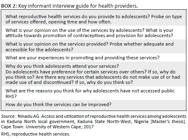
Healthcare providers were interviewed about their perceptions about the quality of RHS provided and the barriers adolescents faced in accessing RHS (Box 2).
The interviews were conducted in a private room at the clinic and each interview took between 20 and 60 minutes. All interviews were audiotaped with the participant's permission and conducted in English as the participants were all conversant in English. The recorded interviews were transcribed verbatim. Trustworthiness was applied in this current study by paying attention to credibility, dependability and transferability.19
Data analysis
The transcribed data were analysed using thematic analysis which included (1) familiarisation with the data, (2) generating initial codes, (3) searching for themes, (4) reviewing themes and (5) defining and naming themes.18
Ethical consideration
Ethical approval was obtained from the University of the Western Cape Biomedical Research Ethics Committee (Ethics number-130416-050) and the Kaduna State Ministry of Health Ethics Committee. Informed written consent was obtained from adolescents aged 18 years and above, service providers and parents or guardians of adolescents younger than 18 years. Assent was obtained from the adolescents younger than 18 years. The parents of these younger adolescents consented to the study because they were aware that their wards were already receiving HIV-treatment services.
Results
Characteristics of the participants
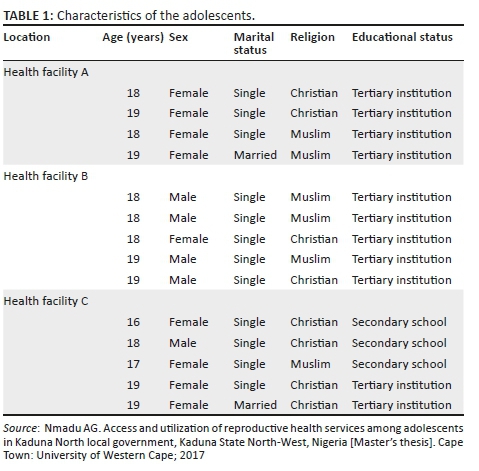
Individual interviews were conducted with nine females and five males aged 15-19 years. Of the 14 adolescents, two were married and were females, three were in secondary school, while 11 were at various levels in tertiary institutions. Based on religious affiliation, eight were Christians and six Muslims (Table 1).
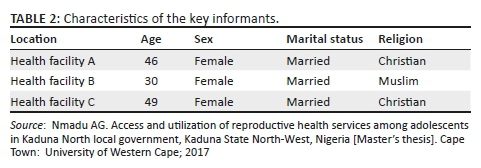
The healthcare providers were nurses and all were women (Table 2).
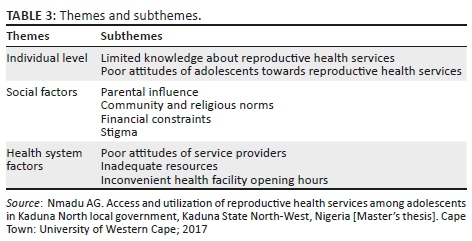
The emerging themes revealed three distinct levels of influencing factors: individual, community and health system-level factors (Table 3).
Individual-level factors
Apart from the two married adolescents, most of the adolescents had limited knowledge of the different types of RHS available at health facilities. The most commonly used method of contraception was condoms, followed by contraceptive pills. There was poor knowledge about other methods of contraception among this group of adolescents:
'Mostly, we guys use condoms to prevent conception from taking place … that is what we are familiar with and comfortable with.' (Male, 18 years, single, Muslim)
The adolescents across religious affiliations generally displayed negative attitudes towards premarital sex and also the use of contraceptives because that was meant to be the norm. The majority of them did not consider sexual relationships acceptable at their age and therefore felt that contraception should be for married people, which deterred them from accessing such services:
'The one [RHS] on sexual intercourse is not good for adolescents like us … condoms are good for some people but not for me because we are not up to age for sexual activities. It's not meant for us, it's meant for adults … husbands and wives [married people].' (Female, 16 years, single, Christian)
Some of the adolescents feared to discuss their sexual health problems with anyone, while others felt more comfortable discussing RH issues with their friends rather than consulting staff at the clinics. Experiences of embarrassment also featured prominently as reasons why adolescents did not access RHS:
'I felt very shy and embarrassed during the process of taking the [vaginal] swab.' (Female, 18 years, single, Muslim)
The findings also showed that when faced with RH problems, some adolescents delayed taking action and only did so when these problems persisted or became serious. This was to avoid stigmatisation from family and the community based on prevalent social and cultural norms.
Community-level factors
Both the adolescents and nurses identified cultural and religious norms as the most significant barriers that affected adolescents' access to and utilisation of RHS. Cultural taboos were reported to prevent adolescents from openly discussing sex and reproductive health issues:
'Adolescents do not normally talk freely to each other about contraceptives, it is a very secretive matter, and it is not culturally acceptable.' (Female, 18 years, single, Muslim)
The adolescents admitted that religious beliefs inhibited discussions about and the utilisation of contraceptives among adolescents:
'Like cases like contraceptives, the religion [Islam] does not allow it [the use of contraceptives], … or as an adolescent, you bring up the issue of contraceptives, and they will say you are spoilt [immoral], where did you learn it from?.' (Female, 18 years, single, Muslim)
These beliefs made the adolescents themselves feel guilty when engaging in sexual activity and also when accessing RHS.
'Like one of the pastors said, sexual intercourse before marriage is like robbery because you are stealing. It's only when it is legal i.e. when you are married that you'll require such [SRH] services.' (Male, 18 years, single, Christian)
Female participants also expressed a preference for a service provider of the same sex, which was mainly influenced by cultural norms and negatively influenced their health-seeking behaviour. They were usually distressed when they had to be attended to by service providers:
'My parents told me that I should never allow a man to touch me, so if I know that it is a male doctor in the hospital then I will never go there, it is better I die in silence.' (Female, 18 years, single, Christian)
'Yes, it is a big issue because many husbands would not want their wives to be examined by a male health worker and I prefer also to be seen by a female health worker.' (Female, 19 years, married, Muslim)
Access to RHS was also related to the socio-economic background of the family. Some of the adolescents mentioned transportation costs and the ability to pay for services as barriers to accessing RHS:
'My dad is the one that gives me transport money whenever I want to go to the health facility. When my dad doesn't have money, I don't go.' (Female, 16 years, single, Christian)
'They [the husbands] complain about the financial burden, which they can do without … Some of them discourage the young woman [from accessing care] because they want to avoid the expenses of giving them money to buy drugs [medication].' (Female, 19 years, married, Muslim)
Health workers also affirmed that culture and religion affect utilisation of RHS by adolescents, but they all unanimously agreed that these services are important for adolescents:
'The very first thing that comes readily to me is culture. It is the kind of setting we have found ourselves. You grow up in a house where everybody is saying don't do this-don't do this [have sex], it is wrong to do this, so culture one. Secondly, is religion, we are very religious openly, but we pretend a lot, so that's second. Then thirdly, there is this issue of stigma, I don't want to be labelled as having had abortion. I have issues with infection …, but then, my parents or anybody I meet in the hospital will say 'she is sexually active' and it is unheard of that I am not marry but I am having sex, but we do [it happens].' (Health worker, 46 years, Christian)
'Also, you know [for] some their religion does not encourage adolescents using contraceptives. Again, others may think people are watching them to see what they are doing in the reproductive health clinic, and so would not want to be seen in a negative light for coming to access reproductive health services.' (Health worker, 49 years, Christian)
'All [reproductive health] services are good for them [adolescents]. You tell them the implication of what you are doing [risk taking behaviour], because in life, as children grow, they are exposed to drugs, sex and other things.' (Health worker, 46 years, Christian)
'To me, it is good to promote and provide it [contraception services] for adolescents and the reason I say this is that if you don't do it at your back they will do.' (Health worker, 30 years, Muslim)
One of the providers expressed her personal thoughts that though abstinence is best for adolescents, those who cannot abstain should be provided with contraceptives:
'For those that cannot endure [abstain from sex], for such children if they are not advised about family planning, their lives are at risk. So, to be on the safe side we invite the parents and have private discussions with them and if they consent, we provide them [the adolescents] with family planning services.' (Health worker, 49 years, Christian)
Health system-level factors
Adolescents raised concerns about lack of privacy and confidentiality at the primary healthcare centres they are not comfortable where members of the community can see them:
'Well … because of what people will say adolescent don't usually go to health facilities before you know it tomorrow the whole town will get to know what you went to see the doctor for. In cases of contraceptives or family planning, you will also have to go to where nobody knows you or you have to access them on your own without prescription [from a hospital].' (Female, 18 years, single, Christian)
'I would like to see a society where adolescents can access reproductive health services without having to think about what she is going to go through, what she is going through, who is going to look at her, who is going to insult her because she knows that everything that is going on is going to be between her and her doctor and is going to be confidential.' (Female, 18 years, single, Christian)
Healthcare workers also confirmed the perceptions of adolescents about confidentiality:
'Before they were not coming freely, but since now it is something that is confidential, they just come straight to me and I give them the health talk and they collect what they want to collect, most of them collect condoms.' (Health worker, 49 years, Christian)
The adolescents complained about the negative attitude and behaviour of health service providers. This included unfriendly and hostile behaviour and not being considerate:
'Health workers have a negative attitude towards unmarried adolescents' use of family planning, they frown at it.' (Female, 19 years, single, Christian).
One health worker also affirmed that being harsh is a turn off for adolescents.
'[Y]ou know a child will never come out to say what he is doing especially when you follow him in a harsh way, but when you follow him with petting, you will get him to tell you the truth.' (Health worker, 30 years, Muslim)
Some adolescents and the service providers identified the inconvenient opening hours of the clinics as a major hindrance to adolescents accessing RHS. Adolescents complained that the opening hours of the health facilities coincided with the times that they were at school:
'I don't know if they [health workers] can talk to the patients to ask what timing is convenient for them and also make some of the clinic days evening hours like for those of us going to school. Some of us usually miss school whenever it is clinic day.' (Female, 19 years, single, Christian).
Some adolescents also complained of instances where they had gone to access RHS, but did not receive the medications prescribed to them because the medications were not available:
'My concern is the medicine. There was a time I came and I couldn't get any medication. I was prescribed, and I went out to buy for myself.' (Male, 18 years, single, Muslim)
The nurses also identified the lack of infrastructure, equipment and educational materials to keep adolescents engaged while attending the clinic:
'The main problem we have is lack of space, but if we have enough space and adolescents can be directed to access services in one place separate from the adults and privacy can be ensured, it is going to be very pleasant and ok.' (Health worker, 46 years, Christian)
'Provisions need to be made for audio-visual educational materials, TVs, infrastructures, equipment, games …' (Health worker, 49 years, Christian)
The nurses identified the lack of staff as another challenge to the provision of adequate services for adolescents:
'There is the issue of inadequate staffing, which puts a lot of strain on the health worker and does not allow us to dedicate enough time when attending to adolescents.' (Health worker, 30 years, Muslim)
Discussion
This study showed that 14.2% of adolescents were married which is not far from the national value of 11.5% of adolescents who were currently married based on the Nigeria Demographic and Health Survey (NDHS) of 2018.10
This study identified barriers to adolescents' access to RHS across individual, community and health system contexts. These interrelated factors identified in this study negatively influenced the adolescents' access to and utilisation of RHS. At the individual level, limited knowledge of adolescents about the types of RHS available, adolescents' negative attitudes towards the use of contraceptives and certain behaviours of the adolescents themselves created barriers to their use of RHS. Such behaviours included shyness, not being comfortable with a health provider of the opposite sex, fear of discussing their sexual health problems and delay in seeking care. Reports from previous studies have also identified some of these barriers. For example, a study conducted in the Lao People's Democratic Republic reported adolescents' limited knowledge about available RHS which constituted a barrier to their use of RHS.20621
A study conducted in Pakistan reported adolescents who expressed fear about discussing their sexual health problems with anyone.2223,2425
The literature has shown that in many African communities individual behaviour is strongly influenced by family norms.2326,2728
The WHO has recommended for global standards of quality healthcare services for adolescents. These include provision of adolescents with information about their health and where and when they can obtain health services; ensuring that parents and community members support the provision of health services to, and their utilisation by adolescents; provision of in-facility services, referrals and outreaches that fulfil the needs of all adolescents; demonstration by providers of the technical competence required to provide effective health services to adolescents; facilities operating convenient operating hours, having a welcoming environment and the required equipment and supplies needed to ensure effective service provision to adolescents; facilities collecting, analysing and using data on service utilisation and quality of care for quality improvement; and finally involving adolescents in the planning, monitoring and evaluation of health services and in decisions regarding their own care.29
The findings of the current study highlight the importance of the creation of a conducive social environment that is supportive of ASRH services with interventions focusing not exclusively on adolescents but also family and community norms around ASRH. There is a need to build relationships between adolescents and their parents who support and reinforce positive health-related behaviours of adolescents. Interventions can be implemented that target parents of adolescents such as parental education on parent-child communication and ASRH issues. A descriptive review of the effectiveness of initiatives to improve adolescents' utilisation of ASRH services in low-income countries concluded that programmes that promote access to and uptake of ASRH services are most effective when adolescent-friendly facility-based approaches are combined with community acceptance and demand-generation activities.16
The negative attitudes and behaviour of health workers seemed to reflect the attitude of the community. This contributed to adolescents in this study avoiding RHS at health facilities for fear of being reprimanded and misjudged. Previous studies have similarly reported about the negative effects of health professionals' attitudes in hindering on adolescents' utilisation of RHS. For example, a study conducted in Kwazulu-Natal, South Africa and a review of evidence regarding the attitude of health workers towards adolescent SRHS in developing countries reported hostile and judgmental attitude of health workers as deterrents to adolescents' use of the services.30,3116,3233,3435
Limitations of the study
Some limitations were encountered in this study; given the qualitative nature of the study, the findings could not be generalisable to the entire population of adolescents in Kaduna because of the small sample size as the participants may differ from other populations and those who chose not to participate in the study. For instance, the level of tertiary education of the general population in Nigeria is 8.8%, while that of adolescents aged 15-19 years is 2.2%.10
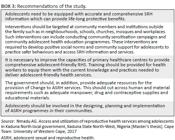
Based on the study findings the authors proposed recommendations summarized in Box 3.
Conclusion
The adolescents' experiences in Kaduna of accessing and utilising SRHS were influenced by factors located within the adolescents and also beyond what they could control. They encountered barriers to utilisation of RHS which emerged across the three specified levels of the individual, social and health system-level factors. Adopting interventions that could address these interrelated factors can go a long way to strengthen services tailored to the needs of adolescents as well as address their SRH needs and rights. Future research is necessary for programmes that target adolescents within the community to provide community-based reproductive health education and culturally sensitive services.
Competing interests
The authors have declared that no competing interests exist.
Authors' contributions
A.G.N. was responsible for conceptualisation, design of the study, data collection, data analysis and drafting of the manuscript. S.M. was the research supervisor and guided the whole process from conceptualisation, proposal writing and data collection, including the critical review of the article. N.O.U. was involved in data collection, data analysis and approval of the final version.
Funding information
This study was part of a Master of Public Health (MPH) dissertation and the author(s) received no financial support for the research.
Data availability statement
Data are available from the corresponding author upon request.
Disclaimer
The views and opinions expressed in this article are those of the authors and do not necessarily reflect the official policy or position of any affiliated agency of the authors.
Acknowledgements
The authors thank the participants for taking time to share their experiences with them.
References
-
1.World Health Organization. Adolescents: Health risks and solutions [homepage on the Internet]. 2018 [cited 2017 May 01]. Available from: http://www.who.int/news-room/fact-sheets/detail/adolescents-health-risks-and-solutions
» http://www.who.int/news-room/fact-sheets/detail/adolescents-health-risks-and-solutions -
2.Hale DR, Viner RM. The correlates and course of multiple health risk behaviour in adolescence. BMC Public Health 2016;16(1):458. https://doi.org/10.1186/s12889-016-3120-z
» https://doi.org/10.1186/s12889-016-3120-z -
3.World Health Organization. Adolescent mental health [homepage on the Internet]. 2018 [cited 2020 Apr 20]. Available from: https://www.who.int/news-room/fact-sheets/detail/adolescent-mental-health
» https://www.who.int/news-room/fact-sheets/detail/adolescent-mental-health -
4.Morris JL, Rushwan H. Adolescent sexual and reproductive health: The global challenges. Int J Gynaecol Obstet. 2015;131(21):S40-S42. https://doi.org/10.1016/j.ijgo.2015.02.006
» https://doi.org/10.1016/j.ijgo.2015.02.006 -
5.Chandra-Mouli V, Svanemyr J, Amin A, et al. Twenty years after International Conference on Population and Development: Where are we with adolescent sexual and reproductive health and rights? J Adolesc Health. 2015;56(1): S1-S6. https://doi.org/10.1016/j.jadohealth.2014.09.015
» https://doi.org/10.1016/j.jadohealth.2014.09.015 -
6.World Health Organization. Adolescent-friendly health services: An agenda for change [homepage on the Internet]. 2003 [cited 2017 May 01]. Available from: http://apps.who.int/iris/bitstream/10665/67923/1/WHO_FCH_CAH_02.14.pdf
» http://apps.who.int/iris/bitstream/10665/67923/1/WHO_FCH_CAH_02.14.pdf -
7.Boonstra DH. Young people need help in preventing pregnancy and HIV: How will the world respond? Guttmacher Policy Review [serial online]. 2007 [cited 2017 May 05];10(3):2-7. Available from: https://www.guttmacher.org/sites/default/files/pdfs/pubs/gpr/10/3/gpr100302.pdf
» https://www.guttmacher.org/sites/default/files/pdfs/pubs/gpr/10/3/gpr100302.pdf -
8.Animasahun V, Sholeye O, Oduwole A. Promoting the sexual and reproductive health of adolescent females in Ijebu-Ode, southwest, Nigeria: A study of sexual risk-taking. Int J Adolesc Med Health. 2016;29(6):20160021. https://doi.org/10.1515/ijamh-2016-0021
» https://doi.org/10.1515/ijamh-2016-0021 - 9.Federal Ministry of Health. National HIV/AIDS and Reproductive Health Survey (NARHS) 2013. Abuja: Federal Ministry of Health; 2012.
-
10.National Population Commission (NPC), ICF Macro. Nigeria Demographic and Health Survey (NDHS) 2018 [homepage on the Internet]. Abuja: NPC and ICF International; 2018 [cited 2020 Apr 25]. Available from: https://www.dhsprogram.com/pubs/pdf/FR359/FR359.pdf
» https://www.dhsprogram.com/pubs/pdf/FR359/FR359.pdf -
11.Ogundipe SO, Ojo FY. Adolescent sexuality education in contemporary Nigeria and its implication for pastoral counselling. Int J Sci Res Pub [serial online]. 2015 [cited 2017 May 10];5(8):1-8. Available from: http://www.ijsrp.org/research-paper-0815/ijsrp-p4439.pdf
» http://www.ijsrp.org/research-paper-0815/ijsrp-p4439.pdf -
12.Federal Ministry of Health. Assessment report of the national response to young people sexual and reproductive health in Nigeria [homepage on the Internet]. 2009 [cited 2017 May 10]. Available from: http://www.actionhealthinc.org/publications/docs/Assessment%20Report%20of%20National%20Respons e%20To%20Young%20People%27s%20Sexual%20and%20Reproductive%20Health%20in%20Nigeria.pdf
» http://www.actionhealthinc.org/publications/docs/Assessment%20Report%20of%20National%20Respons e%20To%20Young%20People%27s%20Sexual%20and%20Reproductive%20Health%20in%20Nigeria.pdf -
13.UNESCO. Levels of success. Case studies of sexuality education programs [homepage on the Internet]. 2010 [cited 2017 May 10]. Available from: https://hivhealthclearinghouse.unesco.org/library/documents/levers-success-case-studiesnational-sexuality-education-programmes
» https://hivhealthclearinghouse.unesco.org/library/documents/levers-success-case-studiesnational-sexuality-education-programmes -
14.World Health Organization. The sexual and reproductive health of young adolescents in developing countries: reviewing the evidence, identifying research gaps, and moving the agenda: Report of a WHO technical consultation [homepage on the Internet]. 2011 [cited 2017 May 01]. Available from: https://www.who.int/immunization/hpv/target/the_sexual_and_reproductive_ health_of_young_adolescents_who_2011.pdf
» https://www.who.int/immunization/hpv/target/the_sexual_and_reproductive_ health_of_young_adolescents_who_2011.pdf -
15.UNFPA. Adolescent pregnancy: A review of the evidence [homepage on the Internet]. 2013 [cited 2017 May 10]. Available from https://www.unfpa.org/sites/default/files/pub-pdf/ADOLESCENT%20PREGNANCY_UNFPA.pdf
» https://www.unfpa.org/sites/default/files/pub-pdf/ADOLESCENT%20PREGNANCY_UNFPA.pdf -
16.Denno M, Hoopes AJ, Chandra-Mouli V. Effective strategies to provide adolescent sexual and reproductive health services and to increase demand and community support. J Adolesc Health. 2015;56(1), S22-S41. https://doi.org/10.1016/j.jadohealth.2014.09.012
» https://doi.org/10.1016/j.jadohealth.2014.09.012 - 17.Watzlawik M, Born A, editors. Capturing identity. Quantitative and qualitative methods Lanham, MD: University Press of America; 2007.
-
18.Braun V, Clarke V. Using thematic analysis in psychology. Qualitative research in psychology. 2006;3(2):77-101. https://doi.org/10.1191/1478088706qp063oa
» https://doi.org/10.1191/1478088706qp063oa -
19.Guba EG. Criteria for assessing the trustworthiness of naturalistic inquiries. Educational Technology Research and Development [serial online]. 2010 [cited 2017 Jun 11];29(2):75-91. Available from: https://pdfs.semanticscholar.org/8d32/23ed3c76cc4066ec894b5aca51c4f4028b7e.pdf
» https://pdfs.semanticscholar.org/8d32/23ed3c76cc4066ec894b5aca51c4f4028b7e.pdf -
20.Thongmixay S, Essink DR, De Greeuw T, Vongxay V, Sychareun V, Broerse JE. Perceived barriers in accessing sexual and reproductive health services for youth in Lao People's Democratic Republic. PLoS One. 2019;14(10):e0218296. https://doi.org/10.1371/journal.pone.0218296
» https://doi.org/10.1371/journal.pone.0218296 - 21.Kirby D, Obasi A, Laris BA. The effectiveness of sex education and HIV education interventions in schools in developing countries. World Health Organ Tech Rep Ser. 2006;938:103-341.
- 22.Talpur AA, Khowaja AR. Awareness and attitude towards sex health education and sexual health services among youngsters in rural and urban settings of Sindh, Pakistan. Education. 2012;62 (7):708-712.
-
23.Biddlecom AE, Munthali A, Singh S, Woog V. Adolescents' views of and preferences for sexual and reproductive health services in Burkina Faso, Ghana, Malawi and Uganda. Afr J Reprod Health. 2007;11(3):99-110. https://doi.org/10.2307/25549734
» https://doi.org/10.2307/25549734 -
24.Cherie A, Berhane Y. Knowledge of sexually transmitted infections and barriers to seeking health services among high school adolescents in Addis Ababa, Ethiopia. J AIDS Clin Res. 2012;3(5):153. https://doi.org/10.4172/2155-6113.1000153
» https://doi.org/10.4172/2155-6113.1000153 -
25.Addo IY, Gyamfuah AI. Utilization of reproductive health services among young people in Sawua, Ghana. Clin Med Rev Patient Care. 2015;3(1):1-6. https://doi.org/10.4137/CMRPC.S29924
» https://doi.org/10.4137/CMRPC.S29924 -
26.Hagey JM, Akama E, Ayieko J, Bukusi EA, Cohen CR, Patel RC. Barriers and facilitators of adolescent females living with HIV face in accessing contraceptive services: A qualitative assessment of providers' perceptions in western Kenya. J Int AIDS Soc. 2015;18(1):20123. https://doi.org/10.7448/IAS.18.1.20123
» https://doi.org/10.7448/IAS.18.1.20123 -
27.Pan American Health Organization. Reaching poor adolescents in situations of vulnerability with sexual and reproductive health [homepage on the Internet]. 2013 [cited 2017 Jun 11]. Available from: https://www.paho.org/hq/index.php?option=com_docman&view=download&category_slug=paho-who-scientific-technical-material-6279&alias=25319-reaching-poor-adolescents-situations-vulnerability-with-sexual-reproductive-health-2013-319&Itemid=270&lang=en
» https://www.paho.org/hq/index.php?option=com_docman& view=download& category_slug=paho-who-scientific-technical-material-6279& alias=25319-reaching-poor-adolescents-situations-vulnerability-with-sexual-reproductive-health-2013-319& Itemid=270& lang=en -
28.United Nations. International conference on population and development, Cairo 5-13 September, 1994 [homepage on the Internet]. 1995 [cited 2017 Jul 08]. Available from: https://www.unfpa.org/sites/default/files/event-pdf/PoA_en.pdf
» https://www.unfpa.org/sites/default/files/event-pdf/PoA_en.pdf -
29.World Health Organization. Global standards for quality health care services for adolescents [homepage on the Internet]. 2015 [cited 2020 Apr 26]. Available from: https://www.who.int/maternal_child_adolescent/documents/global-standards-adolescent-care/en/
» https://www.who.int/maternal_child_adolescent/documents/global-standards-adolescent-care/en/ -
30.Alli F, Maharaj P, Vawda MY. Interpersonal relations between health workers and young clients: Barriers to accessing sexual and reproductive health care. J Community Health. 2013;38(1):150-155. https://doi.org/10.1007/s10900-012-9595-3
» https://doi.org/10.1007/s10900-012-9595-3 -
31.Chilinda I, Hourahane G, Pindani M, Chitsulo C, Maluwa A. Attitude of health workers towards adolescent sexual and reproductive health services in developing countries: A systematic review. Health. 2014;6(14):1706-1713. https://doi.org/10.4236/health.2014.614203
» https://doi.org/10.4236/health.2014.614203 -
32.Kesterton AJ, De Mello MC. Generating demand and community support for sexual and reproductive health services for young people: A review of the literature and programs. Reprod Health. 2010;7(1):25. https://doi.org/10.1186/1742-4755-7-25
» https://doi.org/10.1186/1742-4755-7-25 -
33.Atuyambe LM, Kibira SP, Bukenya J, Muhumuza C, Apolot RR, Mulogo E. Understanding sexual and reproductive health needs of adolescents: Evidence from a formative evaluation in Wakiso district, Uganda. Reprod Health. 2015;12(1):35. https://doi.org/10.1186/s12978-015-0026-7
» https://doi.org/10.1186/s12978-015-0026-7 -
34.Kennedy EC, Bulu S, Harris J, Humphreys D, Malverus J, Gray NJ. "Be kind to young people so they feel at home": A qualitative study of adolescents' and service providers' perceptions of youth- sexual and reproductive health services in Vanuatu. BMC Health Serv Res. 2013;13(1):455. https://doi.org/10.1186/1472-6963-13-455
» https://doi.org/10.1186/1472-6963-13-455 -
35.World Health Organization (WHO). Making health services adolescent friendly: Developing national quality standards for adolescent friendly health services [homepage on the Internet]. 2012 [cited 2017 May 01]. Available from: https://apps.who.int/iris/bitstream/handle/10665/75217/9789241503594_e ng.pdf;jsessionid=8EB4AD2C2188309F9524B054E1125313?sequence=1
» https://apps.who.int/iris/bitstream/handle/10665/75217/9789241503594_e ng.pdf;jsessionid=8EB4AD2C2188309F9524B054E1125313?sequence=1
Accepted: 15 May 2020
Published: 08 July 2020