Community Health Worker programmes' integration into national health systems: Scoping review
Abstract
BACKGROUND: Community health worker (CHW) programmes, when adequately integrated into mainstream health systems, can provide a viable, affordable and sustainable path to strengthened health systems that better meets demands for improved child health, especially in resource-constrained settings. However, studies that report on how CHW programmes are integrated into respective health systems in sub-Saharan Africa (SSA) are missing. AIM: This review presents evidence on CHW programmes' integration into National Health Systems for improved health outcomes in SSA. SETTING: Sub-Saharan Africa. METHOD: Six CHW programmes representing three sub-Saharan regions (West, East, and Southern Africa) were purposively selected based on their deemed integration into respective National Health Systems. A database search of literature limited to the identified programmes was then conducted. Screening and literature selection was guided a scoping review framework. Abstracted data were synthesised and presented in a narrative form. RESULTS: A total of 42 publications met the inclusion criteria. Reviewed papers had an even focus on all six CHW programmes integration components. Although some similarities were observed, evidence of integration on most CHW programme integration components varied across countries. The linkage of CHW programmes to respective health systems runs across all reviewed countries. Some CHW programme components such as CHW recruitment, education and certification, service delivery, supervision, information management, and equipment and supplies are integrated into the health systems differently across the region. CONCLUSION: Different approaches to the integration of all the components depict complexity in the field of CHW programme integration in the region. CONTRIBUTION: The study presents synthesized evidence on CHW programmes integration into national health systems in SSA.
community health work; Integration; CHW programmes; health systems strengthening; national health systems; improved health outcomes; Sub-Saharan Africa
Introduction
Mortality among children under 5 years of age has long been a major public health problem.123
The World Health Organization (WHO) has expressed concern that more than half of the deaths in children under 5 years of age are attributed to preventable and treatable diseases or conditions,3,45,6,7,8,95,7,8,10,11,12,13
The WHO defined CHWs as:
[M]embers of the communities where they work, should be selected by the communities, should be answerable to the communities' needs and priorities, should be supported by the health system but not necessarily a part of the government, and have shorter training than professional health workforce.14
The prospective to effectively render 'cost-effective, high-quality and culturally competent health services within team-based care models'155,8,9,16,17,18,19,20,21
There have been calls for this health workforce cadre to be integrated into National Health Systems.9,225,8,23,24,25,26,275,12,28,29,30
Although recent literature has defined context, mechanisms and guidelines for integrating CHW programmes into mainstream health systems,5,8,9,10,11,16,17,26,27,3126
Policy processes are commonly depicted as linearly cyclic,3233,34
Conceptual framework
In line with Mary Dixon-Woods' suggestions,3536371313
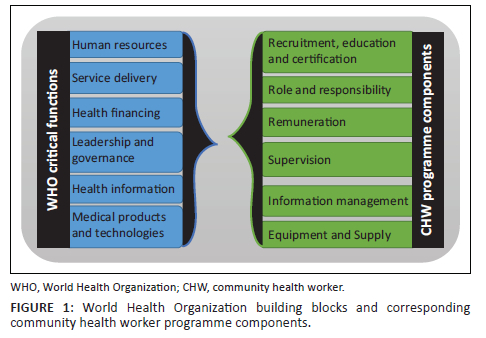
The evidence of integration sought for included government and/or Ministry of Health (MOH) standardised documented polices, plans and guidelines38Figure 1 shows how the proposed WHO building block maps onto the CHW programme components.
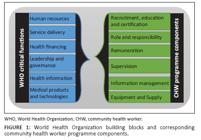
Conceptual framework used in this study shows WHO building blocks133139
Methods
Study design
We conducted a systematic scoping review to provide evidence synthesis on how CHW programmes focusing on child health in SSA are integrated into National Health Systems. A scoping review or scoping study is:
[A] form of knowledge synthesis that addresses an exploratory research question aimed at mapping key concepts, types of evidence, and gaps in research related to a defined area or field by systematically searching, selecting, and synthesizing existing knowledge.40
The review was guided by Arksey and O'Malley's scoping review framework.4142
Search strategy and eligibility criteria
Selection and classification of articles was informed by prior consultation with subject experts in the field of CHW programmes in SSA. This consultation resulted in the identification of candidate CHW programmes that are being operated as comprehensive programmes across several SSA countries. For the purposes of restricting our study to those CHW programmes that are known to be active and operated by respective central governments, a decision was then taken to (1) further consult documentary materials evidencing identified CHW programmes' integration and (2) purposively sample identified CHW programmes to represent different SSA regions.43Figure 3). These strategies finally resulted in the identification of the following six government run CHW programmes:
• Health extension workers (HEWs) in Ethiopia.
• Community health officers (CHOs) in Ghana.
• Health surveillance assistants (HSAs) in Malawi.
• Junior community health extension workers (JCHEWs), community health extension workers (CHEWs) and community officers (CHOs) in Nigeria.
• Agents de santé maternelle (ASM) and binomes in Rwanda.
• Community health assistants (CHAs) in Zambia.
It may appear that the use of purposive sampling in this study makes it difficult to demonstrate that the sample is representative of the wider population of interest. However, because the findings of a research based on purposive sampling can only be generalised to the subpopulation from which the sample is obtained and not to the entire population,444445
Inclusion and exclusion criteria
Having selected the CHW programmes therefore, the following eligibility criteria guided further selection and classification of articles that were to be admitted into the study:
• Studies whose specific focus was on CHW programmes in any of the six selected SSA countries (as listed earlier).
• Studies that described the design and governance of the CHW programmes including government policy documents, CHW country profiles and Community Health Systems Catalogue (an online CHW resource pool that contains information on community health programmes, CHWs, and CHW interventions containing summaries of country-specific CHW programmes policies, strategies, guidelines, plans and reports based on the WHO health system framework)
• The studies had to be in English.
• The studies should have been published between January 2010 and December 2018.
Search terms
Guided by the aforementioned criteria on how to admit eligible papers, we searched databases and grey literature repositories for works that evidenced how the selected CHW programmes are integrated into National Health Systems. Using specific CHW programme names as they were specifically referred to in the selected countries, we designed the search terms to include terms as follows:
• Health Extension Workers (HEWs) in Ethiopia,
• Community Health Officers (CHOs) in Ghana,
• Health Surveillance Assistants (HSAs) in Malawi,
• Junior Community Health Extension Workers (JCHEWs), Community Health Extension Workers (CHEWs) and Community Officers (CHOs) in Nigeria,
• Agents de santé maternelle (ASM) and Binomes in Rwanda, or Community Health Assistants (CHAs) in Zambia.
Databases that were searched include Ebscohost (MEDLINE, PsycINFO PsycARTICLES, and Academic Search Complete CINAHL with Full Text). Grey literature repositories were also explored in order to find any non-indexed literature of significance to the scoping review. These included CHW Central; USAID; WHO; One Million Community Health Workers Campaign; Global Health Workforce Alliance (GHWA); and Advancing Partners & Communities (APC). Literature searches were done between January and April 2018.
Title screening of candidate papers was done by one reviewer (LMM). The accepted articles were imported into EndNote library reference management software. Duplicates were removed. The library was then shared between two reviewers for abstract screening. The abstract screening tool was initially piloted on a sample of 10 academic citations to attain reviewer interrater agreement. A kappa interrater agreement was computed to determine the agreement level. Upon establishment of agreement levels, abstracts were screened for eligibility by two reviewers, using the criteria that were determined beforehand, as advised by the pilot test. Consensus was used to iron out disagreements.
Appraising the quality of evidence
According to Cochrane Collaboration,4641
Extracting and reporting the data
Sifting and sorting of accepted study components of interest was done using all-inclusive and uniform data extraction forms. Admitted literature were examined for which CHW programmes' integration aspects they addressed, what conclusions were drawn with respect to the six integration variables, and how the relevant evidence is clarified. These were noted, reviewed and classified across all studies.
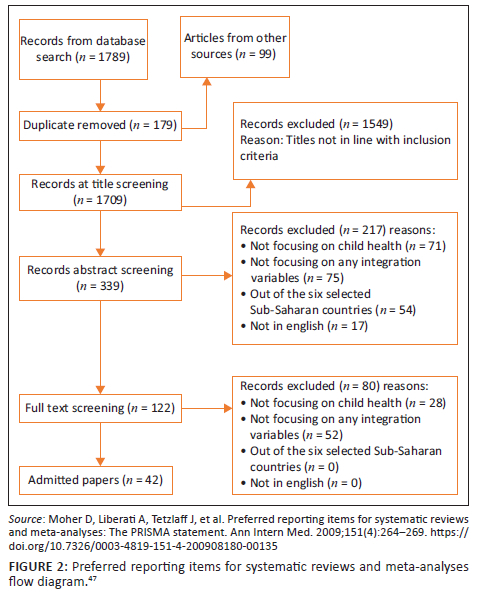
The modified version of PRISMA47484950
Synthesising the evidence
Applying the conceptual framework as presented in Figure 1, the synthesising of evidence was geared towards a general appreciation of how CHW programmes are designed and operated and picking evidence of integration from these processes. This was then refined into a CHW integration narrative. This synthesis resulted in a fine-tuned general understanding of how CHW programmes are interwoven into National Health Systems by finer examination of each of the six CHW programmes in terms of the six integrative variables. At this synthesis stage, the study focused on the integrative philosophy of each CHW programme, looking for strengths and weaknesses among the selected programmes and considering common attributes among them while looking for evidence of differences between stated and actual programme objectives and expectations if carried in any of the available literature.
Screening results
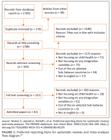
A total of 1789 articles were extracted from search databases. Furthermore, 99 additional articles were identified from references to the articles initially found. A total of 786 articles were screened after a total of 158 articles were excluded during full article screening for the reasons indicated in the PRISMA diagram (Figure 2). In the end, 42 articles were admitted for thematic analysis.
Review findings
This section presents the results of evidence of the integration of CHW programmes into National Health Systems in SSA. The results are divided into three sections: characteristics of reviewed papers, characteristics of the included CHW programmes, and evidence of integration.
Characteristics of the studies
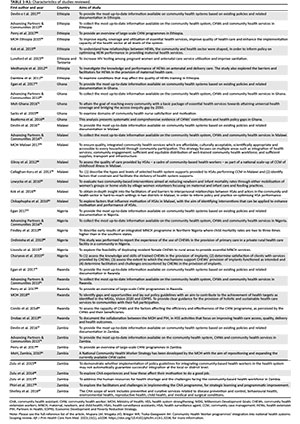
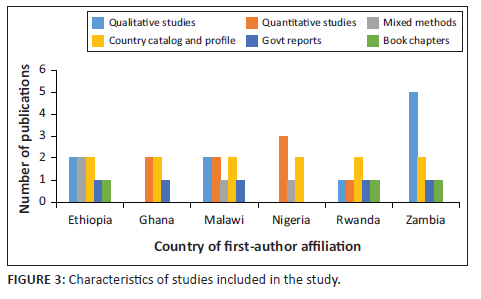
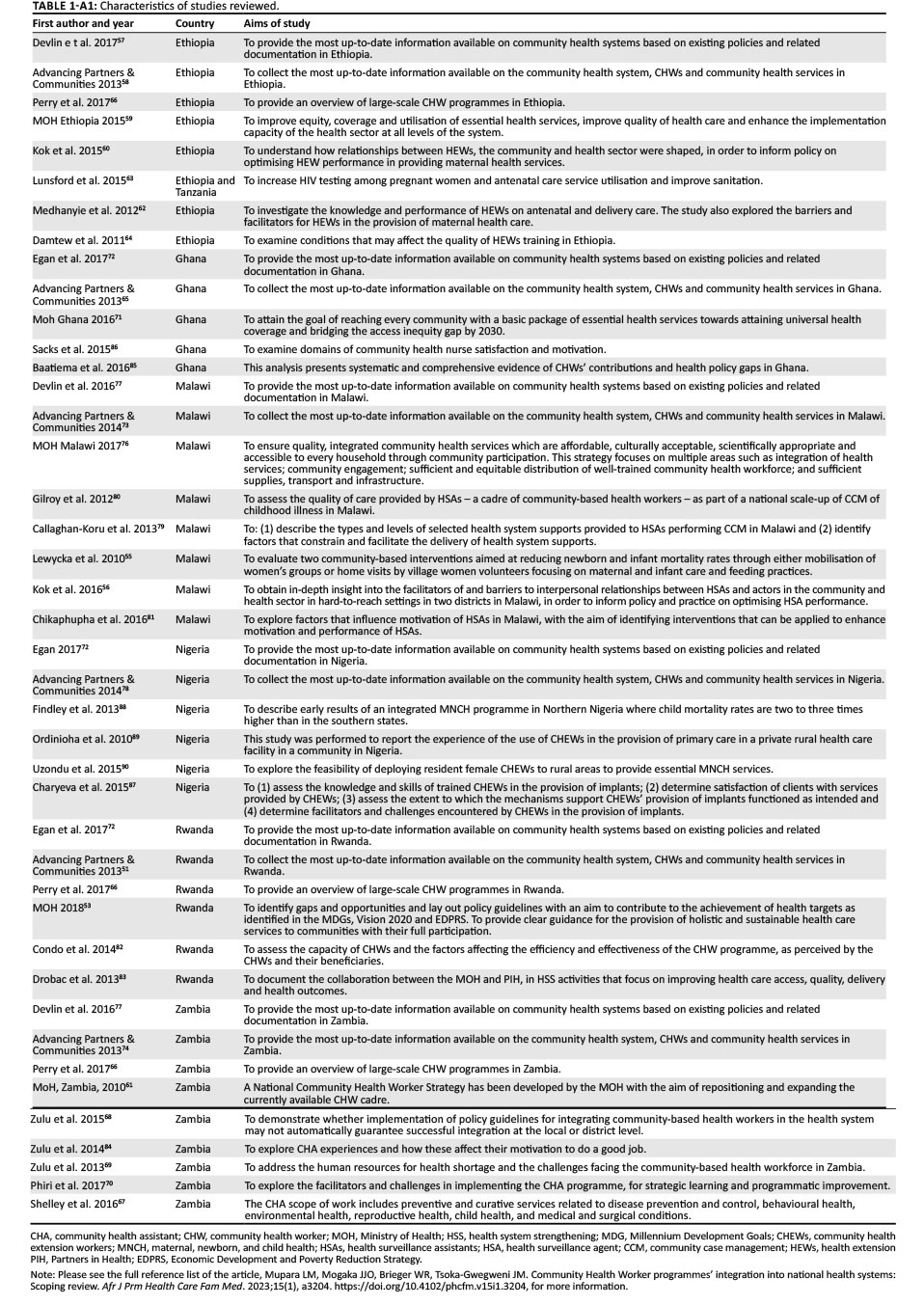
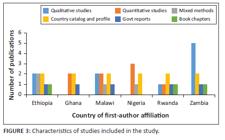
Peer-reviewed journals and grey literature repositories that were searched yielded a total of 42 peer-reviewed journal articles and policy documents that were admitted for the final review. Out of these, six were Community Health Systems Catalogues, six were Community Health Programmes Country Profiles, three were Book chapters with case studies, five were National Community Health Strategic Plans, 10 were qualitative studies, eight were quantitative studies and four used mixed methodologies. Figure 3 illustrates type of studies while Appendix 1 shows other comprehensive characteristics of the different studies by the author and year of publication, country, and aim of study.
Summarised characteristics of the included community health worker programmes
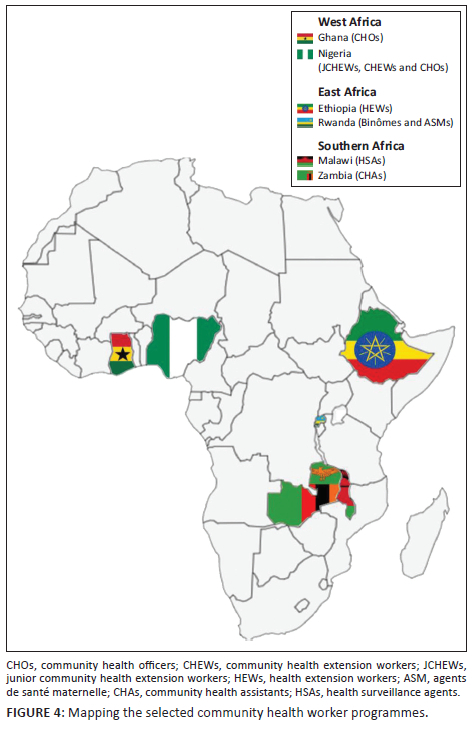
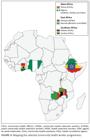
This section gives an overview of the six national CHW programmes admitted into the study. Ethiopia's HEWs work under the National Health Extension Programme57,58,59,6665,71,7273,76,7754,7851,52,53,6664,66,74,75Figure 4 maps the selected CHW programmes by region, country, and name of CHWs.
Key findings on evidence of integration
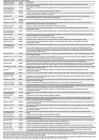
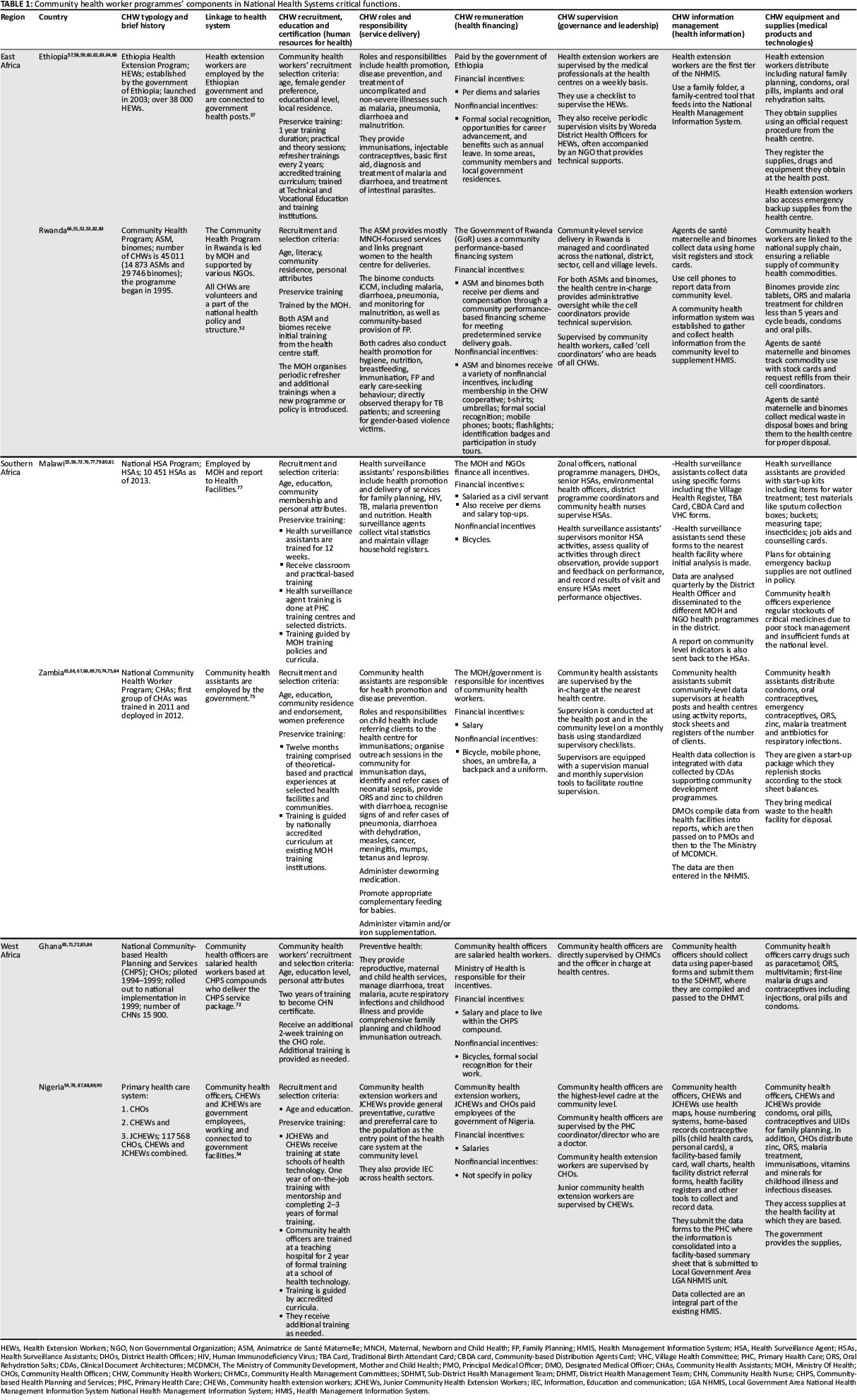
This section presents key findings of the integration of various CHW programmes in their respective countries, as found in the accepted literature. Based on the evidence, the integration variables or themes of CHW programmes for assessing evidence of the integration of CHW programmes into health systems have been developed inductively. They were then paired with critical functions based on their perceived suitability to strengthen the respective WHO health system building blocks. For each building block of the health system, the review examined whether the integration process was in place, as evidenced by the existence of broader government and/or MOH policies that refer to the merger and inclusion of CHWs in the health system.38Appendix 1. Table 1 summarises the most important country-specific characteristics of CHW programmes, CHW typology (programme name, name of CHWs, year of establishment, number of CHWs and linkage to the health system), and the most important findings on integration in the six components of CHW programmes.
Countries integrate different components of CHW programmes into health systems in various ways. The first point of integration that runs across all countries reviewed is the linkage of CHW programmes to respective health systems. This is evidenced by the fact that all CHWs in the respective programmes implement community health initiatives of the respective governments and are all remunerated by governments in different ways.
With regard to CHW recruitment, education and certification, countries' integration practices differ. The standardisation of recruitment criteria and the selection process vary from country to country. For example, age and education or literacy requirements are set out in policy documents of all countries. Membership in the community is ascribed for all countries except Ghana and Nigeria, female gender preference is expressed for Ethiopia and Zambia, while personal attributes are prescribed for Rwanda, Malawi and Ghana. Policy guidelines for preservice training of CHWs apply to all countries, although modalities such as duration, curricula development, accreditation, and certification differ.
With regard to service delivery, all reviewed countries have policy guidelines on the scope of the CHW's work, roles and responsibilities. Although CHWs in different countries provide different services depending on different epidemiological trends and public health needs, health promotion and disease prevention services were common in all countries. The remuneration of CHWs is another component of the CHW programme integrated into the health financing building block in the reviewed programmes. All countries have different financial incentives for CHWs, such as salaries and per diems paid by the respective governments. All countries have policy guidelines on nonfinancial incentives, except for Nigeria. Nonfinancial incentives included work aids such as bicycles and mobile phones, work uniforms such as boots and backpacks, preferential access to healthcare, government residences, social recognition by community members and other healthcare providers, to name a few.
Community health worker supervision is a component of the CHW programme, whose integration into the health system is sporadic across the countries reviewed. For example, all countries provide policy guidelines on who CHW supervisors are, depending on the structures of the respective health systems. However, in some countries, modalities, strategies, procedures and supervision processes such as the use of standardised supervision checklists, the frequency of supervision and CHW-supervisor ratios are not integrated into policy guiding documents. Policy documents from Ethiopia, Malawi and Zambia describe the use of a checklist for the exercise.
Community health worker information management is another component that has evidently been integrated into the critical function of health information of the respective countries under investigation. Firstly and most importantly, CHWs' generated information has been recognised as the first level of the National Health Management Information System (NHMIS) in all countries reviewed. Although each country uses different data collection tools, all countries have standardised data collection tools. In addition, all countries have policy guidelines for consolidating community and facility data before they are submitted to higher tiers of the health system. However, some countries have not provided guidance on the use of processed information for decision-making locally and on improving health outcomes at the community level.
Finally, the CHW equipment and supplies component of the CHW programmes was integrated into the medical products and technologies building block of the system. This was demonstrated by the fact that CHW supplies are linked to the national supply chain of the health system. Other logistics, such as access, restocking and quality audits, varied depending on the services provided. Another indicator of integration that was evident in all countries except Zambia was policy guidance on the safe disposal of medical waste generated by the CHW service. The rest of the results are summarised in Table 1.
Discussion
We examined what is published on the integration of CHW programmes into National Health Systems with reference to child health in SSA. The scoping review was structured around the six building blocks of WHO health systems and their corresponding components of CHW programmes. The entire discourse on whether CHW programmes are integrated into the National Health Systems was based on evidence of integration at the policy level, as identified in the reviewed literature. Therefore, the discussion revolves around the latest WHO guidelines for health policy and system support to optimise CHW programmes.
Human resources for health - Community health workers' recruitment, education and certification
The CHW programme component that addresses the Human Resources for Health (HRH) function in this study is CHW recruitment, education and certification. Evidence of integration from the examined literature included government and/or MOH policies that articulate recruitment, training modalities and certification guidelines. Information on policy-based selection criteria and processes was found for all six countries reviewed, although with variations. Policy guidelines mentioned age, gender, minimum level of education, membership and acceptance by the target group, as well as personal attributes on the selection criteria of the CHWs. Contrary to WHO's recommendation on selection criteria,966727852,53,6661,66,74,75919919257,58,59,64,6661,74,757751,52
Another selection criterion reported in all countries was the level of education. Ethiopia reported 10th grade as a prerequisite57,58,59,64,6665,71,72,8556,73,77,817851,52,53,6661,66,74,75939457,5873,76,7751,52,53,6661,66,68,70,747277529
The WHO suggested the use of certain criteria to determine duration of preservice training. These include: scope of work, anticipated role and responsibilities, competences required for service delivery, prior knowledge and skills institutional capacity, and expected conditions of practice among many others.957,59,62,6661,66,67,68,69,74,75,8465,72,8656,76,7754,78,87,905,24
Service delivery (community health workers' role and responsibilities)
The CHW programme component that has been identified to improve the service delivery in this study is CHW roles and responsibilities. Evidence of integration abstracted from surveyed literature included government and/or MOH policies articulating guidelines on CHW roles and responsibilities31385772545,9,245,24575277757254
Health financing (community health workers' remuneration)
In the study, evidence of integration for health financing was government/MOH guidelines, records on CHW remunerations and incentive payments.31385,24957,58,59,60,62,63,64,665758,71,72,85,8656,73,76,77,7954,78,87,9051,52,53,66,82,83
Leadership and governance (community health workers' supervision)
Evidence of integration sought for under this integration variable include government/MOH standardised CHW supervision plans and guidelines, supervisor job descriptions and qualifications, supervision checklists or other tools, supervision reports and supervision training documents.31524957,58,59,60,62,63,6665,71,72,8654,78,87,895251,52,53,66,82,83
Information (community health workers' documentation and information management)
In this study the integration variable that resonates with the information health system function is the CHW documentation and information management. The evidence of integration sought for under this integration variable was that government through MOH and/or health system provides policy guidelines on CHW documentation and information management,313857,58,5965,72,7173,76,77,8154,7851,52,53,8368,70,74,759
Medical products and technologies (community health workers' equipment and supply)
Evidence of integration for this variable included national government provision of requisite equipment and supplies to CHWs that are needed to deliver services as expected. Examples include: MOH guidelines for CHW stocks and supplies, supply ordering procedures and forms, inventory forms and procedures.315,24957,5865,7273,7754,5851,52,5368,70,74,75
Study limitations
This study focused on CHW programmes run by respective governments. This has a limiting bearing on the kind of integration insights that might have been gained were it to also include CHWs not run by respective National Health Systems. The shortcomings of the health system building blocks framework have a limiting effect on the methods used as the study documents were selected based on the building blocks and the abstracted evidence of integration mapped on the same. The study design also limited the kind of recommendations that the study would have delivered. This is because the admitted papers focused on contextual issues surrounding CHW integration at the expense of theoretical explanations for the same. In addition, the study did not assess the feasibility of the policies to indicate if they are likely or unlikely to be put into practice. Lastly, we did not appraise the quality of papers admitted into the study and this could undermine the quality of the findings.
Conclusion
Globally, CHWs need to complement existing health services to meet unmet community health needs. This has made strengthening health systems to improve child health outcomes a contemporary discourse and priority for health systems today. Zambruni et al.30
As evidenced by the results of this review, some SSA countries have heeded the CHW integration call, but there is still a need to further investigate the extent or degree of integration of CHW programmes into the broader health systems. In large part, this scoping review underscores the willingness of health systems in the region to integrate CHW at the policy level. Evidence of integration through policy-based guidelines for all selected integration variables runs across countries and shows the complexity of CHW integration. Most importantly, the next step, given the implementation guidelines, would be to measure the extent of integration at the implementation level. Rigorous assessments of validated integration measurement metrics are however required in future CHW integration research.
Given the importance of this link to the success of CHW programmes, these study findings could inform policy makers and CHW programme managers on how to strengthen health systems to improve child health outcomes. This could help to further reduce the burden of morbidity and mortality in SSA.
Competing interests
The authors declare that they have no financial or personal relationships that may have inappropriately influenced them in writing this article.
Authors' contributions
All authors contributed equally to this work.
Ethical considerations
Ethical clearance to conduct this study was obtained from the Biomedical Research and Ethics Committee of the University of KwaZulu-Natal (No. BE066/17).
Funding information
This research received no specific grant from any funding agency in the public, commercial, or not-for-profit sectors.
Data availability
Data sharing does not apply to this article as no new data were created or analysed in this study.
Disclaimer
The views and opinions expressed in this article are those of the authors and do not necessarily reflect the official policy or position of any affiliated agency of the authors, and the publisher.
Acknowledgements
References
-
1.Mupara LU, Lubbe JC. Implementation of the integrated management of childhood illnesses strategy: Challenges and recommendations in Botswana. Global Health Action. 2016;9(1):29417. https://doi.org/10.3402/gha.v9.29417
» https://doi.org/10.3402/gha.v9.29417 -
2.You D, Hug L, Ejdemyr S, et al. Global, regional, and national levels and trends in under-5 mortality between 1990 and 2015, with scenario-based projections to 2030: A systematic analysis by the UN inter-agency group for child mortality estimation. Lancet. 2015;386(10010):2275-2286. https://doi.org/10.1016/S0140-6736(15)00120-8
» https://doi.org/10.1016/S0140-6736(15)00120-8 -
3.UNICEF. Committing to child survival: A promise renewed [homepage on the Internet]. New York, NY; 2015. [cited 2022 Oct 08]. Available from: https://data.unicef.org/wp-content/uploads/2015/12/APR-2014-17Oct14-web_194.pdf
» https://data.unicef.org/wp-content/uploads/2015/12/APR-2014-17Oct14-web_194.pdf -
4.World Health Organization. Handbook: IMCI integrated management of childhood illness [homepage on the Internet]. World Health Organization; 2005. [cited 2022 Nov 15]. Available from: https://apps.who.int/iris/handle/10665/42939
» https://apps.who.int/iris/handle/10665/42939 - 5.Bhutta ZA, Lassi ZS, Pariyo G, Huicho L. Global experience of community health workers for delivery of health related millennium development goals: A systematic review, country case studies, and recommendations for integration into national health systems. Glob Health Workforce Alliance. 2010;1(249):61.
-
6.Palazuelos D, Ellis K, DaEun Im D, et al. 5-SPICE: The application of an original framework for community health worker programme design, quality improvement and research agenda setting. Global Health Action. 2013;6(1):19658. https://doi.org/10.3402/gha.v6i0.19658
» https://doi.org/10.3402/gha.v6i0.19658 -
7.Shakir FK. Community health worker programmes: A review of recent literature [homepage on the Internet]. USAID; 2010 [cited 2022 Oct 07]. Available from: https://chwcentral.org/wp-content/uploads/2013/07/Community-Health-Worker-Programmes-A-Review-of-Recent-Literature_0.pdf
» https://chwcentral.org/wp-content/uploads/2013/07/Community-Health-Worker-Programmes-A-Review-of-Recent-Literature_0.pdf -
8.World Health Organization (WHO). Community health workers: A strategy to ensure access to primary health care services. Geneva: World Health Organization; 2016 [cited 2022 Oct 07]. Available from: https://apps.who.int/iris/bitstream/handle/10665/249563/EMROPUB_2016_EN_1760.pdf?sequence=1
» https://apps.who.int/iris/bitstream/handle/10665/249563/EMROPUB_2016_EN_1760.pdf?sequence=1 -
9.WHO. WHO guideline on health policy and system support to optimize community health worker programmes selected highlights [homepage on the Internet]. 2018 [cited 2019 Jan 05]. Available from: http://apps.who.int/iris/bitstream/handle/10665/275501/WHO-HIS-HWF-CHW-2018.1-eng.pdf?ua=1
» http://apps.who.int/iris/bitstream/handle/10665/275501/WHO-HIS-HWF-CHW-2018.1-eng.pdf?ua=1 - 10.Perry HL, Crigler L, Hodgins S. Developing and strengthening community health worker programmes at scale: A reference guide and case studies for programme managers and policymakers. 2014.
-
11.Perry H, Crigler L, Lewin S, Glenton C, LeBan K, Hodgins S. A new resource for developing and strengthening large-scale community health worker programmes. Hum Resour Health 2017;15:13. https://doi.org/10.1186/s12960-016-0178-8
» https://doi.org/10.1186/s12960-016-0178-8 -
12.Singh P, Sachs JD. 1 million community health workers in sub-Saharan Africa by 2015. Lancet. 2013;382(9889):363-365. https://doi.org/10.1016/S0140-6736(12)62002-9
» https://doi.org/10.1016/S0140-6736(12)62002-9 -
13.WHO. Everybody business: Strengthening health systems to improve health outcomes: WHO's framework for action [homepage on the Internet]. WHO; 2007 [cited 2022 Oct 07]. Available from: https://www.who.int/healthsystems/strategy/everybodys_business.pdf
» https://www.who.int/healthsystems/strategy/everybodys_business.pdf -
14.WHO. Strengthening the performance of community health workers in primary health care: Report of a WHO Study Group [homepage on the Internet]. Meeting held in Geneva from 02 to 09 December 1987. Geneva: World Health Organization; 1989 [cited 2022 Oct 07]. Available from: https://apps.who.int/iris/handle/10665/39568
» https://apps.who.int/iris/handle/10665/39568 -
15.Snyder JE. Community health workers: Roles and opportunities in health care delivery system reform [homepage on the Internet]. ASP issue brief. Washington, DC; 2016 [cited 2022 Oct 07]. Available from: https://aspe.hhs.gov/system/files/pdf/168956/CHWPolicy.pdf
» https://aspe.hhs.gov/system/files/pdf/168956/CHWPolicy.pdf -
16.Ballard M, Schwarz R, Johnson A, et al. Practitioner expertise to optimize community health systems: Harnessing operational insight [homepage on the Internet]; 2017 [cited 2022 Oct 07]. Available from: https://chwcentral.org/wp-content/uploads/2018/01/Practitioner-Expertise-to-Optimise-Community-Health-Systems-Harnessing-Operational-Insight.pdf
» https://chwcentral.org/wp-content/uploads/2018/01/Practitioner-Expertise-to-Optimise-Community-Health-Systems-Harnessing-Operational-Insight.pdf - 17.Ballard M, Madore A, Johnson A, et al. Concept Note: Community Health Workers. Harvard Business Publishing. 2018.
-
18.Bhutta ZA. Community-based primary health care: A core strategy for achieving sustainable development goals for health. J Global Health. 2017;7(1):010101. https://doi.org/10.7189/jogh.07.010101
» https://doi.org/10.7189/jogh.07.010101 -
19.Perry H. A brief history of community health worker programmes [homepage on the Internet]. 2013 [cited 2018 Nov 02]. Available from: https://www.mchip.net/sites/default/files/mchipfiles/02_CHW_History.pdf
» https://www.mchip.net/sites/default/files/mchipfiles/02_CHW_History.pdf -
20.Perry HB, Rassekh BM, Gupta S, Wilhelm J, Freeman PA. Comprehensive review of the evidence regarding the effectiveness of community-based primary health care in improving maternal, neonatal and child health: 1. rationale, methods and database description. J Glob Health. 2017;7(1):010901. https://doi.org/10.7189/jogh.07.010901
» https://doi.org/10.7189/jogh.07.010901 - 21.Perry H, Zulliger R. How effective are community health workers? An overview of current evidence with recommendations for strengthening community health worker programmes to accelerate progress in achieving the health-related Millennium Development Goals. Baltimore, MD: Johns Hopkins Bloomberg School of Public Health; 2012.
-
22.Cometto G, Ford N, Pfaffman-Zambrun J, et al. Health policy and system support to optimise community health worker programmes: An abridged WHO guideline. Lancet Global Health. 2018;6(12):E1397-E1404. https://doi.org/10.1016/S2214-109X(18)30482-0
» https://doi.org/10.1016/S2214-109X(18)30482-0 -
23.WHO. Community Health Worker Programmes in the WHO African Region: Evidence and Options - Policy brief [homepage on the Internet]. Licence: CC BY-NC-SA 3.0 IGO. Geneva: World Health Organization; 2017 [cited 2022 Oct 07] Available from: https://www.afro.who.int/sites/default/files/2017-07/Community%20Health%20Worker%20Policy%20Brief%20-%20English_0.pdf
» https://www.afro.who.int/sites/default/files/2017-07/Community%20Health%20Worker%20Policy%20Brief%20-%20English_0.pdf - 24.Singh P, Sullivan S. One million community health workers: Technical task force report. New York, NY: Earth Institute at Columbia University, 2011; p. 304-310.
-
25.UNAIDS. 2 million African community health workers: Harnessing the demographic dividend, ending AIDS and ensuring sustainable health for all in Africa [homepage on the Internet]. UNAIDS; 2017 [cited 2022 Oct 07]. Available from: https://www.unaids.org/sites/default/files/media_asset/African2mCHW_en.pdf
» https://www.unaids.org/sites/default/files/media_asset/African2mCHW_en.pdf -
26.World Health Organization Regional Office for Africa. Community health worker programmes in the WHO African region: Evidence and options - Policy brief [homepage on the Internet]. 2017 [cited 2019 Jan 01]. Available from: https://www.afro.who.int/sites/default/files/2017-07/Community%20Health%20Worker%20Policy%20Brief%20-%20English_0.pdf
» https://www.afro.who.int/sites/default/files/2017-07/Community%20Health%20Worker%20Policy%20Brief%20-%20English_0.pdf -
27.Global Health Workforce Alliance G. Synthesis paper: Outcomes of four consultations on community health workers and other frontline health workers May/June 2012 [homepage on the Internet]. [cited 2022 Oct 07]. Available from: https://chwcentral.org/wp-content/uploads/2013/11/GHWA_synthesis_paperApril2013.pdf
» https://chwcentral.org/wp-content/uploads/2013/11/GHWA_synthesis_paperApril2013.pdf -
28.Martinez J, Ro M, Villa NW, Powell W, Knickman JR. Transforming the delivery of care in the post-health reform era: What role will community health workers play? Am J Public Health. 2011;101(12):e1-e5. https://doi.org/10.2105/AJPH.2011.300335
» https://doi.org/10.2105/AJPH.2011.300335 -
29.Tulenko K, Møgedal S, Afzal MM, et al. Community health workers for universal health-care coverage: From fragmentation to synergy. Bull World Health Organ. 2013;91(11):847-852. https://doi.org/10.2471/BLT.13.118745
» https://doi.org/10.2471/BLT.13.118745 -
30.Zambruni JP, Rasanathan K, Hipgrave D, et al. Community health systems: Allowing community health workers to emerge from the shadows. Lancet Global Health. 2017;5(9):e866-e867. https://doi.org/10.1016/S2214-109X(17)30268-1
» https://doi.org/10.1016/S2214-109X(17)30268-1 -
31.Crigler L, Hill K, Furth R, Bjerregaard D. Community health worker assessment and improvement matrix (CHW AIM): A toolkit for improving community health worker programmes and services [homepage on the Internet]. Published by the USAID Health Care Improvement Project. USAID; 2013 [cited 2021 May 09]. Available from: https://www.usaid.gov/sites/default/files/documents/1864/CHW_AIM _Updated_Programme_Functionality_Matrix_2018_508_final.pdf
» https://www.usaid.gov/sites/default/files/documents/1864/CHW_AIM _Updated_Programme_Functionality_Matrix_2018_508_final.pdf -
32.Jann W, Wegrich K. Theories of the policy cycle. Handbook of public policy analysis: Theory, politics, and methods. 2007;125:43-62. https://doi.org/10.1201/9781420017007.pt2
» https://doi.org/10.1201/9781420017007.pt2 -
33.Adam C, Hurka S, Knill C, Peters GB, Steinebach Y. Introducing vertical policy coordination to comparative policy analysis: The missing link between policy production and implementation. J Comp Policy Anal Res Pract. 2019;21(5):499-517. https://doi.org/10.1080/13876988.2019.1599161
» https://doi.org/10.1080/13876988.2019.1599161 -
34.Stirman SW, Gutner CA, Langdon K, Graham JR. Bridging the gap between research and practice in mental health service settings: An overview of developments in implementation theory and research. Behav Ther. 2016;47(6):920-936. https://doi.org/10.1016/j.beth.2015.12.001
» https://doi.org/10.1016/j.beth.2015.12.001 -
35.Dixon-Woods M. Using framework-based synthesis for conducting reviews of qualitative studies. BMC Med. 2011;9:39. https://doi.org/10.1186/1741-7015-9-39
» https://doi.org/10.1186/1741-7015-9-39 -
36.Dudley L, Garner P. Strategies for integrating primary health services in low-and middle-income countries at the point of delivery. Cochrane Database Syst Rev. 2011;2011(7):CD003318. https://doi.org/10.1002/14651858.CD003318.pub3
» https://doi.org/10.1002/14651858.CD003318.pub3 -
37.Atun R, De Jongh T, Secci F, Ohiri K, Adeyi O. Integration of targeted health interventions into health systems: A conceptual framework for analysis. Health Policy Plan. 2009;25(2):104-111. https://doi.org/10.1093/heapol/czp055
» https://doi.org/10.1093/heapol/czp055 -
38.Ballard M, Bonds M, Burey J, et al. CHW AIM: Updated programme functionality matrix for optimizing community health programmes [homepage on the Internet]. 2018 [cited 2022 Oct 07]. Available from: https://www.unicef.org/media/58176/file
» https://www.unicef.org/media/58176/file -
39.Mupara LM, Mogaka JJO, Brieger WR, Tsoka-Gwegweni JM. Scorecard metrics for assessing the extent of integration of community health worker programmes into national health systems. Afr J Prim Health Care Fam Med. 2021;13(1):a2691. https://doi.org/10.4102/phcfm.v13i1.2691
» https://doi.org/10.4102/phcfm.v13i1.2691 -
40.Colquhoun HL, Levac D, O'Brien KK, et al. Scoping reviews: Time for clarity in definition, methods, and reporting. J Clin Epidemiol. 2014;67(12):1291-1294. https://doi.org/10.1016/j.jclinepi.2014.03.013
» https://doi.org/10.1016/j.jclinepi.2014.03.013 -
41.Arksey H, O'Malley L. Scoping studies: Towards a methodological framework. Int J Soc Res Methodol. 2005;8(1):19-32. https://doi.org/10.1080/1364557032000119616
» https://doi.org/10.1080/1364557032000119616 -
42.Moher D, Liberati A, Tetzlaff J, et al. Preferred reporting items for systematic reviews and meta-analyses: The PRISMA statement. PLoS Med. 2009;6(7):e1000097. https://doi.org/10.1371/journal.pmed.1000097
» https://doi.org/10.1371/journal.pmed.1000097 -
43.Murray CJ, Lopez AD. Mortality by cause for eight regions of the world: Global burden of disease study. Lancet. 1997;349(9061):1269-1276. https://doi.org/10.1016/S0140-6736(96)07493-4
» https://doi.org/10.1016/S0140-6736(96)07493-4 -
44.Andrade C. The inconvenient truth about convenience and purposive samples. Indian J Psychol Med. 2021;43(1):86-88. https://doi.org/10.1177/0253717620977000
» https://doi.org/10.1177/0253717620977000 - 45.Gobo G. Sampling, representativeness and generalizability. In: Seale C, Gobo G, JF Gubrium, editors. Qualitative research practice. SAGE, London, 2004, pp. 405-426.
-
46.Higgins J, Altman DG, Gøtzsche PC, et al. The Cochrane collaboration's tool for assessing risk of bias in randomised trials. BMJ. 2011;343:d5928. https://doi.org/10.1136/bmj.d5928
» https://doi.org/10.1136/bmj.d5928 -
47.Moher D, Liberati A, Tetzlaff J, et al. Preferred reporting items for systematic reviews and meta-analyses: The PRISMA statement. Ann Intern Med. 2009;151(4):264-269. https://doi.org/10.7326/0003-4819-151-4-200908180-00135
» https://doi.org/10.7326/0003-4819-151-4-200908180-00135 -
48.Halas G, Schultz ASH, Rothney J, Goertzen L, Wener P, Katz A. A scoping review protocol to map the research foci trends in tobacco control over the last decade. BMJ Open. 2015;5(1):e006643. https://doi.org/10.1136/bmjopen-2014-006643
» https://doi.org/10.1136/bmjopen-2014-006643 -
49.Nelson ML, Kelloway L, Lyons RF, et al. Stroke rehabilitation and patients with multimorbidity: A scoping review protocol. J Comorb. 2015;5(1):1-10. https://doi.org/10.15256/joc.2015.5.47
» https://doi.org/10.15256/joc.2015.5.47 -
50.Castleberry A. NVivo 10 [software programme]. Version 10. QSR International; 2012. Am J Pharm Educ. 2014;78(1):25. https://doi.org/10.5688/ajpe78125
» https://doi.org/10.5688/ajpe78125 - 51.Advancing Partners & Communities Rwanda. Country profile: Rwanda community health programmes. Arlington, VA: Advancing Partners & Communities; 2013.
- 52.Egan KF, Devlin V, Pandit-Rajani T. Community health systems catalog country profile: Rwanda. Arlington, VA: Advancing Partners & Communities; 2017.
-
53.MOH Rwanda. Rwanda National Community Health Strategic Plan July 2013-June 2018 [homepage on the Internet]. 2013 [cited 2022 Oct 07]. Available from: https://www.moh.gov.rw/fileadmin/user_upload/Moh/Publications/Guidelines_Protocols/CHD_Documents/CHD-Strategic_plan.pdf
» https://www.moh.gov.rw/fileadmin/user_upload/Moh/Publications/Guidelines_Protocols/CHD_Documents/CHD-Strategic_plan.pdf - 54.Egan KF, Devlin V, Pandit-Rajani T. Community health systems catalog country profile: Nigeria. Arlington, VA: Advancing Partners & Communities; 2017.
-
55.Lewycka S, Mwansambo C, Kazembe P, et al. A cluster randomised controlled trial of the community effectiveness of two interventions in rural Malawi to improve health care and to reduce maternal, newborn and infant mortality. Trials. 2010;11(1):88. https://doi.org/10.1186/1745-6215-11-88
» https://doi.org/10.1186/1745-6215-11-88 -
56.Kok MC, Namakhoma I, Nyirenda L, et al. Health surveillance assistants as intermediates between the community and health sector in Malawi: Exploring how relationships influence performance. BMC Health Serv Res. 2016;16:164. https://doi.org/10.1186/s12913-016-1402-x
» https://doi.org/10.1186/s12913-016-1402-x - 57.Devlin K, Egan KF, Pandit-Rajani T. Community health systems catalog country profile: Ethiopia. Arlington, VA: Advancing Partners & Communities; 2017.
- 58.Advancing Partners & Communities Ethiopia. Country profile: Ethiopia community health programmes. Arlington, VA: Advancing Partners & Communities; 2013.
-
59.MOH Ethiopia. HSTP health sector transformation plan 2015/16-2019/20 [homepage on the Internet]. 2015 [cited 2022 Oct 07] Available from: https://www.cmpethiopia.org/content/download/2268/9612/file/HSTP%20Final%202015-10-19.pdf
» https://www.cmpethiopia.org/content/download/2268/9612/file/HSTP%20Final%202015-10-19.pdf -
60.Kok MC, Kea AZ, Datiko DG, et al. A qualitative assessment of health extension workers' relationships with the community and health sector in Ethiopia: Opportunities for enhancing maternal health performance. Hum Resour Health, 2015;13:80. https://doi.org/10.1186/s12960-015-0077-4
» https://doi.org/10.1186/s12960-015-0077-4 -
61.MOH Zambia, National Community Health Worker Strategy in Zambia [homepage on the Internet]. 2010 [cited 2022 Oct 07] Available from: https://www.advancingpartners.org/sites/default/files/cadres/poli
» https://www.advancingpartners.org/sites/default/files/cadres/poli -
62.Medhanyie A, Spigt M, Dinant G, Blanco R. Knowledge and performance of the Ethiopian health extension workers on antenatal and delivery care: A cross-sectional study. Hum Resour Health. 2012;10(1):44. https://doi.org/10.1186/1478-4491-10-44
» https://doi.org/10.1186/1478-4491-10-44 -
63.Lunsford SS, Fatta K, Stover KE, Shrestha R. Supporting close-to-community providers through a community health system approach: Case examples from Ethiopia and Tanzania. Hum Resour Health. 2015;13(1):12. https://doi.org/10.1186/s12960-015-0006-6
» https://doi.org/10.1186/s12960-015-0006-6 - 64.Damtew ZA, Moges AS, Kaasbøll J. Revisiting the quality of health extension workers' training: Case study from Amhara Region, Ethiopia. Ethiop J Health Dev. 2011;25(3):201-205.
- 65.Advancing Partners & Communities Ghana., Country profile: Ghana community health programmes. Arlington, VA: Advancing Partners & Communities; 2013.
- 66.Perry H, Zulliger R, Scott K, et al. Case studies of large-scale community health worker programmes: Examples from Afghanistan, Bangladesh, Brazil, Ethiopia, Niger, India, Indonesia, Iran, Nepal, Pakistan, Rwanda, Zambia, and Zimbabwe. 2017.
-
67.Shelley KD, Belete YW, Phiri SC, et al. Implementation of the community health assistant (CHA) cadre in Zambia: A process evaluation to guide future scale-up decisions. J Community Health. 2016;41(2):398-408. https://doi.org/10.1007/s10900-015-0110-5
» https://doi.org/10.1007/s10900-015-0110-5 -
68.Zulu JM, Hurtig A-K, Kinsman J, Michelo C. Innovation in health service delivery: Integrating community health assistants into the health system at district level in Zambia. BMC Health Serv Res. 2015;15:38. https://doi.org/10.1186/s12913-015-0696-4
» https://doi.org/10.1186/s12913-015-0696-4 -
69.Zulu JM, Kinsman J, Michelo C, Hurtig A-K. Developing the national community health assistant strategy in Zambia: A policy analysis. Health Res Policy Syst. 2013;11:24. https://doi.org/10.1186/1478-4505-11-24
» https://doi.org/10.1186/1478-4505-11-24 -
70.Phiri SC, Prust ML, Chibawe CP, Misapa R, Van den Broek JW, Wilmink N. An exploration of facilitators and challenges in the scale-up of a national, public sector community health worker cadre in Zambia: A qualitative study. Hum Resour Health. 2017;15:40. https://doi.org/10.1186/s12960-017-0214-3
» https://doi.org/10.1186/s12960-017-0214-3 - 71.Ghana M. National community based health planning and services (CHPS) policy. 2016.
- 72.Egan KF, Devlin K, Pandit-Rajani T. Community health systems catalog country profile: Ghana. Arlington, VA: Advancing Partners & Communities; 2017.
- 73.Advancing Partners & Communities Malawi. Country profile: Malawi community health programmes. Arlington, VA: Advancing Partners & Communities; 2014.
- 74.Advancing Partners & Communities Zambia. Country profile: Zambia community health programmes. Arlington, VA: Advancing Partners & Communities; 2013.
- 75.Egan KF, Devlin V, Pandit-Rajani T. Community health systems catalog country profile: Zambia. Arlington, VA: Advancing Partners & Communities; 2016.
- 76.Malawi M. National community health strategy 2017-2022. 2017.
- 77.Devlin V, Egan KF, Pandit-Rajani T. Community health systems catalog country profile: Malawi. Arlington, VA: Advancing Partners & Communities; 2016.
- 78.Advancing Partners & Communities Nigeria. Country profile: Nigeria community health programmes. Arlington, VA: Advancing Partners & Communities; 2014.
-
79.Callaghan-Koru JA, Gilroy K, Hyder AA, et al. Health systems supports for community case management of childhood illness: Lessons from an assessment of early implementation in Malawi. BMC Health Serv Res. 2013;13:55. https://doi.org/10.1186/1472-6963-13-55
» https://doi.org/10.1186/1472-6963-13-55 -
80.Gilroy KE, Callaghan-Koru JA, Cardemil CV, et al. Quality of sick child care delivered by health surveillance assistants in Malawi. Health Policy Plan. 2013;28(6):573-585. https://doi.org/10.1093/heapol/czs095
» https://doi.org/10.1093/heapol/czs095 -
81.Chikaphupha KR, Kok MC, Nyirenda L, Namakhoma I, Theobald S. Motivation of health surveillance assistants in Malawi: A qualitative study. Malawi Med J. 2016;28(2):37-42. https://doi.org/10.4314/mmj.v28i2.2
» https://doi.org/10.4314/mmj.v28i2.2 -
82.Condo J, Mugeni C, Naughton B, et al. Rwanda's evolving community health worker system: A qualitative assessment of client and provider perspectives. Hum Resour Health. 2014;12:17. https://doi.org/10.1186/1478-4491-12-71
» https://doi.org/10.1186/1478-4491-12-71 -
83.Drobac PC, Basinga P, Condo J, et al. Comprehensive and integrated district health systems strengthening: The Rwanda population health implementation and training (PHIT) partnership. BMC Health Serv Res. 2013;13(suppl_2):S5. https://doi.org/10.1186/1472-6963-13-S2-S5
» https://doi.org/10.1186/1472-6963-13-S2-S5 -
84.Zulu JM, Kinsman J, Michelo C, Hurtig A-K. Hope and despair: Community health assistants' experiences of working in a rural district in Zambia. Hum Resour Health. 2014;12:30. https://doi.org/10.1186/1478-4491-12-30
» https://doi.org/10.1186/1478-4491-12-30 -
85.Baatiema L, Sumah AM, Tang PN, Ganle JK. Community health workers in Ghana: The need for greater policy attention. BMJ Glob Health. 2016;1(4):e000141. https://doi.org/10.1136/bmjgh-2016-000141
» https://doi.org/10.1136/bmjgh-2016-000141 -
86.Sacks E, Alva S, Magalona S, Vesel L. Examining domains of community health nurse satisfaction and motivation: Results from a mixed-methods baseline evaluation in rural Ghana. Hum Resour Health. 2015;13:81. https://doi.org/10.1186/s12960-015-0082-7
» https://doi.org/10.1186/s12960-015-0082-7 -
87.Charyeva Z, Oguntunde O, Orobaton N, et al. Task shifting provision of contraceptive implants to community health extension workers: Results of operations research in northern Nigeria. Glob Health Sci Pract. 2015;3(3): 382-394. https://doi.org/10.9745/GHSP-D-15-00129
» https://doi.org/10.9745/GHSP-D-15-00129 -
88.Findley SE, Uwemedimo OT, Doctor HV, Green C, Adamu F, Afenyadu GY. Early results of an integrated maternal, newborn, and child health programme, Northern Nigeria, 2009 to 2011. BMC Public Health. 2013;13:1034. https://doi.org/10.1186/1471-2458-13-1034
» https://doi.org/10.1186/1471-2458-13-1034 -
89.Ordinioha B, Onyenaporo C. Experience with the use of community health extension workers in primary care, in a private rural health care institution in south-south Nigeria. Ann Afr Med. 2010;9(4):240-245. https://doi.org/10.4103/1596-3519.70964
» https://doi.org/10.4103/1596-3519.70964 -
90.Uzondu CA, Doctor HV, Findley SE, Afenyadu GY, Ager A. Female health workers at the doorstep: A pilot of community-based maternal, newborn, and child health service delivery in northern Nigeria. Glob Health Sci Pract. 2015;3(1):97-108. https://doi.org/10.9745/GHSP-D-14-00117
» https://doi.org/10.9745/GHSP-D-14-00117 -
91.Crispin N, Wamae A, Ndirangu M, et al. Effects of selected socio-demographic characteristics of community health workers on performance of home visits during pregnancy: A cross-sectional study in Busia District, Kenya. Glob J Health Sci. 2012;4(5):78-90. https://doi.org/10.5539/gjhs.v4n5p78
» https://doi.org/10.5539/gjhs.v4n5p78 -
92.Källander K, Tomson G, Nsabagasani X, Sabiiti JN, Pariyo G, Peterson S. Can community health workers and caretakers recognise pneumonia in children? Experiences from western Uganda. Trans R Soc Trop Med H. 2006;100(10):956-963. https://doi.org/10.1016/j.trstmh.2005.11.004
» https://doi.org/10.1016/j.trstmh.2005.11.004 - 93.Bhattacharyya K, Winch P, LeBan K, Tien M. Community health worker incentives and disincentives: How they affect motivation, retention, and sustainability. Arlington, VA: Basic Support for Institutionalizing Child Survival Project (BASICS II) for the United States Agency for International Development; 2001.
-
94.Brown A, Malca R, Zumaran A, Miranda JJ. On the front line of primary health are: The profile of community health workers in rural Quechua communities in Peru. Human Resour Health. 2006;4(1):11. https://doi.org/10.1186/1478-4491-4-11
» https://doi.org/10.1186/1478-4491-4-11

Accepted: 06 July 2022
Published: 09 Mar. 2023